Your ShelfYour Projects

Signs of the Times, Vol. 28, No. 1.

THE MOTHER’S WORK
Earlier text: CELESTIAL COMMUNICATIONS

Skirmishes in the Philippines

DESPATCHES from the Philippines bring reports of continued skirmishes with the Filipinos, in most of which a few lives are lost, mostly Filipinos. Quite a number of the presidentes of the native villages have been found guilty of aiding the Filipinos in the field. On this account, General Davis recommends the abolition of civil government in some of the provinces; but the recommendation has not been acted upon.

The Nation’s Drink Bill

A sad fact—and yet it is true—of the adult population of this country to-day one person in every fifteen is a drunkard. The rum bill of the country is over $3,000,000 every day, and more than $1,000,000,000 every year. If this money was spent for the necessaries and comforts of life, it would not only give employment for those at present engaged in the liquor traffic, but also for 1,700,000 others.—Selected.

Marconi’s Wireless Telegraph Experiments

SIGNOR MARCONI has set up a wireless telegraph station on the coast of Newfoundland, and claims to have received a signal sent from a similar station in England. The Anglo-American Telegraph and Cable Company has warned Marconi that he must cease his experiments in Newfoundland, as it has a monopoly of the telegraph business there, and his experiments have been suspended for a time.

Chile and Argentina Prepare for War

The differences between the governments of Chile and Argentina have not been lessened by the recent conferences between representatives of those countries. Argentina has withdrawn her representative from Chile, and while the former country has appealed to England to assist in reaching a peaceful settlement, both countries are preparing for war; both countries are calling out their reserves, buying ammunition, preparing clothing for the soldiers, and beginning the manufacture of implements of war.

General Masso Withdraws from Cuban Presidential Race

GENERAL MASSO has withdrawn from the race for president of Cuba. His followers declare that this is because he sees no hope of having justice done in the election. They further declare in their official organ that the foundation of the republic is being laid in fraud. Thus early are being sown the seeds of discord that bid fair to bring to Cuba times of bitter trouble.

France Moves to End Clergy Funding

The French Government is seeking step by step to release itself from the domination of the Catholic Church. The latest budget is reported to have excluded the provision usually made directly for the salaries of the clergy. To this there is strong opposition in the Chamber of Deputies; but there is indication that the “public worship budget” will be suppressed.

Germany Threatens Action Against Venezuela

It is stated on what seems good authority that the German Government is preparing for military action against Venezuela in order to compel a settlement of German claims against that country. It is reported that Germany has already delivered an ultimatum to Venezuela on the subject. The United States battle-ship Indiana has sailed for Venezuelan waters.

New Intestinal Antiseptic Reported

Physicians connected with the laboratory of the University of Michigan report the discovery of an antiseptic for all intestinal diseases, such as cholera, typhoid fever, and dysentery. They have given the name “benzozone” to the preparation, but its exact composition has not yet been made public. It is well to take such a report with a grain of salt.

Discovery of a Wonderful Natural Cave

A new and wonderful natural cave is reported to have been discovered about 50 miles east of Butte, Montana. The cave is said to contain a large river with a fall of 100 feet. It was explored over an area of about ten miles. Utensils of stone and copper were found, which show that at a remote period the cave was inhabited.

Rebellion in Venezuela

Another serious rebellion is reported to have broken out in the troubled State of Venezuela. The governor of Carabobo, two of the most recent ministers of war, and a prominent general, with their adherents, have joined in the rebellion. A strict censorship has been declared, and little news comes through.

Zacatecas Market House Collapse

The City Market House at Zacatecas, Mexico, collapsed on December 22, and 45 persons are reported to have lost their lives. The great municipal storehouse was on fire, and those who lost their lives in the collapse of the structure were engaged in carrying out the merchandise stored in the building.

Miles Reprimanded for Schley Comment

LIEUTENANT-GENERAL MILES has received a severe reprimand from the Secretary of War for a comment which he made on the findings of the Schley court of inquiry. The general approved of the report of Admiral Dewey.

Collier Matteawan Feared Lost at Sea

The steam collier Matteawan is believed to have foundered at sea off the coast of Washington. The captain and crew of 30 men are supposed to have been lost, as nothing has been heard of them, and the vessel is long overdue.

Unemployment in Germany

REPORTS from Germany indicate a gloomy Christmas for the laboring population. It is stated that the number of the unemployed will reach 500,000. This condition is breeding discord among the laboring classes.

Mint Coinage in 1901

The report of the director of the mint for the year ending June 30, 1901, shows a coinage of 177,000,000 pieces, of a value of $136,340,781. Of this amount $99,065,715 was gold, and the rest silver and minor coins.

POSTMASTER-GENERAL CHARLES EMORY SMITH

has resigned from the cabinet of the President, and Henry C. Payne, of Wisconsin, has accepted the portfolio of office.

Deaths in Boer Concentration Camps

During the last six months there have been 13,941 deaths in the Boer concentration camps in South Africa, and more than three-fourths of these have been children.

Pennsylvania Railroad Tunnel to New York

THE Pennsylvania Railroad Company has completed arrangements for entering New York City by a great tunnel running under the river and a portion of the city.

Growth of Native Christianity in India

of the city. The India census of 1901 shows a gain of 66,000 adult native Christians in 9 provinces since 1891. The census now places the number of native Christians at 161,000.

Groundbreaking for Louisiana Purchase Exposition

The first sod was turned at St. Louis, December 20, for the exposition which is to commemorate the one-hundredth anniversary of the purchase of Louisiana.

Military Posts in the Philippines

The Secretary of War has sent to the House Committee on Appropriations a request for $2,500,000 for the building of military posts in the Philippines.

Kitchener Takes the Field

REPORTS from South Africa state that General Kitchener has taken the field in person, and is directing the movements of the troops.

Senate Ratifies Canal Treaty

directing the movements of the troops.
On December 16 the Senate ratified the Hay-Pauncefote isthmian canal treaty by the decisive vote of 72 to 6.

ONLY A MORNING GLORY.

No one but a child would have thought of having a morning glory for a house plant. But she has not learned that things that come from far away, and cost a good deal, are worth more than things that are near by, even tho the near-by things are just as pretty. But such ignorance is no loss to her.
Little Eva planted a morning-glory seed in a tomato can, and set it in the kitchen window. And it grew and grew, asking no favors of any one, except an occasional drink of water, and plenty of string to cling to.
That little vine won its way into our hearts, as we had an opportunity to become acquainted with its attractions. It looked really pretty, with its bright green leaves, and pink blossoms against the white curtain. It was something refreshing, to have your flowers brand-new every morning. Then on cloudy days, when it was dull outside, it staid in bloom the longer.
That morning glory got to be a thing of interest for the whole family. There was quite a rivalry as to who would be the first to see the new blossoms in the morning.
It was not that this one was better than other morning glories. There were others out of doors. I ran across one the other day, trailing on the ground by an old stump. Poor stunted plant! I should not have noticed it but for its rich purple blossom that smiled up at me from the grass. I am not sure but it would have been prettier than the pink one in my window, if it had had a little care.
How very much like people, I thought. Here is my neighbor across the way. I love her because of her many kind ways that I see day by day.
Then there is that other neighbor back in the alley. She does not appear to have so many outward attractions as some others. Perhaps, like the purple morning glory that grew among the grass and weeds, she never had half a chance. Shall I pass her by? Then there is another neighbor up on the hill, on whom I have neglected to call. I might see much in her to love, if I only knew her. Why not call on her this very day?
One morning I went to my window to see how many blossoms there were that day. I discovered that one of the buds had not opened. On investigation, I found that the end of the bud had grown through a mesh in the window curtain. It was only the work of a moment to push back the curtain, and liberate the bud, when to my wondering eyes a strange sight met my view.
God opened that flower just as quickly as I could have opened an umbrella. I felt as if in the presence of an unseen power, as that bud unfolded without visible help, and became a perfect flower. I thought, Why had not that flower opened before? and what would have happened if I had not come to its rescue? The Lord has put into every bud enough of His divine power to enable it to develop into a perfect flower, under right conditions. He does not waste His power. If there had been a bit more force in the bud, it would either have torn itself in its efforts to bloom, or torn my curtain. But no such thing happened, altho the time had passed when it should have opened.
Quite like ourselves, I thought. Our Heavenly Father endows the human organism with sufficient force to preserve it in health, if we do not interfere with His plans.
But we can obstruct the life-current in our veins by improper clothing, and derange it by wrong habits of diet, and we can cause our bones to grow out of shape, by habitually assuming incorrect attitudes. All the time the Lord patiently waits, altho He is longing to give us health and happiness.
When we place ourselves in right relation to God, and live in harmony with the laws He has established, we are surprised at the marvelous restoration to health that we sometimes see. But it is just what He is waiting to do all the time.
So this little vine kept talking to me all summer of the goodness and power of our Heavenly Father.
The autumn came, and the curtain had to be taken down to be washed. I was obliged to cut off a part of the vine because it had grown through the curtain. The severed branch did not wither for a number of days. The next morning a perfect flower came out. But every day the blossoms grew smaller, and no seed matured. It was like many Christians, who blossom out fairly well, giving promise of usefulness, but who never reach the fruit-bearing stage, because they do not abide in the True Vine.
The humblest flower has its lesson to teach, if we attune our ears to hear its still, small voice.
MRS. LUELLA BAKER PRIDDY.
Lindsay, Ontario.

SORRY HE FOUND FAULT WITH MOTHER.

I was obliged to wait at a railway station, says a traveler, so fell to talking to a young man who was in charge. He was a bright, stirring fellow, evidently bound to get on in the employment which he had chosen. His first service had been in his home town, and this was his earliest experience away.
“So you are really your own man now, and are free from home restraints,” I said, to try him.
“Yes,” he said, “but I am not overwell pleased with the change. I used to think it would be fine to live at a boarding-house and eat fine dinners and have a latch-key; but I would gladly give them all and ten times more for the things at home. We did not have much money, but mother put something into her cooking that I don’t find in boarding-houses; money does not buy from laundry-women the careful darning that mother gave to my clothes. I have a pleasant room—pictures and all that; but I would rather have mother’s face. Look here! Here is a letter giving me an appointment with a large raise in pay. My greatest pleasure in good luck has always been telling it at home; and now I am a hundred miles off. I know, of course, that it is right that I should push off for myself. I could not possibly have earned a living at home; but I wish I had seen how good home was when I was there, and never found fault with mother.”
The youth was now obliged to signal a train and left me; but his words kept coming up: “I wish I had seen how good home was, and had never found fault with mother.”—Northwestern.

"TO THE FRONT."

In the history of our war for Cuba there is one name that stands out with peculiar luster—not for the greatness of the man or the greatness of the deed, but for the determination, and singleness of thought, that lay behind his action.
Shot through the lower ribs in a skirmish, trooper Rowland was ordered by the leader of the Rough Riders to the dressing station in the rear. There the doctor said he would have to go to the hospital, as he was badly hurt, and told him to sit down a short time till he could be taken there. Rowland sat still a few moments, then remarked restlessly, “I don’t seem to be doing much good here,” and picking up his rifle was soon found by Roosevelt at the front.
“Thought I ordered you to the rear,” he said.
“You did, sir,” replied Rowland, “but there didn’t seem to be much doing back there.”
He was sent to the hospital with the rest of the wounded, but in two days was again in camp, having marched six miles over rough country, carrying gun, canteen, and cartridge-belt.
“I thought you were at Siboney,” said the general.
“I was,” answered the soldier, sheepishly, “but I didn’t seem to be doing any good there.” And so, tho wounded, he went into the battle of San Juan. How many men would have done it?
But to Rowland it was not a case of inclination—at least not of the ordinary kind, for that would have kept him at rest at Siboney. No; it is the case of a man who had been trained to regard duty as more important than inclination. It took him to the front. It will take any man to the front in any walk of life.
Let me explain. Two young men of about equal ability come into the church. Number One gives duty first place, while Number Two thinks inclination should have a hearing. One soon has a class in Sabbath-school, and gains an experience that Two loses because he hasn’t time to prepare the lesson, and besides lacks inclination to face the scare of a first class. One takes secretorship; declined by Two because he doesn’t like the work or the reading of the minutes. One speaks in testimony meeting, so encouraging both himself and others; Two keeps his seat or remains away, encouraging others to do the same. Well, so far who is ahead?—Assuredly Number One. He has experience, confidence, and a training that enables him to take other positions, not only in church but outside as well. He also has the habit of going to the front, and of staying there. Number Two has strengthened his habit of yielding to inclination, is consequently more idle, more selfish, and finds it very difficult to express himself in public. If some one doesn’t show him just where he stands, he will soon leave the church, and then—
But you see the point. The path of duty leads up, inclination down.
You have often heard the anecdote of the man who was asked how he had accomplished so much in his life. “My father taught me,” he said, “when I had anything to do, to go and do it.” That training kept him at the front.
But with many men that evil brotherhood,—inclination , fear, selfishness, and idleness,—rules, and that is the cause of the world’s distress and failure. Sometimes for the hour they will it aside, stand out in the heroism of simple manhood, and do great things. Then they say, It was a triumph of enthusiasm beyond human control. But really, in the inspiration or excitement of the occasion, inclination and fear had been laid aside, and will was on the side of duty. These are the magic words—will and duty, for they keep men at the front.
Years ago there was a rich man who lived in idleness and selfishness till he became tired of life, and one night he started for the river to drown himself. On the way he met a little girl crying—a poor, famished, barefooted little creature. His heart was touched. He asked what was the matter, and she told him a tale of suffering, want, sickness, and starvation. She took him to her mother, away up in a garret, and there he found that the child’s words were true. His heart was touched, and he went to get aid. He provided everything they needed, and then went on toward the river. But suddenly he stopped. His heart was full of joy and peace. Drown himself?—No, indeed! He had laid aside inclination for a moment, had been at the front, and in that blessed place he had found happiness.
“My friend,” said the professor to a discouraged student, “put your will on the right side. If there’s a thing you ought to do, go straight through it from beginning to end, regardless of like or dislike—and do it now! In a month the result will astonish you.”
“Why did you refuse the young man?” I asked an employer the other day; “he’s bright and strong.”
“That may be,” said the keen business man, “but he’s not honest with himself. It’s the old story, inclination before duty; and in my business I couldn’t depend on him. The world is full of them. What I want is the boy with whom ‘ought to’ is law. If he says, ‘I ought to go to church,’ he goes. If he thinks he ought not to eat ice cream, do you think he eats it? And if he ought not to spend his money for some trifle, do you suppose he argues himself into doing it?—No; and I’d take a dozen boys like that right now, for they’re scarce.”
Yes, friend; there is plenty of room at the front! Just gird up your loins, buckle on the weapons of your warfare, and come along.
Fresno, Cal.
EDISON J. DRIVER.

THE MASTER'S VOICE.

[From Donahue's Magazine.]
The waves were weary, and they went to sleep, The winds were hushed, The starlight flushed The furrowed face of all the mighty deep.
The billows, yestereve so dark and wild, Wave strangely now— A calm upon their brow Like that which rests upon a cradled child.
The sky was bright, and every single star, With gleaming face, Was in its place, And looked upon the sea—so fair and far.
And all was still—still as a temple dim— When low and faint, As mourner's plaint, Died the last note of vesper hymn.
A bark slept on the sea, and in the bark Slept Mary's Son— The only One Whose face is light where all, all else is dark.
His brow was heavenward turned, His face was fair, He dreamed of me On that still sea— The stars He made gleamed through His hair.
And lo! a moan moved o'er the mighty deep; The sky grew dark! The little bark Felt all the waves awaking from their sleep.
The winds wailed wild, and wilder billows beat; The bark was tossed; Shall all be lost? But Mary's Son slept on, serene and sweet.
The tempest raged in all its mighty wrath, The winds howled on, All hope seemed gone, And darker waves surged round the bark's lone path.
The sleeper woke! He gazed upon the deep— He whispered: “Peace! Winds; wild waves, cease! Be still!” The tempest fled; the ocean fell asleep.

THE RAINY-DAY BOX.

[By A. B. W., in The Christian Work.]
We were discussing the approaching line storm, my neighbor and I, as we cut across lots to call on Mrs. C.
“I always dread a stormy day,” said my companion; “the children drive me about wild.”
I, too, remembered a certain stormy week when, happening in to my neighbor’s, I truly thought they had gone mad. The kitchen where the children had been banished was bedlam indeed. Small horsemen were shouting and whipping the harnessed chairs, the floor and table were strewn with litter, and that a quarrel was on was more than evident. I did not wonder at her remark.
We found Mrs. C. sorting over some silk and velvet scraps, at which I ventured the remark that “I thought crazy-work must be coming in again.”
“O, this is not crazy-work; it’s for my ‘rainy-day box.’” Seeing our puzzled expression, she hastened to explain: “When I was a child, we had the garret to flee to on stormy days. It was filled with the accumulations of years, all kinds of castaways and rubbish, and is even yet a place of blessed memories in my dreams. In the modern city flat there is no such luxury; and when the babies begin to come, one must contrive to provide some way that these shut-in days may not be too taxing on the mother, and at the same time that they may be happy days for the small folk. The rainy-day box seems the best solution. Into it (you see it is a capacious one) goes everything that I think will amuse, from baby Elsie up to our sedate John. My Cousin Sarah (she is a dressmaker in Boston) sent me these scraps for doll dressmaking. The girls already have their little work baskets filled, and these are so fresh and pretty that I thought them quite good enough for my box. They will be a surprise to the girls, who in planning a new doll outfit will be kept happily absorbed more than one stormy day.
“When mother repaired the house, I rescued these old Leslies’ Weeklies. In them are reports of the Franco-Prussian War, which John is studying, and of course they will be more than acceptable to our bookworm. For Elsie’s benefit there is this little box of assorted beads, which are new. She is just beginning to comprehend the mysteries of needle and thread. Here is a box which contains another recent addition—educational toy money, which I found at the kindergarten supply house. It cost only twenty-five cents, and contains sufficient capital to set up a banking house or grocery business in which the five may join.”
“Perhaps nothing gives more genuine pleasure than this microscope—and this,” lifting a magnet; “they are both long residents of the box. Hunting for scale and live stock on my plants affords the children great fun; looking at their hair, their finger nails, their frocks, their trousers, in fact anything that they see about them; for everything looks queer so greatly magnified.”
“Here we keep the clean penny pipes for bubble parties. You should see what fine bubbles they make. Last time we tried a new way: we used pearline instead of soap, moistening it in cold water, then turn on boiling water sufficient to make it the consistency of boiled starch. It made very large and brilliant bubbles, and keeps without molding.”
“Here is a bundle of Pan American time tables, filled with excellent views of the Rainbow City, of Buffalo, Montreal, the Thousand Islands, Niagara and the Ottawa River. Our next stormy day I intend to start them on some Pan-American scrap-books; they made some very good ones last winter from advertising cards for the Children’s Hospital. O, I save circulars, almanacs, seed catalogues, autumn leaves and ferns for spatter-work, old worsted for working perforated cards. See these natural-history cards! Just the thing to teach Elsie the names of the different animals. I got them for a song, and they can be sandwiched in many times, an elephant now, a camel then, and so on. Some days, when they have earned an especially good time, we have a popcorn party or a candy pull to finish off with, and occasionally, for exercise, I arm them with canes and umbrellas, and put them through a mock drill and march with music. The rainy-day box idea is to have, if possible, at least one surprise in store. You don’t know how the children guess and speculate what the next is to be! Sometimes the two older ones have given their pennies to provide a contribution, and great fun they have over their secret. No; since I have adopted this scheme I find that the stormy days take no more of my time than the pleasant ones in which the children can go to school and play out-of-doors. The little time in planning ahead saves me a great amount of time when the children are home for a day. I have only to initiate them into the new task or game, then can return to my own work.”
“There, I’ve learned something. Why did I never think of it?” exclaimed my neighbor, after we left Mrs. C.’s. “I shall begin at once.”
As for myself, I decided then and there that I should tell every mother I knew of this wonderful box.

“WHO HAS SEEN CHRIST IN YOU TO-DAY.”

The minister asked a startling question this evening,” said Mr. Adams, to his wife, Ruth, on his return from church one Sabbath.
“What was it, Roland?”
“Who has seen Christ in you to-day?” I wish you had been there to hear him, Ruth; he made it pretty plain that all who have Christ ought to show by their daily living that they are in earnest, and really believe what they profess.”
“That is true, Roland; I know I often fall short of what a Christian should be.”
“The coat fitted me too, I assure you; for I confess you and the children have not seen Christ in me to-day in every word and act. If I had remembered to be like Christ, I would not have been so cross to you this morning because I could not find the lesson quarterly.”
“And I should not have snapped you up and been vexed,” said Ruth.
“Then I spoke roughly to Willie, because he worried me, and when he cried, I boxed his ears soundly, when a kind word would have made it all right. There are many things I should have done even to-day if I had acted up to the minister’s question.”
“We will try to begin anew, Roland. You are quick, and I am touchy. We both need more of the Christ spirit in our daily living. I notice the children are catching the same sharp spirit toward each other. Let us pray that our children, our friends, and our neighbors may see Christ in us day by day henceforth.”
“Amen. God being our helper, let us strive hereafter to live so others may see Christ in our daily, yes hourly, living.”
How is it with us, dear reader? Let us ask ourselves the question in all earnestness. Who has seen Christ in our walk and conversation to-day? This morning ere you commenced the labor of the day, did you bow before God and ask that your life might reflect Christ in every word and deed? or were you in such haste, you had no time to talk a little while with Jesus, and so started out in your own strength? If so, Christ has not been seen in you to-day. O, if we could always remember that we who profess to be Christians stand before the world as Christ’s representatives, would we not be more careful than we oftentimes are? Do we represent Jesus in His true character? Alas! I fear we do not. Too often we get into the same temper, and use the same sharp words, and do the same actions as do persons of the world, and thus we bring a sad reproach on Jesus, whom we profess to love with all our hearts.
How may Christ be seen in us?—In what we do and say. If Christ does not shine through this, if those around us can not see Christ in our daily living, He does not abide in the heart, no matter how great the profession we make. If Christ abide not in the heart, He surely can not be seen in our lives. If we fret, find fault, and complain, we are not representing Christ. Jesus did not fret, He never gave way to angry passion; He “did no sin, neither was guile found in His mouth.” If we indulge in trifling talk, use slang expressions, Christ is not seen in our conversation. We can be joyful, cheerful, but let no foolish jesting fall from the lips of those who profess to represent Christ.
If we are not true representatives of Jesus in the home, our children know it, for it is there we act out our true selves. If precept is one thing, and example something else, the children are quick to see it. Be very careful fathers, mothers, to represent Christ as He is before your little ones. How often is the cause of God reproached by our careless way of living, both in the home and out. The love of Jesus does not fill the heart; hence the “crooked paths” we hear many professed Christians confess having made. We may never get so perfect in wisdom and knowledge in this life that we will not err in judgment nor make mistakes; but praise God, we can be made perfect in love to Jesus, and perfect in submission to the divine will; then the likeness of Christ will be seen in our daily walk and conversation; God’s wondrous love will be our theme. “Jesus is coming again,” will be the key-note of our song. O, let us arouse, and awake yet more fully to a realization that the day of time is far spent, and there yet remains much to do ere the sun sets.
Let us seek to live so that Christ may be seen in us as a perfect Saviour. The grace of God is sufficient to keep us from sin, under the most trying conflicts of daily life. If Christ is in us, He will be seen “in every thought and action,” and we will be true witnesses for the King of heaven.
Grand Ledge, Mich.  Mrs. M. C. DuBois.

SOLDIERS’ WILLS.

Many queer and pathetic wills, says the Chicago Tribune, have been found upon the bodies of dead soldiers, and in every case the wishes of the testator have been respected and duly carried out. During the Sudan campaign of 1884, the body of one soldier was found upon the battlefield of El Teb, who, before death, had scrawled with the end of a lead bullet on the inside of his helmet the words, “All to my wife.” When an English army invaded Afghanistan, one soldier was caught while doing scout duty, and shot down when none of his comrades were in sight. Weeks afterward his body was found lying before a tall rock, on which he had written in letters of blood, “I want mother to have all.” In both cases the war department held the wills to be valid, and saw them properly carried out. But how much more sure of execution is the will of God.

No Man Is a Hero to His Valet

To his valet no man is a hero.—Goethe.
House of English Bachelor Colonist.

A Sketch of the Early History of Paraguay.
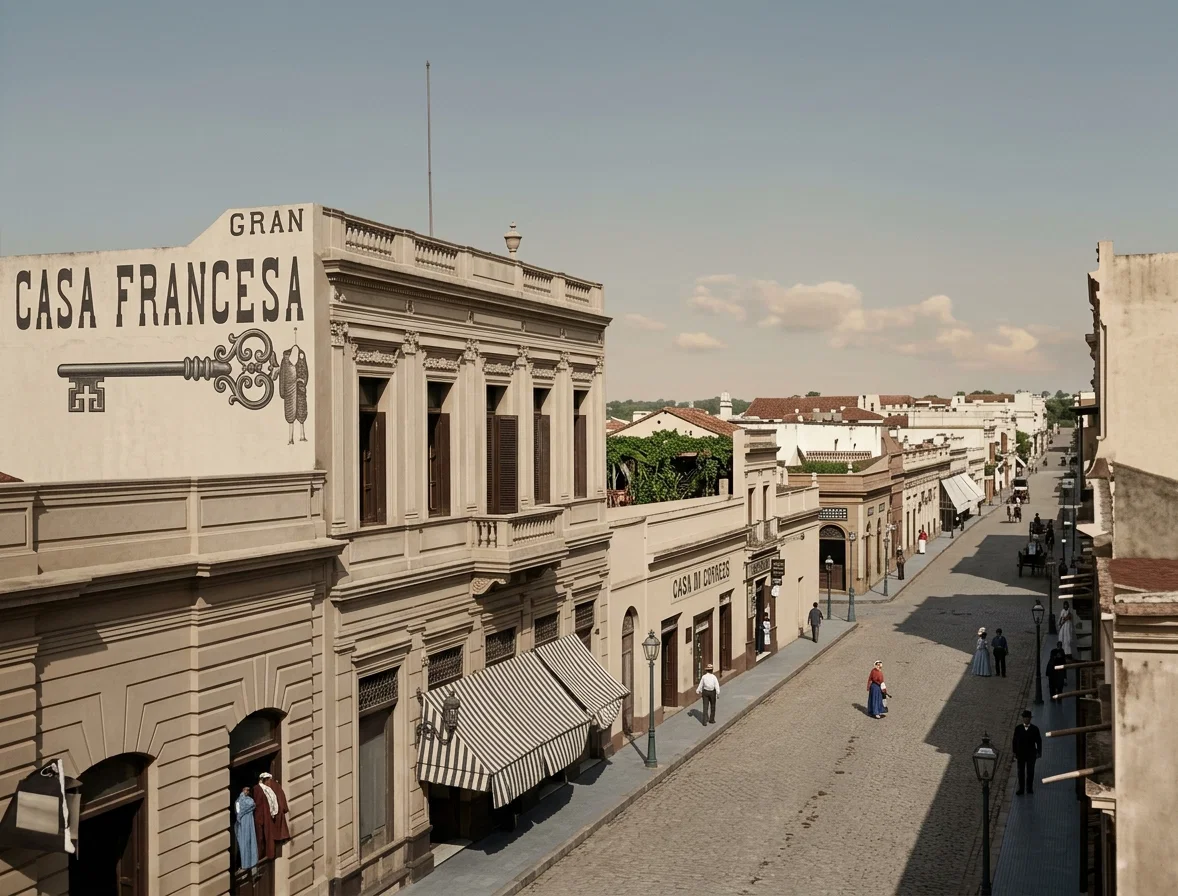
Calle Palmas (Palm Street), the Main Business Street of Asuncion, Paraguay.
The republic of Paraguay is located in the heart of the South American continent between latitude 20° 10′ 14″ and 27° 31′ south, and has an area of about 81,000 square miles, or a little less than the combined area of the States of New York and Pennsylvania. Prior to the war of 1866–70 with the allied powers of Argentina, Uruguay, and Brazil, the country contained a population of 800,000 souls, which by that event was reduced to 243,000. However, the lost ground has been somewhat recovered, the country containing at present a population of 655,500, divided as follows: Asuncion, 70,000; country and smaller towns, 433,000; Chaco, west of Paraguay River, 14,000; yerbamaté forests, 25,000; colonies, 10,500; Indians, 100,000; soldiers, 3,000.
Paraguayan history may be divided into five periods, as follows: (1) colonial; (2) independent and the tyranny of Dr. Francia; (3) the dictatorship of Lopez I.; (4) the dictatorship of Lopez II., with the six years’ war; (5) the constitutional period with reorganization.

The Colonial Period.

April 3, 1526, Sebastian Cabot, famous as an explorer of North American waters, sailed from Spain, with four ships, with the object of discovering a shorter route to the Molucca Islands in the East. The following year he explored the Paraguay River, discovering the country bearing the same name; but the first permanent settlement was not effected until 1537, when Asuncion was founded by Juan de Ayolas. During the colonial period, which reached to May 14, 1811, the country was ruled by “adelantados,” or governors, authorized by the Spanish crown. It was not separated from Buenos Ayres until 1617, the latter province being ruled conjointly with Paraguay until that date. The history of this period is made up almost exclusively of Indian wars, and revolutions, and conspiracies against the governors.
Paraguay was on the road to Peru, where the Spaniards supposed that great wealth was stored, and this fact brought the country into prominence. The first expedition to Peru consisted of 3,000 men commanded by Juan de Ayolas, who in the ascent of the Paraguay met and defeated the Indians in two engagements. After making terms of peace with them, he built a fort on the present site of Asuncion. Leaving his chief officer, Juan Irala, in command, he penetrated to the mountains bordering on Peru, and gathered there an abundant quantity of precious metals. On his return, however, he was surprised and killed by the Indians, all his company sharing the same fate. After much scheming and intrigue, Irala succeeded in being appointed his successor. His first act was to transfer the colonists of Buenos Ayres, numbering 600 to Asuncion, which he fortified. In the year 1539, discovering a plot of the Indians to massacre all the Spaniards, he executed the ringleaders. The other conspirators, in proof of their gratitude, brought as many Indian women as the Spaniards desired, who then became the wives of the latter. Under Irala, Spanish dominion was securely established in Paraguay. He promoted colonial wealth by the introduction of cattle, sheep, and goats from Peru, founded new settlements, and otherwise developed the country.
On Irala’s death, in 1557, he was succeeded in the government by his son-in-law. The history of the period from his death to the date of independence is occupied by the administrations of thirty-two governors. The conditions attending these times can best be described in the words of the historian as follows:—
From the very beginning of Paraguayan conquest, the series of administrations presented all the characteristics of the epoch of decadence that afflicted the metropolis [Spain], whose kings transmitted one to another the deplorable heritage of tyranny, fanaticism, and ignorance, bequeathed them by Phillip II. The two and a half centuries of colonial rule were to Paraguay a blank considered from the standpoint of progress, liberty, and civilization. Not only did this period witness a series of bloody battles with the Indians for their subjugation, but bloody strife among the conquerors themselves, who for the greater part aspired to carry out personal ambitions rather than to conserve the public good.
The first champion of liberty and independence was found in José Antequera, a native of Lima, Peru, who, because of his sentiments in the above direction, became the victim of Jesuitical hatred and conspiracy. Apprehended and imprisoned at Lima, he found a congenial companion in one Fernando Monipó, who readily imbibed Antequera’s spirit of liberty. The latter succeeded in making his escape in the latter part of 1726. He proceeded at once to Asuncion, where he openly agitated the right of liberty and independence. Permeated with revolutionary ideas, the court and officials of Asuncion refused to receive the new Spanish governor, Ignacio Loreta, who, on his return to Lima, inculpated Antequera because of the existing state of affairs. His testimony was confirmed by the Jesuits, and carried weight with the viceroy, who at once ordered Antequera’s execution, which was effected with difficulty in 1731.
On receiving the news of Antequera’s death, the Paraguayans arose in rebellion, looting the convents and driving the Jesuits from Asuncion. This uprising was not put down, and order restored, until 1735.
Asuncion, Paraguay. E. W. SNYDER.
(To be continued.)

I SHALL NOT PASS THIS WAY AGAIN.

[Rev. W. R. Fitch, in Northern Christian Advocate.]
I SHALL not pass this way again! The thought is full of sorrow; The good I ought to do to-day, I may not do to-morrow. If I this moment shall withhold The help I might be giving, Some soul may die, and I shall lose The sweetest joy of living.
Only the present hour is mine— I may not have another In which to speak a kindly word, Or help a fallen brother. The path of life leads straight ahead; I can retrace it never; The daily record which I make Will stand unchanged forever.
To cheer and comfort other souls, And make their pathway brighter; To lift the load from other hearts, And make their burdens lighter— This is the work we have to do; It must not be neglected; That we improve each passing hour, Is of us all expected.
I shall not pass this way again! O, then with high endeavor, May I my life and service give To Him who reigns forever; Then will the failures of the past No longer bring me sadness, And His approving smile will fill My heart with joy and gladness.
Continue reading: SAVING KNOWLEDGE