The Youth’s Instructor, Vol. 34, No. 20.

THE CALL OF ELISHA

The Youth’s Instructor

May 19, 1886

S. D. A. Publishing Association · Battle Creek, Mich. · May 19, 1886

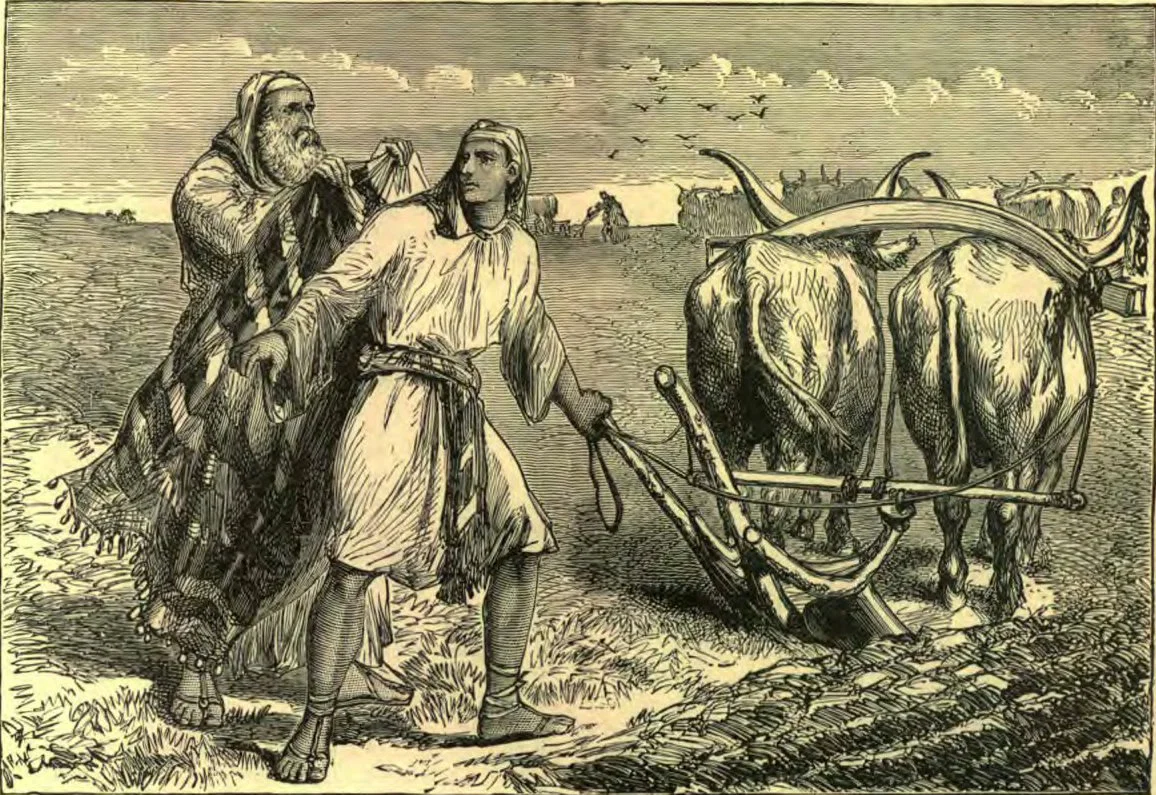
THE CALL OF ELISHA.

ACROSS the burning sands of the desert a weary old man took his way. He was very sad; for the people of his choice had forsaken the Lord their God. “I only am left, O Lord,” he cried; “and they seek my life, to take it away.” But the Lord had words of comfort for his aged prophet. “Yet I have left me seven thousand in Israel, all the knees which have not bowed unto Baal.” How those words must have cheered the heart of this faithful servant!
But Elijah was growing old; and no doubt he was anxious to know who would take his place when he was gone. So the Lord told him to return home and to anoint Elisha to be prophet in his room. With a firmer step, Elijah retraced his way; and at length the long desert lay behind, and the beautiful valley of the Jordan unfolded before him.
On every hand he beheld scenes of active rural life. Rude plows drawn by oxen upturned the rich soil, and busy sowers put out the ground to wheat and barley. Somewhere near the Jordan, Elijah lifted up his eyes and saw twelve yoke of oxen plowing in the fields, and Elisha with the twelfth. In a few moments this holy man of God stood beside the athletic young man, and quickly casting his mantle upon him, passed on his way.
Elisha, no doubt startled by the suddenness of this call which he knew was from God, ran after Elijah, and begged permission to bid farewell to his parents and friends. So Elijah bade him go back. Turning the heads of the oxen homeward, Elisha drew his plow from the unfinished furrow, never to return to these scenes as a laborer again.
When he reached home, he slew the oxen, and boiled them “with the instruments of the oxen,” according to an ancient custom, thus showing to the friends he had called together that he never intended to follow that calling more.
Then he “went after Elijah, and ministered unto him.” No doubt he made to the aged prophet an attentive servant and a diligent pupil, for he showed a tender regard for the feelings of his own parents in bidding them good-by ere he left them.
How many valuable lessons might be learned from the life of this noble man. In all the Bible there is hardly a more remarkable character than his. What a lesson lies in his promptness in obeying the call of God! Very probably he was a man of means; yet he offered no excuse, but left all, and followed the prophet.
Would we, under such circumstances, be as ready, I wonder, as he was, and as willing? If a prophet should call us to a great work, you answer. But Elisha would not have been ready to leave all at the first call from Elijah, if he had not trained himself to fulfill promptly all the lesser calls of duty before that time. There are few who are called to any great work; but to all, duty oftentimes calls as plainly as the aged prophet did to Elisha. It is not the great work we do, but the spirit with which we do what is given us, that makes our service acceptable to God.
W. E. L.

UNSELFISH JOSIE.

Two full years had passed since Josie Breeman had become a member of Miss Scott's class, yet in all that time she had never been absent a single day. No matter how stormy the weather, her teacher was always certain of one smiling face. When, therefore, on one bright spring morning, the plainly-clad little figure was missing from her accustomed corner, Miss Scott thought that the child was sick; and at the close of service, went out of her way several squares to inquire for her.
When she knocked at the door of the humble cottage, it was Josie herself who admitted her, and in her womanly way told her how grateful she was for the unexpected visit.
“I am surprised to find you out of bed, Josie, for I was certain you were sick. You know you are my most faithful scholar,” said Miss Scott, as she was ushered into the tidy room where three little children were busily engaged in arranging the cards that Josie had received at Sabbath-school.
“You don't know how I hated to miss this day, but mother's head ached very hard, and Willie's teeth make him fretful,” answered Josie.
“I am very sorry, indeed,” replied her teacher, “for I wished you to gain the prize. Could you not have left the baby with Johnny for an hour or two?”
“Oh, but ma'am, Johnny is now going to the school, too, and he is as eager for the prize as I am. If he had missed to-day, he would have lost his chance, and maybe he would not have cared about going any more, and might have begun going with the street-boys again. I would rather miss a hundred prizes, and have Johnny as he is now.”
Just then the bedroom door opened, and Josie ran to help her mother to her rocking-chair. Then she hurried off to the kitchen for the tea which she had prepared for the invalid.
“What a little helper she is,” said Miss Scott, looking after the retreating form of the child.
“She is a wonderful comfort. Why, you ought to see how she can manage the children, and that without a harsh word! Going to Sabbath-school has done her a world of good, and I tried to sit up long enough for her to go to-day, but she said it would do her no good when she knew I was suffering. So she has remained at home, and what time the baby has left her has been spent in teaching the other children from the Sabbath-school cards you gave her. I am sure I don't know how I could manage without her.”
“My greatest ambition is to be a teacher like you when I grow up,” Josie confided to Miss Scott at the door.
“Ah, Josie, you are a teacher already,” was the reply; “and who knows but that the blessed influence you are now exerting over your little world at home may be more lasting than years of labor in after life?”
“And will God count work that is only duty?” asked Josie, brightening.
“Every cup of cold water given in his name is sure of a reward,” replied the teacher gently, as she took her leave.—Youth's Evangelist.

PUSH!

In a certain banking house there is a door which is large and heavy. It is closed, and to a careless observer it looks as though it would take a strong man to push it open. On the front of it hangs a card on which is printed, in large letters, a single word of exhortation—“Push!” So, if you have any business with that house, you walk up boldly, and give that door a vigorous push. To your surprise it swings open easily, though large and heavy, for special care has been taken to make it open so. It was never put there to frighten and keep out people who have a right to enter.
Now, young readers, one and all, remember this: that in your journey through life, you will meet some closed door barring the path which you believe to be the path of duty. Do not stand puzzled and perplexed, but push. Turn not away and seek some other pathway; for, go which way you will, some closed door you will be sure to meet. Every pursuit, every trade, and every profession, has something in the way, which seems to bar your progress; and if you are not brave and bold, life will be a failure. Be energetic, and give the door a push. Do not be of the number of those who idly whine, “Oh, that there was an open door of usefulness;” but give some door a push, and see if it will not open. It may swing open more easily than you imagine; but, whether it creaks on rusty hinges or not, give it a push if duty calls you to enter, and your greatest trouble will be over. Timidity harms men no less than too much presumption. Go ahead, and the difficulty of opening may diminish as you push your way. Happy will you be, if, unlike some others we have known, you do not have to be nearly all your life pushing at some closed doors.—S. S. Classmate.

GOD EVERYWHERE IN NATURE.

How desolate were nature, and how void Of every charm, how like a naked waste Of Africa, were not a present God. Beheld employing, in its various scenes, His active might to animate and adorn! What life and beauty, when, in all that breathes, Or moves, or grows, his hand is viewed at work! When it is viewed unfolding every bud, Each blossom tinging, shaping every leaf, Wafting each cloud that passes o'er the sky, Rolling each billow, moving every wing That fans the air, and every warbling throat Heard in the tuneful woodlands! In the least As well as in the greatest of his works Is ever manifest his presence kind; As well in swarms of glittering insects, seen Quick to and fro within a foot of air, Dancing a merry hour, then seen no more, As in the system of resplendent worlds, Through time revolving in unbounded space. His eye, while comprehending in one view The whole creation, fixes full on one; As on me shines the sun with his full blaze, While o'er the hemisphere he spreads the same; His hand, while holding oceans in its palm, And compassing the skies, surrounds my life, Guards the poor rushlight from the blast of death. —Carlos Wilcox.

ANGRY LETTERS.

Aaron Burr used to say, “Talk as much as you please, when there are no witnesses present, but don’t put anything in black and white.” The cunning lawyer acted on the Latin maxim, Litera scripta manet [What is written remains], and never allowed himself to write that which could be used as evidence against him.
Burr’s practice may be cited to emphasize a necessary caution to those tempted to write an angry epistle. The hasty word may be recalled, but anger in black and white may embitter a lifetime. An English essayist tells this anecdote:—
An old gentleman, with a most benevolent look, but evidently of an irascible temper, begged the postmaster to return to him a letter which he had dropped into the box. The postmaster at first refused, as compliance would be illegal; but at last, being won over by the gentleman’s importunity, he returned the letter, having satisfied himself, by comparing the address with a specimen of the old man’s writing, that he really wrote the epistle.
On receiving the letter, the gentleman’s face beamed. Tearing it into fragments and showering them down, he exclaimed,—
“I have preserved my friend!”
While in a state of irritation, he had written his friend a letter which would have ruptured their friendship. In his calmer mood, he asked to recall it, and therefore sought the postmaster. Mr. Saunders, who tells the story in Pastime Papers, adds the advice, “never to write in your anger, or, at any rate, to keep your letter till you are cool.” —Selected.

The Little Missionary.

Before me lies a volume of great worth, a sacred treasure. In it we read of the rise and growth of nations, and the overthrow of mighty kingdoms. Here are noted the acts of cruel and wicked men and women, with the fearful doom to which their follies brought them. Here, too, we read of the devotion, the strong and unshaken trust and faith in God of good men and women, and of the results of their lives.
This book also tells us something about children. I have just read a sketch of a little girl, whom I wish to speak of as the little missionary. Her history is very brief. All she ever said is comprehended in twenty words. These, fraught with faith and confidence, were instrumental in bringing about the cure of a highly esteemed military chieftain, who was suffering from the leprosy, and also of conveying to him and to his family a knowledge of the true God.
This child was a foreign missionary. She could not work through the day, and return home at night to see her father and mother, her little brothers and sisters, and sleep in her own bed. No, she was a captive, away from home and friends, to whom her heart must have been bound by a thousand ties of affection, and living among those whom she never before saw.
This little missionary evidently had a good mother. Doubtless she had often been told of God and heaven, and what she should do to form a right character. And since she could see her dear mother no more, no doubt she many times called to mind the precious lessons of instruction from the one who had guarded and taught her with such tender care.
But though among strange faces, and amid scenes and associations to which she was unaccustomed, she was thoughtful of the interests of others. Her master was in a deplorable condition of health. His honor, his wealth, his power could bring him no relief. Physicians were of no avail. But she believed there was help for him; and with true faith, she said to her mistress, “Would God my lord were with the prophet in Samaria, for he would recover him of his leprosy.”
Now please open your Bibles to 2 Kings, chapter 5, and read the interesting and instructive cure of the leprosy in this case. You will say, perhaps, “This little girl’s master must have loved her very much for her words of faith which led to his cure.” That may be. But it is to be hoped he loved her aside from this reason. Who that has a loving heart, who that loves the Saviour, has not a love for little children? Jesus loved them. He took them up in his arms and blessed them when on earth.
He set a little child in the midst of his disciples, and taught them a lesson pertaining to the kingdom of God. The man or woman who is too far above little children to refuse them a gentle word or a smile of recognition on meeting them, does not in this respect follow the Master closely.
Let us all get more of the spirit of the Son of God, and delight to help children to be good and to do good. How full of instruction and admonition are the following words from Mrs. White, in speaking of Jesus: “He took little children in his arms, and descended to the level of the young. His large heart of love could comprehend their trials and necessities, and he enjoyed their happiness. His spirit, wearied with the bustle and confusion of the crowded city, tired of association with crafty and hypocritical men, found rest and peace in the society of innocent children. His presence never repulsed them. The Majesty of heaven condescended to answer their questions, and simplified his important lessons to meet their childish understanding. He planted in their young and expanding minds the seeds of truth that would spring up and produce a plentiful harvest in their riper years.” “The soul of the little child that believes in Christ is as precious in his sight as are the angels about his throne.”
Little children, be good, do good, and grow good. Always remember that the angels are interested in your salvation. See Matt. 18:10.
A. S. Hutchins.

LIFE'S THRESHOLD.

Oh, little feet, as yet untired By any steps on life's rough way! Oh, sweet blue eyes, undimmed by tears: Oh, dimpled hands, stretched out in play!
Love longs to lead those little feet Through sunny meadows bright with flowers, Where all is fair and glad and sweet— An azure sky that never lowers.
Love longs to teach those laughing eyes To see with clear and earnest sight Each turning page of life's great book, Where few, alas! can read aright.
Love longs to give those little hands, Stretched out to us in merry play, Blossoms to hold that have no thorns, And treasures none can take away.
And yet how powerless, at the best, Is human love! Through hopes and fears Those little feet must walk alone, And those blue eyes shed many tears.
Those little hands may have to yield Up treasures they have toiled to gain; And they must find earth's flowers have thorns, For every joy is fraught with pain.
But, Love Eternal, thou art near, Around our restlessness, thy rest! Those thou dost guard and guide and teach Are now and ever fully blessed.
Oh, may these feet walk in thy ways, May these sweet eyes look up to thee, These little hands receive thy gifts, Thus blessed to all eternity!
—The Christian.

SMALL MEANS.

The power of money, on the whole, is over-estimated. The greatest things that have been done for the world have not been accomplished by men of wealth, but usually by those of small means.
The greatest thinkers, discoverers, inventors, and artists have been men of moderate wealth. Many of them were in circumstances little above those of manual laborers. And so it will continue to be.
Riches are often an impediment rather than a stimulus to action, and in many cases prove a misfortune rather than a blessing. The youth who inherits wealth is apt to have life made too easy for him, and he soon grows sated with it. Having no special object to struggle for, he finds time heavy on his hands, and he often remains morally and mentally asleep. Many bright intellects have been made by continued application from youth, though surrounded by almost insurmountable barriers. Edison, who stands at the head of American inventors, spent his earlier years as a railroad newsboy; Commodore Vanderbilt was a fisherman; Abraham Lincoln, a farmer boy. The ablest statesmen that America ever could boast of arose from poor boys, surrounded by unfavorable circumstances. The reason why they became useful was that they applied themselves, and improved their few opportunities. By so doing their minds kept pace with their physical growth.
J. G. HARDIE, JR.

SINGING HEARTS.

Most boys and girls know what it is to have days when everything goes wrong. It begins early in the morning; one is late to school, and misses his lessons. The sun does not seem to shine brightly, and the games which are so pleasant on other days have no fun in them. Most always it is the boy’s own fault; he has been lazy, or careless, or cross, and so has spoiled the whole day for himself.
Then there are days when his heart seems to sing with gladness from morning to night. Every duty is easier, every pleasure greater. What makes the difference? It is all in the heart. One of the great prophets in the Bible tells us how we can always have bright, sunny, happy days. He speaks of those who believe in God, who know and feel that God loves them, and who love and trust him in return. And this is what he says shall happen to them: When they go out, it shall be as if “Joy,” a bright, white-robed angel, went ever by their side; and as if “Peace,” a calm, gentle, helpful sister, led them by the hand. So happy shall they be that it shall seem as if even the “mountains and the hills broke forth before them into singing,” and as if “all the trees of the field clapped their hands!” Their own happy hearts, at peace with God, should so light up every spot in the world that it would seem as though even the mountains and hills and trees were being glad with them. Would that not be a beautiful way to feel? Then even the dark fall and winter days would be as bright and joyous as the summer sunshine.—Child’s Paper.

CONDUCT IN THE HOUSE OF WORSHIP.

Paul once wrote to Timothy, a young minister: “These things write I unto thee, . . . that thou mayest know how thou oughtest to behave thyself in the house of God.” We should all study what God has told his servants to write in his holy book, that we may know how we ought to behave in his holy place of worship. And remember, we should behave as carefully in the Sabbath-school as during the regular preaching services. It is as truly a part of God’s worship as the other.
How should I behave in God’s house?
1. Quietly. I should do nothing to distract the attention of others.
2. Orderly. I should be careful to comply with the established order of the place, moving about only when directed by the superintendent, and then only as he directs.
3. Thoughtfully. Unless I think of God and of his truth, I can receive no blessing: “God is a Spirit, and they that worship him must worship him in spirit;” that is, with our minds and hearts.
4. Reverently. I should remember with Jacob at Bethel, “Surely the Lord is in this place. This is none other but the house of God, and this is the gate of heaven.”
5. Prayerfully. Unless God bestows his blessing, our coming to his house will do us no good. And he expects us to ask him for his blessing. We should pray in our hearts that he will bless his word to our souls and the souls of others.—Youth’s Evangelist.

BLOSSOM-TIME

Snow, snow, down from the apple-trees, Pink and white drifting of petals sweet! Kiss her and crown her our Lady of Blossoming, There as she sits on the apple-tree sweet!
Has she not gathered the summer about her? See how it laughs for her lips and her eyes! Think you the sun there would shine on without her? May! ’Tis her smile keeps the gray from the skies!
Fire of the rose, and snow of the jessamine, Gold of the lily-dust hid in her hair; Day holds his breath and Night comes up to look at her, Leaving their strife for a vision so rare.
Snow, snow, down from the apple-trees, Pink and white drifting of petals sweet! Kiss her, and crown her, and flutter adown her, And carpet the ground for her dear little feet! —St. Nicholas.

GOD'S JEWELS.

I HEARD a noise, and turning to where the sound came from, I looked and saw two children—brother and sister—quarrelling.
Discontented, disagreeable children, with nothing attractive about them,—that's what I saw with the natural eye; but a ray from the Sun of Righteousness shone upon them. Taking up the microscope of love, and placing it to my spiritual eye, I looked again at the children, and I noticed that what I had seen before was merely the outside—the casket; and that within each lay a bright jewel of untold worth. I tried to realize the value of them, but it was beyond my knowledge. They were the precious jewels that might live eternally, to glitter and shine, reflecting the glory of the “King in his beauty,” or that might be thrown into outer darkness.
The King valued these jewels so much that he purchased them for his own, paying the great price, not with silver and gold, but with his own precious blood; and after all that, they are in danger of being stolen from him, the King’s enemy being always on the look-out for them.
Legions of angels would gladly leave heaven at a word from their Commander to rescue and reclaim the least of these jewels, but the King says, “No; I have soldiers on earth; they must fight for them and win them back; I will require my jewels at their hands. It will be a good way for them to prove their love for me; let each one who really loves me, bring at least one jewel.”
Little Christians, do you really read the parable aright? If not, ask God to open the eyes of your understanding.—H. Archbold.

BE ACCURATE.

MAKE it a habit to be accurate in everything you do. Never take a single step until you are sure that it is just what you want. Be accurate in your writing. Dot your “i’s” and cross your “t’s” is what our school teacher used to din into our ears in our boyhood days, and it taught us habits of accuracy which we never had cause to regret. In sending orders to your merchant, be accurate in them; put down just what you want and how you want it in such plain language that you can’t be misunderstood. Be very careful to get your address right, street, number, town, county, and State, and you will save a great deal of trouble at the office where your order is received. A great deal of the misery in this world is caused by inaccuracy of word or deed.—Exchange.

INTERESTING WATER SCENERY.

Rev. John A. Cass, in Golden Days, speaking of beautiful water scenery, says: “I suppose a person might travel the world over without finding it in such a variety of forms as in Switzerland. No landscape scene is perfect where this element is wanting, and almost none can be found without it in the whole country. From Zurich to Zermatt, and from Geneva to Pontresina, it is always in sight. Every village has its fountain in the public square, and there is no little hamlet far away among the great mountains, or deep down in the sunless valleys, but has the music of perpetual streams.”
But the writer thinks the beauty of this scenery appears in its most striking form in some of the springs and waterfalls in which the country so abounds. One of the interesting examples he gave was as follows:—
“Not far from the little village of Magland, as one journeys from Geneva to the far-famed Valley of the Chamouny, for mile after mile, the carriage-road runs along close under the overhanging cliffs, and the traveler has no reason to suspect that he will cross so much as a mountain brook. But as he turns a somewhat sharp curve, he suddenly hears the roar of a torrent. He sees no opening in the mountains, and is wondering whence the stream can have come, when, lo! he steps upon a bridge, and the mystery is solved.
“Not six yards from where he stands is a spring, or perhaps a number of springs, pouring forth a vast quantity of water in a most singular way. The water comes in jets, and appears so suddenly as to be almost literally shot out of the ground. It does not rise to any height, it is true, but it boils and bubbles as if some great heart were beating below, and an almost incredible volume of it is poured out within a very narrow compass.
“Stepping down from the bridge, I put my hand into one of the little openings in the earth whence the streams issued, and found that it required considerable effort to keep it there against the pressure.
“Some of the other places sent out streams even more powerful than this. Indeed, the volume of water was so great, and reached the surface so suddenly, that, within twenty feet from the first spring, the brook is fully twenty feet wide, and so deep that it cannot be forded, while so rapid is its flow that the strongest swimmer would be in most imminent peril if he should fall into it.
“Within a hundred yards from where it took its rise, the stream had swollen into a roaring and foam-covered river, whose waters were being utilized to turn the wheels of a mill or two, and might have furnished power to run many more.
“For awhile I stood looking at it in amazement, and then began to consider whence so much water came. There were no limestone cliffs through which it could have forced a passage here. Not ten feet behind the spring, rose up the mountain-wall, to the height of more than two thousand feet—a wall unbroken for many miles; so it seemed impossible that it could have flowed down through some half-hidden ravine.
“Some have endeavored to account for it by supposing that far up on the mountains was a lake, to which this was the natural outlet. But the objections to this theory are serious; for, in the first place, it is not known that such a lake exists; and, secondly, if there was one at such a height, its waters, when forced so suddenly to the surface, would of necessity be thrown into the air for several feet, at least.
“The only conclusion at which the visitor to the spot can reasonably arrive is that he has before him a real spring, most remarkable for the volume of its water, and for the way in which that water comes to the surface.”

IMPORTANT BIBLE SUBJECTS.

LESSON 7.—PERPETUITY OF THE LAW.

[NOTE TO THE STUDENT.—Do not consider the lesson learned until you can give at least the substance of every text, with the correct reference for each. The references in black letters indicate those texts that should be committed to memory. A little diligent application each day will enable you to learn them, although this need not be considered a test of scholarship.]
1. GIVE as much proof as you can that the law existed before God spoke it from Sinai?
2. What relation do the ten commandments sustain to the throne of God?
3. From this, what must we conclude as to the extent of their jurisdiction?
4. How long is God’s kingdom to endure? Dan. 4:3; 7:27.
5. Since God is to reign forever, and the ten commandments are the foundation of his throne or government, how long must they endure?
6. In what words does the psalmist corroborate this? Ps. 119:160.
7. To what would a change in the law be equivalent?—To a change in the government of God.
8. What strong language did Christ use concerning the law of God? Matt. 5:17, 18.
9. Can you refer to a noted prophecy that has not yet been fulfilled? Ps. 89:20–37; note especially verses 29, 36, 37.
10. How long will it take for this prophecy to be fulfilled?—As long as the days of heaven, or to all eternity.
11. Then how long will the ten commandments exist unchanged?
12. Quote a direct statement of the psalmist concerning the stability of the commandments. Ps. 111:7, 8.
13. What have we already found the ten commandments to be? Ps. 119:172.
14. Whose righteousness are they? Isa. 51:6, 7.
15. What does God say of his righteousness? Isa. 51:6, last part.
16. How long must the “righteousness of God” endure?—As long as God himself endures.
17. What does the psalmist say of the existence of God? Ps. 90:1, 2.
18. Then what must we still conclude as to the length of time the ten commandments will exist?
19. In making a direct address to the Jew, what does Paul say that he knows? Rom. 2:17, 18.
20. How does it happen that he knows God’s will? Verse 18, last part.
21. Since “being instructed out of the law” causes one to know God’s will, of what must the law be a statement?
22. What scripture further establishes the conclusion that the law of God is his will? Ps. 40:8.
23. Is God’s will changeable? James 1:17.
24. In view of these different lines of argument, what must we conclude in regard to the law of God? Luke 16:17.

NOTE.

CHRIST said that “not one jot or tittle should pass from the law till all be fulfilled.” Matt. 5:18. From the preceding verse it appears that he had reference to the prophets, meaning that nothing should pass from the law until all the sayings of the prophets were fulfilled. In Ps. 89:20–37 we have a prophecy concerning Christ. To fulfill this prophecy will require all “the days of heaven,” that is, all eternity. Therefore Christ’s words are equivalent to the statement that the law will exist unchanged to all eternity.

The Aims of the Sabbath-School.

There are three aims which should be kept constantly before the school.
Our first aim should be to make our school a place of thorough instruction in the Scriptures. By careful teaching in the class, by reviews and supplemental lessons from the desk, by awakening an interest in the Bible, and by quickening its study in the family, we should seek to give to all, and especially to the young people, a knowledge of the book which is able to make them wise unto salvation.
Our second aim should be to make the school a place of earnest, religious atmosphere. We would have it so freighted with religious influence that whoever enters it will realize that he is upon holy ground; that not one scholar shall grow up to mature years without being drawn to Christ; that the clearest conceptions of the spiritual life shall be imparted; the warmest experiences shall be encouraged; that the highest and fullest type of Christian character shall be developed.
Our third aim should be to make our schools a place of genuine enjoyment. Every gathering of our school should be so delightful that he who comes once will long to come again. We would have it a home to all who enter, with all the pleasant associations and all the fragrant memories of a cheerful Christian family circle.
Let every superintendent and every teacher keep before him these three aims, and work toward them.—The Study.

Faith as the Pencil of the Soul

FAITH is the pencil of the soul, which pictures heavenly things.

CONQUERORS

BLESSED are they who die for God, And earn the martyr's crown of light; Yet he who lives for God may be A greater conqueror in his sight. —Adelaide A. Proctor.

THE CARICATURE PLANT.

THERE is such an endless variety of curious and wonderful things in Nature’s workshop that should a naturalist devote all his time to their study he could not examine them all. Whether he gives his attention to the animal, the vegetable, or the mineral kingdom, there is ever something new and fascinating to attract the attention. Among the odd things recently discovered in the vegetable world is a plant which has the appearance of “making faces.” A writer in the St. Nicholas thus describes it:—
“One of the most remarkable plants in the whole vegetable kingdom is that known to botanists as the Justicia Picta, which has also been well named the ‘Caricature Plant.’ At first sight it appears to be a heavy, large-leafed plant, with purple blossoms, chiefly remarkable for the light yellow centers of its dark green leaves, which causes them to look as if some acid had been spilled upon them and taken the color out wherever it had touched.
“As I stood looking at this odd plant and thinking what a sickly, blighted appearance the queer, yellow stains gave it, I was suddenly impressed with the fact that the plant was ‘making faces’ at me. Still, unaccustomed as I was to seeing plants indulge in this strictly human amusement, I was slow to believe it, and stooped to read the somewhat illegible inscription on the card below the plant—‘Justicia Picta, or ‘Caricature Plant.’’ My first impression was correct, then. This curious shrub had indeed occupied itself in growing up in ridiculous caricatures of the human face, until it now stood, covered from the topmost leaf down with the queerest faces imaginable. Nature had taken to caricaturing. The flesh-colored profiles stood out in strong relief against the dark green of the leaves.
“A discovery of one of these vegetable masks leads to an examination of a second and a third leaf, until all are scanned as closely and curiously as the leaves of the comic papers that form the caricature plants of the literary kingdom.
“I have never heard of the cultivation of the Caricature Plant in this country; but botanists tell us it is a hardy shrub. I think we should be glad to see the funny faces on its leaves. After all the lovely flowers we are called upon to admire, I am sure that a plant evidently intended to make us laugh would receive a warm welcome from our young people.
“The Chinese appreciate the Caricature Plant, and in some parts of China it is quite extensively cultivated. Perhaps some of the funny, grinning faces on Chinese toys and ornaments are reproductions of the grotesque features on the leaves of the plant.
“In this account of a very remarkable plant the writer has not drawn upon imagination. The Justicia Picta really exists. It is a native of the East Indies, and is a source of much amusement and curiosity to both botanists and travelers.”

AN EXTRAORDINARY TREE.

In Nevada there is a species of acacia which possesses all the features of a sensitive plant. It is growing rapidly, being now eight feet high. At sunset its leaves fold together, and the ends of the twigs coil up, producing, if handled, evident uneasiness throughout the plant. When it was transferred from the pot in which it had ripened into a larger one, it displayed great agitation; as the gardener said, it went “very mad.” It had hardly been in its new home ere its leaves began to stand up like the hairs on an angry cat’s tail, and it was soon all in a quiver. Besides, it gave forth a most pungent and sickening odor, which filled the house so that doors and windows had to be opened, and it was fully an hour before the tree lapsed into a state of tranquillity.
Continue reading: LIVING LUNCH BASKETS