There is an inherent desire in every human heart for amusement, entertainment, and enjoyment. No one willingly spends all his time in serious labor and anxious care. Every one at times longs for diversion. No doubt this universal feeling is heaven-born, and its gratification to a reasonable degree is not culpable. God has not only implanted within us an appetite for pleasure, but he has surrounded us with a thousand things for the gratification of this desire. The religion of Christ does not compel us to always be solemn and serious. Rather the injunction is, “Rejoice, and again I say, Rejoice.” “Rejoice evermore.” The Christian may have his recreations and pleasures, but the true disciple will be anxious to amuse himself in such a way as not to abuse the goodness and blessing of God.
Man has devised many ways of amusement. We do not believe these plans of pleasure can be catalogued, and certain ones of them recommended and others specifically condemned.11A safer way is to aim to guide our conduct by a few general principles that commend themselves to the common sense and sober judgment of those who earnestly desire to do what is right. Here are a few suggestions:—
1. Do not make amusement the main object in life. “Life is real, life is earnest,” and he who makes it a joke, or a matter of fun, makes it a failure. Pleasure palls when pursued too persistently. Sweetmeats are enjoyed more by one who uses them for an occasional dessert than by one who tries to make three square meals each day on them. So is there more genuine pleasure in an evening’s entertainment after a day of serious, hard work.
2. Don’t engage in amusement simply to kill time. Time is the stuff of which life is made. It is the warp and woof of which we weave life’s weal or woe. When once it is past it is gone forever. At death you will appreciate its value. When Queen Elizabeth was dying, she cried, “My kingdom for a moment of time.” But all of earth’s kingdoms cannot buy one minute of time in its flight. Don’t kill time; you can never resurrect it.
3. Avoid amusements that give pain to man or beast. This was the main feature of the amusements of ancient pagans. To be cultured and refined, to be abreast of the highest progress in civilization, one must avoid cruel, brutal, or violent sports. They are only barbaric and demoralizing.
4. Do not amuse yourself with that which you justify as simply not as bad as something else. Almost every sinner urges that in extenuation of his particular sin. Let your ideal be not better than the bad, but equal to the best. Set your mark high.
5. Avoid amusements of an evil tendency. Some things innocent in themselves may lead to other things which are questionable. A ship in starting from its harbor may vary but the slightest degree from its true course, but in the end of its journey it will find itself far from its destined harbor, if not a wreck upon the rocks. So any one who deviates in the least from the straight and narrow path, is in danger of ultimate wreck and ruin, or at least of missing that peaceful harbor of safety above, where all hope to anchor at last.
6. Beware of amusements that lead to evil associations. Some things you yourself might do without personal defilement, yet if these practices are common to men and women of evil nature, it is only a question of time when you will be polluted by them. “Evil communications corrupt good manners.”
7. Young men should not engage in amusements morally denied their sisters, or to be concealed from their mothers. No doubt this will cut them out of much “fun,” but it will make them much nobler and purer men. The time has come when the same standard of morality is being demanded of both sexes. Whatever is wrong for your sister is wrong for you. Whatever ostracizes her from society, ought to banish you. Whatever will damn her soul in eternity will damn yours, for the final Judge is no respecter of persons, and with him there is neither male nor female.
8. Avoid amusements that destroy your relish for the common duties of life. You must live the most of your life amid its regular duties and drudgeries. If reading flashy literature, or witnessing upon the stage false and perverted views of life, make you dissatisfied with its actualities, and cause you to long for an existence really to be found only within yellow-backed covers or behind foot-lights, depend upon it, you are treading dangerous ground.
9. Shun amusements that corrupt the taste, harden the conscience, or blunt the moral sense in any way.
Finally, let your amusements really be of a re-creating character. They should build you up physically, mentally, and morally, and not destroy you in any of these ways. Make the most of life. Improve your time and talent to the fullest. Aim not merely to have a “good time,” but the best time. Above all, remember that for “all these things God will bring thee into judgment.” Let your daily prayer be, “So teach us to number our days, that we may apply our hearts unto wisdom.” —Our Young Folks.
DIDN'T KNOW HE WAS A CHRISTIAN.
A few years ago, in talking with a young man who had almost decided to be a Christian, we spoke of his employer as being very active, superintendent of a Sunday school, and engaged in many branches of church work. He looked greatly surprised, and said:—
“I didn’t know he was a Christian. I have worked for him for seven years, and never knew he was a Christian. In fact, I am surprised and don’t know what to make of it. Excuse me, sir, but he don’t act like a Christian here. He is exacting and unreasonable with his employes, and scarcely ever—I may say never—acknowledges that he was in the wrong, although sometimes he is so cross and crabbed and gives those under him such a blowing up over what they are not responsible for, and things over which they have no control—oftentimes know nothing about—that I can’t see he is living a Christian life in his business. I am glad he is in the church; but I don’t believe you would find one here in the store who would say that Mr. So and So was a Christian.”
What an influence this man was wielding, and how little his influence was counting for Christ! In his own place of business, where the light of Christ ought to have shone brighter than anywhere else, his employes did not even know that he professed the name of Christ. Well would it be if this were an isolated case, but all know that it is not. It is all too common for you and me to use our Christianity and do all our Christian work in the church and around it, and the world outside know nothing of our profession, oftentimes, and much less do they see anything of practical Christianity in our lives.
This man was stumbled. No wonder. He hesitated long before making the start. It would be well for you and me to question ourselves, to pray over the matter, and see whether or no we are living Christian lives in our business. The eyes of the world are upon us. It ought to be our joy and privilege, not only to profess Christ in church, but to carry out that profession in everyday life.—Union Gospel News.
LIVING PICTURES.
By Harry Armstrong
BY HARRY ARMSTRONG.
[“O Lord, how manifold are thy works! in wisdom hast thou made them all; the earth is full of thy riches.” Ps. 104: 24.]
There is a wise Creator, whose ruling law is love; By him we are created, in him we live and move; And every day rich blessings he sends us from above.
His holy life is written in love o’er all the land, In characters so simple, and yet so strangely grand, That he who runs may read them; a child may understand.
He loves to see his children in all his works delight; He’s made some “living pictures” well pleasing to the sight, Each picture representing some feature of his might.
He makes the sun in splendor with smiles to greet the morn, The trees and choicest flowers are given to adorn, And all the fallowed patches he clothes with rejoicing corn.
The air is full of music; the happy birds invite That we will with their chorus our songs of praise unite, To Him who hath created this wond’rous world of light.
The sweet, refreshing showers, the gentle, early dew, Uniting with the sunshine, doth bring before our view The old earth decked in beauty, with garments rich and new.
And when with sun’s declining, by Him who knoweth best A season is provided for man and beast to rest; The shadowy curtain lowers, and nature is refreshed.
Shall man, the highest creature of God’s creative power, Show forth less praise and glory than beast and bird and flower? Or will he live to gladden and beautify each hour?
London, Eng.
THE BREADFRUIT TREE.
By E. C. Chapman
BY E. C. CHAPMAN.
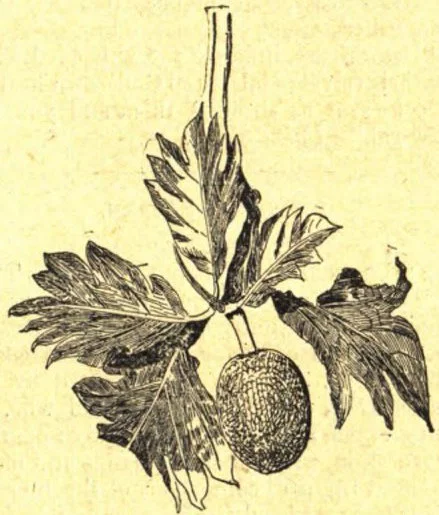
THIS peculiar and interesting tree, which is native to the Pacific islands and to the Indian Archipelago, forms one of the valuable possessions of these ease-loving inhabitants. Its fruit is one of their principal articles of food, and under the shade of its wide-spreading branches the warm days of perpetual summer are smoked away by the natives, who apparently take no thought for the morrow, and are content to live in a wigwam of coconut limbs and eat of the breadfruit, bananas, coconuts, and fish, while the rest of the world moves on in the struggle for bread and riches. With large pinnatifid leaves, that are of a glossy green, and lofty branches that often attain the height of fifty feet or more, this tree presents a majestic and beautiful appearance, especially when the extremity of each branch is drooping under the burden of fruit that sometimes hangs in clusters of three, which gives to one’s mind a faint idea of what Eden must have been before the curse.
BREADFRUIT.
Several varieties of the tree are found here. On some of the trees the large leaves are split with deep incisions, while in others the notching is less prominent. The fruit of most varieties is nearly round, and is about the size of a child’s head, while other trees bear fruit of a larger order, that is oblong in shape and of a softer texture. To the native the round and hard breadfruit has the preference, as tradition tells them of a great man of the past who was choked to death by eating of the soft variety. A tree that would dispense with the necessity of bakers by furnishing nicely raised loaves of the staff of life would indeed be quite a tree, but no such material is plucked from the branches of even nature’s fruit trees.
The breadfruit tree comes nearer to filling the place of the potato than of crowding out the baker. It is roasted in the fire, baked in ovens, or boiled in water and eaten with a relish by those who have learned to like it. On some islands where fresh food is scarce during part of the year, it is buried in the ground and allowed to decay until the time arrives for it to be eaten. Because of its perishable nature, the breadfruit is never seen in the markets of the world, and for this reason less is known about it in other countries than of most any other fruit. The exterior of the fruit is green and rather rough. The stem is joined to a tough core, from which the fine-grained inner texture of the fruit appears to radiate toward the exterior. In ancient times cloth was prepared from the bark of this tree. The wood is also of a substantial and valuable grade.
The thrift and fruitfulness of the breadfruit tree is as the righteous, of whom it is said, “He shall be like a tree planted by the rivers of water that bringeth forth his fruit in his season; his leaf also shall not wither; and whatsoever he doeth shall prosper.” Ps. 1:3. It matters little how high the surrounding shrubbery may be, or how great the difficulties in reaching up to the clear light above, the breadfruit tree surmounts them all and spreads its broad leaves above the tops of surrounding vegetation. Such “is the man that trusteth in the Lord, and whose hope the Lord is. For he shall be as a tree planted by the waters, and that spreadeth out her roots by the river, and shall not see when heat cometh, but her leaf shall be green; and shall not be careful in the year of drought, neither shall cease from yielding fruit.” Jer. 17:7, 8.
Papeete, Tahiti.
HEART'S-EASE
By Belle Louise Pierce
BY BELLE LOUISE PIERCE.
NELLIE MOORE was a flower mission girl, whose mission work extended from the first snowdrop to the last asters and chrysanthemums; and, with a face as sweet as her flowers, she had brightened many cheerless homes and lightened many cheerless hearts. But one morning she stood arranging and rearranging the flowers she held, with a troubled look which attracted her mother's attention.
“What is the matter, dear?” she asked. “Your bouquet is beautiful; is it for Grandma Clarke?”
“That's the trouble, mama, that's my temptation,” Nellie answered with a troubled laugh. “Giving flowers to dear old Grandma Clarke is getting to be a rather selfish act of mercy, for I do so love to do it; but I have given her so many that it seems to me—O mama, do you think I ought to give these to old Mrs. Shaw? Do you suppose she would care for flowers?”
“Give them and see,” Mrs. Moore replied.
“But she is so very disagreeable looking that, really, I am half afraid of her. Her face is so brown and wrinkled, and her head and her hands are always shaking, and her voice is so high and queer that it shakes too. We girls glanced in through the open window one day, and when she saw us she pounded on the floor with her stick and screamed, ‘Stop your staring, young ones, and get out.’ And we did get out in a hurry. And Mattie says she is so cross to the woman she lives with, and finds fault with everything she does. And that woman is cross, too, and doesn’t seem to care whether she is pleased or not. How can such people care for flowers? And these pansies are so sweet, they ought to go to some one who will love their bright little faces.”
“Those women are mother and daughter,” said Mrs. Moore sadly.
“O mama, what an unlovely family!”
“Wait, daughter; mix your judgment with more mercy. I think from what I have heard that there are many excuses for the unhappy tempers of these poor women. They are very poor; the daughter supports them both by washing and scrubbing; and she must come home evenings so tired and lame that I dare say it makes her cross. Then the poor old mother has been sick and helpless a long time—it is disease that makes her shake—that makes her nervous, and, as Mattie says, cross.”
“Still, I should think they would love each other,” said Nellie thoughtfully.
“I suppose they do, but their life has been12so hard and the old love has been covered so long that they have almost forgotten that it is there. Perhaps God has a work for his flowers to do there; they may help them find the lost love.”
When Nellie went to school that morning, a beautiful bouquet for Mrs. Shaw lay on top of her dinner basket.
All was quiet when she reached the house, and, looking through the open window, she saw Mrs. Shaw dozing in her chair. She laid the flowers on a table which stood beside the window, and hurried away. Two days later she carried a fresh bouquet; but when she had tiptoed up to the window, she started back half frightened, for in front of it, her stick between her knees, her keen black eyes looking straight into Nellie’s blue ones, sat Mrs. Shaw.
“Well, come round to the door,” she called in a shrill, tremulous voice Nellie had heard before. “We ain’t got much, but we’ve got a door. Be you the gal that brought them posies?” she asked as Nellie entered.
“Yes,” she answered, “and I’ve brought you more to-day.”
“That was clever of you,” the old woman said graciously. “I’d got to thinkin’ young ones wern’t good for nothing nowadays but to stare and laugh at a poor old body. I always liked posies and I had ’em too when I was young and stout like Mary—that’s my gal—but she’ll never try to raise one. She never does nothing to please me; she just gives me the bare victuals and clothes, nothin’ to cheer a body.”
“Perhaps she’s too tired when she comes home,” Nellie suggested timidly; “washing all day must be hard work.”
“Well, mebbe she is, mebbe I’m too hard on her; but I get so tired sittin’ by myself all day, nothin’ to do but to think how I’m fixed now and how I used to be when I was young. I had my white house and my posy beds on each side of the walk to the gate. Four-o’clocks, marigolds, petunias, and pansies—them was my pets—and at the end of one bed was a bunch of ribbon grass, and at the other a bunch of rosemary.”
“Where is it all now?” asked Nellie.
“Drunk up in the saloon ’round the corner,” answered the poor woman shortly.
“O, I’m so sorry!” said Nellie sympathetically. “Try to fancy these flowers grew in those old beds. I must go now; it is nearly school time.”
But Mrs. Shaw made no answer, and seemed to have forgotten her presence as she sat looking away at the distant hills, her chin resting on her cane. A long time she sat motionless; then, turning with a sigh, she saw the flowers. How fresh and fragrant they were! There were pansies, too, and with trembling fingers she separated them and made them into a little bunch by themselves. Back thirty years they carried her thoughts to the flower beds beside the walk; and as she looked into their shining golden faces, she seemed to see again the laughing faces of her own little ones as she had seen them in that far-away time among the flowers. Charley and Jennie had left her before their faces had lost their baby roundness. But Mamie—she started, as memory placed beside the tall, stooped woman Mary, with her weary face and faded eyes, the merry, dimpled Mamie of that little group.
“She lived and growed up before me,” she sighed, “but she seems more lost to me than the others; mebbe I’ve been too hard with her; that leetle posy gal seemed to think so.”
“Darter,” said a voice from a dusky corner, as Mary entered that evening, “darter, come here,” and as she obeyed wonderingly, the poor, palsy-shaken arm drew her down to where she had not rested since babyhood, down to her mother’s breast; and a voice trembling, but with no harshness in it, was murmuring love names her ears had long forgotten.
“My Mamie, my only baby left me,” it sobbed, “your mother’s been a hard woman to you these many years. My disappointments and my hard luck made me cross and bitter, and I forgot that they was as heavy on you as on me. But it won’t be so any more, Mamie. Life won’t ever be so hard again, now that love’s waked up. Thank God, it’s his doings, through that child and her posy bunches.”
“Don’t, ma, don’t take on so,” whispered Mary brokenly. “It’s been heaps my fault. I might have done much more to make you happy sitting here all day, and I have never done it. But I will, you’ll see. You shall have your flowers—real growing ones—and I’ll ask folks for their old papers and read to you evenings. O, there are brighter days coming, ma, dear!”
And Mary was right; for through Nellie the interest of many others was awakened. Indeed, that first kind act was a seed which grew and blossomed as richly as her own flowers, and yielded bountiful results. The old house was made more habitable, good books cheered their evenings, and pots of flowers brightened their window all winter.
Easier work, too, was found for Mary; and in the spring they were moved into a tiny cottage with a green yard and beds of flowers bordering the walk. And the old mother’s table was seldom without its vase of pansies.
“Heart’s-ease,” Nellie once told her they were called.
“Heart’s-ease, indeed,” she whispered, kissing their velvet petals, “and God’s own heart’s-ease he sent us through them and you, my posy gal.”—Union Signal.
TURKISH CENSORSHIP.
PROBABLY in no other country of Europe has such persistent opposition to the introduction of Christianity been displayed as in Turkey. Neither does this opposition stop at Christianity, but it includes also western methods of education and advances attendant thereon. The arrogance of the Turk would be amusing were it not accompanied by results both exasperating and oppressive. A recent press report says that the Evangelical Alliance has issued a statement containing a summary by its local committee in Constantinople of the shortcomings of the Turkish Government in carrying out the agreement it made in regard to the Christians in 1856. For the past few years freedom of worship has been to a great extent proscribed, and attempts have been made to limit Christian education. The Christians are nearly everywhere abused when not worse persecuted.
The Christians have long since been almost entirely prohibited from public employment. Censorship of the press, as at present conducted, excludes to a large extent Christian literature. Any provincial censor has a right to practically confiscate any books that he comes across. The censorship of the book press is under the control of the minister of the interior. The superior censors of Christian books are all Moslems. The subordinate readers have hitherto been Christians, but have latterly been replaced by Moslems. So stringent are they that admission is refused to English classics, such as Shakespeare, Milton, Scott, and Byron.
No standard history, no encyclopedia, no extended commentary on the Bible, can enter the country without danger of confiscation. As to books published in the country, the restrictions are minute and extreme. Quotation of texts of the Scripture is forbidden. For instance, any text alluding to the rising of the dead may not be used, because the words “to rise,” in some other context, may mean something else. Any passage in the Bible is prohibited which contains any of the following words: Persecution, courage, liberty, strength, rights, union, equality, star, king, palace, arms, bloodshed, hope, tyranny, etc. Terms of purely religious significance, such as “the guiding grace of God,” are forbidden,13because Christians cannot have this grace. “Good news,” because the Gospel is not deemed good news by Moslems. “Apostle,” because apostles of Christ were sent from God, which Moslems deny. So, too, of exhortations to benevolence and practical suggestions for Christian life, etc. Repeated instances have occurred where Protestant ministers preaching upon moral themes of their religion have been arrested and imprisoned. If they urge resistance to sin, they are condemned for suggesting resistance to the Turkish Government, etc. On the other hand, some of the most atrocious attacks upon Christianity have been published freely and with protection from the government, and under approval of the censorship.
NERVOUS CHILDREN.
Never scold or make fun of them. They suffer enough without your threats or sarcasm. Don’t let them know you see their awkwardness when in company, nor their grimaces when alone. A case was reported by the Boston Globe of a boy ten years old who, on being vexed, and often without any apparent provocation, will clinch his hands and make the most frightful contortions of the muscles of his face and head, till his poor mother fears he is idiotic. By no means. He is the brightest boy in his class at school, fond of reading and of natural history; but he is of a highly nervous temperament, and has not been taught to control the little wires, so to speak, on which he is strung.
This is no single case. There are thousands of children who give way to their nerves in similar fashion. Never whip them, but talk to them about these curious little strings, that should be made their servants, not their masters. A prominent physician in this city says that the man or woman who whips a nervous child should for every blow given receive five, and is on a level with brutes that have no reason. It is our duty to encourage and help them. Be patient with them. They are the making of our future successful men and women, for they will work hard at whatever they undertake. Brace up your own nerves first, and then be indulgent to the capers of your over-nervous children.—Selected.
Going Barefoot: Children's Health and Freedom from Cold
The London Lancet says that children who are allowed to go barefooted enjoy almost perfect immunity from the danger of cold by accidental chilling of the feet, and they are altogether healthier and happier than those who, in obedience to the usages of social life, wear shoes and stockings.
Carbolic Soap as a Repellent for Insects
“CARBOLIC soap not only keeps mosquitoes off, but every kind of insect, for which reason it is wise to use it to scrub floors and paint, and always to take a cake when traveling.”
THE POET'S DESIRE.
By Robt. M. Offord
BY ROBT. M. OFFORD.
I would dip my pen in the sapphire blue
Of the arch that is o'er us spread;
I would write the love of my God so true,
And his gift of our daily bread.
I would dip my pen in the sun's bright flame,
As it chases the shades of night,
And the Christ of God to the world proclaim
As the only enduring light.
I would dip my pen in the Saviour's tears,
I would picture his tender heart,
Till the child of woe should forget his fears,
And be healed of his sorrow's smart.
I would dip my pen in the crimson flood
As it falls from the tree of shame,
Till the world should learn of the cleansing blood,
And the glorious, saving name.
—N. Y. Observer.
The Story of PITCAIRN ISLAND
By A Native Daughter
By a Native Daughter.
A new and intensely interesting history of the colony which inhabits Pitcairn Island, in the South Pacific Ocean. It will be remembered that this island was settled by mutineers of the British ship Bounty, in 1789. Miss Rosalind A. Young, the author of this book, is a direct descendant of the mutineers, and tells their history with wonderful fullness and accuracy. The story is admirably told, and, as one writer says, “No novelist ever invented so curious a story; all fiction is cheap beside these astounding facts.”
Third Edition, fifth thousand, is now ready. The book contains 264 pages, with 25 half-tone engravings from original photographs.
Neatly bound in mottled vellum cloth. Price $1.00.
Address,
PACIFIC PRESS PUBLISHING CO.
Oakland, Cal.
18 W. 5th St., Kansas City, Mo. 43 Bond St., N. Y. City, N. Y.
THE YOSEMITE VALLEY and BIG TREES OF CALIFORNIA
“Yosemite” means “a full grown grizzly bear.”
“Yosemite” means “a full-grown grizzly bear.” Horace Greeley said: “Of the grandest sights I have enjoyed,—Rome from the dome of St. Peter’s, the Alps from the valley of Lake Como, Mount Blanc and her glaciers from Chamouni, Niagara and the Yosemite,—I judge the last named the most unique and stupendous. . . . It is the grandest marvel that ever met my gaze.”
Our book entitled
IN THE HEART OF THE SIERRAS
is the only authentic history published of this, the most wonderful of natural attractions. It contains nearly 500 pages of text, with over 150 illustrations, 28 of which are
BEAUTIFUL FULL-PAGE ARTOTYPES.
Its author, Col. J. M. Hutchings, has lived in the Valley nearly a quarter of a century, and tells its wonders as can no other writer.
Price, Old Gold Cloth, embossed in Jet and Gold, $2.75.
A CHEAPER EDITION on thinner paper and containing none of the artotype illustrations, but all of the other matter in the above, has been published, in flexible covers. Price 75 cts.
AGENTS WANTED
PACIFIC PRESS PUBLISHING CO.
Oakland, Cal.
Kansas City, Mo.N. Y. City, N. Y.
Publications on the Sabbath
THE LORD'S DAY, THE TEST OF THE AGES
Presents in the briefest, simplest manner a part of the Bible evidence concerning both sides of the Sabbath question. The subject is treated in a new and interesting way. Fully illustrated with diagrams and original illustrations. 128 pages, paper covers, just out, price 15 cents.
ABIDING SABBATH AND LORD'S DAY
A pointed review of two of the best recent productions for the defense of the Sunday sabbath. The best arguments in support of Sunday are undoubtedly presented in this book. 173 pages, paper covers. Price 20 cents.
CHANGE OF THE SABBATH
A brief treatise answering the question so often asked, “Who Changed the Sabbath?” 218 pages, paper covers. Price 20 cents.
NATURE AND OBLIGATION OF THE SABBATH OF THE FOURTH COMMANDMENT
A candid and thoroughly scriptural treatise on this important question. 96 pages, paper covers. Price 10 cents.
THE SABBATH AND THE LAW
This work covers the Sabbath institution from Eden created to Eden restored, and its arguments are clear and forcible and convincing. 192 pages, paper covers. Price 20 cents.
THE HISTORY OF THE SABBATH
An exhaustive treatise on the Sabbath question, in which every passage in the Bible which has any connection with the Sabbath, either in the Old or New Testament, is examined at length. It is a veritable mine of information, both Biblical and Historical, on this subject. Three volumes, paper covers. Price $1.00 per set.
· · Send for Catalogue containing Price List of other · · Publications on this Subject.
Pacific Press Publishing Co.
Oakland, Cal.
Kansas City, Mo. N. Y. City, N. Y.
Missionary Reports Racial Prejudice Hindering Sunday School at Upper Paarl
Rev. R. M. Clark, seventeen years a missionary at Upper Paarl, Church of England diocese of Cape Town, Africa, reports as follows:—
I have never been able to get together so large a Sunday school as I could desire. There are several reasons for this. One is the lack of interest shown by the white members of my congregation in the spiritual welfare of colored children; another, the foolish and obstinate objection which these same white members entertain to their children associating and mixing with colored children on Sundays. As elsewhere in the colonies, so here, the prejudice of the whites against colored blood is very strong, and exhibits itself in various ways, and at times in a most unreasonable and unchristian-like fashion. Thus it is that, with a congregation such as mine is, comprising in about equal proportions white and colored members, this kind of “caste” feeling gives rise occasionally to not a little unpleasantness and trouble. Did it not exist, much more good church work could be done, for the simple reason that there would be more union, and that we know means more strength and mutual coöperation.
Transformation of the Sioux Indians Through Scripture
The Sioux Indians number about thirty-three thousand, of whom twenty-seven thousand are in the United States and the remainder in Canada. The Sioux Indians of Dakota were one of the most warlike tribes on the continent as late as twenty years ago, requiring a large part of our standing army to hold them in check. They were also very idolatrous, worshiping the sun, stones, and almost every object of nature. Through the teachings of the Bible a wonderful change has been produced. Where a quarter of a century ago every man was dressed as a savage and covered with arms, all are now decently clothed and carry no more arms than the average citizen of our country. Some parts of the tribe have renounced idolatry. At Flandreau, Santee Agency, and Sisseton Agency, as large a proportion of the Indians are members of the church as in the average towns of the eastern states. At Yankton Agency, Crow Creek, Lower Brule, and Devil's Lake a majority are counted as belonging to some Christian congregation.—Gospel in All Lands.
Bishop of Honolulu Warns Against Theosophy's Spread
THE bishop of Honolulu (Church of England), reporting to the Society for the Propagation of the Gospel, after noting the defection of a certain minister from that communion, continues as follows:—
A far more serious matter, which threatens to destroy the faith of some, is the stealthy inroad of theosophy, the advances of which are all the more dangerous on account of the claim that is made that it is not opposed to Christianity, and that one may remain a good Christian while espousing its teachings. A wealthy widow, of Hawaiian birth, is using her influence to make herself a reputation as the patroness of this subtle form of atheism. At her expense a lecturer on theosophy from the United States was here for weeks drawing large audiences from the class that is always ready to hear some new thing. A Theosophical Society has been formed, prominent in which is a brother of the above-mentioned lady, who is a member and office holder of the Anglican Church. I have endeavored, both by letter and a personal interview, to convince him of the incompatibility of theosophy as expounded here with the faith of a Christian, but without avail. He is spellbound by “Isis Unveiled,” a work, I believe, of Madame Blavatsky. He undertook, however, to resign his offices. I am now waiting to receive his resignation. His children no longer attend Sunday school, but are sent on Sunday mornings to a “Lotus” class, held by his sister, where they are taught the blankest atheism. . . . The Roman Catholic Church, with its splendid organization, is reaping a harvest from the ruins of a mission begun, I believe in sincerity, by the Boston Board of Foreign Missions.
Protestant Churches and Missionary Work in Madagascar
THE Chronicle of the London Missionary Society gives these facts: “On the island of Madagascar are 2,000 Protestant churches, with more than 300,000 adherents. More than 1,300 of these churches are connected with the L. M. S., and have 280,000 adherents and 60,000 church members; 803 congregations are in the central province of Imerina, where Christian work was begun in 1820. The native churches themselves, not the missionaries, have been the great converting agency in the island. It is to the strengthening, teaching, and guiding of the churches that the missionaries have mainly given their attention.”
FURNITURE AT ANY PRICE
AT THE PEOPLE'S FURNITURE STORE, OAKLAND, CAL. 421 and 423 Sixth Street, Between Broadway and Franklin Streets.
Bedroom Sets, Carpets, Oilcloth, Stoves, Crockery, Glassware and Tinware. Furniture sold on easy installments. Please call on us before purchasing elsewhere.
CHILDREN'S HAPPY HOME,
1020 Adeline Street, Oakland, California.
A Pleasant Home for Children, with Kindergarten advantages, and a Christian mother's care and supervision. A public school handy by for older children. Charges reasonable. References exchanged. Correspondence solicited.
Address, Mrs. T. C. Howell.
CHRIST, OUR ADVOCATE
His Ministry in the True Tabernacle
An up-to-date pamphlet on the work of Christ in the sanctuary in Heaven. Bible Students' Library No. 128, Fully illustrated. Paper covers. Price, 10 cents.