Your ShelfYour Projects

Signs of the Times, Vol. 37, No. 19.

Question Corner
Earlier text: The Great White Plague

Sketches of the Metropolis of Japan

I. Old Yedo

THE metropolis of Japan is not only the largest city of the country and the seat of government, but it is also the center of learning, and of all that represents the “New Japan.” Hence if one wishes to understand the Japan of to-day, no other place affords so many opportunities for arriving at such an understanding. A glance at the history of Tokyo will throw light upon the city’s present position as the center of the nation’s life.
Side view of great image of Buddha in Kobe
(Photo by F. E. Stafford)
Side view of great image of Buddha in Kobe (Photo by F. E. Stafford)
Entrance to Imperial Palace, Tokyo
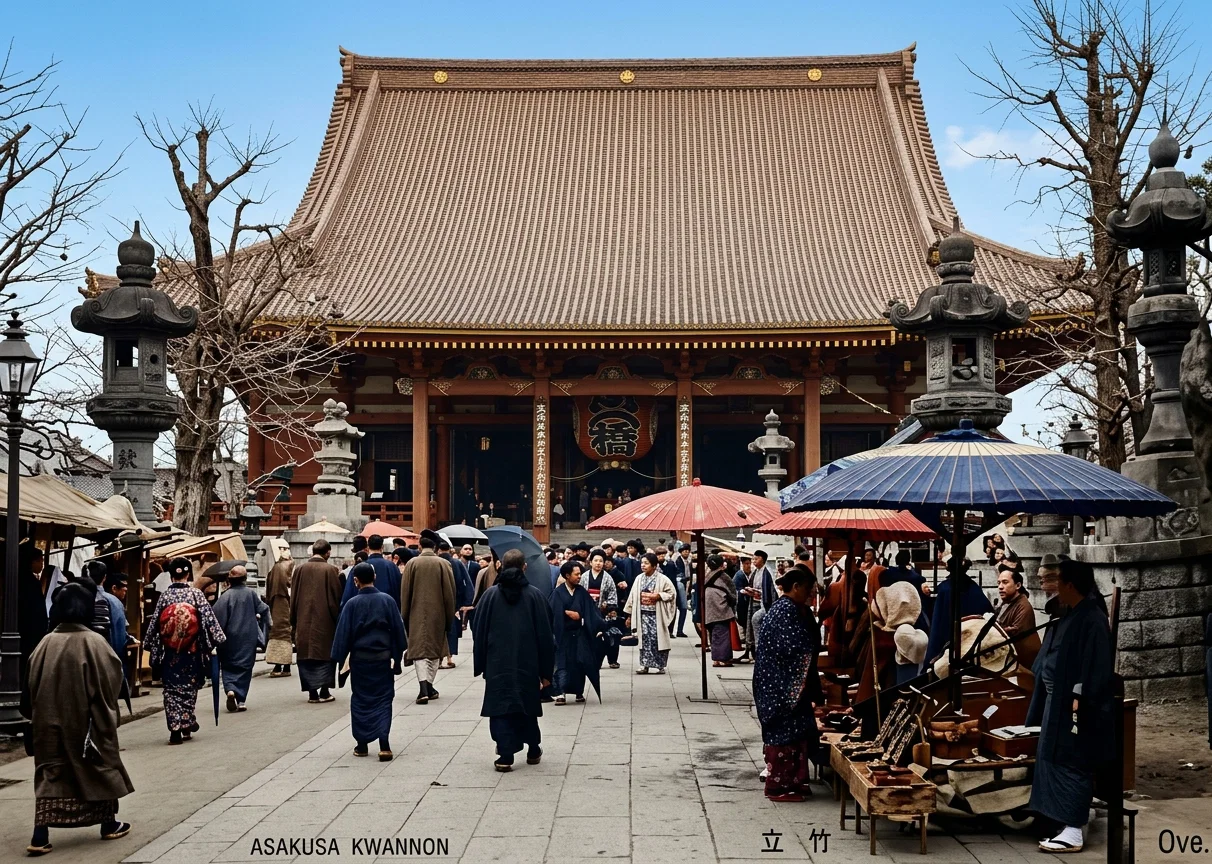
Buddhist Temple, Asakusa Park, Tokyo
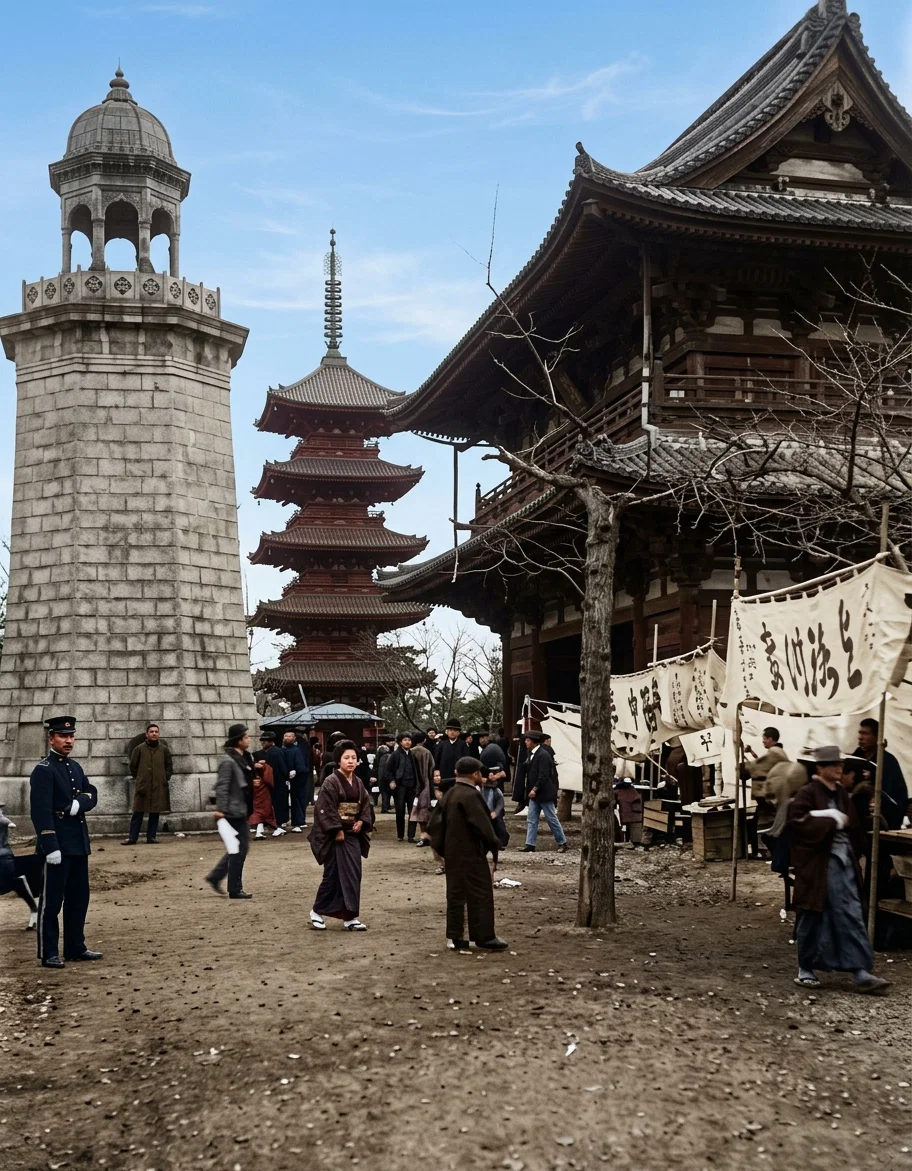
A Pagoda in Asakusa Park (Photo by F. E. Stafford)
Tokyo was known as Yedo until about a generation ago. And for fifteen generations, covering a period of nearly three hundred years, it was the seat of the military government of the Tokugawa Shogunate. For many hundred years the emperors of Japan lived in the seclusion of their palaces, while a military despotism ruled the country. The last of these military dynasties was founded by Tokugawa Ieyasu about the beginning of the seventeenth century, and continued till the beginning of the present emperor’s reign, in 1867, when the military government was overthrown, and the emperor restored to his place as the rightful ruler of the country. Soon after this the emperor removed his court from Kyoto, the old capital, to Yedo, which from that time began to be called Tokyo—East Capital—by way of distinction.
When Tokugawa Ieyasu chose Yedo on Shinagawa Bay as the seat of his government, it was but a small hill fortress surrounded by villages. He and his immediate successors greatly enlarged and strengthened the fortress, as may be seen at the present. The central fortress was located on the highest ground, and around this a very extensive system of canals or moats was constructed, in the form of an irregular spiral. The inner banks of these moats were walled up with stone to a considerable height, forming a stronghold well-nigh impregnable in those feudal times. Most of the old gateways still remain, tho some have given place to broad entrances better suited to present conditions. The outer moats have been filled in and the adjacent walls torn down, and the enclosed ground now forms an important part of the city. The accompanying view is a good representation of the handsome modern bridge spanning the inner moat, as one proceeds to the imperial palace. But only the privileged few are allowed to enter; and a cluster of black tiled roofs is all that the common observer can see of the palace buildings.
The Tokugawa Shogunate was a feudal form of government; for a feudal system almost identical with that which once prevailed in Europe, had grown up. As one means of keeping the feudal barons (daimyo) in subjection to the shogun, they were required to spend a part of each year at Yedo, with their retainers. To accommodate the samurai (warriors) during their sojourn at the shogun’s capital, long, narrow buildings with plastered walls and tiled roofs were built in certain parts of the city; and some of these remain to the present time.
The ordinary Japanese house is a rather frail structure, and so does not last many years. Hence there are no common buildings of any great antiquity in the city. But many of the Shinto and Buddhist temples are built substantially of immense timbers; and some of these have stood since the early history of the city. One of the oldest and most famous of these is the Buddhist temple in Asakusa Park. It is the main temple and headquarters of one of the Buddhist sects in Japan, and is visited by throngs of people on almost any pleasant day.
The population of Tokyo has been rapidly increasing during recent years, till it now numbers about one and one half millions. Yet it is said that during the palmy days of the old régime the city was fully as populous as at present. But it goes without saying that the Tokyo of to-day is a very different city from the Yedo of two hundred years ago. Some of the remarkable changes that Tokyo has undergone within a few years, will be mentioned in a later article.
F. W. FIELD.

Prayer Overcomes Doubt

If our doubts do not prevail so far as to make us leave off praying, our prayers will prevail so far as to make us leave off doubting.—Henry Hickman.

WANTED—A RIDER AGENT IN EACH TOWN

Notice the thick rubber tread
and district to ride and exhibit a sample Latest Model “Ranger” bicycle furnished by us. Our agents everywhere are making money fast. Write for full particulars and special offer at once.
NO MONEY REQUIRED until you receive and approve of your bicycle. We ship to anyone, anywhere in the U. S. without a cent deposit in advance, prepay freight, and allow TEN DAYS’ FREE TRIAL during which time you may ride the bicycle and put it to any test you wish. If you are then not perfectly satisfied or do not wish to keep the bicycle ship it back to us at our expense and you will not be out one cent.
FACTORY PRICES We furnish the highest grade of bicycles it is possible to make at one small profit above actual factory cost. You save $10 to $25 middlemen’s profits by buying direct of us and have the manufacturer’s guarantee behind your bicycle. DO NOT BUY a bicycle or a pair of tires from anyone at any price until you receive our catalogues and learn our unheard of factory prices and remarkable special offers to rider agents.
YOU WILL BE ASTONISHED when you receive our beautiful catalogue and study our superb models at the wonderfully low prices we can make you this year. We sell the highest grade bicycles for less money than any other factory. We are satisfied with $1.00 profit above factory cost.
BICYCLE DEALERS, you can sell our bicycles under your own name plate at double our prices. Orders filled the day received.
SECOND HAND BICYCLES. We do not regularly handle second hand bicycles, but usually have a number on hand taken in trade by our Chicago retail stores. These we clear out promptly at prices ranging from $3 to $8 or $10. Descriptive bargain lists mailed free.
COASTER-BRAKES, single wheels, imported roller chains and pedals, parts, repairs and equipment of all kinds at half the usual retail prices.

$8.50 HEDGETHORN PUNCTURE-PROOF SELF-HEALING TIRES A SAMPLE PAIR TO INTRODUCE, ONLY $4.80

The regular retail price of these tires is $8.50 per pair, but to introduce we will sell you a sample pair for $4.80 (cash with order $4.55).

NO MORE TROUBLE FROM PUNCTURES

NAILS, Tacks or Glass will not let the air out. Sixty thousand pairs sold last year. Over two hundred thousand pairs now in use.
DESCRIPTION: Made in all sizes. It is lively and easy riding, very durable and lined inside with a special quality of rubber, which never becomes porous and which closes up small punctures without allowing the air to escape. We have hundreds of letters from satisfied customers stating that their tires have only been pumped up once or twice in a whole season. They weigh no more than an ordinary tire, the puncture-resisting qualities being given by several layers of thin, specially prepared fabric on the tread. The regular price of these tires is $8.50 per pair, but for advertising purposes we are making a special factory price to the rider of only $4.80 per pair. All orders shipped same day letter is received. We ship C. O. D. on approval.
Notice the thick rubber tread “A” and puncture strips “B” and “D,” also rim strip “H” to prevent rim cutting. This tire will outlast any other make—SOFT, ELASTIC and EASY RIDING.
We will allow a cash discount of 5 per cent (thereby making the price $4.55 per pair) if you send FULL CASH WITH ORDER and enclose this advertisement. You run no risk in sending us an order as the tires may be returned at OUR expense if for any reason they are not satisfactory on examination. We are perfectly reliable and money sent to us is as safe as in a bank. If you order a pair of these tires, you will find that they will ride easier, run faster, wear better, last longer and look finer than any tire you have ever used or seen at any price. We know that you will be so well pleased that when you want a bicycle you will give us your order. We want you to send us a trial order at once, hence this remarkable tire offer.
IF YOU NEED TIRES Hedgethorn Puncture-Proof tires on approval and trial at the special introductory price quoted above; or write for our big Tire and Sundry Catalogue which describes and quotes all makes and kinds of tires at about half the usual prices.
DO NOT WAIT or buy any kind at any price until you know the new and wonderful offers we are making. It only costs a postal to learn everything. Write NOW.

J. L. MEAD CYCLE COMPANY, CHICAGO, ILL.

In India

AN item in our last issue from Brother George F. Enoch of India told how utterly impossible it was to meet the great needs of the Indian field; and in that little note he thanked the SIGNS OF THE TIMES and its readers for the gifts of books for native Indian libraries. We give in this department this week what has been received for that purpose. Any others who may desire to donate to this fund we are sure will be doing good work.

Among the Tamils

Just recently Brethren W. W. Miller and J. C. Little visited our Tamil mission in South India. They found it a great and needy field. Sister Doctor Shryock and her assistants were doing almost marvelous work. She has treated, with her three native helpers, over two thousand people monthly. Patients come from all around, and when they were asked if they believed that Miss Shryock could heal people, they answered that she could help them as the Lord helped her. They feel that the Lord sent her among them; and when asked who should receive the praise, they answered, “Both Miss Shryock and the Lord.” The medical work is carried on in a rented building. Those who had owned the building, did not desire to let it go; but one man who had had a splinter of iron taken out of his eye by one of our brethren, after medical men had refused to operate upon it, demanded the building, and said that if it were not furnished he would stir up the whole people of the town.

Call from Hindus

While here visiting these Tinnevelly Sabbath-keepers, a delegation of Hindus visited them. They pleaded that work might be done in their country some distance from there. They said: “We have one hundred and fifty children to send to your school, and now our hearts are inclined to turn from our idols; our minds are receptive, and we want to become Christians; but if we wait, we may lose our interest, and not feel the need of turning from our idols. Now God has moved us.” And yet the brethren were forced to tell them that they could not comply with the request at that time. All over the world there are hands and hearts reaching out to God and appealing to those who know the light and truth in Christ Jesus to send help. Buildings are needed in Tinnevelly in order that the workers may be properly housed, and the medical work, which is indeed an opening door, be placed in a right condition, and the health of the overburdened workers guarded.

Donations to Missions

We have not made much note of missions for a few months in the past; our make-up and matter seemed somewhat against it. We shall note from time to time the amounts sent in by our readers. Some do not wish their names to appear. In such case will they indicate this in the letter which contains the offering, whether the initials or some pseudonym. In case this is not indicated the name will be published, unless we know the donor objects. We are grateful to God for the following sums, all of which have been donated, without personal solicitation, from Jan. 1 to April 30, 1910:

CHINESE PRESS FUND

Donor Amount Donor Amount
Minnie Peterson $2.00 J. N. Loughborough 10.00
S. S. 50.00 T. and I. Bohlman 1.00
Alex Hinckley 15.00 C. and H. Stoneman .10
K. V. Walley 2.00 Renel Bohna 2.00
A. B. Saunders 20.00 Twila Zinn .05
Hattie Gifford 2.00 Grace E. Dederick 1.70
Mrs. J. Medill 5.00 Emma Tubbs 8.00
Minnie Olive .35 Mamie Elkins .25
W. B. Taylor 10.00 Ray Luther 1.00
Wm. Peake 5.00 Ray and Joy Sweany .20
Mrs. S. A. Joy 2.00 Mrs. D. G. Telfer 3.25
Geo. Benner 5.00 James Platt 13.00
Clifford Jennings 4.00 Grant and Eva Rohrer .50
W. A. Taylor 1.00 Sylvia Weaver .10
Mrs. J. Piper 1.00 Hazel Hawkins .40
Fannie Emory 1.00 Esther L. Stillman .10
S. J. Andrew 1.00 Robin Smith 1.00
Mrs. C. Steele 1.00 C. H. Wilkey 3.25
Walter Harper 5.00 Rosella Burgerson .25
J. H. Goodier 5.00 Clifford Jennings 3.75
H. Hodge 3.25 M. Christensen .40
C. A. Allen 2.25 Katie Farney .10
Carrie Allen 3.00 Horus Workes .10
B. K. Wilcox 5.00 Pearl Ritchey .10
$199.45

INDIA MISSION LIBRARY FUND

Donor Amount Donor Amount
Minnie Peterson $2.51 S. S. $25.00

KOREAN MISSION

JAPANESE MISSION

Donor Amount Donor Amount
S. S. $15.00 S. S. $10.00

A Call to Pua, Chili

Brother F. W. Bishop, formerly of California, now in Pua, Chili, writes that the climate is fine and healthful, much like California. If any desire to move there, and so hold up the light of the truth, they can correspond with the above.

Wanted

(Clean copies, well wrapped, carriage paid.)
A continuous supply of the SIGNS OF THE TIMES, Monthly Signs, Watchman, Youth’s Instructor, and Our Little Friend till Thanksgiving. Address Mrs. Annie Young, 12th and Bluff Sts., Dubuque, Iowa.
A continuous supply of the SIGNS OF THE TIMES, Watchman, and other magazines and tracts, to be used in ship mission work, sent post-paid to Charles Bennett, 733 Dodson St., San Pedro, Cal.
For missionary purposes, copies of SIGNS OF THE TIMES, Watchman, and Life and Health, to Mrs. James F. Woods, 322 S. Detroit St., Warsaw, Ind.
For missionary purposes, copies of SIGNS OF THE TIMES, Protestant Magazine, tracts, or Bibles, to Hubert Weil, Horne Dye Works, 156 East 8th St., Riverside, Cal.

Improved Steam Canner

Have just completed a High Pressure Steam Canner for home and market canning that cans everything so it keeps, without preservatives, in any climate. It is made of boiler steel of sufficient strength to stand more pressure than is ever required. The Process Kettle will last a life time with ordinary care. Requires about one fourth the time for cooking that is required by the hot-water canners or on a stove, therefore is a great time and fuel saver. Burns coal, wood, etc.
The smallest size can be used on a stove, and will cook a meal in a few minutes. This canner is very accurate; is provided with Steam Gage, Safety Valve, and Thermometer. Glass or tin cans can be used. Canning is a very interesting and profitable industry. You can realize more from a small piece of ground than the ordinary farmer does from a large farm. This canner is accurate; any one can do the finest canning from the beginning. There is a ready market for first-class canned goods everywhere. You can make the finest protose or meat substitute, for about six cents per pound, and fine canned beans. Fruits and vegetables canned with this High Pressure Steam Canner become very tender, but not mushy.
Corn is one of the hardest things to can. The large canning factories use 245 degrees F. for canning corn. With the many canners on the market, or on a stove, you can get only 212 degrees F., but with this canner you can get 255 degrees or more.
It is the only complete High Pressure Steam Canner for home and market canning, on the market. Capacity of from 400 to 20,000 cans per day.
This supplies a long-looked-for article.
This canner is fully guaranteed, and in simplicity, durability, and practical working, surpasses them all. Complete receipts and instructions with each canner.
The price is within the reach of all. Send for a circular. Agents wanted everywhere.
JETHRO KLOSS, M.E., St. Peter, Minn.

Bibles

Bibles.—Remember that we are headquarters for anything in the Bible line. We shall be pleased to send you our catalog of Bible selections on application. Pacific Press, Mountain View, Cal.

The Wasteful Unpaid-Letter System

The New York “World” points out one of the inconsistencies of our present postal arrangements in the sending of letters. Thirty years ago, if a letter was mailed without postage it would be delivered, and two cents would be collected from the recipient. Now if a letter is mailed without postage in New Orleans, for instance, and directed to New York, a clerk in New Orleans forwards to the person addressed in New York a card notifying him that a letter without stamp awaits him in that office and will be forwarded to him if he will send two cents prepaid, and that if the two cents are in the form of a postage stamp it must not be attached to the paper. This involves the writing of a letter, with a loose two cent stamp inside, and of course postage of two cents on the envelope. At the cost of four cents, considerable labor, and a delay of days the letter finally reaches its destination. The paper does not use too harsh terms when it declares that such service is “at once wasteful, exorbitant, and inefficient.”

Human Brutality

In a recent brutal so-called boxing bout in San Francisco a young man of twenty was killed by the knock-out blow. He was called an estimable young man. His parents were at the ring side and his mother bet on his success. Among the other things we are told was that he offered prayer before he entered the ring.
Another big bruising mill is listed to come off the Fourth of July, in which millions of dollars will be expended. The ministers and some of the other people in the state are tremendously exercised over the matter, and demand that it shall be stopped. These exhibitions are indeed pitiable for Christian civilization in the twentieth century. There is no question as to that; but a San Francisco daily paper well remarks that our civilization is but a thin veneer after all, and the real brute is dominant in the man. We certainly would hold up both hands to have all such exhibitions stopped and stopped forever; but why should it be confined to what are technically called pugilistic circles, when the same thing is permitted in football? We can not see why the successful bruiser should be arrested and prosecuted any more than should the successful football player who slugs and bruises and kills some of his opponents. There are more killed every year in football than in pugilism. This one thing is true in pugilism, too: the men are trained for it, and everything is carried on in a fair and sportsmanlike way, but in football we are told that men are slugged and punched and injured and “done up,” especially if they are good players, to put them out of the game, and it is done too when the men are not expecting it and are not defending themselves from such treatment.
These things may all make for “manliness,” but it is the manliness of brutality. Thank God there is more of a man than the brute force which he is able to display. The whole man takes in mind and soul. There are many men who could not stand before one of these even light-weight pugilists for a moment, but who have great hearts and souls which are molding the world. Parents ought to look on the two pictures and choose as to which of these two outcomes they prefer for their children. They would not be at the ring side betting or cheering, but praying.

Three Important Series

Are you reading the three important series now running in this journal? They are worth reading. Out of Babylon to Zion, Higher Criticism, and the Bible teaching regarding the Holy Spirit, are important topics. You ought to read them and pass them on to others.

Articles on Japan

We begin in this issue a series of articles on Japan by the superintendent of the Japanese mission, Brother F. W. Field. We hope they will be carefully read. With the article printed from Mr. F. E. Stafford in our last issue there came many excellent photographs for which we are very grateful. We could use but a few of them with his article, but we are glad to use two more in this issue with the article by Mr. Field. We will use others later on.

Railroad Ends Hiring Women Stenographers

The Baltimore and Ohio Road will employ no more women stenographers save those who are now connected with it. They declare that on the average a young woman stenographer does 30 per cent less work than a young man in the same position, and the same in other branches of work. They will retain those who are in their service until they desire to depart, but in the future only male stenographers will be employed.

What the Sabbath Involves

“What the Sabbath Involves” is the title of a little leaflet which ought to be circulated by the millions. It shows clearly that there is involved in this world-wide Sabbath question the veracity and infallibility of the Bible, the authority of the Bible against that of tradition, the existence of Protestantism, and the future of civil government. We believe that every candid person who reads the little leaflet will see this. It is only a half-penny leaflet, only 50 cents for a hundred of them. It is Apples of Gold Library, No. 91.

Questions on the Sabbath

We do not know how many questions come to us such as the following: “How do we know that the week has come down to us correctly from Genesis 1?”
“Was the Sabbath observed before it was given to the Jews?”
“Did other nations know aught of the Sabbath?”
“Why was the Sabbath given the Jews?”
“What change took place when Christ came?”
“Are we now ‘under the law’?”
“What does ‘under the law’ mean?”
“How did the day come to be changed?”
Many questions besides these are asked, which are all answered in that little pamphlet, “The Lord’s Day the Test of the Ages,” the price of which is only ten cents. Bible Students’ Library, No. 134. Address this office.

The Loss from Storm.

The Woman's National Daily of April 26 gives an estimate of the loss to the fruit crop and other crops resulting from the April storm which recently swept the western, southern, and central parts of the country. The loss in Illinois is estimated at six million dollars; Kansas and Indiana, each five millions; Iowa, eight millions; Ohio and Tennessee, each one million; Wisconsin, three millions; Michigan, ten millions; Nebraska and the South, each two millions; the Northwest, seven millions; making a total of fifty million dollars. The fruit crops suffered most, and in many sections will be a total loss. One strange thing about the weather was that while Memphis, Tennessee, was shivering in 30 degrees of temperature, Edmonton, Calgary, and Medicine Hat, away up North in Canada, were enjoying a temperature ranging from 82 to 86 degrees. Later reports seem to indicate that the loss in the South is less than was at first reported.

Save Them from Failure.

In a circular sent out from the California Educational Board by Professor Hyatt, superintendent of public instruction, there is a good earnest word to teachers to “save children from failure.” He tells us that it is one of the most sorrowful signs of civilized life to see a child fail in school at the end of a year; that it is discouraging. He falls out of the procession; forms a habit of failing, and fails through all the years of the future; and then he declares that the wise old teachers are those who would not let their pupils fail, but gave special attention to the slow boys. It is a good word to carry out in the spiritual life as well as the educational; and yet it is a sad thing that nearly always it is the bright ones who get encouragement, and not those who are slower to learn.

The Earth's Own Light

Prof. Garrett P. Serviss, the astronomer, tells us in the Examiner of March 30 that recent investigations made by L. Yntema in Germany have determined that the amount of light in the night sky which the earth itself furnishes is in some places from 7 to 15 times as much as comes from all the stars. This light varies not only from night to night, but at different hours of the same night. Its source is not known. It shows however that there is a luminosity in the earth itself. It is thought that if the earth were seen from a distance it would look like a huge comet. Around this fact of the light there cluster some very interesting spiritual truths.

A Characterization of Mr. Roosevelt.

—The London Times speaks of our Ex-President as follows: “Mr. Roosevelt is the most popular and perhaps still the most powerful statesman whom the greatest, the most progressive, and the most enlightened of the independent states of the New World has produced.” He has played a very great part in shaping the policy, and, what is of more moment to the Vatican, in shaping the ideals of the mighty nation whose Chief Magistrate he was for seven eventful years.” Many Americans will hardly place him on this high pedestal.

A Testimony to the Reality of Spiritism—

Prof. Edgar Lucien Larkin, in the Examiner of April 15, 1910, declares that the levitations and all other astounding mysteries so long observed by William Crookes [in Spiritistic circles] were positive facts. . . . His discoveries in these esoteric lines were literally true.
JESUS TEACHING HUMILITY

You have reached the end of this edition.

Signs of the Times · May 17, 1910