“As the storm approaches, a large class who have professed faith in the third angel’s message, but have not been sanctified through obedience to the truth, abandon their position, and join the ranks of the opposition.”—“Great Controversy,” page 608.
Those who are too independent to work with the organized body will be sifted out. When the sifting time is past, it is said, “They moved in exact order, like a company of soldiers.”—“Early Writings,” page 132. But, like Peter, while the sifting process is going on, some will complain and leave the platform, and afterwards with humble look again step back upon it. See page 121. But the places of those shaken out will immediately be filled by others. Thousands will then accept the truth, the message will finish its mission speedily, victorious through faith, and the work will close triumphantly.
Who Will Endure the Sifting?
It is the praying, believing ones who surrender themselves and their all to God, who alone will stand the test of the last-day sifting time. “When the testing time shall come, those who have made God’s Word their rule of life will be revealed. In summer there is no noticeable difference between evergreens and other trees; but when the blasts of winter come, the evergreens remain unchanged, while the other trees are stripped of their foliage. So the false-hearted professor may not now be distinguished from the real Christian, but the time is just upon us when the difference will be apparent. Let opposition arise, let bigotry and intolerance again bear sway, let persecution be kindled, and the half-hearted and hypocritical will waver and yield the faith; but the true Christian will stand firm as a rock, his faith stronger, his hope brighter, than in days of prosperity.”—“Great Controversy,” page 602. “I saw a covering that God was drawing over his people to protect them in the time of trouble; and every soul that was decided on the truth, and was pure in heart, was to be covered with the covering of the Almighty.”—“Early Writings,” part I, page 35.
While from one viewpoint the sifting time may be looked upon as a time of loss, it is in fact a time of the greatest gain to the cause of God. The unbelieving, the half-hearted, and the hypocritical add numbers to the ranks, but they are always a source of great weakness. Their counsels, their proposals, their cautions, are a hindrance instead of a help. When this class was shaken out in the days of Joshua and in the days of the early church, and the counsels of men of faith prevailed, the cause moved forward by leaps and bounds, in the power and demonstration of the Holy Spirit. So now “if pride and selfishness were laid aside, five minutes would remove most difficulties.” “One who has this great work done for him will not feel that he is rich and increased in goods and has need of nothing.” Righteousness by faith is the foundation that will stand secure during the sifting time. It is the covering that is now being drawn over the people of God to prepare them for the hour of trial that is just before us. To be indifferent now, and to continue in self-indulgences of any kind is to fail in the hour of crisis during the sifting time.
“If the enemy can get the desponding to take their eyes off from Jesus, and look to themselves, and dwell upon their own unworthiness, instead of dwelling upon the worthiness of Jesus, his love, his merits, and his great mercy, he will get away their shield of faith, and gain his object, and they will be exposed to his fiery temptations. The weak should therefore look to Jesus, and believing in him, they can then exercise faith.”—Id., page 63. R. C. PORTER.
The Destiny of the Wicked
By G. B. Thompson
(Continued)
Bible Teaching Concerning the Punishment of the Wicked
The Scriptures clearly show that the lost are not now being punished. There is a time of judgment in which every case will be investigated. Paul preached of a “judgment to come.” Acts 24:25. The judgment is the last work of Christ in the heavenly sanctuary before he lays aside his priestly garments, and closes his work as mediator for sinners. It is not reasonable then that the Lord would send the wicked into the lake of fire prepared for the devil and his angels, before they have been judged. To do this would be similar to sending a man suspected of some crime to the penitentiary, leaving him there for a number of years, and then bringing him before a legal tribunal and examining the evidence to see if he were guilty and merited the punishment which he had received. The just God does not deal with his creatures in this way. The judgment precedes the reward. The punishment in the lake of fire is but the execution of the judgment written.
The apostle Peter states this same fact when he says, “The Lord knoweth how to deliver the godly out of temptations, and to reserve the unjust unto the day of judgment to be punished.” 2 Peter 2:9. They are not now receiving their punishment, but are reserved until the judgment. This language is very clear. Webster defines “reserve,” “to keep back; to retain or hold over to a future time or place.” The apostle says further: “But the heavens and the earth, which are now, by the same word are kept in store, reserved unto fire against the day of judgment and perdition of ungodly men.” 2 Peter 3:7. In addition to the finally incorrigible, we are told that “the angels which kept not their first estate, but left their own habitations, he hath reserved in everlasting chains under darkness unto the judgment of the great day.” Jude 6. So then neither Satan, fallen angels, nor sinners are now receiving their punishment in the lake of fire, but are reserved until the close of the judgment, when each will “receive the things done in his body, according to that he hath done, whether it be good or bad.” 2 Cor. 5:10.
Job also bears similar testimony on this point. He says, “Have ye not asked them that go by the way? and do ye not know their tokens, that the wicked is reserved to the day of destruction? they shall be brought forth to the day of wrath.” Job 21:29, 30. They are not reserved in purgatory, but in the grave. From this prison house of the enemy they will be “brought forth” at the second resurrection, to receive the punishment which the just God in the judgment has decreed against sin.
In Matt. 25:31-46 is given a view of the judgment, and the placing of the sheep, or righteous, on the right hand, and the goats, or wicked, on the left hand. It is at this time, not before, that the wicked “go away into everlasting punishment.” It seems unnecessary to introduce further evidence to show that the lost are not now receiving their reward, as the Scriptures we have studied are conclusive on this point.
Place Where the Wicked Will Receive Their Reward
We are not left in doubt and uncertainty as to the place where the lost will be punished. In earthly governments the transgressors of the law are tried, sentenced, and punished where they committed their evil deeds. It is so here. Thus we read, “Behold, the righteous shall be recompensed in the earth: much more the wicked and the sinner.” Prov. 11:31. The apostle Peter in the scriptures already quoted bears decisive testimony on this same point: “But the heavens and the earth, which are now, by the same word are kept in store, reserved unto fire against the day of judgment and perdition of ungodly men.” 2 Peter 3:7. The apostle here tells us that the executive judgment is the time, and the earth is the place, for the perdition, or destruction, of the ungodly.
This fire which consumes the lost will burn and purify the earth, so that the place where sin has had its throne and kingdom becomes the home of the people of God, thus leaving no place for sinners, or an eternal, burning hell.
“But the day of the Lord will come as a thief in the night; in the which the heavens shall pass away with a great12noise, and the elements shall melt with fervent heat, the earth also and the works that are therein shall be burned up. Seeing then that all these things shall be dissolved, what manner of persons ought ye to be in all holy conversation and godliness, looking for and hasting unto the coming of the day of God, wherein the heavens being on fire shall be dissolved, and the elements shall melt with fervent heat? Nevertheless we, according to his promise, look for new heavens and a new earth, wherein dwelleth righteousness.” 2 Peter 3:10-13.
This will indeed be “the day of the Lord’s vengeance, and the year of recompenses for the controversy of Zion,” when “the streams thereof shall be turned into pitch, and the dust thereof into brimstone, and the land thereof shall become burning pitch.” Isa. 34:8, 9. Everything that fire can consume will be burned up. In that awful hour when the Lord takes vengeance on them that know him not, the heavens will be in flames, the whole earth one vast lake of liquid fire; the rocks will melt, the mountains run down like wax, and the whole earth be devoured by the fire of his jealousy. “The mountains quake at him, and the hills melt, and the earth is burned at his presence, yea, the world, and all that dwell therein.” Nahum 1:5.
The revelator beheld in vision the awful scene here described. He saw the wicked come forth in the second resurrection, a countless throng, numberless as the sand upon the seashore, to receive their reward. He saw them go “up on the breadth of the earth,” and compass “the camp of the saints about, and the beloved city; and fire came down from God out of heaven, and devoured them.” Rev. 20:9. This text, in harmony with the others referred to, shows that the ungodly are on the earth when the fire of God’s indignation is kindled, and they are destroyed. This earth, which they have defiled, becomes the place of their punishment. We feel that this point is clear beyond all doubt to those who will allow the Word of God to settle the question. This constitutes unimpeachable testimony that the lost are not now receiving their reward.
G. B. Thompson.
(To be continued)
Take These Things Hence
An article in a recent number of the Evangelical contrasts the value in gospel work of music rendered by non-Christian choirs compared with the preaching of the gospel, etc. It declares:—
The custom of taking so much precious time for the making of announcements concerning trivial matters is positively ruinous to worship. The pulpit is not a bulletin board to advertise oyster suppers and catchpenny shows. Take these things hence! Our Father’s house is a house of worship and of prayer. Give room and time for the preaching of the gospel. No music draws like that. No ritual attracts like that. The hope of the world lies here, in the preaching of the everlasting gospel of the Son of God.
We need to guard our own church services that too much time is not devoted to the making of nonessential announcements. Many times nearly half an hour is consumed in the making of announcements concerning various things connected directly or indirectly with the affairs of the church. Of course it is necessary to bring many things pertaining to church affairs before the congregation for their instruction and to secure their cooperation, but we should be careful that questions which have no direct or important bearing on the interests of the church shall not intrude themselves into the services on Sabbath morning.
Armed Peace a Misnomer
MANY of the peace advocates of late have sought to harmonize the advocacy of peace measures with the increasing armaments for warfare on the plea that the possession of standing armies and great navies was an effectual safeguard to peace among the nations. Speaking of this, the editor of the Toronto Globe, in a recent number of that paper, makes the following pertinent remarks:—
For one thing, this: “Armed peace” is forever disproved and doomed as an instrument of international safety. There can be no such thing as “armed” peace. It contradicts itself. Peace that must arm is no peace. In spirit and in motive and in all the moral qualities of conduct it is war. All it lacks is opportunity. Give it occasion, and the vulgar brute-force war features are made manifest.
For a generation all these nations have been increasing their armaments, calling it “armed peace,” until the armor plate trusts and war syndicates forced the hands of the despots, and war became inevitable. With brute force as their ultimate appeal, when what they call “justice” and “honor” were involved, there was nothing for it but war. The fallacy of the armed-peace theory, the perfidy of the selfish interests that urge it, and the disastrous consequences to the nations that follow it, are now being made plain to all the world. As well allow all citizens to carry guns in their belts and knives in their boots in the neighborhood of individuals and call it personal safety as allow all nations in the new world-neighborhood to base their peace on the size of their armies, the power of their navies, and the deadliness of their bomb-throwing air craft.
That the possession of these immense armaments for war has proved no safeguard has been amply demonstrated during the last few weeks. The martial atmosphere which the nations of the Old World have breathed for years, the brilliant display of their battleships, and the martial tread of their training armies have fostered a spirit for war. The very fact that the nations possessed these equipments made them anxious to test their efficiency. They have felt that in the burdensome taxation which a preparedness for war imposed, conflict was cheaper than armed peace. It would be quite as sensible to recommend every man in the community to carry with him a loaded revolver, ready to repel instant attack from an enemy, as a means of promoting the peace and good will of the community, as the plan which has been adopted among the nations of securing armed peace. This term is a misnomer. The doctrine is a fallacious evil, out of which has grown much of the horror of the present conflict.
Sentenced to Practice Religion
By Editor
It has frequently been declared by those who favor religious legislation in this country that there need be no fear that any one will be forced to attend church as people were in the early days. While there is not at present any law making church attendance obligatory, yet we have noted a number of instances where persons have been compelled to attend church. The latest that has come to our attention is reported from Wabash, Ind. The report reads:—
“Eleven days in jail or fifty-two Sundays in church,” said Police Judge Wilson after John Yeater had pleaded guilty to the charge of intoxication. The prisoner declared the church to be his preference. Then the court made inquiries and found that Yeater was not affiliated with any religious denomination. Consequently he was compelled to choose a church where he is to attend services for the next year. The pastor of this church has promised to report to the court the first Sunday that Yeater fails to show up.
The idea of turning the church into a penitentiary, a place of punishment for criminals, is wholly repugnant to the idea of religion, to the purpose of our Lord in establishing the church, and to the fundamental principle of the gospel. They who come to Christ must come of their own free will, by invitation and not by force. The only time when Jesus used force in connection with the services of his house was when he cleansed the temple of those who were defiling it. Then it was to drive men out of his temple and not into it. Such an order from a judge as that mentioned above is a travesty on law, on justice, and on religion. If the judicial branch of our government can do that, how long will it be before the legislative branch will follow the example?
Public Health Service Rejects Friedmann Tuberculosis Cure
AFTER an investigation lasting over a year, the United States Public Health Service has rendered a decision discrediting the Friedmann cure for tuberculosis which attracted so much attention in 1913.
In Northwestern Rhodesia
By W. B. White
W. B. WHITE
I RECENTLY had the privilege, in company with Elder H. J. Edmed and Dr. W. C. Dunscombe, of visiting our mission station in Northwestern Rhodesia, superintended by Elder W. H. Anderson. This station is located on a five-thousand-acre farm, eight miles from Monze Siding and about two hundred miles north of Victoria Falls, on the Zambesi River. The country about the mission farm is gently rolling, with good soil and plenty of wood and water, things greatly to be prized in a new and undeveloped country. As we looked over the mission farm, with its five thousand acres of splendid pasture land, its wonderful and never-failing spring, and the seventy-five acres of fertile black soil about it, with plenty of wood for future needs, we quickly came to the conclusion that as far as a farm is concerned, Brother Anderson made no mistake in selecting this land.
The farm cost the General Conference eighteen cents an acre, but not long ago Brother Anderson was offered $4,500 for the property, which indicates something of the rise in real estate in this region.
Savages of village near our Batonga Mission. These are as they appear in their kraals in their heathenism.
Natives at home. Notice old man with long pipe resting on a stool made from solid piece of wood. Also woman at left churning by rolling calabash across her lap.
We should not judge that the native14population in the immediate vicinity of the mission was very dense, though there are a few native villages near by. These we visited, and found the people for the most part living in the dense darkness of heathenism, very near to nature. Advocates of the simple life would find it here to perfection. We wish the readers of the REVIEW could take a peep into one of these native villages, which is untouched by gospel and educational influences. It is a sight long to be remembered. We shall not attempt to describe it here, but only say that in the matter of living, there is not much distinction made between the native and his goats, hens, dogs, and pigs. All seem to have the inalienable right to occupy the same room, which right they exercise to the fullest extent. Dirt and filth are everywhere, the clothing worn never has seen a washtub, many of the children are stark naked, but little clothing is worn by the older ones, and their way of doing things is most primitive. What a contrast these heathen villages present to the villages of our Christian believers on the Malamulo farm in Nyasaland, where, under the Christian influence of our school and church and the persuasive and directing labor of Miss Edie, the natives keep themselves comparatively clean, yards are nicely swept, and lawns and flower beds grace the front yards. Surely this is a needy people, who never have had the privileges we have enjoyed, who never have had the light that has been shining upon us; but we are sure that many in the homeland are receiving such an infilling of the love of God that they will be willing to come to this dark land, to live, labor, and die if need be, that some of Africa’s sons and daughters may find a place in the kingdom of God.
In some respects this station has had quite a struggle to live and do the work for which it was established. It is well located, and the natives in Batongaland need what we have to give them; but so many of our white workers who have come to this place have suffered with malaria that it has seriously retarded the work of extension, even though open doors were on every side. Surely courage and faith have been in the hearts of Brother and Sister Anderson or they long ago would have become discouraged. The decisions of modern research on the question of malaria are practically unanimous that it is caused by the bite of the mosquito, and is carried in no other way. So it seemed to us that the best thing to do was to destroy at once the breeding places of this insect about the station, and especially near the houses of the missionaries. In the council held at this time, it was decided to clear away the tropical jungle about the great spring, which affords an excellent breeding place for the mosquito, and keep this ground under cultivation, and, as soon as possible, to tile and cover the open watercourses; and, further, that the grass land about the homes of the workers be broken up and cultivated for at least five hundred yards from the houses, and that all trees on this tract be cut down; also that the porches be screened, and a screen porch be placed in front of the schoolhouse where the night school is held. We presume this work is now in progress, and we trust that the results may be beneficial. The school is not large, numbering about twenty-two, but there seems to be a good interest, and we look for a larger attendance next year.
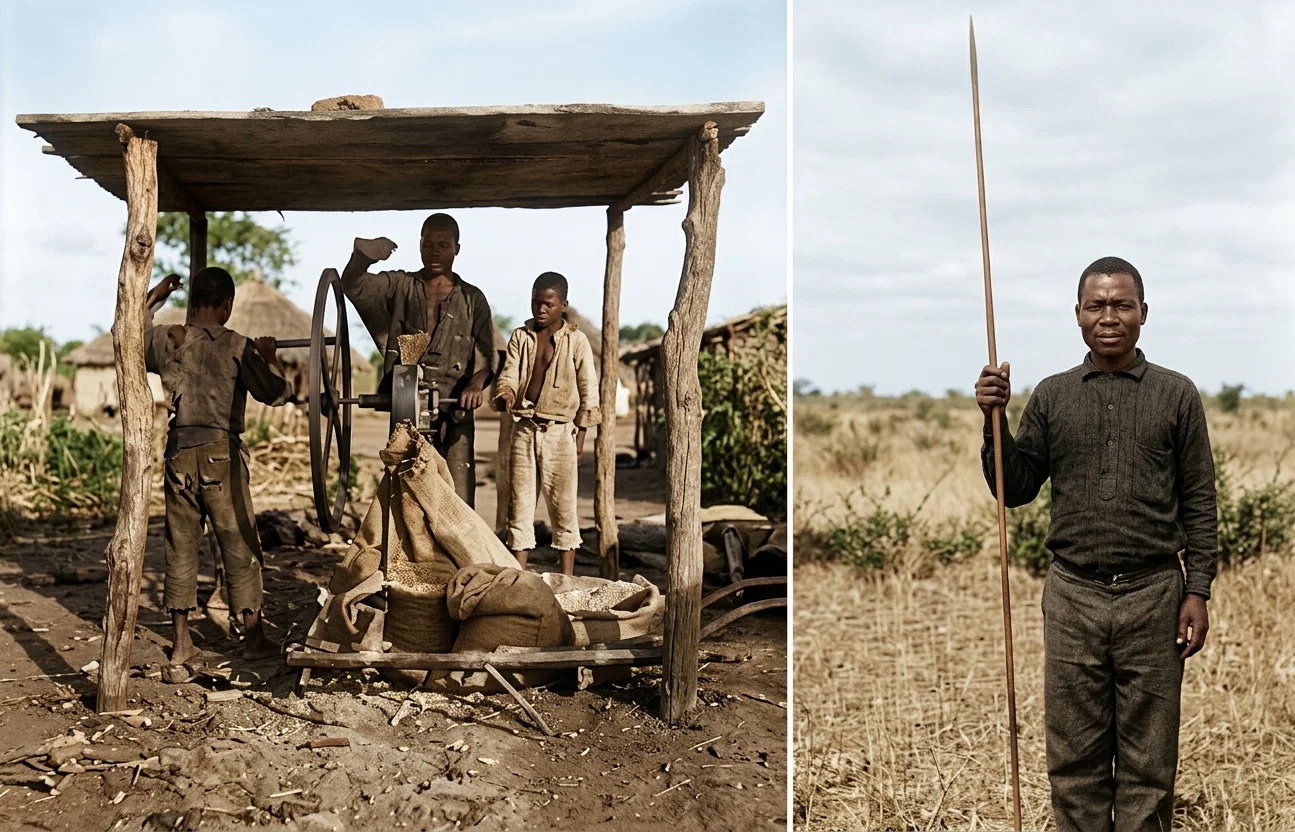
Batonga boys at work grinding corn. From this meal the staple article of food is made. Native teacher in charge of out-school where lions stampeded the cattle.
The mission has a herd of fine cattle, which is increasing each year and is not troubled much with stock diseases, though occasionally there is a loss. The night we reached the station, two lions broke into the cattle yard at one of the outstations about forty miles away, stampeded the cattle, causing them to break out and scatter. In the mêlée an ox and a cow were caught, killed, and partially eaten. A native, armed only with a spear, was in charge of the station; so the beasts had about their own way. So many wild animals prowl about at night that it seems almost impossible to raise fowls, as they are soon captured by these pests.
We spent a week at this station, and thoroughly enjoyed every moment. Several council meetings were held, Bible readings given, and the surrounding villages visited. On the Sabbath the schoolhouse was fairly well filled with people from the neighboring kraals, and a strange crowd it was that gathered that day. It certainly surpassed anything I had ever seen. An old chief of the neighborhood was present and occupied the front seat. I tried to tell the people of the better land than this, and that soon, if faithful, we shall go there; but I fear the sermon did not do much good, for after the meeting I learned that some weeks before this the native commissioner had visited this people in their villages and told them that before long they would have to move to a reservation which was being prepared for them, assuring them that it was a better land than the one they were living in. But the natives do not want to go; so when I mentioned the better land and told them that all the good people would soon be there, they came at once to the conclusion that I was working hand in hand with the government for their removal, and of course did not like the idea. After the meeting was over, the old chief said he did not want to go to the better land; the rest could go if they wished, but he wanted to stay where he was.
The bringing of this people out of their heathenism and superstition and into harmony with the divine will is certainly a great work, and can be accomplished only by the mighty power of God. Surely the workers who are called to labor in these frontier fields need the earnest prayers of the church in their behalf. That God is to work a great work in Africa we have not the least doubt, and we are glad we can have a part in it.
Entering Manchuria
By Bernhard Petersen
BERNHARD PETERSEN
While the great nations of Europe today are engaged in a terrible war, which has even reached us in Asia, we are glad that we can be in a nobler warfare; namely, that of carrying the glad tidings of a soon-coming Saviour to a dying world. The Lord's work is ever onward, and even in these troublous times we are glad that we can open up work in a new mission field.
October 7 we left our home in Shanghai, which it had been our privilege to share with Elder and Sister Porter during the past year. While we were sorry to leave our comfortable and happy home, still, on the other hand, we were glad that the time had come when we, together with Brother and Sister Grundset, could proceed to our appointed field of labor. We are only pilgrims and strangers in this world; so meeting and parting, settling and moving, are just a part of the lot that we as missionaries must share here until the time comes when we are privileged to be citizens of the eternal kingdom.
The last Monday evening at Shanghai will often come into our minds as a pleasant occasion. As Brother Allum and family and Brother Warren and family were to leave for Szechuan only a week later, the sisters had arranged a farewell reception for us all. One could hardly realize that the large room above the press could have been transformed into such an attractive parlor as we saw that evening. Brother Stafford and Brother and Sister Roberts furnished us with some fine music, after which Elder Porter gave an appropriate missionary talk with reference to Christ's method of sending out the twelve and also the seventy. A few remarks were made by the brethren leaving, after which several took part in prayer. Before parting, the good old missionary hymn, “From Greenland's icy mountains,” was sung by all. Our hearts were filled with joy and appreciation for the efforts put forth in providing such a profitable social evening.
Our trip on the “Kobe Maru” was not so pleasant or comfortable as we had hoped, for the sea was rather high; still we felt very grateful for a safe passage, and were glad to catch the first sight of land the morning of the ninth. It was about eleven o'clock before we could disembark. This made us too late for the Mukden morning train, so it became necessary for us to spend the day in Dairen. We were favorably impressed with what we saw of the city. It reminded us more of the homeland than any city we had seen since leaving America.
A BATONGA FISHING GIRL
The basket is drawn through the water.
A fine specimen of feminine strength.
It is situated at the southern end of the Liao-tung Peninsula. Only a few years ago it was a small fishing village. But it was occupied by the Russians in 1898, after the convention between Russia and China, and with remarkable push and energy the Russians undertook to construct a modern commercial port. The building of houses and the laying out of streets and waterworks were steadily pushed forward until the outbreak of the Russo-Japanese War put a sudden stop to these undertakings. In 1905 the lease of territory was transferred to Japan, and the Japanese went forward with the improvements which the Russians had begun.
We boarded the train for Mukden at 8 P. M. It being late, we did not have the opportunity of seeing the country as we should have been able to do had we left on the morning train. But the next morning we awoke early enough to realize that we were in a country where farming was carried on on a larger scale than we hitherto had seen in China. There was quite a marked difference in the climate, it being colder, and the air considerably lighter.
Our train pulled in at Mukden at 8 A. M. the following morning, where we were met by Elder C. L. Butterfield, who had spent several days in this city in search of a house for us. It was no easy matter to find a dwelling, as there are only a few foreign houses, and they are in the Japanese part of the city, three miles distant from the Chinese part.
After some hard searching, we were able to obtain a small compound at a reasonable price, just outside the inner wall. There are two houses, furnishing sufficient room for a chapel for the present. Looking at the houses from the outside, they are rather neat and of a semiforeign style; but stepping inside, one can see at once that they are Chinese. We are occupying one of the rooms of the building while alterations are being made.
This compound seems to be the most suitable at present, and as it is the only one that could be obtained here, we feel thankful that the Lord reserved it for the beginning of the Manchurian work. The owner is a Chinese official, and from the first he has manifested great interest in us.
Our first impressions of the country and people are very favorable. The people in general are larger of stature, more open-faced, and more quiet in their habits than the Chinese we have seen from other provinces. They seem to be ready for the last message. We were surprised to find a large share of them forsaking their temples. We found the American consul living in one of these temples, which had been transformed into a dwelling. The British-American Tobacco Company also occupies one. The secretary of the consul suggested another temple for our location, but it being too far away and the expense of alteration too heavy, we did not consider it.
We have a great work before us in giving this message to the many millions of unwarned Manchuria. As we take up this work, we are of good courage, and ask our brethren and sisters kindly to remember us in their prayers.
Our Outschool Teacher
By Mary E. Ellingworth
MARY E. ELLINGWORTH
CONSIDERING his usefulness in our mission work, no one deserves more of our sympathy and care than the village-school teacher in the outstations. He is patient, plodding, and plucky. He often has to stand alone in the fight against the heathen customs which so degrade the village life, and to which the women especially cling tenaciously; and it is the old women who rule the village to a very large extent. Such a teacher has responsibility thrust upon him which might well appall a trained European teacher, and yet we, with our characteristic optimism, expect him to be cheerful through all, and to be ever smiling and hustling when we visit him for inspection.
Consider him! He has contrived to acquire, maybe at intervals, a little learning, and then for want of trained help he is sent out to fill a call. He teaches three or five hours a day, five days a week, sometimes in schools five miles apart. Then on pay day he receives with eager fingers his salary of from four shillings to ten shillings a month. Some little additional inducement he has in the yearly two-month acting-teachers’ course, given under European supervision at the main station school.
Because of the scarcity of trained native teachers, you will find, even here at the station, one hurrying through grade three so that he may be prepared to teach his more ignorant friend in grade two. One is reminded of the village tenor who, when the vicar’s daughter complained to him about the want of harmony in the choir singing, retorted, “What can you expect when I have to hurry through my tenor so that I may go back and help the trebles?”
Here is a typical village school, the average attendance of which is only fifty-seven per cent of the roll. The teacher has had practically no training in method, and has no great natural aptitude; no inspection has been made by a European for perhaps three months; the students are ill-provided with slates, and the vernacular books at the teacher’s command are very scanty and often inappropriate.
Now you will ask, What can be the result of education given by such teachers and under such conditions? With our characteristic optimism again, we expect and get results. We find pupils able to spell and read in the vernacular, able to write and cipher a little (the former often creditably), and with a knowledge of Christ’s life and teachings that would shame many a Sunday school student. What could we not do with trained teachers: systematic European supervision, which would insure a steadier and increased attendance; and a good set of schoolbooks?
Why do we not have these better conditions? — Because there is a shortage of men and means. A small staff, many schools, frequent fever attacks, and a long rainy season all militate against regular visits to the outschools. Again there are always calls for schools in new places, and to fill these we have to send boys who are not trained, always being careful to choose those who we believe will not only teach the gospel to these waiting people, but live it.
Year by year we strive to better the conditions, and little by little we do improve them. We have this for encouragement, that we have many evidences that the Lord is using the boy who is faithful as his coworker to take the gospel to the many in darkness, in spite of the boy’s many disabilities.