The Youth’s Instructor, Vol. 48, No. 23.

BEAUTIES OF SOUTHERN CALIFORNIA

The Youth’s Instructor

Jun 7, 1900

Review and Herald Publishing Company · Battle Creek, Mich. · Jun 7, 1900

BEAUTIES OF SOUTHERN CALIFORNIA

VIII
The fame of the hotels of Southern California is world-wide, and to the pleasure-loving traveler they stand for all that is excellent and enjoyable of their kind. The Arlington at Santa Barbara, the Arcadia at Santa Monica, del Coronado at Coronado Beach, the Van Nuys and Westminster at Los Angeles, and La Pintoresca and the Green at Pasadena, rank among the largest, and are overtaxed every year during the tourist season.
Standing unique among the pleasure-resorts of the world is Hotel del Coronado. It is a mammoth frame building, erected upon a peninsula, on the very brink of the ocean. From the glass-covered veranda may be seen, in all its majesty, the vast expanse of the sea, in whose stretch rise the rocky Coronado Islands. Coronado is renowned for its tropical and botanical gardens, its grand views and picturesque drives, the lavish provision made for the entertainment of its guests, and its even temperature, which seldom goes above eighty-five, or below forty, degrees Fahrenheit. It is connected with the city of San Diego by a ferry, which plies back and forth every half-hour during the day. During the height of the season the corridors of the hotel ring with a thousand gay voices of guests from all over the world.
The Mecca, sooner or later, of all the pleasure crusaders in this region of the Pacific Coast is Pasadena, the Crown of the Valley. Situated, as it is, on the sunny slopes of the Sierra Madre Mountains, which encircle the valley, and environed by the grand scenery and lovely regions that they afford, it fairly impels the tourist within its borders. Nature has lavished her exhaustless charms here, and looks smilingly on man's improvements. Only nine miles from Los Angeles, the metropolis of Southern California, Pasadena has all the conveniences of that large city, and all the comforts, pleasures, and attractions of the country.
Many wealthy men have built here magnificent winter homes, surrounded by tropical gardens and velvety lawns that in themselves are miniature parks. It has been stated that more wealth is represented in Pasadena than in any other city of its size in America.
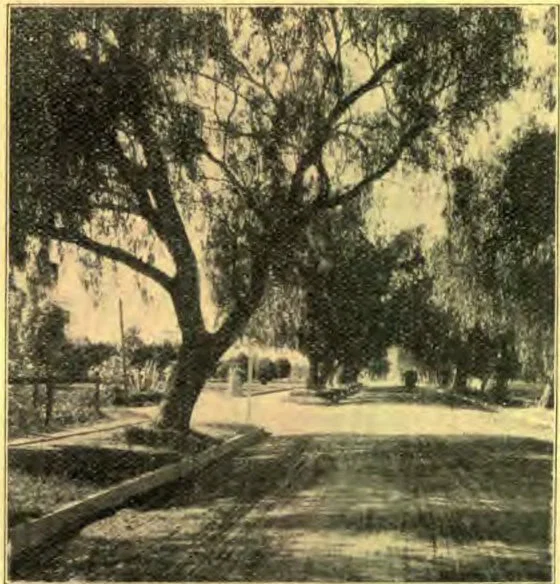
Among its streets are Orange Grove, Grand, and Marengo avenues. The two former are lined with handsome dwellings, which in every way bespeak the wealth of their owners and display the beauties of art; while the latter, with its decorated arch of graceful pepper-trees and an endless succession of palms, shows the natural.
Right in the heart of the city is the commodious Hotel Green, with its grand halls and comfortable apartments. The two buildings of the hotel are connected by an artistic inclosed bridge, through which run electric chairs for the accommodation of the guests in passing from one building to the other.
La Pintoresca, another fine hotel, is situated in the outskirts of the city, upon a high prominence overlooking the valley, and is filled to its utmost capacity every year by those who wish to enjoy a quiet retreat away from the noise and bustle of the city.
But that which seems to be the chief attraction of Pasadena is its grand location as a gateway to the many lovely regions which environ it. From autumn to spring the favorite drives to the mountains, the cañons, and the surrounding resorts are alive with fine carriages, tally-ho coaches, and merry parties of tourists in every sort of vehicle imaginable.
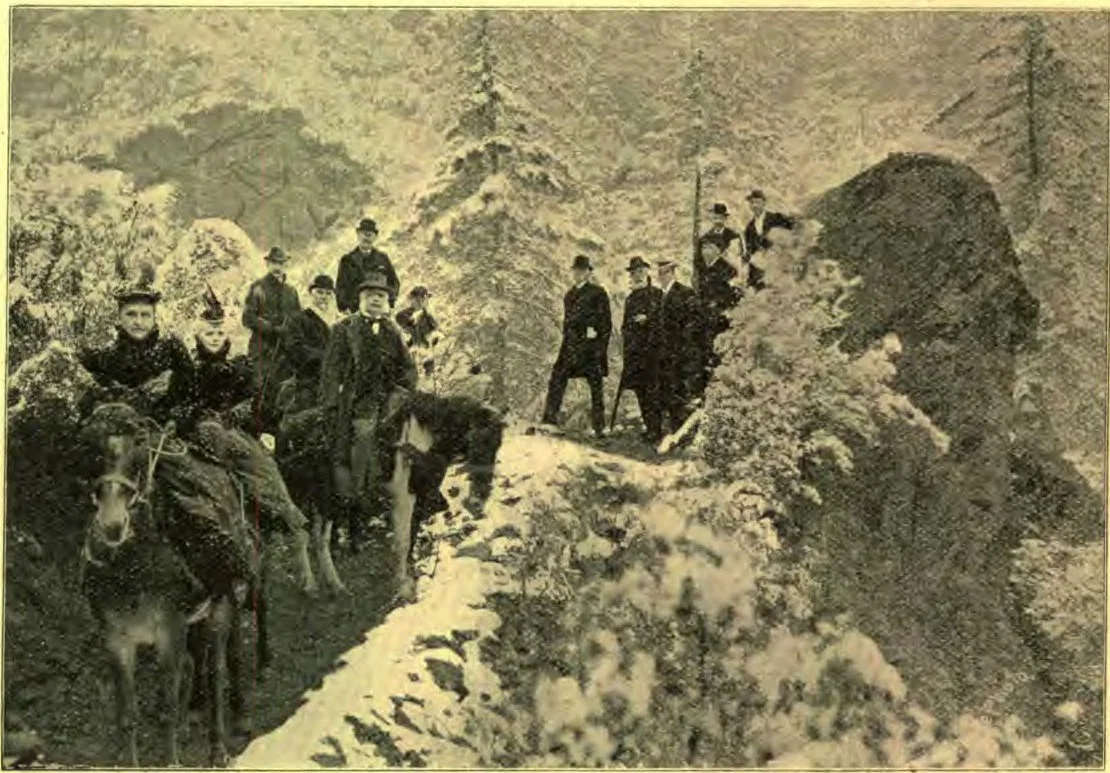
While many come here to escape the severe winter of colder climes, yet when all is balmy sunshine in the valley, and they see the snow-capped mountains above them, the one consuming ambition is to scale these heights, and enjoy what at home seemed a discomfort. The ascent may be made by the railway to Mount Lowe, already described, or to Wilson's Peak by burro train over a well-built, beautifully shaded, and altogether picturesque trail. Part way up, on the sidehill, is a village of fully forty cotton houses, and on the summit is a hotel that can accommodate seventy persons. Here, amid a winter scene of the gently shedding pine leaves and the softly falling snow, may be seen little children, and those whose heads are white with the frost of many winters, alike gleefully indulging in the sports of an Eastern winter's day.
When the best has been said of these beauty spots in nature, they remain simply as reminders of the glories of man's early home, and as hardly a shadow of those that await the child of God.
MRS. KATHLEEN WAGNER-GILMORE.
A PLEASANT AVENUE
A PLEASANT AVENUE
WHILE THE SUN SHINES IN THE VALLEY

Building Nests of Pleasant Thoughts

MAKE yourselves nests of pleasant thoughts. None of us yet know, for none of us have been taught in early youth, what fairy palaces we may build of beautiful thought, proof against all adversity,—bright fancies, satisfied memories, noble histories, faithful sayings,—treasure-houses of restful and pleasant thoughts, which care can not disturb, nor pain make gloomy, nor poverty take away from us,—houses built without hands for our souls to live in.—Ruskin.

THE PRICE OF OUR REDEMPTION

II

Conviction, mingled with passion, led Caiaphas to rend his robe. He was furious with himself for believing Christ’s words; but instead of rending his heart under a deep sense of sin, he rent his priestly robe in determined resistance.
By this act, done to influence the judges to condemn Christ, Caiaphas condemned himself. By the law he was disqualified for the priest’s work. A high priest was not to rend his garment. By the Levitical law this was prohibited under sentence of death. Among the Jews it was the general custom for the garments to be rent at the death of friends, but this custom the priests were not to observe. When Aaron lost two of his sons because they did not glorify God, he was forbidden to show sorrow by rending his garments. Moses said to him and to his sons, “Uncover not your heads, neither rend your clothes; lest ye die, and lest wrath come upon all the people.”
Everything worn by the high priest was to be whole and without blemish. The pattern of the priestly robes was made known to Moses in the mount. Every article the high priest was to wear, and the way it should be made, were specified. These garments were consecrated to a most solemn purpose. By them was represented the character of the great antitype, Jesus Christ. They covered the priest with glory and beauty, and made the dignity of his office to appear. When clothed with them, the priest presented himself as a representative of Israel, showing by his garments the glory that Israel should reveal to the world as the chosen people of God. Nothing but perfection, in dress and attitude, in spirit and word, would be acceptable to God. He is holy, and his glory and perfection must be represented in the earthly service. Nothing but perfection could properly represent the sacredness of the heavenly service. Finite man might rend his own heart by showing a contrite and humble spirit; but no rent must be made in the priestly robes.
The high priest who dared to appear in holy office, and engage in the service of the sanctuary, with a rent robe, was looked upon as having severed himself from God. By rending his garment, he cut himself off from being a representative character. He was no longer accepted by God as the officiating high priest. This course of action, as exhibited by Caiaphas, showed human passion, human imperfection. Caiaphas might truthfully have said of himself, “By our law I ought to die.” He might have been arraigned before the Sanhedrin; for he had done the very thing the Lord had commanded should not be done.
By rending his garment, Caiaphas made of none effect the law of God, in order to follow the tradition of men. A man-made law provided that in case of blasphemy a priest might rend his garment in horror at the sin, and be blameless. Thus was the law of God made void by the laws of men.
Each action of the high priest was watched with interest by the people; and Caiaphas thought for effect to show his piety. And by displaying a horror that seemingly caused him to rend his beautiful garments, he gained a fanatical admiration from the people. But he was committing blasphemy. He was reviling the Son of God. Standing under the condemnation of God, he pronounced sentence against Christ as a blasphemer.
This pretended horror for sin has been acted out over and over again in the history of our world. And by exaggerated religious zeal and pretended piety, men will again deceive their fellow men.
The religion of those who crucified Christ was a pretense. The holy vestments of the priests covered hearts that were full of corruption, malignity, and crime. They interpreted gain to be godliness. Caiaphas was not a priest after the order of Melchisedec. He never knew what it was to be obedient to God. He had the form of godliness, and this gave him the power to oppress. He acted toward Christ as a priestly judge, an officiating high priest, but he was not this by God’s appointment. The priestly robes he rent in order to impress the people with his horror, covered a heart full of wickedness. Though clothed with a gorgeous dress, he was acting under the inspiration of Satan.
The rent garment ended Caiaphas’s priesthood. By his own act he disqualified himself for the priestly office. After the condemnation of Christ he was unable to act without showing the most unreasonable passion. His tortured conscience scourged him, but he did not feel that sorrow which leads to repentance.
The act of Caiaphas in rending his garment was significant of the place that the Jewish nation would thereafter occupy toward God. The once favored people of God were separating themselves from him. Christ came to them with a message, but he was despised and rejected. As he stood on the crest of Olivet, he wept over Jerusalem, and lamented her fall. He foresaw the retribution which the deluded, disloyal nation could not, would not, see. The generation among whom he had worked the works of God he addressed as the most guilty, because of the great light they had had. “You have refused to listen to your Redeemer,” he declared. “If thou art destroyed, O Jerusalem! thou alone wilt be responsible. Ye would not come unto me, that ye might have life. Ye would none of my counsel, ye despised all my reproof.”
When upon the cross Christ cried out, “It is finished!” and the veil of the temple was rent in twain, the Holy Watcher declared that the Jewish people had rejected him who was the antitype of all their types, the substance of all their shadows. Well might Caiaphas rend his official robes, which signified that he claimed to be a representative of the great High Priest; for no longer had they any meaning for him or for the people. MRS. E. G. WHITE.

Our Moon

ASTRONOMICAL STUDY — NO. VIII

Our Moon

Since watching the moon make its majestic march between our earth and the sun, as it did the twenty-eighth of last month, the questions arise, “What is our moon? and what are some of the points of interest connected with this body, that was capable of shutting off so much light a few mornings ago?” To the question, “What is our moon? that is, Of what is it composed?” we answer, honestly, “We do not know.” There are many works published, voluminous in supposed data, that are beautifully and poetically written: but we know many of their statements to be incorrect, considering the matter of astronomy; and when we examine the exact source from which they must draw their data, we become less inclined to receive their wildly beautiful theories.
From a study of spectral analysis, or the analysis of light, we do know of what materials the sun is composed, as far as those same materials are known here on our earth; but when we come to study reflected light, as in the case of the light reflected from our moon, it becomes a very different matter.
Our moon is a globe, the same as is our earth, only it is much smaller, being only a little over two thousand one hundred and sixty miles in diameter. It revolves upon its axis, the same as does our earth, but requires twenty-eight days to turn once around, in place of twenty-four hours. One peculiar thing about this revolution is that its time is exactly the same as is required for the moon to make its circuit around our earth, so that it always keeps the same side turned toward us. We often wish we knew how the other side of the moon looks. This wish must ever remain ungratified in this present life; but when mortality is swallowed up in immortality,—when we shall follow the Lamb whithersoever he goeth,—then, and not until then, shall we know the hidden wonder and history of that apparently desolated world that God has placed so near our own.
At a distance of two hundred and forty thousand miles from us, this desolate sphere swings on in her monthly journey around our earth. So near is she, that the inquisitive eye of our larger telescopes have pierced to the depths her most hidden recesses. We have, to-day, much more correct maps of her geography and topography than we have of our own world. Every mountain of importance; every cliff and rock of interest, every valley, gorge, and cañon, as well as every crater of each extinct volcano, has been faithfully recorded upon our lunar maps, and named in our standard works on astronomy.
Words can not describe the feeling of absolute loneliness and dreary desolation that comes over one as he views this barren waste. The absolute silence that there reigns supreme is oppressive even to think upon. No song of birds, no hum of busy bees, no sound of the woodman’s ax, no merry laugh of childish glee, breaks the awful silence that has locked those barren, rocky shores since the earliest dawn of human history. The dread silence of death hangs over its ragged cliffs, which point their ghostly fingers forever toward the eternal darkness without. Upon the torn and ragged surface of the moon the fierce sun pours its perpetual beams, not in the mellow beauty of our earthlight, but in a piercing glare that shines from one distinct spot in the impenetrable darkness shrouding it in every direction.
The long, dark nights are not moistened with the gracious dews of heaven; no clouds, bearing their blessings of rain, float over this silent sphere; no bow of promise spans its eastern heavens,—it has no heavens; for the azure sky that so beautifully abounds with us is not there to be seen. All is death. No life, either animal or vegetable, is there to be found; no opening bud tells that springtime is near, and no golden grain, no ripening fruit, proclaims that the harvest will soon be past.
The rocks whose hoary heads sparkle and glisten in the intensely white, piercing light of the sun’s rays, cast their dark, inky shadows deep into the chasms that lie thousands of feet perpendicularly below them. We look, with our telescopes, into the craters of volcanoes that must have become extinct ages ago. We see, in the valleys below, what seem to have been, at some distant date, the beds of great oceans, which may have cast their briny billows far out upon their pebbly shore; we see channels where majestic rivers may have moved peacefully along, and where tiny brooks may have wandered amid leafy bowers and hills clad in green verdure.
What has become of this water we do not know; why the blessings of life, in every form, should have been so withdrawn from this little world, we can not conjecture; why the curse of God should rest so heavily upon this satellite of ours, we can not tell. God calls our attention to this matter in Job 25:5, and says, “Behold even the moon, and it shineth not,” as if at some time it might have sustained a nearer relation to our earth than it now does. Whether Satan had seized upon this little world as the inner court, or council chamber, of his proposed government, in his rebellion against God, we can only surmise: but we are told, in Isa. 30:26, that “the light of the moon shall be as the light of the sun, . . . in the day that the Lord bindeth up the breach of his people, and healeth the stroke of their wound.” When we consider that “the whole creation groaneth and travaileth in pain together until now, . . . waiting for the adoption, to wit, the redemption of our body” (Rom. 8:22, 23), and that when one suffers, all suffer, we can the better understand that when that glad day of deliverance shall come, our moon will occupy a position more nearly like that given to it before the curse of sin rested so heavily upon this earth and all connected with it. Regarding this matter, we do not care to speculate; but here is a fact that we may well consider: We know that no rain-storms of any account have ever fallen upon its surface, though we have every evidence that water was once there in abundance. A mist may have gone up and watered its soil, the same as on this earth prior to the time of the flood; but, positively, no rains have ever fallen there, as they have here since the days of Noah.
Dr. O. C. Godsmark.

A WAYSIDE GRAVE

Our upland journey wound its way Past hills that wore the green of May; The dogwood starred the shadowy copse; The light breeze rocked the pine-tree tops. Far off we saw the village spires And fluttering smoke of household fires; But here of voice or tool no sound Fell on the cloistered hush profound.
Sudden I drew my bridle-rein. Dim, shining out from moss and stain, Alone amid a fallow field And half by brier and weed concealed, I saw a rough stone cross, that bore One little dear home name; no more. Some heart had ached, some house had known The desolate hunger for its own, When, hollowed out this narrow grave, They laid, whom love had died to save But could not, one whose name had been To her own people “Josephine.”
A ruined chimney, and the bloom Of a pale purple lilac plume Close by, and this small wayside cross Told all the tale of love and loss, While near and far the fragrant day Was golden glimmering with May.
—Margaret E. Sangster.

Common Violets of Spring and Their Varieties
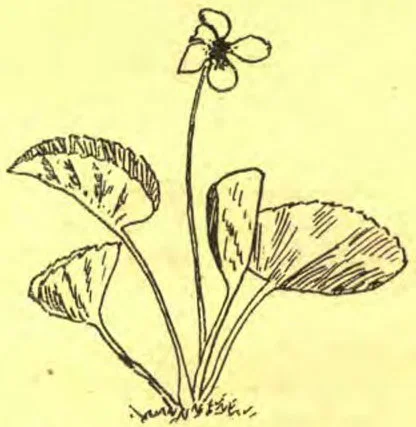
Of all our spring flowers, none are more dearly loved than the violets. Beautiful but humble, fragrant but unassuming, they are at once types of humility and of constancy. I give drawings of three of our most common representatives of this family.
The Downy Yellow Violet I have not pictured. Its flowers grow from the axils of the leaves; while in the blue violet the flowers grow from the roots.
LEAVES OF BIRD-FOOT VIOLET.
The Bird's-foot Violet has a very peculiar leaf, easily distinguishing it from all the others. The branching, slender leafage has somewhat the appearance of a bird's foot; hence its name.
The Sweet White Violet has small flowers, and a faint, sweet odor. It is very common in many of our woods.
SWEET WHITE VIOLET.
SWEET WHITE VIOLET.
The Lance-leaved Violet has white flowers, larger than those of the Sweet White Violet. Its lance-shaped leaves taper into long petioles.
There is another, but still larger, white violet called the Canada Violet. It is the largest of the violets, often reaching a height of two feet. It blooms all summer. The two upper petals of this violet are purple underneath.
The Round-leaved Violet is a pale-yellow variety. The lateral petals are veined with brown; and the leaves are roundish, crenate, lying flat on the ground, and becoming very large and shiny as the season progresses. It is not leafy stemmed.
I am told that on the Atlantic Coast there is a violet somewhat resembling the Bird's-foot Violet, called the Atlantic Violet. It is readily distinguished by its leaves. “They are ovate and reniform in outline, and deeply parted into linear or oblanceolate lobes; the middle one being somewhat wider than the others.”
It is not generally known that the violet was once highly prized as a medicine. It was supposed to be an aid in treating diseases of the lungs. L. A. REED.

Too High and Too Low: Thoughts on Needing Christ

He that thinks he hath no need of Christ hath too high thoughts of himself; he that thinks Christ can not help him hath too low thoughts of Christ.—John Mason.

THE HONEY GUIDE

SOME time ago the South African Review drew attention to a small bird, well known in South Africa as the “honey guide.” The paper says that there is no feathered creature more useful to man in a wild country than this little bird. As soon as it has found a nest of wild honey, it seeks the help of a human being, and begins to attract his attention by every means in its power. It is quite without fear of men, and begins to flutter down close to the man it has found, and to utter a shrill cry.
Every native African knows the cry and the meaning of it, and is not slow to follow the friendly guide. As soon as the bird sees that the man is following, it flutters on before him in a most delighted way, hopping on branches and twigs, looking down upon him coquettishly. Often the native will answer the bird with a peculiar whistle, which it seems to understand.
When the guide has reached the spot where the honey can be found,—usually a hollow tree,—it waits on a branch near the tree, while the native, with his hatchet, opens out the nest, and takes out the comb. The bird does not want the honey so much as the small grubs, or larvæ. The man, therefore, breaks off a piece of the comb containing these grubs, and throws it to the bird, or else leaves the nest so exposed that it can help itself. Sometimes the honey guide falls a victim to the fury of the bees; these settle upon its head and eyes, and sting it to death.—Selected.

GOOD-BY, SWEET DAY

Good-by, sweet day, good-by! I have so loved thee, but I can not hold thee; Departing like a dream, the shadows fold thee; Slowly thy perfect beauty fades away— Good-by, sweet day!
Good-by, sweet day, good-by! Dear were thy golden hours of tranquil splendor, Sadly thou yieldest to the evening tender, Who wert so fair from thy first morning ray— Good-by, sweet day!
Good-by, sweet day, good-by! Thy glow and charm, thy smiles and tones and glances, Vanish at last, and solemn night advances, Ah, couldst thou yet a little longer stay!— Good-by, sweet day!
Good-by, sweet day, good-by! All thy rich gifts my grateful heart remembers, The while I watch thy sunset's smoldering embers Die in the west beneath the twilight gray— Good-by, sweet day!
— Celia Thaxter.

JUNE STUDY OF THE FIELD

PART III: "MEXICO IN ITS RELIGIOUS ASPECTS"

(June 10-16)
1. Interesting Traditions of the Aztecs.—The Aztecs preserved traditions regarding the creation of the world, a universal flood, the confusion of tongues, and the dispersion of men over the face of the globe. These were represented in a great number of their hieroglyphic paintings. In a confused way they had an idea of a Supreme Being, independent and absolute. They considered him invisible, and never attempted to represent him by images. They designated him by the generic name of “God”—“He Who Gives Us Life,” “He Who Embraces Everything.” The knowledge of the supreme Divinity disappeared before a multitude of secondary gods engendered by superstition. The Aztecs also believed in an evil spirit, corresponding to Satan, who was to terrify men, and do them injury. They believed in a future life; and also had laws against stealing and other crimes, which were strictly enforced.
2. Human Sacrifices.—One of the most revolting practices of the Aztecs was the offering of human sacrifices. Every god had its feasts, and these always terminated with human offerings. An idea, at least, of the number of these may be formed from the statement of one author, who said, “The Aztecs had scarcely time to fulfill the duties of their religion.” To one god, the Aztec Neptune, the “Master of Paradise” and “Protector of Temporal Goods,” it was estimated that not less than two thousand children alone were offered annually. A cemetery containing only the bones of children, and supposed to be the burial-place of the young victims sacrificed to this god, was discovered recently on one of the slopes of Popocatapetl. The Aztecs had regular ministers of sacrifice, who inherited their office. Special garments were worn on these occasions, the chief executor being clothed in red, the others in white, bordered with black, their entire bodies being painted black, except around the mouth, which was daubed with white. Frequently the heart of the human sacrifice, while yet warm, was held forth, a trophy and an offering to the sun, and then thrown to the feet of the idol to be burned; or if the idol was large and hollow, the heart was placed in its mouth. The body was usually cooked, and part of it eaten, although in no other sense were the Aztecs cannibals.
3. Modern Worship.—Outside the many practices of the Aztec religion, now a part of the Catholic worship in Mexico, traces may still be found of the ancient worship. One traveler, writing on this subject, says: “And still in grottoes unexpectedly discovered, I have frequently found myself in the presence of an image at the foot of which a recent offering of food had been placed. Were these offerings a piece of homage to a proscribed god? The Indian is mute when questioned.” What it means the reader is left to conjecture.
4. Missions in Mexico.—Aztec paganism was nominally annihilated at the invasion of Cortez, and Mexico was externally converted to Catholicism at the point of the Spanish sword and the Inquisition. Thirty-seven years ago there was only one Protestant minister in Mexico. Two years ago there were fourteen missionary organizations at work, and they had gathered, in six hundred congregations, a native church membership of over sixteen thousand, with more than seven thousand pupils under instruction.
5. Result of One Person’s Effort.—Miss Melinda Rankin began missionary work in Mexico in 1854. This she carried on personally until 1872, when, on account of her failing health, it was turned over to the Presbyterian Board. Two years ago they had stations in twelve of the twenty-three states; a theological seminary; two girls’ seminaries; forty-two churches, numbering over three thousand communicants; and a working force consisting of eleven ordained missionaries, twelve women missionaries, twenty-eight ordained natives, and seventy-six native helpers,—all an outgrowth of the work begun by this humble woman.

THE PASSION PLAY IN MEXICO

MIRACLE plays for the amusement and religious instruction of the people are not characteristic alone of the Middle Ages; they are enacted at our very doors, within sound of the steam-whistle, and under the glare of the electric light. Critical writers, with much truth, declare that the papal propaganda in Mexico is simply baptized paganism, and has hidden the old heathen rites under Christian names. The force of the assertion was apparent on Good Friday in the gaudy colors and tawdry feathers—the altogether grotesque caricature of old Roman magnificence—of the swarthy Indian performers in Mexico’s modern miracle play.
It was performed in one of the suburbs of Mexico City, six miles from the capital. Perhaps five thousand persons were present. Solemnity, there was none. In the church, and in the yard within the wall, the spectacle was enacted, supposedly in the order of events and at the hours indicated by the evangelists. The high priest, the Virgin Mary, Roman soldiers, the centurion, Joseph of Arimathæa, Nicodemus, some apostles, and even the devil with his grinning mask, were all there. The different trials were held, the sentence was loudly proclaimed by a Roman herald; Pilate vainly washed his hands; Judas rushed frantically forth and hanged himself; then the slow procession wound its weary way up the volcanic slopes of the little Calvary. The thieves—huge, hideous cardboard men, were crucified on right and left. A black and bloody image of Christ, with movable head and legs, was nailed with spikes a foot long to a black cross; a crown of long cactus thorns was placed on his brow, when the cross was slowly lifted, and dropped into its socket on the hill. An image of Mary, clad in blue, with beautiful face set in a golden halo, was placed at the foot of the cross.
Other scenes of the crucifixion were then enacted, after which the priest ascended a pulpit under the trees, and told in full tones the story of the crucifixion. He spoke feelingly of Christ as Creator and Redeemer. Next, he turned to Mary, and with more than genuine enthusiasm termed her the co-Redeemer, and applied to her many of the terms already applied to the Saviour. Christ was forgotten in the adoration given to Mary; and at the bidding of the priest all fell upon their knees in worship, and in audible prayer for intercession addressed to her.
The nails were then drawn, the body placed in a large glass coffin, or case, when many gathered about it, with lighted candles. The evening shadows had long since fallen, and we watched the weird procession wind in and out among the trees as it made its way to the church. Was it Roman, was it real?—No; it was an ideal, wild and weird, a mingling of the Aztec and Roman ideas. The nodding plumes were far more Indian than Christian.
Such methods do not change the heart, nor enlighten the conscience. For the multitude it is a huge holiday. Most are careless of its religious import; some doubtfully inquire, as one asked me, Did it really happen?— Condensed from Missionary Review of the World, March, 1899.
Continue reading: SOME FACTS ABOUT THE PHILIPPINES