The common laborer receives about ten cents a day.
Manila is pronounced “Mah-neel'-lah” by the natives.
A fashionable delicacy for the menu is the grasshopper.
The poorer classes robe themselves in one yard of cloth.
The streets of the capital city are under water much of the time.
Manila is considered commercially equal to Calcutta and Batavia. F. W. Howe.
TOO GOOD TO BE TRUE
INTO the midst of a famine-stricken people, where there was no bread, and no hope of any, where dying people had tried to eat the very dirt at their feet, and had found it would not satisfy hunger, came a messenger of hope.
“Come with me,” he said; “I have only to open this door,—see, here is the key,—and within the king’s palace you will find a feast spread for you all, enough and to spare. No price is demanded; it is free. Your king gives it to you out of his loving-kindness.” And what answer do you think they made? They said, “It is too good to be true;” and turned away to die.
Were they mad men? Ah, dear readers! into a company of dying souls a preacher went one day last week, offering them the bread of life. Their need was pressing, the offer was lovingly made; but most of them turned away, saying, “A beautiful story, but it is too good to be true.”
O, believe the gracious promises of the Lord of heaven and earth! “Taste and see that the Lord is good.”—Selected.
“THY KINGDOM COME”
A LITTLE hand can sow
The seed of truth below;
A little voice can tell
How Jesus loved us well.
O teach us, Lord, to pray,
“Thy kingdom come,” each day,
And then with willing heart
To do our little part.
— Selected.
LOTTCHEN
By Elizabeth Rosser
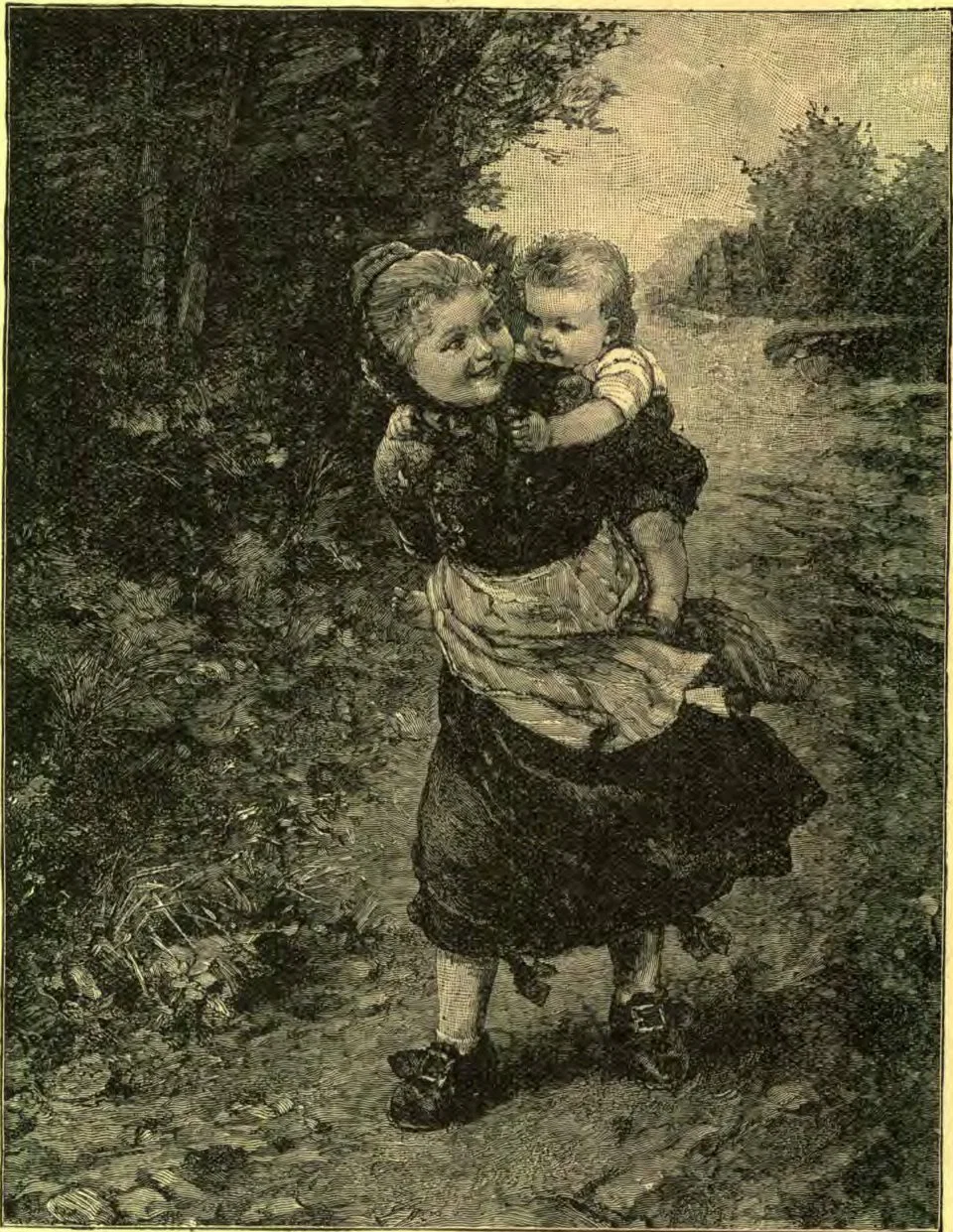
When little Lottchen comes this way,
With laughing Hans, her burden dear,
She brings into the summer day
An added ray of cheer.
The buttercups more yellow are,
The robin's notes more mellow are,
It lightens labor, sweetens play,
When Lottchen comes this way.
And though I may not know her tongue,
And though her words sound strange to me,
Her happy voice is like a song,
Her face is good to see.
The shining sunbeams brighter are,
And hearts o'erburdened lighter are;
Good cheer is sure to bless the homes
Where blue-eyed Lottchen comes.
ELIZABETH ROSSER.
BABY SIGNS
By Annie Hamilton Donnell
The last half of a forty-mile ride is not likely to be as much fun as the first half. That is what the little Todhunters were thinking. For the last mile it had been very quiet indeed in “Grandpa Tod’s” big surrey. Then Katherine broke the silence with a great sigh that could be distinctly heard above the gentle clitter-clatter of the wheels and the thud of Bonnibel’s hoofs. They were passing a bit of a lonely, unpainted house. “There’s a baby in that house,” mama said, suddenly, and her sweet voice was as cheery as if she were not tired at all.
“Where? I don’t see one,” Eric said.
“On the clothesline!” laughed mama, pointing to a row of flapping little dresses. “I can always tell which are the baby houses, Monday afternoons! And I always look. I like to see the little wet petticoats and aprons; and when I don’t find them, I’m always sorry for that house!”
“Why, I never looked!” said Katherine.
“Nor I,” Eric chimed in.
Grandpa Tod laughed. “I’m seventy-two years old, and I never looked. I’m going to begin now.”
“So’m I!”
“And I!”
“Me, too!” It was the tiniest little Todhunter who said that, and they all laughed. She had just waked up, and everybody knew she hadn’t the least idea what she was saying, “Me, too,” to! At the next house there were no little flapping clothes on the line; but Grandpa Tod nodded his gray head decisively. “There’s a baby in that house,” he said.
“Why, Grandpa Tod, I don’t see a sign of one!” Eric cried. “Is there?” he added.
“I see a sign,” and grandpa let Bonnibel walk past the pretty white house very slowly. Mama smiled. She saw the sign, too. Then Katherine saw it. “It’s that board nailed ’cross the kitchen door, to keep him from tumbling out!” she cried; and at the sound of her voice a small brown head and two round brown eyes appeared above the board.
“Well, then, why don’t they wash his clothes?” remarked Eric, gravely. After that they looked at all the houses for baby signs. It was great fun. At the first one they passed that had no “sign” at all, Katherine’s bright little face clouded over. “I’m sorry for that house!” she murmured. Sometimes it was a battered dolly, sometimes a little cart, or chair, or baby carriage. Sometimes one discovered the sign, and sometimes another. More often than not, it was on the clothesline they found it.
“WITH LAUGHING HANS, HER BROTHER DEAR”
“There’s a baby there—hark!” said mama, and they all listened. Some one inside the open screen-door was singing in a low, monotonous, sweet croon.
“He’s just going to sleep,” whispered Katherine. “Drive soft, grandpa.”
At another house, Grandpa Tod discovered the “sign,” and such a queer one! Even mama couldn’t find it.
“There’s the sign,” was all grandpa would say; and how everybody hunted, while Bonnibel stopped for a drink of running water at the trough. But nobody found it but grandpa.
“We give it up—you’ll have to tell,” the children said at last. And then with his whip, Grandpa Tod pointed to a row of poppy plants, with all the bright blossoms lying in wilted little heaps beside them. “Oh!” mama said. “Oh!” the rest chorused.
“Yes, he’s a witch of a baby, too, to pick them all off!” laughed grandpa.
“Are you sure ’bout that sign, grandpa?” Katherine asked, doubtfully.
“Sure! but if you’re not, there’s another for you.” It was a little pink sunbonnet lying beside the road, with a wilted poppy-head near it.
The last half of the forty-mile drive wasn’t long at all. It came to an end too soon. It was Eric, after all, who found the last baby sign, and the most puzzling one of them all. They were passing a pleasant little brown home wreathed in vines. No one was in sight. Under one of the trees was a rocking-chair tipped over backward, and halfway up the trim little board walk lay a heap of soft, white cloth, that somebody had dropped. Those were Eric’s “signs”! Everybody smiled at them, until, just as they were leaving the little brown home behind, a sharp, imperative wail sounded. The baby, crying!
“But what made you think he was in there, just by that tipped-over rocker and that sewing-work, Eric?” cried puzzled Katherine.
“Why,” Eric explained, gravely, “she did that when the baby cried, you know. She got up in such a hurry the chair tipped over, and she dropped her sewing on the walk. He’s the first baby, prob’ly.”
And right then the forty-mile drive ended.—Annie Hamilton Donnell.
WHAT GOD GIVES A BOY
A BODY to live in and keep clean and healthy, and as a dwelling for his mind, and a temple for his soul.
A pair of hands to use for himself and others, but never against others for himself.
A pair of feet to do errands of love, kindness, charity, and business, but not to loiter in places of mischief, temptation, sin.
A pair of lips to keep pure from foul language and unpolluted by tobacco or whisky, and to speak true, kind words.
A pair of ears to hear music of bird, tree, rill, and human voice, but not to give heed to what the tempter says.
A pair of eyes to see the beautiful, the good, and the true,— God's finger-prints in flower, field, and snowflake.
A soul pure and spotless as a new-fallen snowflake, to receive impressions of good, and to develop faculties of powers and virtues which shall shape it day by day, as the artist's chisel shapes the stone, into the image and likeness of Jesus Christ.—Selected.
DANDELIONS
SPRING, in feverish haste and hurry
Summer's coming quick to greet,
Drops her gold. In wild profusion
It lies scattered 'neath her feet.
— Selected.
NOTES AND COMMENTS
By A. J. Bourdeau
Anniversary of Gutenberg.—On June 23 next a festival will be held at Mayence, Germany, to commemorate the five hundredth anniversary of the birth of Gutenberg, the inventor of the art of printing. In this celebration almost all civilized nations will take part.
How Geese Are Shod.—In Poland, where geese are driven long distances to market, it is found necessary to protect their feet. This is done in a very simple yet ingenious way. Just before taking the trip to town, the geese are caused to walk several times through soft tar, and then through sand. In this way their feet are covered with alternate layers of tar and sand, affording them ample protection against rough roads.
A New Paper Material.—“Guaxima” is the name of a new material which it is proposed to use in the manufacture of paper. It is said that its fiber is long and very strong, and that it “resists the action of water, and is much more easily prepared than jute.” This new material is to be found in abundance in Brazil. With the present ever-increasing price of wood-pulp, of which most of the paper of the world is made, it is certain that the discovery of new substances of this kind will be heralded with joy by all paper-users.
Facts about Winking.—Many scientists are not yet clear about the purpose of winking. One of the many theories in regard to the phenomenon is that it serves momentarily to rest the eyes. As the eyes grow tired, winking becomes more frequent, that the eyes may be moistened sufficiently. It has been demonstrated by photographers that the duration of an entire wink is only four tenths of a second, a duration too slight to interfere with distinct vision. The downward movement of the eyelid lasts only from about seven to nine hundredths of a second, while the upward movement averages seventeen hundredths, the eye being thus shut fifteen hundredths of a second during each wink.
Luther’s Argument with Satan.—It is stated upon good authority that Martin Luther once had a short but decisive argument with Satan, greatly to the latter’s discomfiture. These are the words of the great Reformer, describing the same: “Once upon a time, the devil said to me, ‘Martin Luther, you are a great sinner, and you will be damned!’ ‘Stop! stop!’ said I; ‘one thing at a time; I am a great sinner, it is true, though you have no right to tell me of it; I confess it. What next?’ ‘Therefore, you will be damned.’ ‘That is not good reasoning. It is true I am a great sinner, but it is written, “While we were yet sinners, Christ died for us;” therefore I shall be saved. Now go your way.’ So I cut the devil off with his own sword, and he went away mourning because he could not cast me down by calling me a sinner.”
A Ball-Bearing Gun.—Captain Cullen, of Virginia, has patented a gun in which ball-bearings are used instead of the usual “rifling.” When a projectile is fired from this gun, instead of rubbing and twisting its way out of a tight-fitting barrel, it slides out on the steel balls. To give a rotary motion to the projectile, the ball grooves are spirally curved, as is the case with ordinary “rifling.” Official tests show that the gun is in every way the best yet produced. After having been fired 2,311 times, the gun was only three per cent less effective than when first fired. The average muzzle velocity was thirty-two hundred feet a second; while that of the Driggs, Hotchkiss, and Maxim guns, with which this new gun was tried in competition, was only eighteen hundred feet a second at the muzzle. The increase in range is in like proportion. For example, all four guns were fired at a plate of nickeled steel twenty feet square, and one and three-eighths inches thick, at three thousand yards’ range. The Driggs and Hotchkiss guns failed to penetrate the plate, and glanced into the earth in front of it. The Maxim projectile hit the plate, and stuck in it, penetrating to the depth of five eighths of an inch. On the other hand, the ball-bearing gun hit, penetrated, and passed through the plate, and was picked up 1,626 yards beyond the plate, making a total range of 4,626 yards, or two and one-half miles, besides passing through one and three-eighths inches of the best armor plate. All four guns were fired with the same charges of brown, semi-smokeless powder, and the projectiles were of the same weight, the only difference being that the ball-bearing gun’s projectile was perfectly smooth, while those fired by the other guns were banded, to make them follow the “rifling.” Another advantage of this gun is that, owing to the unusual swiftness of the projectile in reaching the gun muzzle, the bursting strain is reduced seventy-five per cent, thus requiring fewer steel jackets around the gun, and thus materially reducing the weight of heavy artillery.
A. J. BOURDEAU.
BLUE PRINTS
By J. Edgar Ross
THE blue-print process is very cheap, very simple, and consequently very much despised. But for many subjects there is no prettier printing process known to photographic science. Of course if one uses blue prints exclusively, for all subjects, he may in time find the sameness of their tone monotonous; but a very simple process of bleaching and redeveloping will turn the blue to a brown, or even to a deep black.
Blue-print paper may be bought ready for the printing-frame; but its cost is not much below that of silver print-out paper. It requires a somewhat longer exposure than gelatin paper, and it does not show as clearly defined an image; but a little practice will enable you readily to tell when it has been printed enough.
After printing, the paper is simply washed until it no longer colors the water. Five minutes is sufficient for this if the print is kept constantly in motion. The picture is then ready to mount, or to dry without toning, fixing, or further washing. Quite simple, isn’t it?
The preparation of blue-print paper is almost as simple as its printing. Any paper may be used, but of course the regular photographic paper is best. Good, smooth, unruled writing-paper answers the purpose well, however. Bristol-board and pen-and-ink drawing-paper are also excellent, especially if the prints are to be kept unmounted.
The sensitizing solution is made as follows:—
Ingredient
Amount
Citrate of iron and ammonia
1¾ ounces
Water
8 ounces
Ferricyanide of potassium
1¼ ounces
Water
8 ounces
These solutions will keep separately, but they should be mixed only for immediate use.
Take equal parts of each, and float, or immerse, the paper for three minutes; then hang it up to dry in the dark. Another method of coating the paper is to swab the surface with the solution. Many prefer this method; so I will describe it in detail.
Take a half-inch board, three inches wide by eight inches long, and cut it out to the shape of the handle of a flat paint-brush. Then wrap a long strip of soft, white muslin about three inches wide around the wide end of this stick, until you have quite a thick pad. Wind a string several times around the muslin, and tie it firmly in place. You will then have a swab that will serve as well as a camel’s-hair brush, for which you would pay a dollar.
Provide a board somewhat larger than the paper to be coated, and fasten the paper to it by placing a drawing-tack or a pin at each corner. Stand the board on end in a tray containing a small quantity of the sensitizing solution, and hold it at an angle of forty-five degrees with one hand, while with the swab in the other you brush the solution over the surface of the paper with a quick up-and-down motion. Turn the board on its side, and repeat the operation, so that the marks of the swab will be in both directions of the paper,—up and down and across.
The paper will look streaked, but that will not matter if the surface has all been covered. The streaks will disappear in the final washing. Two or three dozen sheets of paper can be coated in this manner in half an hour.
Blue-print paper keeps well, but it must, of course, be kept in the dark. A number of large sheets may be sensitized at one time, and then cut, when dry, to the required size, and stored away until needed.
The natural tone of the blue-print gives quite a pleasing effect to most views. The only reason that it is held in such contempt is that the process is so cheap and simple. If you dislike the blue tone, it may be changed to a pretty brown color by the following process: Immerse the prints in a bleaching-bath composed of one part aqua ammonia to ten parts water, until the image is faded out to a pale yellow. Wash through three or four changes of water, and immerse in the following solution:—
Ingredient
Amount
Water
10 ounces
Tannic acid
2 ounces
This bath will slowly redevelop the image to a brown tone.
This formula has been published again and again. I have met people who have used it, and I have seen prints it has produced. The time necessary to redevelop the image in the acid bath is said to be about twelve hours. I must confess that I never had the patience to try it. I did look for a short cut, however, and found it in my plate-developer.
The formula used was the one for eikonogen-hydrochinon developer, as given in the article on Plates and Developer. No doubt other developers would answer equally well, but I have never tried them.
In this developer the faded image comes up clear and strong in a few minutes, losing nothing but the blue color, which has been exchanged for a brown that resembles an old engraving. Personally, I prefer the blue prints, but as tastes differ, the reader should try this method.
J. EDGAR ROSS.
Chicago & Grand Trunk R'y
E. W. Meddaugh and Henry B. Joy, Receivers.
Chicago & Grand Trunk R'y.
Trains arrive and leave Battle Creek.
WEST-BOUND FROM BATTLE CREEK.
No. 9, Mail and Express, to Chicago ... 12.15 P. M.
No. 1, Chicago Express, to Chicago ... 9.00 A. M.
No. 3, Lehigh Valley Express, to Chicago ... 3.40 P. M.
No. 5, Pacific Express, to Chicago, with sleeper ... 1.10 A. M.
No. 75, Mixed, to South Bend ... 8.20 A. M.
Nos. 9 and 75, daily, except Sunday.
Nos. 1, 3, and 5, daily.
EAST-BOUND FROM BATTLE CREEK.
No. 8, Mail and Express, to Pt. Huron, East, and Detroit ... 3.45 P. M.
No. 4, Lehigh Express, to Port Huron, and East ... 8.27 P. M.
No. 6, Atlantic Express, to Port Huron, East, and Detroit ... 2.25 A. M.
No. 2, Lehigh Exp., to Saginaw, Bay City, Pt. Huron, and East ... 6.50 A. M.
No. 74, Mixed, to Durand (starts at Nichols) ... 7.15 A. M.
1. Why is it unwise to lay up riches on earth? Matt. 6:19. What is the better and only wise course to pursue? V. 20; note 1. What intimate relation between the heart and the possessions makes it necessary to choose the latter way? V. 21.
2. What valuable service does the eye render to the body? V. 22. In order to fulfill its duty perfectly, what must be the condition of the eye? Id. What is the state of the eye when not single? And what is the result to the body? V. 23; note 2.
3. What is it impossible for any man to do? Why? To what masters does Jesus refer? V. 24; note 3. In view of these self-evident facts, what admonition does he give his people? In addition, what pertinent question does he ask? V. 25; note 4.
4. To what practical illustration does Jesus call attention, that man may learn to trust God? V. 26. By what question does he show the impossibility of man's helping himself? V. 27.
5. What helpful thoughts may be gathered from a study of the flowers? Vs. 28, 29. What lesson is to be learned as we thus view the beauties of inanimate nature? V. 30. What questions relative to life are not to cause anxious thought? V. 31. Why not? V. 32; note 5.
6. What is the first and only object to be sought by a child of God? What will thus result to him? V. 33. What are the words of our memory verse? What practical lessons do you gather from them? V. 34.
NOTES
1. It is well ever to bear in mind that heavenly treasure is just as real, just as tangible, as earthly treasure; in fact, the only truly real things are the heavenly. “For the things which are seen are temporal; but the things which are not seen are eternal.” 2 Cor. 4:18. In the world to come we shall have substance (Prov. 8:21),—a substance that is better and more enduring. Heb. 10:34. Of course man can not know now in what way God keeps the great account of each man's life, but he may know that every deed of love, every sacrifice, every effort put forth in the name and for the sake of the Lord Jesus, is faithfully set down, and that a reward for each will be given. The Saviour will reward every man according as his work has been. The gift to the poor, which is a loan to the Lord, is actually recorded, and will actually be returned. Prov. 19:17. To lay up treasure in heaven, therefore, is not a figure of speech, but a practical, every-day business matter, to be taken up and practiced by the child of faith.
2. Undoubtedly the eye is here taken as an illustration of the mind or heart. As the eye is the open door through which heaven's sunlight enters the physical being, so the mind is the channel through which the rays of the Sun of Righteousness enter the inner man. To attempt to divide the physical eye would be but to destroy its usefulness,—to blind it. It must be kept whole,—“single,”—else darkness is the sure result. The same is true of the heart. It must be kept whole—altogether given up to the service of God. To speak truly, there can be no such thing as half-hearted Christianity. If the heart is divided, if its affections rest upon the world, Christ is not there. “There is no concord between Christ and Belial.” The divided heart is filled with darkness. “A double-minded man is unstable in all his ways.” “Let not that man think that he shall receive anything of the Lord.” James 1:8, 7.
3. Jesus does not say, Ye may not serve God and mammon, but, “Ye can not.” True service springs from affection, whether the service be good or evil, and is invariably yoked up with loyalty. Loyalty of heart and purpose makes loyal service. But to be loyal to God, to yield to him the heart's love, is to be directly at variance with mammon. For the love of God is to keep his commandments (1 John 5:3), to be righteous; while to love money is to transgress the law, to do evil. 1 Tim. 6:10. The love of money and the love of God are antagonistic principles, drawing their subjects in totally opposite directions. And as a man can not travel in two different directions at one and the same time; as he can not both love and hate the same being at the same moment, therefore he can not serve both God and mammon. To make a success in the service of God one must wholly and forever break his allegiance to the world, and become a citizen of the kingdom of the King.
4. By a careful study of this and other passages it will be seen that Jesus does not teach the utter absence of thought concerning our temporal necessities, but rather he would have us lay aside all worry and trouble about these things, and think of them with a spirit of trust and faith. See Luke 12:29, margin.
5. It would be foolish indeed to think that Jesus would have his people settle down in thoughtless idleness, caring nothing about their earthly needs, and waiting for some kind hand to provide for them. The world owes no one a living; and God says that he who will not work shall not eat, which, put into other words, is but saying that nothing will come to him who makes no effort to obtain. We are to plan, and work as diligently, as we would were our support all dependent upon ourselves; we are to believe and trust, as if it all depended on God. Even the birds, as far as their natures permit, follow this rule; for they go out and gather that which God provides (Ps. 104:28), though they know nothing about care. We are to be diligent in business, ever planning to make the most of present opportunity. At the same time, however, this must be done with a trustful faith, and having everything submitted to God.
We Always May Be What We Might Have Been
By Adelaide E. Procter
Have we not all, amid earth's petty strife,
Some pure ideal of a noble life
That once seemed possible? Did we not hear
The flutter of its wings, and feel it near,
And just within our reach? It was;—and yet
We lost it in this daily jar and fret,
And now live idle in a vain regret.
But still our place is kept for us, and it will wait,
Ready for us to fill it soon or late;
No star is ever lost we once have seen.
We always may be what we might have been.
— Adelaide E. Procter.
The Illuminating Power of Books
By Arlo Bates
Books explain us to ourselves. They reveal to us capabilities in our nature before unsuspected. They make intelligible the meaning and significance of mental experiences. There are books the constant rereading of which presents itself to an imaginative man as a sort of moral duty, so great is the illumination which they throw upon the inner being.— Arlo Bates.
Cincinnati Northern Railroad Co.
TIME TABLE NO. 3.
IN EFFECT SEPT. 24, 1899.
Trains Pass Battle Creek, as follows:
WEST-BOUND.
No. 21, Mail and Express ................. 6.58 P. M.
No. 23, Accommodation ..................... 2.07 P. M.
No. 27, Local Freight ...................... 8.25 A. M.
EAST-BOUND.
No. 22, Mail and Express ................. 8.25 A. M.
No. 24, Accommodation ..................... 1.45 P. M.
No. 28, Local Freight ...................... 5.30 P. M.
Direct connections are made at Toledo with all roads diverging. Close connections for Detroit and Cincinnati.
J. L. READE,
Ticket Agt., Battle Creek.
E. R. SMITH, City Pass. Agt., 6 West Main St.
To Reach BATTLE CREEK
FROM
CHICAGO, BUFFALO, DETROIT, OR TOLEDO,
Purchase Tickets Reading over the MICHIGAN CENTRAL “The Niagara Falls Route.”
A First-class Line for First-class Travel between Chicago and New York and Boston. Elegantly equipped through trains pass Battle Creek in each direction daily.
R. N. R. WHEELER, Ticket Agent, Battle Creek.
O. W. RUGGLES, Gen’l P. and T. Agt., Chicago, Ill.
TAKE THE Canadian Pacific Railway
for . . . CHATHAM, OTTAWA, MONTREAL, LONDON, GALT, QUEBEC, WOODSTOCK, TORONTO, BOSTON, PORTLAND, and
All points in New England, the Maritime Provinces, Great Britain, and the Continent.
Illustrated literature, time-tables, and full particulars, upon application to—
J. FRANCIS LEE, GEN. AGENT,
Passenger Dept. 228 SOUTH CLARK ST., CHICAGO
Branch Offices: 76 Ottawa St., Grand Rapids, Mich. Room D, Chamber of Commerce, Cincinnati, Ohio. 315 Chestnut St., St. Louis, Mo.