The Youth’s Instructor, Vol. 63, No. 48.

A Valuable Book

The Youth’s Instructor

Nov 30, 1915

Review and Herald Publishing Assn. · Takoma Park Station, Washington, D. C. · Nov 30, 1915

A Valuable Book

“THE CRIME OF SILENCE,” by Orison Swett Marden, is a book of important instruction to both parents and young people. Some of the subjects presented by Dr. Marden are:— Purity Is Power; The Crime of Silence; Dangerous Passing; White Slavery and the Child Woman; Mothers and Daughters; Perilous Pleasures; Fathers and Sons; Sowing Wild Oats, and the Harvest; Perils of the New Freedom; How to Regain Your Manhood; The Damnable Double Standard.
The book can be obtained of the Review and Herald Publishing Association, Takoma Park, D. C., for $1.00.

Fido and the Collection

THERE was once a boy who had a dog of which he was very fond. One morning, as the boy sat down to breakfast, he noticed Fido sitting close beside him, looking up into his face in that queer way which a dog has when he is expecting you to give him something.
Harry could hardly withstand the appeal of that wagging tail and those wistful eyes. I think some of you know just how he felt. And when his father passed his plate, filled with warm food, Harry was on the point of putting it down on the floor for Fido. But his father told him it was too good for the dog; after breakfast he might give Fido his portion. So Harry ate his good breakfast, while Fido watched and waited.
After the meal was over, Harry's father told him he might gather up the scraps, and give them to the dog. When he had gathered them up, and set the plate down, he said, “Fido, I meant to give you an offering, but this is only a collection.”
What is the difference? The offering was what the boy wanted to give because he loved the dog; the collection was what remained after every one else had been satisfied.
Which do you think we should give to God—a collection or an offering?—Amos R. Wells.

Questions and Answers

(Concluded)
46. WHAT prophet defied the priests of Baal?—Elijah.
47. What priest made a golden calf?—Aaron.
48. What great lawgiver was a shepherd for forty years?—Moses.
49. What skilled artificer in brass helped Solomon to build the temple?—Hiram.
50. Under what Roman governor did the Lord Jesus suffer death?—Pontius Pilate.—Belle M. Brain.

I Would Be Simply Used

I would be simply used, Spending myself in humble task or great; Priest at the altar, keeper of the gate, So be my Lord requireth just that thing Which at the needful moment I bring. Oh, joy of serviceableness divine! Of merging will and work, dear Lord, in thine; Of knowing that results, however small, Fitly into thy stream of purpose fall. I would be simply used.
— Selected.

Assorted Brief News Items of the Day

The Young Men's Christian Association has a world membership of 600,000.
An envelope-sealing machine, said to be capable of handling thirty thousand separate pieces of mail an hour, has just been patented.
One thousand tons of roses and one thousand eight hundred and sixty tons of orange blossoms are used every year in Italy in the manufacture of perfumes.
A farmer in Missouri is making a specialty of raising sunflowers for the purpose of selling the seed to the manufacturers of specially prepared food for poultry and cattle.
Columbia University now leads the world in the number of students enrolled. The entering class of this year numbers 1,059. The total enrollment on October 5 was 14,573 students.
An oil well at Baku, Russia, is said to ebb and flow with the same regularity as the tides of the ocean. It is believed by scientific circles to be connected with the sea in some mysterious way.
On the night of October 8, Arthur Smith, of Indiana, looped the loop sixteen times over the Hudson River, at an altitude of three thousand feet, in an aeroplane which he himself built.
A concert singer has recently had constructed a treadmill walking machine, that on rainy days she may take her customary walks without exposure. A meter indicates the distance covered.
The Commission for Relief in Belgium has received from Belgium a consignment of empty flour sacks, many of which have been beautifully embroidered by the Belgian women as an expression of gratitude for American kindness.
Two hundred and twenty-nine blocks of stone from the ruins of the dungeon at Rouen, France, from which Joan of Arc went to her death at the stake in 1431, will compose the pedestal of her bronze statue that will soon adorn Riverside Park, New York.
The officials of the Miami conservancy district of Ohio are considering the matter of purchasing the town of Osborn, Greene County, so that the valley may be turned into a great reservoir, for the accommodation of surplus water in flood seasons, to safeguard the Dayton and Miami River basin.

Raised From His Deathbed

WHEN I was at the recent Missouri camp meeting, Brother R. A. Underwood told me about a severe illness in early life, and of the inspiring and immediate response to the prayer of two humble but earnest workers who knelt at his bedside in that critical hour. Believing that the account of this incident will be as helpful and encouraging to many others as it was to me personally, I am taking the responsibility of passing it on to the large circle of Signs readers just as he told it to me.

Puzzled Physicians Consult

“It was away back in 1873. Shortly after being exposed to measles, I was out all day in a terribly cold blizzard. I was just then breaking out, and I became so thoroughly chilled that before night I was suffering from a severe cold, and the measles had struck in, and I became deathly sick. In about two weeks I was so low that I could speak only in whispers. When my bed had to be changed, I was carefully lifted out by two men.
“A little later, I began to suffer the most excruciating pain across the small of my back, and a spot about as large as my hand turned black. The physician who had my case in charge believed that mortification was about to set in. Three physicians were called in counsel, and none of them held out any hope for my recovery.

Told the Undertaker to Come

“Miss Reynolds, to whom I was engaged to be married, had been with me for two weeks, assisting constantly in my care. Brother Sanford Rogers was the elder of the church to which I belonged, and he also had come in to help care for me. Finally I failed so rapidly that the doctor told Miss Reynolds and the members of the family that if they wished to say anything to me, they would better say it without delay, and that as he returned to the village, he would tell the undertaker to come out to the house to lay me out, because I could not possibly live over two hours at the most.

‘I’ve Got Him’

“Immediately after the doctor left my room, I seemed to see, standing at the foot of my bed, a tall person whose features in every way showed marked intelligence, but whose eye was keen and shrewd, and would almost pierce one through. With a sort of hellish grin, he pointed to me, and said, ‘I’ve got him.’ The impression made on my mind was that this was the devil contending for my life.
“Standing about three feet nearer to me, at the side of my bed, was another being, the most beautiful I ever beheld. With a wave of his hand, he seemed to be warning away the one standing at the foot of the bed, and said, ‘Not so sure!’
“As I had given my heart to God, I did not fear to die, but the impression was left on my mind that in some way the devil would triumph if I did die. When this being at my bedside waved his hand, the whole scene passed from my vision. As far as I know, I was in my right mind. I was not asleep; it was not a dream.

‘You Will Not Be With Us Long’

“Miss Reynolds, having heard what the doctor said, came in directly and knelt by my bedside. In a whisper she said to me, ‘Rufus, do you know how sick you are?’ In a low whisper I said, ‘Yes.’ Miss Reynolds continued, ‘I feel you will not be with us long.’ I answered in a whisper, ‘A very short time, unless God heals at once.’ Then I said, ‘Ellen, have you any faith?’ She said, ‘Yes.’ Then I asked her to call in Brother Rogers to join her in prayer for my recovery. She went to the door and called him. He replied he would be there in a few minutes. She said, ‘Don’t wait, for in a few minutes it may be too late.’ He came running, thinking that I was dying, and then she told him that I had requested that they pray for my healing, and also told him that the doctor said I could live only two hours.

Touched With Healing Power

“They both bowed at my bedside. I shall never forget Brother Rogers’s brief prayer. He asked, in substance, that if it could please God and glorify his name, the angel of the Lord might touch me that instant with healing power. No sooner had those words been spoken than the pain that was then so severe, as if it were cutting me in two, ceased instantly, and a thrill of power went through my being. I rose to a sitting posture in the bed, and with a clear voice said, ‘Praise God, I shall live, and not die.’ Brother Rogers closed his prayer with a word of thanksgiving. Then Miss Reynolds began to pray that the Lord might heal me. I said: ‘Ellen, do not ask the Lord to do what he has already done. Just thank him for it.’
“I had not slept a moment for nearly three days. I had apparently been in the very agonies of death; but now I said to Miss Reynolds: ‘I am all right now. God has healed me, and all I desire is to be left alone so that I may sleep. I should like to rest.’
“Within half an hour, the village undertaker, accompanied by another man, came to lay me out, as the doctor had informed them that I would be dead by the time they reached the house. Miss Reynolds told him, as he came in, that I was better, and that she did not think he would be needed; but he insisted on staying, and said he would look after me.

‘It Beats the Devil’

“I persuaded Miss Reynolds to retire, as she had lost much sleep. About midnight, her anxiety led her to come down to see how I was getting along. She asked the undertaker, ‘How is Mr. Underwood?’ I shall never forget his remark. He was a profane man, and he said: ‘Miss Reynolds, it beats the devil. I came here to lay this man out, and he just gets up and helps himself. When I watched over him a week ago, he couldn’t help himself in the least.’ Miss Reynolds remarked: ‘It has beat the devil. Mr. Underwood has been healed.’”

Effectual Fervent Prayer

The Bible recognizes various remedial agencies, such as baths in the case of Naaman, fig poultice for Hezekiah, clay ointment and hydrotherapy for a certain blind man whom Christ met, regulation of diet for Timothy; but it also recognizes the prayer remedy, and assures us that “the effectual fervent prayer of a righteous man availeth much.” James 5: 16.
And whenever we are brought face to face with sickness and suffering, we should feel it a privilege, no matter what else is done for the patient, to commit the case to the care of the Great Healer of both soul and body.—Dr. David Paulson, in Signs of the Times.

The Tempest

W. J. PAULSON
The storm clouds have risen with deadly intent, A sea sanguinary its fury has lent; It rolls in the wake of the war god’s strong breath, And strewn are its shores with the visage of death.
Ye ships that ride safe in the harbor, abide; To the wind and the wave your barks not confide. Oh, venturesome mariners, look ere ye sail! The wreckage adrift met its fate in the gale.
One ship of small tonnage is caught in the blast. Her decks are washed bare, now is seen but her mast. Her crew look for safety; but where shall they fly? The waves wash their ship, and enraged for them cry.
Some ships that have ventured still weather the gale: Feeling safe in their might, they the stormy sea sail. They rise and they fall on the wild ocean’s breast. How long, yes, how long, will the storm them molest?
Some frail hand is raised to command the wild sea; But the storm rages on with increased potency. Some zealous for peace cry, Be still! Oh, be still! But lost are their cries in the hurricane shrill.
O blest Galilee, who allayed thy wild deep? Who with “Peace, peace be still,” assuaged thee to sleep? Yea, men may cry, Peace! but what doth avail? Until He doth command shall the tempest prevail.

A Genius Ruined by Alcohol

OWEN B. McGUINNESS was graduated from the University of Dublin, and coming to New York City, entered the political arena. Possessed of more than ordinary mental power, had it not been for alcohol he would have been a leader among men.
Some time ago, Owen McGuinness, threadbare, gray-haired, unshaven, was arraigned before Magistrate House of the night court of New York City, charged with disorderly conduct while intoxicated. Lawyer Rubin S. Lane appeared to press the charge against the prisoner; and when McGuinness apologized for his conduct, the lawyer refused to accept his apology. Magistrate House knew the history of the prisoner, and addressing the prosecuting lawyer, said:—
“Counselor, this man is one of the best-educated men in this city. I’ve no hesitation in declaring in open court that I should be glad to know as much as he knows. Twenty years ago the name of Owen McGuinness was one which gave promise of being associated with those of honor. He had a bright future, and might have held a high position had he left rum alone.
“I feel sorry for him. He met men of power and influence, and was led into temptation through his efforts to be a good fellow. He cannot resist drink, and now he is a wreck. Think of a brain like his being numbed with alcohol!
“Counselor, this genius, for he was a genius, is down; and why do you want to kick him? He is our peer in the matter of learning. I respect him in his misfortune. With all his ability he has not the will power to fight the demon rum. O, the pity of it! I have broad powers in a case like this, and I’m going to exercise them. Sentence suspended.”
Tears ran down the cheeks of the aged man as he left the court room, and there were many dimmed eyes as he shuffled out, a captive of King Alcohol.
How long will it be before the manufacture and sale of the accursed stuff which destroys intellect and deprives society of many of its noblest men is prohibited by the governments of the world? That which makes slaves of freemen is a menace to every form of government, but especially to a republican form.
May Owen McGuinness yet be brought into personal touch with the One who came not only to declare liberty to the captives, but to make liberty a real thing in the experiences of those who receive him.
JOHN N. QUINN.

Headquarters for Manchuria

In the early autumn the following word was received from Elder B. Petersen, of Mukden, Manchuria:—
“We have finally obtained our long-hoped-for land for our mission headquarters. We just closed the deal today, and I hasten to forward the good news.
“As will be recalled, this is the third piece of land that we have tried to buy. In each of the two previous instances, when coming right up to the time of closing the bargain, there was a hitch, and the deal was called off. The piece of land we have just purchased is much better than either of the other two, it being higher and more level. For some time it seemed that we should be unable to secure this piece. The lama asked $200 (small money) a mu, and wanted 300 taels for the house standing on the property, 60 taels for a well, and 40 taels for a large tree. We felt this was too much to pay, so we offered him $145 a mu. Finally he consented to sell the land for $170 (small money) a mu, 30 taels for the well, and nothing for the house and the tree. It is customary here for the buyer to pay for the well, even if he cannot use it. We accepted this last proposition, and are convinced that we have obtained the land at a reasonable price.
“Mr. Tang, secretary to the American consul, went to see the governor about the place. He saw the governor’s secretary, who said he would call the lama and induce him to sell us the land. He stated that if we should have to pay $400 a mu for the land, it was worth that much. We are all much pleased with this place. It is near enough to the city, and at the same time away from the noise and dirt. There are twenty-nine and one-fourth mu in this tract of land (five acres), for which we paid $1,700 gold.
“It will be too late for us to build this year, as frost falls here in November, and it might be difficult to get the houses dry by that time. It will be unwise for us to stay where we are another year, so we will find a more sanitary place. We are now in the rainy season. During the last month it has rained almost every day, sometimes all day as well as all night, and we shall have a few more weeks of this season. A large pond adjoins our compound, and it is filled with all kinds of filth. At times we can scarcely breathe for the terrible stench coming into the houses. We have the prospect of getting a small new Chinese compound, where we can be very comfortable until we can build.
“We have sent a man to the north where there is an interest, and I shall now be free to help him get located and started in his work. We are planning on opening another chapel in a large city south of Mukden, where there is an interest, and where one person has begun to keep the Sabbath. Other places are calling us to help them, but these two will probably be all we can manage with our present staff of workers. We are in dire need of workers, but we must be patient until they can be sent us or developed here. Today a man came in from a city about one hundred miles distant, stating that there were some there who were much interested in our message, and desired that we should come and instruct them. We are doing what we can, and are glad to see the work moving forward. Others are preparing for baptism, and we look forward to the time when we shall have a strong work here. The ten months that we have been here witness a good beginning.”

Answers to Prayer

PERHAPS the thoughts of our American young people do not often turn to far-away Malaysia, but the message is going there; and from Singapore, that great seaport at the southeast corner of Asia, comes the following report of the Lord’s blessings upon his believing, praying children. Mrs. Roy Mershon writes:—
“Having read with much interest the articles in the INSTRUCTOR on experiences from other parts of the world, I thought perhaps you would be interested in some of the experiences we have had, especially in answer to prayer.
“These experiences are more appreciated when one takes into consideration the labor question, which is a very perplexing problem the mission worker has to meet in this part of the Far East. It is no easy task to advise a man with a family to give up his position, knowing another is not likely to be found.”
One brother had been studying this truth for some time, and keeping as much of the Sabbath as he could. He was employed on the tramway. He longed to have his Sabbaths free, but knowing his manager to be a Catholic and very much opposed to our belief, he was timid about approaching him on the subject. Finally, determining to have his Sabbaths at any cost, he prayed earnestly, and decided to speak to his manager on a certain day. But before that day arrived, the chief manager came. Our brother was at once convinced that he ought to speak to this man. He did so, and as a result retains his position, and also gained one for his son. They both have their Sabbaths free from duty.
“A young Chinese brother who is working for the municipality asked to have his Sabbaths off, and was quite sternly refused and rebuked. The next day the manager who had so sternly refused him was dismissed, and another man, who is quite favorable to our truth, was called to take his place. Our young brother then not only had permission to keep the Sabbath, but also received a handsome increase in salary.
“Soon after this a man who had lost his position on account of the war, began to read some of our literature which had been in his home for some time. He became interested. Noticing the advertisement of our services, he attended, and in a short time fully accepted our faith and was baptized. We prayed with him, and he later called on his old employer, and was reinstated, with his Sabbaths free. But Satan was on his track. He stirred up the other employees to believe that this brother was especially favored, so they began to complain. As a result, after a few months he lost his position, for the sake of the Sabbath. In a few minutes after his dismissal he applied to another office, and being asked concerning his dismissal, he told about the Sabbath. The manager said if that was the reason he was dismissed he should be very glad to employ him. Our brother was given about double the wages he had formerly received, with the added privilege of keeping the Sabbath.
“One of our sisters and her husband were returning from England. Off the coast of Spain their boat was chased by a German submarine. It was a bright, clear moonlight night. The submarine came so close that the lifeboats were put in readiness, and all passengers were ordered on deck. Before leaving their cabin, this sister and her husband knelt in prayer, and asked for the protection of God. Immediately a heavy fog settled. This fog was so dense that the ship, having all lights out, was soon lost to the submarine, and came on safely.” M. E. KERN.

Matabele Astronomy

I CANNOT speak of astronomical ideas among the Matabeles, but only of astronomical names. In their Sintebele tongue they have given names to some of the stars that show how truly the heavens are for “times and seasons” among every tribe and people. The evening skies are bright on the high table-lands of the African interior, brighter than with us in America. The atmosphere is clear, and the stars fairly seem to overflow and drip with light.
“What kind of names do the Matabeles give to the stars?” I asked Brother George Hutchinson, at the Somabula Mission, as we talked of some of the picturesque phrases of the Sintebele tongue.
“Well,” he said, “the evening star they call iCelankobe.”
“And what does it mean?”
“Well, inkobe means boiled mealies [maize], and iCelankobe means to ask for boiled mealies.” Thus, when the evening star begins to rise, it is time for supper.
“Then there is the morning star,” said Brother Hutchinson. “It is called iKwezi. The meaning of this is ‘to make to get up.’”
Very expressive names the Matabeles give to the stars, surely. They make all the starry heavens talk of the little round of their circumscribed daily lives.
“Then there are the Pleiades,” said Brother Hutchinson, “the seven stars. They are called isiLimela, which means ‘the digging time,’ or ‘the digging season.’ When the seven stars are visible just after sunset, as they are about the last of September, it is time to get the ground ready for planting.”
When the Matabeles see the full moon, they cry Ikoliwe—it is satisfied. The same verbal root is used to express satisfaction over a full meal.
The rainbow is umcilo wenkosikazi, or “whip of the queen.”
W. A. SPICER.

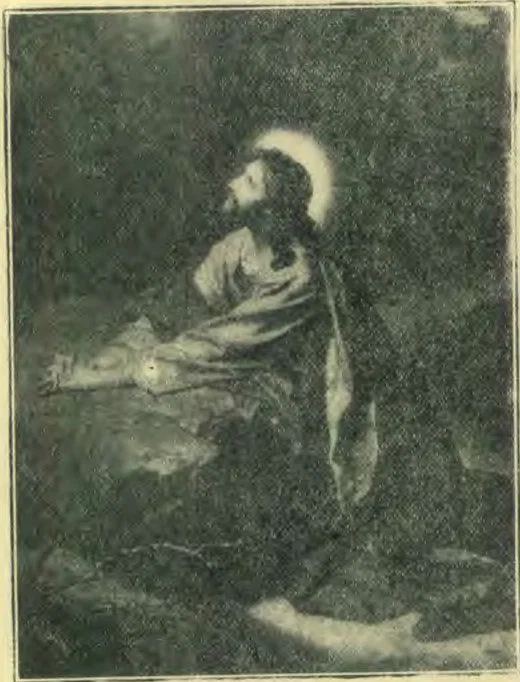
Scene in Gethsemane

THE moon was shining yet. The Orient’s brow, Set with the morning star, was not yet dim; And the deep silence which subdues the breath Like a strong feeling, hung upon the world As sleep upon the pulses of a child. ’Twas the last watch of night. Gethsemane, With its bathed leaves of silver, seemed dissolved In visible stillness; and as Jesus’ voice, With its bewildering sweetness, met the ear Of his disciples, it vibrated on Like the first whisper in a silent world. They came on slowly. Heaviness oppressed The Saviour’s heart, and when the kindnesses Of his deep love were poured, he felt the need Of near communion, for his gift of strength Was wasted by the spirit’s weariness. He left them there, and went a little on, And in the depth of that hushed silentness, Alone with God, he fell upon his face; And as his heart was broken with the rush Of his surpassing agony, and death, Wrung to him from a dying universe, Was mightier than the Son of man could bear, He gave his sorrows way—and in the deep Prostration of his soul, breathed out the prayer: “Father, if it be possible with thee, Let this cup pass from me.” Oh, how a word, Like the forced drop before the fountain breaks, Stilleth the press of human agony! The Saviour felt its quiet in his soul; And though his strength was weakness, and the light Which led him on till now was sorely dim, He breathed a new submission—“Not my will, But thine be done, O Father!” As he spoke, Voices were heard in heaven, and music stole Out from the chambers of the vaulted sky As if the stars were swept like instruments. No cloud was visible, but radiant wings Were coming with a silvery rush to earth; And as the Saviour rose, a glorious one With an illumined forehead, and the light Whose fountain is the mystery of God, Encalmed within his eye, bowed down to him, And nerved him with a ministry of strength. It was enough; and with his godlike brow Rewritten of his Father’s messenger, With meekness, whose divinity is more Than power and glory, he returned again To his disciples, and awaked their sleep, For “he that should betray him was at hand.” —N. P. Willis.

Morning Watch Observers

“THE morning hour has gold in its mouth.”
Abraham “rose up early” when told by God to offer up his only son as a burnt offering. Gen. 22:3.
Moses rose “up early in the morning” to deliver the Lord’s message to Pharaoh, before the king’s mind had been taken up with the business of the day. Ex. 8:20.
Joshua and all the children of Israel “rose early in the morning” to start on their day’s journey. Joshua 3:1.
Gideon “rose up early” to see if God had answered his prayer. Judges 6:38.
Elkanah and Hannah “rose up in the morning early” to worship before the Lord. 1 Sam. 1:19.
David “rose up early” the morning he gained the victory over Goliath. 1 Sam. 17:20.
Job “rose up early in the morning” and offered burnt offerings in behalf of his sons. Job 1:5.
Darius “arose very early in the morning,” and went to the lions’ den to see if God’s servant was still safe. Dan. 6:19.
Jeremiah rose up early that he might deliver the Lord’s messages to the people. Jer. 25:3, 4.
Our Saviour often rose up a great while before day and went into a solitary place where he might commune with his Father, and receive strength to win our redemption.
As Seventh-day Adventist young people, we may never be called upon to arise early and offer up one of our children, or even to visit a lion’s den in the interest of one who has been confined there; but we have the blessed privilege of arising early and receiving strength from the Lord for every day’s conflict with the great adversary, who now, as in the lifetime of those already mentioned, is doing all he can to destroy our souls. The morning watch, faithfully kept, and conscientiously applied to the individual circumstances of every one, will do much toward bringing success in this life, as well as preparing one for a place in the kingdom of God. The Lord says: “I love them that love me; and those that seek me early shall find me.” Prov. 8:17. This promise is for the one who seeks the Lord early in the day as well as early in life. Let us keep the morning watch.
Frank H. Mills.

A Worthy Example

For several years Brother Richard Sisley has been teaching English in Java. He not only supports himself in this way, but also several native missionaries. Elder Daniells, when in China a few months ago, ordained one of Brother Sisley’s missionaries to the gospel ministry.
Brother Sisley’s efforts for the Lord’s cause are indeed a worthy example, but what I have in mind is an incident related in a letter from him. He writes:—
“I learn many useful lessons from my heathen Chinese students. The other evening I went to teach one, and as we were sitting at the study table, he heard his mother speaking to some one, and he said, ‘Please excuse me for a moment, while I greet my mother, as I have not seen her since eleven o’clock, when I left home.’ While I was left alone, I did some thinking. How I did wish that many of our Sabbath-keeping people, especially the young, could have heard these words. They were very forcible, because his tone of voice and general appearance betokened sincerity, that scarce and priceless jewel.”
Surely the commandment to honor our parents means more than to obey them. We should love them sincerely, and cultivate that tender regard and courtesy in the home which keep the fires of love burning brightly in our hearts. M. E. KERN.

The Arrowrock Dam

THE Arrowrock Dam, in Idaho, begun in 1911, is now practically completed, having been finished a year sooner than was expected when operations were commenced. A railroad was built from Barber Junction, the nearest point on the Oregon Short Line Railroad, to Arrowrock, which is a distance of seventeen miles. From Boise to Barber is five miles, making the total distance from Boise to Arrowrock Dam about twenty-two miles by rail. This railroad from Barber to Arrowrock is the only standard-gauge railroad in the country operated by the government.
While in the office of the construction engineer at Arrowrock, I secured the following figures, which can be depended upon, as they come direct from the Department of the Interior. This information is interesting not only from the fact that a great area of desert land will be reclaimed, and thereby homes made for many families, but this dam stands out alone as being not the largest, but the highest dam in the world.
Arrowrock Dam is about 350 feet in height. The concrete used in its construction, if placed in a column ten feet square, would reach to a height of about 27 miles. About 2,500 carloads of sand and cement were used. The gates and accessories weigh 1,000 tons. The Arrowrock Reservoir, together with the Deer Flat Reservoir, will furnish a late-season water supply for about 240,000 acres of land in the Boise valley.
The soil in this section of Idaho is usually known as volcanic ash on the bench lands and sandy loam along the streams. These great stretches of bench land covered with sagebrush and presenting a very uninviting appearance, need but the magic touch of water to make the desert blossom as the rose. Hundreds of thrifty farms are being developed under this project.
Also in other places in the West the United States Reclamation Service is doing excellent work in reclaiming dry land by great irrigation systems.
Would that more government money could be spent in this way. It is estimated that the United States battleship “Arizona” will cost $16,000,000. This amount would build three great irrigation systems similar to the one I have been describing. The great European war is costing the nations involved about $75,000,000 a day. This amount, the cost of a single day, if turned to reclamation purposes, would provide homes for millions, instead of making millions homeless.
HOMER D. CASEBEER.
Continue reading: The Practical Side of Bird Life