THIS is a practical age, and the question that naturally comes to our minds is, Does it pay? Why all this fuss about birds? Wouldn’t it be time more profitably spent if we were to study how better to serve humanity?
The birds are man’s untiring employees, as well as being counted among his true friends and unsurpassed entertainers. The farm, the orchard, and the garden are their habitat. Their speech is a song.
Let’s take a single case as an example. According to the government reports, the American sparrow family, in 1910, saved the sum of $89,260,000 to the farmers in consuming weed seeds that cause great losses, as reliable figures show. Seventy-two thousand weed seeds have been found in the stomach of a single duck, which proves that a duck hunter is one of the enemies of humanity.
A few years ago the American hen was looked upon as a sort of consort for the farmer’s wife. Eggs furnished the pin money for the womenfolk. But today the chicken business totals more than $650,000,000 for meat and eggs, to say nothing of the by-products of feathers.
We fought a fierce political battle on the problem of gold, and yet that year there were $40,000,000 less gold produced than involved in the poultry business.
Eggs have gone up from two cents for a baker’s dozen of thirteen to one dollar for twelve. The latter price is often paid for specially selected eggs for high-class hotel, restaurant, and drug store trade, and fifty dollars a dozen for eggs for sitting purposes is not unusual, while a single hen is worth as much as a farm in Texas, and a married one, together with her family, often costs more than a city residence. Sonoma County, California, alone has produced more than 10,000,000 dozen eggs in one year.
Hens lay for us, but we have to provide feed for them, house them, and care for them as if they were prima donnas, for chickens and grand-opera singers are equally sensitive to the gentlest zephyrs, and both are temperamental.
Birds work for us so faithfully that every time a hen cackles or a rooster crows over the fact that they annually add $650,000,000 to our wealth, the little birds snicker te-hee and sing of their glorious work, accompanied by nature’s symphony orchestra, for they have saved us $1,000,000,000, and cost us little effort and less money for food and shelter.
Chicken shows are more numerous and more profitable than a circus. Why not have a bird show? We have our Arbor Day to plant trees; now what is needed is to make April 9 our national bird day.8
Bird farming is one of the great industries of the future. Just as fox farming has produced $16,000,000 profit in the last two years, so will the wild birds prove veritable Klondikes to the wise men of the near future.
As the new practice of medicine is based upon prevention rather than cure, the bird life of our community ought to be studied with care, for here are to be found the natural enemies of many disease-bearing insects. “Even the nighthawks,” says the Philadelphia Farm Journal, “are great sportsmen, and are such expert aeronauts that no winged insect is safe from them. They contribute greatly to the healthfulness of the section where they live, by disposing, in a most elective and hygienic manner, of several species of mosquitoes, among them the Anopheles, the transmitters of malaria. Nighthawks belong to the whippoorwill family, and subsist entirely upon winged insects, which they capture while gracefully sailing around at eventide.”
The common barn owl lives on rats, mice, beetles, shrews, gophers, and other undesirable squatters in the fields that are intended for corn, wheat, oats, and other food grain. So owl farms are not an iridescent dream.
The National Association of Audubon Societies is doing a wonderful work in the field of research, gathering the facts, and classifying them; and from this mass there is coming into use several new sciences, much useful, practical knowledge, and a greater love for nature. Its national headquarters are at 1974 Broadway, New York City, and a card to that address will bring much valuable information about this movement.
On Jan. 1, 1913, Mr. Wilmer Atkinson, editor of the Farm Journal of Philadelphia, organized the Liberty Bell Bird Club, with one member. On Feb. 1, 1915, the club had 300,000 members. Its sole object is to save the song and insectivorous birds, and it asks the cooperation of every bird lover.
The need of such a club is readily seen when the government reports are studied, and we find that ninety per cent of the bird life in this country has been destroyed, and that $1,000,000,000 a year is lost by the farmers and fruit growers through the ravages of insects.
We read with ever-refreshing interest the story of the plagues of Egypt that Pharaoh encountered thousands of years ago, quite forgetful of the fact that in one year the birds of Massachusetts alone consumed 21,000 bushels of insects.
The Liberty Bell Bird Club has brought the battle for birds before about 4,000 county superintendents of schools, 125,000 teachers, and has introduced bird study into more than 7,000 schools. There are no dues, no assessments, no fines, no fees, no expenses of any kind. All that is asked is valiant service for the birds.
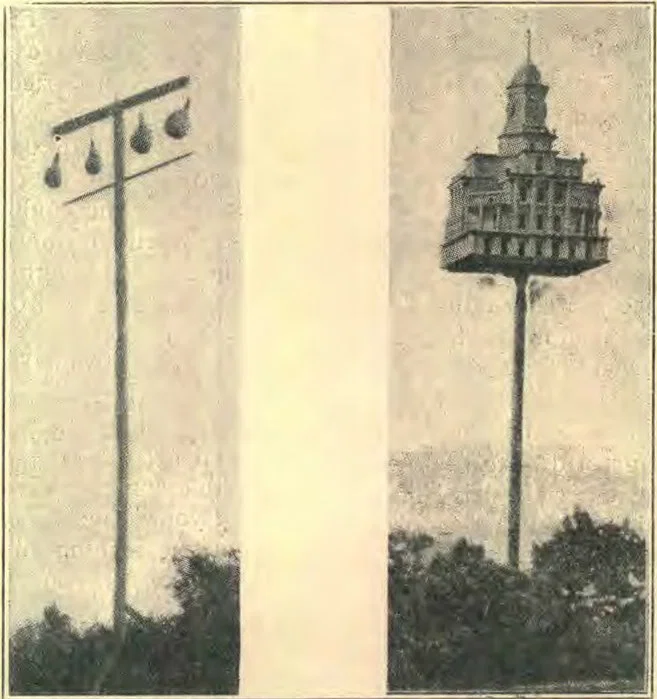
Can we bring back the birds? The Saturday Evening Post some time ago devoted a half page to that very subject, describing how J. Warren Jacobs, of Waynesburg, Pennsylvania, conceived the notion that even departed birds would “come back” to their old haunts, in spite of steam whistles, quarry blasts, and the general racket of forge and factory, if given an intelligent welcome; so in 1896 he built a bird house, designed with a view of attracting martins. This mansion contained twenty rooms, and great was his delight when he discovered an old scout flying around on an investigation tour; and as he saw “to let” on every side, he was not long in deciding to move in.
He hastened away to lead his good mate to their new home. The next day Mrs. Martin inspected every room in the house while Mr. Martin sat on the chimney of his new home looking for neighbors; and in less than a week there were eight couples in Jacobsville, as the martins called it. At that time there were less than two dozen martins in Waynesburg. Last year 1,200 of them left there about the twenty-eighth of August for their flight south to the West Indies or to Central and South America.
On Sept. 17, 1908, 25,000 of these real aviators were gathered from all parts of Pennsylvania, West Virginia, Ohio, and States still farther north, and they halted for the night at New Martinsville, West Virginia, an Ohio River town about forty miles south of Wheeling, which if it wasn’t named in their honor deserved to be; at any rate they took the city. They had gathered for their flight south.
The martin is the friend of man as man is the friend of the martin. The noble red man of the forest was the first to build a rude house for him, and it was he who started the evolution that has changed the martin’s home from a hollow tree to a house built after all the modern plans of architecture.
The pictures of the Jacobs martin house are worth studying. That prince of men, philanthropist, and friend of the race, at Detroit, Michigan, Henry Ford, the manufacturer, has ordered a dozen of these bird mansions for his home and factories. He knows the pleasure that the purple martin brings to those who watch its busy life. Wm. Rockefeller has six of them at his Bay Pond, New York, home. Mrs. Potter Palmer has one in Florida, where she migrates during the cold weather. Two thousand others have these bird mansions on their private property. City parks and public places are dotted with them. They are shipped to all parts of this country. Russia, before the war, was a constant buyer of purple-martin mansions.
Mr. Jacobs has a bird-house factory—his business is a profitable one. It is only in its infancy. There is a great future for the manufacturer of bird houses as a business.
Mr. Jacobs says: “The purple martin is today at the threshold of a stimulating and prosperous advance, which during the next few years will spread its progeny over territory where it has not been seen for years. A large amount of correspondence during the past few years shows a widespread desire and longing to reestablish the martin in communities from which the birds long ago departed.”
In Illinois we have a State law that compels the teaching of kindness to birds and animals in our public schools. We see the value of teaching the young that we are past the age of barbarity, and that we have learned a part of our lesson from the story of the buffalo.
Mr. Ford, the Automobile Manufacturer, and His Birds and Bird Mansions
When a man with as many diversified interests as those which daily confront Henry Ford, the much-written-about automobile builder, can take time from his many activities to give his personal attention to the better protection of song and insectivorous birds, it is time for most of us to give thought to this great economic problem. Mr. Ford has a farm of four thousand acres that is situated at Dearborn, Michigan, about ten miles9from Detroit. The Rogue River flows through it, and Mr. Ford has had it dammed to make a wider series of drinking places for the birds. He has placed about five hundred bird houses in this bird haven, and he finds no trouble in keeping his houses occupied.
He has many houses and feeding stations arranged, and the thick undergrowth, and the big roots from fallen trees, are all good shelters, but especially fine is an arrangement of rails and cornstalks. Fence rails, some distance apart, are laid on the ground, then a layer crosswise, and so on until a series of five or six rows is made. Around and on top of these rails are placed cornstalks until the rails are entirely covered. A better shelter can hardly be made. The birds work in through the stalks, and there is always plenty of dry and warm spaces between the rails. The water cannot get through, and food is thrown between the rails. Hundreds of birds can use these throughout the winter.
In the spring the shelters are burned, and new ones are built in the fall. These cornstalk shelters are from ten to thirty feet long.
It is a great sight to see the motor cars leaving Detroit for the Ford farm, loaded with food for the birds, and to follow them to the places where this food is placed so his little feathered friends can banquet on grain, seeds, suet, doughnuts, and hot cakes, and to hear their little twitters of delight and songs of thankful praise for these favors.
KIND OF HOUSE THE INDIAN BUILT. KIND MR. FORD BOUGHT. THESE HAVE SEVENTY-TWO ROOMS.
Their menu reads like this: Rolled oats, cracked wheat or cracked corn, hemp, millet, or sunflower seeds. Flapjacks are hung on the trees; doughnuts are put where they can be easily found to finish up a short-order lunch. Suet is provided in big quantities, and is placed in wire cages so it cannot be carried away in large pieces. The grains are placed on the trays in the feeding stations, in boxes, thrown under the cornstalk shelters, and, for shy birds, scattered on the ground under the feeding houses. The feeding is done daily, and the birds visit the stations in flocks, and eat up the supply clean.
A daily report shows the feeding stations were visited by 100 myrtle warblers, 110 song sparrows, 150 juncos, 41 white-throated and white-crowned sparrows, 98 tree sparrows, 204 goldfinches; also by many white-breasted nuthatches, downy woodpeckers, robins, and larks. Many other varieties are expected to stay there this coming winter.
Thousands of wild berry plants have been set out for the birds, and, for the ducks and shore birds, wild rice has been planted in the swamps. Many of these, like the mergansers, stay all winter.
Water is provided in winter. Mr. Ford has built a box with an electric heater, which keeps the water tepid. No bird suffers from thirst on the Ford farm.
The fifteen or more feeding stations are all securely built. The trays are at the top, so that the birds can eat in comfort. The rain and snow cannot reach the food.
The Ford farm is not a show place. There is not a caged bird on the farm. The farm is for the birds, and every effort is made to make it an ideal breeding place for them.
The birds have become very tame, and some are absolutely fearless. The wrens and woodpeckers build right up to Mr. Ford’s bungalow, and in a strip of ground thirty by two hundred feet, near the bungalow, there were found twenty-three nests of fifteen varieties of birds.
All the native birds of Michigan are on the farm, and many others. Prairie chickens, quails, and pheasants are there, and rapidly multiplying.
If you are interested in this story of Mr. Henry Ford’s bird farm, send a post card to the Ford Automobile Factory at Detroit, and ask for the literature that this great-hearted humanitarian has gathered, and he will mail it to you free of charge. I know, for I tried it.
Uncle Sam and the Birds
So important are the birds that the Agricultural Department of our national government has led in the research work that has wrought such wonders in recent years. The scientific information that is the basis of our bird knowledge, is largely due to the fostering care given to this great movement by those in authority.
The department has issued many valuable and practicable booklets, pamphlets, and bulletins that are accomplishing wonderful results. The general diffusion of practical ways of protecting the song and insectivorous birds is already felt as an economic factor.
The department has just completed the 1915 bird census, the most complete ever taken. It shows that the robin heads the list as the most numerous bird in America, with the English sparrow as second. In the Northwestern States there is an average of six pairs of robins for each farm of fifty-eight acres.
On each acre of farm land covered by the census there was an average of one pair of birds. The record of density came from Chevy Chase, Maryland, a suburb of the national capital, where one hundred and sixty-one pairs were found nesting on twenty-three acres. Thirty-four species of birds were represented.
The present bird population, it is pointed out, is much smaller than it ought to be, having in mind the fact that birds feed largely on insects. It would be a very easy matter to increase the number of birds to almost any desired figure, by more protection and better care.
“It is an interesting fact disclosed by the government census,” says the Christian Science Monitor, “that breeding birds prefer thickly inhabited centers of population to forests. This gives mankind a larger10responsibility for the preservation of bird life than it was before supposed to have. In other words, the census shows that the widespread belief that the human family and birds are in any sense antagonistic is not true.”
The department has issued a bulletin announcing the result of the census of 1915. It is very interesting, and is ready for distribution.
Our humane societies are aimed at the abuse of animals. They are great organizations, and do a great work. They are humanizing the human race, for no man can love his wife who is cruel to his horse; and if he is brutal to his dog, it’s a sure thing that the children know not the warmth of the tender heart of real love. The way to prevent cruelty is to teach the beauty of love and the power of kindness. An anti-cruelty society is a first step and a necessary one, but for permanent results we must circulate just such little eye openers as the book “Our Dooryard Friends,” with its philosophy, which might be termed the gospel of the larger love. There is only one gospel that every creature can understand, and that is the gospel of love.
— Fred High, in “Our Dooryard Friends.”
November: Poetic Reflections on Autumn's Close
November
What pensive beauty autumn shows,
Before she hears the sound
Of winter rushing in, to close
The emblematic round!
—Wordsworth.
Talk not of sad November, when a day
Of warm, glad sunshine fills the sky of noon,
And a wind borrowed from some morn of June,
Stirs the brown grasses and the leafless spray.
—J. G. Whittier.
Still thy winds, O wild November; let their angry music sleep!
Give us sabbath o’er the city; hush thy tempest on the deep!
—David Gray.
Sharp winds the arrows are, with which I chase
The leaves, half dead already with affright;
I shroud myself in gloom; and to the race
Of mortals bring nor comfort nor delight.
—Longfellow.
Yet one smile more, departing distant sun,
One mellow smile through the soft vapory air,
Ere o’er the frozen earth the loud winds run,
Or snows are sifted o’er the meadows bare.
—Bryant.
The warm sun is failing, the bleak wind is wailing,
The bare boughs are sighing, the pale flowers are dying,
And the Year
On her deathbed, in a shroud of leaves dead,
Is lying.
—Byron.
Harriet’s Victory
By Margaret Phillips
“DEAR sakes, school is out next week! I reckon you can ’most hear your heart beat now when you stop to think how soon you’ll get to see your old father,” said Aunt Betty, as every one loved to call her, to her young boarder, the village school-teacher.
“I remember once, when I was a girl, we lived on a big farm out across the prairie. Father and mother worked hard and sacrificed a great deal to keep us in school. That year times were especially hard on the farm, and one day I overheard father say: ‘I don’t see how we can send both the children to school this year. Betty’s getting older now, and ought to have better clothes; and there are the books to buy. I don’t see where it’s all coming from.’ How my heart sank! I could feel it beating clear down to my toes; but the very next day a letter came from father’s only sister, who lived in the city, begging him to let me come and live with her that winter and go to school. Her husband and her only child had died many years before, and she lived in the big house all alone. She was growing old and lonely, and wanted some one besides a servant to be company to her.
“I can remember,” continued Aunt Betty, “how anxious I was for father to let me go. I thought it would be something wonderful to go away from home, and live in a big house, and be ‘a lady.’ But after I had been there awhile, how homesick I got! How I did long to see the old farm again, and get back into the little kitchen and help mother with the pies and the doughnuts, and help Bob gather the eggs! Staying around dressed up all the time and being ‘a lady’ wasn’t half so wonderful as I thought it would be.
“I’ll never forget how happy I was when school was out, and father said they couldn’t get along without me; and do you know, it was such a comfort to know I was needed!”
“There, I mustn’t bother you any more. Run along now, child, and write that letter to your father. I just know he’s counting the hours till you get home to take charge of things. I’ll write up those recipes you liked so well, and if your father is like my John, he’ll like them, too. It’ll remind him of the days when your mother used to cook for him.”
Harriet Grey rose from her chair and walked quickly to her room. “I don’t see why Aunt Betty talks that way,” she said impatiently to herself. “She knows I just hate housework, and the very thought of staying in that stuffy old house all summer is enough to drive one wild. Besides, I’ve already promised the Daytons I’ll go with them to their summer home in the mountains. Everything is planned. I know we’ll have a delightful time, and I couldn’t disappoint them; and then, I need the rest, too.
“I told father,” she reasoned, trying to still her conscience, “that I could be home only a week, for Clara has insisted that I spend the rest of the summer vacation in the city with her.”
“I’m too tired to finish that letter tonight,” she sighed. “It will have to wait till tomorrow.” She closed her eyes and tried to sleep, but sleep would not come, for Aunt Betty’s words kept ringing in her ears. She could see her tired father coming home from his office with no one to greet him but the crabbed old housekeeper. She could see him sitting alone in his little study with no one to help him while away the lonely hours. At length sleep came, but only to dream her thoughts over and over again.
The next morning after breakfast, noticing how pale she looked, Aunt Betty said, in her sympathizing way: “Now, Miss Grey, you mustn’t think so much about going home that you don’t sleep well nights, for you’ll need all your strength taking care of your father this summer. It will do you a heap of good, too; for you do need a change, and housework will be a rest after teaching all winter.
“Don’t forget your lunch. I’ll declare if you’re not getting to be just as I was; so anxious to get home you can’t remember anything,” laughed Aunt Betty as she closed the door after the young teacher.
Never had Harriet passed through such a long day. Never had such a fierce struggle gone on within her heart. But the victory was won, and peace once more reigned.
That evening letters were written to the Daytons and to Clara, telling them that her plans had suddenly been changed, and that she was going to spend the summer with her father and could not accept their kind invitations. Just a short note was written to her father, telling him when to meet her.
“I’ll save the rest till I see him,” she softly said to herself. The remaining days flew by, and before she realized it she found herself at the home station. Yes, there was father, but how tired and thin he looked!
“O father, I’m so glad to be home again!” she cried. “I’ve been selfish and wicked, but the dear God has forgiven me, and now if you only will, my cup of happiness will be full. I’m going to stay home all summer, and we are going to have such good times together, you and I, aren’t we, father dear?”
His heart was too full for words; but as he folded her in his arms, he whispered, “O Harriet, you are just like your mother.”
How guilty she felt to think she could have been so selfish, and as she knelt by her bedside that night she prayed that God would make her the unselfish, loving daughter she ought to be.
MARGARET PHILLIPS.
“The Man Who Bossed Johnson”
A WAY back in—well, never mind, it’s a good while ago—I was a red-headed boy in a machine shop. I was about eighteen, and had nearly served my time, and wanted a foremanship more than I wanted anything else in the world. You laugh at my wanting to be a foreman before I’d finished my time, but if the truth were known, that’s about the ideal of all youth at that age. They don’t say so,—I didn’t then,—but that’s about it; and it’s a good, legitimate ambition.
We had a traveler who sold nearly all the product of the shop, and it was currently reported that he had graduated from the shop and was getting three thousand dollars a year and doing just as he pleased. Every time he came in from the road, he would come out in the shop and shake hands with every man and boy there. Then he would go around again with the proprietor, discussing the work and looking after the details of his orders, and what he said always went with the proprietor. You’d think that he owned the shop, and the proprietor was the superintendent, if you didn’t know.
Well, I looked on Van as a prince. When I got tired of imagining myself as foreman, I would sometimes wonder if I should ever earn as much as Van. $3,000 a year! And I was getting $1.60 a day. Three thousand dollars was untold wealth to me.
One morning I was in a fearful temper, discontented with myself and the world. Some of the men had sprung some old jokes that morning, and I had bit on all of them. Naturally, that hadn’t helped any. Van came up behind me.
“Well, Reddy,” he said, “when are you going to be foreman?” Then he sat down and drew me out. Finally he said: “You can be foreman, either of this place or of some other, just as soon as you’ve had sufficient practice in bossing men. Everybody wants foremen and superintendents and salesmen, and all you’ve got to do is to start in and practice as you did on the lathe and planer.”
“How can I practice? I’m only an underling here; everybody tells me what to do, and I’ve got to do it. They can practice on me all right—most of them are doing it good and plenty. How am I going to get anyone to practice on?”
“Well, Reddy, there’s one man whom you can practice on; that’s Johnson.”
“Me?”
“No, not you, but Johnson. Every man has two pretty distinct personalities in the one body. One is energetic, ambitious, likes to do right and get along—that’s you. The other is careless, shiftless, lazy, and fond of a good time—that’s Johnson.”
“Now what you’ve got to do is to learn to boss Johnson, and you’ll find it will take a lot of practice. When you get so that you can boss Johnson successfully,—keep him right up to the mark all the time and keep him good-natured about it,—then, and not till then, you’ll have the skill and practice to boss more than one man. Now there’s the man for you to practice on.”
“Will you do it? Shake hands! I feel sorry for Johnson, for he’ll have to stand it. I’m going to be around here for a week, and I’ll start you right. I’ll tell you what to do, and you can tell Johnson, just as the proprietor gives his orders to the superintendent, and you get them from him. That completes the chain and makes it a working agreement.”
Well, I was just boy enough so that the idea pleased me. Van would come and say, “Reddy, tell Johnson to do this, and keep after him; see that he does it.”
In the course of a week I began to like the game. I also found out a lot of things I had never suspected. As Reddy, the foreman, I used to pull myself up as Johnson, the workman, and, according to Reddy, Johnson was a good deal of a slob. Van went on the road, and I kept after Johnson night and day. I ordered him to bed and ordered him up. I checked up on his work, and I made him study. As Reddy, the foreman, I thought less of myself as Johnson, the workman, until my opinion of Johnson was at a pretty low ebb. I noticed that the proprietor was watching me a good deal, and I began to be afraid that Johnson would get his discharge. So Reddy drove Johnson harder than ever.
One night I went to a lecture, and I heard two persons in front of me talking. One had been away, and he said, “How’s Reddy Johnson doing?” “Fine,” said the other; “he’s assistant foreman at the shops now, in charge of the erecting, with from three to ten men under him all the time.”
I heard no more of the lecture. Was I foreman? When had I become foreman? How long had I been foreman? When the new wing was put up six months before, I was put to work in it with some helpers, and my wages had been raised then.
Yes, I had been foreman for six months, and was so busy bossing Johnson I hadn’t noticed it; had to have outsiders tell me about it.
Six months later I was offered a superintendency of another factory at about double the wages, and the firm advised me to take it, saying that I could come back if I didn’t make good. That aroused all the fight in me, and I made good. I think every red-headed man is sensitive to insinuations.
I kept on bossing Johnson until I made a salesman out of him. Now I own some works myself. I am as far ahead of Van’s $3,000 a year as I was behind it when I started. I haven’t had a salary for twenty12years. In my own works I have a number of boys that have started to practice on themselves till they are able to hold a foreman’s job, and there are some others scattered around getting experience that I’ll get back when I want them.
The scheme is working as well with them as it did with me. You see, it’s fundamental. It starts the boy right, and gives him the idea of self-control from the beginning. That’s all that makes the difference between the proprietor and the employee: one can boss himself, the other can’t. It’s an old idea. The Bible teaches that he that is master of himself is greater than he that takes a city.—Selected.
The Cat’s Tea Party
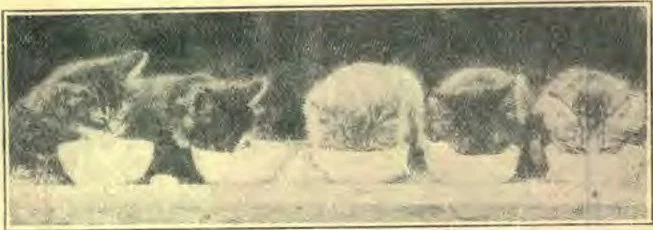
FIVE pretty little pussy cats, invited out to tea,
Cried, “Mother, let us go, oh, do! for good we’ll surely be!
We’ll wear our bibs, and hold our things as you have shown us how—
Spoons in our right paws, cups in left, and make a pretty bow;
We’ll always say, ‘Yes, if you please,’ and, ‘Only half of that.’
“Then go, my darling children,” said the happy mother cat.
The pretty little pussy cats went out that night to tea,
Their heads were smooth and glossy black, their tails were swinging free.
They held their things as they had learned, and tried to be polite;
With snowy bibs beneath their chins, they were a pretty sight.
But oh! alas for manners good and coats as soft as silk!
The moment that the little kits were asked to take some milk,
They dropped their spoons, forgot to bow, and oh! what do you think?
They put their noses in their cups and all began to drink!
Yes, every naughty little kit set up a mew for more,
Then knocked the teacups over quick and scampered through the door.
— Selected.
The Singapore Junior Society
By K. M. Adams
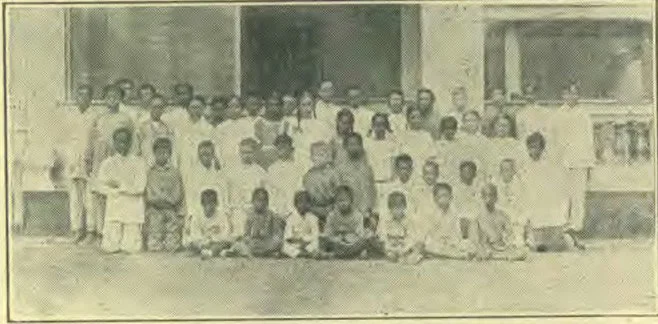
WHEN the Singapore training school was begun, it was thought best to organize a Junior Missionary Volunteer Society for the students, so they could have their own officers and conduct their own programs.
There are forty-four of the younger members of the school in the society. As many of the older ones do not speak English, they cannot take an active part in the meetings, but they do their part in the missionary work.
We have our meetings for one hour every Wednesday morning at chapel time. There are readings, songs, recitations, and talks, just as in the societies at home. One feature we have is a quartet of Battak boys. We have them sing hymns, and they do very well, too.
One morning a program was held on “Kindness to Animals.” At its close, pledge cards were handed out, and every one signed his name. On another morning a testimony meeting was held, and with one or two exceptions all took part. It was interesting to see the children of many nationalities stand and tell of their love for Jesus.
SINGAPORE JUNIOR SOCIETY
They are all eager to give away papers and tracts, almost too eager. One day I went to the tract society office and brought a large armful of old papers and tracts to school, thinking that they would last a long time. When I told the students about them, they seemed glad to get them, and in a few minutes they were all gone. I thought that possibly the papers were being wasted, so next day I cautioned the children about giving papers to those who could not read, and told them not to put them in a yard or house, but into some one’s hands. I got another load of papers and tracts, but they went as fast as the first. The next day some boys came to me and said, “I gave away twenty papers yesterday.” Another said, “I gave away twenty-five.” One boy who does not go to our school, but who is friendly with many of our boys, came riding up on his wheel that afternoon, and said he wanted some papers, too.
I shall give you a report of the first month’s work:—
Papers mailed, lent, or given away .......... 270
Books lent or given away ....................... 6
Tracts lent or given away ....................... 627
Articles of clothing given away ............... 84
Bouquets given away ............................. 6
Scripture cards given away ...................... 7
These children are as anxious as any to hasten the coming of our Saviour. Pray for them, and for their work, that it may bring fruit into the garner.
K. M. ADAMS.
*Singapore, Straits Settlements.
Missionary Volunteer Reading Courses
Senior No. 9 — Lesson 10: “History of the Sabbath,” Pages 479-560
1. WHY are the following names and dates important: Arianism? Clovis? Pepin? Alcuin? Saxons? Peter Damianus? Matthew Paris? Innocent III? Gregory IX? 476? 538? 910?
2. What did the following councils do to obtain strict Sunday observance: First council at Orleans? second council at Macon? council at Narbonne? Council of Paris?
3. How were stories of miracles used to frighten the people into strict Sunday observance?
4. In what countries may Sunday observance during the Middle Ages be traced?
5. What was the “Truce of God”?
6. What part did false letters and rolls play in enforcing Sunday laws?
7. What conditions prevailed among bishops and people at the beginning of the thirteenth century?
8. Do you see any benefits derived by the diligent Sunday legislation?
9. Why have we so little history of the Sabbath during the Dark Ages?
10. Who was Columba? What day did he keep? Tell the story of Iona. What became of the Culdees?
11. How did the Papacy try to stamp out the Sabbath among the Jews? in Bulgaria?
12. Who were the Athingians? Who were the Pasaginians? What Biblical truths did they hold? What shows that they were Bible students?
13. How did Pope Innocent III treat the so-called heretics? What was the Inquisition?
1. WHERE did Jesus go when he was twelve years old? Describe the journey.
2. How was the Passover celebrated? How were the first fruits gathered and presented to the Lord? What was the Feast of Unleavened Bread?
3. Why was the Passover of special interest to Jesus?
4. Why did not Joseph and Mary travel home with the13caravan? What thought must have come to them on their way back to Jerusalem? Why were they astonished when they found Jesus with the lawyers? What shows that Jesus was obedient to his parents?
5. Why did the nobleman go to Cana to see Jesus? How did Jesus test him? How was his faith rewarded?
6. How did Jesus bring great joy into the home of Jairus? What shows the faith of the woman he healed on the way to the home of Jairus?
7. What little girl did Jesus walk one hundred and fifty miles to heal?
8. Why were children attracted to Jesus? How did he show that he loved them? What did children do for Jesus when he came to Jerusalem for his last Passover?
9. How can Jesus be a friend of boys and girls today? What will he do for the children who love him? Where will he take them soon?
10. Learn the beautiful poem at the close of this book.
11. Write a short story about Jesus as a boy.
12. Tell one thing about Mt. Moriah, Bethlehem, Nazareth, Shechem, Shiloh, Dothan, Abraham, Seth, Hazael, Augustus Caesar, Herod, Joash, Jehoiada, Simeon, Anna.
Missionary Volunteer Society Programs for Week Ending December 11
1. REVIEW Morning Watch texts. Have a short paper on “Esther.”
2. Reports of working bands.
3. Bible Study: “The Grace of Giving.” See Gazette. Juniors read “Maggie’s Crutches,” in Gazette; and “Fido and the Collection,” in this INSTRUCTOR.
5. Have a talk or paper on “Beginnings in Manchuria.” Read the articles on this subject in the Gazette; also “Headquarters for Manchuria,” in this INSTRUCTOR. See also “An Outline of Mission Fields,” page 133. Use your map.
6. Recitation for Juniors: “Two Pennies.” Mission Reading: “First Baptism in Manchuria.” See Gazette.