Your ShelfYour Projects

Signs of the Times, Vol. 26, No. 16.

AS IT WAS IN THE DAYS OF NOE
Earlier text: Literal Translation of the Greek New Testament

LESSON IV.—SABBATH, APRIL 28, 1900.

THIRD MEETING WITH THE DISCIPLES.

Sea of Galilee, A.D. 31.
Lesson Scripture, John 21:1-23, R.V.
After these things Jesus manifested Himself again to the disciples at the Sea of Tiberias; and He manifested Himself on this wise. There were together Simon Peter, and Thomas called Didymus, and Nathanael of Cana in Galilee, and the sons of Zebedee, and two other of His disciples. Simon Peter saith unto them, I go a-fishing. They say unto him, We also come with thee. They went forth, and entered into the boat; and that night they took nothing. But when day was now breaking, Jesus stood on the beach; howbeit the disciples knew not that it was Jesus. Jesus therefore saith unto them, Children, have ye aught to eat? They answered Him, No. And He said unto them, Cast the net on the right side of the boat, and ye shall find. They cast therefore, and now they were not able to draw it for the multitude of fishes. That disciple therefore whom Jesus loved saith unto Peter, It is the Lord. So when Simon Peter heard that it was the Lord, he girt his coat about him (for he was naked), and cast himself into the sea. But the other disciples came in the little boat (for they were not far from the land, but about two hundred cubits off), dragging the net full of fishes. So when they got out upon the land, they see a fire of coals there, and fish laid thereon, and bread. Jesus saith unto them, Bring of the fish which ye have now taken. Simon Peter therefore went up, and drew the net to land, full of great fishes, a hundred and fifty and three; and for all there were so many, the net was not rent. Jesus saith unto them, Come and break your fast. And none of the disciples durst inquire of Him, Who art Thou? knowing that it was the Lord. Jesus cometh, and taketh the bread, and giveth them, and the fish likewise. This is now the third time that Jesus was manifested to the disciples, after that He was risen from the dead.
So when they had broken their fast, Jesus saith to Simon Peter, Simon, son of John, lovest thou Me more than these? He saith unto Him, Yea, Lord; Thou knowest that I love Thee. He saith unto him, Feed My lambs. He saith to him again a second time, Simon, son of John, lovest thou Me? He saith unto Him, Yea, Lord; Thou knowest that I love Thee. He saith unto him, Tend My sheep. He saith unto him the third time, Simon, son of John, lovest thou Me? Peter was grieved because He said unto him the third time, Lovest thou Me? And he said unto Him, Lord, Thou knowest all things; Thou knowest that I love Thee. Jesus saith unto him, Feed My sheep. Verily, verily, I say unto thee, When thou wast young, thou girdedst thyself, and walkedst whither thou wouldest; but when thou shalt be old, thou shalt stretch forth thy hands, and another shall gird thee, and carry thee whither thou wouldest not. Now this He spake, signifying by what manner of death he should glorify God. And when He had spoken this, He saith unto him, Follow Me. Peter, turning about, seeth the disciple whom Jesus loved following; which also leaned back on His breast at the supper, and said, Lord, who is he that betrayeth Thee? Peter therefore seeing him saith to Jesus, Lord, and what shall this man do? Jesus saith unto him, If I will that he tarry till I come, what is that to thee? follow thou Me. This saying therefore went forth among the brethren, that that disciple should not die; yet Jesus said not unto him, that he should not die; but, If I will that he tarry till I come, what is that to thee?
1. What is the evidence of the disciples' readiness in this instance, and in what particular way did the Lord make provision for their present necessities? How does this match the law of God (Deut. 15: 14; 16: 10, 11)?
2. What did the disciples recognize, and what was the effect of this on Peter? Did he remember his old work? How does this connect to-day's work for the Master in His harvest field? What other service did he render in the boat?
3. What was the effect of the guarding of the flock after the betrayal? What was the meaning of the Lord's question? What is it to go after the lost? Were other disciples concerned? What reminders of past failures and boasts come to light, and what made the change?
4. In what way did the Lord's questioning of Peter relate to his being re-commissioned? How? But the work is not merely a lesson of service, but a deep, personal relationship. What is it to follow the Lord? How can we learn from this that the work we do is only by the grace of the enemy's conqueror?
5. What is the meaning of that which is said of the disciple and your relationship to Christ in this communion? What is the indication of the Lord's will in the last commission to Peter, and also regarding those who wait?

LESSON V.—SUNDAY, APRIL 29, 1900

JESUS AND JOHN THE BAPTIST.

Lesson Scripture, Luke 7:18-28, R.V.
18 "AND the disciples of John told him of all these things. 19 And John calling unto him two of his disciples sent them to the Lord, saying, Art Thou He that cometh, or look we for 20 another? And when the men were come unto Him, they said, John the Baptist hath sent us unto Thee, saying, Art Thou He 21 that cometh, or look we for another? In that hour He cured many of diseases and plagues and evil spirits; and on many 22 that were blind He bestowed sight. And He answered and said unto them, Go your way, and tell John what things ye have seen and heard; the blind receive their sight, the lame 23 walk, the lepers are cleansed, and the deaf hear, the dead are raised up, the poor have good tidings preached to them. And blessed is he, whosoever shall find none occasion of stumbling in Me.
24 "And when the messengers of John were departed, He began to say unto the multitudes concerning John, What went ye out into the wilderness to behold? a reed shaken with the 25 wind? But what went ye out to see? a man clothed in soft 26 raiment? Behold, they which are gorgeously appareled, and live delicately, are in kings' courts. But what went ye out to 27 see? a prophet? Yea, I say unto you, and much more than a prophet. This is he of whom it is written,
"Behold, I send My messenger before Thy face, Who shall prepare Thy way before Thee.
28 I say unto you, Among them that are born of women there is none greater than John; yet he that is but little in the kingdom of God is greater than he."
NOTE.—The lesson section this week includes the whole story of John's message and Jesus' discourse thereon, in Matt. 11:2-19 and Luke 7:18-35.
Golden Text: "He hath done all things well." Mark 7:37.

SUGGESTIVE QUESTIONS.

(1) In what way did John learn of the work Jesus was doing? V. 18. Note 1. (2) Whom did John call to him at one time? To whom did he send them? What question were they to ask Jesus? V. 19. Note 2. (3) What did these men say when they met Jesus? V. 20. (4) Instead of answering their question directly, what did Jesus begin to do? V. 21. (5) What command did Jesus then give to John's disciples? What were they to tell John? V. 22. Note 3. (6) What did Jesus say of those who should not stumble because of Him? V. 23. (7) When John's messengers had departed, what did Jesus begin to do? What question did Jesus ask His hearers concerning John? V. 24. Note 4. (8) What else did He ask them concerning their visit to John in the wilderness? Why would they not expect to find in the wilderness a man dressed in fine apparel? V. 25. (9) Repeat the Saviour's third question to His hearers. How did He answer His own question? V. 26. (10) What did the Saviour then plainly say of John? In making this declaration, what did Christ really imply concerning Himself? V. 27. (11) What did Christ say of John's greatness as compared with men of this world? How does his greatness compare with that of heavenly beings? V. 28. Note 5.

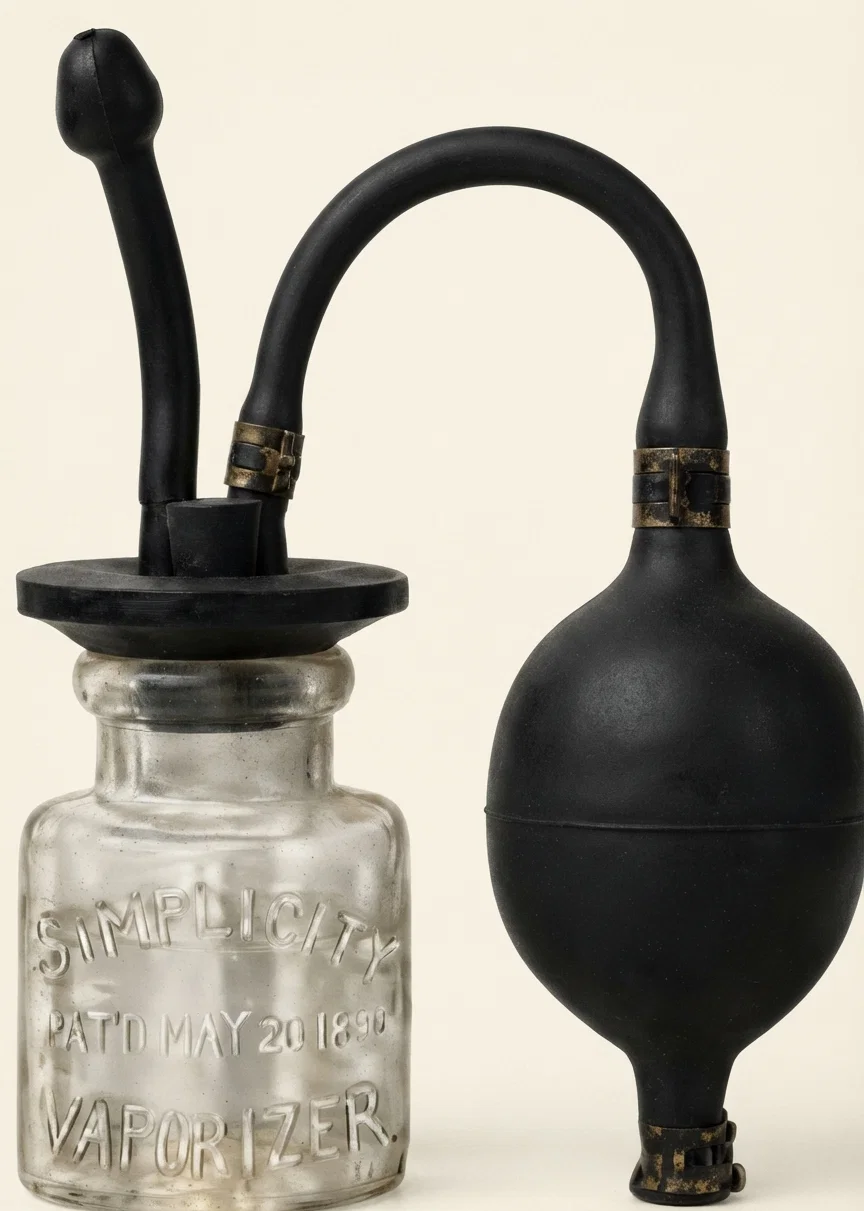
SIMPLICITY VAPORIZER

Agents' Outfit, $1.00

Good Agents Wanted in every town in the country to represent the

SIMPLICITY VAPORIZER

Recommended by eminent physicians for the treatment of catarrh, coughs, colds, sore throat, bronchitis, etc.
A necessity in every family. If you haven't a cough or catarrh now, get a Vaporizer. "Prevention is better than cure."
Special Offer.—Any one sending $1.00 will receive one Simplicity Vaporizer with medicine and list of formulas post-paid.
Order now as this offer will not appear again.
Good profits to good agents. Send for agents' wholesale prices.
A few extracts from agents:—
"Please send me one dozen Simplicity Vaporizers. I disposed of the last order quite readily. The instruments are all right."
"Send me another dozen instruments. I sold five in one afternoon."
"Please send me one dozen Simplicity Vaporizers at once. I have eight orders now. They sell fine."
"Please find money order for ¼ dozen more. If I can get one or two more to give the satisfaction the first one did, I know I can do a rushing business, although I never did a bit of canvassing in my life."
Names and addresses are omitted to save space. If others can have success, you can, too. Try it, but be sure to order now.
Address ALFRED MALLETT, 39 Bond St., New York
Mention SIGNS OF THE TIMES

TO CONTRIBUTORS.

THE SIGNS OF THE TIMES is a purely missionary enterprise. For this reason it has felt free to ask for contributions from its friends. It pays nothing for contributions, either prose or poetry, unless solicited by the editor, and then the fact is stated when the articles are asked for. This is a plan rarely followed, but sometimes deemed expedient.

Articles Desired.

Those which set forth in the Spirit of Christ the great saving truths of God, short and to the point. It is better to treat one important truth clearly, in a short article, than many points vaguely in a long one. We desire no caustic, critical productions, which might minister to personal pride or pleasure, but can not save souls.

How Prepared.

Write plainly, with typewriter or ink, with wide space between the lines, to freely admit of editing, writing of subheads, etc. Write on one side of the sheet only. Sign the name to the manuscript, as it becomes oftentimes separated from accompanying letter. Anonymous contributions are not used, whatever their merit. If the writer does not wish his name to appear, let him furnish a pseudonym for the public. But we wish the name.

Manuscript Returned.

We will return all unused manuscript desired if stamp and directions are inclosed. We are forced sometimes to return good manuscript mainly for three reasons: (a) Sometimes the articles are too long; (b) sometimes we have a number on the same subject; (c) sometimes our plans are such that an article can not be used till it is out of date. We therefore hope that no offense will be taken by those who have freely contributed their best thought if their productions are returned. When we receive so much matter, we can not use all.

NOTE.

We wish those who ask questions to take particular notice: (1) Only such questions will be answered here as we believe to be of general interest and information. (2) We can not undertake to explain from four to a dozen scriptures, as in one sentence we are often requested to do. (3) Do not ask to "explain" a certain text or passage. State clearly the point in question. (4) Give full name and address, not for publication unless desired, but as evidence of good faith, and to give us the privilege of replying by letter if deemed best. (5) Unsigned communications of any kind find the quickest way to the waste-basket. (6) It is always well to inclose stamp. (7) "Foolish and unlearned questions avoid," also those that minister to mere curiosity. (8) Study the Scriptures yourselves.

AN INTERESTING BOOK.

"Thrilling Incidents in the Life and Experience of John F. Bahler (a blind brother), with Poems by His Wife; also Fifty Hints on Health and Forty Recipes of Great Value," is an interesting, useful, and beneficial work of 96 pages. Price, 25 cents. For sale by the Texas Tract Society, 510 Jackson St., Dallas, Texas.

THE HOUSE

Editions of

THE HOUSE

WE LIVE IN

Will be Published in
London, England Oakland, California Kansas City, Mo. and New York City

75 cents

The book is attractively bound in cloth. Contains 218 large pages, is illustrated, and will sell for

75 cents

It is a book for home reading, intended to assist mothers in teaching their children how to care for their bodies, and the evil effects of narcotics and stimulants.
The author is Mrs. Vesta J. Farnsworth.
Following are its chapter titles:
Houses and Temples The Outside of the Body Substances in the Body Our Frame Proper Care of the Bones The Walls of Our House Weatherboards and Roofing The Cupola Our Telephone System Our Kitchen The Hall or Passage The Eating Room Food and Fuel A Pumping Engine The Caretaker The Bath Room How the House Is Heated The Music Room The Hearing Passage Some Wonderful Windows A Good Servant A Faithful Watchman A Gentle Nurse A Wicked Thief A Cruel Murderer Character of the Master

Pacific Press Publishing Company, Oakland, Cal

Additional information will be sent on request
This book will be sold by subscription

Pacific Press Publishing Company, Oakland, Cal.

39 BOND STREET, NEW YORK CITY
18 W. FIFTH ST., KANSAS CITY, MO.

Instructions for Ordering.

1. REMIT by P. O. Money Order, Express Order, or Bank Draft on New York, Chicago, or San Francisco.
2. If paper money or silver is sent, register the letter.
3. Orders and Drafts should be made payable to the PACIFIC PRESS PUBLISHING CO., or to SIGNS OF THE TIMES.
Postage-stamps.—Please do not send postage-stamps, as they are liable to stick together, and are useless in this condition.
Foreign Money.—Do not send any.
Receipt.—No formal receipt is sent unless by special request. The address label on your paper will indicate the time to which your subscription is paid. In case of non-receipt of papers, or any other irregularity, please notify us immediately.
Expiration of Subscription.—All papers are discontinued at the expiration of the time paid for. Notification will be sent several weeks before date of expiration, thus enabling you to renew in ample time to secure unbroken files. Please be prompt, as we can not always furnish back numbers.
Change of Address.—When ordering change of address, please give both the old and the new address.
Important.—Use a separate sheet for SIGNS orders, separate for other papers, separate for books, for tracts, etc., and if you address the editor, use a separate sheet. All can be sent in one envelope, and the money all sent in one order, but write each kind of business on a separate sheet. In this way each order can be handed to the proper clerk and filled at once.

Testimonies for the Church

Nos. 1 to 33 Are now published in five volumes 2,904 pages
Cloth, $1.00 per volume; $5.00 per set Library, $1.50 " " $7.50 " "
Volume 5, containing Nos. 31 to 33, may be obtained on thin paper and bound in limp leather and colored edges, very convenient for workers, $1.50.
PACIFIC PRESS PUB. Co., Oakland, Cal. New York, N. Y. Kansas City, Mo.

Angels of God

"Angels of God." (Spanish.) A collection of five Bible readings on the following subjects: 1. The Angels of God. 2. Satan and His Work. 3. Christ the Resurrection and the Life. 4. The Second Chapter of Daniel. 5. Signs of the Coming of Christ. Two illustrations; paper; price, 5 cents. Address, PACIFIC PRESS PUBLISHING Co., Oakland, Cal.

The Roman Catholic Church and Sunday

Mr. Crafts says that Sabbath-keepers "must show that the Roman Catholic Church 'changed the day' of the Sabbath." What is meant by this? Sunday observance came into the church through apostasy, through half-converted, sun-worshiping heathen. That apostasy began as early as the days of the apostles. The Gauls turned back to the heathen times, chief of which was Sunday-keeping. Gal. 4: 8-10. That apostasy grew into the Roman Catholic Church, which used its ecclesiastical power and organization to make a Sunday-morning service cover the whole day, and what began as local customs, universal. Constantine helped forward this work mightily by promulgating the first civil Sunday law. The apostasy in the church was responsible. That apostasy developed into the Roman Catholic Church. And the Roman Catholic Church claims the power to change times and laws, in proof of which she cites the Sunday holy day as an evidence. When Protestants admit that there is no scriptural authority, there is but one authority left, the church of the apostasy.

The Lord's Day

"The Lord's Day."—What is it?—That is, according to the Lord's own Word and the Lord's own example, what is the Lord's day? It is not a question to be settled by common usage. Many counterfeit bills pass because well worn, but they are not the less counterfeit; and, if brought to test, the fact of their continued use has no bearing with the honest official. The bill must go; judged by government standard, it is false. So the Lord's day must be tested by government standard. This standard is not the corrupt semi-heathen "fathers of the church." They may be brought forward to sanction every error which has ever cursed the church. The standard of God is His Holy Word. According to that standard, what is the true Lord's day? (1) Jesus Christ was the Creator of all things. John 1:1-3; Col. 1:16. (2) He, the Son of God, made the seventh day in the beginning "holy unto the Lord." Gen. 2:2, 3. (3) "The seventh day is the Sabbath of the Lord thy God." Ex. 20:10. (4) Christ, whose Spirit spoke through the prophets (1 Peter 1:11), calls it in Isa. 58:13, "My holy day." (5) Jesus says, "The Son of man is Lord also of the Sabbath day." Mark 2:28. (6) Finally, He Himself observed that day as an example. John 15:10; 1 John 2:6. Therefore, according to the standard of the Lord's Word, according to the example of the Lord, what day is the Lord's day? In the light of the judgment, reader, how would you answer the question?

ARTICLES OF INTENSE INTEREST.

There will soon be published in the SIGNS OF THE TIMES a series of articles of more than ordinary interest, and this not alone from the subject matter presented, but in the manner and style of their presentation. These articles will be upon the Spirit of God and the giving of that Spirit to the children of God.
These papers, eight in number, are from the pen of Pastor A. F. Ballenger, Washington, D. C. Those acquainted with the evangelical labors of the writer know that his style is not hackneyed nor his matter stale. The titles are as follows:—
The Fruits before the Gifts, How to Seek Spiritual Gifts, Miracles of Healing, The Gifts of the Spirit, Bestowal of the Gifts of the Spirit, Confirming Signs, "Why Marvel Ye at This?" Salvation for the Body.
These articles will show why there is not more power in the church of Christ, and also how to obtain that power. Every spiritually-minded soul will read them with gladness; and every reader of them will be instructed.

"CHRIST IN SONG."

ONE of the important parts of worship is song. Inspiration has recognized this, not only in the book of Psalms, but in various places in the Holy Word. Five things are requisite to meet popular needs in a good Christian song-book. First of all, the hymns should express truth; there should be sufficient variety; the music should generally be simple; there should be enough of the old, old songs; and the collection should be reasonably cheap. Is there a book which combines all these features? There was not once, but there is one now, and the only one we know of. It is entitled "Christ in Song Hymnal," compiled and published by F. E. Belden, Battle Creek, Mich. This book contains over 700 of the best hymns, new and old. It is arranged in four parts: (1) Invitation and Repentance; (2) Consecration and Praise; (3) Work and Trust; (4) Home and Heaven. It contains 414 pages. For the writer of this note, five words express his idea and appreciation of the book—It is the best yet. And its price is reasonable. Flexible cloth, 35 cents; paper-covered boards, 40 cents; canvas-covered boards, 50 cents; half morocco, $1.00. Address, Review and Herald, Battle Creek, Mich., or it may be obtained from this office.

CONTAINED IN THIS NUMBER.

Poetry. "Thine Ears Shall Hear a Word behind Thee," HART HALL . . 2 There Is a God, C. N. HALSTEAD . . 4 Peace Like a River, GEO. A. SNYDER . . 5 The Vanished Hand . . 10 His Yoke, ALICE M. AVERY-HARPER . . 12
General. "As It Was in the Days of Noe," . . 1 "Try the Spirits," . . 2 Living by Faith, C. P. BOLLMAN . . 2 A Cure for Despondency, MRS. H. HURD HASKELL . . 2 The Two Mysteries, H. C. GILES . . 3 Christ and Nicodemus, MRS. E. G. WHITE . . 4 The Necessity of a Resurrection, J. O. CORLISS . . 5
Editorial. Led by His Voice . . 6 The Day of the Sabbath . . 6
Question Corner.—Nos. 1053 to 1058 . . 7
Outlook.—A Result of the War with Spain, o—Imperialistic Tendencies, C. M. SNOW . . 8, 9
The Home.—The Play Spirit, FREDERICK GRIGGS—The Value of Fruit as a Diet, DAVID PAULSON, M.D.—Nut Foods, H. E. S. HOPKINS . . 10, 11
Missions.—What the Gospel Has Wrought in Fiji, MRS. SUSIE N. FULTON . . 12, 13
International Sabbath-school and Sunday-school Lessons . . 14, 15
Publishers . . 15

The Test of Spiritual Discernment

The test of our spiritual discernment is not in seeing what was true yesterday for yesterday, but what is the truth for to-day.

It Is Coming.

And now we have a city (San Francisco) superintendent of schools advocating the teaching of boxing—"the manly art of self-defense," or, as the empire-State governor would phrase it, "the strenuous life"—in the public schools. What with the Boys' Brigade in the church enthusing the youth with militarism and the boxing classes in the public schools stimulating pugilism, the nation's cup of joy ought to be full. The sad truth is that all these are in training for Armageddon.

Christianity Is Not Profession but Life

An infidel paper prints very many Gospel precepts and promises, and asks, "How many real Christians are there?" We reply that there are not as many as there ought to be; not as many as we wish there were; not as many as the Lord desires there shall be. One may call himself a Christian, but that does not make it so. A professed Christian who rejects Christ and His teaching is only an infidel, or free-thinker, parading in borrowed garments. A real out-and-out hypocrite, whatever his profession, is only an infidel. Christianity is not in profession but life.

Rules for Submitting Questions

Questions.—We wish to say that:—
1. We answer no question which is not accompanied by the name and address of the party asking it. We do not ask these for publication, but that we may reply by letter if deemed advisable.
2. All questions should be accompanied by stamp. Our postage bill is enormous. Those who write us do not think of this, we are sure, or they would help us share it when it is for their benefit.
3. We undertake to send no papers containing answers of questions for less than ten cents in stamps. It is too much trouble and expense. Some have written us, saying, "I am not a subscriber; please answer and send me the paper." Another says, "If you answer these questions, send me the paper, and I may subscribe." We have no time to answer such questions.
4. Let these rules guide you. Ask only such questions as are profitable or helpful. Leave unasked those questions which minister to mere curiosity. And in asking, put yourselves in the place of the editors.

Consumption and the Cure for Sin

Consumption in Colorado.—The Denver Post of February 27 declares that, while for ten years after its settlement Colorado had no consumptives within its borders, now "the contracting of the disease is as common here as anywhere else—in fact, people are more exposed to it here than in many other parts of the country, because the disease germs exist here in far greater quantities than in localities where consumptives do not congregate." And this great fact is becoming true throughout the world. California has more than its quota of sick folk, largely those who came here for their health. This old world is sick with sin, manifest in a myriad symptoms and phases. There is but one eternal cure,—the obedience of faith in Jesus Christ.

The Test of Our Courage

The test of our courage, as a true soldier of Jesus Christ, is not to live upon our laurels of yesterday, but to fight God's battles to-day.

Politics Not a Remedy

Politics Not a Remedy.—With much force American Progress says: "The condition of the country would not be bettered if the 'outs' were in. The ultimate purpose to-day in national, as well as in State and municipal affairs, is to oust the other fellow. The Republicans want the Democrats out; the Democrats want the Republicans out; and the Populists want them all out; while the Socialists and Anarchists want them all in—to mention just where would not look well in print. The time and energy of many able men are devoted entirely and alone to supplanting some one else. The whole game is, get into office, and while there make sufficient appointments so the respective pull of the various officers will insure your re-election. The interests of the people don't enter into the question." And yet American Progress looks to politics to help the matter. It never will, brethren. At the very most, politics—partisan or non-partisan—is but a palliation which in imagination puts further off the evil day. The only remedy is the Gospel of Christ.

What Would Jesus Do?

We have no idea that Mr. Sheldon, or any one else, for that matter, would run a daily newspaper the way that Jesus would; for it is only Mr. Sheldon's idea or concept of Christianity which will control his methods. Take, for instance, one thing. What Jesus would do may be learned by what He did do while here on the earth. Mr. Sheldon, it is said, will print an edition both morning and afternoon of Saturday, the seventh day, but none on Sunday. Now we know that Jesus would not do this if He conducted a newspaper; for He observed the Sabbath of Jehovah, the seventh day. He believed in the Decalogue. Sunday to Him was like all the other days of the week; and He is "Jesus Christ, the same yesterday, and to-day, and forever."

McClure’s Magazine for April

"McClure's Magazine" for April has some interesting matter besides Watson's "Life of the Master," beautifully illustrated in colors and black and white, by Linson. There is "The American Invasion of China," by William Barclay Parsons, of special interest now in these days of expansion and earth hunger; "An Arctic Day and Night," by Walter Wellman, commander of the Wellman-Arctic expedition of 1898-99. These are all well illustrated.

You have reached the end of this edition.

Signs of the Times · Apr 18, 1900