ON second thought the people of Vermont are coming to their senses on the prohibition question. Two years ago, through the influence of the liquor traffic upon her politicians, the state voted to substitute high license for prohibition, but at the election held a few weeks ago, eleven of the fourteen counties voted to return to prohibition. The vote is said to have been the result of actual experience of the evils of the licensed saloon. The Burlington News says that “it beats all how many men who voted for license suddenly discovered, after thirty days' experience, that it was a failure.” The New Voice says:—
North, east, south, and west the prohibition movement is sweeping on this winter season, with an ever-increasing importance. Liquor men never were so awake to their imminent peril of utter defeat and extinction. Oregon has secured a referendum on a strong state local prohibition bill. Maine, at the other limit of the nation, is proving, by persistent enforcement, that liquor men can not dazzle the brave patriots with the high license bait.
But despite all this apparent reverse, statistics still show an increasing aggregate in the manufacture and consumption of alcoholic beverages throughout the country as a whole. Strong drink has a terrible hold on the people. A domestic, in a fashionable family in one of California's smaller cities, recently told of the club to which her mistress belongs. From every meeting of the club, some of the women go home drunk. And the club is composed of members and adherents of a certain nominally Protestant church. Were it not for the strenuous efforts of temperance advocates to combat the evil, the demon of strong drink would soon swallow up the great majority. Conservative temperance people do not realize how much they owe to the untiring efforts of the stalwarts to hold in check the terrible evil.
Speaking of the work of high license, Dr. Gregg, of Allegheny, Pa., says:—
It has given the liquor traffic commercial respectability, so that now it is a financial temptation financed by vested interests. Under the sanction of license the curse has intrenched itself in commerce, and has become mighty. It dictates to Legislatures, intimidates politicians, silences pulpits, and subsidizes the press. It has become our leading business; it is our greatest commercial organization; and yet its issues are evil, and only evil.
The New York Tribune sums up the license evil as follows:—
The liquor traffic costs more every year than our whole civil service, our army, our navy, our Congress; including the river, and harbor, and pension bills; all we pay for local government, all national, state, and county debts, and all schools of the country. In fact, this country pays more for liquor than for every function, and for every kind of government. We spend more for drink than we do for bread. Does this indicate that the license system is a success? No system laying claim to brain or morality of any kind could be more of a failure.
City Lawlessness
City Lawlessness.—Of conditions in San Francisco, the daily Examiner says that “the present conditions resemble those of a lawless mining-camp rather than those of a great and civilized city. Crimes of violence are of almost daily occurrence. Footpads ply their trade with as little danger of being molested by the police as a carpenter or blacksmith going about his lawful work. Burglars break into houses, get away with their booty, and apparently have as little trouble in disposing of it as any merchant in selling his wares. Men are knocked down, shot, kicked and robbed, and nobody but the victim suffers for it. Robbers break store windows on the principal streets, walk away with what they can gather up, and are not molested.” Furthermore, the same journal says that “eighteen crimes of robbery, accompanied in most cases by violence, and in one case by murder, were committed in San Francisco in the first twenty-two days of March, and in only three of these cases were the criminals caught.”
ONE OF THE TROUBLES.
By M. E. O.
["M. E. O." in London Present Truth.]
AFTER all, the preaching is the great test of the church. Is the preaching of to-day loyal to the Word of God? and does it bear the character of a divine message? We fear not. The so-called Higher Criticism is permeating our pulpits, and leavening the churches. The minister who gives up the divine authorship of the Bible, can not preach with authority any longer. He loses his character as a servant of God, and becomes a sort of a teacher of philosophy. His sermons may be perfect from the æsthetic standpoint; they may be suggestive, thought-stimulating, inspiring, uplifting; but they will not be soul-saving. His congregation may be pleased; they will not be fed.
Philosophy is attractive to the educated classes,—to the men and women of leisure; it never has appealed to working men. To the extent, then, that the pulpit has degenerated into a chair of philosophy, and the minister has taken to discussing the problems of life without offering the divine solution of them, the working classes will stay away.
There is to-day an urgent need of positive preaching. The Word of God must be expounded, its lessons enforced. The trumpet must give a certain sound. Men must repent and believe, if they would be saved. Sin is a terrible reality from which Christ alone can save. Sin must be plainly pointed out; the ax must be laid at the root of the tree. God's Word is to be magnified as the sole test of doctrine, and the perfect guide to right conduct in the daily life.
The Temper of the Day
By Editor
The "Temper of the Day."—There is a significance in this expression by the Springfield, Mass., Republican:-
If the Methodist Episcopal Church had wanted a trial for heresy, they had an excellent opportunity offered them in the case of Professor Bowne. He could easily have been found guilty,—a great many heretics have been discovered and stigmatized for less free and less divergent opinions than his. But the temper of the day is not healthy for such proceedings.
By the "temper of the day" we understand the growing tendency of the ministry to depart from the old standards of faith.
This is greatly encouraged by the so-called New Thought movement, which sets up one's "inner consciousness," or individual imagination, as the supreme authority in matters of doctrine. No doubt this accounts for the fact that, altho the one accused of heresy "could easily have been found guilty," the "minister who made the charges was turned down by the conference." But it is not only in the M. E. Church that the "temper of the day is not healthy" for proceedings against heresy. In fact, the church standard that fails to recognize "the commandments of God and the faith of Jesus" (Rev. 14:12), or that by faith in Christ we establish the law of God (Rom. 3:31), is not itself entirely clear of heresy.
“THIS GOSPEL.”
Jesus says: “This Gospel of the kingdom shall be preached in all the world as a witness unto all nations; and then shall the end come.” Matt. 24:14. Here is one of the mighty agencies set forth in an exchange:—
The American Bible Society announces that the Bible is now circulated in the languages spoken by seven-tenths of the population of the globe. A fact so majestic and gratifying must be pondered a little before we can fully comprehend it. The population of the earth is estimated by the best-informed geographers to be about 1,488,000,000. Seven-tenths of this would be over one billion (1,041,000,000). The Bible Society says that one century ago only two-tenths of the earth’s inhabitants had the Bible in their own tongues, so that within one hundred years the Bible has been translated into the languages of one-half of the earth’s inhabitants (744,000,000), which is nearly ten times the population of the United States.
The True Christian Union
There is frequent mention of a coming Christian union, or, as some express it, denominational union. There are frequent optimistic expressions of desire for such a union, and of demand for it, and of belief in the possibility of such a consummation. The one query that perplexes the divided professors of Christianity is, What shall be the creed and the polity of the united church? That the Lord has a people in all of them is settled by the fact that He calls them to come out of “Babylon.” This indicates that when all of His people shall have come out, there will be others left. Then there never will be a union of all who profess His name. There will be some whom the Lord will disown in the judgment; He will say to them, “I never knew you; depart from Me, ye that work iniquity.” They will have on them the “mark of the beast,” they will not have come out from the confusion and the corruption of “Babylon.” Those who heed His call are “they that keep the commandments of God, and the faith of Jesus.” By this we know the creed and the polity of the truly united and recognized church of Christ.
Rents at St. Louis
By Editor
Rents at St. Louis.—If you are going to attend the exposition at St. Louis, you may be interested in the price of houses and flats during that season of luxury and display. The Real Estate Bulletin, of that city, gives the following list of ordinary prices, and the prices that will rule during the fair. These prices are by the month:—
Western Dwellings.
Number of Rooms.
Usual Rent.
Exposition Rent.
Ten
$60
$150
Nine
45
125
Eleven
40
100
Twelve
50
125
Thirteen
40
100
Twelve
40
100
Western Flats and Rooms.
Eight
$35
General Dwellings.
Sixteen
$110
Southwest Flats and Rooms.
Five and six
$25
Furnished.
Fourteen
$85
Nine
70
Not given
110
Thirteen
125
There are other items of expense about which you might wish information that are not so frankly published; but it is fair to suppose that everything else will bear about the same relation to ordinary prices as the items given above. That is, during the fair every item of expense will be from two to five times the ordinary rate.
New Volcano Near Mount Colima
A new volcano has appeared in the vicinity of Mount Colima, Mexico, which is throwing out showers of sand and hot rock. Consternation prevails among the people in that vicinity.
WAR IN THE ORIENT.
JAPAN and Russia seem to be now sparring for an opening. Their military forces are now abreast of each other on the banks of the Yalu. The Russian commander's plan of operations is to compel the Japanese to invade Manchuria and have the Yalu River at their backs, but to dispute the passage of the river as much as possible without risking a general battle there. He would make the crossing of the river as costly as possible for the Japanese, but keep the great body of his army as far back in Manchuria as he is able. It is reported that a serious engagement has occurred on the Yalu, in which a Japanese column suffered a reverse; but no details of the engagement have been permitted to come through.
At Port Arthur the Russians have suffered another disaster. Some steam launches were laying mines at the entrance to the harbor when one of the mines blew up under the stern of one of the launches, killing one lieutenant and twenty-nine men. This careless handling of their own munitions continues to cast gloom over the Russian people.
Some reports from the East indicate that at least one Japanese cruiser was lost in the recent engagement at Port Arthur. The report seems impossible of verification. Reports from those with the armies indicate that a serious engagement is near at hand. It is said that General Kuropatkin intends to conduct the Russian operations in person in the first serious engagement of the war.
Herculaneum, Aeronautics, and Panama Canal
By Editor
An important archeological undertaking is about to be inaugurated in Italy, namely, the complete excavation of Herculaneum. It is proposed that the vast work be carried out by the co-operation of Italy and all other civilized countries. There is to be an international committee appointed to have charge of the work. No excavation on a large scale has thus far been attempted on account of the fact that the present city of Rosina is built on the site of the buried city. Archeologists feel that Herculaneum offers a far richer field for excavation than Pompeii or any other ancient site.
There is continual progress in aeronautics, in spite of the many failures that have been made. The Greth dirigible balloon, of San Francisco, made a successful flight on April 23, proving her ability to remain in the air and maneuver in all directions. The airship of two Virginian inventors is reported also on a fair road to success, having demonstrated its flying ability. These, with the partial successes reported in France, show that advancement is really being made in this dangerous undertaking.
The Panama Canal is now the property of the United States. The contract by which the transfer was made was signed at Paris, on April 23. The following day the contract was ratified by the stockholders of the Panama Canal Company. The transfer is complete and without reservation, and the title now vested in the United States is said to be a perfect title. An American commission is now in Panama, ready to take up the preliminary work of constructing the canal.
The House, on April 19, passed the Statehood Bill, admitting New Mexico and Arizona as one state under the name of Arizona, and Oklahoma and Indian Territory under the name Oklahoma. There seems to be much dissatisfaction in the states affected over the turn which their application for statehood has taken. The Senate has not yet passed the bill.
A twelve-million-dollar fire occurred in the city of Toronto, Canada, on April 20. The flames swept through the wholesale district with frightful rapidity, destroying more than thirty of the leading business buildings. The modern fire-proof buildings are demonstrating themselves to be wonderfully susceptible to the flames.
The city of New York is to have the largest and best-equipped hospital in the world. The buildings and the land will cost at least $15,000,000. The structure will cover three blocks. It will contain beds for 2,700 patients. One hundred and twenty-five surgeons will be employed, besides a large corps of nurses.
A serious engagement between Turks and Bulgarians at Lipa, in a valley of the Vardar, occurred on April 18. Exact details of the fighting have not been given; but it is reported that many were killed on both sides.
A terrible collision occurred on the Mexican Central Railway near Zacatecas on April 19, in which 69 persons lost their lives and a large number were more or less seriously injured.
Six Mexican paper factories have formed a paper manufacturing trust, with a capitalization of $15,000,000, for the evident purpose of controlling the paper output of that country.
There is probability of another strike of street-car men in San Francisco. After long negotiations between the men and the company no agreement has been reached.
NEATNESS AND ORDER IN THE HOME.
By Mrs. L. D. Avery-Stuttle
BY MRS. L. D. AVERY-STUTTLE.
"ORDER is heaven's first law." "Let all things be done decently and in order."
"There!" exclaims Mrs. Overlynice. "Now you are talking sound sense. I have wondered how long it would be before somebody arose and said a word in favor of decency and neatness;" and Mrs. Overlynice tucked her sleeves up a little higher, twisted her hair in a fantastic knot on the top of her virtuous head, and proceeded to scour and scrub and polish the old pine table in the back kitchen until it almost shone. Mrs. Overlynice was a good little woman in the main; of course she was a trifle cross once in a while when John or the boys forgot to wipe their feet or remove their heavy boots before invading the sanctity of her spotless parlor. But John always made allowance for his wife, because he said nobody could be perfectly kind and lovely when their back ached from scouring, and their arms ached from sweeping, and their whole body ached from a constant battle with dirt; and John was right.
"Why don't you let me give that old pine table a coat of paint, my dear?" he asked.
"Why, John! do you think I want to cover up dirt with paint?"
"Well, I am going to buy you a carpet-sweeper to-day, and then Jennie can do the sweeping as well as you."
"I tell you, John, I never saw a carpet-sweeper in my life that could do as thorough a job of sweeping as I can;" and Mrs. Overlynice placed her hand on her aching back for a moment, and went on with her sweeping.
Now I am not writing this article for Mrs. Overlynice, I am writing it for her neighbor, Mrs. Slipshod.
I called at her house only this afternoon and found her helping Mr. Slipshod chase the cattle out of the clover pasture, where they had been all the morning in defiance of a broken-down gate and rickety fence. Mr. Slipshod said he had intended to mend that gate and to fix the fence for a long time; but now it was too late, for in all probability their best cow would die; and Mrs. Slipshod said she didn't see why they were always so unfortunate. Then she invited me in. At one side of the patch, leading to the front door, reposed in state the decaying carcass of a pig. I did not wonder that Mrs. Slipshod said none of the family had been well for a week.
The chickens hurried off from the front stoop, which they had evidently used for a roost for some time, and cackled impatiently at being disturbed.
"Eggs are very high now," I remarked. "I suppose you have plenty of them."
"Well, no; Mr. Slipshod intends to build a park when he has time, but really our chickens have no place at all, and I believe they lay their eggs over at Neighbor Thrifty's barn."
"That's too bad; how are Mamie and little Dick?" I asked, hearing childish voices in the kitchen.
"Mamie had to stay out of school to-day, because, the fact is, she has nothing to wear. I can't get time to make her anything, and really I think it's sinful to encourage the children's vanity. I hope you'll excuse this room, I haven't swept up since yesterday's wash."
"Why, you don't wash on this pretty carpet, do you, Mrs. Slipshod? I should think you would wash in your back kitchen, you have a nice, large house."
"I would be glad to, but the windows have been broken out for a long time, and I don't like to stand in a draft. Mr. Slipshod is going to putty them in when he gets time."
But I saw that meantime the water spilled from many washings had caused the delicate colors in the carpet to run badly. The few pictures on the walls were draped with dust and cobwebs, and were so unevenly hung as to suggest the idea that there had been an earthquake in the near vicinity.
Just then two dirty little faces appeared in the doorway.
"Why, Mamie Slipshod! you take Dicky and run right back into the kitchen. I'm ashamed of you! you're not fit to be seen."
"We look just as well as mama does, don't we, Dicky?" muttered Mamie, as she led a very dirty little boy out of the room.
Mrs. Slipshod looked a trifle uneasy as she glanced down at her greasy gown, with three or four long slits in the skirt. But as I did not appear to notice it, she grew more confident, and smoothed her frowsy hair complacently.
"Where is your daughter Edith?" I asked. "I have not seen her for some time."
"No," whimpered Mrs. Slipshod, "Edith has left home for good and all. Mr. Slipshod tried to get her to come back home with him when he went to the city, but she wouldn't hear a word to it. Her father takes it pretty hard."
"Was she not contented at home?" I asked.
"No, that's just it. Edith's got to going with a lot of stylish high-fliers, and she's ashamed of her home and her family;" and the poor woman wiped her eyes on her ragged apron.
"That's too bad," I volunteered. "When was she home last?"
"Over three months ago. She brought a lot of company home with her to dinner, and—well—I dare say the house didn't look so very stylish. She sent word she was coming, and I suppose I ought to have had things fixed up a little. But I think it's downright sinful to fuss, and pattern so after the world," and poor Mrs. Slipshod sighed virtuously.
Well, I did my errand, and cut my call short. I pitied the poor woman from my heart. She followed me to the gate, bewailing their bad luck, and wondering why their daughter could not be contented to stay at home. I have since heard that poor Edith is keeping company with a set of young people of very questionable morals, and she has severed her church connections entirely. My heart bleeds for the poor girl, and for her misguided parents; and I said to myself: "Mrs. Slipshod is making a greater mistake than is Mrs. Overlynice. Neither are making true homes for their children, and, as a consequence, the young people of both families are lost to the church, and are going into the world." Then I remembered a certain admonition in the Good Book:—
"Let your moderation be known unto all men."
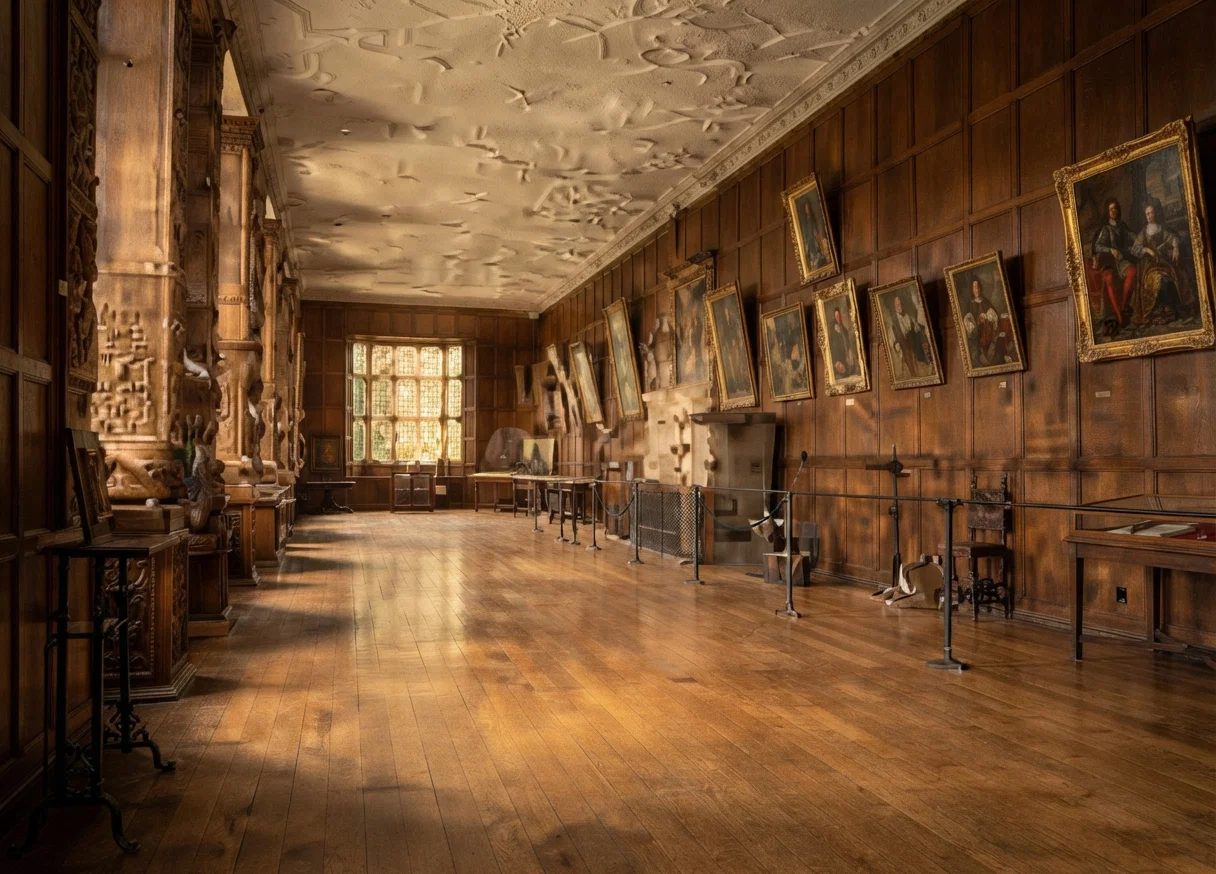
Art Gallery in Aston Hall, England.
ASTON HALL, ENGLAND.
By C. H. Castle
BY C. H. CASTLE.
NEARLY every city, borough, and village in England claims some mark of distinction, historically; and, judging from what one hears from time to time as he visits about, England abounds in places of interest. The people make the most of these interesting places and take delight in telling visitors about them.
Birmingham is known as one of England's large cities, and when we come to remember that it is surrounded by numerous suburbs independent of the city proper, so far as government and municipal control is concerned; that many of them contain thousands of inhabitants; also that the dividing line between them is so slight that none would recognize it; we may then get a faint idea of the magnitude of this great city. It is a large city of itself, and is made to appear much larger because of the clustering villages about it.
One of the most noteworthy places of interest is Aston Hall, in the town of Aston, adjoining Birmingham. As we approach this old building, we find it surrounded by a large area of well-kept grounds, with an abundance of flowers and trees within its borders, and the Hall itself standing on an eminence in the central part. It formerly embraced several acres, but has gradually been cut down to a very few acres of land. One is impressed with the ancient appearance of the building from the exterior, but the interior is even more striking in this respect.
Sir Thomas Holte was the builder of this quaint old edifice, and its erection was begun as early as 1618; but it was not completed until 1635. One of the first memorable events connected with the place11is the entertainment of Charles I. on Oct. 16, 1642.
The old house was most substantially built, and is a place that engages one's attention for hours. The old stairways are constructed of solid oak, and the floors are of the same material undressed, or as we term it, "rough," and are made of wide boards without being matched together, or "tongued and grooved."
At one time during some trouble locally, this place was attacked, and the results of the cannonading are to be seen to this day. One of the large solid oak posts supporting one of the main stairways, of which there are several, was splintered by a three or four-inch ball, which is preserved as a relic in a glass case beside the post it so many years ago defaced. Also the exact place on the wall where it entered the building is indicated by a line drawn around it, and the date of the attack written by the side of it.
The Manor, as it was formerly called, passed from one party to another, until finally, at the request of Queen Victoria, upon the occasion of her visit to the Hall on June 15, 1858, the corporation of Birmingham acquired the mansion, and the remnant of the park, and thus secured it to the public. It now contains many interesting collections, and is virtually an art gallery and museum.
The visit of the queen was an event of considerable moment, and adds greater interest to the Hall than it would otherwise have. It is in what is known as the "Great Gallery" that the finest of oak panelling is to be found. Many interesting portraits are to be seen there. In a book under one of the windows is the autograph of the late Queen Victoria.
Another most interesting room is the great kitchen. It is said that there were a very large number of servants occupied about the mansion. In this great kitchen the animals that were eaten were brought in alive, and actually slaughtered, and prepared for the table. The great hook in the ceiling has undoubtedly supported many a bullock and sheep. The butcher's block is in the same room with the great fireplace, where the meat was roasted by means of a spit large enough to accommodate a whole animal. The spit was worked by a smoke jack, the draught up the great chimney being sufficient to turn the spit without manual assistance. While visiting this dark and dreary room, one could almost imagine he could see the butler with his army of assistants preparing the meal for the large family.
Page after page might be written upon this interesting place, but space does not permit. There are something like twenty rooms upon the first floor, and several on the second floor. In one of the top rooms the musketeers were stationed during the siege previously mentioned. Another room is pointed out as being the scene of a suicide. In another was imprisoned a young woman who refused to marry the man chosen by her parent. Thus each room has some special interesting feature attached to it. Hence, when one has viewed its interior and exterior, he gazes upon it with a feeling of awe, as he tries to recall a few of the many thrilling events connected with this crumbling monument.
PLENTY OF TIME.
By Margaret E. Sangster
I HEAR you complaining, dearest,
You have ever too much to do;
Your temper is worn with trying
To make old things look like new.
You sew for the little children,
You mend for the rollicking boys,
You were never a shirk, and you try, and work
Till your life is shorn of joys.
If the day were longer, dearest!
If you never need go to bed!
But the time goes racing by you
Till the hurrying week has sped;
And your basket's overflowing,
And your tasks are never done.
Poor, weary friend, will they never end,
Till the sleep of death is won?
It's time you are needing, dearest!
Ah, yes! but there's time to spare
If you'd let our Father carry
One end of your load of care.
If you'd tell Him all your trouble,
And ask from His tender hand
The gift of His peace, your pain would cease;
His way you would understand.
There is time for loving, dearest,
If we take the time there is,
And fill that up with sweetness,
Whatever beyond we miss.
Let the little frocks be plainer,
Let the dust alone for awhile;
Let the good man see how blithe it can be,—
His home, in your tender smile.
Get out in the sunshine, dearest!
There is time for that, be sure—
If you'll only let the flowers
And the birds your steps allure.
Go out in the sunshine, dearest,
And bring it back with you;
Don't sit in the gloom, when His lilies bloom,
And His bending skies are blue.
—Margaret E. Sangster.
THE VITALITY OF A TURTLE.
By Frank T. Bullen
[Frank T. Bullen, in Leslie's Monthly for March.]
ALMOST alone among God's creatures, the turtle has but a single enemy—man. It does not seem to matter to the turtle whether he stays beneath the surface for an hour or a week, nor does it trouble him to spend an equal time on land, if the need arises. He is neither fish, flesh, nor fowl, yet his flesh partakes of the characteristics of all three. Eating seems a mere superfluity with him, since for weeks at a time he may be headed up in a barrel (with the bung out) and emerge after his long fast apparently none the worse for his enforced abstinence from food, from light, and almost from air. And, finally, it may truly be said that, of all the higher, warm-blooded organisms, there are none so tenacious of life as the turtle. I can truly say that I have seen the flesh cleared out of a turtle shell and, hung upon a tree, where for hours the quivering, convulsive movements of the muscles went on. Not only so, but on one occasion only the head and tail were left attached to the shell. Some time had elapsed since the meat had been cut out of the carapace, and no one could have imagined that any life remained in the extremities. But a young Dane, noticing that the down-hanging head had its mouth wide open, very foolishly inserted two fingers between those horny mandibles. They closed, and our shipmate was two fingers short; the edges of the turtle's jaws had taken them off clean, with only the muscular power remaining in the head. Signor Redi once cut a turtle's head off, and noted that it lived for twenty-three days without a head, and another, whose brain he removed, lived for six months, apparently unconscious that it had suffered any loss.
LITERARY NOTICES.
By Editor
"Poems." By Wilfrid Earl Chase, 302 State Street, Madison, Wisconsin. Price, postpaid, fifty cents.
This neatly-printed, neatly-bound book contains only six short poems, three in blank verse, three in rhyme. There is some quite pretty word-mongering, some obscure in meaning, and unrhythmic, and uncertain in teaching.
"A New School Management." By Levi Seeley, Ph.D., Professor of Pedagogy in the State Normal School, Trenton, N. J. Cloth, 12 mo., 330 pages, $1.25. Hinds & Noble, 31-35 15th St., New York City.
We do not know how this book could be otherwise than helpful to teachers of youth in any school who would use it. It is an excellent work, full of instruction to the inexperienced teacher, of suggestion to the experienced. The book is designed for training-classes and normal schools, and for young teachers who have not had the advantages of a professional course. Professor Seeley's work would also be immensely profitable to school trustees and parents. Sabbath-school teachers could read it with profit. The scope of the book is the teacher, his personality, preparation, responsibility, his programs of work in the school, grading, government discipline, etc. There are twenty-one chapters and an Appendix on Moral Instruction.
"Devotional Songs."—Edited by W. H. Doane, Mus. Doc., Wm. J. Kirkpatrick, and Herbert P. Main. 276 songs, with music, bound in cloth. Price, $25 per hundred; 30 cents a copy by mail. The Biglow & Main Co., Chicago and New York.
"Devotional Songs" contains a large variety of songs, many of the old standard Gospel songs, and many good new songs, adapted to religious gatherings of all kinds. May its sweet songs lead many to a deeper experience.
"History of Socialism in the United States." By Morris Hillquit. Cloth, 5 1/2x8 1/4 inches, 371 pages. Price, $1.50, net. Funk & Wagnalls Co., New York and London.
The author is a Russian by birth, who has studied law in America, and has been admitted to the bar in New York City. He is a member of the Socialist Labor Party. Mr. Hillquit's book treats of the origin of Socialism in the United States, the manner of its growth, the tendencies of its future development, the various sectarian communities, such as the Shakers, etc., the various periods of growth, the organization period, the Socialist Labor Party, the present-day Socialism. Its aim is not to present theories of Socialism, but history, and that from the sympathetic side.
"American Prohibition Year-book for 1904." Compiled by Alonzo E. Wilson. Cloth, 35 cents; paper, 15 cents. 96 pages with index. United Prohibition Press, 92 La Salle St., Chicago.
The contents of the book are as follows: Almanac, Total Abstinence, Criminology, Cost of the Drink Traffic, National Problem, Legislation, Results of Legislation, Political Action, Election Figures, Organization. Every temperance worker ought to have it.
"Talks with My Students." By Prof. Frederick Griggs. 84 pages. Cloth, 40 cents; paper, 25 cents. May be obtained from Paul C. Mason, South Lancaster, Mass.
This little book, daintily bound in white, contains some selections from the chapel talks given by Principal Griggs to his students. The topics discussed are Adaptability, Be Enthusiastic, Learn to Wait, The Value of Minutes, Our Conversation, Economy, Promptness, Our Manners, Association of Young Men and Women, "If Thine Eye Be Single," The Love of the Beautiful, "Lest We Forget." These are inspiring, helpful words to young men and women.
"Esarhaddon and Other Tales." By Leo Tolstoy. Translated by Louise and Aylmer Maude. Cloth, 4 1/2x6 1/2 inches, 64 pages. Price, 40 cents, net. Funk & Wagnalls Co., New York.
These three little stories—"Esarhaddon," "Work, Death and Sickness," and "Three Questions," were contributed to help the Jews of Kishineff. The first is a parable teaching kindness, but colored with the author's peculiar views; the second an Indian legend to teach the necessity and blessing of work and union; and the third a story to teach the importance of the present time, and present opportunities.
"Northfield Hymnal." By Geo. C. Stebbins. Cloth, $25 per 100, 30 cents per copy, postpaid. The Biglow & Main Co., New York and Chicago.
This is a compilation of old songs from the Gospel Hymnals and later books, with new pieces by the author and others, at the request of Mr. W. R. Moody, designed for all religious meetings. There are 250 songs, on 25 or more topics.
"A Retrospect." By J. Hudson Taylor, M. R. C. S., F. R. G. S. Third edition. 136 pages, 20 chapters, illustrated. China Inland Mission, 507 Church St., Toronto, Canada.
This little book is Mr. Taylor's call to the service of God, and a retrospect of his life in mission work in China. It reveals the blessing and providence of God, and the advancement of Christianity in China. There are two full-page illustrations, with chapter headings and tail-pieces, together with a map showing the mission stations, and a table giving the date of the founding of each station. The book is a witness that Jesus Christ works still; that the Gospel is still the power of God unto salvation to every one that believeth.
"Minutes of the First Hebrew-Christian Conference of the United States," held at Mountain Lake Park, Md., July 28-30, 1903. Edited by the Executive Committee. Price, 15 cents. Address, Maurice Reuben, 333 Forty-second St., Pittsburg, Pa.
This little pamphlet contains names and portraits of delegates, minutes of proceedings, and papers and addresses. The addresses reveal the earnest spirit of the Hebrew-Christian movement. It is too bad that some of their workers class the Sabbath of the moral law among the ceremonies to be forsaken.
Three Times a Day to CHICAGO
THE ONLY DOUBLE TRACK RAILWAY between the Missouri River and Chicago.
THREE TRAINS DAILY via the Southern Pacific, Union Pacific, and Chicago and Northwestern Railways.
OVERLAND LIMITED, Vestibuled. Leaves San Francisco at 10.00 a. m. The most luxurious train in the world. Electric lighted throughout. Buffet smoking cars with barber and bath, Booklovers' Library, dining cars, standard and compartment sleeping cars and observation cars. Less than three days to Chicago without change.
EASTERN EXPRESS, Vestibuled. Leaves San Francisco at 6.00 p. m. Through Standard and Tourist sleeping cars to Chicago. Dining cars, free reclining chair cars.
ATLANTIC EXPRESS, Vestibuled. Leaves San Francisco at 9.00 a. m. Standard and Tourist sleepers.
Personally Conducted Excursions
WEDNESDAYS, THURSDAYS and FRIDAYS
The best of everything
R. R. RITCHIE, G. A. P. C.
CHICAGO & NORTHWESTERN RY.
617 MARKET ST. (PALACE HOTEL) SAN FRANCISCO
OR S. P. COMPANY'S AGENT