The Youth’s Instructor, Vol. 48, No. 31.

PICTURES FROM REAL LIFE IN CHINA

The Youth’s Instructor

Aug 2, 1900

Review and Herald Publishing Company · Battle Creek, Mich. · Aug 2, 1900

PICTURES FROM REAL LIFE IN CHINA

New Year's Night
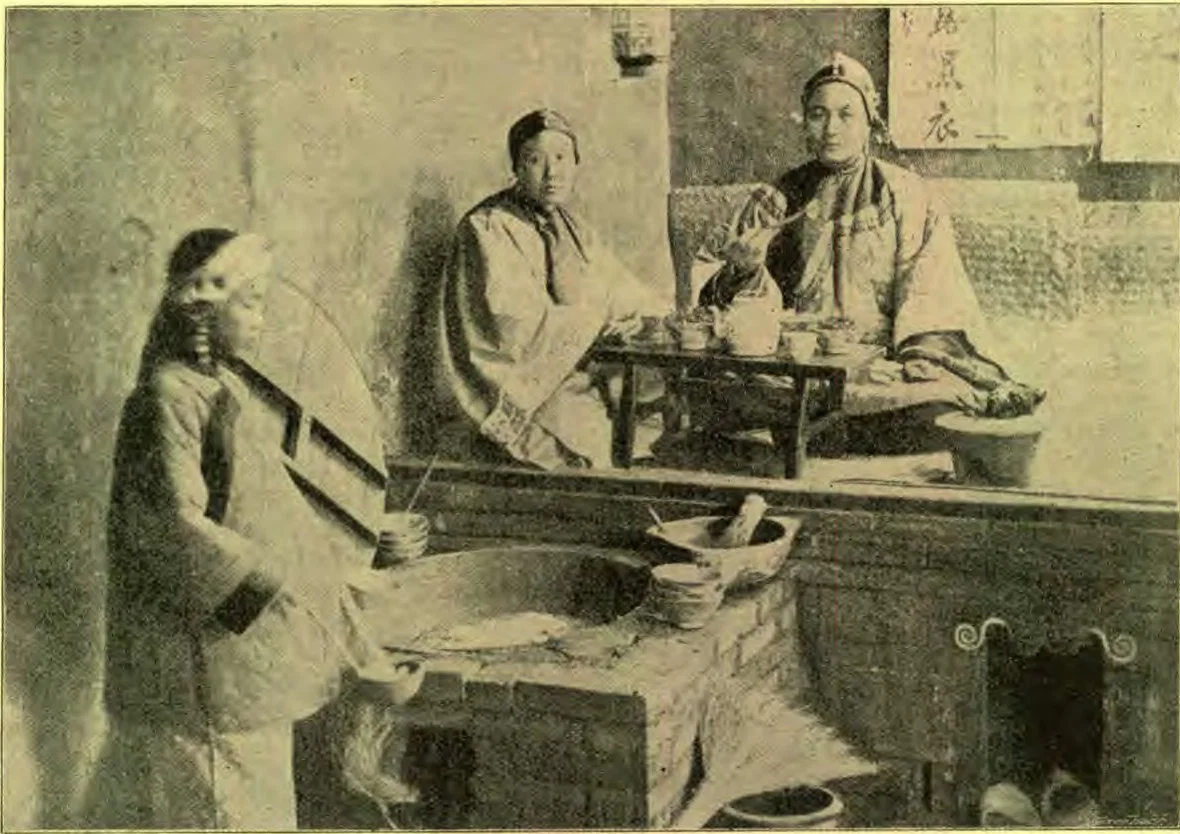
Although no human voice is heard outside, it is not always so inside. The unruly crowd that filled the streets a few hours ago is still alive, but behind closed doors. The food purchased must be eaten with great noise and glee. No guests are invited to the feast, for the simple reason that there are none to invite. Each one wishes to be at home, around the family table.
As a rule, the Chinese do not sleep at all on New Year's night. They regard it as a sacred duty to watch through the hours in which the new year, in the symbol of a fatted ox, is warring with the old year, represented by the symbol of the skeleton of a cow. There can be no question as to the fatted ox gaining the victory. In their ecstasy at this, they begin with a festival that is beyond description, and to shout, with all their might, “Shi-in-pao, chong-in-y!” which means, “At the beginning of the year, fat and satisfied; at its close, abundance.” The fat ox and profusely decked tables are to represent each day of the year. But to tell the truth, which the Chinese themselves, though unwillingly, are often obliged to disclose immediately after the New Year's festival, one readily sees that they lack the necessities of life. Empty dishes and cold kettles can no longer supply the need that, during the festival, they fondly hoped would be supplied. The fat disappears from the ox in an alarming manner, and the disagreeable skeleton presents itself to many when they awake from their opium stupor late in the forenoon of the first day of the new year. “The five blessings are absent this year again,” is their complaint, as they begin to look about for something to eat.
Every member of the family is present at the New Year's feast, and the best room is occupied. Here are found food and wine in abundance. Hungry mouths must be filled, and sad hearts made happy—but alas, what happiness! In many instances the beginning and end are, especially to the mother and daughters, a severe scolding and misuse; and the New Year's etiquette is soon forgotten.
CHINESE HOME—A MEAL ON THE TANG
The food generally eaten through the night is a mixture of all the vegetables that can be bought. These are prepared with oil. Cakes made with oil are also served in abundance. Pepper and other spices, also pork, are freely used. All this food is eaten with wooden chopsticks seven or eight inches long. Much whisky is served, but fortunately it is not intoxicating. It has, however, a very offensive odor, which has been likened to that produced by burning iron chips in sulphuric acid. Opium is smoked all night.
On the “kang,” the elevated platform that serves as table, chair, bed, etc., the family gather before them all that has been prepared for the feast. This “kang” is provided with a fireplace on one side, and pipes, through which the Chinaman seeks to conduct the smoke and heat. But smoke is usually spiteful, at least in China, and goes out the same way it came in. All except foreigners seem to thrive well on the “kang,” however.
Some lie down, drawing the poison from their opium-pipes; others sit around with their wine-bottles. Card-playing receives its share of attention. Some one in the family who has the faculty of surprising the uncultivated ear by means of song and playing, has perhaps secured an old drum, and now he beats it with great force, at the same time singing in a loud voice a monotonous song. No one can wonder that this is pleasing to the now stupid Chinese. They are in ignorance; they do not know the Saviour, the spring of all joy and gladness. They have not tasted the waters of the stream of blissful peace. The heartstrings are broken, and discord is heard in every corner.
Shortly after midnight a great uproar begins. Any one not aware of what is coming could not but believe himself surrounded by hostile armies. Doors are opened, and out troop men and boys, all supplied with fireworks, rockets, fire-crackers, large and small, bombs, shells, etc., and the air is filled with noise and din till daybreak. Bells are rung, and every imaginable instrument that can be made to produce a sound is worked upon till the echo is heard from mountain to mountain. Past valley and hill is heard the loud noise to frighten the serpents and witches. Demons and kwei-tsi of all kinds flee when they hear the New Year's noise,—at least so think our fallen brothers in China; but when they are brought to believe in the world's Redeemer, they rest as sweetly as you and I when the old year dies, and the new begins.
When morning dawns, and the sun is shedding his golden beams over land and sea, the noise dies away, and all voices are hushed. The angel of peace hovers over mountain and valley, and with her wings fans away the echo of the last night's uproar. The work of New Year's night is ended; next comes hao-ko-nien, or Happy New Year. E. PILQUIST.

The Tempter's Excuse: No Time to Pray

“THE tempter whispers in our ear, ‘You have no time to pray:’ But he never tells the gambler that he has no time to play; He never tells the drunkard that he has no time to drink The poison that benumbs his soul, and kills his power to think.”

OUR INFLUENCE

From every human being there goes forth an influence that either gathers with Christ or scatters from him. Our every action, our every word, exerts an influence either for good or for ill. This influence affects the eternal destiny of those with whom we associate. Influence and example, when viewed in the light of the cross and in their true relation to eternity, assume infinite importance. A word fitly spoken, an action rightly done, may save a soul from death. Day by day the example we set and the influence we exert are registered in the records going beforehand to judgment.
The child of God must never forget that he is only part of the whole. He is only a thread in the web of humanity. Everything he does makes an impression on his character, and influences others. The letters that are written sow the seeds either of tares or of wheat. Our thoughts, our words, the spirit in which we perform our daily duties,—all act their part in the formation of character.
The daily influence of purity and devotion, the observance of the courtesies of life, unbending integrity and steadfastness, will be to all around us a constant recommendation of our faith. But if those who profess the truth are light and trifling, reckless in their conversation and careless in their deportment, they deny Christ, and the world is made worse by their profession. With less of such advocacy the truth of God would stand higher in the estimation of unbelievers.
It is the duty of every Christian to show himself a true follower of Jesus, loving the truth for the truth’s sake, hating every species of impurity, willingly denying self for Christ’s sake. The poorest man in this world is rich as long as he preserves his integrity of character. The one who is victorious in life’s battle is he who gives himself earnestly and unreservedly to God. The life of such a one is a constant confession of Christ. He who refuses to live for self-pleasing, who will not abate his efforts to live the truth, no matter what difficulties he may meet, walks the earth as a nobleman in his Master’s sight. He is constantly doing and saying something to prepare himself and others for the future life. He has the mind of Christ, and in private and public life his light shines with clear, steady rays.
Judicious conversation exerts an influence which is a power for good. But often those who talk much do little deep, earnest thinking, little real work for the Master. Often they neglect those who have little to make life happy, in order to talk about what should be done for the needy and unfortunate. They think that by talking they can make up for their deficiency. They talk, but they fail to show by their actions that they are directed by the Spirit of God. To such the angels of God would say, Not words, but deeds. The daily life tells much more than any number of words. A uniform cheerfulness, tender kindness, Christian benevolence, patience and love, will melt away prejudice, and open the heart to the reception of the truth. It is the doers of the word who are justified before God.
God requires us to put ourselves into his hands without reserve, to obey his directions implicitly. When we take the Lord as our counselor, when we follow him, placing body, soul, and spirit under his control, we can work as Christ worked. Those who make Christ a personal Saviour, seeking him most earnestly in prayer, are enabled by his grace to live true, noble lives. They work in a way which Heaven approves. By unselfish actions they reveal the character of Christ. They realize that they can not afford to lose sight of Christ; for by so doing they give unbelievers an occasion to cast reproach upon the truth.
We are to be courteous to all men, tender-hearted, and sympathetic; for this was the character manifested by Christ when he was upon this earth. The more closely we are united to Christ, the more tender and affectionate we shall be in dealing with one another. The redemption of the fallen race was planned in order that man might be a partaker of the divine nature. When by the grace of Christ we become partakers of this nature, our influence on those around us will be a savor of life unto life. Looking unto Jesus, the author and finisher of our faith, we shall be a blessing to all with whom we come in contact.
Mrs. E. G. White.

WE WANT TO HEAR THE LITTLE GAL

The Christian Herald tells this incident connected with the children taken from their heated New York homes for two weeks’ outing each year at Mont Lawn:—
Bess was kept for longer than ten days, and went back to the city much improved, although the poor little back was still lame; and as for the limp, the Home doctor confirmed the sorrowful prophecy of the physicians at the hospital where Bessie had spent several months of her short life,—they had said the child would never walk well, and that she might at any time lose altogether the use of her lower limbs.
How Bessie came by her affliction is a tale almost too sad for telling. Her father is an honest, industrious dock laborer. Once he was out of work for a good while, and his wife, sickly, overworked, lost her mind through fear that her family would starve, and—well, she is in the insane asylum now, but she did not go there before Bessie got the fall that lamed her.
The missionary who first presented Bessie as a candidate for the Home says:—
“One rainy Sunday, two years ago, the father sent for me at a new place to which they had just moved. As I climbed the steps, flight after flight, to the room, I could not help seeing, through the open doors, men drinking and gambling on all the floors. Drunken men were lying on the stairs; I had to step over one to enter Bessie’s home, and inside the door the rain struck my face. Bessie, her father, and little brother were sitting at a table; and she was singing to them songs she had learned at Mont Lawn—singing loud and clear, in a beautiful little voice,—
“There is sunshine in my soul to-day.”
“Her father looked at me with tears in his eyes. ‘I’ve paid a month’s rent, and the landlord won’t give it back. It’s a terrible place for the children, and I away all day. And see how the rain is pouring in!’”
“‘I will see the landlord,’ I said.
“I had left the door open; and now, to my dismay, several men lumbered in. The father rose, half angrily.
“‘We want to hear the little gal sing,’ the foremost one said, sheepishly.
“‘Let them stay,’ I whispered.
“‘All right, neighbors,’ he said, with simple heartiness. ‘There ain’t much to make you welcome to, but you’re welcome all the same. Sing for ’em, Bess.’
“The child needed no urging; she gave her favorite:—
“I think, when I read that sweet story of old, When Jesus was here among men, How he called little children as lambs to his fold; I should like to have been with him then.”
“When she finished the last stanza, there was scarcely a dry eye in the room. Hardly had the last words died away before the willing entertainer was singing, ‘Yield not to temptation.’ True, sweet, and tender, the little voice rang:—
“Ask the Saviour to help you, Comfort, strengthen, and keep you; He is willing to aid you, He will carry you through.”
“‘Friends,’ I said, ‘I think we can all ask God, as with one voice, to bless this little one who has cheered us so, and to make each of us more childlike and true. Let us pray.’
“And right there we had a prayer-meeting in Bessie’s room. People had come in until the place was full, and many were looking in from the hall. Afterward, as I was going down the steps, several men said, ‘Missus, we’ll be better men for this night. The Lord spoke to some of us in that little gal’s singing.’
“‘I don’t want her to see some things I had to see coming up these steps,’ I said, gently. ‘Her father is a poor man; he has paid a month’s rent, and is too poor to move his family away.’
“‘We’ll see to it she won’t see any more wrong than we can help, ma’am. We’ll see to it the best we can.’
“I spoke to the landlord next day, and the roof was fixed.
“And now I want to tell you something wonderful: In a year the moral tone of that place was changed for the better. I dare not say little Bessie did it all, but I know there was a change; and has not the Bible said, ‘A little leaven leaveneth the whole lump’? I went to her room once a week, and we had a short prayer and song service, neighbors dropping in as on that first night. Women all around began to ‘mother’ Bessie, poor things! as well as they could, and the children thronged about her. She was always glad to tell the pretty Bible stories she had learned to the eager crowd clustered round her; to show the pictures in her picture-books; to teach them the songs she loved. What pretty choruses issued from that poor little room way up in the dingy tenement! I used to think a bit of heaven was up there. Don’t think that that neighborhood became all it ought to be, by any means; I only say that it was fifty times better than when little Bessie first went there.
“Last winter I had a message to come to her, and found the child in a high fever; the doctor said she had pneumonia. She was not uncomfortably circumstanced now; her father was getting good wages, and had taken two rooms; besides, the child was rich in friends. She was very patient during her sickness, giving as little trouble as possible, always wanting to smile, and wishing she could sing. One day, as I sat by her, she whispered: ‘Please—I can’t—you sing about “that beautiful place He has gone to prepare.”’”
“When she was too weak to speak, I sang it again for her. One night, just as I, struggling to hold back my tears, had uttered the line, ‘For of such is the kingdom of heaven,’ her father said, weeping quietly: ‘O ma’am! she’s gone!’
“But the memory of her life is still with us, and flowers of love that she planted are still yielding perfume.”

A RESPONSE

A little wayside pool, left by the rain, Earth-bound, nor fair, nor bright; But, see! the sun, low sinking, with its train Of gold and crimson light,—
A living, glowing color ecstasy; Freed from its earthly bonds,— To all the glory of the western sky The wayside pool responds.
A lowly life, humble and meek and still, Set in an obscure place, May shine with glory, living out God's will, Reflecting his own face.
—Selected.

Astronomical Study No. IX: Jupiter

ASTRONOMICAL STUDY — NO. IX

Jupiter
The large yellow star that is now to be seen in the southern skies immediately after sunset is the planet Jupiter. If you will watch for it any clear night, and notice the first star that appears directly in the south immediately after sunset, you will be able to point out to your friends this interesting planet, about which all have heard, but which few can locate. We wished to call your attention to this planet some weeks ago, but other work crowded out the time we intended to devote to the INSTRUCTOR family.
During the latter part of May we approached to within about 390,398,000 miles of this world, which is much nearer than we shall be again during the coming year. At that time a good field-glass or an ordinary three-foot achromatic telescope would have plainly shown four of Jupiter's five moons, and made the planet itself appear in the form of a globe. Since the twenty-seventh of May our earth has been rushing on past that beautiful star, leaving it so far behind that the smaller glasses will soon be too weak to show the sparkling gems of light that come to us from its moons. The constantly increasing distance between that world and our own affords an excellent opportunity for our amateur astronomers to train their faculties of observation in using their pocket-telescopes. We hope that when next the earth swings around in the neighborhood of Jupiter, our time will not be so taken up as to prevent calling the attention of our readers to this interesting portion of God's handiwork in time for them to observe its moons.
Jupiter is the fifth planet in order from the sun, and the second from our earth. Its mean distance from the sun is 483,288,000 miles; and it swings in an orbit 3,110,000,000 miles in circumference about the sun, requiring 4,332 days, fourteen hours, and two minutes of our time to make its yearly circuit. Thus the year, to the inhabitants of Jupiter, is as long as nearly twelve years of our time. The onward movement of this planet through space is thirty thousand miles each hour, or about eighty times the velocity of an ordinary cannon-ball. When we consider the great size of this world,— that it is 88,439 miles in diameter, thus equaling in bulk thirteen hundred worlds the size of the one on which we live,— we obtain something of an idea of the immense magnitudes and velocities, even in our own comparatively small solar system, with which the mind must deal in the study of the workings of an all-wise Creator and Redeemer.
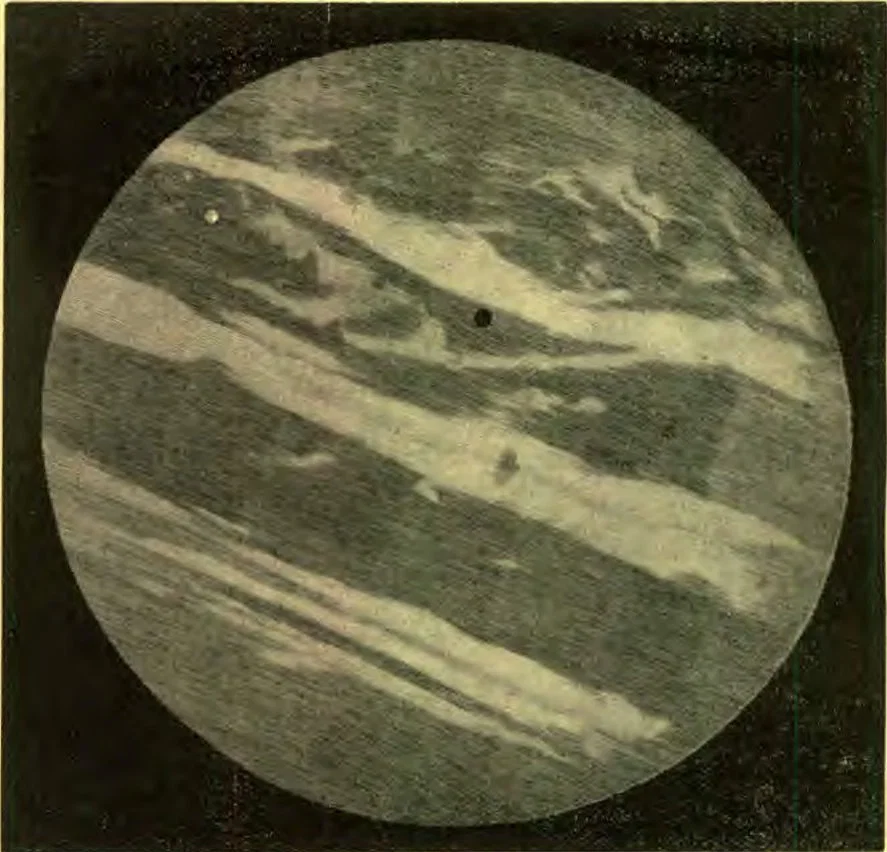
There are times when we come within three hundred and seventy million miles of this wonderful world; then again, we swing so far away from Jupiter that the light coming from this planet to us must span the distance of six hundred million miles. Although Jupiter is so many miles distant, when the earth approaches near this planet, we can see it, even with an ordinary telescope, as shown in the accompanying illustration, with the belts, or dark lines, upon its surface, also four of its five moons.
JUPITER
JUPITER
Would it not be well for every reader of the INSTRUCTOR to locate this wonderful world as it marches majestically along its God-given path in the heavens, and follow it during the coming summer and fall months, as it passes seemingly along among the stars that twinkle in the darkness beyond? Remember that although it appears to be right among the other stars, it is, in reality, many millions of miles this side of any of those you at present see in its immediate neighborhood. Get the location of the planet fixed in mind now; watch it as it moves along past the different stars, so far in the distance beyond; also notice how, each evening during the coming months, it will appear to be getting nearer the sun, or, to be more correct, the sun will be continually marching on through the heavens toward the east, and so getting in line between us and Jupiter.
If time permits, we will prepare a drawing during the coming week that will illustrate exactly the real relations and the apparent movements of the earth, the sun, and Jupiter, and will also tell you more about those moons that are represented in the accompanying small illustration. The large picture shows the planet as it appears when we see its full, illuminated face beneath a large telescope. The dark bands running across the planet show plainly in both illustrations. The dark spot, a little above the center, in the larger picture, shows the shadow of one of the moons of Jupiter; and were we living at that particular place on that world, we should have the pleasure of seeing an eclipse of the sun similar to the one we had the 28th of last May, to which your attention was called in these articles.
DR. O. C. GODSMARK.
861 5th St., Milwaukee, Wis.

GOING DOWNHILL

I HAPPENED to overhear two men talking about a third man the other day, and one of them said, sympathetically, “Poor George! he seems to be going downhill all the time.”
“Yes,” was the reply, “he does. It is a pity that some one can not turn him around, and start him up the hill of life again.”
The conversation set me to thinking of something that that noble American woman, Mrs. Mary A. Livermore, wrote recently. It was this: “Some years ago I resolved to cultivate habitual cheerfulness under all circumstances. It has not been an easy task, but I have succeeded; and now, drifting on to my eightieth birthday, burdened with heavy cares, stripped of those nearest and dearest to me by death, I am not sorrowful. I am not going ‘downhill,’ as people say of the old, but ‘uphill’ all the way, and I am sure that life is better farther on.”
JUPITER AND ITS MOONS
The fixed habit of cheerfulness is a great help in climbing the hill of life. You will find that the people who are “going downhill” are almost invariably morbid, and that they are steadily looking down instead of up. One always goes downhill much faster than one goes up; and when you see a man who is going downhill, you may be sure he will reach the bottom very soon if he does not turn right-about face, and start uphill again. It is never “better farther on” to those who are going downhill. It is never well with them at all. The lowlands of life are unhealthy for both body and soul. It is better to keep looking and climbing upward.—Selected.

FROM SKY TO EARTH

In the beautiful cloud-land my wings so light I bathe in the sunshine soft and bright; In ecstasy pure I soar so high As almost to touch the bending sky. What joy to dwell in these fields of light, Far, far above earth's shadowy night!
O tiny speck in the great mist-sea, How little thou knowest thy destiny! Though high in the heavens, canst thou forget A life more blessed waits thee yet? Bound up in self, thy life is vain, While the thirsting earth looks up in pain.
Soon over the cloud a breath so chill, Like the touch of death the pulse to still, Droops every wing, affrights each heart, And floods of raindrops downward start. As down they sink, they tremble with fear And dread of the dark, cold earth so near.
But through the drops a sunbeam flies, And lo! a rainbow spans the skies — Blest token of hope! And the raindrop found A greeting glad as it touched the ground; For the earth smiled thanks for the draught refreshing, And the raindrop was blessed in bringing a blessing.
Mrs. S. M. Spicer.

Justice and Generosity Before God

“If we are not just with God, how can we expect God to be generous with us?”

NOTES AND COMMENTS

Newfoundland Seal Slaughtering.—The capture of seals in the Newfoundland fisheries for the last season amounted to three hundred and fifty-five thousand—the largest catch for twenty-five years.
A Salty Load.—An idea of the amount of salt there is in the vicinity of Salt Lake City, may be gained from the fact that a solid train of twenty carloads of salt was recently shipped from that place at one time.
Napoleon’s Estimate of Greatness.—Said Napoleon: “Alexander, Cæsar, Charlemagne, and myself founded empires by force, and they perished: Jesus of Nazareth alone, a crucified Jew, founded his kingdom upon love; and at this hour, millions of men would die for him.”
Automobiles in Paris.—It is stated that “by actual count, the number of automobiles in regular use in Paris represents two or three per cent of the traffic on week-days, with a very much higher average on Sundays and holidays, probably reaching five per cent.” Automobile accidents have become so numerous of late that rigorous regulations have been enacted to prevent their occurrence.
Only Czars May Rule Russia.—The present czar of Russia, Nicholas II, has three daughters, but no son. He is therefore without a successor; for ever since the edict of Emperor Paul, the son of Catherine the Great, which was issued to discredit his mother’s memory, none of the czar’s daughters may become a successor to the throne. Catherine, however, amply proved her capacity for ruling the empire in her day.
The Mining of Coal.—It is said that coal was mined prior to 1113 A. D., and that “in the Liège district, coal was first found about 1199. In 1214 coal was attracting some attention on the southern side of the Firth of Forth. This was a hundred years after the mines in the Worm district are said to have been opened and regularly worked. It is not likely that coal was mined in Great Britain before the thirteenth century.”
The Extent of Political Intemperance.—Many politicians, whatever their party affiliations, are heavy drinkers. As an example of gross intemperance, it is said that “the Tammany Club of New York had on board the special train which carried them to the convention at Kansas City, two dozen cases Scotch whisky, two dozen cases assorted brandies, two dozen cases American rye, two dozen cases assorted cocktails, ten thousand bottles of beer, five hundred bottles of ale, one thousand quarts of champagne, one thousand pints of champagne, and two dozen cases of Rhine and Moselle wines.”
Injurious to the Eyes.—It is said that the curved pages of any book are injurious to the eyes. Mr. F. G. Murphy shows that “the curved page causes a constant change of the focus of the eye as it reads from one side to the other, necessitating a continued effort on the part of the ciliary muscles. The light also falls unequally on both sides, further interfering with a continued, clear field of vision.”
Boston Barbers’ Regulations.—In the city of Boston, barbers are required by the board of health to “sterilize their razors, shaving-brushes, and mugs immediately after using them; to give every customer a clean towel; and to wash the hands between each shave. The use of sponge and powder puffs is prohibited; and, instead of stanching a cut with a lump of alum that has done duty in that direction before, the barber must apply to the abrasion a little new alum powder with a clean towel.”
Distributing Cool Air.—A Washington corporation has applied to Congress for permission to lay underground pipes in the streets of that city, for the purpose of distributing cool air through the business buildings and residences thereof. They propose to erect a refrigerating plant, from which will be pumped the cold air, for distribution through the pipes. The flow of cold air will be regulated and measured in a manner somewhat similar to that of gas. When wanted, the cold air will be turned on, just as hot air is turned on from a furnace.
The New Testament in Real Scotch.—The New Testament is about to be published, by Mr. Alexander Gardner, of Paisley, in the Scotch language,—not in the present vernacular of the Lowlands, which is called Scotch, but the tongue of Burns, the “braid Scots” of the early part of the century. The following is the rendering of the Lord’s prayer: “Faither o’ us a’, abidin aboon! Thy name be holie! Lat thy reign begin! Lat thy wull be dune, baith in yirth and heeven. Gie us ilka day our needful deudin. And forgie us a’ oor ill deeds, as we forgae thae wha did us ill: and lat us no be siftit; but save us frae the Ill-Ane! For the croon is thine ain, and the micht and the glorie, for evir and evir. Amen.”
Victoria’s Warlike Reign.—Although Queen Victoria is opposed to warfare, it is plain to be seen that she has not always succeeded in keeping her people in the quiet paths of peace. During her reign of sixty-three years, at least forty wars have been waged and carried to a conclusion by the British, besides numerous revolts and uprisings which could not rightfully be called wars. The following is a list of the wars of the Victorian era: A war against Russia, 1854; three wars against Afghanistan, 1838, 1849, 1878; four wars against China, 1841, 1849, 1856, 1860; two wars against the Sikhs, 1845, 1848; three Kaffir wars, 1846, 1851, 1877; three wars against Burma, 1850, 1852, 1885; eight wars in India, 1857, 1860, 1863, 1864, 1868, 1879, 1890, 1897; three Ashantee wars, 1864, 1873, 1899; one war against Abyssinia, 1867; a war against Persia, 1852; one war against the Zulus, 1878; one war against the Basutos, 1879; one war in Egypt, 1862; three wars in the Sudan, 1894, 1896, 1899; a war in Zanzibar, 1890; a war against the Matabeles, 1894; two wars against the Transvaal, 1881, 1899.
A. J. BOURDEAU.

PANORAMIC PICTURES

Last Paper

You may sometime wish to take a picture including a greater angle than your lens covers. To accomplish this, it will be necessary to take two or more negatives, and join the prints, either by vignetting them, and printing on one piece of paper, or by mounting the separate prints together. The first method is the more satisfactory, as it gives a continuous print, like that taken by a regular panoramic camera; but a special printing-frame is required, and the process is a somewhat complicated one for a beginner. I will therefore describe the more simple method.
Set up your tripod in the desired position, and be sure that it is perfectly level. The camera must not be tilted either up or down. If necessary to raise or lower the position of the image on the ground-glass, it must be done with the rising and falling front.
Before making the first exposure, it is best to rotate the camera to the different positions to see how many negatives will be needed, and what will be included in each. You must think of all the different pictures as one, in order to see what objects should be included in the first.
Make the first exposure in the ordinary manner, and remove the plate-holder. Now notice some object about three fourths of an inch from that end of the ground-glass where the remainder of the picture lies. Loosen the tripod screw, and rotate the camera until that object is about the same distance from the other end of the ground-glass. This will make the same objects in the view occupy about three fourths of an inch at one end of each negative. As the prints must be joined in this space, it should be in that part of the view that is of the least possible importance.
If more than two negatives are needed, it will only be necessary to repeat the operation as for the second, until the desired view is secured. The plates must of course be given an equal exposure; and as the light is constantly changing, they should be taken as soon after one another as possible.
It is best to develop all the negatives of a series at one time, and in one tray, as they will then be sure to be of equal density. But if you have no tray large enough to hold all the plates at one time, be careful to develop all as nearly alike as possible, and you will have no trouble about the printing.
Make prints the full size of the negatives, and be sure to print all equally dense. They may be trimmed either before or after toning; but as most paper has a tendency to curl after it is toned and dried, it is better to trim them first.
The ends that are to be matched may be trimmed by cutting through the same objects in each print separately. A better way is to overlap the parts that contain the same objects, and match them accurately. This can be readily done by holding them between you and the light. They may then be trimmed together, with one cut of a knife drawn along the edge of a ruler. After toning, they should be mounted side by side on one piece of cardboard; and, except for the scar of the trimming-knife, they will look like one picture.
J. EDGAR ROSS.

ON GRANDPA'S FARM

Yes, the city 'll do to live in when the snow is on the ground, But with summer days it loses all its charm. When the green things all are growing, and the days are bright and long, Then I like to visit out on grandpa's farm.
There are chickens at the doorstep, waiting for their morning meal, And swallows build beneath the sheltering eaves; There are cattle in the meadow, and horses in the stall, And rabbits nibbling grass and lettuce leaves.
There's a dear old-fashioned garden, full of roses white and red; And ivy-vines that clamber up the wall; Morning-glories at the window; “old woman” and “old man;” And hollyhocks in bunches, straight and tall.
There's a row of currant bushes all along the garden fence; The cherries offer me a daily treat; And there's clover hay to gather, and roasting-ears to pluck, And towering loads of yellow oats and wheat.
There's the well, with wheel and bucket, where I love to get a drink; And a swing to rest me when the day is warm: And there's room for me to run with Carlo down the grassy lane; And there's Grandpa, and there's Grandma, on the farm!
ELIZABETH ROSSER.
Continue reading: THE JUMPING-MOUSE