“O Aunt Annie! here is Puss with such a funny looking mouse,” called Ralph, from the garden. “May we bring it for you to see?”
“She may not be willing for you to take it,” said Aunt Annie, looking up from her sewing.
“Oh, yes, she always brings all her mice, rats, moles, and squirrels for us to see. As soon as she comes near the house, she begins calling us; and when we come out and look at them, she acts as pleased and proud as anything. But she never lets us have a bird when she catches one.”
“Probably her instinct teaches her it would not be safe to let a bird go.”
“But do look at this mouse. He is such a queer color,—reddish-gray above, dull orange on the sides, and white beneath.”
“And how long his tail is,—much longer than his body. Please lend me your tape-line, so I can measure him,” said Mary. “See! his tail is six inches long, and his head and body are only three and one-half inches long,” she added.
“Notice, too,” said Aunt Annie, “his curious legs. The forelegs are very small,—scarcely more than little claws,—but the hinder ones are long and stout. I have no doubt he is nearly related to the jerboa, of Central Asia, which is about twice as large as this mouse.
“The jerboa is said to be able to outdistance a horse by his long leaps in a race. His food is composed of vegetables, insects, and the eggs and young of birds. The young jerboas, from five to eight in number, are hidden in burrows in the earth, and neither old nor young leave the nest in winter. They are captured and eaten by the natives of the steppes, their burrows being surrounded, and water poured in, until the little animals are forced to come to the surface.”
“Why does Kitty always play with the little creatures before she eats them, and often before she kills them?”
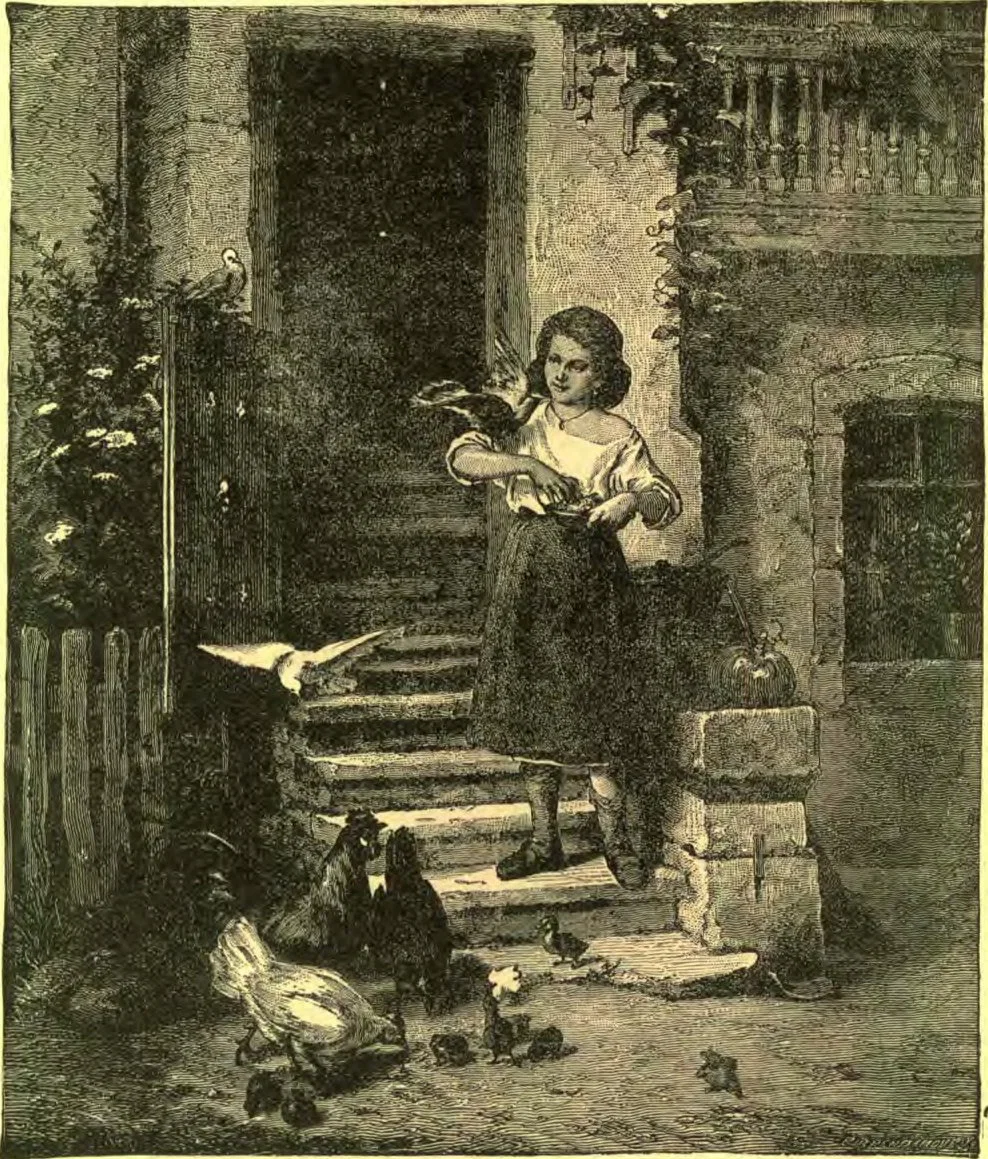
“THERE ARE CHICKENS AT THE DOORSTEP”
“The cat is a very playful animal; and although it looks cruel to see her play with something she means to kill, it reminds us of the time when all the animals lived in peace together, playing with one another with no thought of harm. By and by, in the beautiful new earth, it will be so again; for we read that ‘the wolf and the lamb shall feed together, and the lion shall eat straw like the bullock: . . . They shall not hurt nor destroy in all my holy mountain, saith the Lord.’”
AUNT BETTY.
A “PERFECT LITTLE GENTLEMAN”
By Mrs. Eva Malone
He was only nine years old when I first met him. But what he was then he continued through life; so I will tell you about him as I first remember him.
One blustering March day I was walking along the street with my arms full of bundles; and just as I turned a corner, my hat-pin lost its grip, and the wind blew my hat first into my face and then into the street. Of course I made a frantic dive for my hat, and that loosened my hold on the bundles. Away they all went, chasing one another like wild things, and I trying to catch first one and then another, and ending by catching none at all.
Then he came upon the scene—my “perfect little gentleman.” Even in that March wind he did not forget to tip his cap, and say, in the politest way, “Let me help you.”
First, he rescued my hat; and by the time I had that on my head, and securely pinned, he was ready with the bundles. When I thanked him with all my heart, he bowed politely, and said, in the sweetest of voices: “It doesn’t matter at all; I am glad to help you.”
After that I often saw him, but always on the street. He was always the same “perfect little gentleman,” his cap off when he met an acquaintance, and ever ready to do some kind, polite thing for those he met. He never seemed out of temper, never cross or rude, like most of the boys I met.
About six months after I first saw Clarence, I was on the cars, coming from Knoxville to Mendon. It was a rather windy autumn day—one of those days when old winter seems to get into the air, and say, “Look out, I am coming!” Two or three seats in front of me sat a lady and a boy. I was reading, and did not notice them until I heard the lady say: “Son, please put down the window. The air is giving me a cold.”
“O pshaw! I want to look out. Can’t you put your shawl around you?” came in a voice that sounded familiar to me, though I had never heard it in such tones before.
Alas and alas! it was Clarence, the “perfect little gentleman” whom I had seen do so many kind and beautiful things on the street,—and the lady was his mother!
She sighed, put her veil over her head, and drew herself farther from the window. My “perfect little gentleman” went on enjoying the scenery. When, a little while later, she gave a distressing cough, he pulled the window down with an angry bang, and scowled at his mother as if she had struck him.
When we reached our journey’s end, Clarence and his mother got off, and so did I. His mother had her umbrella, purse, and some small bundles in one hand, and a bandbox in the other. My “perfect gentleman” had his hands in his pockets, and did not take them out to relieve her of any of her things. The last I saw of them, she was still carrying them all, and Clarence had stopped to talk to one of his friends. I heard him say: “You can just go on home, mother. I’ll be there in time for dinner.”
“What sort of boy is Clarence Stedman?” I asked of Aunt Cindy, who washed for me as well as for Mrs. Stedman.
“Law’m, doan’ ax me, Miss,” she answered. “He’s all sawts uv a boy. Effen yo’ see ’im in de street or wid ’is comp’ny mannahs on, yo’d t’ink sugah would n’ melt in hes mouf. But6bless me! Des wait tell he git home. He don’ furgit all hes primpyness an’ hes bowin’ an’ scrapin’, an’ hedes’ ’bout de mos’ onmanelliest young ’un yo’ gwine see in many a day. He doan’ mek no bones ’tall o’ sassin’ hes maw, an’ ez fur waitin’ on hesse’f, he doan’ no mo’ purten’ t’ pick up atter hissel’ den ef he were Queen Victorious—’deed he doan’. He ’low dat’s w’at wimmen’s made fur. I git dat outdone wid ’im sometimes dat I can skacely keep my han’s offen ’im. When I sees ’im doin’ de fine genternum f’um home, t’inks I t’ myse’f: ‘Yo’ bettah sabe some o’ dat sugah an’ ’lasses fur yo’ own folkses, ’stid o’ gibbin’ dem nuff’n but vinegar.’”
And so my “perfect gentleman” tumbled down from his pedestal, and became that most unlovely of all things, a cheat and a fraud.—Mrs. Eva Malone.
AUGUST STUDY OF THE FIELD
PART II: “RELIGIONS OF CHINA”
(August 5-11)
1. Earliest Worship.—It was asserted by ancient authorities that some of the descendants of Noah penetrated into China in the first or second century after the deluge, laying the foundation of this vast and mighty empire, and, instructed by tradition, worshiped the Almighty Ruler of the universe. This mode of worship was continued until the time of Confucius, who founded the sect that bears his name. The canonical books of the Chinese everywhere confirm the idea of a Supreme Being. The conduct of the first emperors in time of disaster and public calamity proved what exalted ideas they had formed of the justice and holiness of the Supreme Being. Not content with putting themselves under his protection by offering sacrifices and addressing prayers to him, they aimed to discover what secret faults they had committed that might have called down the vengeance of Heaven on their people. They often acknowledged their faults in the presence of the whole nation assembled. They confessed that these were sufficient to excite the indignation of Heaven, and offered themselves as victims, to avert vengeance from their people.
2. The State Religion.—Confucianism is the religion of the state. The emperor is the high priest of this sect; and the mandarins and officers, both civil and military, are the subordinate priests. The heavens, earth, sun, and moon are worshiped. When heaven is worshiped, the emperor is clad in silken robes of azure blue; when earth, in those of a saffron color. The garments worn at the worship of the sun are crimson, and during that of the moon of a cream-white hue. The sacrifices are offered at fixed periods, the victims being cows, pigs, bullocks, and sheep.
3. Confucius.—In the early part of the sixth century, before the Christian era, Confucius stood forth as the exponent of Chinese doctrines. His birth had made glad the heart of his father, for he was the long-wished-for son. His father having buried his first wife in his old age, and being left with nine daughters, resolved to marry a second time, hoping that succession to the family might be continued by the birth of a son. Three years after Confucius was born, the father died; and upon the young widow, for such she was, devolved the future care and education of the boy. We are told that she was a woman of more than ordinary strength of character. The adage that “great men have short biographies” has been abundantly fulfilled in the life of Confucius. That he was born in the state of Lu; that at six years of age he played at ceremonies and sacrifices; that at fifteen his mind was set on learning; that when nineteen he was married; that at twenty-three he began to preach; that he was much impressed by the death of his mother, and very much unimpressed by that of his wife; that his life was spent in wandering from court to court in the hope of obtaining converts to his ideal plan of government, and that in these missions he was oftener unsuccessful than successful,—this is about the sum and substance of what tradition has told us of the man whose influence has become identical with the religious life of the Chinese nation. When he died, his disciples buried him with great pomp, built huts near his grave, and remained there, mourning as for a father, for nearly three years. One of his favorite disciples continued this for another period of the same duration. The news of his death went through the state as with an electric thrill. The man who had been neglected when alive seemed to have become all at once an object of unbounded admiration. Thus the tide began to flow that has scarcely ebbed during three and twenty centuries.
4. His Teachings.—Confucius laid no claim to divine revelation. His teachings were singularly devoid of references to anything but what was seen and temporal. Man as he is, and the duties belonging to him in society, were all that he concerned himself about. We quote a few of his most characteristic sayings, which show the tendency of his views: “What you do not like when done to yourself, do not do to others.” “What the superior man seeks is in himself; what the small man seeks is in others.” “The superior man is dignified, but does not wrangle, social, but not a partisan. He does not promote a man simply because of his words, nor does he put good words aside because of the man.” “A poor man who does not flatter, and a rich man who is not proud, are passable characters; but they are not equal to the poor who yet are cheerful, and the rich who yet love the rules of propriety.” “Learning undigested by thought is labor lost; thought unassisted by learning is perilous.” “The cautious seldom err.” Confucius had no idea of progress or of the regeneration of society. His religion related to virtue and vice measured by a human standard only. Good and evil would be recompensed by the natural issues of conduct within the sphere of time,—if not in the person of the actor, yet in the person of his descendants. There is no doubt that the moral element of his teaching, springing out of his view of human nature, attracted many of his disciples, and still holds the best part of Chinese men of learning.
5. Buddha.—The following facts briefly cover the history of the life of Buddha: Somewhere between the years 560 and 480 B. C., at a little village situated on a branch of the Ganges River, was born a son to the chief of the tribe of Sakya. Seven days after his birth his mother died, and he was reared by her sister. His father was possessed of considerable wealth, so that his life was probably one of comfort and ease. At an early age he was married, becoming the father of one son. When twenty-nine years old, he took the extraordinary step of exchanging the comforts and pleasures of a luxurious home for the hardships and austerities in the life of a homeless, begging monk. For seven years he lived this life,—not years of rest, but of struggle,—searching for light, hoping in some way to find release from the misery that he believed was inseparable from life. At the end of the seven years, one night under the bo-tree came the great enlightenment. In a supreme moment there flashed upon the monk what seemed to him a clear vision of all the errors in which men were wandering, of all the sources from which human misery flows, and the way to the annihilation of this misery. He soon began to present this “light” to others, and converts multiplied rapidly. During the greater part of the year Buddha and his monks wandered from place to place with shaven heads and in yellow garb, preaching the new way, begging their food, and living under the open sky, or in huts or rude buildings erected for them by pious laymen. After a career of forty-five years, at the ripe age of eighty this teacher died, not many miles from the place of his birth; and the best hope he had given his followers was that by right living they might reach a condition where there would be no possibility of another existence—utter annihilation.
6. Buddhism accepts without questioning, and in its most exaggerated form, the doctrine of the transmigration of souls, which lies at the root of so much that is incomprehensible in the Eastern character. When a man dies, the Buddhists believe that he is immediately born again, or appears in a new shape, according to his merit or demerit; and that shape, if he is to be punished, may be of any of the innumerable orders of beings composing the Buddhist universe, such as a woman or a slave, a persecuted or disgusting animal, a plant, or even a piece of inorganic matter, as a clod. If his demerit were not thus sufficiently punished, he would be born in some one of the one hundred and thirty-six Buddhist hells, situated in the interior of the earth, where the least term of life is ten millions of years. A meritorious life, on the other hand, secured the next birth in an exalted and happy position on earth, or as a happy spirit, or even divinity, in one of the many heavens. But however long the life, either of misery or blessing, it has an end; and at its close the individual must be again born, and pass over the same existence, with the possibility of being either happy or miserable. All hope of escaping this was to be found in what Buddha termed “Nirvana,” the exact nature of which has been a matter of dispute. According to etymology, the word means “extinction,” “blowing out, as of a candle;” and most Orientals are agreed that in the Buddhist scriptures generally it is equivalent to annihilation. Such is the hope of the Buddhist, and his only means of reaching even this state is through his own effort. The contemplation of the utter hopelessness of the Buddhist and the Confucianist, in contrast with our bright hope through the gospel, should lead some of us to acquaint them with God’s dear Son and the promise of his soon coming.
Thou Hast the Largest Share of Our Griefs
By F. W. Faber
DEAR LORD! in all our loneliest griefs
Thou hast the largest share;
And that which is unbearable
'T is thine, not ours, to bear.
— F. W. Faber.
1. Where was Paul converted? Acts 9:3. Where did he go after this? Gal. 1:17. How long was it before he went to Jerusalem? How long did he remain there? V. 18. Where did he go from Jerusalem? V. 21.
2. After how long a time did Paul again visit Jerusalem? Gal. 2:1. What had he been doing during these years? Note 1. Who went with him to Jerusalem?
3. Why did Paul go to Jerusalem at this time? Acts 15:1, 2. How did the brethren at Antioch propose to have this question settled? V. 2.
4. How was Paul led in this matter? What did he lay before them at Jerusalem? In what manner did he present the gospel? To whom did he present it? Why did he present it in this way? Gal. 2:2; note 2.
5. Of what nation was Titus? What does Paul say of him? V. 3.
6. What kind of brethren were brought into the council? How had they come in? For what purpose? Into what would they bring the true believers? V. 4.
7. What position did Paul take? Why? V. 5; note 3.
NOTES
1. In Acts 11:25, 26, we read how Barnabas sought out Paul, and brought him to Antioch. Here they labored together for a year. In chapters 13 and 14 is the account of their first missionary trip among the Gentiles. Returning to Antioch, “they abode long time with the disciples.” Acts 14:28. It was during this time that the question about circumcision arose, an account of which we have in Acts 15. Paul says this second visit to Jerusalem was fourteen years after his first visit; it must therefore have been seventeen years after his conversion, since he had spent three years in Arabia. He was converted in A. D. 34; so the meeting at Jerusalem, mentioned in Acts 15 and Gal. 2:1, was held in A. D. 51.
2. He first sought a private interview, in which he set the matter in all its bearings before the leading apostles, Peter, James, and John. With farseeing wisdom, he concluded that if these men could be led to take a right position, everything would be gained. Had he first presented the question before the whole council, there would have been a division of sentiment. The strong prejudice already excited because he had not enforced circumcision on the Gentiles, would have led many to take a stand against him.—“Sketches from the Life of Paul,” page 193.
3. In this dispute about circumcision, “the truth of the gospel” was at stake. Paul saw this clearly, and met these false teachers with firmness. He did not go to Jerusalem to find out the truth in the matter, but to present to the apostles there the truth as God had revealed it to him. The churches in Galatia were being troubled over the same questions. In relating to them this experience of former years, Paul shows them that he had had experience in meeting these same errors.
ANSWERS TO “100 QUESTIONS”
THE response to the call for written answers to the list of questions published in the INSTRUCTOR of June 21, has been indeed gratifying, as it shows an active interest in the history of the Bible. All the lists were carefully written, and some had very few mistakes. The best list of answers received (the name of the writer is omitted by request) is given below:—
1. Sixty-six; 2. Thirty-nine; 3. Twenty-seven; 4. A covenant; 5. A going out; 6. The Pentateuch; 7. Abel; 8. Jared; 9. Six hundred years; 10. Eight persons; 11. Abraham; 12. Abraham; 13. Sarai, or Sarah; 14. One; 15. Abraham; 16. Forty years; 17. Esau and Jacob; 18. Twelve; 19. Reuben, Simeon, Levi, Judah, Dan, Naphtali, Gad, Asher, Issachar, Zebulun, Joseph, Benjamin; 20. One—Dinah; 21. One forty-seven years; 22. Seventeen years; 23. Ephraim, Manasseh; 24. By the children of Israel after they entered the land of Canaan; 25. Amram and Jochebed; 26. Aaron, Miriam; 27. Zipporah; 28. Ten; 29. Sinai; 30. Tubal Cain; 31. Levi; 32. Aaron; 33. Joshua; 34. Jericho; 35. Rahab and family; 36. Caleb and Joshua; 37. Queen of Sheba; 38. Eli; 39. Samuel; 40. Saul; 41. Jonathan; 42. David; 43. Three; 44. Rehoboam; 45. Elijah; 46. Elisha; 47. Zedekiah; 48. John; 49. Nehemiah; 50. Elisha; 51. Isaiah; 52. Angel Gabriel to Daniel; 53. John the Baptist; 54. Zacharias, Elizabeth; 55. Bethlehem of Judea; 56. Three and one-half years; 57. Matthew, tax-gatherer, Levi; 58. Mark; 59. No; 60. Nathanael, a disciple, but not one of the twelve; 61. Luke, Luke’s gospel, Acts; 62. John the Beloved; 63. John’s Gospel; 1st, 2d, 3d John, the Revelation; 64. Simon Peter, Andrew, James, John, Philip, Bartholomew, Matthew, Thomas, James the son of Alphaeus, Simon Zelotes, Judas, Judas Iscariot. Luke 6:14–16; 65. Feast of unleavened bread, feast of weeks, feast of tabernacles; 66. John the Baptist; 67. Ananias and Sapphira; 68. Cornelius; 69. Timothy; 70. Barnabas; 71. Matthias; 72. Paul and Silas; 73. Paul; 74. Eutychus; 75. “It is more blessed to give than to receive.” Acts 20:35; 76. Paul; 77. Paul—Romans, 1 Corinthians, 2 Corinthians, Galatians, Ephesians, Philippians, Colossians, 1 Thessalonians, 2 Thessalonians, 1 Timothy, 2 Timothy, Titus, Philemon, Hebrews; 78. John; 79. “Jesus wept.” 80. Golgotha; 81. Five; 82. Twelve; 83. Thirty-five; 84. Forty; 85. Pharisees and Sadducees; 86. Lazarus, Mary, Martha; 87. Daniel; 88. Moses and Elias; 89. Three; 90. Twelve after the choosing of Matthias; 91. Of the second coming of Christ; 92. Habakkuk; 93. Aaron and Hur; 94. Michael; 95. Samson; 96. Ass; 97. John; 98. Peter and James; 99. Jael; 100. Esther.
To Reach BATTLE CREEK FROM CHICAGO, BUFFALO, DETROIT, OR TOLEDO,
Purchase Tickets Reading over the MICHIGAN CENTRAL “The Niagara Falls Route.”
A First-class Line for First-class Travel between Chicago and New York and Boston. Elegantly equipped through trains pass Battle Creek in each direction daily.
R. N. R. WHEELER, Ticket Agent, Battle Creek.
O. W. RUGGLES, Gen’l P. and T. Agt., Chicago, Ill.
TAKE THE Canadian Pacific Railway
FOR CHATHAM, LONDON, WOODSTOCK, PORTLAND, OTTAWA, GALT, TORONTO, and MONTREAL, QUEBEC, BOSTON,
All points in New England, the Maritime Provinces, Great Britain, and the Continent.
Illustrated literature, time-tables, and full particulars, upon application to—
J. FRANCIS LEE, GEN. AGENT,
Passenger Dept. 228 SOUTH CLARK ST., CHICAGO
Branch Offices: 76 Ottawa St., Grand Rapids, Mich.; Room D, Chamber of Commerce, Cincinnati, Ohio; 315 Chestnut St., St. Louis, Mo.
Cincinnati Northern Railroad Co.
TIME TABLE NO. 3.
IN EFFECT SEPT. 24, 1890.
Trains Pass Battle Creek, as follows:
WEST-BOUND.
No. 21, Mail and Express ............ 6.58 P. M.
No. 23, Accommodation ............... 2.07 P. M.
No. 27, Local Freight ................ 8.25 A. M.
EAST-BOUND.
No. 22, Mail and Express ............ 8.25 A. M.
No. 24, Accommodation ............... 1.45 P. M.
No. 28, Local Freight ................ 5.30 P. M.
Direct connections are made at Toledo with all roads diverging. Close connections for Detroit and Cincinnati.
J. L. READE, Ticket Agt., Battle Creek.
E. R. SMITH, City Pass. Agt., 6 West Main St.
CHICAGO & GRAND TRUNK R'Y
E. W. Meddaugh and Henry B. Joy, Receivers.
CHICAGO & GRAND TRUNK R'Y.
Trains arrive and leave Battle Creek.
WEST-BOUND FROM BATTLE CREEK.
No. 9, Mail and Express, to Chicago — 12.15 P. M.
No. 1, Chicago Express, to Chicago — 9.00 A. M.
No. 3, Lehigh Valley Express, to Chicago — 3.40 P. M.
No. 5, Pacific Express, to Chicago, with sleeper — 1.10 A. M.
No. 75, Mixed, to South Bend — 8.20 A. M.
Nos. 9 and 75, daily, except Sunday.
Nos. 1, 3, and 5, daily.
EAST-BOUND FROM BATTLE CREEK.
No. 8, Mail and Express, to Pt. Huron, East, and Detroit — 3.45 P. M.
No. 4, Lehigh Express, to Port Huron, and East — 8.37 P. M.
No. 6, Atlantic Express, to Port Huron, East, and Detroit — 2.25 A. M.
No. 2, Leh. Exp., to Saginaw, Bay City, Pt. Huron, and East — 6.50 A. M.
No. 74, Mixed, to Durand (starts at Nichols) — 7.15 A. M.
Nos. 8 and 74, daily, except Sunday.
Nos. 4, 6, and 2, daily.
A. S. PARKER, Ticket Agent,
Battle Creek.
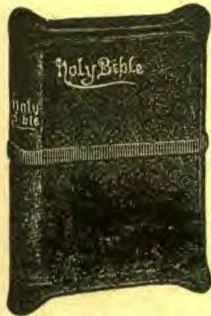
Self-Pronouncing S. S. Teachers' Reference Bible.
CONTAINS the celebrated Teachers' Helps, comprising nearly 400 pages. Also a complete series of fifteen new maps.
Description. — Imperial Seal Binding, Tuck Edges, known as “Divinity Circuit,” Rounded Corners, Full Red under Gilt Edges.
We offer this Bible, post-paid, for only SIX NEW YEARLY SUBSCRIPTIONS at 75 cents; or TWELVE NEW SIX MONTHS' SUBSCRIPTIONS at 40 cents.
We will also send it, post-paid, with the INSTRUCTOR one year for $2.25. For 20 cents extra we will stamp your name in gold upon the cover.
A Bonanza for Live Agents!
MEN OR WOMEN
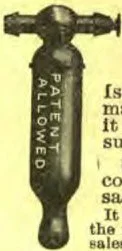
The Magic Pocket Vaporizer
Is one of the best-selling articles on the market to-day. Compact and effective, it appeals at once to the man or woman suffering from catarrhal affections.
Energetic agents throughout the country are making good wages by its sale.
It will be to your advantage to read every word of the following unsolicited letter from one of our salesmen:—
1101 Lincoln Ave., Saginaw, W. S., Mich., Feb. 6, 1900.
Modern Medicine Co., Battle Creek, Mich.
GENTLEMEN: I have canvassed the greater part of the time for more than thirty years, keeping my eyes open all the time for the best-selling books and other articles that might come upon the market, but do not hesitate to say your Magic Pocket Vaporizer is the best thing I have ever found to pick up money with. It is a real money catcher, as you will see by the following. On arriving in my territory, I went directly to work. At sundown that day I had sold four and taken five orders; the second day I put in about eight hours, and had fourteen in orders and sales. I can usually average eleven orders out of fifteen exhibitions, or a profit of from four to six dollars a day. I have succeeded in putting thirteen Vaporizers in one home, receiving $12.50 for them; eight Vaporizers in another family; five to a Baptist minister; three to another family. Yours truly, H. S. Merchant.
Write at once to the MODERN MEDICINE COMPANY, 105 Washington Ave., Battle Creek, Mich., for terms and territory.
TWO WAYS
“What are you reading, Doris?” asked a teacher of one of her girls one pleasant vacation day not long ago. She had “run in” to rest a moment on the wide, shaded porch, and had found her young friend enjoying the luxury of a hammock, a cool breeze, and a book.
“Oh—I—why—I—oh—m-’m-’m——” murmured Doris, in confusion, turning hastily to the title-page,—“oh, yes, it is—— ——,” and she named the title of a popular book for girls. “How stupid of me to forget!” she exclaimed.
“And who is the author?” inquired Miss Bryant, pleasantly, this time further to test Doris’s observation.
Another confused glance at the title-page revealed the fact that the girl had not had sufficient interest in the author even to learn her name.
“It’s a lovely book, though,” she explained, not without blushing at this second display of her inattention, “and it won’t hurt any one to read it—do you think so?”
“That would depend, Doris, on several things. Often a book that is excellent in itself may work real injury by the way it is read.”
“But I don’t just understand.”
“Well, before I explain, suppose you give me a connected outline of what you have read this afternoon—you have not gone so very far. Try!” she added, as Doris hesitated.
And Doris tried; but the result was such that her cheeks were as pink as the rose at her throat when she had finished. Miss Bryant had helped out in many places, or the girl would have failed entirely.
“I don’t know what makes me so,” said Doris; “I used to remember everything I read, but lately I can remember hardly anything.”
“That is because, as a child, you did not read so many books, and those you did read you did not lay aside after the first reading. You thought about them, and read them again, until at last you knew them almost ‘by heart,’ as the saying is.”
“That’s so,” assented Doris; “I remember well all the books I read till I began to draw them from the public library. Most of those blur together in a confused jumble.”
“You see, Doris,” said Miss Bryant, “the harm that may result from reading does not lie altogether in the book itself: much depends on the way it is read. If, when we have finished a book or an article or a sketch, we can not tell the title,—what it was about,—as well as the name of the author, and retain a connected idea of the whole; and if, besides, we have not arrived at some knowledge of his purpose in writing,—then the best of books may result in positive injury, by weakening the mind given us to improve. Careless reading results in careless thinking; and by and by, if the habit is allowed to strengthen, it becomes almost impossible to remember anything read, while to be really benefited by what is read is out of the question.
“And that is not the worst of it. One who reads simply to pass the time pleasantly, to please the emotions, is like one who eats only to tickle the palate—both soon come to have a positive distaste for healthful food. The one feeds on sweets and condiments, and as a result has dyspepsia and a muddy complexion; the other chooses mental food of an unhealthful character, and becomes a mental dyspeptic, with a foggy, muddy mind. Stand in the public library some day, and notice those who come and go, and the books they bring back and carry away; and in many cases you can not but see for yourself the effect their reading is having on their minds.”
“I’m sure I don’t wish to become a mental dyspeptic—as much pains as I take to keep a sound stomach in a sound body,” said Doris, gaily. “Papa looks out closely for the sound stomach; and now you shall be my mind physician, and I’ll follow your prescription,” she added, caressing the gray curls that were no index of the youthful heart that endeared Miss Bryant to all her young acquaintances.
“First of all, then, I would advise you, before reading a book,—any book,—to decide why you wish to read it—to be simply amused, or to be instructed and benefited. If the reason is good, it will be well to learn something about the author, if possible; if he has written a preface, do not ‘skip’ it; and then, having once begun, do not fail to read slowly. The habit of fast reading is one of the chief causes of mental dyspepsia. To read a book through in three hours that should take twelve, is as harmful as to eat a hearty meal in five minutes. Whatever is worth reading at all is worth reading slowly.”
“As for this particular book, Doris, I have a charming sketch of the author, who was a noble, true-hearted woman, and whose brave struggle against poverty and disappointment and apparent defeat has been an inspiration to many other girls, who have been led to be more thoughtful and kind at home, and more faithful in the work in which they hoped to succeed, by her example. You will receive more help from the book itself, to say nothing of more enjoyment, if you read this sketch first.”
“That is not a hard prescription,” laughed Doris.
“No, it sounds simple enough: the hard part of it will come when your easy-going habit gets the upper hand, and you are tempted to hurry and skip and skim, or to let your reading take you from the performance of some duty. Remember—choose wisely; read slowly; look up in the dictionary every word you can not pronounce or do not understand; and then keep a list of the books you read, and the impression they make on you. Above all, do not forget that it is ‘not how much we read, but how much we remember, that makes us wise,’” concluded Miss Bryant, as she parted with Doris at the gate.
This incident has a lesson that no one who finds enjoyment in reading will need to have written out. Nearly every one has had the experience of feeling, when he had finished reading some article or book, that he “didn’t know a thing he had read.” It would be far better never to read at all than to read so carelessly, or when so tired, that this could ever be true. There are, in the matter of reading, as in all other acts, two ways,—the way of careful, wise choice; attentive, thoughtful reading; and remembering the important points: and the way of careless choice; inattentive, thoughtless reading; and forgetting one page as soon as the next is turned. Two ways—one leading to health of mind and body; the other to spiritual, mental, and physical degeneration. Danger! is written large over the one; Peace and Pleasantness over the other. Which do you choose?
FOR EVERY DAY OF THE WEEK
SUNDAY:
“Cheerfulness is sunshine in the soul—cheerful people are always welcome.”
MONDAY:
“A little work for the Master,
Though love's reward be dim,
Yet the world is purer and better,
For a single thought of him.”
TUESDAY:
“If the vitality of Christ could but flow into our efforts, our friendships, our aspirations, what a lifting up to a higher plane there would be! How imperfect and struggling aim would leap into glorious achievement! How our halting and fragmentary friendships would glow with divine significance, and deepen into infinite tenderness! The entire scenery of life would be transformed. Gloom would give place to gladness, depression to exaltation, inertia to energy, halting effort to complete fulfillment.”
WEDNESDAY:
Is happiness thine utmost bent?
Why search afar for many a year,
When thou mayest find it now and near,
If thou but find content? — C. E. Stevens.
THURSDAY:
“The important consideration about a seed is not its size, but the fact that it is alive. Put it into the ground, give it a chance, and it will grow. The massive boulder is imposing beside a grain of wheat, and yet the produce of that little living thing may be feeding the world's hungry ages after the boulder has crumbled to dust. A word or a deed should be put to the same test. The question is not whether it is big or little, but whether it is alive. Will it grow? Will it develop? Will it be a blessing to those who come after?”
FRIDAY:
“For the heart grows rich in giving. All its wealth is living grain;
Seeds which molder in the garner, scattered, fill with gold the plain.”
SABBATH:
“Hast thou not known? hast thou not heard, that the everlasting God, the Lord, the Creator of the ends of the earth, fainteth not, neither is weary? there is no searching of his understanding.” Isa. 40: 28.