Your ShelfYour Projects

Review and Herald, Vol. 56, No. 3.

EXTRAVAGANCE IN DRESS
Earlier text: WHAT ROMANISM IS DOING

WISCONSIN H. AND T. SOCIETY.

Friday afternoon, June 11, 1880, the annual meeting of the Wisconsin H. and T. Society was held in connection with the camp-meeting at Portage City. The meeting was called to order by the President, Eld. G. C. Tenney. The minutes of the previous meetings, held at Madison, June 16, and Hundred Mile Grove, Oct. 19, 1879, were read and approved.
On motion, the Chair appointed O. A. Johnson, S. S. Smith, and C. W. Olds a Committee on Nominations; and H. W. Decker, E. G. Olsen, and Nellie C. Taylor a Committee on Resolutions.
It was suggested by the President that suitable persons be appointed to canvass the entire camp, and obtain all the names possible for the different pledges.
Adjourned to call of Chair.
Second Meeting.—Called to order Monday evening, June 14. The meeting opened with the singing of a stirring temperance song, followed with prayer by Eld. O. A. Johnson.
The Committee on Resolutions failing to report, the President offered the following, which were unanimously adopted:—
Resolved, That we recognize the hand and providence of God in the health and temperance movement.
Resolved, That we heartily invite the co-operation of all our ministers and people in extending the knowledge and influence of this cause.
The Committee on Nominations submitted their report, recommending for President Eld. G. C. Tenney; for Secretary, Mary F. Stillman. The report was accepted, and the candidates were unanimously elected.
The canvassing committee obtained forty additional signers to the different pledges, but reported some S. D. Adventists who refused to sign away their liberty to use tea, coffee, and tobacco.
A statement of the membership of the society was called for, and the Secretary submitted a report showing the number of full members to be 517. Of these, 509 signed the teetotal pledge, 7 the anti-rum and tobacco, and 1 the anti-whisky. The pledge members numbered 587. Of these, 396 signed the teetotal pledge, 139 the anti-rum and tobacco, and 52 the anti-whisky, making the entire State membership 1,104. There are now 20 local clubs in the society, the most of which hold regular monthly meetings.
On motion, the meeting adjourned sine die.
After the meeting was adjourned, Eld. Geo. I. Butler gave a lecture on “Health and Temperance,” showing very clearly the relation this work sustains to the cause of God. The interest was manifested by the good attention and quietness of the audience during the lecture.
G. C. TENNEY, Pres.
MARY F. STILLMAN, Sec.

UNCLE ZEB.

Our nearest neighbor, “Uncle Z——,” as he was called, a professing Christian, whose praise was in the mouths and hearts of all who knew him, was suddenly bereft of reason, and his insanity partook of the character of the man; there was no raving, destructive mania, as though the demons of natural depravity had been let loose before their time, but a mild and harmless incoherence, like an innocent childish prattle, and the engrossing topic of his thoughts was still salvation by Jesus Christ. He was as regular in attendance on the means of grace as he had been before. But all the social meetings in the region were sure to be visited by his person and edified by his exhortations, which, if not as pertinent to the general train of others’ remarks, were fully as sound and Scriptural as any. But the striking feature of his remarks, which then so forcibly impressed my mind, was the reformatory nature of them, as directed to professing Christians. In this lay his forte. From the scarcity of ministers then in that region, all were called on to “exercise their gifts,” and Uncle Z. always exercised his, whether called on or not; and his eloquence, when illustrating wholesale confessions, was masterly, and often appalling to individuals, as well as electric to the whole audience.
To illustrate: Brother A. gets up, and says he would not give up his hope for the world, but finds his heart so sinful that at times he almost despairs of getting to Heaven; he trusts the brethren will pray for him, and try to forgive him. The moment he sits down, Uncle Z., hitherto undiscovered, is on his feet, exhorting the brother “not to give up his hope, but to keep it at anchor, and to go right off and tell Brother J. that he is sorry he did not pay him that bushel of corn for the last week’s work, according to agreement, and that he is willing to restore to him fourfold, and he will never cheat him or anybody else again as long as he lives. He that confesseth and forsaketh his sins shall obtain mercy—Amen! Brethren, let us pray for Brother A.;” and a short prayer is made in perfect accordance with the facts in the case, during which Uncle Z.’s mind is refreshed with other incidents of Brother A.’s life, which are all borne to the throne of grace in simple, fervent and touching intercession for mercy, taking it for granted that Brother A. is really penitent. What poor Brother A. feels can better be imagined than described. I think he did not go to confession again till he was somewhat posted up in particulars. Next, Brother B. rises and laments a want of conformity to his blessed Master, but hopes that when Christ shall appear, he shall be like him, etc. The brethren were not asked to pray for him, but Uncle Z. is very glad that as Brother B. has discovered that the Saviour of mankind was not addicted to trading colts, or to going by a prayer-meeting to attend a caucus, his conformity will now more approach the great pattern. Amen!
These illustrations, from their truthfulness and simplicity, produced marked results. Some felt like shouting and clapping at the pictures drawn, but could not say that they themselves might not look as bad, if sketched by the same hand; others dared not stir, for fear their turn would come next. The subjects themselves might have evaded or concealed the thrusts under a fit of anger, but all knew that Uncle Z. was crazy, and a man must be a fool to be angry with him; besides, he had cut so like a skillful and compassionate surgeon, the tears often trickling down his face while he was thrusting the knife into the sorest part of the wound! And then, who had a better right than Uncle Z. to administer reproof, even if he had not been crazy? for no one could ever have said to him, “Physician, heal thyself.” Hence, great good seemed to be the result.—Watchman and Reflector.

GEORGE WHITEFIELD'S REMINDER.

GEORGE WHITEFIELD stopped at one time in a certain town in the house of a general who treated him very kindly. Whitefield, as his custom was, intended to speak to the family individually about the gospel of Christ, but Satan said, “Do not say a word to these good people, it will grieve them; they have been so kind to you. Why, you cannot tell the general, ‘Except a man be born again, he cannot see the kingdom of God;’ they would be too harsh words to address to such a man as that. And you cannot talk to the wife and daughters concerning the things of the kingdom. See how kind they have been to you! the warning will not come well from one who has been so much obliged to them as you.” And no doubt the flesh a little aided the temptation, so that when Whitefield retired to rest that night he had not spoken to any of the persons of the house according to his usual wont. This troubled him. The Lord visited him by night, and said to him, “Thou art my servant, and yet thou hast not done my work,” and conscience whispered, “These people have been kind to you; is it not great unkindness not to warn them of the wrath to come?” And then the Spirit said, “You dare not leave this place until you have addressed to them a word that might be blessed to their souls.” But still the flesh was strong, and he did not dare say a word. However, when the flesh failed, God came in and directed his servant’s mind. Whitefield happened to have a diamond ring in his possession at the time, with which he wrote upon the window-pane, “But one thing thou lackest,” and, having prayed much about it, he went his way.
No sooner had he gone than the master of the house entered the room where the good man had slept. The first thing that struck the general’s eye was this writing on the window-pane—“But one thing thou lackest.” The thought flashed across his mind, “Then this holy man of God loves my soul; I thought that he did not love it, for he said not a word to me about it. It appears that he does.” “Wife,” said he, “come here and see what is on that window.” “Yes,” said she, “depend upon it, he has been unhappy in our house. We have done the best we could to make him comfortable, but because we do not love the Lord, he has been disturbed and unhappy.” They both stood; the Spirit of God was at work in their hearts; they were convinced of the truth of that sentence, “One thing thou lackest.” “Call up the children,” said the father. And the son and the three daughters came, and, strange to tell, they were all brought to contrition of heart for sin at the sight of that text. Around the bed the whole family knelt—six of them—before God, confessing their sins, and rose up believing in the Lord Jesus Christ. A member of the church at present under the care of Dr. Thomas Armitage, of New York, has now in her possession the very pane of glass on which Whitefield wrote the words, and she tells the story of how her mother was one of those daughters who were thus converted to the Saviour.—The Methodist.

DAKOTA

Tindall, Bon Homme Co., June 28.—Came to this place by the advice of Bro. Conroy, who lives near Springfield, and who also assisted us to move from Yankton. This place is simply a railroad station and a post-office in the midst of an intelligent and well-to-do farming community. The interest has been good from the first, the attendance generally ranging from one hundred to two hundred. Have just introduced the Sabbath question, which seems to increase the interest. However, the prince of the power of the air seems bound to follow us. We erected the tent the 17th, and soon after getting it up, and while seating it, a storm came up with such strong wind that we were obliged to drop it, and the wind whipped it so after it was down, that it tore one breadth from top to bottom. The next morning we patched it up as good as new, and were ready for our appointment the following evening. Though we have since had frequent storms and wind, yet providence has favored us with pleasant evenings, excepting one, when a storm came up just before meeting time. The interest was such that several came out notwithstanding the threatening appearance of the heavens, and we had our meeting in the small tent, as we had to lower the large one.
Yesterday our audiences were large, although it was so stormy that a meeting appointed for a Congregationalist minister in the tent was a failure, as he did not come. This evening the Methodists are to have a meeting in the tent, there being no other place for worship but the railroad depot. S. B. WHITNEY.

DEDICATION AT OLIN, IOWA.

Sunday, June 27, was a happy day for the brethren of Olin. They have been making an earnest effort to build a house of worship, and now the undertaking is crowned with success. They have a neat building, capable of seating between two and three hundred people, and it is well finished, painted, and grained. They have cash on hand and pledges to cover all outstanding claims. The people outside of the church were very liberal, one man giving the lot on which the church stands, and $50 in cash.
The dedicatory service was at eleven o'clock; at ten the house began to fill, and when the service commenced it would hold no more. Some went away, and others stood at the windows to listen. The best of interest was manifested throughout. At the close of the service we repaired to a beautiful stream near the church, and three went forward in baptism. Bro. J. T. Mitchell officiated. I think I never witnessed a more solemn or beautiful baptism.
At five o'clock we met at the church for preaching service. The house was again well filled, and as we tried to tell of the love of God to poor sinful man, a very tender spirit was manifested by all present, and we could feel the deep movings of the Spirit of God. I think there is a very good outside interest here, which can be followed up to good advantage. If the brethren live near the Lord, they may be the means of leading many to a knowledge of the truth as it is in Christ.
J. D. Pegg.

HOW THE LEAVEN WORKS.

BRO. C. F. F., of Shull's Mills, Watauga Co., N. C., came out from the Baptist church, and commenced to keep the Sabbath of the Lord. He soon found himself a mark for much petty persecution. On one occasion a Baptist brother asked Bro. F. if he "kept Saturday." On being told that he did, the next question was, "You work on Sunday, then, do you not?" "Yes," was the reply. The Baptist brother then told Bro. F. that although he had dealt with him a great deal, and had always found him strictly honest, he would have no further dealings with him or any of the "Advents." "Then you hold us as enemies, do you?" said Bro. F. "Yes." Bro. F. then quoted to him the words of Christ, "Love your enemies," etc. After relating the above incident, Bro. F. says:—
Thus it will be seen that the spirit is at work which is to result in the law that none shall buy or sell but those who have the mark of the beast. One brother was indicted because he would not observe the man-made Sunday; but the Lord delivered him.
The truth is seldom preached here; we need help. I recently had the pleasure of burying one brother in a watery grave; he was formerly a Methodist, but is now an active, earnest worker in the cause of truth. The Sabbath-keepers in this place are few, but strong in the faith. They desire the prayers of the brethren.

INTERMITTENT FAITH.

A CORRESPONDENT who is in quest of advice on spiritual matters writes to the Christian Union, that in the Christian life which he is endeavoring to live he finds much discouragement in the fluctuation of his faith. For days he has great hope and faith, God becomes all in all to him; then comes the reaction—doubt and anguish of mind, with a dislike of all religious topics. From the answer of the Christian Union we clip the following: “You have fallen into the common mistake of measuring your faith by your feeling. Churches and ministers have often done this; the New Testament never does it. Emotion is, in the nature of the case, transient. You find yourself in a high state of feeling. You enjoy it; you want to keep it up; you try to do so. But feeling never comes by trying. You fail. While the feeling is at flood, you suppose you have much faith; when it is at ebb, you suppose that you have little. Neither the flood nor the ebb proves anything. You should neither be exhilarant because of feeling, nor depressed for lack of it. Feeling no more proves the existence of religious life than the sparkle of the sun on the snow proves growth in the grass beneath it. The corn needs night and darkness as much as sunlight. Life is the test of faith. To follow Christ is to go about doing good.”

Notes of News.

—Boston is to have a Cardinal.
—France has commenced the work of expelling the Jesuits.
—Queen Victoria intends to visit Ireland this summer, for the first time in 30 years.
—Iron ore was recently discovered while sinking an artesian well under the New York Hotel, New York City.
—The German church bill, with Article 4 omitted, has passed the Diet by a vote of 206 to 202.
—The Chinese army invading Southern Russia has encountered Russian forces, and is victorious.
—During the 24 hours ending at noon, July 1, there were 94 deaths from sunstroke in New York City.
—A dispatch from St. Petersburg states that a fire is raging in Razan. Sixty houses have been burned, and the fire is rapidly spreading.
—The steamer Seawanhaka was burned near New York City, June 28. It is thought that no less than 50 of the passengers perished.
—On the 27th, near Louisville, Ky., three men who had taken shelter under an elm tree during a thunder storm, were struck by lightning and instantly killed.
—Prof. Sylvester, of Johns Hopkins University, is the first Jew on whom Oxford University has conferred the degree of Doctor of Civil Law.
—Young J. Allen, D. D., Methodist missionary at Shanghai, has been appointed a mandarin by the Chinese government. He is the only foreigner ever honored with the title.
—The beer-sellers of Birmingham, England, complain that the opening of coffee-houses and the provision of cheap amusements is injuring their business.
—In Liverpool and other places in England, over 8,000 men have struck work. They demand an increase of five per cent in their wages.
—Mrs. Booth, wife of “General Booth” of the Salvation Army, says that that army now has 157 stations and 2,280 public speakers. The people subscribed last year $73,345 to the purposes of the work.
—A Constantinople dispatch states that the famine continues in the districts of Bayazid, Alashgerd, and Van. It is reported that 10,000 persons, chiefly Kurds, have perished from hunger.
—The Belgian bishops have received instructions from the Vatican, recommending prudence. They are to oppose the new educational law, but at the same time keep strictly within the limits of the laws of the country.
—The Liberal State Convention and camp-meeting of this State convened at Lansing, Mich., June 28, with about 150 delegates in attendance. The meeting excited no interest among the citizens.
—A dispatch from St. Paul, Minn., gives an account of the explosion of an excursion steamer on Lake Minnetonka, by which four persons lost their lives, and a number of others were seriously injured.
—On the 30th inst., the Sny levee on the Mississippi River broke at a point 15 miles below Hannibal, Mo., flooding an extensive area of the finest farm lands in Illinois. One entire family was drowned. The damage will be very great.
—At Omaha, Neb., a curious freak was performed recently by the wind. Florence and Willow lakes, north of the city, were blown nearly dry, the wind scooping out the water. The ground in the vicinity of the lakes is covered with dead fish, which were blown out with the water.
—The custom receipts of the United States for the fiscal year ending June 30, were $185,108,611, being an increase over the preceding year of $47,858,653. The internal revenue receipts for the fiscal year were $123,623,251, an increase over the previous year of $10,061,640.
—The Nonconformists in the British Parliament are classified as follows: Congregationalists, 23; Baptists, 7; Wesleyan Methodists, 9; Calvinistic Methodists, 3; Unitarians, 19; Presbyterians, 29; Friends, 17; Roman Catholics, 48; Jews, 5; others in favor of disestablishment, 34.
—On the 1st inst., a 25,000-barrel iron tank of burning oil at Olean, N. Y., overflowed, the burning fluid spreading so rapidly that several men who were digging trenches were seriously and probably fatally burned before they could get out of the way of the flames. Earnest efforts are being made to check the fire.
—An Episcopal clergyman in Philadelphia, in an essay on Sunday-schools, proves that they were established among the Germans over 200 years before Robert Raikes opened his first school. He also says that Sunday-schools were in practical operation in this country nearly half a century before they were known in England.
—The Methodist General Conference, in their late session, decreed that the use of tobacco shall hereafter be forbidden to candidates for the Methodist ministry. The Congregationalist criticises this action, thinking the matter should be left to each individual’s conscience, or else the use of the filthy narcotic should be forbidden to all ministers.
—In the South a new industry is springing up, in the utilization of several palms for paper-making and other purposes. These trees are exceedingly abundant, especially in those parts of Louisiana and Florida bordering on the Mexican Gulf. The principal forms are the saw palm, the cabbage palm, and the dwarf palmetto. The fiber is tenacious and lustrous, of peculiar value for bond and note paper.
—The atheist Bradlaugh, over whose case there has been so much controversy in the British House of Commons, has finally been permitted to affirm instead of taking the customary oath. And now a suit has been brought against Bradlaugh to recover the penalty, £500, for affirming instead of taking the oath, and afterward sitting and voting in the House of Commons.
—The committee appointed by the French Senate to consider the plenary-amnesty bill, has reported, rejecting the bill. They say that the country does not desire pardon for the Communists; and that the present time, when religious congregations are being expelled, is not the time for allowing assassins to return. However, we are informed by cablegram that 6,000 of these agitators, banished in 1871, have returned to their native country.
—The case of Mirzar, the Greek, naturalized as an American, whom Minister Maynard has sentenced to death for the murder of an Egyptian lawyer, has called attention to the constitutionality of the act of Congress which authorizes our consuls and ministers in the East to try American citizens charged with crime; and both the President and the Secretary of State are of the opinion that the act is unconstitutional, and that no American citizen can be deprived of right to trial by jury.
—Canadians are not a little annoyed by the large emigration from the Dominion to the United States. It is said that 57,000 Canadians have left Ontario during the last eight months, nearly all of whom have permanently located in this country. What makes it worse for our Canadian neighbors is, that they are made up of the best class of farmers and mechanics, who are dissatisfied with the slow progress the government is making, and with the steady increase of the public debt.

AN INCIDENT.

BY A. R. LUCAS.
In conversation, a few days since, with a gentleman who is an infidel, I found his principal objections to the God of the Bible to be as follows: “How can a just God torment his subjects forever?” and, “How could you, a Christian, enjoy Heaven while some of your friends were in everlasting fire?” I judged from further conversation that he knew more of theology than of the Bible.
This is only one of the many cases I have known where the eternal-torment doctrine has made infidels.

An Assyrian Call to Prayer.

At a recent meeting of the Society of Biblical Archæology in London, Mr. W. St. Chad Boscawen read a paper pointing out a close parallel between the Bible precepts and the Assyrian tablets, regarding prayer as an antidote to sin. The following, translated from a clay tablet, is remarkable:
“Pray thou! Pray thou! Before the couch, pray! Before the throne, pray! Before the canopy, pray! Before the building of lofty head, pray! Before the rising of the dawn, pray! Before the fire, pray! By the tablets and papyra, pray! By the side of the river, pray! By the side of a ship, or riding in a ship, or leaving the ship, pray! At the rising of the sun, at the setting of the sun, pray! To the gods of Heaven, at the altars on earth, pray! On coming out of the city, or entering the city, pray! On coming out of the house, or entering the house, pray! In the place of judgment, pray! In the temple, pray! On the road, pray!”

Doing Well Without Thought of Fame

—It was a remark of John Hunter, that “there never was a man who wanted to be a great man who was ever a great man. For great men have endeavored always to do some great action that seemed to tend to some great good, and the effect made them great. Wanting to be great is vanity without power.” Something parallel to this was Longfellow’s saying: “The talent of success is nothing more than doing what you can do well, and doing well whatever you do, without a thought of fame.” But the climax of the sentiment, after all, is found in the inspired precept, “Whatever you do, do all to the glory of God.”—Presbyterian Journal.

Obituary Notices.

“Blessed are the dead which die in the Lord from henceforth.” Rev. 14:13.
Goff.—Died in Battle Creek, Mich., June 29, 1880, of consumption of the bowels, Morris D. Goff, son of D. A. and Juliette K. Goff, aged 19 years, 6 months, and 13 days. Bro. G. was of such an exemplary character that his parents testify that the only pain he ever caused them was the pain of parting with him at last. From the time he came to Battle Creek, in March, 1879, till the close of his life, he greatly prized the society of Sabbath-keepers and the privileges he here enjoyed. The last labor he performed was that of night watchman at the REVIEW Office. And as he went his regular rounds, he had not only his particular points to visit, but places where he would bow before the Lord in prayer. Such faithful, praying young men are too few, and the death of any such is a loss hard to bear. But we have this consolation, that he leaves behind the pleasantest of memories and the evidence of a well-grounded hope. Remarks at the funeral from Rom. 8:28, the last passage of scripture which he repeated before his death, and which was consequently chosen as the text. U. S.
Harris.—Died of consumption, at Meadville, Pa., May 5, 1880, Sister Ella I. Harris, in the twenty-fourth year of her age. Sister Ella became convinced of the truth about four years ago, by reading, and in company with a sister who survives her, amid much opposition, committed herself fully to it. Her life was one of faithful endeavor to know and do the will of God, and her earnestness in the missionary work evinced her gratitude for the light she had received. Her sickness was marked by patient submission and earnest heart-searching. Though she desired to live to engage in the Master's service, when it became evident that this could not be, she yielded with sweet resignation. Her mind was clear through all her sickness, and to the last the truth was very precious to her. She is greatly missed by all who have loved her, and especially by the sister with whose faith hers was so closely linked; but we hope, if faithful, to meet her “when Jesus comes.” The funeral services were conducted by Prof. Hyde of Allegany College, assisted by the superintendent of the city schools, in one of which she had for six years held an honored place. B. L. Whitney.
Lock.—Died at Mount Auburn, Ohio, Sabbath morning, April 24, Lucinda Lock, in the sixty-ninth year of her age. Her disease was pneumonia; she had also had two strokes of paralysis. She suffered much during her short illness of three weeks, but was patient and resigned. There was a time when she seemed not entirely herself, but about a year ago her mind became clear, and she has since been a humble, devoted Christian. She did all she could for those around her by talking to them and distributing tracts. Having known her in her last days, we have no fears but that she sleeps in Jesus. Adelia Robbins.
Merry.—Died of diphtheria, at Sauk Center, Minn., June 11, 1880, the only child of Joseph and C. J. Merry, aged 2 years and 4 months. They have laid their darling away to rest, with strong hopes of meeting her in the resurrection. Funeral discourse from 2 Sam. 14:14. John I. Collins.
Reish.—Florence Ellen Reish, daughter of Samuel Reish, died in Clarke Co., Iowa, June 17, 1880, aged 17 years. Sister Ellen connected herself with the S. D. Adventist church Dec. 3, 1876, and her life has since been that of a consistent Christian. We sorrow for her, but not as those who have no hope. Remarks by the writer to a large congregation at the funeral, from John 14:1–3. A. W. H. Millard.
Foster.—Died at his home near Imlay City, Lapeer Co., Mich., May 4, 1880, Bro. John Foster, aged 65 years. Bro. F. learned the message from Bro. Kenyon, seven years ago. His companion and children have hope in his death. Discourse by the writer, from Dan. 12:2, 3. Geo. A. King.

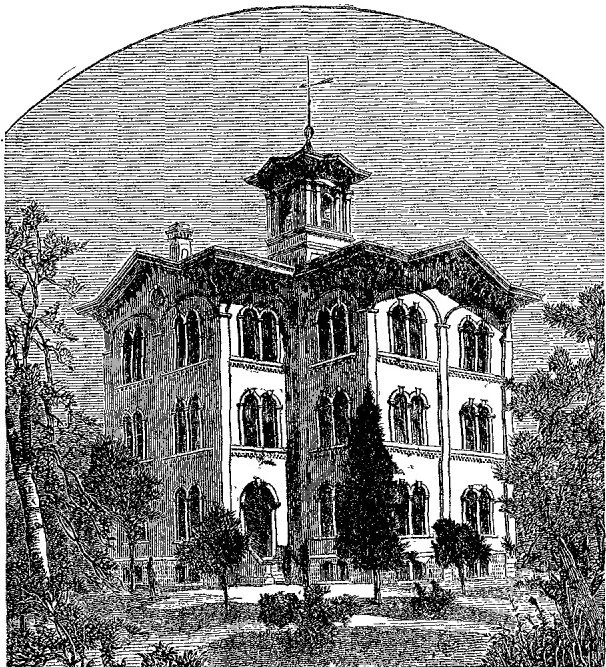
BATTLE CREEK COLLEGE.

A MODEL EDUCATIONAL INSTITUTION,

COMPRISING FIVE DEPARTMENTS.

Nearly 500 Students Enrolled Annually, Coming from 32 States and Territories.

DEPARTMENTS.

I. DEPARTMENT OF THE ARTS AND SCIENCES.

This includes a Classical Course of FOUR YEARS and an English Course of three years, each with its Preparatory Course of two years.

II. NORMAL DEPARTMENT.

This includes a Teachers' Course of FOUR YEARS, and a Model School. The course in this department includes all the branches required for a first-class certificate in any State. Professional instruction in Didactics is also given to those in this department who are expecting to teach.

III. COMMERCIAL DEPARTMENT.

This includes instruction in the following topics: Bookkeeping, Business Correspondence, Business Forms, Business Penmanship, Commercial Law, Banking, and Telegraphy. The common branches are also pursued in connection with the topics given above; also, French and German.
There are two sessions daily,—afternoon and evening.
The courses in this department are of varying length, and the tuition ranges from $5.00 to $30.00.
Superior advantages for those desiring to prepare themselves for Tract and Missionary Secretaries and Librarians. (Send for special circular.)

IV. DEPARTMENT OF THEOLOGY.

This department has a course of three years, which includes, besides the usual common branches, Geology and Greek.

V. DEPARTMENT OF HYGIENE.

This department has a course of one year. It is designed for those who desire to obtain accurate and scientific information on all subjects pertaining to the preservation of health, together with a fundamental knowledge of anatomy and physiology, and a practical acquaintance with the nature and ordinary treatment of common diseases.

THE FACULTY

numbers fourteen members. They are all men and women of experience and critical scholarship.
The majority of the students are young men and women of true moral worth. Their influence over the unstable is highly restrictive and salutary, making it comparatively easy to maintain the most rigid discipline.

EXPENSES.

Probably there is no other College in the United States where a thorough education can be obtained at so small an expense.
A system of clubbing, which has become very popular among students, enables them to secure excellent board at $1.10 a week, exclusive of lodging, which costs 50 cents to $1.00 more.
The annual expenses of each student, including all but traveling expenses and clothing, need not exceed $113.00. A full descriptive Catalogue will be sent free, upon application.
Address BATTLE CREEK COLLEGE, Battle Creek, Mich.

STIMME DER WAHRHEIT.

A GERMAN MONTHLY ILLUSTRATED FAMILY JOURNAL.
Devoted to the maintenance of practical Christianity and Bible religion. It is bold and outspoken in its explanation of the prophecies and defense of the doctrines of the near coming of our Saviour, and the binding obligation of the Law of God.
Its neat appearance and the beautiful illustrations of many Bible subjects secure general favor, while the low price at which it is offered places it within the reach of all.

TERMS, PAYABLE IN ADVANCE.

TO AMERICAN SUBSCRIBERS.

Single copy, one year…50 cents.
To new subscribers, with Way of Life as premium…75 cents.
Five or more copies to one address, for missionary work, per copy…40 cents.
Ten or more copies…35 cents.

TO EUROPEAN SUBSCRIBERS.

Single copy, one year…70 cents.
To new subscribers, with premium…$1.00.
Five or more copies to one address, per copy…55 cents.
Ten or more copies, per copy…50 cents.
Address REVIEW AND HERALD, or,
STIMME DER WAHRHEIT, Battle Creek, Mich.

HEALTH PUBLICATIONS.

The Household Manual. A book brimful of information on a hundred useful topics. 20,000 have been sold in two years. Bound, 172 pp. 75 cts.
Digestion and Dyspepsia. By J. H. Kellogg, M. D. This work embodies the results of the author's experience in dealing with all forms of the disease, in all of its stages, and is a thoroughly practical treatise on this prevalent malady. In cloth, 176 pp. 75 cts.
Plain Facts about Sexual Life. The most complete and important book for the general public yet published on the subject named in the title. The Boston Journal says of it, “A book so intelligently written should not lack for readers.” Handsomely bound in cloth, gilt edges, 416 pp. $2.00
Uses of Water in Health and Disease. Giving careful and thorough instructions respecting the uses of water as a preventive of disease, and as a valuable remedy. In cloth, 166 pp. 60 cts. Paper covers, 136 pp. 25 cts.
Diphtheria. A concise account of the nature, causes, modes of prevention, and most successful mode of treatment of this now prevalent and fatal malady. Board covers, 64 pp. 25 cts.
Alcoholic Poison; or, the Physical, Moral, and Social Effects of Alcohol as a Beverage and as a Medicine. This is the

ADVENT HAROLDEN.

SIXTEEN PAGES.
A SWEDISH RELIGIOUS MONTHLY.—PUBLISHED AT BATTLE CREEK, MICHIGAN, AND CHRISTIANA, NORWAY.
ADVENT HAROLDEN is devoted to the proclamation of the second coming of Christ, the explanation of Prophecy and Bible doctrines in general, and the defense of the commandments of God and the faith of Jesus. Its family department is filled with instructive reading, accompanied with beautiful illustrations, and also gives valuable hints with reference to the preservation of health and the treatment of disease.

TERMS, INVARIABLY IN ADVANCE.

TO AMERICAN SUBSCRIBERS.
One copy, one year — 75 cents.
To new subscribers, with Way of Life as premium — $1.00.
Five or more copies to one address, per copy — 50 cents.
Ten or more copies, per copy — 40 cents.
TO EUROPEAN SUBSCRIBERS.
One copy, one year — 90 cents.
Five or more copies, per copy — 60 cents.
Ten or more copies, per copy — 50 cents.
Address REVIEW AND HERALD, or,
ADVENT HAROLDEN, Battle Creek, Mich.
Continue reading: BOOKS IN PAPER COVERS