Up the long country road came two little girls, with their school books under their arms, and their bright tin dinner-pails flashing in the hot sun. A heavy farm wagon crawled slowly down the road, raising a cloud of dust. But the children minded neither the heat nor the dust, so eagerly were they planning how they should spend their first day of vacation.
“You come up to my house in the morning,” Candace was saying, “and we’ll make a play-house out in the arbor, and take our dinner out there.”
“Oh, that will be splendid!” cried Lucy, giving her friend a little hug.
“Good-by!” called Candace, as they parted at the corner, “don’t forget.”
“No, I won’t, ‘honest true, bright and blue,’” Lucy answered back.
The morning was fair; there was not anywhere a speck to cloud the blue. Lucy hurried and washed up the breakfast dishes. This was quite an unusual thing; for she did not like to do them, and generally waited so long that her mamma had to come and help her.
“Now,” thought Lucy, “I can go. I guess I’ll change my dress first;” so, slipping softly up stairs, she quickly put on her best pink dress and her slippers. When she reached the foot of the stairs, she met her mother.
“Why, Lucy Brown!” said she, “what have you put on your best dress and slippers for?”
“O please, mamma,” said Lucy in her most coaxing tone, “Candace wants me to come up to her house ever so much to-day. I’ve hurried and washed the dishes, and fed the chickens; and I’ll be real good. Say, can’t I go?”
“Please, mamma,” Lucy pleaded, as her mother slowly shook her head.
“No,” her mother replied, “I can’t spare you to-day. I have a very hard headache, and I want you to take care of baby. Now put on your old dress and shoes, and help me.”
“O dear!” Lucy cried, as she turned to go up stairs again, “it’s always ‘take the baby.’ I wish baby wasn’t anywhere. So there!” and she slammed to the bedroom door.
It took her a great deal longer to put on the old dress than the new one. It was almost half an hour before she came down. The frowns were still on her face.
Baby Nat was playing with his blocks on the floor. Seeing Lucy, he began rolling a great red apple toward her. Lucy took no notice of baby’s friendly attempts, but stood still in the center of the room, thinking what naughty thing she could do to “pay mamma off for being so mean.”
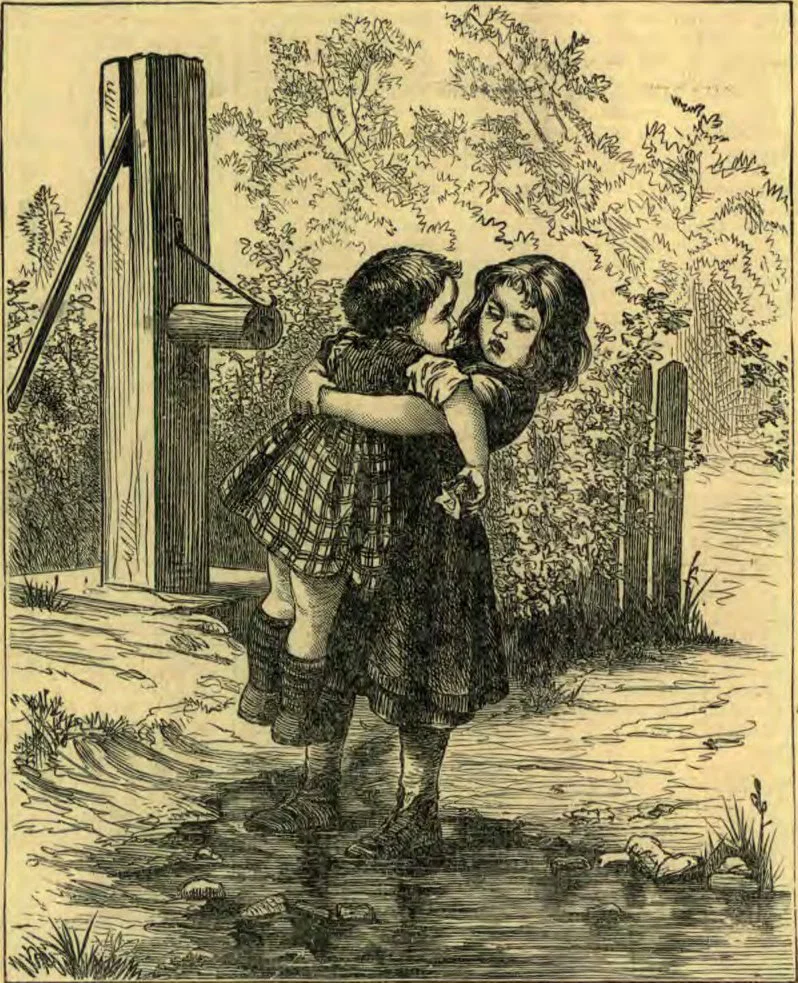
“I know,” said she to herself at length, “I’ll let the chickens out.” So, bent on mischief, Lucy sped down the garden path. Natty left his blocks, and safely reaching the bottom step of the veranda, followed after her. He stopped near the old red pump, and set up a lusty crowing over a little toad that he found hopping in the path.
“O dear!” cried Lucy, running back, and picking him up in her arms, “why can’t you stay where I put you? I wish you wouldn’t tag everywhere I go. Now stay there!” and she pushed him up on the edge of the veranda with no gentle hand.
Just as she reached the door to the hen-house, she heard a loud scream, and looking back, saw baby fall down the long steps onto the stone walk leading to the gate. Mamma heard too, and running to the door, saw Natty lying white and still.
“O baby! oh, he’s killed!” she cried, and clasping him in her arms, hurried back into the house.
Lucy stayed down by the hen-house. She was not angry now, only so frightened. “What would they do to her if she had killed baby?” By and by she went softly around the house, and crept in at the front door. Natty lay in his cradle in the cool front room. There was a bandage across his forehead, his cheeks were flushed, and he moaned and tossed in his sleep.
Just then mamma came in, and sat down in the large arm-chair by the cradle. She did not see Lucy. She leaned her head back, and shut her eyes. Poor mamma! How white and tired she looked! A sudden pang shot through Lucy’s heart.
“O mamma!” she sobbed, running up to her, and putting her head in her lap, “I—am—so—sorry! Will Natty die?”
“No dear,” said Mrs Brown, softly stroking Lucy’s hair. She did not scold her, for the fright was punishment enough. She just took the tear-stained face between her hands, and kissed it. “My little girl must be very careful,” said she, “or her quick temper will make her a great deal of trouble.”
And Lucy was more patient. One glance at the deep scar on Natty’s forehead was enough for months afterward to check her, no matter how angry, until she grew to be a sunny-tempered little girl. W. E. L.
LITTLE DANDELION.
By Helen B. Bostwick
Gay little dandelion
Lights up the meads,
Swings on her slender foot,
Telleth her beads,
Lists to the robin's note
Poured from above;
Wise little dandelion
Asks not for love.
Cold lie the daisy banks
Clothed but in green,
Where, in the days agone,
Bright hues were seen,
Wild pinks are slumbering,
Violets delay;
True little dandelion
Greeteth the May.
Brave little dandelion!
Fast falls the snow,
Bending the daffodil's
Haughty head low.
Under the fleecy tent,
Careless of cold,
Blithe little dandelion
Counteth her gold.
Meek little dandelion
Groweth more fair,
Till dies the amber dew
Out from her hair.
High rides the thirsty sun,
Fiercely and high;
Faint little dandelion
Closeth her eye.
Pale little dandelion,
In her white shroud,
Heareth the gentle breeze
Call from the cloud!
Tiny plumes fluttering
Make no delay;
Little winged dandelion
Soareth away.
—Helen B. Bostwick.
THE BETTER WAY.
“Remember, dear, speak softly. That is your watch-word this week, you know.”
Harry and Lina were just starting for school. Harry stopped.
“Mamma, I did forget yesterday. I will try to remember to-day.”
Mrs. Gray had a habit of giving watch-words to her children, and this was one that Harry especially needed.
That very day a dispute arose among the boys of Harry’s class. It was a matter which concerned Harry, and when he appeared, he was appealed to at once by each side.
His first word was loud and heated. What was the little voice that whispered, “Speak softly”? His face flushed, and he was silent for a moment. Then he spoke slowly and pleasantly, and the trouble was soon settled.
Going from school, Harry told Lina all about it.
“It was the better way,” he said. “We should have had a quarrel, may be a fight, if mother hadn’t reminded me of our watch-word. The boys were all ready for it, and so was I!”
“Mother’s way always is the better way, I think,” said Lina, after a little pause. “May be it’s because she always tries to find out what God’s way is.”—Selected.
Letter Budget.
MAMIE BROWN, of Oneida Co., N. Y., writes: “I wrote a letter for the INSTRUCTOR last summer, when I was at Oswego, and I will add that while there I stayed at Eld. Place’s, about a mile from the lake, where his granddaughter and I spent many a pleasant hour throwing stones into the lake, and wading in it. I attended the Syracuse camp-meeting, and expect to go to school in Rome this winter. I went to Utica to canvass for ‘Sunshine at Home’ and Signs of the Times. I hope the few subscriptions I have taken may do some good in spreading the truth and saving souls in the kingdom of heaven. I am trying to live so that I can meet the INSTRUCTOR family in the new earth.”
Mamie’s letter was written the fore part of January. Probably her school term at Rome is nearly ended. Wonder what good work she will take up during vacation next summer.
AUTEN HANSEN, of Montcalm Co., Mich., writes: “I am thirteen years of age. I have four brothers; the oldest is fifteen years old. I love God and his people. I was baptized at the East Saginaw camp-meeting two years ago. We live on a farm, and raise wheat, corn, oats, and potatoes. We have two horses; their names are Prince and Ned. They are four years old. We have five cows, five calves, and six sheep. We do not keep hogs, because they are not good food. I used to live in Chicago, where I was born. I have a step-father. My own father was drowned in Lake Michigan. He was a fisherman, in company with two other men, who were drowned too. They fished because they could get no other work and keep the Sabbath. I like the INSTRUCTOR very well; the ‘Budget’ and about Boston and the Revolutionary war the best. I wish all the INSTRUCTOR family good bye.”
Auten finds a good deal to write about which will interest the readers of the Budget. And so all the INSTRUCTOR family can, when they write as if they were visiting with a near friend.
LENA AURORA WELLS, of Sargent Co., Dakota, says: “I often read your paper, and like it much. I have never taken it myself, but friends have kindly sent it to me. I intend to subscribe for it in a few days. I am a little girl eight years old, and have two little brothers younger than myself. We used to live in Coopersville, Mich., but two years ago we came to Dakota with our parents. I like it very much out here. In the summer time the prairie is covered with grass and flowers, and it makes a nice, big playground. We have had a pleasant winter; the sun shines most every day. Johnny and I saved up enough money to buy us each a Bible. Brother Johnny reads two chapters on the Sabbath, and one every day; and I read one every day, and six on the Sabbath. I am in the book of Jeremiah, and Johnny is in the book of Exodus. We don’t have any Sabbath-school to attend, but we get our lessons just the same, in Book No. 1, and mamma hears us recite them. We also have a little meeting of our own. We do not go to school, but mamma teaches us at home. Johnny and I raised a little garden last year, and made one dollar and a half. We intend to do better this year, and save money to buy us good books, and to pay for our paper. I am trying to be a good girl. I send love to all.”
How we should like to join the INSTRUCTOR family on that nice prairie playground, to gather the flowers and visit with Lena!
WILLIE WYBARK, of California, sent for an INSTRUCTOR outfit last winter, and in just a little while he wrote again, saying, “I have got four names for the INSTRUCTOR and ‘Golden Grain Series.’ I hope to get more, for I value the paper very highly. I am trying hard to circulate it with the book around here. It is a small place, and the people are much prejudiced. Some laugh at me, but I try the more. I am ten years old. I keep the Sabbath with ma. There are only three families of Sabbath-keepers here. The Sabbath-school is held at our house. We have nineteen scholars, and always some that we invite, besides. I am learning to write, and I hope I shall be able to write better next time.”
No doubt Willie finds it hard sometimes to do duty among those who do not appreciate his efforts; but, dear boy, the experience you may gain there may be just what you will need sometime in the future, when you have greater difficulties to contend with. Don’t lose the benefit of the experience by shrinking from any known duty. And this we say to all our readers.