SOLITARY reading will enable a man to stuff himself with information; but, without conversation, his mind will become like a pond without an outlet— a mass of unhealthy stagnature. It is not enough to harvest knowledge by study; the wind of talk must winnow it, and blow away the chaff; then will the clear, bright grains of wisdom be garnered, for our own use or that of others.—Wm. Matthews.
Miss Margaret
By S. B. T.
A YOUNG minister was traveling on horseback through a mountain district. One day he noticed groups of people coming from every direction, many of them having evidently walked a long distance. It was not Sunday, yet these people were dressed in Sunday garb, and everywhere was the deepest solemnity. To his inquiry if a protracted meeting were going on, a mountaineer answered:
“Naw, mister, but Miss Margaret’s dead.”
“Miss Margaret?” the stranger asked, inquiringly.
“You-uns don’t know Miss Margaret? She was the ‘best woman ever lived, an’ she’s dead!” There were tears in the man’s eyes.
“Are all these people going to the funeral?”
“Deed they is, mister; it’ll be the biggest funeral ever seen in these parts.”
Deeply interested, the minister attached himself to one of the silent groups, and passed on with the long procession. It was a never-to-be-forgotten scene.
The meeting-place was a plain, rough schoolhouse. The cheap, plain coffin, the poorly dressed throng, were all forgotten as the stranger gazed upon the still face of the girl lying in her last sleep. It was not a beautiful face, but it wore, even in death, a look of high resolve and self-forgetfulness that thrilled the looker-on to the depths of his soul. The throngs that gathered round beheld that face with streaming eyes.
Who was she? What was she? Only the teacher of that humble, mountain school. She had come, a stranger, among these rude, ignorant people. For the love of Christ she had labored in season and out of season to teach the children, and also their elders, the better ways they had never known. Before she had been among them six months, the houses were in better repair, and kept in a cleaner, more homelike fashion. The rough manners were softened; kindness and neighborly love were manifest as never before, and the Bible became a well-read, beloved Book. Many a soul had been led to Jesus by her simple words, and her beautiful, unselfish life.
And now she was dead, leaving her flock bereft. Not one in all that company was of kin to her, save as brother or sister in Christ Jesus. Never was queen more truly mourned, never granted truer honor, than this humble, quiet girl, who entering one of earth’s dark corners, made it glorious with the knowledge of him who is the “light of the world.”—S. B. T., in Christian Life.
What Would You Do?
“WHAT would you do,” a mother asked me lately, “if your two-year-old child refused to eat the cereal he has always had for breakfast? I can’t coax or force my little boy to take it.”
In the first place, I would help him forget as fast as I could that that particular cereal was ever invented. I should look about for a totally different variety of breakfast food, and I would even go so far as to serve it in a different little bowl, as gay as could be found. First, I would have seen to the cooking of it myself, to make sure that it had steamed long enough, that it was free from lumps, and not scorched. And I would bring it to him with a smiling face, and a voice as free from wheedling as from any suggestion of force. The idea of cramming food into a child against his will and expecting it to do him good is highly humorous if one stops to regard it.
When a child suddenly and violently deviates from a given routine, there’s a reason. One dish of lumpy, badly cooked cereal is sufficient to prejudice a little stomach against it for months to come. Or if the selfsame food is served without variation for weeks, a child’s appetite becomes as hopelessly dulled as our own would be. “Always” is a long time to be eating one kind of food. It sounds to me as if this particular small boy were “just plain tired” of the monotonous round. The key-note of scientific feeding is now conceded to be variety, and the mother who wants to be sure of the best nurture for the small body must have frequent recourse to the grocer.—American Baby.
The Seventh-day Adventist Mission of Eritrea and Abyssinia
By Ludwig Richard Conradi
L. R. CONRADI
KING MENELIK OF ABYSSINIA
(See article on Abyssinia on page 8)
Missions, as well as countries and individuals, have their peculiar histories; so this new mission has its history from the beginning of investigations until its final establishment at the end of 1909. Some twenty years ago the writer's attention was first attracted to Abyssinia while editing Elder J. N. Andrews's “Sabbath History” for the German people. As I learned that the Abyssinians in their high mountain recesses prevailed for ten centuries against the overwhelming powers of Islam; that when they appealed in the seventeenth century to the Portuguese for help, the Jesuits took advantage of their distress, and granted assistance on the pledge that the king would insist that his people submit to Rome and renounce their peculiar tenets—among them a special regard for the seventh-day Sabbath as a day of public worship in memory of the creation; and that the Abyssinians shook off the iron yoke, an ardent desire arose in my heart some day to come into direct contact with them. From the meager knowledge possessed by the world in regard to that people, I also learned that the Abyssinians ever since this cruel attempt of the Jesuits were suspicious of all missions, and had lately closed their doors against all.
QUEEN TAITU, WIFE OF MENELIK, KING OF ABYSSINIA
Years afterward, while traveling on a Russian steamer bound for Joppa, six dusky pilgrims, joining us at Beirut, increased my interest in this mission field. Their crosses suspended on blue strings around their necks, their praying before every meal, their reading in prayer-books, attracted my attention, and soon I found out that my neighbors were Abyssinian pilgrims. Reaching Jerusalem, I soon found their church, near our health institute, and was informed that they had services every Sabbath. In conversation with some of their priests through an Arab interpreter, I was assured that they had special services on the seventh day in accordance with the fourth commandment, while Sunday services were also held because it was customary among the other Christians. Returning to Germany, I told the simple story, and our members quickly responded, and about five hundred dollars was collected as the first Abyssinian mission fund.
Six years ago I met in Dar-es-Salaam, an aged German missionary who for years had been laboring on the Egyptian side, and had married a Galla woman, but finally had had to give up the attempt of entering Abyssinia from the west.
Next I learned that Swedish Lutherans had carried on mission work from the Red Sea for nearly thirty years, and, at my first opportunity, I visited their headquarters at Stockholm, and their school at Johannelund, where I gained much information both from books and also from missionaries who had been there. Here I also formed the acquaintance of Professor Taleen, who, at the request of the German emperor, had been sent by King Menelik to teach the Amharic language in the oriental seminary at Berlin. He assured me that, especially in some of the interior provinces, the Sabbath was held in greater esteem as a day of worship than Sunday. One of the Swedish missionaries informed me that Bishop Tucker, of Uganda, had expressed the conviction to him that the best way of access, especially to the Galla people in the south, would be from Lake Rudolph. But inquiry made by the British commissioner destroyed the hope of entering from that section; for the English government had no agent as yet in the territory close to Lake Rudolph, and they were averse to having any missionaries settle there.
Next I made the acquaintance of Missionary Flathe, who had labored about fifteen years among the Abyssinian Jews, or fellahs, with success, but was taken captive by King Theodor, who sent him as a special envoy to Queen Victoria. But as soon as Emperor Menelik [see his picture on first page of this paper] gained full control, all missionaries had to leave. Thus every avenue seemed closed, except one—the Italian colony of Eritrea.
When our German, British, and French Sabbath-keepers began to occupy their respective colonies in Africa, it was but natural that the Scandinavians should also have a special portion, and as the Swedish Lutherans labored in Eritrea, providence pointed to it, and to Abyssinia with its ten millions of people, as their special field. In the early part of 1907, Brethren P. N. Lindegren and J. Persson were appointed, and after some preparatory study sent to Eritrea. They rented dwellings at Asmara, and at once began the study of both Italian, the government language, and Tigré, the language spoken by the natives. In the fall of 1908 Brother Lindegren attended our general meeting at Beirut, expecting9to take Sisters Larson and Rhode back with him on his return. But a few days before we left, he was taken sick with typhoid fever, and the two sisters had to proceed alone. The Italian officials demanded so many documents for the marriage that Brother Persson could not marry until August, 1909, and Brother Lindegren until the end of December, 1909.
The brethren looked over the whole colony to secure suitable locations for our missions, and there seemed to be no obstacle in the way of securing them. In view of this, Elder E. Grundset, of New York, was selected as director of this new field at the last General Conference, and Dr. F. W. Vasenius and Brother V. E. Toppenberg were appointed to assist there. In order that Elder Grundset might become somewhat acquainted before I should arrive, he left for Asmara in October, while Dr. Vasenius and wife, and Brother Toppenberg came with me. Immediately after my arrival on November 18, we looked at some places near Asmara, and called on the secretary, as the governor was absent, and also on Professor Baldrati, the land commissioner.
Four days after my arrival we secured an audience with the governor. He informed us that the colony had but a small population, that there were already several missions, and that the political situation across the Abyssinian border was so uncertain that they had to use every precaution not to stir up any trouble among the Abyssinians in their own colony. Consequently he could only grant us some land within the town limit of Asmara,—about a three-mile circle.
We therefore selected a suitable piece of about sixty acres, near a village, but on the twenty-seventh the reply came that we could secure only fifteen acres as a free grant; that the villagers were objecting to our securing the farm in question. As the fifteen-acre homestead grants were limited to one piece, near the fortress, with no surety of water, we next turned our attention to some homesteads already occupied by Italians. Several were willing to sell their rights, but again the matter had to be submitted to the governor. Finally, on December 2, we received the reply that we were at liberty to buy any favorable concession in the prescribed town-limit. After prayerful consideration, we finally concluded that we would buy the homestead of a Mr. Pollesco, containing seventy-five acres, on which there was a fair crop of wheat, and which also had water. We agreed on nearly eight hundred dollars for this concession. As he had been back on it the required time, and had fulfilled all other requirements of the homestead law, we entered into his rights, and can obtain the concession as full property at any time we desire. The only open question is whether we shall have it deeded free, or whether we must pay an additional two hundred forty dollars to the government. Meanwhile we pay a nominal rent of twelve dollars to the government.
On December 6 I called once more on the governor, to convey our thanks, and to ask several favors, also on the secretary, and on Professor Baldrati, the latter having been very kind to us, as has also the chancellor, Signor Consortori, who made out the deed to the “Seventh-day Adventist Mission of Eritrea and Abyssinia,” which was duly signed on the same day. The farm joins the first sixty acres for which we applied, and lies within one and one-half miles of the center of the town. Asmara, being the capital, will soon be a railway center; it is the natural gateway to northern Abyssinia, and has an excellent climate; so we have every reason to be grateful to God that such a fine location has been secured.
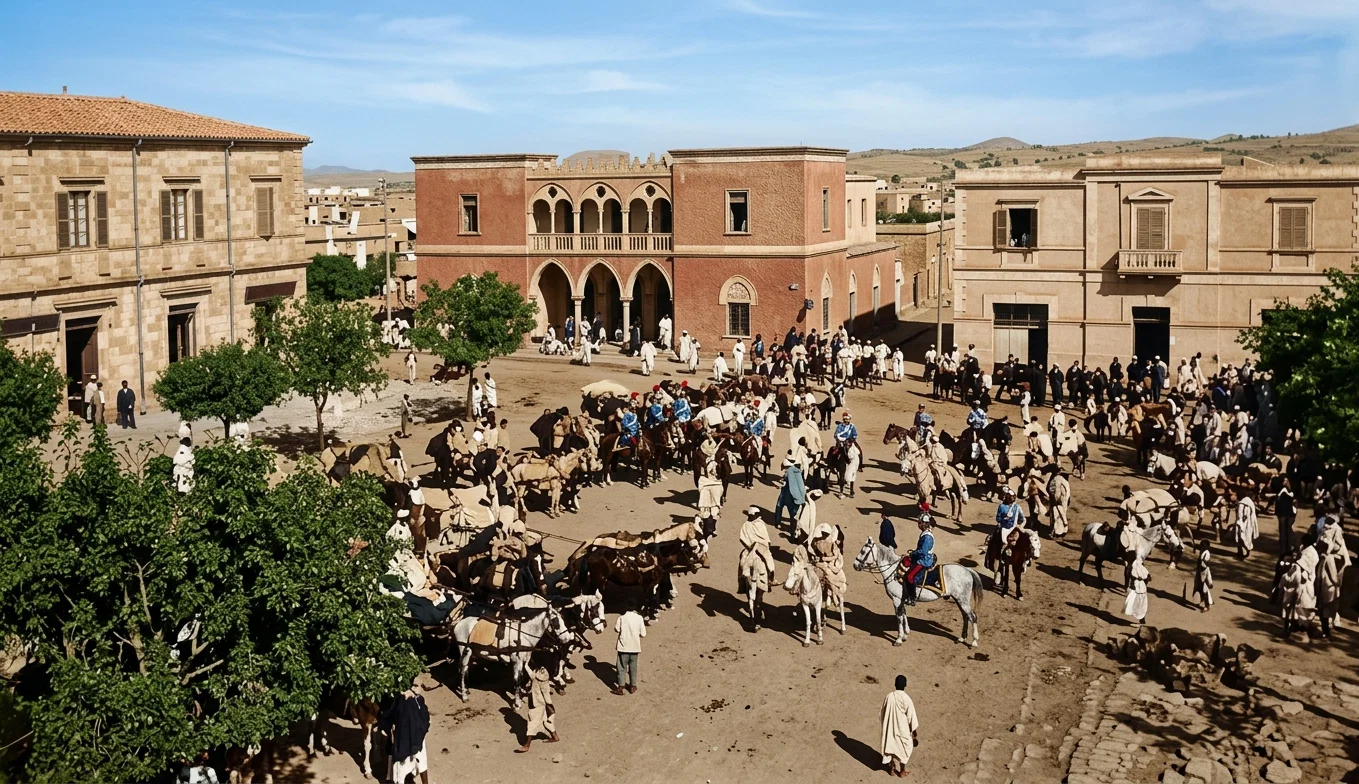
ASMARA
Building in center is the post-office. Near this our missionaries now live. Italian mounted soldiers standing in the square
Both the Roman Catholic and Lutheran missions endeavored to keep us out, but we went many times to the different officials, beseeching them like the importunate widow, and the Lord did not disappoint us. Meanwhile we studied the question of building, and obtained the prices for materials, etc., also drew up plans for a school and for a dwelling-house for two families.
There is sufficient stone on the very spot where the buildings are to be placed. The buildings, well, seed, oxen, carts, etc., will cost us about two thousand dollars, and we shall have to send some four thousand dollars within the first four months of 1910. As the Abyssinian Mission is to have three thousand dollars from the $300,000 Fund, we hope that all our people will rally to raise this amount soon.
In four months the buildings are to be completed, and we expect that the products raised, together with the nominal rent charged our missionaries, will give sufficient means to keep from ten to fifteen young men at school. The cost for each is figured at some thirty dollars a year. One of the hard problems will be to secure good reliable young men, who will unite with us and become workers.
On Sabbath, December 4, the church at Asmara was organized, nine offering their names, and a tenth one expecting to be baptized at the earliest opportunity; and though it is a church of missionaries, yet a foundation for the spiritual building is laid. The Lord drew near to us as we celebrated the ordinances, and all testified of his goodness in opening the way before us.
Quite a number of problems still need to be worked out. If possible, our medical missionaries ought to enter Abyssinia proper during 1910. This means some important and careful correspondence. Probably one of our workers may go in the spring to Uganda, as the way seems now to open, and begin work from that corner. But meanwhile, all our missionaries have here the very best chance of studying the three leading languages of Abyssinia. Brother Persson has already such a fair knowledge of both the Italian and Tigré that he could fluently interpret for me. Brother Lindegren is working hard to gain a knowledge of the Tigré; Elder Grundset and family are beginning to study the Tigré, while Dr. Vasenius and wife are to study the Amharic, and Brother Toppenberg the Galla.
Asmara being heathful, and good lodgings obtainable at fair prices, our missionaries have here a golden chance to learn the languages, as well as the ways of the people, at the same time helping in constructing the buildings, and becoming in every way better prepared for their work. Asmara itself is a favorable location for our school, as here we have religious liberty, weekly mail facilities, and Europe and Abyssinia are easy of access to us. After all was settled, I remained with them two days and a half. During this time I rode about seventy miles on muleback, visiting the Swedish superintendent, who had just returned from Syria, at Zazega, and going some twenty-five miles south to Debaroa, toward the Abyssinian border, where our brethren thought of establishing another station if the way should open. About forty miles more would have brought me to the present border of Abyssinia.
But twenty years ago Asmara was an important Abyssinian town, and there are thousands of Abyssinians living in and about it. The Abyssinian Mission is fairly opened, a foothold has been obtained, and soon another school will be erected at an elevation of eight thousand feet, to shine as a beacon light in this portion of Africa. It is now for our people to rally to our support, helping with their means and their prayers, that the work may be quickly extended.
Asmara.
Sinai and Calvary
By John Hay
THERE are two mountains hallowed
By majesty sublime,
Which rear their crests unconquered
Above the floods of time.
Uncounted generations
Have gazed on them with awe —
The Mountain of the Gospel,
The Mountain of the Law.
From Sinai’s cloud of darkness
The vivid lightnings play,
They serve the God of vengeance,
The Lord who will repay.
Each fault must bring its penance,
Each sin the avenging blade;
For God upholds in justice
The laws that he hath made.
But Calvary stands to ransom
The earth from utter loss —
In shade than light more glorious,
The shadow of the cross.
To heal a sick world’s trouble,
To soothe its woe and pain,
On Calvary’s sacred summit
The Pascal Lamb was slain.
The boundless might of Heaven,
Its law in mercy furled,
As once the bow of promise
O’erarched a drowning world.
The law said, “As you keep me,
It shall be done to you.”
But Calvary prays, “Forgive them;
They know not what they do.”
Almighty God, direct us
To keep thy perfect law!
O blessed Saviour, help us
Nearer to thee to draw!
Let Sinai’s thunders aid us
To guard our feet from sin,
And Calvary’s light inspire us
The love of God to win.
— John Hay.
Looking Forward
FORGET the things behind, look forward to the things before. The wisdom of a divine life lies hid in this principle.— Robertson.
The Papacy and the Sanctuary
By Editor
Editorial
“CALL to remembrance the former days,” said the apostle. All along the way the Lord has led in this advent movement by the light of his Holy Word.
The Word is the chart and compass, and it is also our sure defense. It is interesting to note how the objections now urged against the truths of the message are usually the same that were urged in the early days of the work. The word of the Lord cleaves the clear way through them all.
The Papacy and the Sanctuary. — As the pioneers saw the light of the sanctuary truth, and preached it, they met the determined attacks of First-day Adventists, who held to the old view that the sanctuary to be cleansed was on earth. “How could a heavenly sanctuary,” they said, “be trodden under foot?” Elder James White answered (in No. 4 of the REVIEW, January, 1851) by showing how the Papacy had done that very thing in its warfare against the truth of God:—
The sanctuary in heaven has been trodden under foot in the same sense that the Son of God has been trodden under foot [Heb. 10:29]. In a similar manner has the “host,” the true church, also, been trodden down. . . . The Catholic Church has trodden under foot not only the “holy city,” but the sanctuary, and its minister, or priest, “the Son of God.” Rome has been called “the Holy City” and the “Eternal City,” which can only be said of the city of the living God, the New Jerusalem.
An Earthly Substitute. — Continuing, Elder White showed how an earthly service had been substituted for a heavenly:—
The Pope has professed to have “power on earth to forgive sins,” which power belongs alone to Christ. The people have been taught to look to “the man of sin,” seated in his temple,—or as Paul says, “so that he as God sitteth in the temple of God,” etc.,—instead of looking to Jesus, seated at the right hand of the Father in the heavenly sanctuary. In thus turning away from Jesus, who alone could forgive sins and give eternal life, and in bestowing on the Pope such titles as “Most Holy Lord,” they have “trodden under foot the Son of God.” And in calling Rome the “Eternal City” and the “Holy City,” they have trodden down the city of the living God and the heavenly sanctuary. The “host,” the true church that have looked to Jesus in the true sanctuary for pardon of sins and eternal life, has, as well as their divine Lord and his sanctuary, been trodden under foot.
The time of restoration came in 1844, with the opening of the judgment hour in the heavenly sanctuary. With the joy of men who find great treasure, those early pioneers went forth to preach the message which is to restore to believers the truths obscured and trodden under foot through the centuries by papal tradition.
Faith and Finance
By W. A. S.
PHILANTHROPY was not the primary motive that led George Müller, of Bristol, England, to establish his famous orphanages.
As a comparatively unknown pastor, he was distressed at the general lack of faith in God. “I longed, therefore,” he said, “to have something to point to as a visible proof that our God and Father is the same faithful God as ever he was, as willing as ever to prove himself to be the LIVING GOD.”
He was impressed that an orphanage would be used of the Lord as a means of teaching the lesson of faith. He said:—
Now if I, a poor man, simply by prayer and faith, obtained, without asking any individual, the means for establishing and carrying on an orphan house, there would be something which, with the Lord’s blessing, might be instrumental in strengthening the faith of the children of God, besides being a testimony to the consciences of the unconverted of the reality of the things of God. This, then, was the primary reason for establishing the orphan house.
This was in the year 1835. Soon the beginning was made in a small rented building. The primary aim in view, and the circumstances under which Mr. Müller believed he was brought into this work, led him to lay down as fundamental the following plan of finance: “That there would be no enlargement of the work by going into debt.”
Thus the work began. Through the years Mr. Müller and his associates pleaded with God for help in every financial need. In order that it might be evident that God was the living God, and that he directly intervened to help, those associated with the orphanage were forbidden even to tell any one outside the home concerning needs or times of shortage.
The needs were laid before God alone. Again and again, when funds were gone, and the larder was empty, individuals were impressed to send help just at the right time to provide the next meal or the next payment.
One thing stands out very clearly in the record of George Müller’s life; his determination not to enlarge the work by going into debt did not narrow down his work or repress its growth. Dr. Pierson’s summary of Müller’s life-work—as regards financial outlay—shows that his fidelity to convictions of duty was vindicated; for in sixty years he, a poor man, had been enabled,—
1. To build five of the largest orphanages in the world, in which over ten thousand children had been cared for.
2. To give to school work over half a million dollars.
3. To circulate nearly two million Bibles and portions, and three million books and tracts.
4. To give over a million and a quarter dollars in aid of missionary work in various lands.
5. Altogether, in the sixty years, this man, without personal resources, who had less than three hundred dollars in money when he died, had had put into his hands to distribute about seven million five hundred thousand dollars.
Truly the Lord helped George Müller to leave the witness, according to his desire, that God is the living God.
W. A. S.
Shall It Be Victory?
By C. M. S.
It would please our Maker to write “Victory” after the life-work of every soul upon the earth. He himself says that he has “no pleasure in the death of him that dieth.” Life is God’s purpose for us over all the agencies and all the ways that lead to death. His desire is expressed in these words: “Turn yourselves, and live.” Turning from our own ways to God’s way, puts us in the channel of life, in the highway of hope. And that done, the powers of heaven are then enlisted in our behalf. Self dies, hope revives, and the purpose of God is accomplished.
From day to day we meet men and women whose hopes seem to have fallen in upon one another like the walls of a ruined house. The bright light of faith and hope no longer beams out of the windows of the soul. Its casements are barred, and only dissolution and hopeless despair stare out at the passer-by. Every ruin has its history, and the history of the ruined life is written on the soul.
There are storms on every sea; there are shoals or rocks or quicksands on every shore, and they all take toll of the human harvest this world produces. Waters that are the pathway of progress for some furnish the graves for others. The hopes that lie confined in the mighty deep are a numberless host; and the souls that have gone down beneath the waves of disappointed hope are as many as the cries that go up to the gods of wealth to-day from the sea of unrequited toil.11
But there is no purpose of our Maker that can not be fulfilled in us to-day. We have only to let him take the helm, and he will guide our bark out of every storm that rages around us. “Without me,” he said, “ye can do nothing.” But men to-day are saying in their hearts and by their acts, “I can accomplish what I will by my own efforts;” and when the storm comes down, the source of their power, the fountain of their dependence, is shaken and shattered, storm-tossed, engulfed; and with that gone, their all is gone. Like the ships upon the sea, their only dependence is in themselves, and the storm is often stronger than the ship.
There is a better source of strength and protection than self,—a source which no storm can shake, no power of earth destroy,—and it is open to every voyager upon the sea of life. “Fear thou not, for I am with thee; be not dismayed, for I am thy God; I will strengthen thee; yea, I will help thee; yea, I will uphold thee with the right hand of my righteousness.” Isa. 41:10.
There is no necessity for the wrecks that strew the shores of the sea of life. There has been ample provision made for the safe voyage of every soul that has set out upon that sea. God can not save the soul that flees from his power and his protection. Such a soul must go down; for the powers that wrestle for its ruin are greater than the powers to which it looks for succor.
There is a chart and compass for every voyager, and a light to dispel every fog and to shine through the darkest night that shuts its curtains down upon the sea. That chart and compass are found in the Word of God, the Bible. But in the confidence of self, many have chosen to trust to the will-o’-the-wisp of their own reason, have set their course into the fog-bank of doubt, and so have crashed upon the rocks of eternal ruin. These are the saddest wrecks that strew the sea of life to-day, and they outnumber a hundred to one the wrecks that stud the bottom of the sea.
The shipwrecks of the sea are sad events. But how much more sorrowful than the wreck of a ship, how much more terrible, is that life, loaded with a perfect wealth of possibilities, that lies mangled upon the rocks of unbelief, or lies loaded with the seaweed of miscarried purposes on the shore of life’s sea—all because unbelief was at the helm and self upon the bridge, and God and his great purpose were shut out of the mind and heart.
The wrecked ship lies in its cold bed at the bottom of the sea; but the life wreck, like a floating derelict, is often found moving about among us, hopeless, purposeless, drifting with the ebb and flow of the tides of doubt, a menace to other voyagers, and a sad reminder of the folly of unbelief.
There is hope for every voyager upon life’s sea; but that hope is not in self. God must be the pilot; God the protector; God the help and refuge in every stress of trial; the comforter in every sorrow; the power that wafts the vessel onward and homeward; and his Word the light to dispel every cloud of gloom and every fog that would enshroud the ship. He will do all that for you; his Word will be all that to you. Let us take him then for all that he has promised to be, and let his purpose be wrought out in our lives, and our destinies be wrought out in his hand. There can be no sad wreck in such a life; but the light of God’s blessing will shine out through the windows of the soul, and they that see it will learn to hope and trust in him who can not fail.
C. M. S.
Judge Not
By F. M. W.
The members of the church of Christ are to come into a relationship with one another different from that of the world around them. That relationship is forcibly illustrated in the apostle’s letter to the Corinthian church, by the human body. In the same manner that one afflicted member draws out the sympathy of all the others, so the members of the body of Christ should feel for any of their number who are afflicted, or have fallen into temptation. Christ by word and example represented to his church this spirit of tender solicitude one for the other. We find it in his loving invitation to his disciples: “Come ye yourselves apart into a desert place, and rest awhile.” We see it in his continual ministry of love to their physical needs; in the manner of his crowning act of humiliation when he washed his disciples’ feet. How tenderly he passed over their weaknesses! With what a spirit of love did he act the part of friend, teacher, and brother to them in all of his human companionship! He dealt kindly with doubting, hesitating Thomas and with impatient, impetuous Peter. He ministered to the sinning Samaritan woman at the well of Samaria, to the outcast Syrophœnician, as well as to the learned Pharisee and proud noblemen. With lofty, Godlike dignity, coupled with generous, loving compassion, he dwelt among men, witnessing, but not partaking of, their prejudices; the object of, but not a party to, their jealousies and animosities; living in the world, but unmoved by the spirit of the world around him. This was the noble dignity, the broad generosity, and the tender charity exhibited by our Example.
It is for us to manifest this spirit as members of his church to-day, and the times in which we live, and our associations with others, will afford us abundance of opportunity. The issues which confront us are such as will try our very souls, and test us to the utmost. Abnormal conditions exist everywhere. We ourselves are abnormal, and think and reason abnormally. Only as the Spirit of God clarifies our vision, and gives us sound minds, can we see clearly.
While we may see many things even in the church of God that are wrong, there are other things which may appear to us wrong when we ourselves are at fault; hence, we need to take kindly and charitable views of conditions. We need continually to study as to whether we ourselves are normal in our measurement of men and methods.
The ways we would choose, and our times, may not always be God’s ways and times. Some of our fellows may appear too slow, but may be serving God’s purpose in holding things in reserve. Others may sometimes appear too aggressive, but they may be but the leaders of God’s advance movement in the finishing of his work. If we do not always agree with our brethren, we can at least show them this consideration, that we credit them with honesty; and if we can believe that our brethren are honest, however much their methods may differ from ours, it forms a bond of union between us; it bridges the gulf by which each may cross to the other. This love and this confidence become the cable which holds against the pressure from without.
Our Lord admonishes, “Judge not, that ye be not judged.” Even when our brethren fall under the power of temptation, it is better for us to believe that it was an accident in their lives rather than a part of their purpose. Believing12this, we can labor for them with confidence.
One great need of our churches to-day is the cultivation of love and confidence among its membership, the elimination of evil-speaking, and the exercise of charitable forbearance one with the other. We need to come closer to one another, to enter into one another’s experiences. This closer acquaintance will beget confidence, and confidence will lead on to deeper brotherly love. Toward our fellows we should exercise the beautiful spirit expressed in the following lines by Adelaide Anne Procter:—
“Judge not; the workings of his brain
And of his heart thou canst not see;
What looks to thy dim eyes a stain,
In God’s pure light may only be
A scar, brought from some well-won
field,
Where thou wouldst only faint and yield.
“The look, the air, that frets thy sight
May be a token that below
The soul has closed in deadly fight
With some infernal fiery foe,
Whose glance would scorch thy smiling
grace
And cast thee shuddering on thy face.
“The fault thou darest to despise,—
May be the angel’s slackened hand
Has suffered it, that he may rise,
And take a firmer, surer stand;
Or, trusting less to earthly things,
May henceforth learn to use his wings.
“And judge none lost; but wait and see,
With hopeful pity, not disdain;
The depth of the abyss may be
The measure of the height of pain
And love and glory that may raise
This soul to God in after days!”
But the spirit of not judging to which we are exhorted by our Saviour, does not teach, as some have unwisely interpreted, that the church of God has no duty to take into account the conduct of its membership, determining who should be retained and who rejected as members of the visible church. This kind of judging is separate and distinct from the personal judging of purposes and motives as mentioned above. When we judge less as individuals, there will be less necessity for the church in its official capacity to deal with the erring.
In proportion as we find exercised in the church the spirit of personal judging, criticism, gossip, and faultfinding, to that extent does backsliding increase, and the work of the church in eliminating from its membership the disobedient is made necessary. Let us keep the membership of the church pure and wholesome, but in passing judgment that is often necessary, and eliminating backslidden members from church fellowship, each one should have the consciousness that he has done all in his power to reclaim the backslider, and that by no unwise or uncharitable course on his part has he contributed to the downfall of his unfortunate brother.
F. M. W.
No Heroic Way
By F. M. W.
THERE is no heroic way to everlasting life. The one who gains heaven at last must go over the same road trodden by the Master. There will be rugged mountains to scale, deep valleys to pass through, arid, burning sands to cross, sharp stones to wound the feet, and pitfalls to avoid on every side. There will also be many blessed experiences. Thrilling joy will ofttimes fill the heart of the wayfarer, but the joy will be the joy of service and sacrifice. It will be the joy of communion with the blessed Spirit, the joy of doing good to others. After the toil will come the rest; after the battle, victory; after the cross, the crown; after the reproach and humiliation and anguish of spirit for Christ's sake, honor, glory, and joy everlasting in the kingdom of God. It is a straight and narrow path that leads to the gates of glory, but a blessed and glorious reward awaits him who pursues the journey even to the end of the race.