The Youth's Instructor, Vol. LI, No. 5

The WATER LILY

The Youth's Instructor

February 12, 1903

Review and Herald Publishing Company · Battle Creek, Michigan · February 12, 1903

The WATER LILY
Nearly every one is more or less acquainted with the white and yellow lilies which form so conspicuous a part of the vegetation of lakes and ponds. Many have experienced the pleasure of plucking them with their own hands while boating some fine summer day. Others have perhaps seen them only away from their native habitat, and have no thorough acquaintance with the habits of these plants.
The family represented by the Water Lilies is not very large, and while its members differ considerably in some particulars, yet there is one characteristic common to all of them, that of living in the water. Hence they are known as Aquatic Plants, as are all others that have at least their lower part growing under water.
To this family has been given the botanical name Nymphaeaceae, from the fact that the Water Lilies, the principal plants belonging to the family, were dedicated by the Greeks to the water nymphs, an inferior class of heathen deities. If we keep this name in mind, it will serve as a reminder to us, while enjoying the beauty and fragrance of the lilies, that there are still heathen in the world who are waiting for some one to tell them the gospel story.
The plants are safely anchored at the bottom of the water by means of thick, fleshy rhizomes, or rootstocks, embedded in the mud, and from these are sent up, on long peticles, rounded, heart-shaped leaves, which generally float upon the surface of the water, but sometimes rise above it or remain beneath the surface.
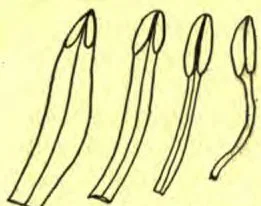
The rhizomes are often as thick as a man's arm, the leaves float upon the surface of the water, and the large, handsome flowers are produced all summer. The four sepals are green on the outside, but petal-like on the inside. The petals and stamens, both of which are numerous, present a remarkable peculiarity. In all the plants that we have thus far studied these two sets of organs differ decidedly in form, but in the Water Lilies the petals gradually grow narrower from the circumference toward the center of the flower. Some of these, though undoubtedly petals, are tipped with a small yellow anther. Nearer the center of the flower they become still more stamen-like, until they assume the form of the genuine stamen. In this case there is no distinct dividing line between the petals and stamens.
From the axils of the leaves the flower stalks are produced. These lengthen until they reach the surface of the water, where each is terminated by a single flower, often of great beauty.
A somewhat similar peculiarity is found to a greater or less degree in some other plants. The rose, for example, in its natural condition, as shown by the various species of wild roses, has but few petals and numerous stamens; though when brought under cultivation, some of the stamens may be replaced by petals, forming the so-called double flowers; or all of the stamens, as well as the pistils, may be replaced by petals, producing the full double flowers. These are of course unnatural, and incapable of producing seed, as the essential organs of the flower are absent. While they serve to gratify our love of the beautiful, they are useless as far as propagation of the plant is concerned.
This unnatural condition of plants brought on by cultivation can be preserved and propagated only by skillful management on the part of the cultivator. When left to themselves, such plants either perish or return to their original form.
Because of the tendency exhibited by the different parts of the flower to replace each other, and also on account of their close resemblance to leaves in many cases, all the parts of flowers are now regarded by botanists as modified leaves.
This view helps us to understand something of the unity of plan in the mind of the Creator before plants were brought into existence, and the boundless resources of the infinite mind in the creation of the endless variety of beautiful forms exhibited by flowers from modifications of a single type of structure. In all the Creator's works can be seen an orderly design, a unity in diversity.
The following words are quoted from Wood's Class Book of Botany: —
“The scientific world was slow to learn that the numerous organs of plants, so diversified in form and use, are all modeled from a single type, one radical form, and that form the leaf!”
“This interesting doctrine, now universally admitted, sheds a new light upon nature, making it all luminous with the divine Presence. It brings the operations of the Great Architect almost within the grasp of human intelligence, revealing the conceptions which occupied his mind before they were embodied in actual existence by his word.”
Modified parts of Wheat
There is another peculiar thing about the flowers of Water Lilies. They open about eight o'clock in the morning, and close about two o'clock or a little later in the afternoon, this being continued for several days in succession. After pollination has taken place, the flower closes into the form of a bud, and is drawn beneath the surface, where the seeds are ripened beyond the reach of aerial dangers.
The ovary is globular and many-celled, with a little knob at the top, from which the numerous stigmas radiate as in a poppy-head. The seeds are numerous.
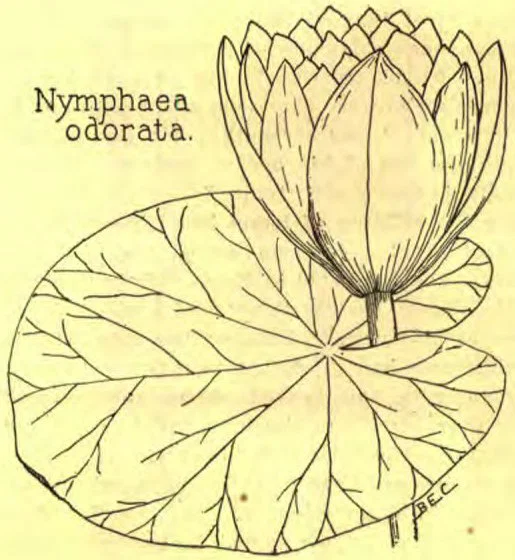
There are two species of white Water Lilies native in the Northern States. The sweet-scented Water Lily (Nymphaea odorata) bears flowers from two to six inches broad, usually white, but sometimes pinkish or pinkish-red, or with a delicate tinge of purple, and exceedingly fragrant. The leaves are from two to nine inches broad.
Nymphaea reniformis or Nymphaea tuberosa has somewhat larger flowers, four to nine inches in diameter, pure-white, and with only a faint odor, which bears some resemblance to that of apples. The leaves are also larger, being from eight to fifteen inches wide.
The white Water Lily has often been referred to as a symbol of purity. Growing amid the slime and filth at the bottom of the water, it remains uncontaminated by its surroundings, while it develops its beautiful, spotless, white blossoms, which are a joy and inspiration to both old and young. So may we, though surrounded by sin on every hand, develop beautiful, Christlike characters, which shall bring joy and gladness to all with whom we come in contact.
There are cultivated and tropical species of Water Lilies with flowers of various colors, ranging from white to rose-color, yellow, and blue.
The Egyptian Lotus (Nymphaea lotus), or Water Lily of the Nile, is common in the tropical countries of the Old World. It is held sacred by the Hindus of India, who use it extensively for medicinal purposes.
Victoria regia is a gigantic Water Lily native to South America, but successfully cultivated in the Northern States. When full grown, the leaves are from four to six feet in diameter, and the flowers one foot across when expanded. When growing in its native rivers in the South, the leaves are still larger, often from eight to twelve feet in diameter.
Pond Lilies are in some ways much like Water Lilies, but they have smaller, rather inconspicuous, yellow flowers, sometimes tinged with purple. The leaves often rise above the water instead of floating upon its surface, and its fruit, unlike that of the Water Lilies, is ripened above the water. There are several species common in sluggish streams and muddy lakes in most parts of the United States. B. E. Crawford.
Nymphaea odorata.
Nymphaea odorata.

Clover from Egypt

Seeds of a wonderful plant called “berseem” have been brought to this country from Egypt by the Department of Agriculture, and efforts will probably be made to introduce it in regions of the United States to which it is adapted. It is otherwise known as “Egyptian clover,” being nearly related to ordinary clover.
Berseem is likely to be specially valuable to the irrigated and orchard lands of California and Texas, and it is thought that the Colorado Desert, with its rich soil and abundance of water obtainable by irrigation, would furnish an ideal place for a trial of the plant. Its yield of seed is much heavier than that of clover, and it develops at a marvelous rate, outgrowing most weeds, and actually killing out the latter. Dr. David G. Fairchild, agricultural explorer for the department, says that while Egypt’s great money-making crop is cotton, the foundation of her prosperity rests upon berseem.
Dr. Fairchild says that there are few countries in the world to-day where agriculture pays better than it does in Egypt, though the methods of plowing and seeding practised by the people have changed scarcely at all in thirty centuries. A million acres of berseem are grown in the valley of the Nile, where it affords a conspicuous feature of the most beautiful crop checkerboard to be seen anywhere on earth. Its white flowering heads present a lovely spectacle when adorning extensive areas, and one learns that not only farm animals, but the fellahs themselves eat it.
Though the origin of the plant is unknown, it seems to have been introduced into Egypt in comparatively recent times, no representation of it being found on any of the ancient monuments. To-day all the cattle are fed on it, as well as the camels and donkeys, and in the cities every cabman has a sack of it under his feet with which to feed his horse. In early morning all the avenues leading to the city of Cairo are lined with long files of camels and asses half hidden under their loads of the green foliage.
The hollow stems of the berseem are very succulent, and the whole plant is decidedly more delicate than either clover or alfalfa. Once introduced into the United States, it would probably be a great success, in some regions of the country at all events, and would prove an important addition to our agricultural products.—Saturday Evening Post.

Strength in Self-Sacrifice

In order that Moses might know how to be kind and tender toward his erring brethren, God taught him, through the hardships incident to the life of a shepherd, precious lessons of kindness and tenderness, patience and self-sacrifice. Years afterward, while leading the children of Israel to the promised land, he was often severely tried by the waywardness of his brethren, but at such times he pleaded with God to work for them.
When in their flight from Egypt the Israelites came to the Red Sea, and learned that the Egyptians were following them, it seemed to them as if they had been taken there to perish. They were in a position of great peril, the Red Sea on one hand and an impassable mountain on the other, and Pharaoh pursuing them; and they murmured against Moses, saying, “Because there were no graves in Egypt, hast thou taken us away to die in the wilderness?” The Lord had wrought wondrously in their behalf, but still their faith was small.
But Moses had learned to trust in God. In this emergency he looked in faith to his invisible Leader, and his cry was heard. God gave the command, “Speak unto the children of Israel, that they go forward.”
As the people stepped into the sea, the waters rolled back, a path was made, and they walked through on dry land. As they went forward in the path that Providence had made for them, the pillar of cloud rose and grandly moved over their heads, descending between the two armies, following the Israelites instead of going before them, thus shielding them from the sight of the Egyptians.
“The Egyptians pursued, and went in after them to the midst of the sea, even all Pharaoh’s horses, his chariots, and his horsemen. And it came to pass, that in the morning watch the Lord looked unto the host of the Egyptians through the pillar of fire and of the cloud, and troubled the host of the Egyptians.”
The mysterious cloud changed to a pillar of fire before their astonished eyes. The thunders pealed, and the lightnings flashed. “The clouds poured out water; the skies sent out a sound: thine arrows also went abroad. The voice of thy thunder was in the heaven: the lightnings lightened the world: the earth trembled and shook.”
The Egyptians were seized with confusion and dismay. Amid the wrath of the elements, in which they heard the voice of an angry God, they endeavored to retrace their steps, and flee to the shore they had quitted. But Moses stretched out his rod, and the piled-up waters, hissing, roaring, and eager for their prey, rushed together, and swallowed the Egyptian army in their black depths.
The faith that Moses had is the faith that Jesus desires us to have. When difficulties arise, let us have confidence in God. When it seems that we must meet impossibilities, let us pray. Like Moses, we may commune with the God of heaven as with a friend, trusting in him to work for us. Wherever we are, we may send silent petitions to him for counsel and strength. His ear is ever open to the cry of his needy children. “Man’s necessity is God’s opportunity.”
After the children of Israel had listened to the giving of the ten commandments, they fell into idolatry. The Lord said to Moses, “Let me alone, . . . that I may destroy them; and I will make of thee a great nation.” But no; the man who in the wilderness had so often sought the lost sheep, the man who had braved storm and tempest rather than leave one sheep to perish, could not give up the people placed in his care.
Moses discerned ground for hope where appeared only discouragement and wrath. The words of God, “Let me alone,” he understood not to forbid but to encourage intercession; to imply that nothing but his prayers could save Israel, but that if thus entreated, God would spare his people. He “besought the Lord his God, and said, Lord, why doth thy wrath wax hot against thy people, which thou hast brought forth out of the land of Egypt with great power, and with a mighty hand?” And his earnest intercession prevailed.
When in need, we should bear in mind our relation to the children of Israel. Their history has been recorded for our admonition. We are not to imitate their example of murmuring. “Our light affliction, which is but for a moment, worketh for us a far more exceeding and eternal weight of glory; while we look not at the things which are seen, but at the things which are not seen: for the things which are seen are temporal; but the things which are not seen are eternal.”
Cleanse the soul-temple of its defilement, that Christ may come in and reign supreme. Consecrate to God your strength, your mind, all your abilities. Wherever he places you, however humble your position, work with fidelity. In order to know the power of true godliness, you must hide in Jesus, giving yourself to him without reserve. When you make an entire surrender, laying yourself on his altar as a living sacrifice, you will be accepted.
Not all the gold or silver of this earth can redeem one soul. Neither intellect nor education can win the immortal inheritance. Only as a free gift, received through entire surrender to God, can we gain eternal life.
In this world there is neither comfort nor happiness without Jesus. Let us acknowledge him as our Friend and Saviour. How can we fail of loving him who has first loved us? In him are matchless charms. O, may we all so live during this brief period of probationary time that we shall reign with him throughout the ceaseless ages of eternity! Mrs. E. G. White.

Sunrise in Tennessee

It was a misty morning down in the Graysville Valley. But I had climbed a good six hundred feet above, and stood upon the rounded back of Black Oak Ridge. The boldest stars had scarcely yet withdrawn from sentry duty, and the stillness of the dawn lay over forest and stream, deeply accentuating the first shrill calls of birds and the far-coming sounds of hammer, ax, and voice.
Upon the lower stretches of the climbing road, a faint flush had appeared to touch the eastern sky, but from the summit the low-lying clouds hung leaden; the roseate promise to the valley-dwellers was delayed to the watcher upon the hill.
The seeming delay was timely; the faculties, made alert and receptive by the conditions of the hour, were yet incapable of drinking in all the beauty of the panorama. The world that lay before me was wrapped in a wondrous robe, the enfolding vapors uniting with the clinging shadows to make a scene of weird and rare beauty. The soft white folds of the fog lay heavily in the hollows, and wreathed the wooded slopes with filmy laces. A few miles away, the river’s course was revealed by the denser bank of mist, a low wall of white. Beyond, the prospect, dimming with the distance, was finally shut off in a maze of mingled clouds and mountains, so interlaced and deceptive that no eye could distinguish the one from the other.
About me, down the slope a little way, the dark-green livery of a band of pines, splashed with the crimson of some intermeddling oaks, formed as for a protecting guard; over their heads, in the near distance, the undulating forest, broken here and there with the clearings ringing the little cabins; beyond, the appearance of a watery morass, pierced by straggling tree-tops, dotted with hilltop islets, and almost inviting the touch of a light-pressed foot,—the indefinable horizon,—mystery.
The glamour of the scene sank into the soul; the misty became mystical, a bridge leading to the unseen world. Almost, from the midst of the seas and pillars of cloud, I could discern the lofty pinnacles and the massive, glorious gates of the City of Promise, as John’s eyes beheld them long ago.
The sky was now alight; its eastern face began to glow. The scattered clouds had been drawing nearer to the opening gates of day. One of the lowest caught the first shafts of the bright king, and, bathing itself in rosy light, tossed on the gleams to its nearest fellows. Swiftly the colors passed, deepening, changing, spreading, the carmine leaping from lower to greater heights, leaving a touch of gold, of rose, of amber, and of white, to flush and light the faces of the somber clouds. It was not gorgeousness, it was glory,—black, purple, leaden, and gray melting and mingling in the warmer colors, until even clearer could the fancy see the opening of the gates of Paradise. The mists that lay below maintained their ghostly uniform, but slowly, very slowly, deserted their ground, dissipated in the warming atmosphere.
Then, as I watched, suddenly, low down it seemed in the maze of clouds and mountains, struck in a little fiery crescent, half reversed. With rapid pace it climbed the cloud-steps, growing in size, rounding in shape, barred and flecked with heavy masses of dark clouds. Though angry red, the eye could rest with ease upon its huge round face. As it rose, it worked. Its glowing heralds it recalled from cloud and sky, the greeters of its coming scattered from before its face, the mists shrank into nothing, or here and there rose to join their higher fellows. The light, first softly diffused, now glowed and streamed, and bathed the hills, the tree-tops, and the slopes; then, glancing over, struck the gray cliffs of the mountains behind, and all the world saw a new day. It was a sunrise of prophecy.
Again I stood upon the heights, at a little different vantage-point, and watched for the coming of the Day-Ruler. It was a little nearer the sunrising, and life was more fully astir. The scattered crows in the woods about me had sent forth their gathering cry, and joining the marshaled bands, were passing down into the valley on their daily foray. The clanging of cow-bells, mellowed by distance, came musically up the slope, and from near a cabin, half hidden among the hills, was borne the strong yodel of a boy’s voice.
Above, the light cirrus sentinels of the small cloud-army flecked a paling blue; and below, massing as if to repulse an attack in the rear, the dark host awaited the onset. Low down they hung, and though no intervening mists shut the distant mountains of the Blue Ridge from view, beyond, through its gaps, could be dimly seen a cloudy counterfeit of another range. Color there was none, except the pale lightening of the sky.
Like Abraham, I thought, upon some height of the Plains of Mamre in the early morning, I stood straining my eyes over Canaan’s hills against the far mountains of Moab. Suddenly, through a cleft of the distant range, a dull glow spread and deepened, and as I watched, its flame sprang along the seeming narrow valley, until in startling distinctness were revealed in molten conflagration the cities of the plain. The uncapped expanse of a great furnace it seemed, as it gleamed and ascended in masses of fire, to break, and die, and shoot again; and through the haze of its smoke, upon the hills behind was cast the dull glare of its reflection.
From far behind, streamers of light, like the rays of borealis, but steadily, spread over the eastern sky almost to the zenith; and then, against the background of dark and light, of coloring cloud and brightening sky, a little, dying, vapory roll, pushed by some wayward wisp of wind, infolding and turning upon itself, sped like the accusing parchment that Zechariah saw shaken over the land. My eyes passed downward again to the smitten plains, but all their fire had sunk in ashes; until over the cloud-hills behind rose the triumphant face of the mighty worker of these wonders, whose going forth is as the coming of a bridegroom out of his chamber, and rejoicing as a strong man to run a race, by whose hand the Lord teacheth the simple, and giveth eyes to the dull of sight.
It had been a sunrise of history.
A. W. Spaulding.

My School

Ah, you have bonny things to tell of school-days long gone by; Your cheeks were ruddy as you went, your hearts were light; but I— I watched you caper down the road to Knowledge-land, and then, With smiles to keep the tears away, I wandered toward the glen, The woods, the rills, the hidden nooks, so rich in nature’s lore, Were waiting for the sickly child — and who could ask for more?
The rill was whispering ’mid the ferns, enchanted as a dream; It hastened down and lost itself within the wider stream; It told me of a mighty world that never thought of me, And myriad little laboring brooks that perish in the sea! And, all unheeded, by my side I saw a lily spring; It taught me of a Love and Law that guideth everything!
From out the throats of wondrous birds melodious anthems poured Of all the lovely, holy things that live not for reward. And when upon the ethereal sky the rose of even smiled, I turned me slowly home again, a solemn, dreaming child.
Your books were lightly thrown aside, yet bubbled o’er with play, But I was pondering o’er the things I learned in school that day.
— St. Nicholas.

The Joy of Appreciation and Encouragement

“Recognition is the sunshine for which many souls are craving and languishing. It is amazing what joy a little word of appreciation, of sympathy, of encouragement, will bring to one of those patient, humble workers of whom, thank God! the world is so full.”

Sowing Seven Grains

We are told that it is a custom among the Indians, when they are planting maize, to put seven kernels of corn into each hill. One was asked why this was done. “Well,” said the Indian, “we put in one for the crows, another for the worms, and a third for the squirrels, and we expect that the rest will bring forth fruit.”
The Indians teach us a lesson. They teach us to sow good seeds liberally, and not to be disappointed if all that we sow does not bring forth fruit. Our Saviour teaches us that some will fall by the wayside, some on stony ground, and some among thorns. This we must expect as good seed-sowers. But what of it? Should this fact lead us not to sow at all? It should rather lead us, like the Indian, to sow more bountifully, lest, with scanty sowing, the crows, worms, and squirrels get the whole harvest. If we sow bountifully, we may rest assured that the good seed of truth will find its way into some honest and good hearts, and bring forth fruit, thirty-, sixty-, and a hundredfold. The inspired word tells us, “He which soweth sparingly shall reap also sparingly; and he which soweth bountifully shall reap also bountifully.” W. A. Colcord.

The Soil in General

"The cultivation of the soil will prove an education to the soul"
Is there any boy or girl who has not seen a bottle filled with variously colored sand? If you want to study the soil with me for a few weeks, I would like to have you begin by collecting samples. All the apparatus that you need to begin with is a clean bottle. Any bottle or glass can will do, but one with a wide neck, like a common vaseline bottle, is best. From the nearest place to your house, where you can get some clean earth, take enough to fill the bottle. Throw out lumps or stones; and when your soil is dry, fill the bottle and cork it.
That first sample may be pure, white sand from a walk or garden border. Next time you go farther from the house, you will come to another kind of soil. This may be red clay, which will make a fine contrast to set beside your bottle of white sand.
When you go down onto the low ground or into the woods, there will be found a rich, black loam, which you will want for your third bottle. In neighboring valleys, on hillsides and along roads and ditches, other colors and variations of these principal soil families will add to your collection. The Sands and Clays and Mucks, with all their brothers, aunts, uncles, and cousins, will make three interesting groups. And it will surprise you to find how many there are in your vicinity.
From this soil that we walk upon comes the world's wealth. The working capital of mankind consists of but a few classes of things: —
  1. The direct organic soil products in the form of food and clothing — cereals, fruits, cotton, and flax — satisfy nearly all our needs.
  2. Wood and stone and brick, all derived from mother earth, build our dwellings, and carry on much of our commerce.
  3. The minerals, held captive within and beneath the soil, furnish material for the remainder of man's activities and aspirations.
Turning to the animal kingdom, as a kind of exception to these other classes, we have only to remember that animals are but a second-hand product of the soil. “The soil, the corn, the pig,” is such a common illustration that all will see its application here.
Look now at your samples of soils, and examine them frequently. Begin to get acquainted with the three families,—your nearest neighbors. You will soon see some good qualities in them, even though they have been given an unsavory reputation by ungrateful mortals whom they have only enriched.
But there is even a closer tie binding you and me, in the very nature of things, to the families of Sands, Clays, and Mucks. It is a kind of blood relationship. And this brings us in our study to the Book of books.
“The Lord God formed man of the dust of the ground.” Our modern word “soil” is now used instead of “dust.” Thus we find our intimate relationship to the soil stated at the very beginning of things recorded in the Bible. Gen. 2. 7. We can understand this relationship better by finding out just what the soil is made of, and comparing this with what we find our bodies made of. Here, then, are the elements of the soil, that you are to put into these bottles, set down beside the elements that compose the flesh and bones of your body: —
Soil The Human Body
1. Oxygen 1. Oxygen
2. Hydrogen 2. Hydrogen
3. Nitrogen 3. Nitrogen
4. Silicon 4. Silicon
5. Carbon 5. Carbon
6. Chlorine 6. Chlorine
7. Phosphorus 7. Phosphorus
8. Sulphur 8. Sulphur
9. Fluorine 9. Fluorine
10. Calcium 10. Calcium
11. Magnesium 11. Magnesium
12. Potassium 12. Potassium
13. Sodium 13. Sodium
14. Iron 14. Iron
15. Manganese 15. Manganese
16. Boron
17. Aluminum
The seventeen elements here given are the commonest in the substance of the earth’s crust, and make up about nine tenths of its bulk. Fifteen of them are identical with those forming the tissues of our bodies. For instance, iron is present in all soils. Many stones and rocks contain it, and they are constantly breaking up and wearing away to make soil. In the blood of the human body, iron is also a well-known element, and it enters into the structure of some tissues. So it is with all the elements in the foregoing list.
So when man was “formed,” the Creator took these common elements of the soil, and organized them into this remarkable creature which David describes as “fearfully and wonderfully made.” Thus is established a near relationship between the substance of our human bodies and those of “mother earth.”
Before dismissing this question of relationship, I wish you to notice some other things which are related to the soil: Every tree, pleasant to look at, trees good for food, the tree of life, in fact all plants and animals, were first made of the soil upon which they now live. See Gen. 2: 5, 9, 19.
Do not neglect to begin collecting your soil families. They will prove very interesting and helpful to you. Yesterday I brought home a fine-looking member of the Clay family, from the bank along the railway. J. C. Rogers.

Religion as Armor, Not a Cloak

Religion is the best armor in the world, but the worst cloak.—Bunyan.

Extracts from Iowa Reports

Boone.—This Society has twelve members, mostly children. These have taken a lively interest in the meetings held, and have earnestly set out to do what missionary work they can. They have sold one hundred and fifty copies of The Life Boat, and have distributed copies of our Swedish papers and of The Signs of the Times. The children have also done quite a little in piecing quilts. One of the members writes: “We like the work very much, and are glad to have something to do to help others.”
Sioux Rapids.—Here are nineteen members, two of whom were added during the last quarter. Weekly meetings are held, and the lessons given in the Instructor are used. The members are selling tracts and papers, and making missionary visits in the neighborhood. The secretary says: “A very good interest is taken in the work, and all do as much as possible to make the meetings interesting.”
Atalissa.—This Society meets each Sabbath, using the Instructor lessons in their meetings. They have eleven members.
Nevada.—Ten members are enrolled, and meetings held each Sabbath afternoon. The members have been at work with The Life Boat and other periodicals.
Grant City.—This little Society of thirteen members holds a meeting each Sabbath. The members have been helping in the campaign for the sale of “Christ’s Object Lessons,” and have been successful in selling some books. They have also been sending out our denominational papers, and are now planning to sell The Life Boat.
Algona.—This Society at one time thought to drop the work, but the interest revived, and meetings are held weekly. The members have been especially interested in the work in France, and this has been a live topic in other Iowa Societies. They have also sold a number of copies of The Life Boat. Twenty-one members are reported.
Des Moines.—This large Society of forty members reports encouragingly. Nine new members were added during the quarter. The members have collected twenty dollars. This money has been used in carrying on the branch Sabbath-school work, which has become a permanent feature of the young people’s work there. The members have also been very active in Christian Help work. A number of copies of The Life Boat have been sold. The interest in the work is excellent, and there seems to be a willing spirit manifested by each member.

The Weekly Study

Paul's Missionary Qualifications

(February 15-21)
Commendable Ambition.—Rom. 15: 20, 21; Gal. 2: 7-9.
Elements of Strength.—Concentration of purpose. Phil. 3: 13, 14; 1 Cor. 2: 2. Courage. Acts 21: 13. Sense of divine commission to preach Christ. 1 Cor. 1: 17; 9: 16. Conscientiousness. Acts 24: 16; 2 Cor. 1: 12. Avoidance of appearance of evil. 1 Thess. 5: 22. Redeeming the time. Eph. 5: 16; Col. 4: 5.
Deep Spiritual Life.—Deep humility. 1 Cor. 15: 8, 9; Acts 20: 19. Prayer life. Acts 16: 25; 20: 36; Col. 1: 3; Phil. 1: 4. Dependence on the Spirit. Acts 13: 9; 16: 6. Personal devotion to Christ and identification with his life. Gal. 2: 20; Phil. 1: 20, 21.
It will scarcely be possible in one short hour to study all the elements that made the apostle Paul the power he was in the evangelization of the world in his generation. The texts are suggestive. Some Societies may consider with profit one phase of his qualifications, while others may find blessing in studying his life from another point of view.
The mystery of iniquity that had already begun to work in Paul's day (2 Thess. 2: 7; 1 John 2: 18) will give a good basis for a study of the conditions of the religious world in Paul's time, as compared with our own.
The extent of the preaching of the apostles and early Christians is described in a very interesting manner by Mr. John R. Mott in his book, “The Evangelization of the World in this Generation.” We quote a few paragraphs in another column.
“Nineteen hundred years have passed since this life of which we have been studying was laid upon the altar of service,—nineteen hundred busy, eventful, fateful years,—and we stand facing new conditions. Why should we not be Pauls? Is there no need to-day of the work that he did? Has the arm of God failed, so that it can no longer sustain his servants as it sustained Paul? Or should not we go forth to a life that shall approach his, and in some true measure resemble the larger life of Him who was Paul's inspiration and reward?”
“The apostle Paul began his large missionary career with a dream of heathen need. We begin ours with a real vision. We have seen the facts of many of those who speak the message which the man of Macedonia spoke to Paul, and they call us to a life of as much more service and energy than his as the field is wider and the call more intense. O, may the spirit of Paul's God fall upon us, and give to those of us who have eyes to see such a glimpse of the risen and uplifted Christ as shall be to each of us the promise of strength sufficient for the service to which he calls us, until that service shall be swallowed up in eternal worship before the throne of God.”
Continue reading: What the Early Christians Did to Evangelize the World