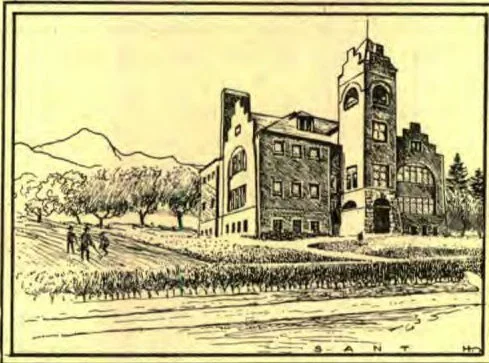
The Youth’s Instructor, Vol. 51, No. 5.

The WATER LILY
Earlier text: What the Early Christians Did to Evangelize the World

What Does Our Christianity Mean?

“My daughter is so busy, so taken up with her work in the church, that I hardly see her any more,” said a mother, with a sigh. “I wish Allie hadn’t joined the church. She never has time for a fellow these days,” complained a brother. “If it would make me as cross as it does you to be a Christian, why, I’m glad I’m not one,” exclaims a too frank sister. And sometimes, at the end of a recital of some wrong, one hears it said, with bitterness, “And he’s a Christian!”
You have heard such sentences as these, have you not? You may have listened, even, to some such word spoken of your own life,—and been glad to think, afterward, that you had had the grace to keep silence in face of the taunt. Or perhaps in the secret place you wept miserably, and thought the world very unjust and unkind; or it may be you declared, in self-justification, that you were just the same as you always were,—only people seem to expect so much more of you now.
There is one thing the young Christian should understand, and the sooner he knows it for himself, the brighter will be his experience: The world does expect, and it has every right to expect, more of those who declare themselves to be Christians than of those who make no such profession. And is it not a pitiful comment on any Christian’s experience, “that he is just the same as before”? If he is not much more than he was before; if he is not more kindly, more gentle to the unfortunate, more thoughtful, more considerate in every way; if he is not more patient under trial and more joyful in the dark hours; if he does not, in fact, shine for his Master, has not the world a right to be disappointed?
Let us ask again, What does Christianity mean? To begin, What does your profession mean in your home? Do those who “live with you” find you more unselfish, more thoughtful, more willing to bear your share, and a little beyond your share, of the home duties and burdens? Are you a better sister? a kinder brother? Instead of less time for the companionship of your brothers and sisters, less willingness to help the younger ones along the way you have so lately passed over, less time for your parents, and less inclination to be eyes and ears and feet for the aged ones in your home, are you allowing your time to be filled in other ways? If so, you are missing one of the sweetest fields of Christian service.
But though the fruits of a true Christian experience will be seen in the home, they will not be confined within its limits, any more than the fragrance of the rose is imprisoned behind its delicate, flushed petals. The true Christian will have a winning personality—he will make many friends, because he will draw hearts to the true Friend. Paul was a man of this character. “The glowing postscripts of his letters tell how many hearts Paul loved, and how much he loved them, and how many loved him. Just hear him send his love to some of these friends: it is in the end of what, in solemn phrase, we call the Epistle to the Romans,—what Paul would perhaps have called ‘the letter I sent to the dear souls in that little church in Rome.’—
“‘I commend unto you Phebe, our sister, that ye assist her in whatever business she hath need of you’ (help that woman): ‘for she hath been a succorer of many, and of myself, also. Greet Priscilla and Aquila, my helpers in Christ Jesus: who have for my life laid down their own necks. Greet Mary, who bestowed much labor on us. Salute Andronicus and Junia, my kinsmen, and my fellow-prisoners. Greet Amplias, my beloved in the Lord. Salute Urbane, our helper in Christ, and Stachys my beloved. Salute Tryphena and Tryphosa, who labor in the Lord, and the beloved Persis, and Rufus, chosen in the Lord, and his mother and mine.’”
“His mother—his and mine! No doubt Paul had a dozen dear old mothers in those seaboard cities where he came and went. It brings him very near to us to read such words. They bring Paul down out of his Bible niche, and forward out of the magnificent distance of a Bible character, and make him just ‘Paul,’ alive and lovable; a man to whom our hearts warm still, because his own heart was so warm that men fell on his face and kissed him when he told them they should see his face no more.”
So every true Christian will make many friends—friends who will help him, to whom he may be a blessing in countless ways, and who will be uplifted and cheered and made better because they have known him.
These are two of the ways, then, that our Christianity may “mean something,”—something blessed and helpful in daily home living and in our association with others.

Gift to the India Mission Fund

We have received, from Mrs. E. Summerton, of Oxford, Wisconsin, a gift of seventy-five cents to be applied on the India Mission Fund. In some way the gift was overlooked at the time it was received, so we acknowledge it in this way.

Berrien Springs School Students Canvass for Funds

The Berrien Springs school has closed for two weeks, and all the teachers and nearly all the students are in the field canvassing for “Christ’s Object Lessons,” the funds so raised to be used in behalf of the school. Reports from the workers tell that they are meeting with excellent success.

Why the Instructor Has Few Pictures Lately

We suppose that the younger readers of the Instructor have been wondering these last few weeks why so few pictures have been used in the paper. To tell just why would be a long story, and one that even then you would not understand unless we could take you with us from place to place as the paper is made ready to be printed. But we have some unusually nice pictures on hand, and are hoping that by the time the following issue of the Instructor is printed, we shall be able to begin to use them. Meanwhile we are sure you have found many interesting things on the Children's Page, even if it has had few illustrations.

Beginning Right

How often the first morning hour tells the story of the day! By “beginning wrong,” how many a new day, fresh from its Maker, and lent to us to be writ with loving deeds, is returned to him with its hours all marred with a record that angels must weep to read! Very often the whole story would be different if one spent a little time “beginning right.”
“The morning is the gate of the day,” wrote Dr. Spurgeon, “and should be well guarded with prayer. It is one of the threads on which the day’s actions are strung, and should be well knotted with devotion. If we felt more the majesty of life, we should be more careful of its mornings. He who rushes from his bed to his business, and waiteth not to worship, is as foolish as if he had not put on his clothes or cleansed his face, and as unwise as if he had dashed into battle without arms or armor. But it is ours to bathe in the softly flowing river of communion with God, before the heat of the wilderness and the burden of the way begin to oppress us.”

A Mistake

The Little Boy had been taught to spell at home, so the first day he was taken to the primary school, he had a poor opinion of the words given out by the teacher. “Cat,” “dog,” “boy,” “cow,” passed down the line; and when it was Teddy’s turn, “Rat,” said the teacher. Teddy had known r-a-t “always;” why should he spell a word he knew so well? So he looked very important, and spelled, slowly, “E-l-e-p-h-a-n-t.” When the children laughed, and the teacher told him to sit down, and pronounced the same word gravely for the next boy to spell, Teddy couldn’t understand, and had to wink hard to keep back the tears.
We smile at the childish exhibition of importance; but how often do older people than Teddy, despising the simple task set for them to do, leave it undone, and boastfully select something else, something “bigger,” just to show that they can! By and by Teddy will learn that it is what he is asked to do, not what he can do, that will determine his grade in his class work; and we older pupils in life’s great school shall be wise, if we learn as well that it is what God gives to us to do, not what we would choose for ourselves, that will earn the “Well done” at last.

You have reached the end of this edition.

The Youth’s Instructor · Feb 12, 1903