The Youth’s Instructor, Vol. 47, No. 28.

A MALAY VILLAGE

The Youth’s Instructor

Jul 13, 1899

Review and Herald Publishing Company · Battle Creek, Mich. · Jul 13, 1899

A MALAY VILLAGE.
(Concluded.)
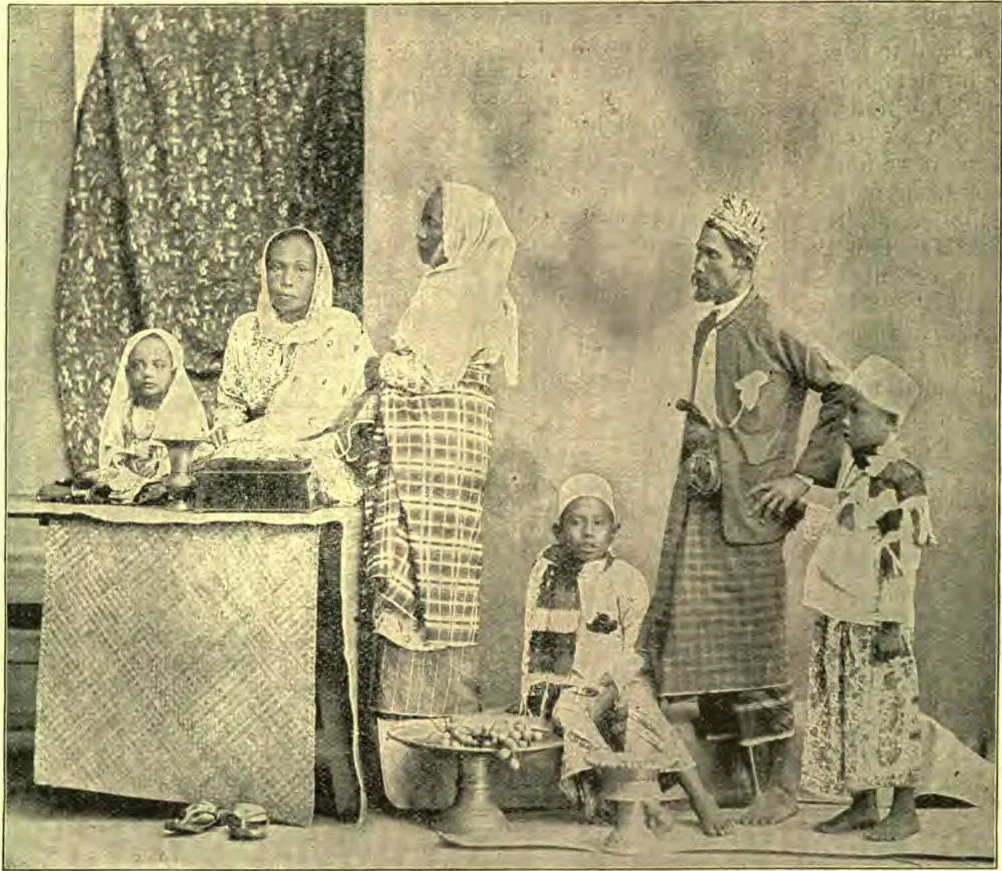
A MALAY FAMILY.
A MALAY FAMILY.
THE Royal Engineers’ Department of the British Army, which has charge of the submarine mines of the harbor at Singapore, muster their recruits entirely from among the Malays, because of their aquatic propensities. They are not only good swimmers, but excellent divers. Every New-year’s day the European athletic associations of Singapore arrange for the New-year’s sports, which always include boat-racing. Entries are made by the captains of the merchant marine, Her Majesty’s ships, and the Malay boatmen. It frequently happens that the Malays carry off the best prizes. As already indicated, their boats are of very graceful form, and present the least amount of resistance by friction with the water, have little or no keel, and can be manipulated with great skill.
I was spending the holidays by the seaside about six years ago, when I witnessed a sight that seems almost incredible, and which I could scarcely have believed had I not, with others whose eyesight was better than mine, watched the event. We had a pair of binoculars, and so could see all the movements of the sailors. A dozen or more boats had passed the goal at the far end, and were on the home stretch, when one of these Malay boats, manned by about a dozen Malays, was capsized by a sudden gust of wind from another quarter. In order to understand what occurred, it will be necessary to explain how they handle their boats. They carry no ballast, in the ordinary sense of the word, but, instead, engage men for that purpose, the advantage being that the eight or nine Malays who serve in this capacity can shift their position at every variation of the wind, thus enabling the boat to carry a much larger spread of canvas than would otherwise be possible. The boatmen further increase their power by adjusting a rope to the top of the mast, and making a loop in the bottom end. One of the men sits in this loop, with his feet against the gunwale on the windward side of the boat; and when the wind blows strong, he throws himself out from the side of the boat, thus keeping it from capsizing. A sudden slack of the wind often catches the man in the rope unprepared, with the result that the boat loses its equilibrium, and having no keel, readily capsizes. This is what actually happened on the occasion referred to, and we saw a dozen men floundering in the water, the boat bottom side up, and no relief at hand. The other boats in the race passed them by, paying no more attention to them than would the scorchers in a bicycle-race to the unfortunate fellow who had come to grief on the race-track . We who were unacquainted with the Malay and his boats, thought the poor fellows were going to drown. I rushed out of the house, and frantically beckoned to a Chinese boatman, who was passing with his sampan, to go to their relief. He seemed very stupid or unwilling; for it was some time before I could induce him to go to their assistance. After he had started out in their direction, I turned my attention again to watching the poor fellows who were struggling in the sea. Imagine my astonishment to behold the boat righted, and the sailors distributed on each side of it, rocking the water out of it. After a few minutes one of them climbed in, and began to bail out the water with one hand and kick it out with one foot. Presently another followed, and then another, until the boat was quite dry. Then they drew in the mast, which had been removed, and placed it in its socket. They gathered in the sail, wrung it out, and ran it up; and in less than twenty minutes from the time they capsized, they were following on in the race.
For ages the Malays have been accused of being bloodthirsty pirates, and the fact is that they have abundantly sustained their reputation until within comparatively recent years. The Spanish in the Philippines, the Dutch in the Netherlands East Indies, and the English on the mainland, have all contributed to the suppression of piracy in this archipelago. The British East India Company, when it was first organized, contemplated trading among these islands; but the capture of one of their vessels, and the massacre of its entire crew, resulted in their abandoning this field of operations, and turning aside to India, as Hindustan is now generally known. The Dutch bitterly resented the invasion of the English, and were glad enough to see them driven out. Within very recent years there have been occasional outbreaks of piracy.
The Malay is a quiet, self-contained, retiring character. He is polite, genteel, and hospitable, and a cursory acquaintance would lead one to think that he was incapable of such atrocities as have been attributed to him. But there slumbers within every Malay a nature which, if circumstances but afford an opportunity, will break forth in the most cruel deeds. A few years before my arrival at Singapore, a Chinese junk, which was passing along the western shore of the Island of Singapore, was suddenly attacked by several Malay canoes, most of the crew were murdered, and what plunder could be carried away was taken. One poor fellow, who lost both arms but escaped with his life, has for years stood at the entrance to one of the popular dining-halls frequented by Europeans, with a large placard hanging about his neck, announcing the fact that he was a victim of Malay piracy, and begging for alms. Five of the principal actors in this crime, four men and one boy, were hanged.
It is said that, until after the days of steam navigation, the Spanish and the Dutch authorities experienced the greatest difficulty in running down and capturing these pirates. They were such skilful sailors that they would run away from the revenue-cutters; and when the wind failed them, they would ship their oars, and run right away in the eye of the wind, making it impossible for the police patrols to run them down. But when steam-gunboats were brought into requisition in later years, they did not find it so easy to escape, notwithstanding they led the respective governments concerned a very hot and a very long chase before they were finally suppressed. The innumerable bayous and arms of the sea and small streams, covered with the densest foliage and tropical jungle, furnished places of hiding and rendezvous that it was practically impossible to discover without the aid of the pirates themselves. It finally became such risky business to carry on piracy that some of the least energetic and courageous Malays found that it paid them better to act as guides for the European governments than it did to participate in the spoil, without any of the attendant dangers; and so it came about that piracy was driven off the high seas.
R. W. MUNSON.

Honorable Tiger Miss.

A Japanese trained nurse! It is hard to say why the idea strikes us as odd; for Japan is provided with excellent physicians and hospitals, and the empress herself is president of the Japanese Red Cross. Nevertheless, if we find something surprising in the thought, there is much that is winning in the embodiment, if O'Tora San, the nurse described by Mrs. Hugh Fraser in a recent volume of reminiscences, may be taken as a fair specimen.
“She was barely four feet high,” writes Mrs. Fraser; “her complexion was dark; her feet were encased in white linen socks with divided toes, and shod with dainty straw sandals with green velvet straps.
“Her figure, the shape of a very soft feather pillow, was draped in a tight-fitting white apron with a large bib, and she was kept inside her buttonless and stringless clothes by a cruelly tight and wide leather belt, put on over apron and all. Into this belt, holding her breath for a long time first, she could with great effort push her fat silver watch; her clinical thermometer; two or three yards of a Japanese letter (which she would read, a foot at a time, when she thought I was asleep); her carefully folded paper pocket-handkerchief; and the relentless little register in which she noted down, from right to left, cabalistic signs with which she and the doctor conjured every morning till they knew all the sins my pulse and temperature had been committing.
“Her name was O'Tora San,—Honorable Tiger Miss,—but her ways were those of the softest pussy that ever purred on a domestic hearth-rug; and oh, what a nurse she was!—so gentle, so smiling, so delightfully sorry for one!
“I have often caught the tears running down her little brown nose when the poor Okusama was extra bad; and through long nights of pain has she sat on her heels on a corner of my bed, fanning me ceaselessly with the all but imperceptible flutter of the fan's edge,—a movement possible only to those wonderfully sensitive Japanese fingers, but most refreshing to the fanned one.
“When it was time for her meals, my maid O'Matsu would creep into the room, having shed her sandals at the door, and after inquiring about my health, would make a deep and graceful obeisance to Honorable Tiger Miss, and inform her, in a respectful whisper, that her honorable dinner was ready.
“The polite little Tiger would jump up, return the bow, ask permission to depart, and slip out to feed on fish, pickles (such dreadfully strong-smelling pickles!), and rice, washed down with thimblefuls of green tea or fish-soup.
“After about fifteen minutes of solid feeding, she would return, come up to my bedside, and express her gratitude for the meal supplied her. Then she would drop down on the cushion in the corner; and with the calm unconventionality peculiar to her race, let out a couple of holes in the leather belt.”
Her ugly uniform discarded, however, and arrayed in her own dove-gray kimono and wide sash, as her patient afterward often saw her, the queer little lady became as charming as she was quaint,—the very demurest and daintiest of domesticated tigers.—Youth's Companion.

“GIVE US THIS DAY OUR DAILY BREAD.”

THE prayer that Christ taught his disciples had a deeper meaning than we realize. The petition, “Give us this day our daily bread,” means more than a request for temporal food. No one could receive temporal food, were it not for the One who gave his life for the life of the world; but the words, “Give us this day our daily bread,” refer not only to temporal food, but to spiritual food, which brings everlasting life to the receiver. When we believe and receive Christ’s word, we eat his flesh and drink his blood.
When tempted by Satan to alleviate his hunger by turning stones into bread, Christ met the temptation with the words, “It is written, Man shall not live by bread alone, but by every word that proceedeth out of the mouth of God.”
On one occasion Christ told his disciples and the multitude which thronged him that they did not follow him because of the miracles that he did, but because they ate of the loaves, and were filled. “Labor not for the meat which perisheth,” he said; be not overanxious for temporal food, “but for that meat which endureth unto everlasting life, which the Son of man shall give unto you: for him hath God the Father sealed. . . . Verily, verily, I say unto you, Moses gave you not that bread from heaven; but my Father giveth you the true bread from heaven. For the bread of God is he which cometh down from heaven, and giveth life unto the world. Then said they unto him, Lord, evermore give us this bread.” The One then speaking to them had in the wilderness given their fathers angels’ food to eat. Oh, had they but known who was addressing them, how changed would have been their attitude toward him!
“I am the bread of life,” Christ said; “he that cometh to me shall never hunger; and he that believeth on me shall never thirst. . . . This is the bread which cometh down from heaven, that a man may eat thereof, and not die. I am the living bread which came down from heaven: if any man eat of this bread, he shall live forever: and the bread that I will give is my flesh, which I will give for the life of the world. . . . Verily, verily, I say unto you, Except ye eat the flesh of the Son of man, and drink his blood, ye have no life in you. . . . He that eateth my flesh, and drinketh my blood, dwelleth in me, and I in him.”
When man believes in Christ as his personal Saviour, he is eating the daily bread which has been purchased for him at an infinite cost. As by eating temporal food the physical system becomes strong, so by eating the flesh of the Son of God the spiritual nature is strengthened. God’s word is life to all who appropriate it. He who partakes of Christ’s flesh and blood is a partaker of the divine nature. He is a branch of the Living Vine. As in nature the branch receives nourishment by its connection with the parent stalk, so the believer receives his life from Christ. A vital, life-giving current flows from the Saviour to him.
Man fell through disobedience, severing his life from the life of God. Christ stooped to take humanity, that through him man might gain eternal life. In the guise of humanity, Christ defeated the purpose of the enemy. But Satan has interposed between the sinful human being and the living source of power, so that it is impossible for man, of himself, to appropriate the circulating element of the divine nature. Unless man has a vital connection with God, he will pervert every blessing he receives, and employ every gracious gift as a weapon against the bountiful bestower. It is only as human beings receive Christ, that God can bless them. Thus only can they be elevated and placed on vantage-ground.
Christ stands at the head of humanity as its substitute and surety, to represent God to man, and, through his power, to cause a stream of spiritual life to flow earthward. The Sun of Righteousness, he desires to shine into the chambers of the mind, purifying and elevating the soul, that he may abide therein, and control the affections and emotions, bringing the entire being into conformity to his will.
When the human being receives daily spiritual food from God, a blessed union is formed between earthly and heavenly intelligences. The believer is sustained by the life of Christ. Continually he receives blessings from the hand of God, and continually he imparts. “God, who is rich in mercy, for his great love wherewith he loved us, even when we were dead in sins, hath quickened us together with Christ, . . . and hath raised us up together, and made us sit together in heavenly places in Christ Jesus: that in the ages to come he might show the exceeding riches of his grace in his kindness toward us through Christ Jesus.”
By receiving Christ we are made partakers of his nature. We live in him, and are enriched by the highest, fullest blessedness. This means a life hid with Christ in God,—a life purified, exalted, devoted to the grandest, noblest purposes. This is indeed having eternal life. God himself is enthroned in the hearts of his people, who are his representatives. This great and unspeakable gift is offered to all. The Jews would have made it a national blessing, confining it to themselves, but the Saviour proclaimed the truth that the bread of life is not confined to time or place, nation or people, but is free to all.
MRS. E. G. WHITE.

CONSECRATION

I bring thee myself, dear Lord, And all that I want to be, My joys and my weary cares, And consecrate all to thee; Whatever the days may bring Of gladness or grief or pain, There's nothing to be withheld; I give it to thee again.
I wait for thy blessing, Lord, The touch of thy loving hands, The strength that thy grace can give To do what thy love commands. The way be hard and long, The burden be very great; But all that I am I bring, And cheerfully consecrate.
And if in my pain, dear Lord, I sometimes cry for relief, Thou knowest if thy dear will Shall bid me still bear my grief. I claim but thy promise, Lord; Thou wilt not leave me alone, But close to thy loving heart Wilt tenderly hold my own.
— Christian Work.

Breaking Up Fallow Ground for Strength of Thought

You can not till a field by tickling it with a hand-rake. It is so with the mind; we must get something that will go deep, and that will break up the fallow ground, if we would have strength of thought.— W. B. Caswell.

Chapter V.

Aunt Nell tried to detain Shirley with talk, hoping that if she was late in sleeping, she might be late in waking, and so miss the early train.
But the girl was on the alert. “I must go right to bed now, Aunt Nell,” she said, when the things had been put out for her, “and sleep; you know what a sleepy head I am. I must have my sleep out and be on time; for I would not miss that train for the world. I should be desperate if I did. Good night,” she added, kissing her; “you’re an awful nice auntie; I know you think I’m bad, and that makes it all the nicer ’n you. I appreciate it, and will try to be gooder ’n I have ever been, for your sake, as well as——” she choked a little, and then went on, rapidly: “I promise I won’t keep you in suspense about me a minute longer than I can help.”
Aunt Nell folded her sisterly arms about the young girl. Her eyes were wet, and her voice was thick, as she said: “No, you must not, Shirley. I took care of you when you first came, you know,—and I can’t have you go off so; and if I can’t, what about your mother? Poor sister! she will break her heart,—and you have n’t said one word about her! You don’t seem to remember that you have a mother.”
Shirley threw herself up straight away from her aunt, and cried, “Don’t I, Aunt Nell? Well, then, let me tell you I do, and it’s because I think so much, that I say so little. I can’t talk about her.”
She flung herself passionately into the little bedroom, and shut the door with a bang, while her aunt stood still, with the tears running down her face. In a moment the door opened just a crack, and Shirley said, huskily, “Will you please give me a scrap of paper, a pencil, and an envelope, Aunt Nell?”
Aunt Nell hastened to her desk, and taking out a whole new tablet, a package of envelopes, and some stamps, put them into the hand that was still thrust through the opening.
“Put them in the bag, dear,” she said; “I don’t see how I came to forget those; and,—you’d better write two before you go, and wait for the answers.”
Shirley did not reply, but closed the door. Aunt Nell sat down on the floor before it, thinking thoughts that made her cheeks grow paler yet, and her eyes hot with tears. After a few moments she tapped gently.
“Yes,” said Shirley’s voice.
“I want to come in, dearie, just a minute.”
It was so long before the door opened that her heart began to sink; she felt fearful, as she never had in her life. But the door was opened at last, and she entered, feeling that she was unwelcome.
“And did n’t you want me to come in?” she stammered; for it seemed so strange she was abashed.
“I don’t know; I think I know what you came in for.”
“What, then?”
“To—to—pray with me,” she whispered, while her face grew white and set.
“Well, dear child, should I not? How can I let you go without it?”
“You must, Aunt Nell,” and her voice took on a tone of excitement and intense opposition. “I can’t have it now. No, no! you must leave me alone now, Aunt Nell. But I do love you, Aunt Nell. I—I—believe in you. Pray for me after I am gone. I shall need all the good angels, but I can’t have any praying now.”
Aunt Nell stood an instant with her eyes, from which all tears had dried, fixed on those of the wilful child, over whom her whole heart yearned, while its beating almost stopped in the greatness of her distress. But there was no yielding in Shirley. She was hardening herself more and more every second; so Aunt Nell turned and left her without another word or touch, closing the door softly behind her.
She retired at once, but did not sleep until almost dawn; and then, from actual exhaustion,—for she was not used to severe heart and mental struggles,—she sank into a deep sleep.
She was awakened by her children; the oldest a boy of three, and the baby girl of eighteen months, who had begun the day’s work for themselves in their own way, doing the best they could under the new and strange circumstances produced by the mother’s long sleep.
It was yet early for any but farm people, but late enough to cause her to leap from the bed, and run to Shirley’s room. The door was open, and Shirley was gone.
Aunt Nell, regardless of the children, ran to the window which overlooked the road leading to the railway station a mile distant; and on a rise of ground she saw a tall figure, with a satchel in its hand, silhouetted against the eastern sky. Just a moment it seemed to grow taller and larger, then shorter, until it had disappeared behind the full glory of the morning, which was flooding the landscape with light.
“O Shirley! my Shirley!” cried Aunt Nell, with a sob, “have you really gone? O Father in heaven! keep her from harm; but I am awfully afraid. I’ll go and give Benjamin Goss a piece of my mind to-day. He shall know, for once, what I think of him and his way. He knows no more about women and girls than a fence-post.”
She had gone desperately into the little bedroom, and begun tossing the clothes that Shirley, always neat, had left, in spite of her haste, spread out before the open window. Aunt Nell was unconsciously looking for Shirley, or something that would satisfy the unreconciled longing of her soul for one more opportunity to save the dear child from herself. Surely she must have left something!
Yes, there was something,—the scattered bits of a letter torn to atoms. She gathered them up, and tried to fit them together; there was one scrap large enough to contain the address; it was “Darling Aunt Nell,” and at sight of that her heart seemed to break; she sat down heavily on the floor, and sobbed bitterly, while the children stood for a moment awe-stricken with wonder. They had never seen their strong, happy, practical mother cry before; they almost never cried themselves. The sight was too much, and in a moment they had both tumbled into her lap, and were wailing in sympathy.
Robin’s first screech seemed to frighten him into silence, and catching his breath, he gasped, “Is you hungry, too, mama?—’cause we’d better stop crying, and have our breakfast.”
“Yes, darling, we will all stop crying; that, at least, does not bring anybody back. But, Robin, you can see what it will do to mama if you are ever naughty and run away,” and she folded both the children to her breast.
“But I hain’t runned away,” said Robin.
“No, you have n’t; you are mama’s precious, tender little son, and she is going to try to be a good mama.”
“You is a good mama,—gooder ’n peaches an’ cream. Papa said so.”
The little clinging hands of her children, their sweet lips and innocent prattle, were balm to Aunt Nell’s wound, but they could not quite heal it; and when, after giving the children their breakfast and getting them out to play, she began to study the torn letter again, her tears fell afresh; she succeeded in matching the pieces so as to make it out, and this is what she read:—
DARLING AUNT NELL: I never loved you as I do to-night, for I can understand your feelings, and yet you don’t try to force me into doing what you think is right. Don’t think I don’t appreciate your prayers. I believe in you and your religion, and that is the reason I could not let you pray to-night, so that I should hear it; for I knew if I did, I should not be able to go, and I will not be hindered now. I must make a break for liberty and self-respect sometime, and now I have gone too far to go back, and have it all to go over again soon.
I know you are praying now, while I am writing, and it is all I can do to resist going out and saying—
Here the letter abruptly ended, and Aunt Nell bowed her face down over it, and prayed as she had never prayed before in her life, that the dear truant might be sheltered and protected in spite of herself, and be returned sweeter and as pure as when she went away; that she might learn, in this effort of her will to have its own way, how much better it is to yield to the will of the loving Father in all things.
She also prayed for the selfish father, whose unwise way had led to such serious consequences, and for the weak and suffering mother, upon whom the blow must fall most heavily; and in praying for them, she herself was comforted.
MRS. S. M. I. HENRY.
(To be continued.)

—N. E. Magazine

Dawn.

The glassy water, cool and clear, Reflects one solitary cloud; And morning song-birds, far and near, Repeat their matins shrill and loud: "The night is done, and day is here."

—N. E. Magazine

WISE SACRIFICE.

“WHAT do you intend to be, when you are a man?” asked an eminent surgeon of a boy in whom he was interested.
“I want to be a surgeon, like you, sir,” was the quick reply.
The surgeon took the boy’s hand, and spread it out beside his own. “You enjoy playing baseball?” he said.
“Oh, yes!” cried the boy, “I enjoy it better than anything else. I play it almost all the time, when I am out of school.”
“I thought so,” said the surgeon. “Look at your hands. See how thick the fingers are getting. They feel hard and stiff, too. Before you know it, they will be twisted and out of shape. A surgeon needs the most flexible hand in the world, as sensitive and delicate of touch as a woman’s. If you keep on playing ball in the extravagant fashion you are doing now, until you are twenty-one, your hands will be spoiled for a surgeon’s work. Now I am going to put to you a hard question: Would you be willing to give up baseball for the sake of being a better surgeon than you otherwise could be?”
The boy’s face grew very sober for a minute. Then he looked up, and cried, eagerly: “Yes, sir, I would! I would give up anything for the sake of my best.”
The famous surgeon laid his hand approvingly on the boy’s shoulder. “You will do,” he said, with a smile. “Yours is the spirit that makes success sure.”
Willingness to sacrifice the lower to the higher good is one of the surest tests of character. It is something we are all called upon to do. Every life is full of cross-currents of opportunity. Nine times out of ten, the question is not: “Are both of these opportunities good?” but, “Which is the better opportunity?” Each is almost sure to conflict with some other, and we are absolutely obliged to make a choice.
Wise and happy is the boy or girl who, while the opportunities of life are fresh and abundant, has the strength and courage to seize those which are best, and let those go which conflict with the best. Happiest and wisest of all is the young person who seizes the grandest of all opportunities,—the opportunity of lifelong Christian consecration and service,—at whatever cost of pleasure, or indulgence, or freedom from responsibility.
We must all sacrifice something. If we choose inferior things, we have to give up what is better. This kind of sacrifice may cost us less in the beginning, but it will cost us infinitely more in the end. How much wiser to choose at the outset what we know to be the best, and then, having paid once for all the trivial temporal cost, enjoy the ever-increasing reward throughout eternity.—Young People’s Weekly.

The Room for Improvement

“ONE of the largest rooms in the world is the room for improvement.”

ABOUT BUILDING.

WELL, boys, perhaps some of you begin to think it is about time for me to say something in regard to building. If you will give strict attention to what I now write and illustrate to you, I will teach you how to plan and build a cottage. It is important to know how to plan and draft out a piece of work to a scale before you build it; then you can lay your rule on your plan, and get accurate measurements for the work, and thus avoid making mistakes.
You will need a few tools with which to do your drawing. First, you should have a drawing-board. Get a good pine board about fifteen inches wide; or, if a board of that width is not easily obtained, glue two pieces together. It should be about twenty inches long, and of equal width. Dress both sides smooth, and make the ends as nearly square as possible. Get drafting-tacks, or pins, to hold your paper to the board. Next you want a T-square, which is made of cherry, maple, or some other finely grained wood. This tool costs but a trifle. It would be well to purchase a set of high-school mathematical instruments, which can be procured for about $1.50. If you can not get this set, use a pair of common dividers. Then you want an architect’s drafting-scale; or, if you have a good brass bound two-foot rule, you will find, upon the inside, four scales,—a one-inch, three-fourths-inch, one-half-inch, and one-fourth-inch, each divided into twelfths. You can draft by these scales until you can procure something better.
A word in regard to the use of scales will be of value here. A floor plan or the elevation of a house is usually drawn on a scale of four feet to the inch; but where the building is large, requiring a sheet of paper of a size inconvenient to use, it is sometimes drawn one eighth of an inch. But the prettiest scale to work to in drawing out details of work is one and one-half inches to the foot, which gives you one eighth of an inch for one inch in the scale. But I will speak further of this another time.
Whatever the building you construct, you should see it in your mind as complete as if it already existed before your eyes. When our grandfathers were boys, people were ignorant of the methods of laying out a frame for a large building, but would lay out a stick at a time, and fit it together by what they called the “scribe rule.”
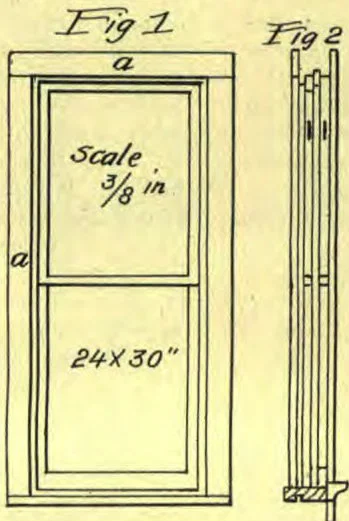
I want you to learn the technical names of the different parts of a house, so that you can work understandingly, after which we will together draw the plans for a nice cottage, and build it, step by step, until it is completed. In this lesson I will give a few illustrations of some parts of a house. Fig. 1 represents a window frame complete, such as we would need for a cottage. The size of the glass is 24 x 30 inches, with check-sash.
Fig. 2 is a side section of the frame, showing the stops and casings, drawn on three eighths-inch scale.
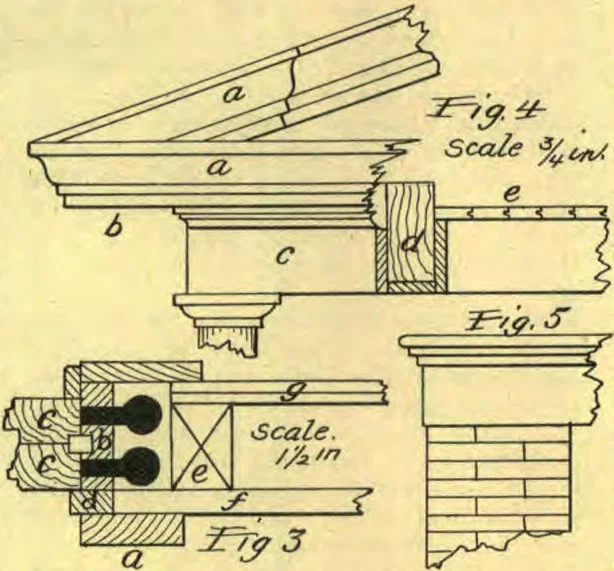
In Fig. 3 we have a section of the side of the frame drawn upon a scale of one and one-half inches to the foot. This scale is so large that the different parts can be lettered, so that when they are mentioned again, you will easily recall them. As represented, a is the face casing, usually four inches wide, one and one-eighth inches thick. This is the outside; the top casing measures the same. At b is shown the jamb, on which the sash slides; at c, c, the window-sash. The jamb is about five inches wide. It has a groove at b three eighths of an inch deep, one-half inch wide for the check-stop between the sash. At d is the blind stop, which projects one-half inch beyond the face casing, and is nailed on before the face casing is attached. You will observe two pulleys through the jamb, with their weights. Each weight should equal about half the weight of the sash and glass combined. There is a pocket in the jamb to put the weights through, which will be explained later. At e is the stud, 2 x 4 inches, which is set two and one-fourth inches from the jamb, thus leaving room for the weights to play in raising and lowering the sash. You will see at f the sheeting upon the outside of the studding, of common, mill-dressed lumber, covered with building-paper, and at g, the lath and plaster.
In Fig. 4 we have a section of veranda cornice, drawn upon a scale of three fourths of an inch to the foot. The crown-mold is shown at a, a. It is thus named because it is the crowning member of the cornice. The board underneath the crown-mold, at b, is the plancher. Under the plancher, at c, is the bed-mold. At d is shown a section of the box cut through that which runs over the columns. This is called a soffit. Below the soffit is shown the upper end of a column. At e may be seen the matched ceiling over the veranda.
Fig. 5 represents the end of the veranda floor, with casing and molding under the floor, called the nosing.
As I have already said, I hope you will give strict attention to this lesson, in order that you may keep pace with the instruction in cottage-building. W. K. LOUGHBOROUGH.
Continue reading: ORIGIN OF NAMES OF STATES