THE name of California first originated in the imagination of the author of a Spanish romance, “Les Sergus de Esplandian.” In this fiction he described the “Island of California,” where a great abundance of gold and precious stones was found.
Oregon was a name formerly given to an imaginary river of the West. The name was finally applied to the present State of that name.
New Hampshire was named from Hampshire County, in England, by John Mason, of the Plymouth Company, to whom the territory was originally granted by the English government.
The State of Massachusetts was named from the bay of that name. The word originated from the Indian word massa, great; wadchuash, mountain or hills; and the suffix et, meaning at, or near.
Authorities are not agreed as to the origin of the name Rhode Island. Some say it was named from the Isle of Rhoda; others, that it originated from the Dutch Rhode Eslinat, signifying “red island.”
Connecticut, spelled in an Indian dialect, Quin-neh-tuk-qui, signified “land on a long tidal river.”
New York is named from the Duke of York, the original grantee. His charter included lands “from the west side of the Connecticut River to the east side of Delaware Bay.”
The territory of New Jersey was given by royal charter to Sir George Carteret and Lord Berkeley. Carteret, in England’s great civil war, had bravely defended the Isle of Jersey, in the British Channel, and his new possessions were named in commemoration of this fact.
Pennsylvania was first named “Sylvania,” “forest country,” to which the name of Penn was affixed. Three counties lying southeast of Pennsylvania were formerly territories of that State. In 1701 they were granted a charter, and named Delaware, after Lord de la Ware, who first explored the bay into which the river empties.
Maryland was named in honor of Henrietta Maria, wife of Charles I.
Virginia was named in honor of Queen Elizabeth, who was known as the “virgin queen.”
The territory of the Carolinas was granted to the French settlers in 1662, and named after Charles I, of France.
The State of Georgia was named for George II, of England.
Maine, in the charter granted by Charles I, in 1639, was named “the Province or Countie of Mayne,” being regarded as a part of “the Mayne (main) Lande of New England.”
Vermont is formed from two French words, verd and mont, meaning “green mountain.”
Kentucky is an Indian word, variously explained as meaning “at the head of the river,” “river of blood,” and “the dark and bloody ground.”
Mississippi is from the Indian Meesyedee, not “the father of waters,” but “the great water.”
Colorado is named for the Rio Colorado. In Spanish, Colorado means “ruddy,” or “red.”
Tennessee is supposed to have been named from Tenas See, one of the villages of the Cherokee Indians, situated on the Tennessee River.
The name Minnesota is taken from the Indian Minisotah, meaning “colored water.”
Nevada is named from the Sierra Nevada Mountains, which, in turn, are named from the Sierra Nevadas of Granada, Spain.
The word Nebraska comes from an Indian word meaning “shallow river.”
Kansas is named from its principal river. A tribe of Indians, formerly living in that locality, were known as the Konsos, or Kows, and the State is probably named from them.
Florida was discovered by Ponce de Leon on Easter day, and was called, in Spanish, Pascua Florida, or “flowery Easter.”
Alabama is named from an ancient Indian tribe of the Mississippi valley; the name signifies “here we rest.”
The word Ohio originates from O-he-sah, of the Wyandotte Indian dialect, which means “something great.”
Iowa is named from a river of that name. Missouri is derived from the Indian Min-he-sho-shay, signifying “muddy water.” The State takes its name from the river.
The name Wisconsin is of French-Indian origin. It was formerly spelled Ouisconsin, meaning “westward flowing.”
Illinois was the name of a confederacy of Indians. The name is from illini, man, the Indian plural uk being changed by the French to ois.
The name Michigan was first applied to the lake. It comes from Indian words of Algonkian and Chippewa origin—Mitcha, great, and gan, lake.
Louisiana was named in honor of Louis XIV, of France, and was formerly applied to the French possessions in the Mississippi valley.
Arkansas is of Indian origin. A tribe of Indians, who rebelled and separated from the Kansas nation, were celebrated for the fine quality of their bows. From this they were called Arc, or Bow, Indians, and afterward Arkansas.
Arizona is said to be a corruption of Papago orison, meaning “little creeks.”
Utah is an Indian tribal name.
In Spanish, Montana means “mountain land.”—Our Times.
“BE READY ALWAYS.”
By L. D. Avery-Stuttle
Ready for what? How many of the girls and boys can quote the remainder of the verse? Suppose we turn to 1 Peter 3:15, and read the last clause: “Be ready always to give an answer to every man that asketh you a reason of the hope that is in you with meekness and fear.”
One Sabbath not long ago, as I was hurrying to Sabbath-school, a little tot overtook me, and trotted along by my side. “What day is this, Charlie?” I asked. “Sabbus!” was the prompt reply. “How do you know?” I ventured, looking back at the dot of a figure scampering after me.
“My papa says so!” he announced, with an air of settling the point beyond controversy.
It seemed almost too bad to question the little fellow further, when he had such wonderful confidence in his father, and I thought, “Well, it is better to have such a reason as little Charlie’s than no reason at all.”
But we may have a better reason than this. If some one were to ask you, my boy, or you, my girl, how you know that the seventh day is the Sabbath, would your answer be any more to the point than Charlie’s? Of course you all know where the Ten Commandments are found, though I once knew about a minister who did not, and was obliged to ask. How sad it would be for any of the boys and girls of the INSTRUCTOR family not to be able to turn promptly to the chapter where God’s holy law is found!
But how many can repeat the Ten Commandments correctly? If I were writing this to your parents, I should beg them to see that you all learn, at once, every one of God’s Ten Words by heart. But I am writing to you, so I shall appeal to you. If you will read them all over carefully twice every day, you will soon have them all learned.
Oh, if only you will give the same anxious study to God’s word that you give to your lessons at school, you will never grieve the dear Lord, or make your Sabbath-school teacher sad and perplexed by having a poor lesson on the Sabbath. Will you do this?
Let us all read again the text quoted at the beginning of this article.
“But,” you say, “no one will ever ask me to give a reason for my hope. I’m not a minister nor a Bible worker.”
Yes, I know; but think what a deep understanding Christ had of the Bible when he was only twelve years old. His reasoning was so profound that it astonished the wise doctors of the law.
If we wish to be like Christ, we must study the Bible as he did. You may think it unnecessary, and that you will never be called upon to answer for your faith; but the time is at hand—is come—when the question of Sabbath observance will be one of the leading questions of the day, and if we do not, young and old, place our feet upon the firm platform of God’s word, we shall surely be swept away, not being able to stand. Who among us would be willing to spend days and months within the gloomy walls of a prison, rather than give up the faith? Ah! you must have some better reason for a belief upon which hang such important results, than “father and mother say so.” How do you know that they are not mistaken? Christ says: “Search the Scriptures.” It may be that you will very soon be met with cunning arguments against God’s truth; but if you can meet them with “Thus saith the Lord,”410
the enemy will be put to confusion, no matter how young you are.
People will tell you that the law has been done away; that it was nailed to the cross; and that the fourth commandment, which enjoins the observance of what they call the “old Jewish Sabbath,” has been abolished.
Can you give an intelligent answer as to what law was nailed to the cross of Christ and thus abolished? There was a law which ceased to be in force after Christ said, “It is finished.” What law was it? Do you think it was the Moral Law? If it was, do you think there could be any condemnation to a thief for breaking the eighth command? or to a murderer for breaking the sixth? or to a heathen for disobeying the first and second? Is it any less a grievous sin for children to disobey their parents to-day than in the Jewish age? So you see that the Ten Commandments are in force to-day, the same as ever. But some, in order to destroy the claims of the fourth command, declare them all abolished.
Were there certain Sabbaths which were done away when Christ died?—Oh, yes; these were the ceremonial sabbaths, and, along with other ceremonies, types, and shadows, they ceased when the Substance was met. You know a shadow always points to the substance, and ceases when that substance is reached. But notice the difference between the Sabbath of the fourth command and these ceremonies: The Sabbath of Jehovah always points backward to creation, and always did, and always will. The others pointed forward to the cross, and were then abolished.
Study Eph. 2:13-20, and we will have another talk soon.
MRS. L. D. AVERY-STUTTLE.
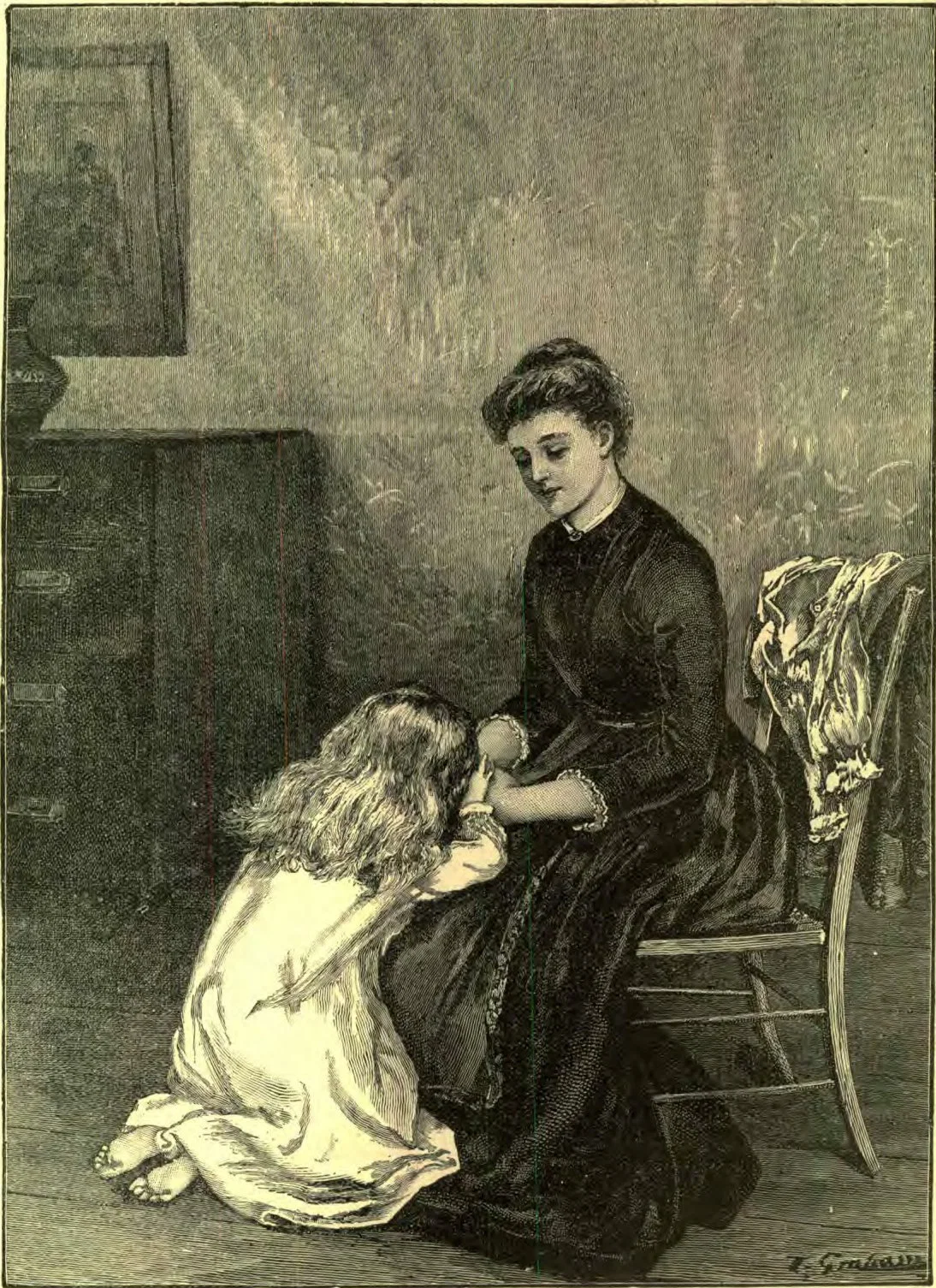
NOW I LAY ME DOWN TO SLEEP.
Golden heap so lowly bending,
Little feet so white and bare;
Dewy eyes, half-shut, half-opened,
Lisping out her evening prayer.
“GOLDEN HEAD SO LOWLY BENDING.”
Well she knows when she is saying—
“Now I lay me down to sleep”—
’T is to God that she is praying;
Praying him her soul to keep.
Oh, the rapture, sweet, unbroken,
Of the soul who wrote that prayer;
Children’s myriad voices floating
Up to heaven, record it there.
If of all that has been written,
I could choose what might be mine,
It would be that child’s petition
Rising to the throne divine.
— Selected.
WHOSE BABIES?
THREE of them, in a little house without windows or door or roof, the top all open to the sky. Yet the babies do not get wet. Do you ask why?—Because of a wonderful umbrella, tall and straight, with a covering of green, in more pieces than you could count, to shield them.
But that is not all. Babies like to be amused. Rattles?—Well, no; but a sound that is like the clapping of tiny cymbals. I have even heard of some babies who thought the world was made of these same green bits. That was before they had wandered from the house. Afterward they knew better.
Shall I tell you more about the little house? Some would call it a cradle. It is round and smooth. At night it has a covering of softest down. The cradle is rocked, although the babies never see the one who rocks it. Sometimes this invisible helper sings, as he rocks the cradle, a lullaby unlike any other they have heard, and yet strangely like them all.
The house is just large enough,—no room to spare. When the babies are ready to leave the little house, it will no longer hold them. It is only for their baby days.
It was the mother who made the house. The father brought all that was needed,—hair, and moss, and bits of wool. As for the babies themselves, when they first come, they have only a sparse covering of finest down. You can scarcely see it. Their eyes are closed. They seem only to eat and sleep.
The father and mother feed them. If the mother goes for food, the father watches near, that no harm may come to them. While the mother is away, the bright sunshine wraps them in its soft, warm mantle.
The babies are not always sparsely clad. After a time they have a dress that is soft, warm, and of a beautiful brown, or grayish-brown, color. The marking of this dress is one of the strangest of strange things. If you should see one of these half-dressed babies, you would laugh. Their clothing is all shreds and patches, yet it does not fall off.
Soon the eyes open, bright and keen of sight, the dress is completed, and the house is no longer large enough to hold the babies.
Now comes the prettiest time of all,—a time of coaxing and calling, and oh! such love and tender care,—a time of trying and failing , and trying again, and at last the new, free life.
What does it all mean? Can you tell?—Kindergarten Review.
INTO THE LIGHT.
By Lena E. Howe
May and Grace were seventeen years of age, and were among the brightest students in their high school. Six months before our story opens, both girls had accepted Christ as their personal Saviour, and had ever since been loyal, faithful workers for him. In the room of each hung this text: “In all thy ways acknowledge him, and he shall direct thy paths.”
As soon as May went away, Grace began to study the texts they had read that morning. They shone with new force and beauty, and she became so absorbed that her lunch remained untouched when May returned.
They at once entered upon the study of the signs of Christ’s coming, Grace turning to Matt. 24:29, and reading: “Immediately after the tribulation of those days shall the sun be darkened, and the moon shall not give her light, and the stars shall fall from heaven, and the powers of the heavens shall be shaken.”
“You notice, Grace,” said May, “that the very next thing is the coming of Christ in the clouds of heaven; and if you will read the third verse of this same chapter, you will see that the disciples had just been asking him for a sign of his coming. He not only gave them the signs, but also told them when to look for them.”
“What does he mean by the ‘tribulation of those days’?”
May turned to her note-book, and read: “The days of tribulation began in 538 A. D., when the papacy was established, and ended in 1798, when the pope was taken prisoner.”
“Oh, yes; I remember having that in our history class. It was Berthier who took him prisoner, wasn’t it?”
“Yes; and Elder Barnes read that between those dates between fifty and one hundred millions of the people of God were put to death. Some were starved, some burned at the stake, some thrown to wild beasts. Every means of torture that Satan and wicked men could invent was employed to compel men to renounce their faith. That is the ‘great tribulation’ spoken of by Christ, immediately after which the signs were to be given. In Mark it reads a little differently. Please read Mark 13:24.”
“But in those days, after that tribulation, the sun shall be darkened, and the moon shall not give her light.”
“You see that the darkening of the sun and the moon, in order to be the signs spoken of by the Saviour, must come before the end of the days in 1798, and after the tribulation.”
“How is that?”
“In Matthew 24 Christ says, ‘But for the elect’s sake those days shall be shortened.’ ‘The suppression of the order of Jesuits by the pope of Rome, and the influence of the Reformers, together with the edicts of toleration passed by Austria and Spain cut short the tribulation,’ so that it ceased a few years before the ‘days’ ended, about 1773; so you see the signs must come between 1773 and 1798.”
“That is very clear; but did they come then?”
“Why, of course they did. Elder Barnes read several extracts showing that the sun was darkened May 19, 1780. During the following night it was so dark that, as one writer expressed it, ‘a sheet of white paper held before the face was equally invisible with a piece of the blackest velvet.’ During the latter part of the night the darkness disappeared, and the moon looked like blood.”
“It could not have been an eclipse?”
“No; the moon was full, and you know it is not possible to have an eclipse at such a time.”
“That is true. That verse we read in Matthew 24 says that the stars shall fall from heaven. Has that been fulfilled?”
“Yes; I asked Elder Barnes to let me take his book, ‘Facts for the Times,’ and I copied this, taken from the Connecticut Observer of Nov. 25, 1833: ‘We pronounce the raining of fire which we saw on Wednesday morning last, an awful type, a sure forerunner, a merciful sign of that great and dreadful day which the inhabitants of the earth will witness when the sixth seal shall be opened. The time is just at hand, described not only in the New Testament, but in the Old. A more correct picture of a fig-tree casting its leaves, when blown by a mighty wind, it is not possible to behold.’ Rev. 6:13 describes the falling of the stars. Grandpa says that he saw them, and that it was the grandest sight he ever witnessed. Almost every one was greatly frightened, thinking that the end of the world had come.”
“But instead of the end, it was only one of the signs of it?”
“Yes. God always warns the world before he visits his judgments upon it. He is not willing that one should perish. For one hundred and twenty years, Noah preached the coming of the flood; but the people had never seen any rain, and they ridiculed and scoffed at the idea.”
“But the flood came.”
“Yes; and Christ will come.”
“Did he give any other signs of his coming?”
“Yes, a great many. In the chapter we have been reading, he says that there shall be wars and rumors of wars, famines, pestilences, and earthquakes. He also says that false Christs and false prophets shall arise, and shall deceive many, because of the great signs and wonders that they show. He warns us against being deceived by any of these, and says, ‘For as the lightning cometh out of the east, and shineth even unto the west; so shall also the coming of the Son of man be.’ Now read verses 32 and 33.”
“Now learn a parable of the fig-tree: When his branch is yet tender, and putteth forth leaves, ye know that summer is nigh: so likewise ye, when ye shall see all these things, know that it [‘he,’ margin] is near, even at the doors.”
“If he is at the door, he must be very near.”
“The next verse shows that. Please read it.”
“Verily I say unto you, This generation shall not pass, till all these things be fulfilled.”
“The generation that learns the parable, that knows these signs as signs of his coming, will not have passed away when he appears in the clouds of heaven.”
“How thankful I am that the Lord has sent some one to tell us about these things. You remember, May, that John says, ‘If any man will do his will, he shall know of the doctrine.’”
“Yes, Grace; but I must go now. Next time I come, we will try to finish the reading on the present subject, and perhaps I shall have something else that is new to us.”
“I shall be glad when I am able to go with you. Come as often as you can.”
“You may be sure I will do so; and now, good-by.” LENA E. HOWE.
THE HOUSE A MOUSE BUILT.
He was a clever little mouse, who wished to go to housekeeping. He found it difficult to get any material; for he lived in a house where there were no carpets, and the man who lived alone in the house was so careful that he never left the smallest thing about that could be nibbled and made soft for a mouse’s dainty house. It became very serious. Cold weather would soon come, and the wind did blow so hard through the cracks of the house, and there was nothing but the bare, but warmest, corner between the outer and inner walls of the old house for the little mouse to live in.
One day the little mouse made a discovery. He found in a box, through which he nibbled while the owner was gone, some pieces of paper that would suit perfectly for the house he would build in the warmest corner. He worked hard carrying the paper, and shredding it until it looked like wool. On this paper were pictures. Whether this mouse was artistic and liked pictures, or whether it was an accident that he did not make wool of these corners, no one will ever know; but he left the pictures whole.
One day there was a great deal of hammering, and the poor little mouse in his beautiful house between the walls scampered away, frightened almost out of his wits. The hammering went on; at last the men broke through into the very corner where the little mouse had built his comfortable house. The moment the hammerers saw the house, they stopped hammering; and the poor mouse saw that his pretty house created the wildest excitement, especially the pictures.
The little mouse had built his woolly house of money that the man who lived alone had saved! The pictures were all carefully smoothed out, and it was found that the little mouse had built a house worth two thousand dollars. How much more it cost, no one could tell but the miser who owned the money, and he did not speak. The pictures told, at least in part, how much the mouse’s house was worth. They were taken to the Treasury Department at Washington, and redeemed; that is, good money was given for them.—Selected.
Being One of the World's Dependables
It is worth something to be one of the world’s “dependables,”—a person who can be depended on in every emergency.
THE PLANTED FIELD.
I gazed athwart the planted field,
And saw therein a struggling crop,
That looked as if it were the yield
Of seeds that merely chanced to drop.
It seemed an acre overgrown
With sprouting grain that upward thrust
Where'er it could, 'twixt sod and stone,
And grew because, forsooth, it must.
I, musing, thought: “The husbandman
Is careless of his striving grain.
The seeds he scattered without plan
For sheaves to load his harvest-wain.”
And then I wandered on, heartsore,
And filled with bitterness for all
Humanity, chance-scattered o'er
The rough-plowed world from wall to wall,
Until, 'mid tears, I looked again
Upon the planted field, and lo!
There stood the crop of goldening grain
In stateliest order, row on row.
No careless hand those seeds had sown;
The husbandman had furrowed fair.
Looking athwart, I had not known
Both love and law abided there.
Persons: Jesus, twelve disciples, man possessed with a devil, Moses, Elias, Gadarenes. Places: Coasts of Caesarea Philippi, Mount of Transfiguration, Sea of Galilee, Gadara.
QUESTIONS.
1. What questions did Jesus ask his disciples as they journeyed through Caesarea Philippi? Matt. 16:13-15. What were their respective answers? Vs. 14, 16. What did Jesus say was the source of Peter's grand testimony? Verse 17. What statement, addressed to Peter, did Jesus then make concerning the foundation of his church? V. 18. What authority did he say should be given to the church on earth? V. 19; note 1.
2. In connection with these statements, what instruction did Jesus give? V. 21. How did Peter receive it? V. 22. What rebuke did Jesus administer? V. 23. What principle of Christian life was then set before the disciples and people? Mark 8:34, 35. By what questions did Jesus seek to show the value of true self-denial? V. 36, 37. What conclusion did he draw? V. 38. Why? Matt. 16:27; note 2.
3. To what place did Jesus repair, and for what purpose? Luke 9:28. Who accompanied him? Why no others? Note 3. What wonderful changes took place in the Saviour while communing with God? V. 29. Who appeared to him? V. 30. Of what was this scene a type? Note 4. What subject was discussed by these celestial visitors? V. 31. In what condition were the disciples during this interview? V. 32. Through their failure to remain awake, what did they lose? Note 5.
4. Upon awakening, what did Peter say to Jesus? V. 33. By what were they soon surrounded? V. 34. What voice was heard at this time, and what was said? V. 35. What was the effect upon the disciples? Matt. 17:6. What did Jesus do and say? V. 7.
NOTES.
1. In the person of Peter, the Lord addresses his church. The words spoken contain a meaning the very opposite of that which the Roman Catholic Church endeavors to put into them. Christ, not Peter, is the very foundation of the church of God. 1 Cor. 3:11; Eph. 2:20. The word translated “Peter” signifies a loose, disconnected stone, fit symbol of the unstable character of Peter, and of all things most undesirable for a foundation. But the word from which “rock” is derived is, on the other hand, one that signifies crag, or cliff, or fixed and immovable stone. It is upon this fixed and everlasting Rock, Christ Jesus, that the temple of God's church is erected, not upon changeable, erring man. To the church, Christ has given the keys, the power, of the kingdom. These “keys” are the words of the Lord, as recorded in the Scriptures. See “Desire of Ages,” pages 412-414.
2. It is only in the light of Christ's second coming that we may rightly estimate the value of earthly things. How foolish it were to exchange one's soul for things which must be destroyed “by the brightness of his coming”! If all rewards are to be given then, it is evident that no reward of any true worth can be had before that time. Hence the word, “What shall it profit a man, if he shall gain the whole world [which is but transitory], and lose his own soul [which may continue to all eternity]?”
3. Peter, James, and John, of the entire twelve, were the only ones who could receive the manifestations that Jesus designed to give. These three were Christ's closest companions, not because they were more loved by him, but rather because they more fully yielded themselves to him, and thus could better appreciate his plans and enter into his work. This principle still holds true; he is taken into closest relation with God, whose heart is most in sympathy with the divine.
4. The persons in the transfiguration scene are types of the future glorious kingdom of Christ. In that kingdom will be found the Son of God, glorified, sitting as King of kings and Lord of lords. Of this he was a type when on the mount; his face shone as the sun, and his raiment became white as the light. In that future kingdom will be the raised dead of all ages; of these Moses was a type. Yet another class will be there,—the translated ones, the one hundred and forty-four thousand who will not have tasted death; these are typified in the person of Elias. In this sense the kingdom of God was seen by the disciples before they tasted death. And thus it was that Peter, in after years, when preaching the coming of the Lord, appealed to this event as proof of his knowledge. 2 Peter 1:16-18.
5. Through being overcome with sleep, the disciples heard little of what passed between Christ and the heavenly messengers. Failing to watch and pray, they had not received that which God desired to give them,—a knowledge of the sufferings of Christ, and the glory that should follow. They lost the blessing that might have been theirs through sharing his self-sacrifice. Slow of heart to believe were these disciples, little appreciative of the treasure with which Heaven sought to enrich them. Yet they received great light. They were assured that all heaven knew of the sin of the Jewish nation in rejecting Christ. They were given a clearer insight into the work of the Redeemer. They saw with their eyes and heard with their ears, things that were beyond the comprehension of man. They were “eye-witnesses of his majesty,” and they realized that Jesus was indeed the Messiah, to whom patriarchs and prophets had witnessed, and that he was recognized as such by the heavenly universe.—“The Desire of Ages,” page 425.
How long is the interval between the occurrences of the previous lesson and those of this lesson? How long did Nebuchadnezzar reign? By what was his reign interrupted? What is said of Belshazzar? What was the probable occasion of this feast? Give order of events up to the calling of Daniel. How did Daniel regard the offer of the king? Why was Belshazzar so inexcusably guilty? What had he desecrated, and whom had he defied? Where did the writing appear? What meaning had each of the words? What order was issued? What was the significance of the robe and chain? What position did Daniel hold? Who took the kingdom from Belshazzar? When was the king slain? How many prophecies were fulfilled in the overthrow of Babylon?
NOTES.
1. “A period of about forty-two years intervenes between the last lesson and the present lesson (B. C. 538). Nebuchadnezzar, after a reign of forty-three years, interrupted by seven years of insanity (Dan. 4: 33), died; and in due time Belshazzar came to the throne.”
2. Sir Henry Rawlinson has discovered inscriptions which give the history of the exploits of King Nabonadius, who associated his own son, Belshazzar, with himself in the kingdom. He was defeated in the field, and retreated to Borsippa, where he was held in siege. Belshazzar was in Babylon, and held royal honors till his death. This explains why Daniel held the third place in the kingdom, and also harmonizes history and the Bible. Some of the most remarkable and striking prophecies of Jeremiah and Isaiah, as well as of Daniel, refer to the destruction of Babylon. The prophecies and their fulfilment in relation to Babylon have a special interest, inasmuch as they have a double significance, picturing the condition and fate of the world, and vividly bringing to view the utter overthrow of all who oppose and exalt themselves above God.
3. “Is not this great Babylon that I have built?” Nebuchadnezzar had said, in the pride of his heart. The great city upon which he looked down was a marvel of cities, and has not been equaled to this day. It was “laid out in a perfect square sixty miles in circumference, fifteen miles on each side; surrounded by a wall three hundred and fifty feet high and eighty-seven feet thick, with a moat, or ditch, around this of equal cubic capacity with the wall itself; divided into six hundred and seventy-six squares, each two and a quarter miles in circumference, by its fifty streets, each one hundred and fifty feet in width, crossing each other at right angles, twenty-five each way, every one of them straight and level and fifteen miles in length; its two hundred and twenty-five square miles of enclosed surface, divided as just described, laid out in luxuriant pleasure-grounds and gardens, interspersed with magnificent dwellings,—this city, . . . containing in itself many things which were wonders of the world, was in itself another and still mightier wonder. . . . And there, with the whole earth prostrate at her feet, a queen in peerless grandeur, drawing from the pen of inspiration itself this glowing title, ‘The glory of kingdoms, the beauty of the Chaldees’ excellency,’ sat this city, fit capital of that kingdom which constituted the golden head of this great historic image.—“Thoughts on Daniel,” pages 46, 47.
4. From the prophets we know what powers they were which should march against Babylon to destroy it; we know who should lead the armies; we know how the city should be taken; and we know the condition of things in the city when the invading forces should enter. For God mustered the forces, directed the siege, and led the leaders, and by his prophets his plans were all revealed from sixty to one hundred and seventy-five years before the city and the kingdom of Babylon fell.—“Great Empires of Prophecy,” page 37.
5. When all was prepared, Cyrus determined to wait for the arrival of a certain festival, during which the whole population were wont to engage in drinking and reveling, . . . and then silently, in the dead of night, to turn the water of the river, and make his attack. . . . Belshazzar, with the natural insolence of youth, to mark his contempt of the besieging army, abandoned himself wholly to the delights of the season, and himself entertained a thousand lords in his palace.—Id., page 42.
6. Cyrus declares, on a tablet recounting his capture of Babylon, “that Babylon was captured ‘without fighting’ on the fourteenth day of the month Tammuz. . . . On this day of all days the women took part in the horrible rites [celebrating the union of Istar and Tammuz], and it was in this feast of king, princes, wives, and concubines that Babylon was taken, and Belshazzar slain.—Wm. Hayes Ward, D. D.
7. When the morning came, Cyrus found himself undisputed master of the city, which, if it had not despised his efforts, might with the greatest ease have baffled them. [“Thus saith the Lord to his anointed, to Cyrus, whose right hand I have holden, to subdue nations before him; and I will loose the loins of kings, to open before him the two-leaved gates; and the gates shall not be shut.” Isa. 45: 1.] Thus perished the Babylonian Empire.—“Great Empires of Prophecy,” page 46.
8. Earth’s greatest city, type of the destruction of all the cities of men, lies in dust and oblivion; but there is a city whose builder and maker is God, and through its gates shall enter the holy and harmless, who shall go no more out forever.
To Reach BATTLE CREEK
FROM
CHICAGO, BUFFALO, DETROIT, OR TOLEDO,
Purchase Tickets
Reading over the MICHIGAN CENTRAL
“The Niagara Falls Route.”
A First-class Line for First-class Travel between Chicago and New York and Boston. Elegantly equipped through trains pass Battle Creek in each direction daily.
R. N. R. WHEELER,
Ticket Agent, Battle Creek.
O. W. RUGGLES,
Gen’l P. and T. Agt., Chicago, Ill.