The End of the Prophetic Wonders—Resurrected to See the Climax—The Sealed Book Opened and Knowledge Increased
By JEAN VUILLEUMIER
This is the concluding study by Elder Vuilleumier on the book of Daniel. Our issue of October 19 will contain his opening study on that other interesting prophetic book, the book of Revelation. Many people regard the book of Revelation as being sealed, so that it cannot be understood; but the book itself claims to be a revelation, and therefore it is open to our understanding. Our readers, we are sure, will enjoy the studies that Elder Vuilleumier will furnish. Editor.
“AND at that time shall Michael stand up, the great Prince who standeth for the children of thy people.” Dan. 12:1, A. R. V.
The vision recorded in the eleventh chapter of Daniel brings us down the course of time, through two thousand five hundred years, to the close of human kingdoms. “At that time,” says the angel Gabriel to Daniel, shall Michael, the Son of God, “stand up.” Dan. 11:3, 7, 20. This means that He takes His “great power” and reigns, because then shall “the God of heaven set up a kingdom which shall never be destroyed.” Rev. 11:17; Dan. 2:44. Then “the saints of the Most High shall receive the kingdom, and possess the kingdom forever, even forever and ever.” Dan. 7:18. Then, as says Isaiah, “the government shall be upon His shoulder” whose name is “Prince of peace.” Isa. 9:6.
“And there shall be a time of trouble, such as never was since there was a nation even to that same time.” Dan. 12:1.
DISTRESSED BY SIN
This “time of trouble” coincides with “the great and terrible day of the Lord,” described years before Daniel, by the prophet Zephaniah, as “a day of wrath, a day of trouble and distress, a day of wasteness and desolation, a day of darkness and gloominess, . . . a day of the trumpet and alarm, against the fortified cities, and against the high battlements. And I will bring distress upon men, . . . because they have sinned against Jehovah; and their blood shall be poured out as dust, and their flesh as dung. Neither their silver nor their gold shall be able to deliver them in the day of Jehovah’s wrath.” Zeph. 1:15–18.
“And at that time thy people shall be delivered, every one that shall be found written in the book.” Dan. 12:1.
When the time of trouble begins, the Investigative Judgment has just closed on all the righteous by the blotting out of their sins. The names of all such are therefore retained in the book of life; and the happy throng of the faithful among the living will be “delivered” from the terrible calamities and plagues then poured upon a wicked and impenitent world.
SPECIALLY RESURRECTED
“And many of them that sleep in the dust of the earth shall awake, some to everlasting life, and some to shame and everlasting contempt.” Verse 2.
This verse describes a partial resurrection of a few leading characters selected from both righteous and unrighteous, just before the coming of Christ upon the clouds. The most renowned among the wicked will thus witness the triumph of the cause of Christ, which they have derided, oppressed, and persecuted; while the risen saints with exultation wait for the glorious appearing of the King of kings.
“And they that are wise shall shine as the brightness of the firmament; and they that turn many to righteousness as the stars forever and ever.” Verse 3.
Every one knows the brightness of the sun, which is so many times larger than our earth. But what do we know of the brightness of the polestar, 86 times brighter than our sun? of Vega, Capella, and Arcturus, whose light is respectively 344, 430, and 516 times greater than that of our sun? of Alcyone in the Pleiades, with a brightness that exceeds that of our sun 12,000 times, and whose light reaches us only after traveling 700 years at the rate of 186,000 miles a second? The comparison drawn by the prophet serves to illustrate the overwhelming glory of the saved.
A CONSUMMATION WORTHY OF GOD
With this glorious promise ends the long prophecy embraced in the eleventh chapter of Daniel, covering all the great political changes on the face of this earth during twenty-five centuries, until we reach the eternal kingdom of God. The consummation of this long and bloody struggle is worthy of the God who rules in the affairs of men; the reward given to the saints of the Most High is worthy of the long, sad waiting. And now the angel gives the aged prophet a word of encouragement as to the future usefulness of the book in which these wonderful revelations are written:
INCREASED KNOWLEDGE AND APPROACHING GLORY
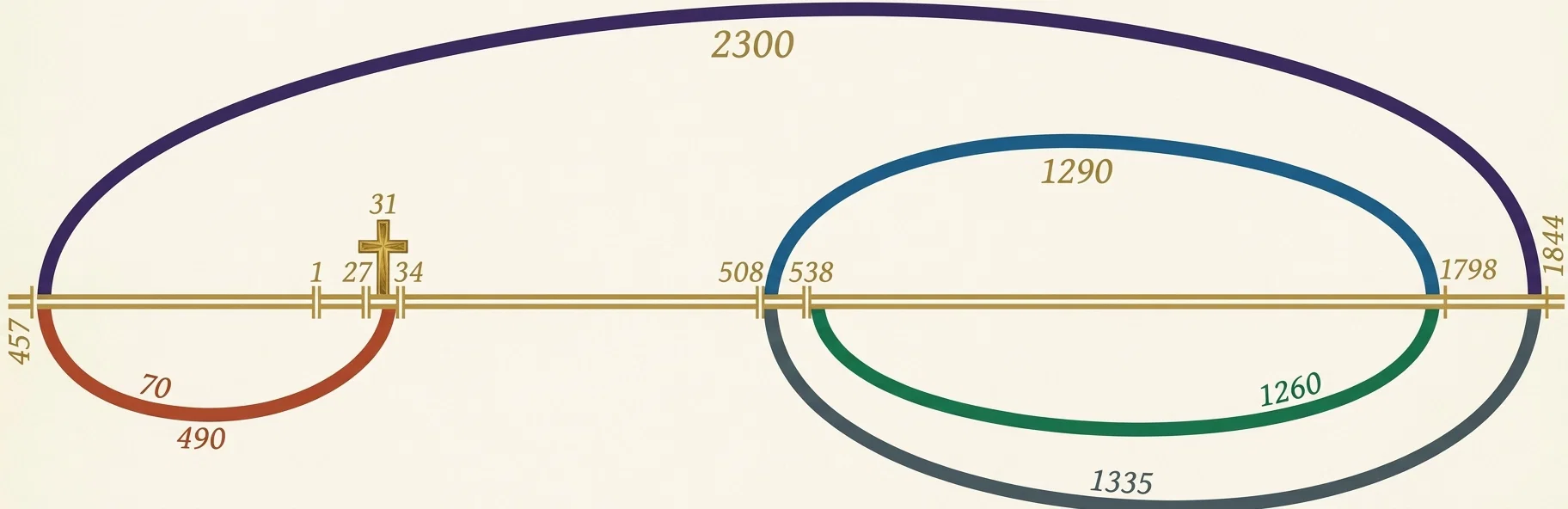
The above diagram includes, as will be seen, all the five prophetic periods of the book of Daniel. It shows at a glance the wonderful harmony and the sublime unity of prophetic chronology. The immutable firmness of the divine plan is seen in the fact that the least change in any period or date would upset the whole scheme, riveted on events, like the death of Christ in 31 A. D. All these periods are absolutely unassailable as matters of chronology.
“But thou, O Daniel, shut up the words, and seal the book, even to the time of the end: many shall run to and fro, and knowledge shall be increased.” Verse 4.
This closing caution and promise have both been fulfilled. For twenty centuries, the book of Daniel was nearly a blank. But since the beginning of the nineteenth century, a flood of light has been graciously poured from heaven upon the prophetic Word, of which the book of Daniel is the key. In all countries, devout men began to study these revelations; and the church of God has found new courage and hope in these unfolding mysteries, the sure harbingers of the approaching glory.
“Then I, Daniel, looked, and, behold, there stood other two, the one on the brink of the river on this side, and the other on the brink of the river on that side. And one said to the man clothed in linen, who was above the waters of the river, How long shall it be to the end of these wonders? And I heard the man clothed in linen, who was above the waters of the river, when he held up his right hand and his left hand unto heaven, and sware by Him that liveth forever that it shall be for a time, times, and a half; and when they have made an end of breaking in pieces the power of the holy people, all these things shall be finished.” Verses 5–7.
HOW LONG TO THE END?
And now to the “man greatly beloved” is given the rare privilege of beholding not only two more angels, but the divine Son of God, the future Messiah and Prince of peace. Compare Dan. 10:5, 6; Rev. 1:13–15. One of the angels graciously volunteers to be spokesman for the overawed prophet, voicing, at the same time, a question which would naturally come to every earnest student of these prophecies in future ages; namely, “How long shall it be to the end of these wonders?” To that honest inquiry, the great Michael Himself gives answer in the most solemn manner, swearing “by Him that liveth forever that it shall be for a time, times, and a half” (3½ x 360 = 1,260)—one thousand two hundred sixty years, reaching, as we have seen, from A. D. 538 to 1798.
But this important prophetic date, 1798, which marks the beginning of “the time of the end,” does not reach to the final end of the great controversy. “They”—the enemies of God—must yet make “an end of breaking in pieces the power of the holy people.” A latter-day persecution is yet to break out, of which the book of Revelation gives the full account.
“And I heard, but I understood not: then said I, O my Lord, what shall be the issue [margin, ‘latter end’] of these things? And He said, Go thy way, Daniel; for the words are shut up and sealed till the time of the end. Many shall purify themselves, and make themselves white, and be refined; but the wicked shall do wickedly; and none of the wicked shall understand; but they that are wise shall understand.” Dan. 12:8–10.
To Daniel, this period of three and a half times is shrouded in total darkness. So he ventures to repeat the question of the angel. The answer comes back that the understanding of these things must be left to those who shall live in “the time of the end.” At that time, these very prophecies will serve to “purify” and “refine” God’s people, who shall then “understand”; but a woeful pall of ignorance shall rest on “the wicked.”
“And from the time that the continual (burnt offering) shall be taken away, and the abomination that maketh desolate set up [margin, ‘taken away to set up the abomination’], there shall be a thousand two hundred and ninety days.” Verse 11.
SOME LONG PROPHETIC PERIODS
A new prophetic period is here given,—one thousand two hundred ninety days,—which is by thirty prophetic days, or 30 years, longer than the one mentioned in verse 7. The first period began in 538 A. D., when the “abomination that maketh desolate” was581not set up. The second period, starting “from the time that the continual shall be taken away” to make room for the abomination, precedes it by a period of thirty years, and therefore begins in A. D. 508. As we have shown at length on chapter 8, this “continual” to be “taken away” in 508 is organized paganism.
“The Complete Extinction of Paganism in the West” is the title of book 12 of Beugnot’s “History of the Destruction of Paganism in the West.” Paris, 1835. That “complete extinction” was brought about by an edict of Theodoric the Great, who was king of the Ostrogoths in Italy from 490 to 526. This edict, which must have been issued somewhere about 508 A. D., is found in the Edictum Theodorici Regis (Frankfurt, 1613), and pronounces the pain of death on all found guilty of “sacrificing according to pagan rite.” “What no emperor had dared to do,” says Beugnot, “a Gothic prince carried out without flinching.”
We find, therefore, that both periods, the one thousand two hundred sixty and the one thousand two hundred ninety days, bring us to the fateful date of 1798, where the papacy received that terrible blow from which it has not yet recovered.
“Blessed is he that waiteth, and cometh to the thousand three hundred and five and thirty days.” Verse 12.
IT ALSO POINTS TO 1844
A third prophetic period is brought to view by the Son of God, one thousand three hundred thirty-five years, symbolized by as many days. No new starting point being given, it must of necessity begin at the same date as the one immediately preceding it, 508 A. D. But it brings us to the year 1844, the very year that marks the end of the famous period of two thousand three hundred years of chapter 8. Well may we say, “Blessed is he that waiteth, and cometh” to the end of these two prophetic periods; for such reach the time when God’s work in the earth is soon to close, the time when the Judgment sits in the heavenly courts on the cases of the righteous,—a short period, at the end of which the living are to witness the first resurrection and the coming of the Lord. This short period is the antitypical day of atonement. Blessed is he who comes to such a time. He may expect to see with his own eyes “the latter end of these wonders.” “But go thou thy way till the end be; for thou shalt rest, and shalt stand in thy lot, at the end of the days.” Verse 13.
The venerable prophet, “greatly beloved,” must rest satisfied, after having written these things for remote generations, to go to his rest, with the happy assurance that he will be raised at the resurrection of the just, and stand in his appointed lot at the end of the days.
A Matter of Connections
By Josef W. Hall
MANY persons who do not themselves realize it, make prayer a task. But the truth is usually disclosed when they come to the text, “Pray without ceasing.” “How do you explain this?” they ask with troubled faces. And they are often put off with the meager explanation that the text means, “Keep in the attitude of prayer.”
To the man who has walked with God it means a great deal more than “attitude.” It means a line of constant communication open between him and God. It means the instinctive upward turn of the heart; the turning to God for everything and in everything as naturally as the babe turns to its mother, and the knowledge that God likewise turns toward him. “Pray without ceasing” means the conduct of every affair, occupation, plan, friendship, and love on the partnership basis; it means keeping the receiver down at both ends and the wires clear, so that everything is heard, even thoughts,—the thoughts of the Christian shared by God, and the thoughts of God shared by the Christian.
JOSEF W. HALL.
The Rights of the Individual
By W. Mayhew Healey
Does the Majority Have the Right to Oppress the Minority?—The Despotism Proposed in Sunday Laws
By W. MAYHEW HEALEY
DURING the International Lord’s Day Congress recently held in Oakland, California, the question was frequently discussed as to who and what should be exempt from Sunday laws. It was admitted that many persons engaged in different kinds of labor must be allowed to work on Sunday, and therefore should be exempt from the penalties of the law, but they should be allowed and required to rest on some other day of the week.
Those who religiously observe the Bible Sabbath, the seventh day of the week, and therefore desire to pursue their ordinary vocations on Sunday, were considered a distinct and separate class from all others. The general sentiment, as expressed, favored their exemption. Some advocated this on the ground of common justice, some on the principle of liberty of conscience, others because it was thought expedient to do so. There were those who evidently preferred to make no exemption on religious grounds. Reference was made to the Canadian Sunday law, which was claimed to be the best in existence, and which has no exemption for those who observe another day.
WOULD PURSUE AND COMPEL THEM
The Rev. Wm. M. Rochester, secretary of the Lord’s Day Alliance of Canada, said: “The question of exempting from the law those who observed the seventh day was considered, and at first quite strongly recommended, but was not made, for two reasons: First, because of the precedent established by Nehemiah when he enforced the Sabbath law on those who encamped about Jerusalem on the Sabbath.”
That action of Nehemiah’s was in no way a parallel to this case. Those who camped about Jerusalem were there for commercial purposes only. No conscientious principles were involved. Nehemiah said to them, “Why lodge ye about the wall?” The ground “about the wall” belonged to the people who kept the Sabbath; and Nehemiah was merely enforcing the principle contained in the law for “the stranger that is within thy gates”—that is, on premises under a Sabbath keeper’s personal control—that he should regulate his conduct consistent with Sabbath keeping.
If Nehemiah had followed out the Canadian principle, he would have pursued those people to their own homes, and there, by police force, have compelled them to observe, or at least rest on, a day in which they had no interest, and in opposition to their desires and business pursuits.
ONE IN TWO HUNDRED WITH NO RIGHTS
The second reason given was that “only about one half of one per cent of the population of Canada keep the seventh day. Ninety-five per cent of the employees of seventh-day factory owners keep Sunday. Therefore their law does not give recognition to dissenters.”
Then we were told that “it is impossible to make a law that does not work a hardship on some one.”
This idea that laws may properly, and must practically, oppress some one, is quite essential to the advocate of Sunday laws as an excuse for their injustice and oppression.
If law can justly take away one right, it can take away any and all rights, and government would cease to be protective, and become oppressive. The ruin of good government would be inevitable under the rule of any party that should adopt such ideas into its general laws, and enforce them upon the people.
If a law may, as the Canadian government claims, take away the rights of one half of one per cent—one person in every two hundred—of its population, then the United States could at any time deprive half a million of its citizens of their rights, destroy their business, confiscate their property, and deny them their liberty.
SHOULD MAJORITIES PILLAGE?
That which may be done to one half million people may with equal propriety be done to any other half million people, under the same conditions; and in this case, the only condition is that they are a very small minority opposed to a large majority. Robbery and pillage could be established by the large majority over the small minority. The only principle of a government thus founded is that “might makes right.” Every true form of government is one that allows no laws to be made except such as are just to all, and oppressive to none.
This false theory of government, that all law works a hardship and an injustice upon some, is the corner stone of anarchy. If all law works an injustice on some, the more laws a country has, the more injustice is done to its citizens, and the anarchistic idea of having no law comes nearest to the ideal condition under which to live.
JUDGMENTS ON SAN FRANCISCO
These Sunday law advocates claim that God is displeased because Sunday is so poorly observed. Some of them at the “congress” declared that God would mete out some terrible judgment because the exposition in San Francisco is opened on Sunday. These persons want Sunday laws, regardless of whom they oppress, that they may gain favor with the court of heaven.
Caiaphas, the Jewish high priest in the time of Christ, recognized the fact that his people were losing the favor of Rome. He proposed to kill Christ, and declare that it was done to protect Cæsar, and so gain favor with Rome. He said, “It is expedient for us, that one man should die for the people, and that the whole nation perish not.” John 11: 50. Caiaphas cared nothing for the rights of one man so long as he thought there was a chance to gain favor with the great Roman power.
WHOEVER OFFENDS A LITTLE ONE
The word of the Lord has sounded a terrible warning to all the advocates of this doctrine that it is right to destroy the rights and liberties of the few to please the many.
“But whoso shall offend one of these little ones which believe in Me, it were better for him that a millstone were hanged about his neck, and that he were drowned in the depth of the sea.” Matt. 18: 6. Thus the great God, whose kingdom is greater than the empire of Rome and all the powers of earth, declares that while His kingdom rules the vast universe, having subjects without number, the rights of the least one are precious to Him, and that dire punishment shall be meted out to those who infringe upon the rights of one little child.
Questions and Answers
THE individual who possesses a copy of “Questions and Answers” has a rare and helpful book. See description in another part of this paper.
Are There Two Bible Evenings?
By Arthur L. Manous
When Does the Evening Begin?—And When Does the Sabbath Day Begin?
By ARTHUR L. MANOUS
“AND when it was evening, His disciples came to Him, saying, This is a desert place, and the time is now past; send the multitude away, that they may go into the villages, and buy themselves victuals.” Matt. 14: 15.
“And when He had sent the multitudes away, He went up into a mountain apart to pray: and when the evening was come, He was there alone.” Verse 23.
Unfortunately, some are teaching an error in reference to these scriptures. For example, one writer says: “15. The first evening, which commenced at three o’clock. The second evening, which began at sunset, is that mentioned in verse 23.”
Another says: “Verse 15. Evening. That the first evening, which began at three, is here meant, is plain from verse 23 of this chapter, where another evening is said to have come after the people were fed and dismissed, namely, the second evening, which began at sunsetting.”
So far as the writer’s knowledge goes, he must say, with all due respect to those who differ, that this theory of an evening beginning at three o’clock is a wresting of the text; for it is Scripturally evident that the Biblical evening of the day begins, not at three o’clock, but when the sun sets. A few texts only will suffice to prove this truth.
“At even, at the going down of the sun.” Deut. 16: 6.
“In the evening, at the going in of the sun.” — Young’s translation.
“At even at the setting of the sun.”—Septuagint version, Greek and English.
“At even when the sun was doune.”—Tyndale’s translation, 1526.
“Evening being come, when the sun had gone down.”—Darby’s translation.
“In the evening, after sunset.”—Wakefield’s translation, 1820, second London edition.
“In the twilight, in the evening [Hebrew, ‘in the evening of the day,’ margin], in the black and dark night.” Prov. 7: 9.
But it was not “after sunset,” nor yet even sundown, when the disciples came to Jesus, of which it is said, “And when it was evening, His disciples came to Him.” From these facts, we may profitably study this expression.
The Greek word ginomai, here translated, “when (it) was,” is also rendered by the king’s translators thus:
From this usage of the original, it would seem that its meaning in Matt. 14: 15 is that the day was then “turned” toward the evening; that the evening was coming on, or “drawing nigh.” In harmony with this idea, others translate the expression “when it was evening,” thus:
“And when the even drew on.”—Cranmer’s translation, 1539.
“But when the evening drew near.”—S. Clarke’s Paraphrase, 1795.
“And towards evening.”—Boothroyd’s translation, 1853; also Thomson’s and Campbell’s.
“But when evening was approaching.”—Weekes’s translation, 1897.
These translations of the expression in Matt. 14: 15 are in full accord with the records of Luke and Mark of the same time and event, as rendered by the King James translators:
“And when the day began to wear away.” Luke 9: 12.
With all these harmonious facts before us, there is surely no excuse for wresting Matt. 14: 15 into teaching that there is a Biblical evening beginning at three o’clock. If this erroneous theory were the truth, instead of an error, there might be some question as to which evening should begin and close the Sabbath.
But since there is no Biblical evening beginning at three o’clock, we have no question as to when to observe the Sabbath. “From even unto even [margin, ‘From sundown to sundown’], shall ye celebrate your Sabbath.” Lev. 23: 32, the Newberry Bible.
The Land of Life
By L. D. SANTEE
By L. D. SANTEE
The hills give their streams to the ocean,
The billows roll in from the sea;
And my soul, with a tender emotion,
Muses oft on the glories to be.
And like those bright streams in their welling,
Or the waves that wash sands on the beach,
There's a joy in my heart beyond telling,
Beyond language or speech.
Though I walk in the pathways of danger,
I shall rest in the garden of God.
I shall feel there at home, not a stranger,
Where the footsteps of sin never trod;
Where the sweet face of youth ne'er grows older,
And the flowers of heaven never fall;
Where the warm hearts of friends ne'er grow colder,
But love governs all.
How many the families severed,
To meet upon earth not again!
But, nearing the glorious forever,
There's a recompense sweet for all pain.
Let us help, let us pray for each other,
In this world of temptation and sin,
That the children, and father and mother,
Be all gathered in.
I think of the promises gracious,
That, free from the thralldom of wrong,
Is a land that's eternal and spacious,
Reserved for the glorified throng;
And like the bright streams in their welling,
Or the waves that strew sands on the beach,
There's a joy in my heart beyond telling,
Beyond music or speech.