Miscellaneous Items on Temperance, Religion, and Current Events
Page 2
The Youth’s Instructor
Apr 25, 1916
Review and Herald Publishing Assn. · Takoma Park Station, Washington, D. C. · Apr 25, 1916
Miscellaneous Items on Temperance, Religion, and Current Events
“THE voice with the smile wins.”
MR. HARRY G. PETERMAN hires all the clerks for a thousand stores.
MORE than eight hundred of our daily newspapers refuse liquor advertisements.
THE largest Sunday school in America is in Canton, Ohio, and enrolls 5,223 members.
THE church at Elgin, Illinois, has ordered nearly one thousand TEMPERANCE INSTRUCTORS.
ROLLED newspapers cut into small pieces are used as fuel by Italian soldiers. They give as much heat as a spirit lamp.
MANITOBA, Canada, is dry by vote. All bars, wholesale liquor houses, and licensed clubs in the province will close May 31, 1916.
VIRGINIA is to have a prohibition commissioner, whose business it will be to see that the law prohibiting the sale of intoxicating liquors is enforced.
FORTY miles an hour is the speed an ostrich of Kansas City recently attained in a race with a policeman on a motor cycle.
“It is a rare attainment to be able to refrain from speaking of the faults of others, although keenly alive to the fact they exist.”
GOVERNOR BRUMBAUGH of Pennsylvania, in an open letter, declared himself out and out for county option. The whole State is aroused, and the fight to obtain it is on.
THE Trenton (Missouri) Chamber of Commerce has a motto which reads, “Get acquainted with your neighbor—you might like him.” Is not this as good a motto for the Christian as for the commercial man?
MORGAN PARK, the site of a new steel plant, is a town ten miles from Duluth, Minnesota. It was recently built by the United States Steel Company. The whole thing—steel plant and town combined—represents an investment of $16,000,000.
OUT of 4,043 American millionaires, all but twenty started life as poor boys, and all but forty of them have contributed largely to their communities. But, alas! not one rich man's son out of seventeen dies rich.—Russell H. Conwell.
ELIZABETH while out roller skating was asked by a lady wishing to purchase some plants, where the nurseries were. The term was a new one to the child, but knowing that nurses were a part of a near-by sanitarium equipment, she replied that “they must be at the sanitarium.”
A WALK across the continent backward is the task set himself by Mr. Harmon, of San Francisco, who expects to reach New York in July. Mr. Harmon is fifty years old, and is making a schedule of fifteen miles a day. He walks the whole distance to the East with his face to the setting sun, and the traditional wager of some $20,000 is to be won on arrival in New York within the two hundred and sixty days set for the trip. The whole route of his walk, 3,000 miles, is to be made with his face to San Francisco and his feet moving toward New York. Mr. Harmon uses a mirror, hung on a special frame, to guide him on his way, and is accompanied most of the time by walking companions.
AN eclipse is a shadow in which the people who see it are standing. An eclipse of the sun is caused by the passage of the moon between the sun and the earth. The moon prevents the light of the sun from coming to the earth. An eclipse of the sun is, therefore, the shadow of the moon cast on the earth, and those who are within that shadow cannot see the sun because the moon is in the line of sight. An eclipse of the moon is the shadow of the earth upon the moon. The earth then is between the sun and the moon, and prevents the light from passing to the moon.—St. Nicholas.
“Mother Hubbard”
By D. D. Fitch
SOME weeks ago a request was made in the Review for papers to be used in missionary work here in Santurce, Porto Rico. For a while hundreds of papers came in response, but the supply has gradually become less and less, until the other day when I went to get some for the young people to use, I was made to think of the nursery story about the old woman who went to her cupboard to get her poor dog a bone, but found it bare. You may believe that story, for it might be true; but I think you do not believe that when earnest young people in Porto Rico are desirous of doing missionary work they should be kept from it because they have no means or material with which to do it. I am sure that with this reminder many will be glad to gather up their INSTRUCTORS, Little Friends, and other papers, such as the Signs, Watchman, and Review Extras, wrap them well, and send them to the writer, so that his missionary cupboard will no longer be bare. A limited number of clean Reviews can be used.
When these papers come, my mother, who has loved this message for forty years, takes charge of them. She sorts the papers and places on each a stamp telling where other literature can be obtained, and then wraps them in bundles for the young people.
In many Porto Rican homes are young people who have been taught English in the schools, and there are older ones who are learning to read it, so the youth’s papers are very appropriate for them. Since most of them read Spanish, the stamp serves as an invitation to attend the church services.
There is also a great demand for such papers as the Signs and our excellent magazines to place in the hands of lawyers, merchants, and the Americans who are here engaged in business.
It should be remembered that the same rates of postage apply here as in the United States.
D. D. FITCH.
Our Work in Mexico
By G. W. Caviness
G. W. CAVINESS
In order to understand the difficulties and conditions which confront the work in Mexico, it may be well to give a brief description of the people, together with their history. When Cortés discovered and conquered Mexico, some four hundred years ago, he found the people well advanced in many respects, having a civilization much superior to that of the Indians farther north. Of course they had a system of pagan worship, with its gods and goddesses, and some of their rites were vile and cruel.
But the Roman Catholic Church, that has had control of them during all this time, has changed matters only in name in many things, and in some respects they are in a worse condition than before. In almost all the houses, and even in the huts and stores, one finds images, and candles or incense burning to them. The image most extensively used is that of Guadalupe, which for many takes the place of Mary, the mother of Christ.
The history of the worship of Guadalupe is as follows: An Indian passing a rocky hill near the city of Mexico, claimed to have seen the apparition of a virgin, who told him that a temple must be built on this particular spot, and that he should go to the bishop and tell him about it. The Indian went to the bishop as ordered, but received no encouragement. On returning by the place, the vision again appeared to him. When the Indian told the virgin of his failure to gain the support of the bishop, she told him to pluck some flowers that were growing there and carry them to the bishop. The flowers were miraculously produced on the bare and rocky spot, and the Indian, placing them in his blanket, set out to see the bishop again. This time, as he made his business known, he opened up his blanket to show the flowers, and behold the image of the virgin was painted on the blanket in indestructible colors. With this the bishop was convinced, the church was built, and the wonderful blanket was framed and hung up in it. Copies of the picture have been reproduced, and are now found in almost all the houses of Mexicans, and the Virgin Guadalupe has been made the patron saint of Mexico.
A few years ago, in order to give additional honor to their saint, the Church of Rome decided to crown her. Thirty thousand dollars was raised to purchase the crown, and as a literal crown could not very well be placed on the head of a picture, it was hung just in front of the top of her head. All the clergy of Mexico, with the archbishop, and visitors from other parts of the world, were present at the ceremony, thus sanctioning the fraud.
Many other stories of pretended miracles are disseminated by the priests in various parts of the country. Every one, even the most ignorant peon, knows that they are frauds, and he can have but little confidence in a church that is always seeking to advance her interests by means of such tricks. They are sometimes called “pious frauds,” and it is no wonder that nearly everybody looks upon the church and the priests as frauds, with but little piety. That the very poor and ignorant understand this, is clear from what an uneducated Indian told me. He had heard me speak about the vanity and uselessness of their saints and images, and so told me the following story:—
In a certain village there lived a shoemaker. In his yard there was a tree, under which he frequently sat while engaged in his occupation of mending shoes. A priest who often passed that way, sometimes stopping to chat with the man, noticed that this tree was of fine wood, and decided to buy it in order to make a saint. Having bought the tree, the priest had it cut down and the trunk of it taken to a wood carver and made into a saint, which he called St. Francis. The saint was set up in the church, and soon there were rumors of great miracles that it was performing,—healing the sick, lame, and blind. Meanwhile the shoemaker took the limbs of the tree and used them for firewood to cook his meals. One limb that was of considerable size, he decided to keep for use, and made a pig trough out of it. When he heard of the miracles of the new saint, he went to the church to see about it. Entering the church, with hat in hand, he stood before the image and looked him over carefully, then said: “Well, St. Francis, I haven’t forgotten you. We used to be companions in days gone by, but you have grown very great indeed, such wondrous things I hear of you. But, St. Francis, you must remember that you are a full brother to my pig trough.”
The priests, when they enter upon their office, take the vow of celibacy, but very few of them are true to their vows. While I was in a little village in the4southern part of the country, talking with some acquaintances, a woman passed by. One present said, “There goes the mother-in-law of the priest.” I asked them if the priests had mothers-in-law, and they said, “Yes, that is what we call them.” When a church is engaged in propagating “pious frauds” and her priests are untrue to their vows, how can the people have very much respect for religion? The church claims the right to celebrate marriage ceremonies, and the government has declared that only civil marriage is legal. The fact is that a large part of the people live together as they see fit, without respect to either church or government. For the church it is a question of dominating the people, and getting money out of them.
A servant girl whom I knew wished to get married. She asked the priest what it would cost. He said, “Twenty-two pesos.” The poor people can never get that much money together to pay for getting married, so they dispense with any ceremony in the matter.
“The Virgin of Guadalupe,” near Mexico City, Mexico
When the church itself is connected with so many frauds, it is no wonder that fraud and dishonesty among the people prevail. I have been told that it is quite customary to search all the laborers on a job as they leave in order to prevent them from carrying away something. I have known such cases. When a building is to be erected, a wall is built about the lot on which it is to be built. Then the workmen as they leave for dinner and at the close of the day, have to pass through a door and be examined to see that they do not have some tool or something of value concealed about them. Anything, such as a hammer, hatchet, or saw, or a garment, can be carried to the pawn shops, which are plentiful, and disposed of for a few cents. In the city of Mexico there is one place called “the thieves’ market,” and almost anything that one can think of is there, and without doubt the greater part of this merchandise has been stolen.
In a country full of pious frauds and deceptions, wooden and painted saints, immorality and theft, the preaching of the gospel still has power to convert hearts and change the life and practice. It is indeed a blessed sight to see the saints thrown out of the houses and burned, and the law of God hung up in their place. This, in a word, is our work in Mexico. We have now companies and churches scattered from one end of the country to the other, the main centers being in the north at Monterey and Torreón, in the central part, at San Luis Potosi and Mexico City, and in the south on the Isthmus of Tehuantepec. There are also believers in Guadalajara in the west, and Tampico in the east. The change that takes place in these people when they accept the truth is very noticeable. They drop all such habits as the use of strong drink and tobacco, and become more industrious. They begin to clean up and live better, and to get in better conditions in every way, so that often their neighbors say, “I am going to be a Protestant so that I can get rich.” Of course they are not rich, but are so much different from their neighbors that in comparison they seem rich. Many of the poor people live in mud huts, without floors and with no furniture, except by chance a rude bench or a box. Their bill of fare is not very extensive either. I have frequently dined with them on corn cakes and beans, and for drink had cinnamon tea. Many of them sleep on the ground, wrapped up in a blanket, with only a straw mat under them. It certainly is good to see such conditions change for the better.
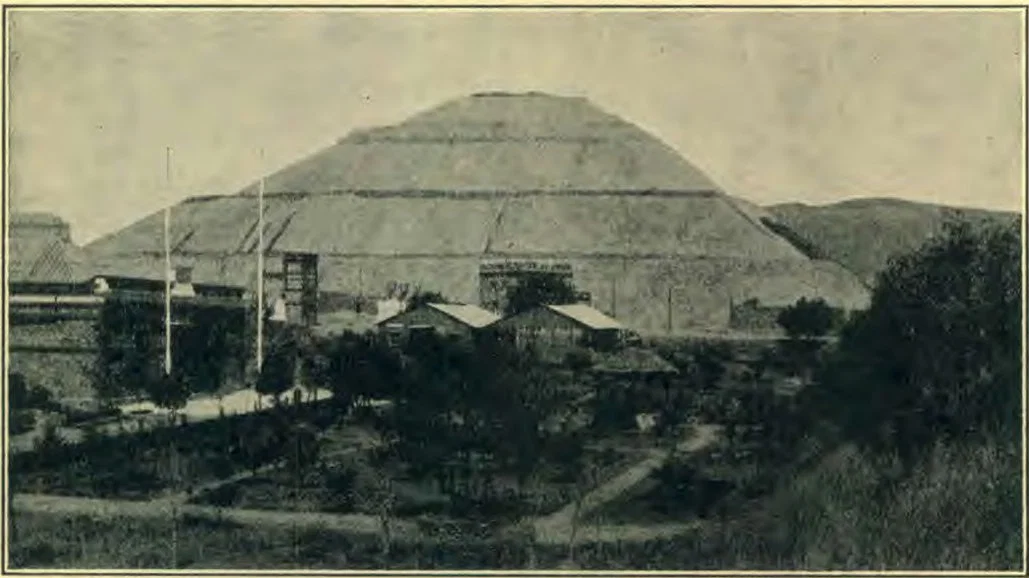
A pyramid built by ancient Mexicans, on which to offer human sacrifices
In one of our churches the brethren formerly had land, but they had lost nearly all of it. After receiving the truth, they began to buy back small portions of their property. The last time I was with them, it was in the time of roasting ears. With what pleasure the brethren invited me to accompany them to their little cornfields. There they roasted some corn, and we had a feast. On the way to their patches of corn, we passed other fields. On asking them, they would tell me the names of the owners, then they said: “A few years ago we would not have passed by others’ fields to go to our own, but would have taken corn wherever we could get it.” One can realize from this little incident something of the change that has taken place in them. One old man who had given up his saints, to whom he had been accustomed to pray, or rather repeat certain formal words without any particular meaning, said he did not know how to pray at all any more. He was shown the Lord’s Prayer, and as he had a Bible, he soon found many prayers in the Psalms, some of which he could5make his own, and he could pray as well as anybody.
There certainly is a great joy in seeing the transformation wrought by the preaching of the message. The greater part of our brethren can read and write, although the per cent of the illiterate is about eighty. It is very evident that the Church of Rome has not tried to educate the people very much when such conditions prevail in this twentieth century. For over five years the country has been in revolution, and for more than two years it has not been possible to travel to any great extent, so we have not been able to visit our brethren. By letter, we learn that nearly all of them are faithful, and that in almost every place others are awaiting baptism. I have the names of about sixty that have asked for baptism, and there are more who with proper instruction will soon be ready to unite with us. None of them have been forced into the army.
A few families, because of politics, have been led astray, and one worker, a young Spaniard, who was laboring on the isthmus, left us last year for the Millennial Dawn delusion. This leaves us without a laborer among our Zapotecan Indians. There seems to be an excellent opening among this people who number more than five hundred thousand in all. This part of the country has been in comparative peace all through these troubled years, and even this year our canvassers have done well in that part of the field, one man selling nearly a thousand Mexican dollars’ worth of literature in the month of January. We are looking for a consecrated young man who understands Spanish to take up the work in that part of the vineyard. From Mexico City, where we united with the Red Cross in helping the poor, comes the report that many homes are now open to our Bible worker. We have but one in all that great city of a half-million inhabitants. She has many more openings than she can possibly fill. From Guadalajara, also, comes the word that a number there are anxious to study the Word of God. If once the country could have peace, there would be a wonderful opportunity in nearly every part. We should be prepared to enter with greater force and do the work rapidly when peace comes.
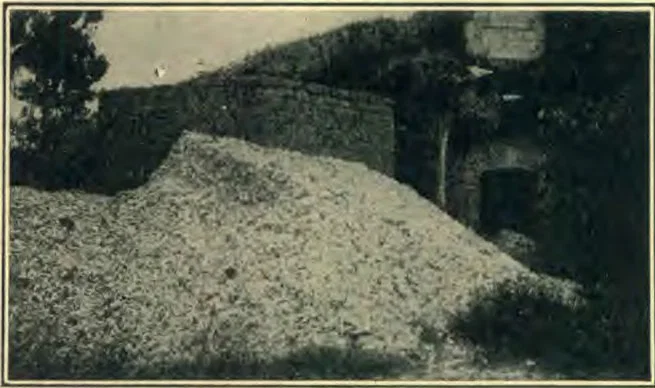
A human bone-yard, Mexico
The few workers that we have are still at their posts, and the Lord is blessing their work. Our literature has been disseminated in many parts, and has been our principal evangelical agent. But when we think of fifteen millions of poor people, more than seventy-five per cent of whom can neither read nor write, and all that they have known of the gospel is what they have learned through the Catholic Church, which in Mexico appears to be one great fraud without much piety, we realize that a great work must be done, and we plead earnestly for laborers. We know that the gospel is the power of God unto salvation to them that believe. We have seen some of its proofs in poor benighted Mexico, and we firmly believe that from this dark land, so long held under the double curse of ignorance and superstition, a goodly number of faithful ones will yet come to sit down with us at the supper of the great King in the everlasting kingdom of our God.
Zapotecan Indian girl of Mexico
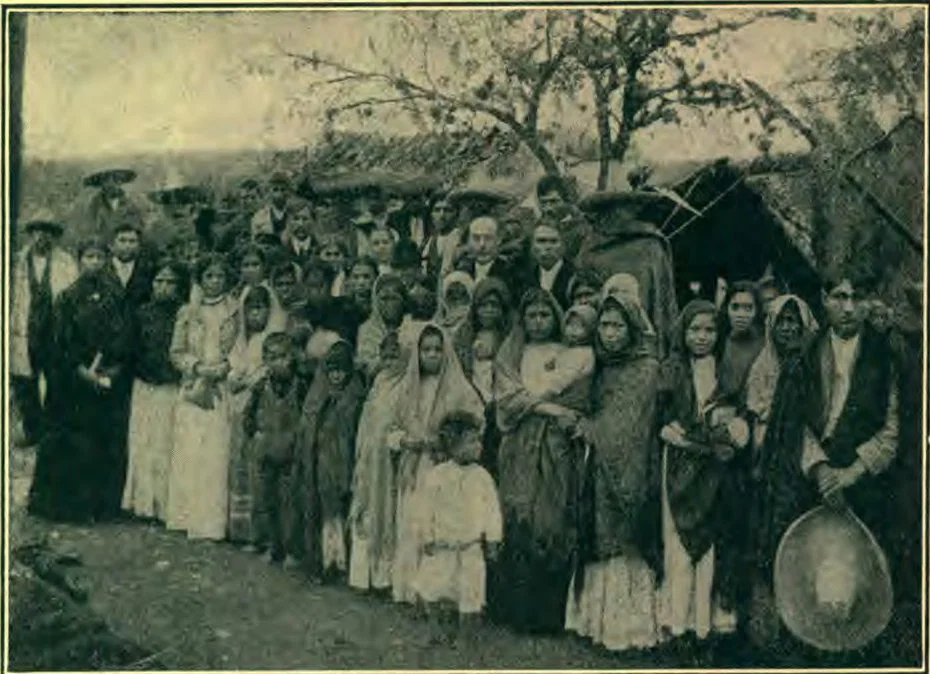
Mexican workers and Sabbath keepers
New Every Morning
By Ernest Lloyd
INSTEAD of looking at the duties and burdens of the new year until we are weary with a sense of responsibility, suppose we regard each day as an opportunity fresh from the hand of God. In his interesting6and practical way, Dr. H. W. Pope tells us the outlook will be something like this:—
“Three hundred and sixty-five days in which to walk with Jesus. You remember the walk of the disciples to Emmaus. How their hearts burned within them as He talked with them by the way and opened to them the Scriptures! Three hundred and sixty-five similar walks for us, in a companionship just as close and intimate as we choose to make it.
“Three hundred and sixty-five days of intercession for others. How much a single prayer has often accomplished! Think of three hundred and sixty-five days of such opportunity, before an open mercy-seat, with the undivided attention of God and with the Holy Spirit to help frame your pleas and suggest what you forget. When you mingle with the children, pray that God will keep them pure. If a tramp calls at your door, remember him and his class. Who needs your prayers more? When traveling, ask God to bless the trainmen and the passengers. Some are in trouble, others in temptation, all in need of the grace of God. Pray for our schools and colleges. Pray for those who are making their wills, that they may remember their Elder Brother. What a variety of needs are suggested by each day’s contact with the world! Remember that intercession is the mightiest weapon in the Christian’s armory.
“Three hundred and sixty-five combinations of Providence in our behalf, for ‘all things work together for good to them that love God.’ Consider what a single combination has often wrought,—a word, a tract, a little loan or gift of money. How a sickness or bereavement has broadened our spiritual vision! How disappointment has revealed our self-sufficiency and brought us in penitence to our knees! How a letter or a chance acquaintance has stirred our hearts and given life a new meaning! Three hundred and sixty-five just such combinations, and each the best God can devise for that day.
“Three hundred and sixty-five days for the Spirit to reveal to us the blessed will of God. A single glimpse of it has often fired our souls with a holy purpose, but think of three hundred and sixty-five days in which the Spirit will pour the truth into us just as fast as we are able to receive it. Last year it was true of us as of the disciples, ‘I have yet many things to say unto you, but ye cannot bear them now.’ This year, if we desire it, we may reasonably expect that he will unfold to us more of the deep things of God.
“Three hundred and sixty-five days to witness for Christ in our appointed place, to stand at the post of duty, though it bring no praise or honor save the approval of him who knoweth his own, and who hath said, ‘Be thou faithful unto death, and I will give thee a crown of life.’ Regarded in this way, how attractive the new year seems! We are eager to enter it and to share in its joys and triumphs.”
At the bloody battle of Marengo the French line fell back in complete rout, and the officers rushed to their commander, crying, “The battle is lost!” “Yes,” exclaimed the general, “one battle is lost, but there is time to win another!” Inspired by his faith and courage, the officers hurried back, turned the head of the retreating column, and when in a few hours the last gun was fired, the French camped on the field of battle. Marengo had been won. So if we are thinking of battles lost during the past year, in school or business, or, worse still, in character,—lost temper, lost patience, lost spirituality or prayerfulness,—let us remember that there is yet time to “win another battle.” Raise the standard once more, take fresh courage, put on the whole armor, and God will surely give the victory. Somewhere I have read that “God’s plans for us each day are greater than our ambitions for ourselves.” So let us trust him. Let us be sure that we let him have his way in us if we desire him to grant us to realize our highest aspirations. “So teach us to number our days, that we may apply our hearts unto wisdom.”
ERNEST LLOYD.
The Terrible Results of Association with the Ungodly
By Arthur L. Manous
THE Bible is that book above all others which will thoroughly furnish “the man of God” “unto all good works.” 2 Tim. 3:16, 17.
In the thirty-fourth chapter of Genesis we have recorded by inspiration the terrible results that came from the association of Dinah with unbelievers. She “went out to see the daughters of the land.” That seems a very simple and harmless thing to do, but it brought the most terrible results that one could possibly imagine.
Referring to this very experience one writer truly says:—
“The tarry of Jacob and his sons at Shechem ended in violence and bloodshed. The one daughter of the household had been brought to shame and sorrow, two brothers were involved in the guilt of murder, a whole city had been given to ruin and slaughter, in retaliation for the lawless deed of one rash youth. The beginning that led to results so terrible was the act of Jacob’s daughter, who ‘went out to see the daughters of the land,’ thus venturing into association with the ungodly. He who seeks pleasure among those that fear not God, is placing himself on Satan’s ground, and inviting his temptations.”—“Patriarchs and Prophets,” p. 204.
The words to which the reader’s attention is especially invited are italicized. And the reader is also requested to reread and study carefully the lesson brought out on this point in the book just quoted, chapter nineteen. ARTHUR L. MANOUS.
Lying Low Before Life's Great Crises
“At Waterloo, the English troops, obeying orders, fell on their faces for a time, and let the hot fire of the French artillery pass over them; then they sprang to their feet, and rushed to the thickest of the fight and beat back their foes. The Lord wants his people flat on their faces before they attempt to meet the great crises of life.”
The Marble Cutter and the Preacher
“A MARBLE cutter, with chisel and hammer, was changing a stone into a statue. A preacher looking on said, ‘I wish I could deal such clanging blows on stony hearts.’ The workman made answer, ‘Maybe you could, if you worked like me, upon your knees.’”
Gordon's Parting Message on the Power of Prayer
“WHEN the heroic Gordon went to the Sudan, his parting message to me was,—written on a card, and referring to a prayer meeting held at his house,—‘I value more the prayer of that little circle than all the wealth of the Sudan.’”
A Lie Is the Handle That Fits Sin's Tools
“SIN has many tools, but a lie is the handle that fits them all.”
B. F. M. SOURS
By B. F. M. Sours
Resurrection
O BREAK in song, celestial bands,
The "Christ is risen indeed"!
We come, before his feet we bow,
We bring to him our homage now,
From death forever freed.
O break in song, ye riven hearts
Whose pathway has been drear!
He is your Saviour; now redeemed,
The glory, as from heaven streamed,
Is than the sun more clear.
The grave is burst, the fetters broke,
The Christ is risen again:
Lift up your gates, O heaven above,
He rises to the throne of love,
Redeemer now of men.
B. F. M. SOURS
God’s Man
By Zelia Margaret Walters
A YOUTHFUL man of forty came to our town a few years ago to take charge of a manufacturing business. It thrived from the start. He was a very likable man, and soon found many friends in the town. He did not respond to nearly all the social demands made upon him, pleading as his excuse that his shop kept him busy.
But he always had time to answer another kind of demand. Was there a poor widow in a dingy alley, he could always find time to visit her and arrange for her comfort. Did some overactive boy get into trouble, he had time to go to court, and help straighten the matter out, and afterward keep an eye on the boy. He had time for the ambitious youngsters who hoped for an education though there wasn’t much ground for hope, time for the discouraged head of the family, struggling with sickness and unpaid bills. He gave to this sort of work so much more time than his business associates thought that they could spare that people wondered about it.
In a little group that knew him intimately he was asked one time how he managed, and why he chose just this sort of thing for the “recreation” for his hardly gained leisure hours. He told a little story in answer that is worth the attention of every young person choosing his paths in life and eager to make his life worth while:—
“When I was a boy about eighteen, I left home, and went into another city to take up work. I had been brought up by a devout Christian mother, and partly by my own choice and partly to please her I united with a church in the city. The church had established a Sunday school mission in the worst part of the town; and when they asked me to go there and take a class of boys, I consented. My boys were little chaps of about eight. I liked them, and did my best for them. By some small kindnesses and treats that cost little besides effort I soon bound them to me, so that I had great influence over them. What teacher said was law and gospel to them.
“But you know the temptations that come to the boy away from home. I made friends in the office. The boys introduced me to their social sets, and I had many invitations to pleasant affairs. There was nothing wrong about it. I had no gross tastes, and was not in danger of dissipation. The young people I associated with were well-bred and clever. But my social life was beginning to fill up all my spare time.
“I determined at length to give up my class. I had become irregular in church attendance because I was so tired Sunday mornings that it was easy to persuade myself that I needed to sleep Sunday mornings. It was only justice to my business that I should not be overtired on Monday. None of the other fellows gave up their Sunday afternoons to a dozen poor little ragamuffins. Why should I? Probably it did no good, anyway. Their surroundings were against them. I couldn’t hope to make them useful men by an hour’s teaching on Sunday. At length I convinced my lazy soul that it was quite all right to drop that class.
“I went a trifle early to Sunday school the afternoon that I intended to be my last at the work. I had been secretary, too, and I sat down behind a partition that made the office, to get the records in order. Two of my boys came in, and sat down together just outside the partition.
“‘I ain’t coming any more after today,’ said one.
‘He’s going to quit.’
“‘No, he ain’t neither,’ contradicted small Tony, indignantly.
“‘Yes, he is, too. The boss of the Sunday school said so.’
“‘No, he ain’t neither. He dasn’t quit.’
“‘Yes, he dast, too. He’s grown up, and got a job and lots of money. He don’t have to mind nobody.’
“‘Yes, he does, too, have to mind. Don’t matter how big you are, or what kind of a job you’ve got, there’s the boss, and you’ve got to mind. I guess you wasn’t here when he first came, but I was the first boy in his class. And us kids asked him one Sunday what made him come ’stead of going out riding and to picnics and things. And he said God sent him to teach us. And he said God was his boss, and he had to do as he said. And he said God was the boss of all of us; only some folks didn’t get in and work when they ought to, and of course they wouldn’t be on hand when pay day comes round. He’s God’s man, I tell you, and he dasn’t quit.’
“‘Betcher he does,’ said the doubter. ‘God ain’t always paying attention, and lots of folks does what they want to.’
“But still stanch little Tony declared I was God’s man, and couldn’t quit.
“He was right. Sitting there behind the partition, I took a look at my life. I was crowding out the high, eternal things for the glittering things that perish in the using. I was God’s man, but I had been about to shirk my job. No, I dared not do that. I was under orders, and I would stay and do my best.
“There was another thought, too. Those boys were reading God in me. I was God’s man, and they’d judge of my ‘Boss’ by what I did. If I didn’t care much, they would think he was too far away to care about poor little chaps in the alley. I had to show them the God I knew.
“I’ve tried to do that ever since. If ever I got lazy and wanted to shirk, I’ve said to myself, ‘God’s man,’ and then I’ve had to be what that name meant.
“All of the good things of my life, even to my business promotions, have come out of that. The fellow that stays on the job is bound to be there when pay day comes round, and I’ll tell you, God’s pay is big. It’s out of all proportion to the work you’ve done.”—Zelia Margaret Walters, in Christian Endeavor World.