The Youth’s Instructor, Vol. 63, No. 50.

Biblical Word Picture—A Carousel in a Palace
Earlier text: Biblical Word Picture—A Carousel in a Palace

The Story of the Rebellion Against the Government of King Jehovah

The Great War—No. 15

The Story of the Rebellion Against the Government of King Jehovah

God Sends His Son to Win Back the World

CARLYLE B. HAYNES
Satan, though he had gained the world by causing the fall of man, was not left in undisputed possession of it. In the promise given in the garden of Eden, that the seed of the woman should bruise the serpent’s head, there was an assurance that an attempt would be made on the part of God to win this earth back to its allegiance to the Ruler of the universe.
Satan had studied the prophecies of the Bible, and knew that Christ would be born in Bethlehem. When his birth took place, and Satan was sure it was indeed the Son of God who had been born, he immediately attempted to destroy the Christ child by arousing the jealousy of Herod. Herod sent soldiers to Bethlehem, and all the children under two years of age were destroyed, in the hope that the One who was “the king of the Jews” might perish with the rest.
But God protected the helpless child from the wrath of Satan, sending him into Egypt. Later, when Herod was dead, Joseph and Mary returned and took up their residence in Nazareth. Here the Saviour received his early training from his mother. At the age of twelve he was taken by his parents to Jerusalem, where, by seeing the lamb offered in the temple, he caught the deep impression of what his own mission in life was to be.
For eighteen years after this journey to Jerusalem he remained at Nazareth with his parents, quietly doing the work of a carpenter in the humble little village. And then, at the age of thirty, recognizing his call in the preaching of John the Baptist, he started out upon his work of ministry, which was to lead him to the cross.

Jesus Tempted

Immediately upon the beginning of his ministry, as soon as he was anointed at his baptism, the devil met and opposed him. Having fasted forty days, and being hungry, he was visited by a being in the form of an angel. This being talked with him, and said that if he were indeed the Son of God, as he had just been told at his baptism, it would be an easy matter to demonstrate that fact by turning stones into bread, and thus satisfying his hunger. But Christ was not to use his divine power to help himself, and he refused this temptation.

The World Offered to Christ

After also failing in tempting Christ to cast himself down from a pinnacle of the temple and thus presume upon the protecting care of God, Satan revealed himself to Christ in his true character. He openly avowed himself to be Lucifer, who had sinned in heaven. And, he declared, he knew full well why Christ had come into the world. He knew that he had come to regain the world. He pointed out that to do this Christ would be compelled to die a most ignominious death and to undergo almost unbearable suffering. And he declared that such a course was entirely unnecessary. If Christ had come to get the world, he need not travel such a blood-stained path and die such a terrible death. The world was in Satan’s power, and he could give it to whomsoever he would.
Taking Christ to a high mountain, he caused all the kingdoms of the world to pass before him in a moment of time, and showed him all the glory of them, and said, If this is what you have come for, if this is what you want, you can have it all. “All these things will I give thee, if thou wilt fall down and worship me.” Matt. 4:9.

The Tempter Defeated

It was a temptation indeed. The world was the very thing Christ had come to gain. He was told that he could have it all, that he need not endure the shame and ignominy of the cross to secure it. But he saw at once that to take it on such terms as were offered by Satan would be to acknowledge all that Satan had contended for in heaven,—that he was superior to Christ,—and that he must then hold the dominion of the earth subject to Satan. Seeing that if he accepted this proposition the great conflict of the ages would be decided in favor of Satan, he turned to the tempter with the words, “Get thee hence, Satan.” Matt. 4:10. He determined to go on with the work of redemption, in harmony with the purpose of God, though the decision meant that he must go down into the valley of the shadow of death.
Defeated in his purpose, Satan nevertheless was determined that even yet he would prevent Christ from winning the victory. He buffeted him at every step, harassed him wherever he went. He caused the Jewish leaders to reject him. He did all he could to oppose and destroy his work, and finally moved Judas to betray him into the hands of his enemies.

The Destiny of the World in the Balance

The strongest temptation with which Satan wrung the heart of Jesus was in the garden of Gethsemane. Here the weight of the sins of the world with all its awful force was felt by the Saviour. He saw that he must die with these sins upon him, bearing also the frown of God because of sin. Tempted that this might mean that he was never to have a resurrection, but must bear the frown of God forever, and thus be forever separated from his Father by death, Christ cried out, “O my Father, if it be possible, let this cup pass from me.” He was unable to see that he could ever be brought from the tomb if he died with the sins of the world upon him. His own future was dark.
It was here that the fiercest temptations of the devil wrung the agonized heart of Christ. Almost he was tempted to let man bear the consequences of his own guilt and die for his own sins, while he himself returned to that place which he occupied with the Father before the world was created. The sacrifice to be made for sin seemed too great if it meant that he must be blotted out of the universe. The wages of sin is death, eternal death. The sins of the world were upon him, and for the first time he was realizing all their terrible guilt. He was experiencing what the sinner will feel when he suffers the consequences of transgression.
It is taught by many that the punishment of the wicked will be eternal torment. But this cannot be true, for if it were, then Christ, in taking our punishment upon himself, would have been consigned to eternal torment. Eternal torment is not the wages of sin, but eternal death and separation from God. And it is evident that Christ could not take our place as our sin bearer without experiencing the awful fear and dread of eternal separation from God. It was this thought that forced from his pores in the garden the sweat which “was as it were great drops of blood falling down to the ground.” Luke 22:44. His Father’s face was hidden from him; he was conscious of his Father’s frown; he felt that the burden of the world’s sin which he bore was separating him from God, and that if he should die with it upon him he could not hope for a resurrection; he was unable to see beyond the grave, his hope in the future was dimmed, and the agony seemed more than he could bear.
Will he make the great sacrifice? Will the Son of God take the place of the human race and die? The fate of the world hung upon the answer.

The Great Decision Is Made

When the struggle seemed about to become too great for his strength, he was given a view of the human race which he came to save. He saw that unless he took its sin upon himself, it must perish. It was his life or the existence of the race. It was separation from God for himself or for humanity. Some one must die for the broken law, and it was either the race as a whole or the sacrifice which God had freely offered and which Christ had volunteered to be.
With this vision of the lost race before him unless he makes the sacrifice, and facing the darkness shrouding his own future, Christ makes his decision: he will go forward upon his great mission at any cost to himself. “Having loved his own which were in the world, he loved them unto the end.” John 13:1. He faced again the great purpose for which he came into the world, and he decided in favor of the race which he loved. He set his face steadfastly toward the cross; and as he rose from the ground in submission, he cried, “O my Father, if this cup may not pass away from me, except I drink it, thy will be done.” Matt. 26:42.
And so while his disciples slept, the great decision was made. Alone, with none to help or comfort, he drained the last drop of the bitter cup, the cup that none else could drain. If men were to be saved, there was no other way for him but this. And having made the decision, his temptation was over—the temptation to escape by his own divine power the fate in store for the human race. From this time on the flesh was conquered. He had determined to meet the full penalty of sin, and no lesser pain could now make him afraid. The priests and rulers might insult and jeer him, the whole nation might taunt and gibe, but not one cry would be forced from those lips by pain, or thirst, or glaring noonday sun, or thorns, or nails, or prison chains, or smitings of sin-stained hands. As a sheep before its shearers, so would he be dumb.

Taunts With Jeers and Mocking Words

And so they hurried him before Annas, before Caiaphas, and then before Pilate, and on to Herod, and back again to Pilate, always in the midst of the taunting crowd, who buffeted him, and smote him with the palms of their hands, and spit in his face, and demanded that he perform for them a miracle. Taking him the last time from Pilate’s judgment hall, after the sentence of crucifixion had been pronounced, they crushed down upon the weary head the cruel crown of thorns, and bowed in mockery, crying, “Hail, King of the Jews.” With no rest through the long night, hurried from one proud ruler to another, travel-stained, weary, footsore, and bruised and lacerated with the cruel scourgings he had received, now, in addition to it all, he is laden with the weight of the heavy cross, and, with no covering for his head from the broiling midday sun but the crown of thorns which had torn his brow in heavy gashes, he staggers on, the world’s Redeemer, through taunts and jeers and mocking words.
Reaching Calvary, they stretched his weary frame upon the cross and drove the nails through the quivering flesh. Then raising the cross with the Saviour upon it, they let it drop with a dull thud into the hole they had prepared for it, tearing wider the wounds of the hands and the feet where the nails had pierced. With jeers and mockery they watched his dying agonies. And thus the Son of God gave up his life for you, and in giving it up brought this old world back into the fold of God.
If Jesus had committed one sin, he never would have been brought from the tomb, and the human race would also have been hopelessly lost. But because his own life was spotless, and there was not the stain of one sin upon his own character, he was brought up again from death.

The Lost Dominion Regained

Thus Jesus regained the world which had been lost by sin. He became the second Adam, and won the victory over sin which the first Adam failed to win. He met the devil on his own ground, in his own dominion, and wrested the control of the world away from him. He regained the lost dominion, and made a way of escape for all who had fallen under subjection to Satan.
And in consequence of his victory he drove Satan out of the courts of heaven for the last time. And now “we have an advocate with the Father, Jesus Christ the righteous.” 1 John 2:1. Our representative in the councils of heaven is now the Lord Jesus. We have a friend at court. It is this time of which John speaks: “And I heard a loud voice saying in heaven, Now is come salvation, and strength, and the kingdom of our God, and the power of his Christ: for the accuser of our brethren is cast down, which accused them before our God day and night. . . . Therefore rejoice, ye heavens, and ye that dwell in them. Woe to the inhabitants of the earth and of the sea! for the devil is come down unto you, having great wrath, because he knoweth that he hath but a short time.” Rev. 12:10-12.

Taking Your Measure

PEOPLE do not wait for a great occasion to take your measure. Your employer sizes you up on the average, uninspiring day when you feel a little lazy and a little dreamy. Your careless, impatient speech may settle in the mind of some acquaintance that you do not deserve the name of gentleman. If we could know beforehand when our measure was to be taken, we could prepare for it, as we prepare for having a picture taken; but unluckily the operation may take place when we are most off our guard. Only as we do our best continually are we sure that the estimate our friends and acquaintances form of us will do us justice.— Young People's Weekly.

Recitations and Song for the Thirteenth Sabbath, December 25

A Chinese Maiden’s Prayer

Ten years, ten long and weary years, Have passed since last I gazed upon this scene; Ten years spent far away from home, With stormy winds and rolling seas between; Ten years spent in a foreign land, The land they call the Home of Liberty; Ten years spent where I learned of God, And of the Son he gave to die for me.
'Twas just today I reached my home; My mother, glad to see her child once more, Directly led me to her gods,— The old ancestral gods above the door. Of course, I could not worship them, For I had learned to pray to God above; And mother, in a fit of rage And horror, drove me from the home I love.
And so I came away up here, Where I can be alone to think and pray, For now I feel that I have need Of strength divine to meet each coming day. There is no place where I can go, No place on earth that I can call my home; But I’m so glad of this one thing— My God is with me everywhere I roam.
Here, from this lofty mountain top, I look upon a varied scene below,— The little towns and villages, With winding roads between; the great Hoangho That flows down to the Yellow Sea, Along whose banks live thousands of my race, Degraded, sinful hordes of men Who know not God nor of his saving grace.
Just down the trail a little way There stands a large and fine old locust tree. This tree is covered with small boards And bannerets, for it is thought to be The home of some great spirit who Can heal disease; and when some one is ill, This oracle is visited, And off’rings made to merit his good will.
Just over there, upon that hill, There is a group of rare and noble trees; The bamboo, with its feathery boughs, Lifts high its head, to catch the straying breeze. Can sin be there?—Ah, yes; beyond I see the temple of some hideous god, Not worshiped from a sense of love, But from a fear of his avenging rod.
And at the foot of that same hill I see a field of poppies, pink and white, So beautiful, yet they are used To plunge men’s souls into eternal night. Look! slowly coming up the path I see a group of pilgrims. Watch them bow Their heads and kneel each step or two, As on they journey to fulfill some vow.
'Tis just the same through all this land, The people serve the same old gods today They served twelve hundred years ago, And do the same things in the same old way. They have their temples and their tombs, With hundreds of their gods each one is filled; They serve the sun, they worship men Whose hearts and voices long ago were stilled.
Yet, they’re my people, snared by sin And superstition. Oh, what would I give If I could tell them all of God, And of his Son who died that they might live! I’ll give myself—but what am I? I’m only one, and there are millions, yes, Four hundred million souls in all, Whose lives are filled with sorrow and distress.
Four hundred million! can it be That these must all go down into their graves And never hear of Jesus Christ, Who loves, who rescues, who redeems and saves? O God! if thou dost love us so, Do help us some way, as thou seest best, And all the glory will be thine Forever, Lord; so hear this, my request.
FLORENCE WHITNEY

Anhwei

If I told you of a neighbor living just across the street, Needing doctor’s care or nursing, needing clothes, or food to eat, “Why, I’ll come at once and help them!” I can almost hear you say; Would you come if I should tell you of the needs of “dark Anhwei”?
Not your neighbor? You’re mistaken, for it is your neighbor, too, Just across the world you live in—yards adjoining straight down through! And suppose that you’d been born there, and the other folks lived here, And your life the life in bondage to an awful, slavish fear,—
Fear of spirits of ancestors, fear of evil spirits more, Fear to dig lest you disturb them, fear lest they should find your door,— Just suppose, dear friends, that those folks there were you instead of they: Don’t you think that you’d be thankful for some light in “dark Anhwei”?
True, good work is going forward from our quarters at Nanking, And two churches now established, where our gospel songs they sing; Two! That’s good, of course, and yet, I’d like to ask you, what are they ’Mid the three and twenty millions of the province of Anhwei?
Ignorant and superstitious, of all foreigners afraid, It was through our papers chiefly that this opening was made. And if some one now could go there, a dispensary to start, I am sure ’twould win their confidence and help to reach their heart.
It is needed, oh, so badly! They are precious in God’s sight; And not simply to enjoy, ourselves, he’s given us such light. If you think he’s coming soon, then there’s not time for much delay, If some jewels for his kingdom shall be gathered from Anhwei.
PEARL WAGGONER

Shantung

SHANTUNG, the northern province Of all those in the East; The last one to be entered, Although in need not least, Where none but native workers Have heretofore been sent,— ’Tis this, the needy province, I wish to represent.
’Tis true we have one worker— This summer just gone by— Who went up there for health’s sake For fear he else might die, And, while his health regaining, Is doing what he can To tell about the Saviour Who gave his life for man.
Yet, nestling in the valleys, Or studding thick the plains. Are villages, all swarming (In markets and in lanes) With denser population Than any other part; Think! thirty-eight full millions— All hungering in heart!
And hungry, too, in body, Since poor the crops and soil, With drought and floods acquainted, Yet men of patient toil, From whom arose Confucius And others strong of mind; Ah, what will be the harvest When once the truth they find!
If “in this generation” These millions you would reach, Some one must go (and quickly!) God’s blessed Word to preach. No folk more honest-hearted, More sturdy are, than these; I plead for help, for workers Among the Shantungese!
PEARL WAGGONER

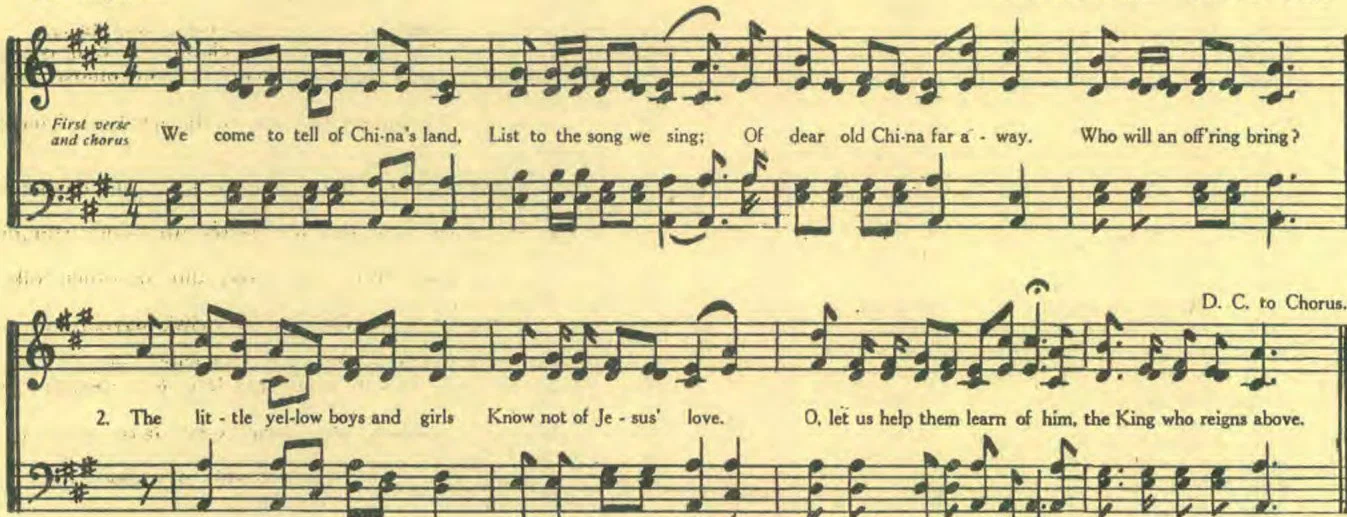
A SONG FOR CHINA

W. C. John. Barbara Knox Albertsworth
Copyright 1915
3. The mothers bind the girl babes' feet, Which then can scarcely grow: Let's give, to teach them better ways; Let's give, our love to show.
4. We'll go and teach them how to pray To Christ, our Saviour dear; We'll drive the idols from their homes, Teach them our God to fear.

PEARL WAGGONER

Kiang-Su

PEARL WAGGONER

From the best-known Eastern province, From Kiang-su, the most progressive, From its foremost seat of culture, From its seat of wealth, come I: Where our work was first to enter, Where we have our East headquarters, Training school, and printing center, In the city of Shanghai.
Where the mighty Yangtse floweth, Flows from west through south of province, Where unnumbered lakes and rivers And canals abound, I dwell. But though waterway extensive, Yet the land still needeth water,— Needs the gospel’s living water, Which to you is known so well.
From the capital of Nanking On the west, to e’en the coast land, Spread its fertile rice and wheat fields,— Flat in tract, but rich in yield.
But another harvest waiteth, Calling loudly for more reapers, Waiting for some hand to gather For the Master of the field.
Rich in silks and flowered satin (Exports from the city Su-chau), Are the people of this province; But in some things, oh, how poor! Will not you, who know the gospel, Help to send them further teachers, That they, too, may have a portion In the riches that endure?
And whatever here occurreth Straightway spreads to every province,— Sets the fashion for all China; Hence would I appeal to you For this great, important center, For this mighty, leading province, For this needy Eastern province,— For the province of Kiang-su!

Is It Worth While to Report?

SOMETIMES this question is asked. And one would almost think that it had been answered in the negative by many, judging from the difficulties our Missionary Volunteer secretaries have in getting reports.
Why should we report missionary work done?
We are engaged in a great work,—a work which requires faith, devotion, perseverance, and self-sacrifice. There are discouragements in Christian work. Often our efforts are not appreciated, and many times it seems that what we do brings very meager results. We need always to remember that the Lord is our leader, and that our cause cannot fail.
Nothing is more heartening to the one who toils for the Master than to hear of others’ success in the work. It gives new courage to us in our little corner of the vineyard to know that many others are at work, and that the combined efforts of all are bringing large results.
When Nehemiah told his fellow workers how wonderfully God had led him, “they strengthened their hands” for the work, and rose up to build. When Paul and Barnabas returned from their first missionary tour, they gathered the church, and “rehearsed all that God had done with them.”
So when we come together in our Missionary Volunteer meetings, let us not hesitate to tell in a modest way what we have endeavored to do for our Master. When all these reports are gathered, it is a great encouragement to the whole church to see the evidences of increased activity on the part of our youth the world over. Many young people in all parts of the world are watching these reports. From Porto Rico comes this word: “We were much interested in the report of the Missionary Volunteer Societies in Germany and the East Indies, and it has spurred us on to do more.”
Of course, the work is more important than the reports, but the report is very important to ourselves and others. Let us make daily use of the reporting pages in our Morning Watch Calendar. As we seek fresh supplies of grace from our Heavenly Father each morning, let us also put down what, by his grace, we have been able to do for him. Is it not true that the reporting page shows to quite a large degree the results of our vital connection with God? For is it not just as natural for a Christian to work as it is for a light to shine?
Will you not resolve now to be more faithful in reporting,—to form the habit of recording and reporting your missionary efforts?
M. E. KERN.

CORA FERRIS

Playtime

CORA FERRIS

Down beside the winding river, Little footsteps love to steal, Where, among the mournful willows, Merry sunbeams dance and wheel.
Calm the water lies, and silent, Shadows in its depths of gray, Here and there a ripple breaking, As a curlew flies away.
Underneath a shady gum tree Stands a playhouse all complete,— Table, chairs, and many “dishes,”— Everything kept clean and neat.
“Here’s the parlor, there’s the bedroom; This is where we bake our bread; We black our stove up every morning,” Earnestly small Thelma said.
“Sometimes Rover comes to see us, Then we shake his paw, or bow; And we put him in the armchair— He can sit up nicely now!”
Down beside the winding river, Playing, playing all the day,— Playing “mother,” playing “teacher,”— So the glad hours speed away.

Thanksgiving Ann

In the kitchen doorway, underneath its arch of swaying vines and purple clusters, an old woman sat, tired and warm, vigorously fanning her face with her apron. It was a dark face, surmounted by a turban, and wearing just now a look of troubled thoughtfulness not quite in accordance with her name,—a name oddly acquired from an old church anthem that she used to sing somewhat on this wise:—
“Thanksgivin’ an’—
“Johnny, don’t play in de water, chile!
“Thanksgivin’ an’—
“Run away now, Susie, dearie!
“Thanksgivin’ an’—
“Take care o’ dat bressed baby! Here’s some ginger bread for him.
“Thanksgivin’ an’ de voice of melody.”
You smile! But looking after all these little things was her work, her duty; and she spent the intervals in singing praise. Do many of us make better use of our spare moments?
So the children called her Thanksgiving Ann, and that she would be now to the end of her days. She had lived with Mr. and Mrs. Allyn for years, had a grandmotherly guardianship of all the children, and a voice in most matters that concerned the father and the mother, while in the culinary department she reigned supreme.
The early breakfast was over. She had bestowed unusual care upon it, because an agent of the Bible society, visiting some of the country places for contributions, was present. But while she was busy in the kitchen, the gentleman had departed unobserved, and Thanksgiving Ann’s “Bible money” was still in her pocket. “Didn’t ask me, nor give me no chance. Just as if ’cause a pusson’s old an’ colored, dey didn’t owe de Lord nuffin’,” she murmured.
However, Silas, the long-limbed and shrewd, who regarded the old woman with a curious mixture of respect and veneration, had volunteered to run after the vanished guest. And even while Thanksgiving sat in the doorway, he returned.
“Well, I came up with him, and gave him the three dollars. He seemed kind o’ flustered to have missed it—said it was a ‘generous donation’—equal to your master’s. And that proves,” said Silas, meditatively, “that some folks can do as much good just offhand as some other folks can do with no end of pinchin’ and savin’ beforehand.”
“Think it proves dat folks dat don’t have no great amount can do as much in a good cause by thinkin’ ’bout it beforehand as other folks will dat has more, and puts der hands in der pockets when de time comes. I believes in systematics ’bout such things,” and with an energetic nod Thanksgiving walked into the house.
“Thanksgivin’ an’ de voice of melody,” she began, in her high, weird voice; but the words died on her lips; her heart was too burdened to sing.
“Only three dollars out’n all der ’bundance,” she murmured. “Folks, an’ hosses, an’ tables all provided for—an’ de Lord of glory lef’ to take what happen when de time comes! Well, der’re missin’ a great blessin’.”
These friends, so beloved, paid little attention to the old servant’s opinion upon what she called “systematics in givin’.”
“The idea of counting up one’s income, and setting aside a fixed portion of it for the Lord, makes our religion seem arbitrary and exacting; it is like a tax,” said Mrs. Allyn one day. “I like to give freely and gladly of what I have when the time comes.”
“If ye ain’t give so freely and gladly for Miss Susie’s new necklace an’ yer own new dresses dat ye don’t have much when de time comes,” interposed Thanksgiving Ann.
“I think one gives with a more free and generous feeling in that way,” said Mrs. Allyn, not seeming to heed the interruption. “All these things are mere matters of opinion. One person likes one way best, and another person another.”
“’Pears to me it’s a matter of which way de Massa likes best,” observed the old woman, settling her turban. But there was no reply to her comment, and affairs followed their accustomed routine. Meanwhile, out of her little store, she carefully laid aside one eighth. “I’d like to frow in a little more, for good measure,” she said.
And now another call had come.
“Came, unfortunately, at a time when we were rather short,” Mrs. Allyn said, regretfully. “However, we gave all we could. I hope it will do good, and I wish it were five times as much.”
Old Thanksgiving shook her head over that cheerful dismissal of the subject. She shook it many times that morning as she moved about her work.
In the course of the forenoon Mr. Allyn brought in a basket of peaches, the first of the season. “Aren’t those fine, Thanksgiving? Let the children have a few, and give us some for dinner.”
“Sartain, I’ll give you all dar is,” she replied.
Presently came the pattering of small feet, bright eyes spied the basket, and immediately arose the cry: “Oh, how nice! May I have some?”
“Help yourselves, dearies,” answered the old woman composedly. She was sitting in the doorway, busily sewing on a calico apron. She still sat there, when, near the dinner hour, Mrs. Allyn passed through the kitchen, and, a little surprised at its quietness, asked, wonderingly:—
“What has happened, Thanksgiving? Haven’t decided upon a fast, have you?”
“No, honey; thought I’d give you what I happened to have when de time come,” said Thanksgiving, holding up her apron to measure its length.
It seemed a little odd, Mrs. Allyn thought. But then old Thanksgiving needed no oversight; she liked her little surprises now and then, too; and doubtless she had something all planned and in course of preparation. But when the dinner hour arrived, both master and mistress looked at the table in astonishment, so plain and meager were its contents, so unlike any dinner that had ever been served in that house.
“What has happened?” asked Mr. Allyn.
“Dat’s all de col’ meat dar was—sorry I didn’t have no more,” said Thanksgiving, half apologetically.
“But I sent home a fine roast this morning,” began Mr. Allyn, “and you have no potatoes, nor vegetables of any kind.”
“Laws, yes! But den a body has to think ’bout it a good while beforehand to get a good dinner cooked; an’ I thought I’d give ye what I happened to have when de time come, and I didn’t happen to have much of nuffin’. ’Clare, I forgot de bread!” and trotting away, she returned with a plate of cold corn cake.
“No bread!” murmured Mrs. Allyn.
“No, honey; used it all up for toast dis mornin’. Might of made biscuits or muffins if I had planned for ’em long enough, but dat kind o’ makes a body feel as if dey had to do it, an’ I wanted to get dinner for yer all o’ my warm feelin’s, when de time come.”
“When a man has provided bountifully for his household, it seems as if he might expect to have a small share of it himself,” remarked Mr. Allyn impatiently.
“Cur’us how things make a body think o’ Bible verses,” said Thanksgiving musingly. “Dar’s dat one ’bout ‘who giveth us richly all things to enjoy,’ an’, ‘What shall I render unto the Lord for all his benefits to’ard me?’ Dar! I didn’t put on dem peaches!”
“Has Thanksgiving lost her senses?” asked Mr. Allyn, as the door closed after her.
“I suspect there is a ‘method in her madness,’” said his wife, a faint smile on her lips.
The old woman returned with the basket, sadly despoiled of its morning contents; and composedly bestowed the remainder in a fruit dish.
“Dat’s all! De chilern eat a good many, an’ dey was used up one way an’ ’nother. I’s sorry dar ain’t no more, but I hope y’ll ’joy what dar is, and I wishes it was five times as much.”
A look of intelligence flashed into Mr. Allyn’s eyes, as he asked, “Couldn’t you have laid aside some for us, Thanksgiving?”
“Wall, dar now! ’spose I could,” said the old servant, relenting at the tone. “B’lieve I will next time. Allers kind o’ thought de folks things belonged to had de best right to ’em; but I heard givin’ whatever happened to be on hand was so much freer an’ lovin’er a way, dat I thought I’d try it. But it does ’pear as if dey fared slim, an’ I s’pecs I’ll go back to de ole plan o’ systematics.”
“Do you see?” asked Mrs. Allyn of her husband, when they were again alone.
“Yes, I see—an object lesson with a vengeance.”
“And if she should be right, and our careless giving seem like this?” said Mrs. Allyn, with a troubled air.
“She is right, Fanny; it doesn’t take much argument to show that. We call Christ our Master, and believe that every blessing we have in this world is his direct gift; yet while we provide lavishly for our own needs, we apportion nothing for the interests of his kingdom or the forwarding of his work. It doesn’t seem like very faithful or loving service.”
There was a long talk over that dinner table; and that afternoon the husband and the wife examined into their expenses and income, and set apart a certain portion as sacred to the Lord, doing it somewhat after Thanksgiving’s plan of “good measure.”
Mrs. Allyn told the old woman of the arrangement, and concluded laughingly, though the tears stood in her eyes,—
“Ann, now I suppose you are satisfied?”
“I’s ’mazin’ glad,” said Thanksgiving; “but satisfied—dat’a a long, deep word; an’ de Bible says it will be when we awake in his likeness.”
“I don’t believe anybody ever loses by what one gives to the Lord,” said Silas; “he’s pretty certain to pay it back, with compound interest; but I don’t suppose you’d call that a right motive, would you?”
“Not de best, Silas, not de best; but it don’t make folks love de Lord any de less ’cause he’s a good paymaster, and keeps his word. People dat starts in givin’ with dat kind o’ motives soon outgrows ’em.” And she went into the house with her old song upon her lips,—
“Thanksgivin’ an’ de voice of melody!”
— Kate W. Hamilton.

Beneficence Is a Duty

BENEFICENCE is a duty. He who frequently practices it, and sees his benevolent intentions realized, at length comes really to love him to whom he has done good.— Kant.

Courage, Self-Control, and Grim Determination

“It takes a little courage, And a little self-control, And some grim determination, If you want to reach the goal.”
Continue reading: On Jest That Wounds Another's Feelings