S. D. A. Publishing Association · Battle Creek, Mich. · Sep 10, 1890
THE SONG OF THE WAYSIDE SPRING.
By Fannie Bolton
A hot and dusty traveler,
Stop! I've a song to sing;
Sit by my mossy stones awhile,
And hear the song of the spring.
Aye, take the cup I offer,
And dip it into my heart;
I never grow less for those I bless,
Since Heaven gives back the part.
It is blessed to give, 'tis the way to live,
And the livelong day I sing;
My waters are cool and beautiful,
Though I'm only a wayside spring.
I cannot sing like the fountain,
But I've some of the fountain's song;
I cannot roll like the river, That floweth the meads along;
I cannot surge like the ocean;
I cannot water the plain;
But, O, I can sing, I'm a wayside spring.
And I get my share of the rain.
It is blessed to share in Heaven's care;
The Father my want supplies,
And he keeps me full of his waters cool
From his fountain in the skies.
I am blessed, dusty traveler,
For being beside the way;
For many sit and listen,
As you do here to-day,—
Men and maidens and children,
Old and weary and sad,
And many pass, after seeing my glass,
With a peaceful look and glad.
And sometimes to poor hearts weeping
I've tried my song to sing,
And I've heard them say, as they went their way,
"God bless the dear little spring."
The stars look down in the evening,
And seem to crowd the space, Looking, looking with tapers tall
To see themselves in my face.
And winds come whispering to me,
And birds nest near my ring,
And flowers peer up, to nod in my cup.
And fragrance floods my spring.
O what is more blest than a heart of rest,
That can sing the song I sing?
What task so dear as to give the clear,
Sweet water out of my spring?
And sometimes, dusty traveler,
I feel the throb of a wave,
Flowing deep down in my bosom
With a joy pure spirits crave,
And I know it comes from the fountain,
From the river, the rill, the sea,
And I know it comes from the Father
In his tender love for me.
And I feel a part of the ocean
Of God's love, that boundless thing,
And I sing of his love that flows from above
To a little wayside spring.
FANNIE BOLTON.
THE CLOSED DOOR.
I REMEMBER it so well; it was one morning many years ago, when I was a very little child. I had been disobedient at breakfast time, and papa had said to me gravely and sadly, “Carrie, you must get off your chair, and go and stand outside the door for five minutes.”
I got down, choked back the sob that rose in my throat, and without venturing to look into papa’s face, I went outside the door, and it was shut against me.
The moments seemed very long and silent. I remember well how my tears dropped down on the mat; I was so grieved and ashamed. The five minutes were not nearly over, but the handle of the door was partly turned, and Johnnie’s curly head peeped out.
Both his arms were around me in a minute, and he said, “Carrie, go in; I’ll be naughty instead of you,” and before I had time to say a word, he had pushed me in and shut the door.
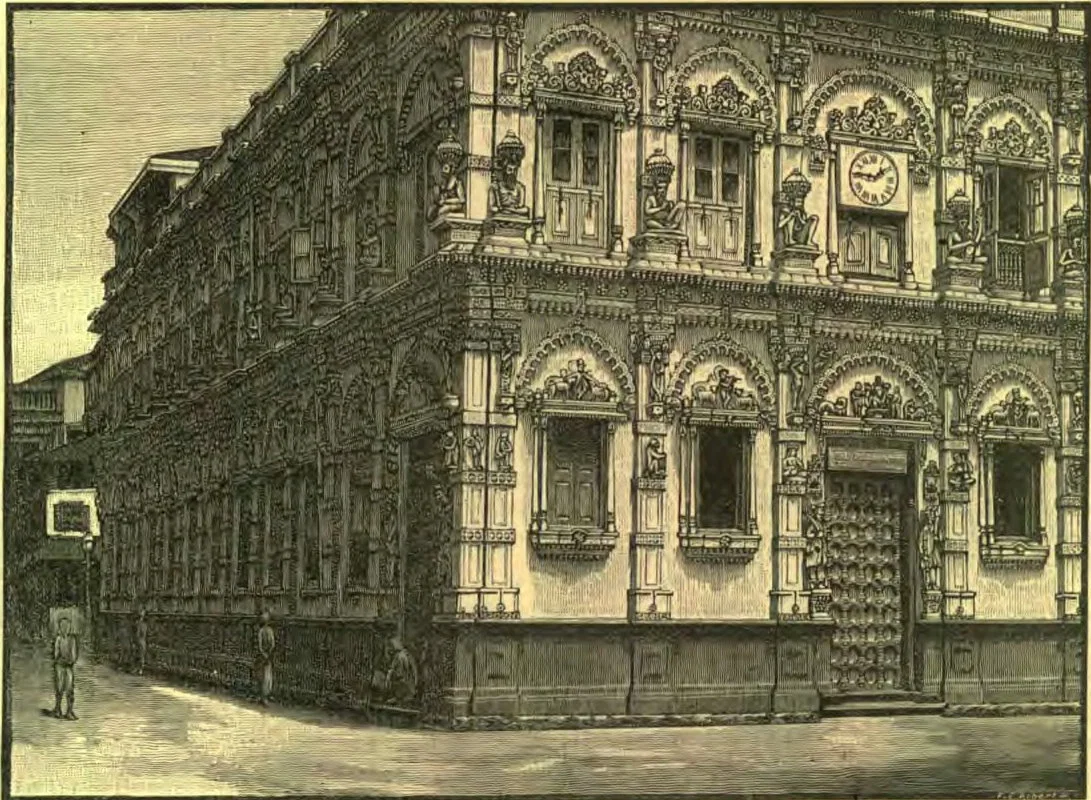
A HINDOO TEMPLE.—SEE “ROUND THE WORLD.”
There I stood with my eyes on the floor, feeling so red and uncomfortable, not knowing whether I might go up to the table; but papa took me by the hand, and led me to the table, and kissed me, and put me on my chair; and I knew I was forgiven just as much as if I had borne all the punishment myself; but oh, how I wished that Johnnie might come in!
When the five minutes were up, he was called in, and then father took us both—me, the poor, little, naughty child, and Johnnie, the loving brother—and folded us both in his arms, and I sobbed it all out—the repentance and love and gratefulness—while we were held close to that loving heart.
And now that I look back to that little scene, it seems to me to be a very typical one. For the years went by, and I found myself outside another door, separated from the Father, sin having come between my soul and God, till I saw one who loved me come and take my place, and I was forgiven for Christ’s sake; and I knew the fullness and freeness of that forgiveness; for my Father drew me close to his divine heart of love, and there with the Lord Jesus, my sin-bearer, I found “joy unspeakable and full of glory.”—Selected.
ROUND THE WORLD.—26.
By P. T. M.
BENARES.
Benares is emphatically the home of Hindooism. The city is “wholly given to idolatry.” Her temples are more than a thousand, exclusive of the numerous small shrines which meet the eye at every turn. The number of idols worshiped in this city is said to be half a million. It is possible to comprehend how men can follow in the footsteps of Satan, rather than those of the Redeemer, when he burnishes sin with a covering of gold, and gives to the most disgusting vices garments of virtue; but what the dark-minded Hindoo can see to worship in images of wood and stone, so hideous that pen cannot portray them, is a problem that will puzzle any one who has ever traveled in the land of the Vedas. Of beauty and symmetry of form these idols have none; they are painted in the most ferociously vulgar colors, and their faces are an abominable combination of man and monkey, with noses like an elephant’s trunk. As for their bodies, they are nondescript, a heterogeneous mass representing everything in nature and out of it, from a jelly-fish to a gorilla.
In the midst of the lowest slums in the city, is the temple of Shiva, known as the Golden Temple. We had to wade through the filth of narrow lanes, which seldom see the sunlight of heaven, to reach this sacred edifice, and would respectfully advise all intending to visit it to come armed with handkerchiefs laden with Eau de Cologne. The holy pile is in the center of an inclosure, and consists of three small rooms, raised on a slight platform, and crowned with three domes. Two of these are said to be overlaid with gold, but it may be brass. In each room there is a “Mahadeo,” a plain, conical stone set on end. The Mahadeo is the deification of “Lingam,” or the creative principle. The worship consists in throwing rice-flowers, etc., on the stone, which is afterward washed off by a stream of the Ganges water.
Close by is the “Well of Knowledge,” a putrid sink, but nevertheless crowded with worshipers. It is surrounded by a handsome colonnade of forty pillars. Immediately to the east of the colonnade is a large stone figure of the sacred bull.
Next comes the “Well of Fate.” Over the trellis work of its outer wall is a square hole, so situated as to allow the sun’s rays at noon to strike the water below. At this hour the place is visited by those wishing to search into the secrets of the future.
Another place of note is the “Monkey Temple.” Here are thousands of our Darwinian ancestors, and we congratulated ourselves that the fates had decreed we should be born in a later generation. Each one is a living deity. They seemed to enjoy luxurious living, for they were fine and fat. Nevertheless, although reverenced as gods, they are evidently victims to the ills to which the flesh is heir; for one was laid up with a sore toe, and another with rheumatism in146his leg. They are of every size, from the venerable patriarch to the babe ape in its mother’s arms. Dangerous neighbors they must be in this crowded district, ignorant as they are of the laws of meum and tuum; but the Hindoo venerates them, and their sacred character protects them from all molestation. They are walking idols, absolutely inviolable. Any one offering them insult would be liable to suffer instant death. They are reverenced as the representatives of Hanuman, the monkey-god associated with Rama. The legend is that Rama, the great god of the Hindoos, fell in love with Sita, daughter of a king called Janaka, who had a wonderful bow, and who had promised to the man that could bend it, the hand of his beautiful daughter in marriage. Rama bent the bow, and Sita became his wife. But Ravana, the king of the demons, took her away beyond the seas, to the Island of Lanka, the present Ceylon. Rama pursued, and by miracles crossed the strait between the mainland and the island, and formed an alliance with Sugriva, the monkey-king. By the assistance of the monkeys, Lanka was taken, Ravana slain, and Sita restored to her husband. Such is the reason given by the Hindoo for the veneration in which the ape is held.
The cow is to the Hindoo the mother of gods, and in one of the temples some of the most highly-favored kine are kept, pampered and petted to their heart’s content. The temple was a large, square building, but rather low. Round the walls were the sacred mothers. In the center were hundreds of chandeliers, which illuminate the place at night. Good as these sacred mothers of gods must be, their worshipers see wisdom in tying them up; for their holiness certainly does not, although their corpulence might, prevent them from engaging in a frolic with the chandeliers. It called to mind the time-worn expression, “A bull in a china-shop.” If a Hindoo can only die grasping the tail of one of these cows, he believes he goes to heaven straight. If I had to be an animal of any kind, I believe I should want to be a sacred cow! Rich men, just prior to their death, often canonize a cow, and it is then for a number of days permitted to roam at will in the streets. It may toss the gold-embroidered fabrics in the bazaar on its horns and ruin them, but none must molest it till the days have expired, and then it is tied up in the temple.
Early the following morning, as the sun was rising, we entered an ancient-looking boat that might have been constructed from the remnants of Noah’s Ark, so far as antiquity seemed concerned, and paddled up the river,—the sacred Ganges. The bank on the city side is precipitous, and towering all over its heights are temples and ancient palaces, facing the sacred stream. Their number is legion. The picture gives a fair representation of the appearance presented by many of them. Hordes of worshipers were bathing in the holy water, or lifting it up in their glittering brass lotas, and pouring out their libations to the gods. With folded hands some were praying to the sun, their faces toward the east. There were pilgrims, with long staffs and tattered garments, wending their way to the sacred stream to purge themselves from sins contracted in less holy habitations. We watched others carrying the dead on stretchers to be cremated. There seemed to be something fascinating in the scene, lighted up, as it was, by an Oriental sun, bringing out the many tints of Asiatic dress and the gilded domes of mosques and temples.
Benares is noted for its brass work. Chatelaines, vases, salvers, urns, in fact everything that the yellow metal can be manufactured into, may be seen at Benares. The articles are beautifully engraved, in the most intricate and delicate designs, and every line of the tracing and all the molding is done by hand. A native, a skilled workman, will toil at this work for about eight, or ten cents a day. We laid in a large stock of it, hoping that the custom-house worthies in the dominion of Uncle Sam will let it pass, so that we may carry vouchers for our travels to our homes in the land of the free. P. T. M.
Praise Shown Forth When the Lord Opens Lips
WHEN the Lord opens the lips, they show forth his praise.
A DRAUGHT FROM A DEEP WELL.
Dr. Pentecost said: “I remember going into the country on one particular occasion for my vacation. At the farm where I lodged there was an old well, working with a sweep—that is, a big beam working on a pivot, with a bucket at one end, which was so suspended that the bucket end could be dropped into the well, which was about sixty feet deep. I got hold of the beam, and swung it round till the bucket touched the water, and I got a good drink. Just then the old farmer came out; he had seen me at the well. ‘I have no doubt that is fair enough water,’ he said, ‘but you do not know how to get a right good drink,’ and coming over, he seized the beam, and sent the bucket down into the water about twenty feet, and I got a draught taken from the very heart of the living rock. I had thought the water I had drawn myself all that could be desired, but when I tasted the other, I thought I had never tasted real water until then. I have often thought that young converts do not get deep enough spiritual draughts. If, dear friends, you wish to know Christ in his inexhaustible fullness, you must drink deep of the living water which he so freely offers.”—Selected.
AMY'S LESSON.
By Margaret Sangster
“If there is anything in this world that I despise, it is selfishness,” said Amy, looking up with a flash in her blue eyes, and a shake of her golden curls, as if she were challenging some one to oppose her. “The girl in this book is horrid, just horrid! She never makes a single sacrifice, she won’t give up her own way for anybody, and all the time she seems to think that she is perfectly lovely. I dislike that sort of character; don’t you, Uncle John?” appealing for sympathy to a gentleman who was reading his evening paper in a chair under the great oak-tree in the garden.
Amy herself was cosily lying in a beautiful striped hammock, which was swung in the very cosiest corner of the veranda. Her golden head rested on a scarlet pillow, and a light wrap of Shetland wool lay in scarlet meshes over her fleecy white dress. She made a pretty picture, and was as easy and luxurious as possible, in attitude and occupation.
“Yes, dear,” said Uncle John; “selfishness is very hateful. Few of us can endure it—in other people,” he added after a pause.
“Now, Uncle John! That isn’t fair.” Amy’s tone was a little petulant, and a frown came on the smooth forehead as she returned to her interesting book.
Presently, Aunt Nanny came, rather feebly, out from the parlor. She had been ill, and her face was very pale. It did not enter Amy’s mind that auntie would like to be pillowed in the hammock, not even when Uncle John, springing to his feet, gave his arm to the invalid, and, resigning his own chair, seated her in it, taking a less comfortable one himself.
“Amy! Amy darling!” This time it was mamma who called.
“Well, mother!”
“I want you, dear, to go upon an errand. Come at once, Amy.”
“Can’t Johnny go, mamma?”
The little figure in the hammock did not move until an answer was returned, in quite decided tones,—
“No, Amy; I want you.”
“That’s always the way. Just as I get to the very best part of a story, I always have to leave it. Nobody else is ever interrupted as I am.”
“Poor Amy!” said Aunt Nanny. “She would be so sweet if she were not so very selfish. Is it not a pity?”
And Uncle John observed, “Yet she does not think herself selfish.”
“She is not wholly selfish,” said grandpa, who had observed the little scene. “She is always ready to share a treat with others, and she is very amiable so long as she is not disturbed in her own pursuits. That little outburst about the heroine of the story was quite genuine. Amy only needs to see herself as others see her, to turn over a new leaf.”
“I wish Amy might have an object lesson,” said Aunt Nanny, who was now reposing in the hammock, to which she had been gently lifted by Uncle John. “John, dear, cannot we give the dear child the sort of picture lesson she needs?”
“You cannot, Nanny,” said Uncle John, “but I will try my skill at playing the part of bear.”
Next morning when Amy, book in hand, came to the veranda, she found Uncle John in possession of the hammock. He hardly looked up in reply to her “good morning,” and when, after a few moments, Aunt Nanny appeared, he went on reading as if he did not see her.
“Uncle John, Aunt Nanny is here!” said Amy.
“O my dear! I’m glad you feel well enough to come out-of-doors,” said he, hardly turning his head, while his wife sank wearily into the first chair.
Amy’s eyes were widely opened. This was peculiar behavior, indeed!
“Why, uncle!” she exclaimed, “I should think you would let Aunt Nanny have the hammock! It is much the nicest place for an invalid!”
“Oh! is it? I didn’t know. Well, I suppose she must have it,” he said, rising, with a shrug of his shoulders, but assisting the lady in, nevertheless. “I don’t know why I must always be the person to be disturbed,” he said, with a grimace and a yawn, as he strolled away.
“What can be the matter with Uncle John?” exclaimed Amy. “I am always so proud of him. He is so kind and good. He can’t be well.”
“Malaria,” suggested brother Guy, gravely.
“For my part,” said Aunt Nanny, “I can only observe that my husband never in his life acted in this way before; and it does look very strange.”
“John,” said grandpa, coming round the corner of the house.
“Well?” replied the person addressed.
“If you are going to the village, will you call at Smith’s for me, and leave it message?”
“H-m-m!” replied Uncle John doubtfully. “To call at Smith’s will take me a half-mile out of my way. Can’t Rufus go?”
The manner was in exact imitation of Amy’s usual tone when her mother proposed an errand for her. Amy recognized it, and colored, but said nothing.
“For that matter,” began grandpa, severely. But Uncle John interrupted him.
“O I’ll go, of course.” Then in a lower tone, audible to Amy, but not to grandpa, “I never do plan out a morning for myself, that everybody does not break in with half a dozen things that somebody else could do perfectly well. If I could only be let alone for once.”
“Uncle John!” exclaimed Amy, “I never talk so; I never make myself so disagreeable. There!”
“Pray, who said you did?” answered Uncle John, as if in great surprise. “There was no reference to Amy that I heard.”
Amy was silent and thoughtful. The day wore on. At dinner unexpected guests came, and it was necessary for some one to wait. It must be either Amy or Johnny. Johnny had been obliged to wait so often that to-day, particularly as he had an engagement with his base-ball nine, his mother thought it better that Amy should do so. Amy was, as usual, beginning, “I think it’s really too bad, mamma; I always am obliged to”—when a quizzical look in Uncle John’s eye stopped her.
A week later, in a twilight talk with mamma, one of the sweet, confidential talks which girls and mothers sometimes have, Amy confessed that she had seen the “picture lesson,” and was trying to overcome her fault.
“I see how hateful it looks in others,” she said. “Truly, mamma, I never thought of it before; and I did not know that I was so much like that wretched girl in the story I read, until I saw Uncle John acting precisely as I had been doing. Now, mother dear, won’t you give me a text to help me along?”
And her mother gave her this one: “For even Christ pleased not himself.”—Margaret Sangster.
A QUARREL.
THERE'S a knowing little proverb
From the sunny land of Spain;
But in Northland, as in Southland,
Is its meaning clear and plain.
Lock it up within your heart,
Neither lose nor lend it,—
Two it takes to make a quarrel;
One can always end it.
Try it well in every way,
Still you'll find it true.
In a fight without a foe,
Pray what could you do?
If the wrath is yours alone,
Soon you will expend it—
Two it takes to make a quarrel;
One can always end it.
Let's suppose that both are wroth,
And the strife begun;
If one voice shall cry for peace,
Soon it will be done.
But if one shall span the breach,
He will quickly mend it—
Two it takes to make a quarrel;
One can always end it.
—Selected.
Flexible Stone.
What is described as a geological curiosity is in the office of the acting chief clerk of the United States War Department, Washington. It is a piece of stone weighing about one pound, thirteen inches in length, two and a half inches in width, and one third of an inch thick. There is no doubt about its being a genuine stone, but it nevertheless possesses the flexibility of a piece of India-rubber. When taken in the hand, and shaken in the direction of its flat surfaces, it will bend backward with a dull sound. It is stated that a whole mountain of it exists in Southern Nevada, a short distance east of Death Valley. It is found in California, Georgia, and other localities in the United States,—The Christian Union.
SOME QUEER CRADLES.
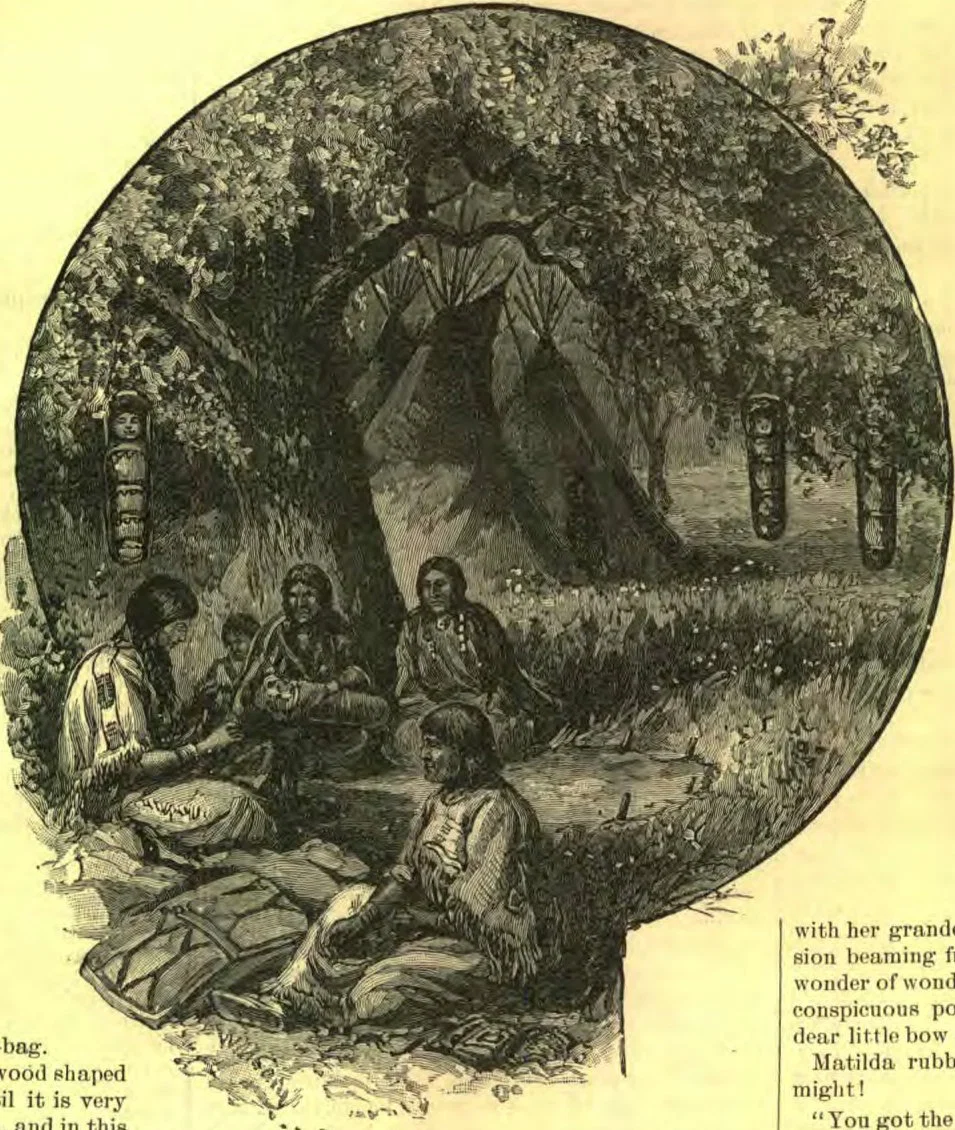
WHAT queer cradles some little folks have! The cradle of the Esquimaux baby is the mother's hood, where he remains with very few airings until he can walk. It is a very warm cradle, and travelers who have seen the wondering eyes and chubby face stuck out of the opening, are struck with the good-nature of the Arctic babies. When he comes out of the hood, he is stuffed into a fawn-skin bag, and a string draws the garment together like a pudding-bag.
In Lapland the cradle is a piece of wood shaped like a canoe, and hollowed out until it is very light. A quantity of grass is put in, and in this soft bed the baby laughs, sleeps, and plays with simple toys all the very long days. When his mother attends church, she leaves him outside to keep warm in a hole made in the snow, with a faithful dog to drive the wolves away. Sometimes several cradles are left in a cluster, when the children set up such a chatter as to disturb the meeting. When the Laplander can walk, he is dressed in reindeer-skin.
The winter cradle of a Chinese baby is shaped like an hour-glass—open above and below. The waist holds the child up, and in the open end below is placed a sort of foot-stove to keep him warm. His hands are free to play with odd-looking rattles.
The Indian baby is strapped to a birch-bark board, and hung up in a tree or carried on his mother's back—no toys, no companions, sun and storm beating in his face; if he cries, he is either unheeded or whipped. But when he escapes from thralldom, the Indian baby is a happy, wild little romp, full of vigor and capers.
There is no land without children—the little kingdom is universal. The reign of the baby will endure as long as the world stands; and child-life is pretty much the same the world over, notwithstanding they are brought up in some queer cradles.—Selected.
THE LITTLE WORD THAT WAS LOST.
By Alice Wellington Rollins
I LOST a very little word,
Only the other day;
A very naughty little word
I had not meant to say.
If only it were really lost,
I shouldn't mind a bit;
I think I should deserve a prize
For really losing it.
For if no one could ever find
Again that little word,
So that no more from any lips
Could it be ever heard,
I'm sure we all of us should say
That it was something fine,
With such completeness to have lost
That naughty word of mine.
But then it wasn't really lost
When from my lips it flew;
My little brother picked it up
And now he says it too.
Mamma said that the worst would be
I could not get it back,
But the worst of it now seems to me
I'm always on its track.
Mamma is sad; papa looks grieved;
Johnny has said it twice:
Of course it is no use for me
To tell him it's not nice.
When you lose other things, they're
lost;
But lose a naughty word,
And for every time 'twas heard before
Now twenty times 'tis heard.
If it were only really lost,
Oh, then I should be glad!
I let it fall so carelessly
The day that I got mad.
Lose other things, you never seem
To come upon their track;
But lose a naughty little word,
It's always coming back.
—Alice Wellington Rollins, in Wide Awake.
WHY DIDN'T SHE WAIT!
By Margaret Sidney
It was a little changeable green silk parasol, with long, sweeping fringe, very old-fashioned and queer, but in the eyes of Matilda and Louisa Budd the most “really and truly” beautiful thing in all the world.
It had been their mother’s best one, but she had bought another, and now this was kept in the upper drawer of the big bureau in the spare room, and every Sabbath of the long, hot summer-time the little girls were allowed to run in and take it out to carry to Sabbath-school.
Only they must take turns in the carrying.
And when it was Matilda’s turn, and the little white cambric sack was drawn on, and the small straw bonnet, with its knot of daisies on top, was tied securely under her fat chin, she would race into the spare room with all her might, tug wildly at the heavy drawer, and come out with a very red face, but an exceedingly triumphant manner, holding the precious parasol aloft, while she called loudly to Louisa to, “Hurry, we’ll be late!”
And Louisa would never go under the cool shade that the green silk and long fringe afforded, even on the most sultry, baking days, although kindly invited with the most patronizing air.
The sun might pour down his scorching rays so that even the birds crept gladly under the nearest leaves, the other little cambric sack and small straw bonnet with the knot of daisies on top would march sturdily by the side of happy magnificence, protesting, with flushed cheeks, that she wasn’t warm a bit!
And when it came Louisa’s turn, the neighbors would see Matilda stalking off as far as possible from her happy sister, as if there were not such a thing in all the world as a parasol!
“You feel so smart,” said Matilda one day, peering under the long fringe into Louisa’s chubby face, “an’ you always have it the very nicest days, you do!”
It really seemed true, that the sunniest, hottest days of all that hot summer-time did indeed fall to Louisa’s lot, when she could sail off, cool and proud, an object of envy to all.
She tossed her little round head up among the spokes of the parasol, and said, with a most moral air, “You shouldn’t envy folks; teacher said ’twas wicked.”
“I a’n’t a-envyin’!” declared Matilda, stalking sturdily on. “I only wish I had it!”
“Well, you can’t,” said Louisa, clinging to the long handle with confidence, “’cause it’s mine, you see, an’ we’ve got an awful long ways to go yet before we get to Sabbath-school, too, ’Tildy!”
Matilda preserved a grim silence, but something dark was just at that moment passing through her mind. Why not hurry and get dressed first the Sabbath it came Louisa’s turn to carry the parasol, rush into the spare room, capture the prize, and run off with it before the little fat sister knew a thing about it!
“She’s had it all the best days,” she reasoned to herself, walking on, “an’ so it’s fair—yes, ’tis!”
The idea grew so delightful, the more she came to think of it, that she forgot all about the next Sabbath when she should have it all to herself as a thing that fairly belonged to her.
And all the days between, over and over, at school and at home, Matilda kept planning and planning, until the time came, when, in the little white cambric sack and the small straw hat with the knot of daisies on top, she stood before the big bureau drawer.
Hastily she drew out the precious green parasol with the long fringe, and, rushing out of the house, she fairly flew up the street, not breathing safely till she turned the corner.
Then she did not dare to raise it till she was quite sure that Louisa was not scuttling just after. And so she didn’t begin to get the least enjoyment out of it, until she was nearly at the school room.
And every step of the way, each breeze that blew the sweeping fringe seemed to say, “O, you mean little thing you! O, you me—an little thing you!” until she was ready to dash it into the middle of the street, and sit down on the curb-stone to cry in sheer vexation.
But she was presently obliged to sneak into her class, where she usually brought a smiling face, and tucked herself into the smallest corner.
“Where is Louisa?” asked Miss Root.
“She’s—she’s a-coming,” stammered Matilda, with very hot cheeks.
“Is she sick?” pursued the teacher anxiously.
“No’m,” said Matilda, “that is—I d’no,” she finished, desperately.
The scholars laughed outright at that. But Miss Root looked grave, and took up her book to begin the lesson.
And just then in walked Louisa, with her grandest air, and a most contented expression beaming from every line of her fat face. And wonder of wonders! in her hand she held, in the most conspicuous position, a bright blue parasol, with a dear little bow on top, and a shining white handle.
Matilda rubbed her eyes, and stared with all her might!
“You got the green one, didn’t you?” said Louisa, after getting into her seat with dignity, and glancing at her sister’s side. “Oh, well, it’s yours now, mother’s given it to you, ’cause Aunt Em’ly sent me this, last evenin’, only we couldn’t find you to tell you. A’n’t mine sweet?”
Sweet? Well, Matilda never had one minute’s comfort in what was hers now—after that. Why hadn’t she waited?—Margaret Sidney.
A RACE.
A DIMPLE and a Wrinkle had a race one day. Where do think it was?
They were both in Daisy’s pretty little face. The Dimple on her round, rosy cheek, the Wrinkle up in her forehead.
The Wrinkle was an ugly, sullen-looking thing. No one ever felt happy or pleasant when he was about. He kept bad company, too. Whenever you saw him, you might be sure that Fret and Whine and Snarl and Grumble and Growl were not far off.
But Dimple—ah! if you could see the merry little company she kept about her. Smile and Laugh and Sweet-words were always with her. No matter how cloudy and dismal the weather out-of-doors might be, there was sure to be sunshine in the house if this cheery little crowd were in sight.
What was the race about?
“Mamma,” said Daisy, “may I go over and see Susie Lee?”
“Not this afternoon, dear,” said mamma; “you148have a cold, and I think you would better stay at home.”
Then came Wrinkle, making a dreadful mark right up and down her forehead.
“But, mamma, I want to go.”
Dear me! There came Fret and Whine, sure enough.
“I’m tired of staying in the house all day. You hardly ever let me go out.”
Grumble and Growl, too. You see, if you encourage one bad fellow, the others are sure to come.
“Won’t you draw some pictures for me, Daisy?” asked her little brother Teddy.
“No, I’m tired of such nonsense.” Snarl, too, in his very worst temper.
It was sad to see how all the dear little Smiles and Dimples ran away and hid. Daisy turned to the window and looked out.
It had been cloudy all day, but now she saw a little bit of break in the clouds. It looked as if the sun, somewhere up behind, was trying to break through and shine.
“How nice it would be if he would!” she said to herself.
It made her think of something she had heard at Sabbath-school about little children and what they can do. There are a great many things they cannot do. They have to grow and learn a great deal. But every little child can have a share in the Lord’s own work.
It was just here that Dimple began to peep out and see if she had any chances against Wrinkle.
“Yes, I do believe the sun is coming through,” cried Daisy.
Teddy came to look, and Daisy put her arms around him, and lifted him on the seat beside her. And just at that moment Wrinkle began fading out, and Whine and Snarl and Grumble went skulking out of sight, looking uglier than usual, if that were possible.
“See that little patch of blue up there, Teddy?” said Daisy.
“Now is my time,” said Dimple. “Perhaps I can get there if I hurry.”
“Is the sunshine going to shine?” asked Teddy.
“I don’t know,” said Daisy. “I’m going to make pictures for you, anyway.”
Oh, how the Dimple made its way deeper and deeper into the roses! How the bonny red lips parted, and showed the pretty white teeth inside! How the smiles brightened and beamed! Dimple had won the race. And as the two sat on the floor making pictures, the sun shone in and smiled with them.
Dear little boy or girl, go and look in the mirror, and see the face there. Don’t you think the dear Lord made that pretty mouth for smiles and dimples and loving words?—Selected.
Choosing the Seed for the Harvest
WE are working in the great harvest fields of our Master. The soil is good, and all that makes growth is ordered abundantly by him; but the seed we are to choose, and according to our choice will the harvest be.
SPEAK REVERENTLY.
When Prince Bismark, the great German statesman, was a lad, his father once overheard him speaking of the emperor as “Fritz.” He reproved him for the familiarity, and added, “Learn to speak reverently of His Majesty, and you will grow accustomed to think of him with veneration.”
The words made a deep impression on the boy. Even in his old age he lowers his voice, and assumes a respectful tone whenever he speaks of his sovereign. When a message was brought to him from the palace, either verbal or written, he always stood to receive it.
What a lesson is the custom of this great statesman to boys who speak so lightly, if not profanely, the name of the King of kings!
It is very easy to lower our standard of reverence for anything. We have only to speak of it habitually in a light way. There is nothing like it to take the life out of the most precious texts of Scripture.—Selected.