THE city of Santa Rosa, county seat of Sonoma County, Cal., with a population of 10,000, has a thrilling earthquake story which we barely noted in our first edition. In some respects this place fared worse than San Francisco in proportion to size. This is especially true of its death-roll, which a week after the disaster was officially reported as fifty-six. This is on the authority of Mr. Geo. E. Peery, who reported the names of the dead, injured, and missing to the Oakland Herald. The injured and missing numbered eighty-seven. The death-roll is much larger in proportion to the population than that of the Bay City.
From Mr. Peery's general report we take the following extract:
The appalling immensity of San Francisco's catastrophe obscured Santa Rosa's sorrow from the world's attention. Tho less in extent, it was greater in degree than that of the metropolis. The loss of life was proportionately greater, and the business part of town was absolutely annihilated. Santa Rosa differed from most towns of similar size in being more compactly built. All its business houses were closely grouped about the center, where stood the county courthouse. So, when this group of business blocks was tumbled into blazing ruin, there were no suburban stores to supply the pressing needs of the moment.
There was neither bread nor meat for the living; there were no coffins for the dead. The breaking off of communication left the world in ignorance of Santa Rosa's destruction; and beyond mere surmises, this city's first intimation of San Francisco's disaster was the arrival of a train load of nearly a thousand refugees, wounded, sick, half-clad and half-starved, seeking shelter where there were no houses, and begging help that none could give. Before Santa Rosa had begun to put water upon her own fires, or to drag her own dead and wounded from the ruins, she was called upon to help San Francisco.
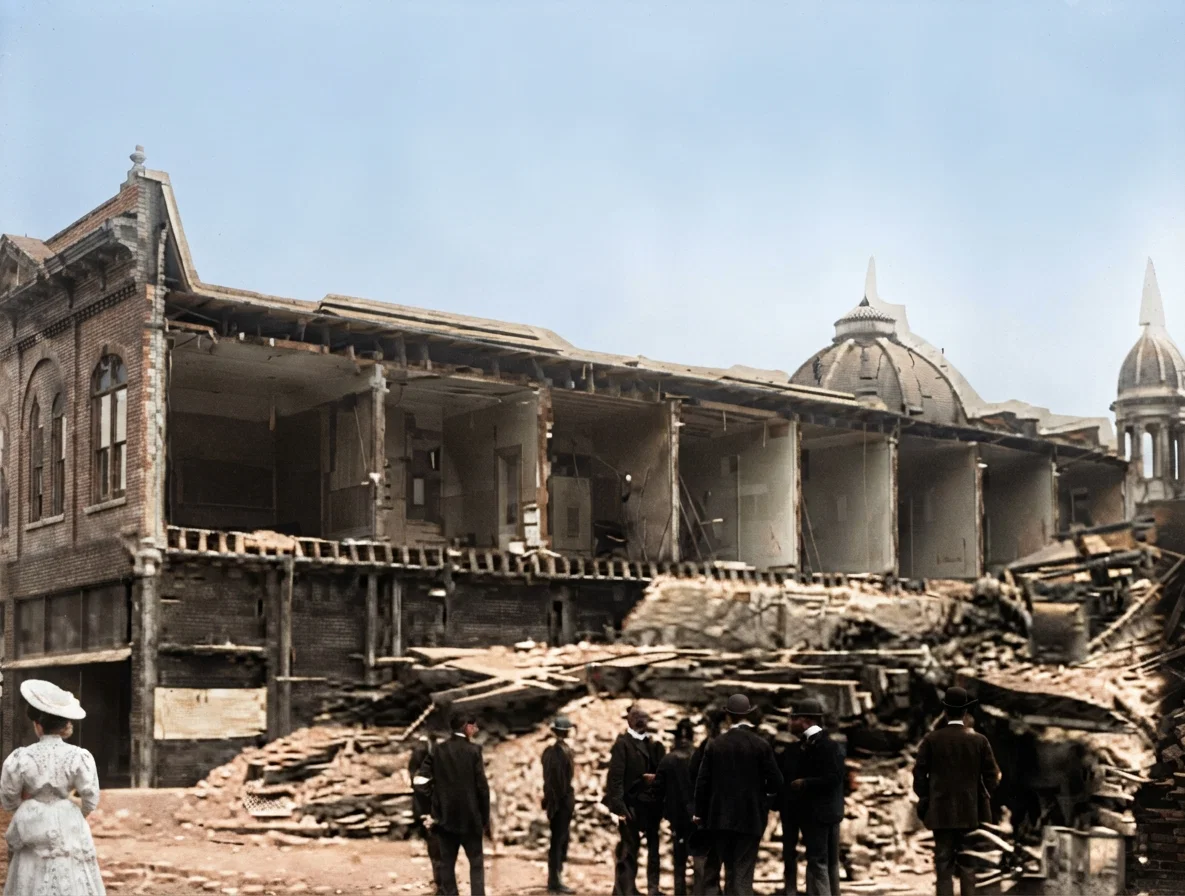
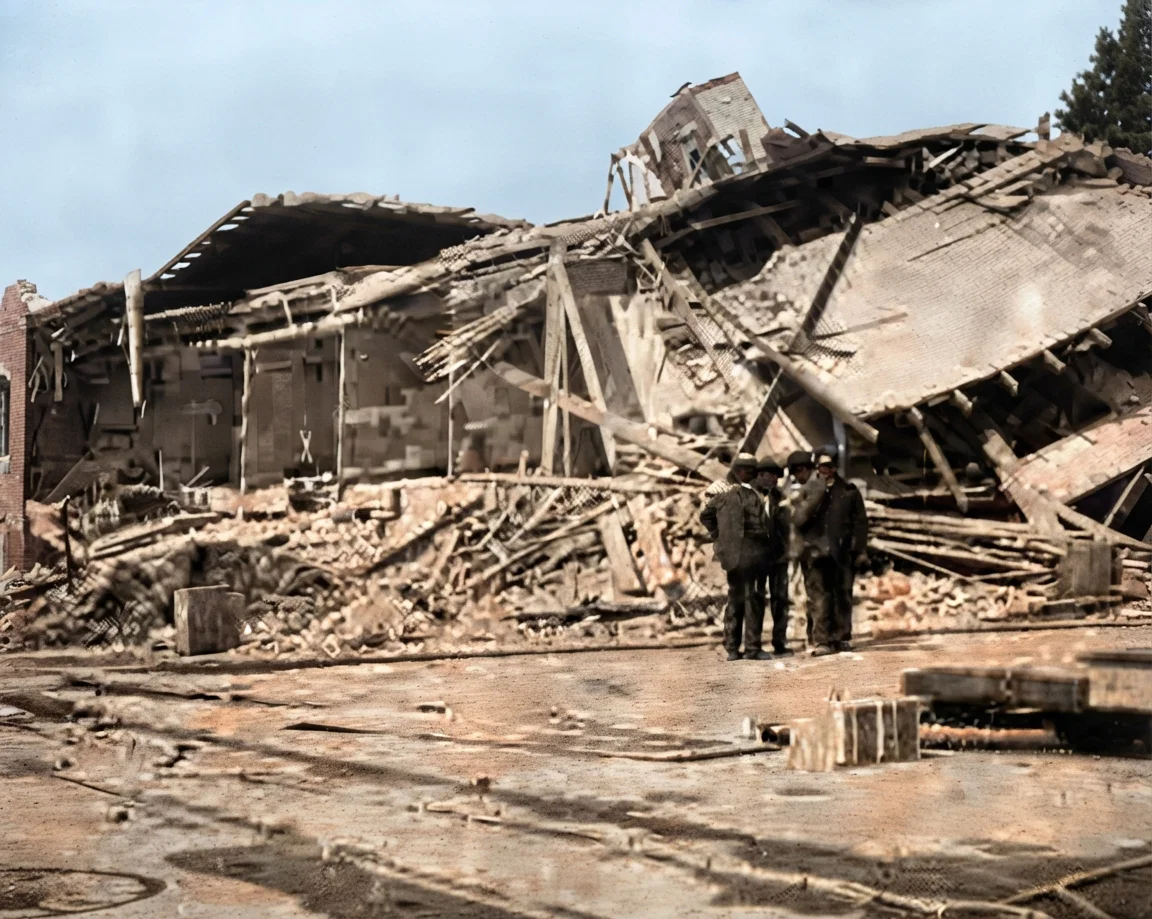
Hobson's Store—a complete wreck, under which three persons were buried. Two of these were rescued alive.
San Francisco's call for aid was heard far and wide, and spendthrift hands responded, but Santa Rosa's moaning reached only her own ears at first9and the suffering was intensified as it lengthened.
The earthquake shock buried firemen, horses, and engines under their own walls and roofs. Frantic efforts freed them, and valiantly they served. There were two steamers in Santa Rosa, and Sebastopol sent a third—Sabastopol, which had so often called upon her neighbor for help, was at last able to pay the debt she owed.
The water system was unimpaired, and the supply sufficient, and within three hours the three engines had twenty scattered fires under control. Just how many lives those three hours cost can not be told.
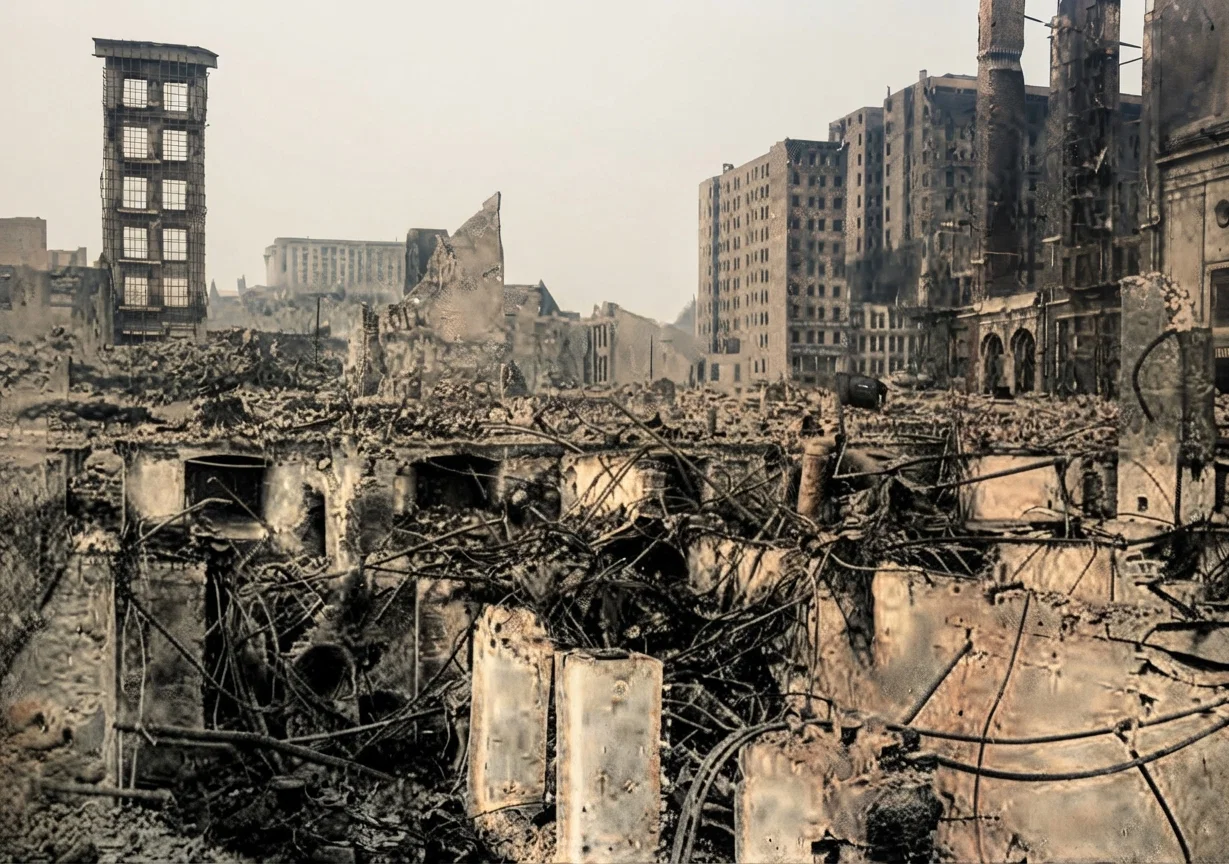
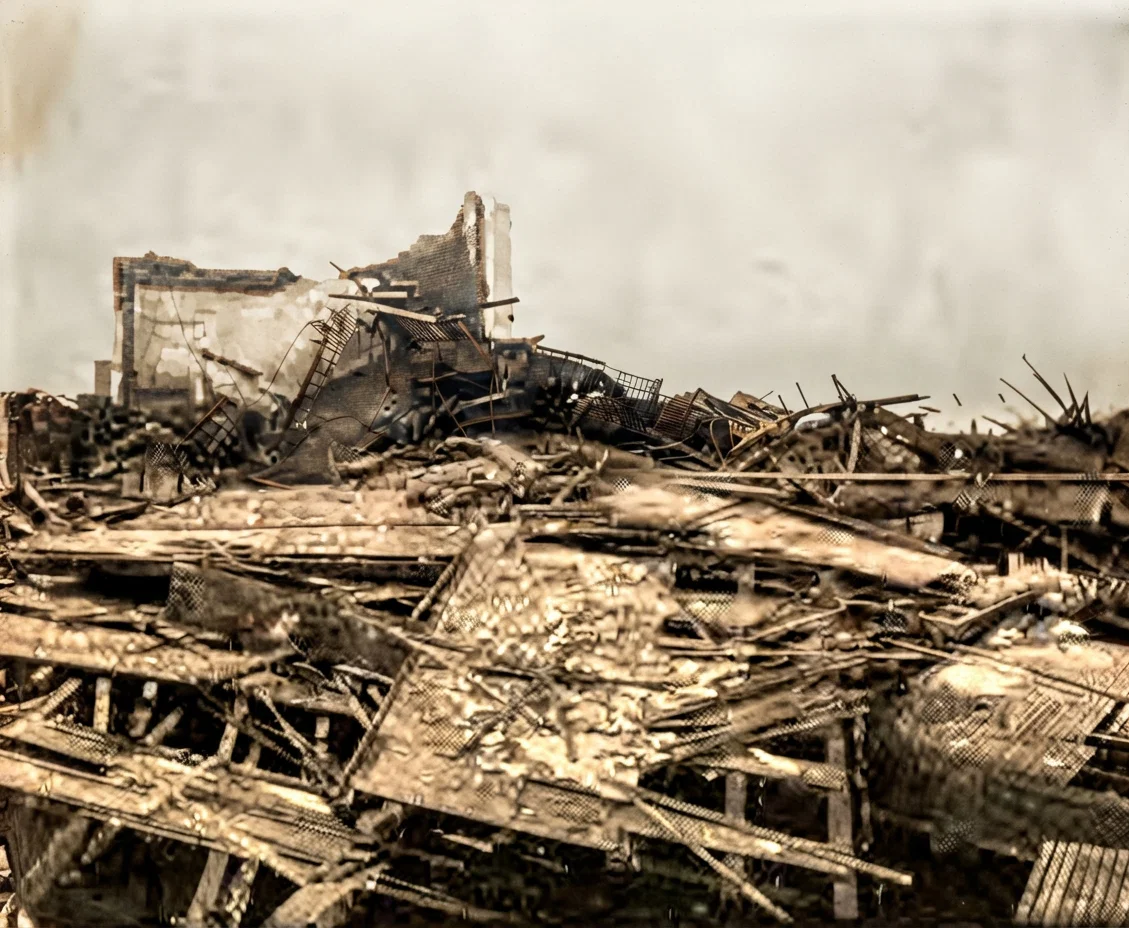
A typical wreck and tangle to be seen in the manufacturing districts of San Francisco.
Many of the corpses found in the ruins had been crushed when the buildings fell; but many others had been living survivors of the earthquake until the fire reached them.
Harry Newman was one of these tortured victims. He slept in a gallery over his drug store in the Doyle & Overton building. The crash penned him in, unhurt, but unable to escape. The chemicals in his stock ignited, and the flames encompassed him, stilled his cries for help, and drove back those who with desperate and frantic efforts tried to set him free. The hideous remembrance of the awful torture that ended his life will never be forgotten by those who witnessed it, and who knew the man and loved him.
In the office of the Press-Democrat newspaper, four lives were lost. The night's work was finished for compositors and for members of the staff. These had gone home. There were left in the office the pressman and three carriers. The night foreman and the circulating manager were leaving the building.
Wreck of Occidental Hotel, Santa Rosa.
While they were still under the steel lintel of the pressroom door, the structure thundered down, covering them with black-and-blue bruises, but sparing their lives. Five or six of the carriers were already upon the streets. All of these escaped but one. He was caught under the outward-falling front of the telephone building as he pushed a paper under the door.
Milo Fish was a printer and pressman who had quit the trade after years of service, and had bought a restaurant. Just for one night—the fatal night—he went back to run just one edition, and give his successor a night off. Three carriers—George Bluth, Willie Bluth, and Chester Shepard—were still in the pressroom waiting for their papers. These, with the pressman, were crushed to a pulp when the three-story building slid backward with its thousand-ton weight upon the one-story press room.
St. Rose Hotel, Santa Rosa. Fine modern building, third story on the ground.
The Hotel St. Rose was a new building, four stories high, and believed to be of modern, scientific construction. It crumpled as a pasteboard box, imprisoning some of the hundred guests within its walls, and sliding others outward into the street unhurt. It required hours to free some of those shut in. Dr. Light, a Butte County physician, lay for nine hours with a beam across his hips. The fire drew near and was quenched, while he was nearly drowned in the floods the engines poured upon him. Finally he was freed, and afterward read his own obituary. He had been a guest at the Metropolitan Hotel in San Francisco, and had left unexpectedly without giving notice. He was published in the list of those who perished in the Metropolitan.
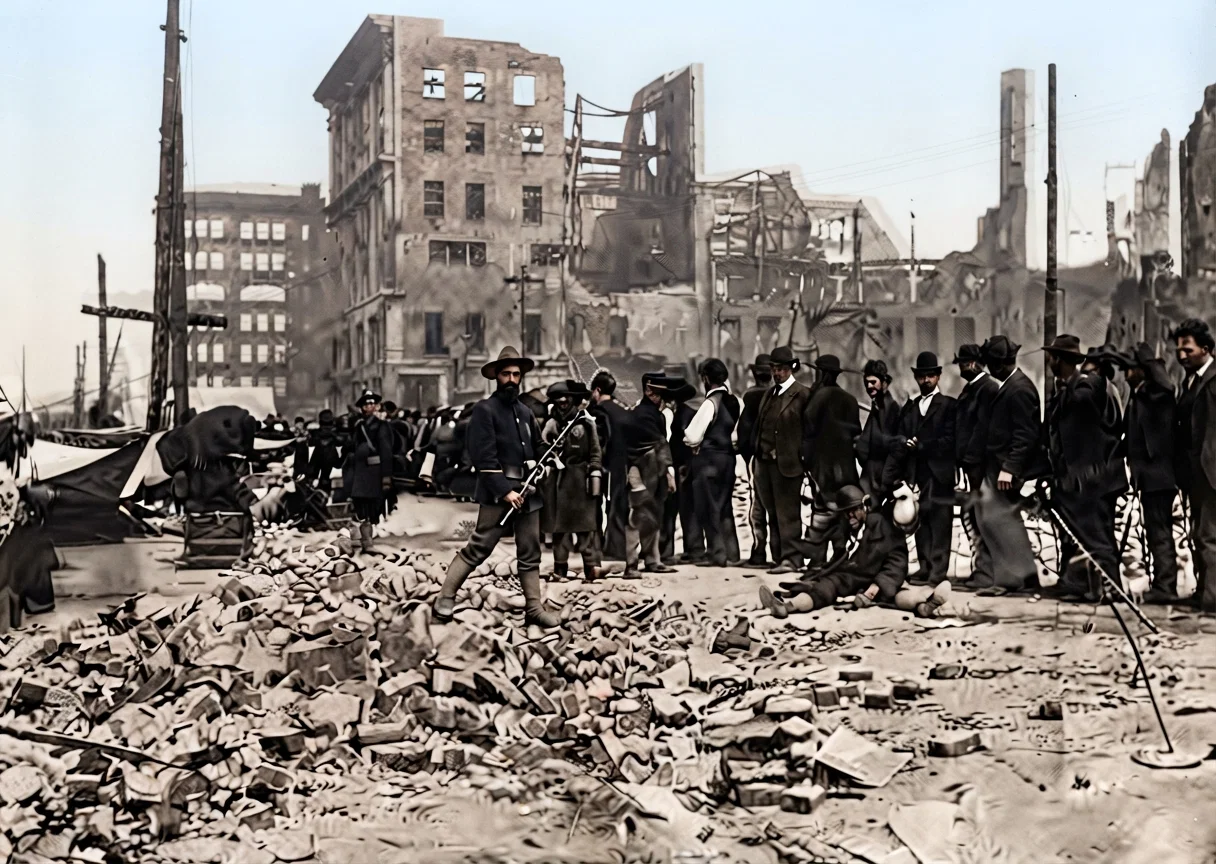
A view in San Francisco showing the reign of martial law and the needs of the survivors of the awful calamity. The men with muskets are soldiers standing guard over a typical bread line, men in rank receiving bread as it is dispensed at one of the many temporary commissary departments. Such ruins as these may be seen everywhere in the burnt district.
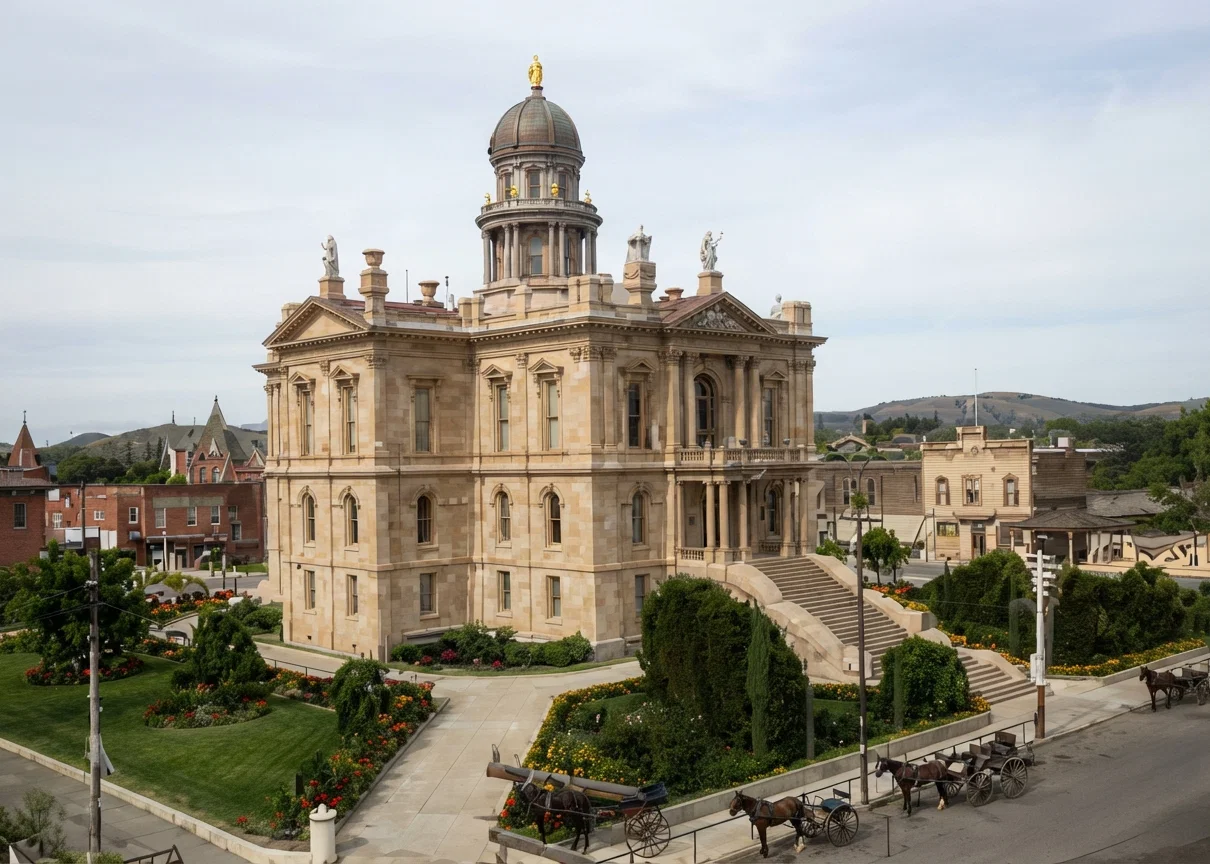
The courthouse lies a mighty heap of ruin, its massive dome sank nearly out of sight, with its summit resting against the eastern wall, which bulges with the weight. The new Masonic Temple, in which the mortar on the topmost course of yellow stone was scarcely dry, now lies as tho battered by a month's bombardment. One block east is a heap of blue basalt, that a week ago was the public library. The earthquake's vibrant swing flung blocks of stone that weighed a quarter of a ton apiece, across the street.
Five banks with deposits aggregating nearly nine million dollars, were in the earthquake's path. Now, five naked steel vaults, loom among a chaos of shattered walls, guarded by sentinels with rifles. Three brick hotels, three and four stories high, one hotel of stone, and two that were built of wood, are all laid low by earthquake shock and fire. The big brewery, five stories high, the shoe factory, a three-story building only a year old, a four-story brick
flour mill, two theaters, five public halls, the Odd Fellows' Temple, and a score of office buildings, retail stores, and flats and lodgings—all are gone, and nothing left but rubbish.
Stanford University
By David Starr Jordan
President Jordan Makes Statement Regarding Earthquake
THE injuries to Stanford University by the earthquake of April 18 are in brief as follows:
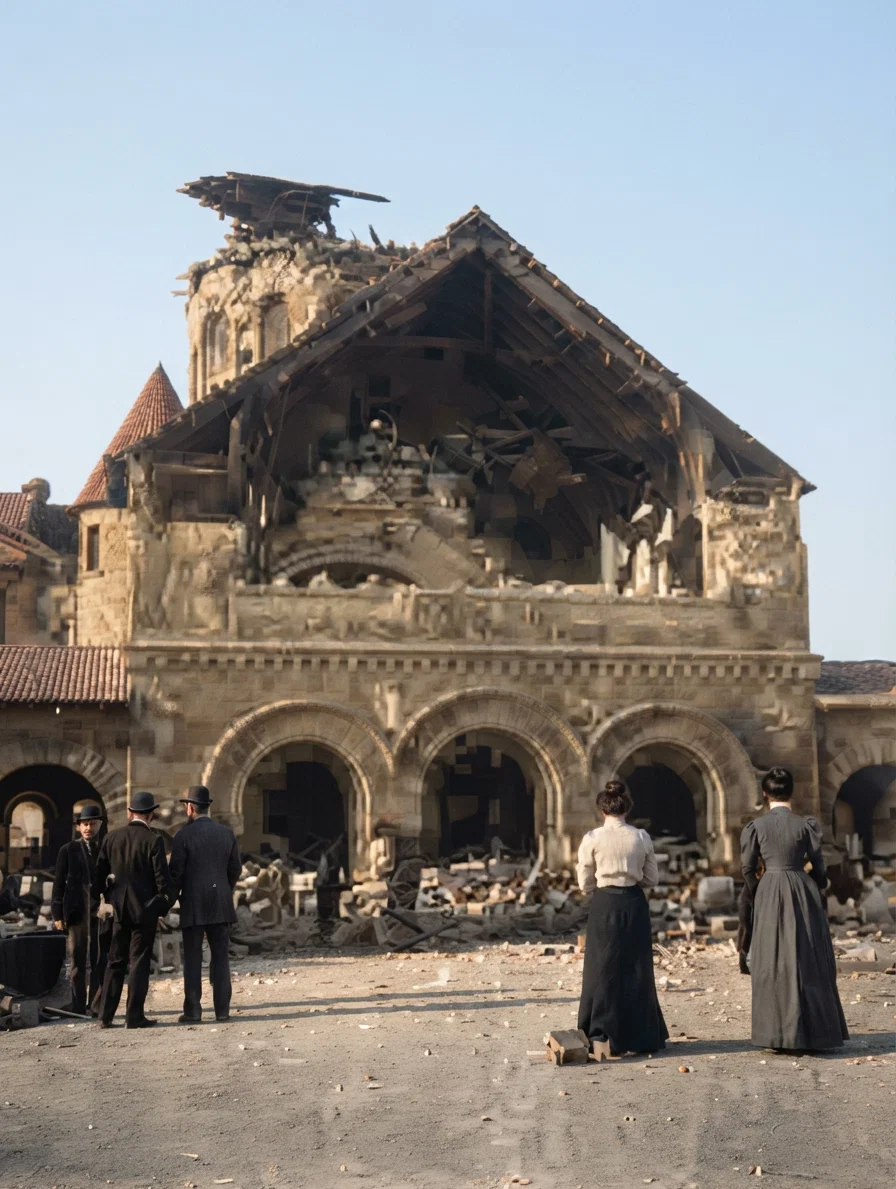
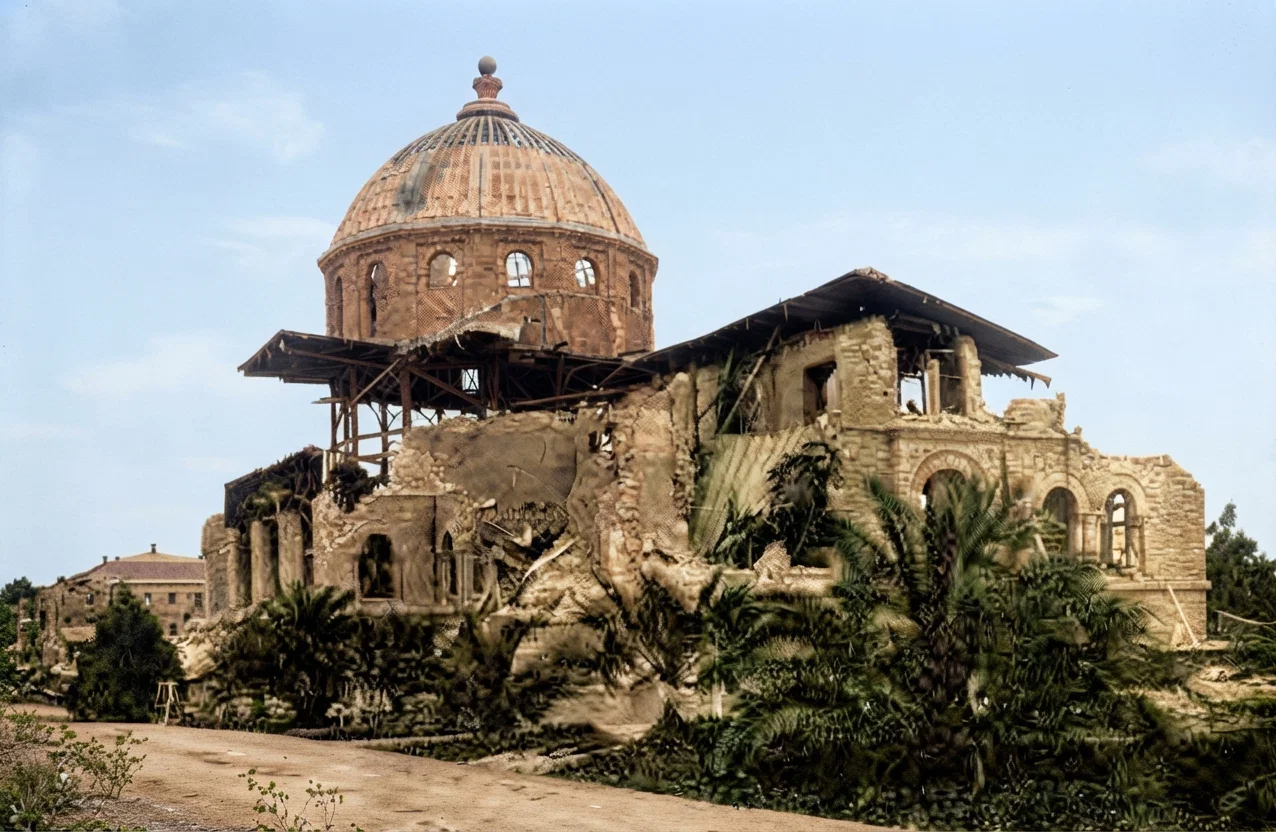
1. Wreckage of the Memorial Church by the fall of the heavy spire, which crashed through the nave, the air blowing off the upper part of both ends of the church. The walls generally, of steel construction, are intact, but the building is ruined.
2. Wreck of the unfinished library. The great dome and its steel supporters are unharmed; their swaying completely wrecked the rest of the building.
3. Wreck of the new gymnasium, brick faced with stone.
4. Wreck of parts of art museum which were made of brick faced with cement. The central part of concrete strengthened by steel rods is intact.
5. The Stanford residence in San Francisco, a huge wooden structure, heavily built, was not harmed by the earthquake, but is completely consumed by fire.
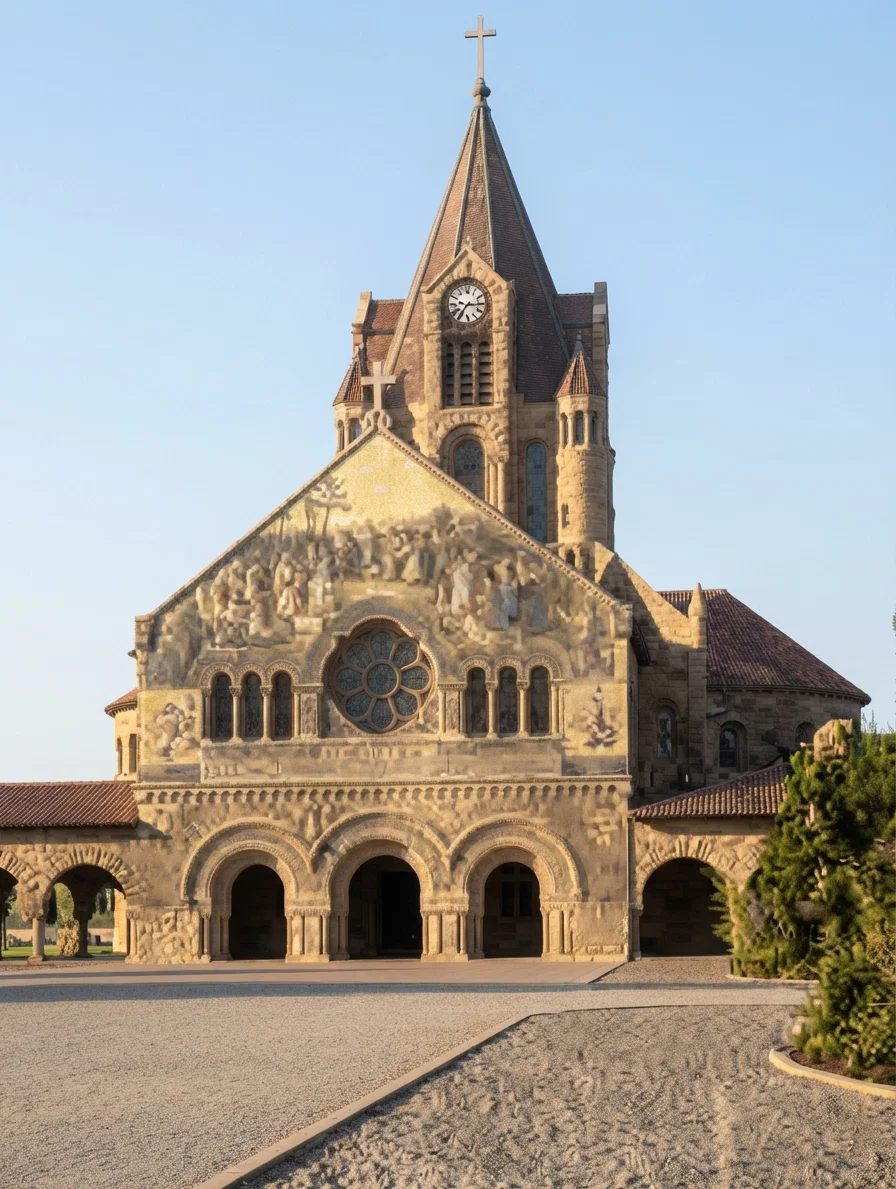
Stanford Memorial Chapel, built in memory of Hon. Leland Stanford by his wife at a cost of $1,000,000 for the building and $600,000 for the decorations, containing many beautiful mosaics.
Memorial Chapel after the earthquake.
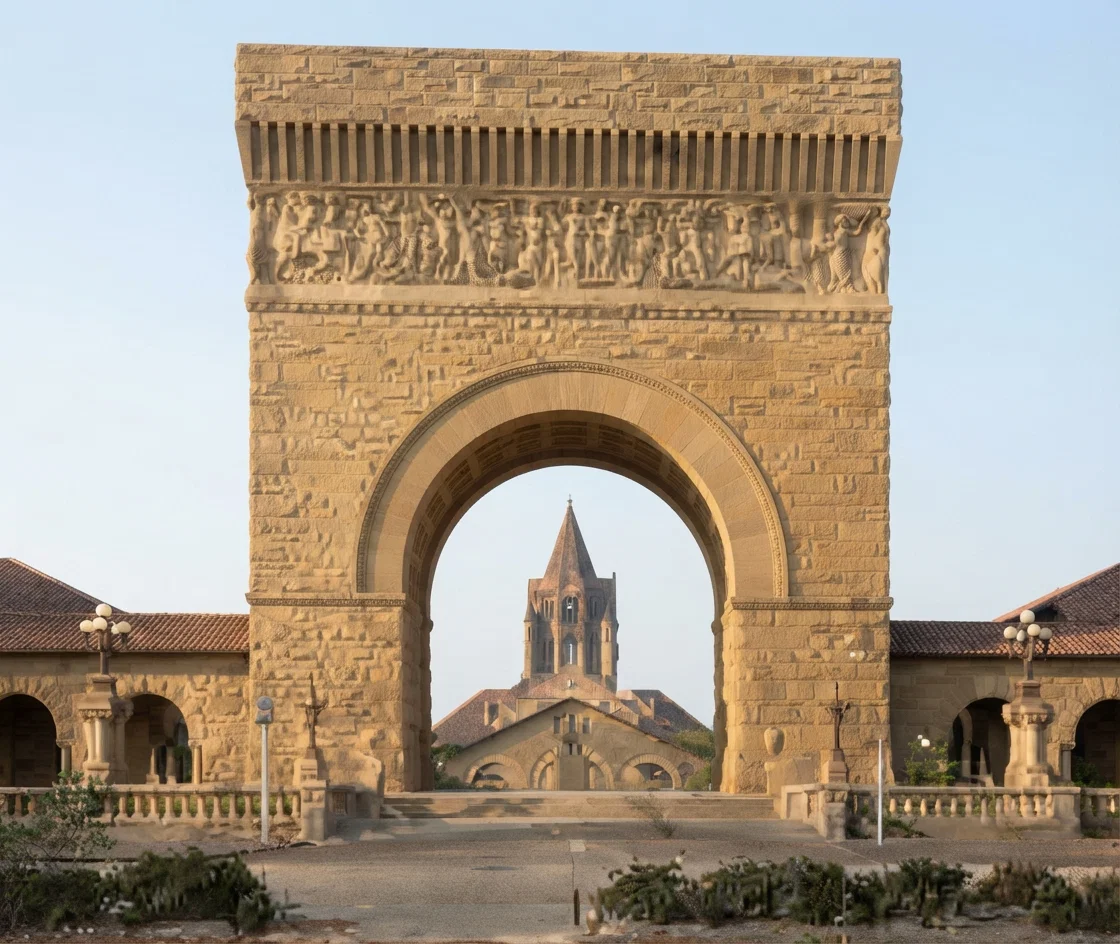
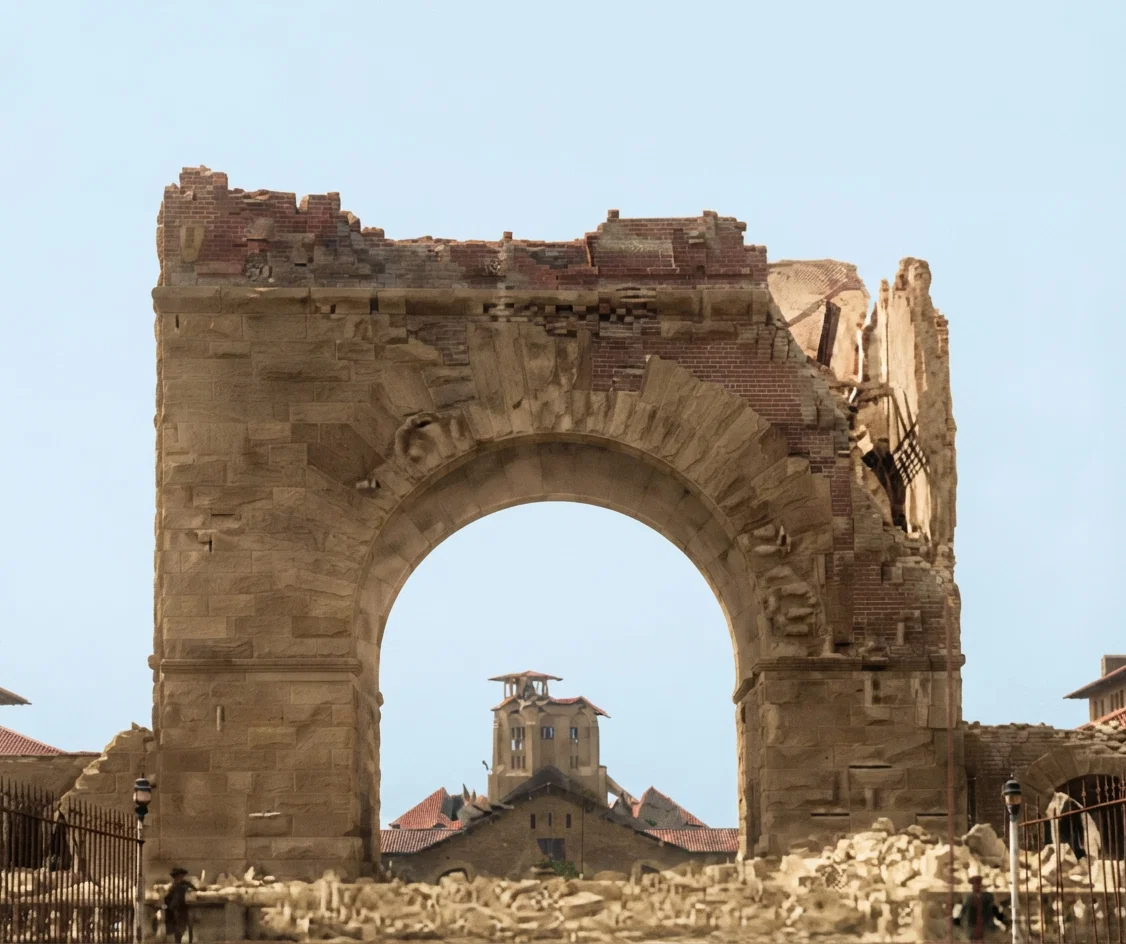
Arch at the entrance of the Quadrangle, with Memorial Chapel in the distance.
Arch at the entrance of the Quadrangle after the earthquake.
6. The inner quadrangle and engineering shops, of heavy masonry and one story high, are unharmed.
7. The outer quadrangle contains four large buildings reinforced by steel, the laboratories of zoology, botany, and physiology, with the temporary library and assembly hall. These are virtually unharmed.
8. The power-house was wrecked by the tall stone chimney, which was snapped off like the lash of a whip.
9. The Memorial Arch had its upper part snapped off and is split almost to the base, so that it is an entire wreck. This structure was of brick, reinforced with steel and faced with stone.
10. The chemistry building lost all its chimneys and is externally damaged by the fall of part of its stone facing. The building and its contents are little injured.
11. The four large buildings of the outer quadrangle, of brick unreinforced, and faced with stone, are somewhat damaged, the history building least, the incomplete mining building most.
12. Roble Hall, women's dormitory, of concrete with steel wires, is absolutely unharmed except for the fall of two ornamental chimneys.
13. Encina Hall, men's dormitory, a very large, finely-built stone building, was injured by the fall of stone chimneys, one young man being killed. The building also has a serious crack in each of two corners, but is otherwise unharmed.
The wooden buildings on the grounds lost only chimneys and parts of plastering. No injury was done to books, and very little to apparatus or collections. The working part of the university as distinct from its architectural effects is little harmed. The most effective part of its architecture, the inner arcades with their Spanish arches and towers, is wholly undisturbed.
DAVID STARR JORDAN.
Doctor Jordan adds in a later note:
The quadrangles, chemistry building, and dormitories will be at once repaired. The Memorial Church, not so badly wrecked as supposed, will have a temporary roof and will be protected. No attempt will be made to restore that or other large outside buildings for a long time to come—probably not until some donation is made for the purpose. Next term will begin August 23. In haste,
JORDAN.
SAN FRANCISCO’S SISTER CITIES TO THE RESCUE.
By A. J. S. Bourdeau
Oakland, Berkeley, and Alameda.
TOUCHED by the sad plight of their sister city, San Francisco, the Bay cities came nobly to her assistance. Oakland, Berkeley, Alameda, and other sister cities less afflicted, vied with each other in their warm-hearted efforts to extend shelter, treatment, food, and comfort to the refugees from San Francisco. Owing to their close proximity, it was but natural that
These Cities
should lead in this noble work. Tho badly shaken up, Oakland escaped with the loss of only seven lives. Her large public buildings were greatly damaged. Having escaped the scourge of fire, the people across the Bay immediately forgot their own woes in the effort to relieve the awful distress. Homes, churches, hospitals, public halls, and the parks, were thrown open to the refugees; and rich and poor strove with each other to excel in deeds of kindness. Storekeepers stripped their shelves and gave their goods away; householders emptied their wardrobes and pantries to relieve distress. Every citizen seemed to belong to the Relief Committee. Every house of worship not condemned as unsafe was turned into a hospital, restaurant, and lodging-house. The popular churches threw aside their thumb-worn creeds, and forgot their large profession and their little deeds, in their zeal to minister to afflicted humanity the milk of human kindness. All-told, these cities cared for about 50,000 refugees.
Further Particulars.
All of the great San Francisco newspaper plants having been wiped out of existence by the great temblor and the flames, the Call, Chronicle, Examiner, and Bulletin, were obliged to remove their headquarters to Oakland. The publishers immediately had their papers printed at the offices of the Oakland Tribune and Herald. Thursday morning, April 19, in fact, the three leading dailies of San Francisco printed a combination, four-page paper, entitled The Call Chronicle Examiner.
A Hopeful Spirit
seems to pervade the atmosphere. The newspapers breathe a spirit of buoyancy and good cheer, and seem to hurl proud defiance even at the elements, boasting of their tall sky-scrapers as “great, scarred giants that withstood the shock of earthquake and the destructive flames.”
So Many People Are Blind
to the meaning of these catastrophes. They refuse to accept them as warning from the Almighty to get ready for the great consummation of all things earthly. I was standing with a physician on Washington Street, Oakland, when another prominent physician stepped up to talk the situation over with us. My friend and I remarked that this great disaster was but an introduction to other worse ones that are to precede the second coming of Christ. The newcomer sneered and said: “I don’t think God had anything to do with this earthquake! If I thought He did, I would have no respect for such a God.” We answered: “No doubt, my friend, many people in Noah’s day said they had no respect for a God who would bring a great Flood upon the earth.” “I don’t believe there ever was a Flood,” rejoined the physician. This is but one of many like remarks that I heard during these days following the earthquake. So many are determined to ridicule and scoff at the Bible and all that it predicts concerning the last days. On the other hand,
The wreck of the new Library Building at Stanford University, Palo Alto, Cal.
Many Interpret Aright
the catastrophe of Wednesday, April 18, 1906. Scores have said, within my hearing: “God wants to remind us that He is running things.” “I thought surely the end of the world was upon us!” “God made the country; man made the cities.” “This made us remember our God.” “We all began to pray to our forgotten God.” And other like expressions.
Governor Pardee, whose headquarters are in Oakland, issues, from day to day, a proclamation making every day a legal holiday, thus closing all banks in the state until the great San Francisco banks can be opened.
Martial Law.
The cities about the Bay have now become great military camps. Every attempt to enter a public building without the proper pass from the police or military authorities, is promptly met by a soldier presenting the flat of his gun to your chest. Bayonets are fixed. All guns are loaded with ball cartridges. All instructions are to shoot to kill. Every one in San Francisco is at liberty to leave the city, but no one from the other cities about the Bay is allowed to enter the ruined city without a military pass from the governor of the state. Each morning a line of about 2,000 men and women may be seen slowly winding in and out of the City Hall in Oakland, all waiting for a permit to go to the burned metropolis. A curious crowd they are—mothers anxious to return to find their children or husbands, eastern relatives searching for dear ones that lived in the burned district, laborers looking for work, etc. Many are refused the passes.
The Oakland Chamber of Commerce, 12th and Franklin Streets, Oakland, was like a swarming bee-hive from morning till night. Throngs of refugees registered there and found at the hands of willing volunteer clerks vital information regarding their loved ones. Many, however, turned away with sad, tearful faces, not having heard any news, good or bad. By recommendation of the Relief Committee, any destitute person was secured free transportation to any part of the state, and often to remote parts of the United States, all of the great railways being generous to the extreme. The railway officials collected no fares from refugees on all out-bound trains from San Francisco, on either side of the bay. One paid if one chose—otherwise it was all right. The great ferry systems did likewise on the bay.12
Our Denominational Property in Oakland including the large church on 12th and Brush, the former buildings of the Pacific Press Publishing Company, and the headquarters of the Pacific Union Conference, at 1059 Castro Street, all escaped without any damage to speak of. All of these were frame buildings.
Each day the newspapers are filled with long lists of names and addresses of the dead, of relatives missing and found, and other desired information—page after page, each page containing nearly 1,000 names and addresses, etc. Nailed on the walls of each church or public building are to be found alphabetical lists of the refugees housed within.
Oakland's Probable Gain in Population.
Not counting the thousands who will return to San Francisco to help rebuild the ruined city, many other thousands will, without doubt, make Oakland their future home. The fact that it escaped most of the evils of the great disaster, together with its proximity to San Francisco for business purposes, will aid materially in building up Oakland, Berkeley, Piedmont, and Alameda. But, who can say where the next earthquake will be? There is safety only in Him who is our Rock.
A. J. S. BOURDEAU.
Santa Rosa Court House before the Earthquake.
OTHER TOWNS THAT SUFFERED.
GILROY suffered in about the same proportion as did San Jose (see article in another column). Nearly all the large buildings on Monterey Street are down or wrecked. No lives lost; financial loss about $50,000.
Hollister was severely damaged, and three lost their lives there. Financial loss placed at $100,000.
Santa Cruz was seriously damaged, losing many of her best buildings, but no lives.
Petaluma suffered little.
Glen Ellen, the Home for Feeble Minded, was terribly shaken by the earthquake; but none of the inmates were injured.
Sebastapol had one serious wreck.
Sacramento was damaged but little.
At Wrights the big railway tunnel is caved in, and large fissures and ridges were made.
Monterey was not seriously shaken.
Boulder Creek has not a chimney left standing, and destruction of property will amount to thousands of dollars.
Del Monte—all chimneys crashed through the roofs, and two persons, a bridal couple from Arizona, were killed, the bed on which they were sleeping being driven through two floors by a falling chimney.
Napa had forty buildings destroyed, and one death is reported. Financial loss, $50,000.
Salinas is reported to be about half ruined.
Santa Clara was very badly wrecked. Her loss will approximate $500,000.
Agnew's principal loss was the complete destruction of the great insane asylum located there, which contained 1,088 patients at the time, besides physicians, nurses, and attendants. Two physicians and, as near as can be ascertained, 117 inmates and attendants were killed.
Los Gatos was damaged to the extent of $30,000; and Morgan Hill about $5,000.
Alameda did not suffer so severely as her sister city Oakland (see another column). No lives were lost there. Her financial loss will reach $175,000.
In Mendocino County many large mills were injured and have been compelled to close down for repairs.
No damage is reported from Stockton, Fresno, Modesto, Bakersfield, Merced, San Luis Obispo, or Los Angeles.
It is reported by the captain of the coast steamer Alliance that the light-house at Point Arena was destroyed by the earthquake. Thus the shock was quite severe for three hundred miles north and south. Altho a comparatively narrow strip inland was affected, no one knows how far it extended under the ocean. The same captain reports that while off Eureka that morning his vessel was severely shaken.
THE CRY OF THE CHILDREN.
By Edgar Goldsbury Fields
[By Edgar Goldsbury Fields, in the Examiner.]
Our hills lie naked, gaunt, and gray.
With ashes heaped on hearth and head
We stand in funeral array
And mourn our dead.
When fair winds blow we rate as men;
When cities sway and tremble, we
Are but Thy little children then,
Who turn to Thee.
Help us to meet each day's demands;
With Thine own strength our hearts endow;
We ask Thy blessing on the hands
That help us now.
It was our habit, day by day,
To heed Thee not when it was light;
But help us, God, to find our way
Through this—our Night.