1. NAME the things made on each day of the creative week.
2. What two institutions have come down to us from Eden? Were they instituted as types? By what acts was the Sabbath made?
3. In what respects was man different from the animals in his creation? Gen. 1: 26, 27; 2: 7, 19.
4. Trace the successive steps in the temptation and fall.
5. How, when, why, and how many times, was the earth cursed during the patriarchal age?
6. Carefully trace the causes, and state the effects of the flood.
7. Why, when, and where was the tower of Babel built? Why, how, and with what result was it destroyed? Is this in favor of, or against, concentration in the Lord’s work? Give reason for your reply.
8. Give Scripture reasons why Abraham, Isaac, and Jacob were called to be pilgrims and strangers in a strange land.
9. In what special sense were they the called of the Lord?
10. By what characteristics, manners, and customs, or habits of life, were they distinguished from the world?
11. How often, and under what circumstances, did the Lord appear to Abraham? to Isaac? to Jacob?
12. In what places did Abraham sojourn? Isaac? Jacob?
13. In what places did they erect altars of worship?
14. What special promise was made and confirmed to them all? How, when, under what circumstances, and how many times?
15. What was the patriarchal age? Describe the patriarchal government. Why was the genealogy of this age kept with so great care?
16. Trace the genealogy of the world to the death of Joseph.
17. Make a list of the prophets, and of their prophecies, giving interpretations, showing in whom they all center.
18. In how many ways did the Lord commune with them? In how many ways does He speak to us?
19. In what different ways is the plan of redemption revealed in the book of Genesis.
20. Under what covenant did the patriarchs live? Give proof.
21. Of how many of the patriarchs have we a record of their “last end”? What do the brevity and simplicity of that record show?
22. Make a list of the benefits you have received in the study of the book of Genesis, and fix them in your mind.
23. What are the principal events recorded in the book?
24. Make an outline of the book. Give the lesson headings in their order, of the twenty-six lessons of the past two quarters, naming the scripture included in each.
1 "In the beginning was the Word, and the Word was with God, and the Word was God. The same was in the beginning with God. All things were made by Him; and without Him was not anything made that hath been made. In Him was life; and the life was the light of men. And the light shineth in the darkness; and the darkness apprehended it not. There came a man, sent from God, whose name was John. The same came for witness, that he might bear witness of the light, that all might believe through him. He was not the light, but came that he might bear witness of the light. There was the true light, even the light which lighteth every man, coming into the world. He was in the world, and the world was made by Him, and the world knew Him not. He came unto His own, and they that were His own received Him not. But as many as received Him, to them gave He the right to become children of God, even to them that believe on His name; which were born, not of blood, nor of the will of the flesh, nor of the will of man, but of God. And the Word became flesh, and dwelt among us (and we beheld His glory, glory as of the Only-Begotten from the Father), full of grace and truth."
Golden Text.—"In Him was life; and the life was the light of men." Verse 4.
SUGGESTIVE QUESTIONS.
(1) What was in the beginning? Where was the Word? What was the Word? Vs. 1, 2. Note . (2) What was made by Him? V. 3. Note . (3) What great universal principle was in Him? What is that life to us? V. 4. (4) Where does the light shine? With what result? V. 5. Note . (5) What man was sent from God? V. 6. (6) For what purpose did John come? Vs. 7, 8. (7) What is the special characteristic of that light? V. 9. (8) With what ignorance did He meet? V. 10. Note . (9) How did "His own" treat His overtures? V. 11. (10) What did He give to them that did receive Him? V. 12. (11) How are these children born? V. 13. Note . (12) What did the Word become? Of what was this flesh full? V. 14. Note .
NOTES.
1. "In the beginning."—We learn nothing from this expression as to definite length of time in the past. If we consider the beginning of things to us visible, or to the beginning of all created beings, at the remotest time of which we can conceive in connection with any material existence, the Word was, implying a pre-existence. The Word was co-existent with God, for "the Word was God."
2. "Were made."—That is, "all things" came into being by Him, or through Him, or from Him; and apart from Him nothing came into being.
3. "The Light."—Jesus says, "I am the Light of the world; he that followeth Me shall not walk in darkness, but shall have the light of life." John 8:12. And John says, "God is light, and in Him is no darkness at all." 1 John 1:5. "Apprehended."—The common version has "comprehended," and the margin of the R.V. has "overcame."
4. "Every man" endowed with ordinary reason has some light from God, which, if followed, would lead him to the fuller light of truth and salvation. Even those who have only the knowledge of God through His visible works are "without excuse" if they reject the Light. See Rom. 1:18-25.
5. "Not born of blood."—"Ye must be born again," but the second birth is spiritual. John 3:3-6; Rom. 8:5-15. "If any man be in Christ, he is a new creature." 2 Cor. 5:17. "For as in Adam all die, even so in Christ shall all be made alive." 1 Cor. 15:22. For results in this life, see 1 John 5:1-5, 12, 18.
6. "The Word became flesh."—This verse is the fullest proof that the Word referred to in the previous verses is Christ. He dwelt "among us," and He was "full of grace and truth," as none other ever was upon the earth. As He "dwelt among us," so "in Him dwelleth all the fulness of the Godhead bodily. And so ye are complete in Him." Col. 2:9, 10. Therefore, "as He is, so are we in this world." 1 John 4:17. This is true if we really have the Spirit of Christ. "If ye then be risen with Christ, seek those things which are above, where Christ sitteth on the right hand of God," etc. See Col. 3:1-17.
Lessons by Mail on Medical Electricity or How to Use the Battery
By Prof. G. L. Abell
Member of the Board of Directors of the Electro-Medical Society of San Francisco.
Learn how to use the battery and treat yourself. Many diseases are quickly cured by the proper application of electricity. The course embraces the treatment of every organ and part of the body. The lessons are written in plain language and are illustrated. Course, five dollars. Send for circular. Address,
PROF. G. L. ABELL, School of Chemistry and Electro-Therapeutics. 22½ Geary St., San Francisco, Cal.
Brother L. I. Sage, of Ventura, California, has opened a music house at that place, and has agreed to furnish pianos or organs to all readers of THE SIGNS OF THE TIMES, from Seattle, Washington, to San Diego, California, at a much lower price than outside dealers will furnish them, handling all grades of pianos and organs, and selling for cash or on easy terms.
Those desiring an instrument should correspond with him at once.
When you write, please mention the SIGNS OF THE TIMES.
Healthful Delicious Nut Foods
EASILY and cheaply made in any household by the use of our complete equipment for grinding and emulsifying nuts. The production of our mills is unsurpassed. Full directions and a booklet containing many valuable nut food recipes, free with each mill.
NUTS
Shelled and unshelled, of all kinds at reasonable prices. For further information, catalog, price-list, etc., write to JOSEPH LAMBERT, Battle Creek, Michigan. When you write, please mention the SIGNS OF THE TIMES.
ROMAN CANDLES
100-page monthly magazine on the lives of popery. One copy, 10 cents. One year, $1.00. Address, "Roman Candles," San Francisco, Cal. When you write, please mention the SIGNS OF THE TIMES.
NUT BUTTER
NUT MILLS
AND NUTS
Health is wealth. Eat pure foods. Buy them of us or make them yourself. Write for prices of Nut Butter, Nut Roast, Nut Meal, Maltosia, Maltoil, Malt Extract, Almond Butter, Crackers, and other health foods, Nut Grinders, Roasters, Blanchers, Shelled Peanuts, Roll Bakers, Gem Irons, etc.
Knapp Brothers
407 E. Burnside St.
E. Portland, Ore.
When you write, please mention the SIGNS OF THE TIMES.
Heralds of His Coming
Heralds OF HIS COMING, by Milton C. Wilcox, shows conclusively that Christ's coming is very near. 25,000 already sold. Price, $1.50 per 100.
PACIFIC PRESS PUB. CO.
Oakland, Cal.
39 Bond St., New York City
18 W. 5th St., Kansas City, Mo.
THE HOME
By Mrs. Frances D. Gage
"That our sons may be as plants grown up in their youth; that our daughters may be as corner-stones, polished after the similitude of a palace."
I KNOW A BEAUTIFUL WOMAN.
I know a beautiful woman,
But she's not of "sweet sixteen,"
Full sixty winters have come and gone
The "now" and the "then" between.
Yet every year hath added
A something so fair and true
That to me she's the sweetest woman
I think that I ever knew.
Her eye may be dimmer growing,
It hath lost the glance of youth,
But up from the inner fountains
It is flashing love and truth;
Her cheeks have not all the freshness
Of the rosebud's glowing red;
The purity of the lily,
Full blown, has come in its stead.
All over her face of beauty
There are lines of days gone by—
Of holy loves and earnest hopes
That have wrought there patiently;
They are lovelier far than dimples,
For I know that each was given
To mark the years of dutiful life
That have fitted her for heaven.
I never think of that woman
But my heart throbs high with love,
And I ask, "Can she be more beauteous
In the blissful realms above?"
I can scarcely in my dreaming
See her face more fair and bright;
She seems to me now, with her radiant brow,
A spirit of love and light.
The poet may sing his praises
Of the glow of "sweet sixteen;"
But there's a holier beauty
Of sixty-five, I ween;
For the girlish face that's molded
By a true and loving heart,
Will brighten as the heart throbs on,
Rechiseling every part.
—Mrs. Frances D. Gage.
THE HOME
WHAT SHALL WE EAT? WHAT SHALL WE DRINK?
By B. F. Richards
A LIBERAL sprinkling of common sense with the food we eat, the fluid we drink, and the air we breathe, would save an untold amount of suffering, a world of inconvenience, and the lives of a nation. Man is made of food, water, and air, and every particle of these passes through the mouth and nostrils, which are the doors. Keep on the outside of the door every particle of unwholesome food, contaminated water, and impure air. Do not ever let them enter; for they are the lowest type of highway robbers, thugs, and hold-ups, bent on an errand of destruction and death.
Were we to enter a shipyard where ships are in process of building, and there see the carpenters framing and mortising timbers that were decayed, worm-eaten, and in every way unfitted for their intended use, we should at once say, "Why, that ship will never stand the storms on the ocean for a single season!" Why do we come to this conclusion?—Because the material from which the ship is made was decayed, rotten, and worthless before it entered into the construction of the vessel. We are vessels on the ocean of life, confronted with dangers and perils of a very hazardous nature, exposed in calm as well as in storm, by both day and night, whether awake or asleep; hence the importance of personally inspecting the material that is used in building this body of ours and keeping it in good repair.
Let us notice the attention we give to the horse, and watch the results of our labor. We groom him daily, from the tip of his ear to the ends of hoofs and tail; we give him water to drink at least three times each day, and more frequently six times; we give him his grain by actual measure, and as an extra precaution lock the grain box, or secure it in some other way, so the horse can not, if he should get loose, go to the bin and founder himself by overeating. Turn him out in the lot, or hitch him to the buggy, and notice the grace and ease of his movements. The horse looks well, acts well, and is well, because proper care has been given to his body in keeping it clean, and to the quantity and quality of his food and drink.
There are valuable lessons to be learned from the care we give our dumb animals; for the same attention given to ourselves will secure us, as a reward, a healthy body, a sound mind, and many happy days.
What shall we eat and drink? has become an all-important and perplexing question, notwithstanding the direct command given by the great God, the Maker of all things, that we should not be anxious about our lives in regard to what we eat or drink. Matt. 6:25. But, regardless of command, the human family have gone on disobeying and violating the laws relating to the body, so that to-day we are a nation of dyspeptics, reaping a crop of misery and pain, natural results from seed of our own planting.
We do not receive health and strength from the food eaten, but from the food digested. So every particle of food left in the stomach that can not be taken care of by the system, will sour and decay; and sour or decayed matter is the same in the stomach as it is in any other place,—it is full of death and destruction, never quiet, but dealing out, with a heavy hand, deadly germs that travel through every portion of the body, leaving their poison all along their trail.
The sin of the age is overeating and gluttony. So voracious have we become as a nation, so rapidly do we devour our food, that it would almost seem that we think our very lives depend on removing it from the plate to the stomach in the shortest time possible. We do not stop to consider that there is a very important station between, known as the mouth, in which every particle of food should pass through a rigid milling process, being ground and pulverized with the teeth; and, while the mill is grinding, the food is becoming saturated with the first and very important digestive fluid, called saliva, which has a prominent part to act in the digesting of starch foods and in inducing the stomach to secrete its gastric juice.
The classification of foods should be known by every person; for a large per cent. of suffering is caused by not knowing that foods are like people, and do not, and will not, agree with each other. So foods that are antagonistic to each other should be kept apart, and not brought together at the same meal.
Fruits, grains, and nuts are of a peaceable family, and will agree in one meal; but when taken with vegetables, a quarrel will usually occur. Grains and nuts with vegetables will agree if properly cooked and masticated; but for the safety and comfort of the persons eating such a meal, it is not best to take fruit, for fruit and vegetables are more often in war than in peace with each other. The acid in the fruit and the starch in the vegetable make yeast when brought together in a warm place.
Yeast is leaven, and a "little leaven leaveneth the whole lump."
B. F. RICHARDS.
San Francisco, Cal.
THINGS HANDY TO KNOW.
THE following is a capital list of questions, that you can put to your brothers and sisters—after having answered them yourself.
Boys should never go through life satisfied to be always borrowing other people's brains. There are some things they should find out for themselves. A farmer's boy should discover for himself what timber will bear the most weight, what is the most elastic, what will last longest in the water, what out of the water, what is the best time to cut down trees for firewood. How many kinds of oaks grow in your region? and what is each specially good for? How does a bird fly without moving a wing or a feather? How does a snake climb a tree or a brick wall? Is there a difference between a deer's track and a hog's track? What is it? How often does a deer shed his horns? and what becomes of them? In building a chimney, which should be the largest, the throat or the funnel? Should it be wider at the top, or drawn in? The boys see many horses. Did they ever see a white colt? Do they know how old the twig must be to bear peaches, and how old the vine is when grapes first hang upon it? There is a bird in the forest which never builds a nest, but lays her eggs in the nests of other birds. Can the boys tell what bird it is? Do they know that a hop-vine always winds with the course of the sun, but a bean-vine always winds the other way? Do they know that when a horse crops grass he eats back towards him, but a cow eats outward from her? Why?—Selected.
Sincerity in Every Endeavor
By Thomas Carlyle
No man adequate to do anything, but is first of all in right earnest about it, what I call a sincere man.—Carlyle.
USES OF PULP.
By Lewiston (Me.) Journal
It almost looks as if the old saying, "Cotton is king," might be revised to apply to wood pulp. Wood pulp has been used as a substitute for iron, steel, wood, stone, glass, ivory, and innumerable kinds of animal and vegetable fiber. As a material for car wheels the manufacturers have found it superior to any kind of metal, being about three times as durable as steel and much more elastic. It has been found available as a material for paving bricks, drain tiling, and conduits for electric cables. For ivory, which is becoming scarcer every day, cellulose is the best substitute that has yet been found. When properly treated, it is practically proof against heat and moisture, hence it has been found superior to timber as a material for telegraph poles and screws. Cannon, too, and bicycles are made out of wood pulp in Germany and Chicago, respectively; while a Frenchman has succeeded in producing a thread from the same substance, which he declares can be worked up into all sorts of fabrics. A Vienna inventor declares that his wood-pulp leather is superior to animal leather in fineness and durability. Among the other articles made of wood pulp are boats, canoes, cuspidors, pails, flower-pots, tables, chairs, bureaus, barrels, wagons, horseshoes, and imitation porcelain ware. The manufacture of silk from wood pulp is now an important industry in England and France. And in wood pulp the resources of Maine seem to be almost limitless.
—Lewiston (Me.) Journal.
NOW READY
By Editor
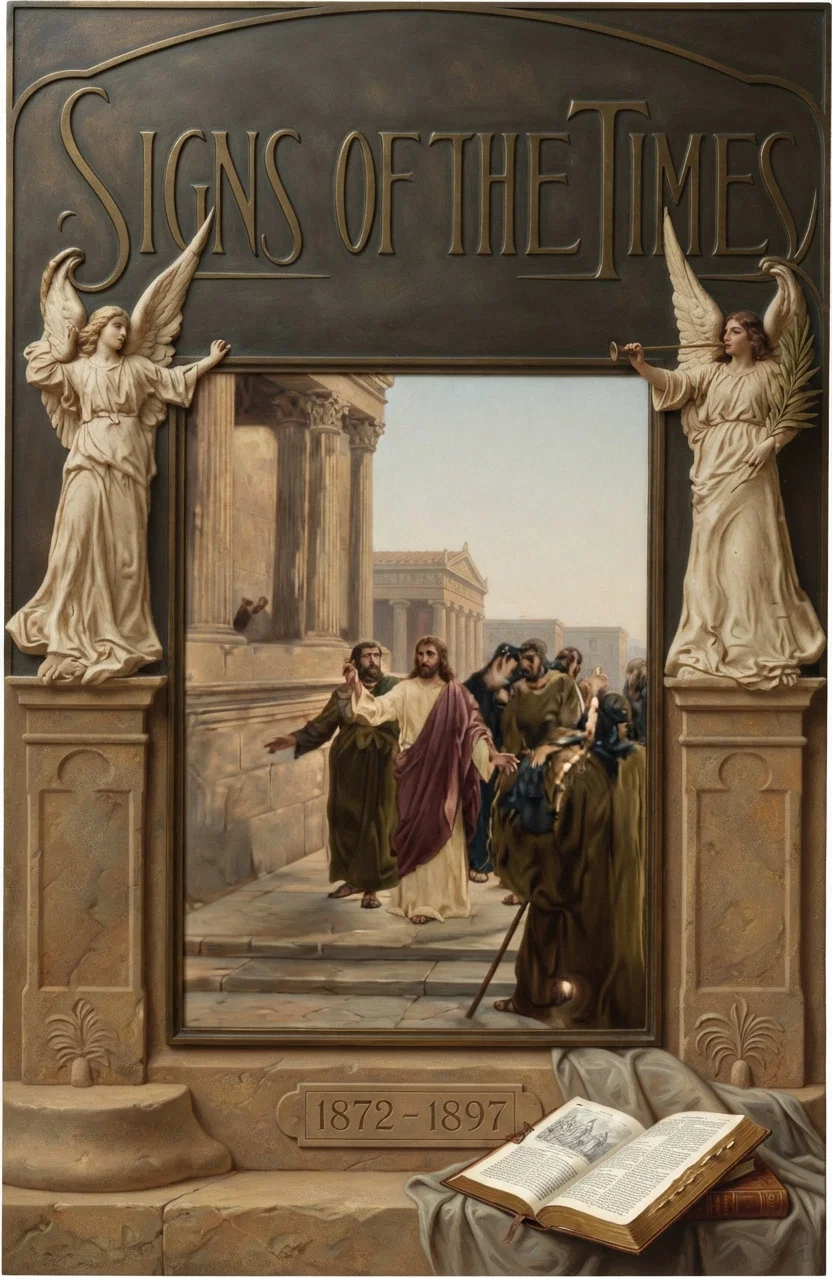
Quarter-Centennial Edition of the
Signs of the Times
Double Number
36 Pages
One Million Copies
This Quarter-Centennial Edition gives a panoramic view of the important events of the last twenty-five years and is a veritable mine of information, brimful of Gospel truths.
Interesting and striking facts are given on the Military and Naval Power of To-Day
Political and Ecclesiastical Changes in Europe
Church and State Union in the United States
Development of the Money Power
Astronomy—Recent Discoveries
Wonderful Inventions
God's Witnesses in Stone
Progress in Medical Science
The Last Reformation
The Gospel of Jesus Christ
False Religions and Isms
Medical Missionary Work
The Open Door for Christ's Ambassadors
Pacific Press Publishing Co., Publishers, Oakland, Cal. Reduced facsimile of first page of Quarter-Centennial Number. Printed in colors
These are but a sample of the score and a half of subjects ably presented, covering a vast field of research and giving up-to-date facts for all classes of society.
This issue is beautifully illustrated by zinc etchings and half-tone engravings. The cover design is printed in three colors, thus making a very attractive paper.
Price of this special double number
# 10c PER COPY
For convenience and to save handling, single copies will be mailed direct from this office when five or more are ordered at one time, and accompanied by the cash, at the rate of 5 cents per copy.
Regular subscription price, one year, 52 numbers including this special issue, $1.00. Six months, 50 cents.
Address
Signs of the Times
Oakland, Cal.
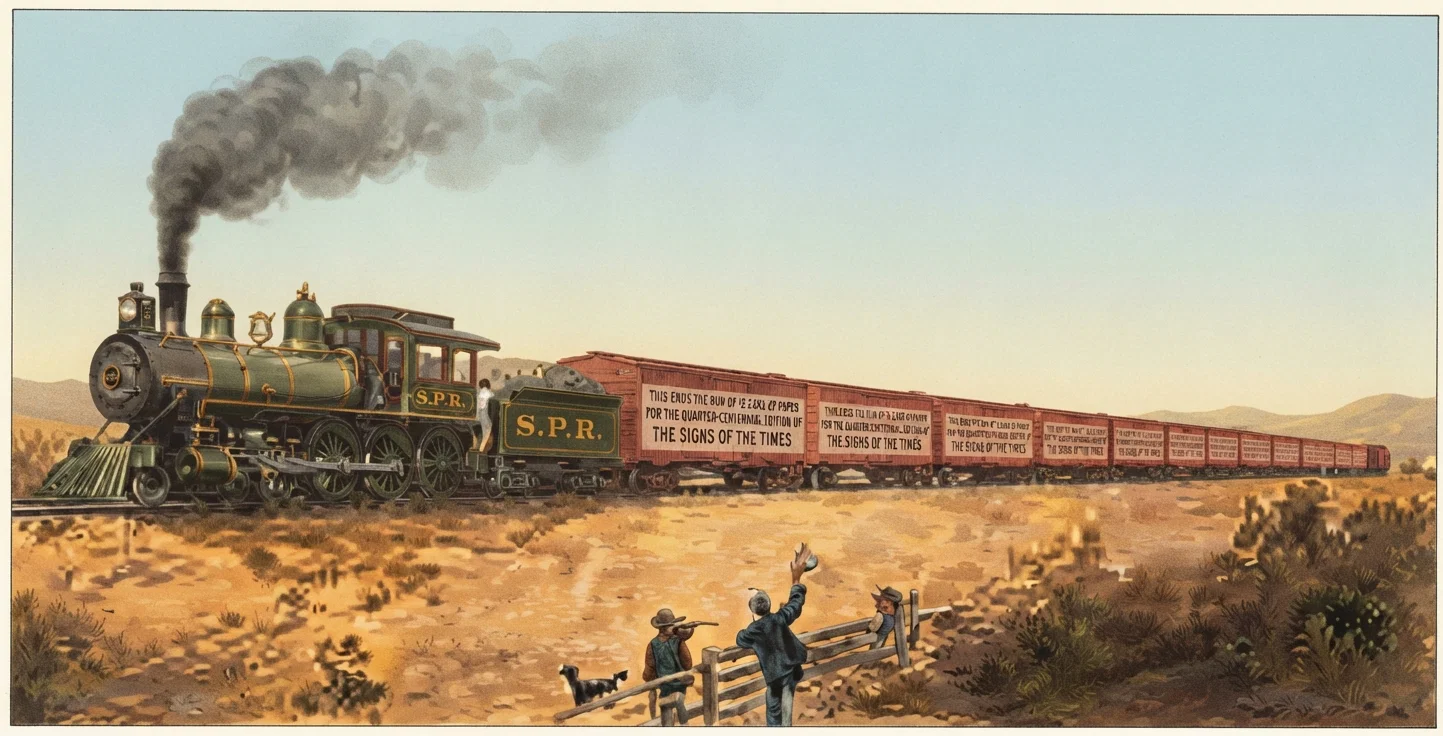
15 CAR-LOADS OF PAPER USED IN CELEBRATING OUR 25th ANNIVERSARY. The largest edition of any newspaper or magazine ever published on the Pacific Coast
Domestic
Domestic.—Over 500,000 tons of steel rails have been ordered during the past week by railroad companies centering at Chicago and Pittsburg. . . . . . The government has sent a large quantity of seeds of various kinds to the Philippine Islands, to test the soil and to produce vegetables for the army of occupation. . . . . . The government has appropriated $25,000 for the construction of a flying-machine, under the supervision of Professor Langley, of the Smithsonian Institute, who has constructed already a successful working model. . . . . . The American Linseed Company filed articles of incorporation on December 5, with a capitalization of $33,500,000. It is also reported that all the large packing-houses in the country have entered a combine, merging into one trust their joint capital of about $75,000,000. . . . . . James Stillman, of New York, has given $350,000 to Harvard College to cover the cost of land and buildings for a projected Harvard infirmary, to bear the name of the donor. . . . . . On account of the great prevalence of typhoid fever among the New York troops stationed in Honolulu, it has been decided to have the troops sent home. . . . . . The battle-ships Oregon and Iowa have sailed from Montevideo for Valparaiso, Chile, where further orders will await them. . . . . . One of the most gigantic trusts in the world was recently formed in New York by the consolidation of nearly all the large flour-mills in the United States. The trust expects to control three-fourths of the flour supply of the world. There is about $150,000,000 represented in its capital stock. . . . . . There is prospect of another Indian war in Minnesota. The Indians on the White Earth and Leech Lake Reservations are openly violating the game laws and defying the wardens to arrest them. They claim to have won a victory over the soldiers at Leech Lake, and are anxious to win another.
The tobacco-growers of Kentucky have organized a combination for the purpose of opposing the tobacco trusts of the country. They are perfecting plans to fight the trusts in the State and Federal courts. . . . . . The transport Minnewaska left Savannah, Ga., on December 5, with a regiment of New York troops for the occupation of Pinar del Rio Province, Cuba. . . . . . The United States gunboat Helena arrived at Gibraltar on December 4, and took on a supply of coal preparatory to the completion of her voyage through the Mediterranean, the Suez Canal, and Indian Ocean, to Manila, where she will join the fleet of Admiral Dewey. . . . . . Another severe storm swept the New England and central States on December 5, wrecking a considerable amount of shipping, and seriously impeding the railway and telegraph service. . . . . . The third session of the fifty-fifth Congress was called to order at noon, December 5, when the President's message was read. The message was one of the most lengthy documents ever presented to Congress by a President, and deals almost wholly with the war with Spain, the events leading up to hostilities, and the results growing out of them. It also refers to American interests in China, urging the appointment of a commission to study the commercial and industrial conditions of the Chinese Empire. The President maintains the equal rights of Americans in the territories of China which have recently come under the influence of other nations; and expresses the cordial sympathy of this nation for the peace proposals of the czar of Russia. An extensive merchant marine is also favored, and a recommendation made for governmental support for American steamship lines. The President advises that the regular army be increased to 100,000 men, and that the volunteers be retained in service until the army reaches that footing. In respect to the navy the President incorporates the report of the Secretary of the Navy, and endorses his recommendations, which are that the navy be increased by the addition of three powerful battle-ships and twelve cruisers of various tonnage. The construction of the Nicaragua Canal is advised, and Congress urged to institute the necessary legislation.
International.—There was another anti-Dreyfus riot in the streets of Paris on December 5, which was with difficulty quelled by the police. . . . . . News from Spain is to the effect that that country is seething with sedition born of bankruptcy and ruin. There is a very strict censorship over the press, and the people are not allowed to know the true condition of the country. . . . . . France is making new and rigorous demands upon China, which are equivalent