A Touch of the Master Relieved the Sick—The Multitude That Thronged to Gaze—His Spirit Averse to Adulation and Pompous Display
MRS. E. G. WHITE
IN the fisherman's home at Capernaum, the mother of Peter's wife is lying sick of "a great fever," and "they tell Him of her." Jesus "touched her hand, and the fever left her" (Matt. 8:15), and she arose and ministered to the Saviour and His disciples.
THE TIDINGS BROUGHT A SICKLY THRONG
Rapidly the tidings spread. The miracle had been wrought upon the Sabbath; and for fear of the rabbis, the people dared not come for healing until the sun was set. Then from the homes, the shops, the market-places, the inhabitants of the city pressed toward the humble dwelling that sheltered Jesus. The sick were brought upon litters, they came leaning upon staffs, or, supported by friends, they tottered feebly into the Saviour's presence.
Hour after hour they came and went; for none could know whether to-morrow would find the Healer still among them. Never before had Capernaum witnessed a day like this. The air was filled with the voice of triumph and shouts of deliverance.
THE LAST SUFFERER RELIEVED
Not until the last sufferer had been relieved, did Jesus cease His work. It was far into the night when the multitude departed, and silence settled down upon the home of Simon. The long, exciting day was past, and Jesus sought rest. But while the city was wrapped in slumber, the Saviour, "rising up a great while before day," "went out, and departed into a solitary place, and there prayed." Mark 1:35.
LEFT THE CROWD THAT THRONGED HIM
Early in the morning, Peter and his companions came to Jesus, saying that already the people of Capernaum were seeking Him. With surprise they heard Christ's words, "I must preach the kingdom of God to other cities also; for therefore am I sent." Luke 4:43.
In the excitement which then pervaded Capernaum, there was danger that the object of His mission would be lost sight of. Jesus was not satisfied to attract attention to Himself merely as a wonder-worker or as a healer of physical disease. He was seeking to draw men to Him as their Saviour. While the people were eager to believe that He had come as a king to establish an earthly reign, He desired to turn their minds from the earthly to the spiritual. Mere worldly success would interfere with His work.
CARELESS CROWD JARRED ON HIM
And the wonder of the careless crowd jarred upon His spirits. No self-assertion mingled with His life. The homage which the world gives to position, wealth, or talent, was foreign to the Son of man. None of the means that men employ to win allegiance or command homage did Jesus use. Centuries before His birth it had been prophesied of Him, "He shall not cry, nor lift up, nor cause His voice to be heard in the street. A bruised reed shall He not break, and the dimly burning flax shall He not quench: He shall bring forth judgment unto truth." Isa. 42:2, 3.
THE PHARISEES AND OSTENTATIOUS CEREMONIALISM
The Pharisees sought distinction by their scrupulous ceremonialism, and the ostentation of their worship and their charities. They proved their zeal for religion by making it the theme of discussion. Disputes between opposing sects were loud and long, and it was not unusual to hear on the streets the voice of angry controversy from learned doctors of the law.
THE MARKED CONTRAST
In marked contrast to all this was the life of Jesus. In that life no noisy disputation, no ostentatious worship, no act to gain applause, was ever witnessed. Christ was hid in God, and God was revealed in the character of His Son. To this revelation Jesus desired the minds of the people to be directed.
The Sun of Righteousness did not burst upon the world in splendor, to dazzle the senses with His glory. It is written of Christ, "His going forth is prepared as the morning." Hosea 6:3. Quietly and gently the daylight breaks upon the earth, dispelling the darkness and waking the world to life. So did the Sun of Righteousness arise, "with healing in His wings." Mal. 4:2.
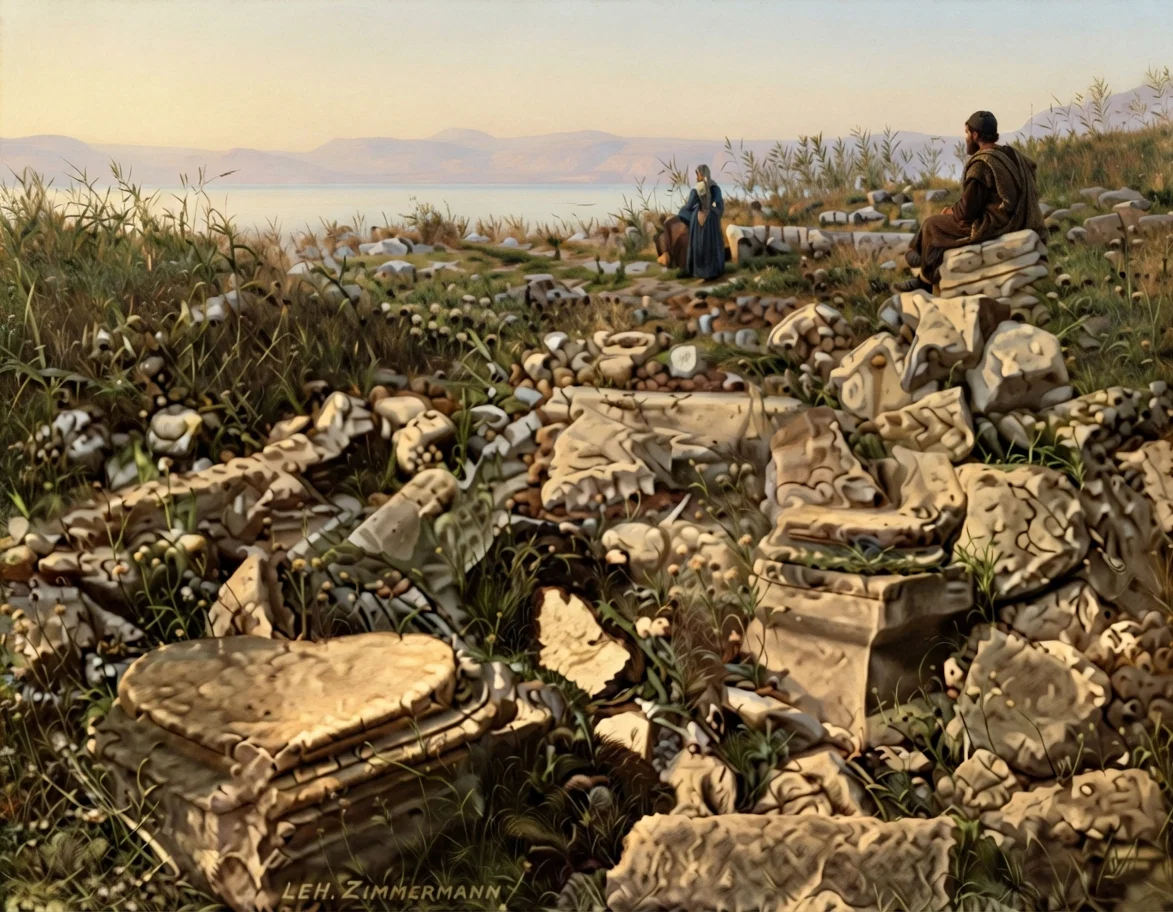
RUINS OF CAPERNAUM
Praying for Understanding
“THOSE who profess to believe the Word, should daily pray for the light of the Holy Spirit to shine upon the pages of the Sacred Book, that they may be enabled to comprehend the things of the Spirit of God. The words of men, however great, are not able to make us ‘perfect, thoroughly furnished unto all good works.’”
Religion’s Dominating Influence
"REMEMBER that in your life, religion is not merely one influence among others; it is to be an influence dominating all others."
Christ's Own Joy in His Second Coming
By Herbert J. Edmed
Looking Forward to the Day When He Can Take His Church to Himself— Such Surpassing Love Should Win Us
HERBERT J. EDMED
THERE is nothing more touching in the Bible narrative of our Lord's life on earth and in heaven than the evidences it gives of His earnest longing for the association of those for whom He died.
LONGS TO BE WITH HIS PEOPLE
As Son of God, He was so infinitely superior to the highest angel, as well as to the best of men,—so much more holy, wise, powerful, and kingly,—that we who are accustomed to the class distinctions and the worship of royal genius common to this world, can never fully understand this trait in the Saviour's character. Yet it is a stupendous truth, as incomprehensible as it is sweet, that He who shrank from being separated from His Father in His humiliation and shame, could not endure the thought of separation from His people when He was to be honored and glorified.
It is somewhat easy for us to grasp the idea that He could yearn for the companionship and sympathy of His brethren when He was here in the flesh as the Son of man. The faithful minister who has labored continuously to win souls for the kingdom, and who has passed through the disappointment of bringing people to the very gates of salvation, so to speak, and then seeing them turn back, can enter into the touching incident in which it is said, "From that time many of His disciples went back, and walked no more with Him." Such a one can know something of the earnest solicitude as the Master inquired of the loyal ones, "Will ye also go away?"
SOLACE IN COMPANIONSHIP
His suggested appreciation of the solace He had found in the companionship of those who, He said, "have continued with Me in My temptations," was perfectly human. The sad incident of Gethsemane, when He wrestled with the immeasurable burden of the world's sin while His disciples slept, does not surprise us when we read that His fevered lips expressed in loving rebuke, "Could ye not watch with Me one hour?" These are all consistent elements of humanity. They serve to convince us that He was really and truly just like us, and as such, when under trial and temptation, yearned for kindred sympathy from those He loved.
WAS EVER LOVE LIKE THIS?
When we think of Him as the divine Son of God, however, possessing all the attributes of Deity, surrounded by ineffable glory, and companioned by His glorious Father and a retinue of sinless angels, then the sublime truth of His longing for human fellowship and association inspires us with inexpressible admiration. We stand entranced, and cry out, "Was ever love like this?"
The apostle Peter tells us that the Old Testament prophecies were inspired by the "Spirit of Christ." 1 Peter 1:10, 11. When those sacred predictions were given, Christ lived in His Father's presence. He stood with God as the highest being in the universe. Heaven was His throne. The earth was only His footstool. The harmonies of heaven, in voicing His praise and holiness, resounded from the lips of ten thousand times ten thousand, and thousands of thousands, of loyal, sinless beings.
PROPHETIC PROMINENCE OF THE SECOND ADVENT
Yet His heart of infinite love for fallen humanity so yearned for them to be with Him, that in all the messages He sent by prophets, by far the greater number of references to Himself in the Old Testament are connected with the subject of His second advent. It has been stated that in the New Testament also from three hundred to four hundred times the Lord has spoken directly, or through agents, of His second coming in glory.
Take the "Gospel of Isaiah," which was sent from glory. The fifty-third chapter, in describing His humiliation, says, "He shall see His seed," and "the travail of His soul." Paul takes up the strain, and names this "the joy that was set before Him." In other words, it may be said that the Saviour's contemplation of His second advent and the resultant association with His followers in glory, brought enough joy to His heart while He was on the cross, that it enabled Him to endure the suffering and despise the shame. Heb. 12:1, 2.
IT WOULD COMPENSATE THE SUFFERING
Or again, while He was yet enjoying the bliss of heaven as Son of God, His love for our association was so great that He felt that the prospect of our being with Him in glory would amply compensate Him for all that He should suffer, and that the compensation would be stronger while on the cross than the suffering. That was love that is stronger than death.
The joy with which He anticipated mingling with the redeemed in glory was really what fortified Him to endure dying in our stead.
TO SHARE HIS GLORY IN HIS PRESENCE
Let us think often and long, too, upon those lover-words Jesus spoke just before He left this earth, when He and the disciples were fast reaching the parting of the ways: "Let not your heart be troubled. . . . I will come again, and receive you unto Myself; that where I am, there ye may be also." John 14:1, 3. I am your lover, going only to prepare our home, and soon I will come back again and take you where we can be together. Just as fair maiden grieves not while her fiance is absent preparing the home, so His disciples must not be troubled; and like the young man, buoyed by the hope of some day bringing her to himself forever to be his, so, said Jesus, I will go, prepare the home, filled with the joy that soon I will have My own with Me.
Then comes the prayer gift, "The glory which Thou gavest Me I have given them"; to be followed by the thrilling request that ascended to His Father, and which He can not refuse, "Father, I will that they also, whom Thou hast given Me, be with Me where I am; that they may behold My glory, which Thou hast given Me." John 17:22, 24.
Such words are suggestive of the most eloquent love story. They breathe the divine Lover's longing for the time when His chaste virgin, the purified church, shall share with Him, as the Lamb's bride, the mansions of eternal glory.
A TOUCHING STATEMENT
There is a significant statement of Paul's in Heb. 10:12, 13, which shows how much value the Lord now places upon His second advent from this standpoint. The apostle affirms that after Jesus had offered one sacrifice for sin, He sat down on the right hand of God. One would suppose that, having gained universal approbation and honor in His victory over sin, He would now think less of the ungrateful race that despised and rejected Him. We might have felt He was justified had He shown less affection for us. The severe contrast between the way we treated Him on this earth, and the honor and love He received in heaven, would have excused Him had His affection and ardor weakened. But it is not so. Paul adds those emphatic words, "henceforth expecting"—lover-like, longing for the final union, living only to intercede for and cleanse His spouse, until the Father can say she is ready.359
ALSO THE LORD'S BLESSED HOPE
No human emotion can express the intensity that is wrapped up in that word "expecting." It is from the Latin ex, out of, and specto, to behold; that is, to look with concern for a thing.
O, yes, the "second coming" event is the dear Lord's blessed hope, as well as it is ours! It will be the time when the two lovers meet in bonds inseparable for eternity; when, "as the bridegroom rejoiceth over the bride, so shall thy God rejoice over thee."
No human love could equal this. Such love is truly divine. The thought is wonderfully emphasized in a love-letter Jesus sent to His church, after He had ascended to His Father, and while in the expectant frame of mind and heart. The first chapter is still suggestive, for it says, "Behold, He cometh with clouds; and every eye shall see Him." The last chapter in its benediction echoes the promise, "Behold, I come quickly"; and in each chapter between, the Lord seems to count the days over and over again, recapitulating events that must first transpire, and then telling how long it will be.
My heart responds in the words of the beloved disciple, "Even so, come, Lord Jesus." That hope is my hope also; and the thought that it is the hope of my Saviour, makes me long for it with an ever-grateful and increasing intensity.
Hold the Banner High
By Ella Stowell Barr
ARE you looking for the Saviour?
Are you longing day by day
To behold Him in the heavens,
Clothed in glorious, bright array?
Does your heart beat high with rapture
As you see the signs appear
Which the prophets said would tell us
That His coming's drawing near?
Are the dearest of your loved ones
Held by Death's relentless grasp?
Does your heart grow sick with longing
Once again their forms to clasp?
Would you hasten the glad morning
When the righteous dead shall be
Brought again from Death's dominion,
Clothed in immortality?
Do you know that by our efforts,
By our prayers, and gifts of gold
Spent in heralding His coming,
Bringing others to His fold,
We can bring the glad day nearer
That shall put an end to strife,
When the dead shall hear the summons
Calling them again to life?
O, then hold the banner higher,
That the world around may know
That there's something more to live for
Than earth's vanity and show.
Keep the beacons brightly burning,
With a sacred flame divine,
So that each benighted trav'ler
May the sure path quickly find.
For the hours are swiftly passing;
Soon will sound the cry, "Too late,"
From the angel who in mercy
Holds ajar the pearly gate.
ELLA STOWELL BARR.
The Word "Angel" as Used in Scripture
By Frank D. Starr
The Term Sometimes Clearly Applies to Men — The Original Word Variously Translated
FRANK D. STARR
L ET us examine the use of the word "angel" in the original Greek, as first written by the pen of inspiration.
In Luke 7:24 we read, "And when the messengers [Greek, "angels"] of John were departed, He began to speak unto the people concerning John."
In Luke 9:52, this language is used: "And sent messengers [Greek, "angels"] before His face: and they went, and entered into a village of the Samaritans, to make ready for Him." Here the term "angels" is unquestionably applied to human beings.
In Matt. 11:10 our Saviour says: "For this is he, of whom it is written, Behold, I send My messenger [Greek, "angel"] before Thy face, which shall prepare Thy way before Thee." As stated in verse 7 of this chapter, the Lord was here speaking of John the Baptist.
The same use of the term "angel" is found in Mark 1:2 and Luke 7:27.
In the Septuagint, the Greek version of the Old Testament, this use of the term "angel" is very common. We will notice a few instances. Haggai 1:13: "And Haggai, the Lord's messenger [Greek, "angel"], spoke among the angels of the Lord to the people, saying, I am with you, saith the Lord." Gen. 32:3: "And Jacob sent messengers [Greek, "angels"] before him to Esau his brother." Here the same word is used as in verse 1, there translated "angels." It will be noted, however, that in verse 1 they are designated as angels of God.
"And there came a messenger [Greek, "angel"] unto Job." Job 1:14. See also Joshua 7:22; Num. 20:14; 2 Chron. 36:15, 16. Scores of instances like these could be cited where the word "angel" (Greek, angelos) is used as applied to human beings.
CONTEXT DETERMINING THE MEANING
As recognized by all scholars, languages, both ancient and modern, are more or less dependent upon the context for the precise determination of the meaning of a word. So whether the word "angel" applies to a celestial or other being will, to some extent, have to be determined by the words with which it is associated.
The three messages of Revelation 14 are proclaimed by three angels. Are these heavenly beings, or is the word "angel" to be here understood in a manner similar to that in connection with the seven churches of the second and the third chapter? Without doubt some heavenly messengers have in charge the work indicated by these movements, but the preaching of the gospel is done by human beings, according to the great commission of our Saviour.
"ANGEL," "GOSPEL," AND "PREACH"
In the statement, "I saw another angel fly in the midst of heaven, having the everlasting gospel to preach unto them that dwell on the earth," the original language gives us three words very similar to each other, derived from the same root. Of course this resemblance is not discernible in our translation. These words are "angel," "gospel," and "preach." The actor, the action, and the thing receiving the action, are all akin to each other. To illustrate, the construction would be somewhat similar to these statements: The dreamer dreamed a dream; the shepherd was shepherding his sheep; the harvester harvests his harvest.
The Greek word for "angel" is thus defined by Liddell and Scott: "A messenger, envoy, one that announces or tells, in New Testament an angel, a bishop or superior of a particular church." Webster defines the word "angel" thus: "Latin angelus, Greek angelos, messenger, a messenger of God, an angel, from angellein, to bear a message, to announce. . . . A messenger."
If the following language were permissible, the text in question could be rendered thus: "I saw another messenger having an everlasting good message to messagize to the people." Of course we have no such word as "messagize"; but if we had, its use in this instance would help us to understand more clearly the close relation existing between the original words here rendered "angel," "gospel," and "preach."
We may approximate the sense by employing such constructions as these: I saw an announcer with an announcement to announce. I saw a preacher with an everlasting good preaching to preach to them that dwell upon the earth.
THE CLOSE RELATIONSHIP
Whatever terms are used, they should be such as will not obscure the close relationship between these three things, the actor, the action, and the object receiving the action,—the angel, the gospel, and the preaching.
In Rev. 9:11 we read of the angel of the bottomless pit. The connection in which this expression is used, shows that it is here applied to the king of the Ottoman empire, Othman, the founder of that empire. In Rev. 9:14, 15, mention is made of four angels bound in the great river Euphrates. We can hardly suppose these angels to be either celestial or infernal beings. A correct exposition of this prophecy shows the language to apply to four sultanries of the Turkish empire.
The Converted Man’s Testimony
"The converted man becomes an agent whom God can employ to work out His purposes. He represents Christ, holding forth to the world His mercy and love. He has a testimony that he desires others to hear. In the language of the psalmist he says: 'Bless the Lord, O my soul: and all that is within me, bless His holy name. Bless the Lord, O my soul, and forget not all His benefits: who forgiveth all thine iniquities; who healeth all thy diseases; who redeemeth thy life from destruction; who crowneth thee with loving-kindness and tender mercies.' Ps. 103:1-4."
"IF GOD SO CLOTHE THE GRASS"
By L. A. R.
As We "Consider," We See the Marvelous Provisions — Nature as a Great Lesson Book — All Designed to Show His Care for You
SOMETIMES we wonder that certain plants can grow all summer long and apparently not receive a drop of water for months. The common plantain is one of these; but when we examine it carefully, and notice how it grows, and the means by which it is able to exist during the long, arid summer, the mystery is clear. God has provided for its life.
THE COMMON PLANTAIN
HOW IT MOISTENS ITS ROOTS
We notice, first of all, that the root is primarily a tap-root, running directly downward from the center of the plant. Out from this center the leaves are spread, sometimes for a foot or more; and every portion of these leaves is so planned and laid out that every particle of water falling on them is carried down to the midrib; and this midrib, being hollowed, like a rain trough, carries all the water to the central portion, to sink into the ground and water the root.
THIS PLANT DOES IT DIFFERENTLY
Not all plants are designed in this way. In the picture accompanying this you will see another plant. The roots are spreading; and the leaves are arranged to drip in such a way as to put every particle of night dew or mist or fog that may be gathered by the leaves, to the place on the ground where the roots need it most. Thus these plants are able to live in a dry climate, in soil that is apparently without moisture. They can gather enough moisture at night, in the dew that falls, to continue life's circle to its close.
"CONSIDER" THEM AND GET THE LESSON
This is one of those phenomena that Jesus points us to when He says, "Consider the lilies of the field, how they grow." "Consider" all the flowers and the plants. If God makes such adequate provision for them, how much more will He do for you!
We will not know about these things unless we consider them. Jesus says, "Consider." It is a strong word. It means to study. It means to think carefully. It means to give our attention to it. Consider the plants, how they grow. And as we consider, we see there the provision of God for their lives and for their welfare. We are to remember that God will do more for us than for them. It is a good, live way to study botany. It puts a vim and a vigor into it that nothing else can. It makes the plants utilitarian. They have a use — a use for our souls.
AS MEDICINES FOR THE SOUL
Some men study plants to gather them for their medicinal purposes, as medicines for the body. Very well; but we may study and gather plants that they may act as medicine to our souls by the thoughts they give us,—thoughts of God, thoughts of peace and not of evil, preparing us for a happy future.
HOW THE HORSERADISH PROLONGS ITS LIFE
Almost every one knows the horseradish, whose roots are gathered and grated by some as a relish.
In the summer-time the leaves of the horseradish are large and thick and wrinkled, almost like those of the pie-plant; but I have observed in Illinois that toward fall, when the nights become cool and the days short, the horseradish puts forth new leaves — leaves that are cut and slashed and apparently torn into ribbons.
This is God's provision for the plant, in order to lengthen its life and give it a longer period of growth. By the cut leaves, the plant is enabled to conserve its moisture. The roots can not gather moisture as rapidly during the colder weather. There is not so much moisture to gather, anyway, in the dry field, and the leaves are likely to lose more moisture than the plant can gather. And so leaves are given it that will allow as little evaporation as possible. Thus the plant lives on for a few weeks or months longer than it otherwise would.
WILL HE NOT PROVIDE FOR ETERNITY?
If God does this to lengthen the life of a horseradish, what will He not do to lengthen the life of you and me? O, we of little faith! If God will make special provision in nature for a few weeks more of life for a horseradish, will He not make greater provision for an eternity of life for you and me?—Yes, He will.
And the provision He has made for us, more than the provision for horseradishes and all the plants that grow on earth, is the provision that we find in the gift of His blessed Son. Thank God for this unspeakable gift! As we look at the plants, consider them, and study them, it should cause us to look to the great things God has done for our souls.
MARKS OF CONDEMNATION
It is true that in nature there are marks of God's condemnation, as is witnessed in the thorns and the thistles and other analogous forms of animal and vegetable life. This condemnation thus pictured in the visible world is but a token of God's condemnation of sin, which, through man's rebellion, has entered into the dominions first given to the man Adam. But the condemnation is of such a character that it constantly points the way from condemnation to a possible justification. For example, while there are thorns, there are also roses. The thorns teach the condemnation, but the roses teach that perfection of character may bud and blossom and come to full maturity.
CENTRIFUGAL AND CENTRIPETAL TRANSMISSION OF WATER
The condemnation taught in nature is therefore one that begets hope in man, and not despair. God employs nature as a pattern of the human soul, picturing its conditions and its possibilities, and thus nature becomes a pathway up to the knowledge of God.
However, we must go to the word of God to find how we may escape the just condemnation of God, and through Christ receive His justification, and the fruition of a heavenly character. L. A. R.
A WORD TO OUR READERS
By Editor
We send no papers from this office to individuals without pay in advance. When persons receive copies without ordering them, they are sent by other parties, and we can give no information in regard to them. Persons thus receiving copies of the SIGNS are not indebted to the office, and will not be called upon to pay for them. Please read the papers you may receive, and hand them to your friends to read.
DATE OF EXPIRATION
The SIGNS wrapper bears date of last issue due on your subscription. Unless renewed in advance, paper stops with expiration date.
If herewith is an order-blank, you will know you have overlooked sending renewal. You will not wish to miss a single issue. Back numbers often can not be furnished.
SCRIPTURE QUOTATIONS
Our authority for the doctrines we teach is the Bible. Quotations are usually from the King James Version or the American Standard Revised.
One new yearly subscription and one renewal, or two new, sent at one time, $3.00.
Two new yearly subscriptions and one renewal, or three new, sent at one time, $4.00.
Three new yearly subscriptions and one renewal, or four new, sent at one time, $5.00.
Five or more copies to one person, six months, each $0.60.
Five or more copies to separate addresses, six months, each $0.65.
Weekly and Monthly SIGNS one year, $2.25.