What love can not win can not rightly be won. What love can not do can not rightly be done. God is love. “What could have been done more to my vineyard that I have not done in it?” God so loved that he gave his Son. “How shall he not with him also freely give us all things?” What shall separate us from the love of Christ? What shall stand before that divine, that infinite power?
Satan and his hosts, and those who receive his spirit, in the last day shall acknowledge, even when too late, that Christ is King of kings and Lord of lords. Yea, every knee shall bow, and every tongue confess, though even when too late, in the awful day when Christ shall come. Bright beams shall stream from the wounded side and the wounded hands. Brighter than all the glory that quavers and gleams through all the heaven above are the beams that come from the wounds which Hate gave to Love when he came to conquer or to die, when he came, yea, to conquer by dying.
O brother, the love of God and of Jesus his Son has not lost its infinite power upon every one who will be saved. There are hearts that seem as hard as a millstone that will be melted into tenderness by the love of God manifested through you. How can they know that God is love, except it be revealed in you? How can it be revealed in you except through the kindness that you manifest in tribulation, under slander, evil words, yea, and evil deeds? Love hopeth all things, endureth all things. Love never fails. What you can not win by argument, what you will only make more impervious, more impossible to win, by contention, you may conquer by love.
O the wonders of God's love revealed through Jesus Christ by you, my brother, my sister, to your own family, to those nearest to you, to your neighbors, who have sorrow and heartaches, yea, even to some who seem prosperous, but who are waiting for a kindly word, a loving smile! There is resurrection power in love.
Let all bitterness, all revenge, be put away. They are of the enemy, and he is a failure. Love is of God, and he can not fail. Go into the fight to win. Let the peace, the quietude, be in your heart, but the fiery zeal and energy, the determination unyielding as adamant, to win, to save, to conquer or die.
All about you, yea, near you, are those whom you may save, if you but have love in your heart, love that never grows weary, love that fails not, that lives, yea, the life of the eternal One, that sings, above the wreck and the ruin that hate has wrought, the everlasting victory.
Are your hands weak? Do your knees tremble? God loves you. Be strong. Carry the message of love, and you shall bring out of the ruin that sin has wrought, souls that can be saved by nothing else or nothing less than the wonderful, blessed love of God manifested through you.
Scripture Cake
By Helen B. Loring
AUNT SUSANNA was troubled,
Worried as she could be;
The ministers were coming,
What would she have for tea?
She’d heated well the oven,
The bread and pies to bake;
“I guess,” said Aunt Susanna,
“I’ll make a ‘Scripture cake.’”
So while the bread was baking,
Intent on kitchen lore,
Her cook-book Aunt Susanna
Was conning o’er and o’er.
And then from out her pantry,
When bread and pies were done,
She took, with careful fingers,
Ingredients, one by one.
From Kings, first, twenty-second,
Of chapter fourth, she took
Four cups, one half; then lightly
This in a pipkin shook.
One cup, one half, 5 Judges,
Verse 25 (last clause),
She next put in the pipkin,
And stirred without a pause.
Then two she took of Nahum,
Verse 12, and chapter third;
And one of 17 Numbers,
Verse 8, with these she stirred.
And now, if you have watched her,
My aunt you might have seen
Two tablespoonfuls taking
Of Samuel 25, fourteen.
She put this in the pipkin,
Sure not a bit to waste;
Then with 9:9, of Chronicles,
She seasoned all to taste.
The prophet Jeremiah
Then helped the cake to mix,
From chapter 17:11,
I saw her beat up six,
And heard her say to grand’am,
“I’m sure this won’t be bad.”
Leviticus then, 13, second,
A pinch I saw her add.
From the last clause of Judges,
The fourth, and verse 19,
She took just half a cupful,
And stirred it in, I ween.
Two teaspoonfuls of Amos
4: 5 to make it light,
“I’m sure,” said Aunt Susanna,
“This cake will be just right.
“And now, as I am meaning
To make it extra nice,
I think I’ll have to follow
Old Solomon’s advice.”
“What’s that? — O look in Proverbs
14, and twenty-three,
And there, for cake and children,
You’ll find the recipe.”
Sub rosa, let me whisper;
Be sure you keep it mum,—
The ministers all liked it,
And ate up every crumb.
— Helen B. Loring, in Good Housekeeping.
The Conversion of Our Children
By T. E. BOWEN
T. E. BOWEN
WE are in the season of our camp-meetings, when many of the youth and children gather at these annual convocations to seek the Lord. These are important occasions, and places to which children and youth should assemble with their parents.
At these meetings opportunities are given to seek the Lord in a special way. And this is right. But there are some points of instruction the Lord has been pleased to give us which parents and others would do well to study. It sometimes occurs that parents, in their great anxiety to have their children go forward in a public profession of Christ, overlook some very important points that have a bearing upon true conversion of heart. The Lord does not always operate in the same manner. And it must be remembered that God is constantly looking upon the heart, and not so much upon the outward demonstrations. Some who seem to have a wonderful experience at camp-meetings may not really make that true and lasting advancement in those inner struggles and victories which count so much in conversion as do those who are more retiring and reserved in their ways.
Again: parents often seem to think that unless some special meeting can be cited where their boy gave his heart to God, or where their girl surrendered to Christ, they have not been accepted of him. This is a mistaken idea. Please study carefully the following words from “Desire of Ages,” page 515:—
“Fathers and mothers should look upon their children as younger members of the Lord’s family, committed to them to educate for heaven. The lessons that we ourselves learn from Christ we should give to our children [in the home], as the young minds can receive them, little by little opening to them the beauty of the principles of heaven. Thus the Christian home becomes a school, where the parents serve as under-teachers, while Christ himself is the chief instructor.
“In working for the conversion of our children, we should not look for violent emotion as the essential evidence of conviction of sin. Nor is it necessary to know the exact time when they are converted. We should teach them to bring their sins to Jesus, asking his forgiveness, and believing that he pardons and receives them as he received the children when he was personally on earth.”
How simple this all is! And the beauty and strength of it is that it is so simple. Neither we ourselves nor our children need go on week after week burdened with a sense of sin. Bring it all to Jesus, in secret prayer, or about the family altar in confession, and then believe Jesus has heard and forgiven, which is really true.
Then so much depends upon the father’s conduct in the home. Often it is that unnecessary harshness that drives the children away from the Lord. “Fathers, provoke not your children, that they be not discouraged” (Col. 3:21), is God’s word upon this point.
“Jesus was the pattern for children, and he was also the father’s example. He spoke as one having authority, and his word was with power; yet in all his intercourse with rude and violent men he did not use one unkind or discourteous expression. The grace of Christ in the heart will impart a heaven-born dignity and sense of propriety. It will soften whatever is harsh, and subdue all that is coarse and unkind. It will lead fathers and mothers to treat their children as intelligent beings, as they themselves would like to be treated.” —“Desire of Ages,” page 515.
Often the confession of parents to the children of their harshness and unkindness and failure to treat them in the home as they should be treated, is the last obstruction needing to be removed from before them in their efforts to find Jesus. The Lord did not fail, but as parents we do, on the point of kindness (not to be interpreted to mean loose government). But simple, heartfelt confession, alone with the children, will bring forgiveness, and prove effective in winning their affection and love both to parents and to the dear Saviour.
Murmuring: Is There no Remedy for It?
By Elsie A. Brown
ELSIE A. BROWN
THE tendency to repine seems fully as strong in human nature to-day as in the days of ancient Israel; and it is by no means those upon whom the hand of affliction has rested most heavily who seem most strongly disposed to this evil, but frequently it comes to us when in the enjoyment of many blessings, with a strength which nothing but the aid of divine power can enable us to resist, while often those suffering under great pressure seem the least inclined to complain.
I recall the case of a young man whom I met while engaged in Bible work in Philadelphia, many years ago, who from an injury to the spine, was paralyzed from the waist down, and had no power to move the lower portion of the body. Although but thirty years13of age, he had lain for five years upon his cot, with no hope whatever of ever being able to rise again in this life. Though naturally proud and ambitious, he was obliged to endure the cross of being supported by his young and not very strong wife, and this left him to be alone much of the time; yet his was an exceptionally bright face and cheerful disposition.
I had also a dear friend in the South who had met with greater reverses in life than any other individual I have ever known. Born to wealth and ease, in a proud Southern family, the idolized daughter of her fond parents, she was united in marriage to one of the same rank with herself, who became an army general and arose to great distinction in the South. She, because of her beauty and culture, added to the advantages already mentioned, became a woman of wide social influence and power.
But seemingly in the midst of the greatest prosperity which the world can bestow, she was stricken and brought low. Her husband came to a sudden death by assassination. A heavy stroke of paralysis left her unable ever again to take a step. The partial paralysis of the vocal organs made it difficult for her to speak so as to make herself understood except by those very familiar with her manner of speech. The wealth, which at this time would have been so great a boon, took wings, as is often the case, and she was left finally to the care of those who were in no way related to her. The stroke, though so heavy, had seemingly left her with unimpaired mental strength, which enabled her to appreciate most keenly the change in her surroundings and circumstances.
The citizens of her home city presented her with a home, which she rented, reserving for herself a single room, and here for long years she lay, nearly as helpless as a babe, in the care of a colored attendant. I visited her often,—during the last year of my stay there, every week, and sometimes oftener,—and more than once, when her affliction and needs had been mentioned, did she say to me, “I don't complain,” and neither did she. Indeed, I do not remember of ever hearing a complaining word from her. She sometimes wept, but not a murmur escaped her lips.
She was of an unusually cheerful disposition, and almost always greeted my coming with a radiant face, and often with a little clapping of the dear hands from which the strength had not been wholly removed. How many sweet and precious lessons I gathered from her, which I would that I could more faithfully put into practise in these days.
The Lord gave her sweet release and rest finally, and for her sake I could but praise his name for it, but in my own life and experience I realized the loss of an association which to me had been most helpful.
O could we but resist the disposition to murmur, to which human nature under trial seems so prone, to what heights might we not hope to attain in blessing the world! The Lord grant us the spirit and power to do it. Does not his Word say, “My grace is sufficient for thee,” and that “sin shall not have dominion over you”? Are we not told that he will subdue our iniquities? The time spoken of by Jeremiah could never come, when the iniquity of Israel shall be sought for, and there shall be none; and the sins of Judah, and they shall not be found, were it not so. “Surely there is an end; and thine expectation shall not be cut off,” and with David we shall yet be able to say, “He hath delivered my soul in peace from the battle that was against me.”
Watrousville, Mich.
The Tongue
By Mrs. M. C. Du Bois
MRS. M. C. DU BOIS
Have you ever thought of the power there is in that little boneless member we call the tongue? What says the Word of God of this member?
“Even so the tongue is a little member, and boasteth great things. . . . And the tongue is a fire, a world of iniquity: so is the tongue among our members, that it defileth the whole body; and setteth on fire the course of nature; and it is set on fire of hell.
“For every kind of beasts, and of birds, and of serpents, and of things in the sea, is tamed, and hath been tamed of mankind: but the tongue can no man tame, it is an unruly evil, full of deadly poison.
“Therewith bless we God, even the Father; and therewith curse we men, which are made after the similitude of God. Out of the same mouth proceedeth blessing and cursing. My brethren, these things ought not so to be.” James 3:5-10.
What a terrible picture is this! The tongue, though so small—what terrible work it can do! Man can do many wonderful things, but the taming of the human tongue is beyond his boasted power.
“The tongue is a fire.” Who has not felt the scorching blast from a fiery tongue, burning with its cruel words to the very heart’s core!
“An unruly evil, full of deadly poison.” Who has not felt the power of an unruly tongue, and this, too, from one professing to love God.
“My brethren, these things ought not so to be.” Who of us is not guilty before God because of the improper use of the tongue?
Only the power of God can tame this fiery little member of our body. Shall we let him subdue this unruly member, and remove the venom from it?
“The boneless tongue, so small, so weak, Can crush and kill,” declares the Greek.
“The tongue destroys a greater horde,” The Turks assert, “than does the sword.”
The Persian proverb wisely saith, “A lengthy tongue, an early death;” Or sometimes takes this form instead, “Don’t let your tongue cut off your head.” “The tongue can speak a word whose speed,” Says the Chinese, “outstrips the steed;”
While Arab sages this impart: “The tongue’s great storehouse is the heart.”
From Hebrew writ this saying sprung, “Though feet should slip, ne’er let the tongue.”
The sacred writer crowns the whole, “Who keeps his tongue, doth keep his soul.”
Grand Ledge, Mich.
Infection from Kissing Animals
The disgusting and dangerous fondling and kissing of beasts can not be effectually opposed, perhaps, on the whole; but some persons may be benefited by the repetition of warnings against the numerous infections which that practise is liable to incur, such as hydatids from dogs, diphtheria from cats and pigeons, and from cats the obstinate and loathsome diseases of the ringworm and favus. Dr. Leviseur suggests this warning in the Medical Record, from having had occasion repeatedly to trace individual cases, as well as small epidemics, of both ringworm and favus to their source in the endearment of cats. He gives two recent cases, with particulars, of both cat and child. Favus, he states, is a disease peculiar to mice, from which the cat gets it.—American Analyst.
The Book “Education”
By S. H. Carnahan
S. H. CARNAHAN
“EDUCATION” is the best book extant on the subject. A careful perusal of it will broaden our ideas in regard to education, which is to train us to be thinkers, and not mere reflectors of other men's thoughts.
It is simply the good, not both the good and the evil, that we should learn. The true teacher is satisfied with nothing short of instilling in the students those principles that will make them a positive force for uplifting souls and helping to establish character.
To be truly educated is to know God, and to be transformed to his image. All in this world who become prepared to render the truest and highest service to God or man, get their training in the school of experience. And if we do not get it in youthful days, much of our life is wasted in selfishness and sin ere we learn it, if we ever do.
Every father, mother, and young person among Seventh-day Adventists should read this book carefully at once. Our canvassers, ministers, and lay members should strive to place a copy in the hands of every public-school teacher and person interested in educational matters.
Through the prophet Hosea the Lord says, “My people are destroyed for lack of knowledge;” and they are rejected because they reject it.
Let us as individuals respond to duty ere the Lord's gracious Spirit ceases striving with us.
Enterprise, Ore.
Central America
By E. L. CARDEY
E. L. CARDEY
Central America, although a near neighbor of the United States, is far distant so far as the people and their habits are concerned. Perhaps there is no place in the world where the people are farther behind the civilization of today than they are in this country. Plows, and such things for tilling the ground are unheard of among the natives. Central America is a rich country in natural resources, and it seems strange that the people of the States have not turned their eyes this way more than they have. The ground is very productive. The growing of bananas and cocoanuts constitutes the chief occupation of the people.
It also seems strange that the attention of our own people has not been turned toward this country more than it has. However, it is true that the truth entered what is known as the Central American Mission field nearly twenty years ago. But the work has been very largely confined to the English-speaking part of the field, which contains perhaps forty thousand people. Then when you consider that there are in this field over three million people, you will see that just a start has been made. The work among the English-speaking people has been very fruitful; as we now have about three hundred and fifty Sabbath-keepers, nearly all English speaking. The work among the Spanish will go much harder and slower, nevertheless this message must be carried to every nation.
Then again we have within our borders other tribes and peoples. There are the Carib Indians, numbering thousands, scattered all along our coasts. Protestant missionaries have done but very little for this people, but we must do something for them.
The Mosquito Indians also are scattered throughout this country. They know nothing about God, much less the message of his soon coming. Only last year the Bible was translated into their language. In many respects they resemble the old American Indians, making their home wherever night overtakes them. The question that confronts us is, How can we take this message to them? Some one will have to give his life to giving them the message. Are there not some strong young people who feel a burden for such a work?
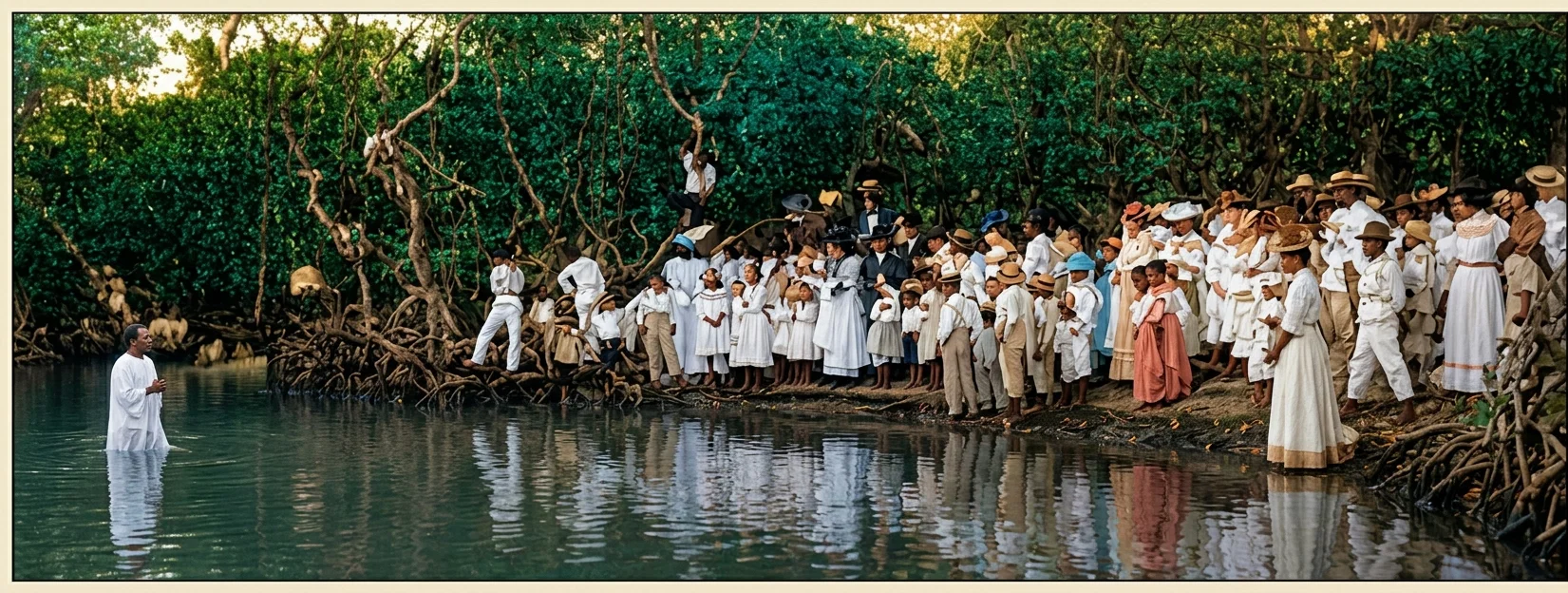
The Lord is blessing our work in this field in all the departments. Since taking up the work here, we have had many evidences that the Lord is doing a quick work in the earth. Seed that has been sown in the past is now springing up, and bearing a hundredfold. In the first part of the month of May the writer held a meeting in French Harbor, Ruatan, Bay Islands. Much interest was manifested, although there was some very bitter opposition. However, at the close of the meetings the Spirit of God had so wonderfully worked on the hearts of the people that twelve souls presented themselves for baptism.
BAPTISMAL SERVICE AT FRENCH HARBOR, RUATAN
Sunday evening, May 19, just as the sun was setting over the western mountains, a large concourse of people gathered on the beautiful shore of the sea to witness the baptism of these dear souls. It was a blessed sight indeed, one that will long be remembered. There is yet a good interest at this place, and we hope that others will soon step out on the platform of truth and righteousness.
At the close of this meeting I went to Bonacca, another of the Bay Islands, and while there held meetings at North East Bight and Mangro Bight. Surely the Lord came near in these meetings. When they closed, there were nineteen souls that were ready for baptism. This was a blessed experience to the writer. Such experiences as these give joy to the heart of the missionary, and inspire him with courage to press the battle to the gates of the enemy.
These dear souls were baptized in the blue waters of the Caribbean Sea. I expect to organize a church at Mangro Bight when I return to that place. The Lord is also working here in Belize. Last Sunday one was baptized here, and at the night meeting two more took their stand to keep the commandments of God and the faith of Jesus. Surely we are in the time of the latter rain, and we praise God that he is sending us a few drops in this part of the great harvest-field.
Daily Life at the Mission
By J. C. Rogers
J. C. ROGERS
At daybreak the missionary arises to call the boys and girls who make up the school. At the rear and to one side of the main building, where the missionary and his family live, stands a row of square, thatch-roofed, one-room houses. These are occupied by boys—three or four in each. On the other side and in the same line, are similar houses for girls. The boys have made themselves little wooden bedsteads, while the girls at this mission sleep on the floor.
The boys quickly dress after hearing the rising call, and are assigned to various kinds of work about the farm. Some have the milking to do; others prepare grain, taking the hulls off by stamping it; others grind this grain in a hand grist-mill, when it is ready for cooking as porridge. Some carry water, others cut wood. Three kinds of grain are chiefly used here, inyauti, poko, and Kafir corn. Inyauti resembles canary seed. Poko is like millet seed, but reddish in color. Inyauti grows on a stalk as high as Indian corn, but the ear, or head, is at the top, and looks like a “cattail” growing in a swamp. Poko grows on a stalk like oats, but the head is like a star-fish with his legs curled up. Kafir corn looks like broom-corn, grows in the same way, and the kernels are the size of small peas.
A small store is kept at the mission, where grain is bought or exchanged for cloth, salt, thread, etc. One native boy has charge of the store, and is trusted with the money, which he faithfully brings to the missionary each evening. It is said that this boy was never known to lose or steal anything.
While the boys are in the field, the girls are cooking the porridge. The cooking is done over a fire of sticks, on the ground, in big kettles held up by long legs. The native kitchen is like their living-houses, twelve feet square, but has a flat iron roof instead of thatch. The only kitchen furniture is a long table made of native wood, sawn by hand.
About eight o’clock the bell is rung for breakfast. The kettle is carried on a pole by two girls, into the schoolroom, used also as dining-room. The furniture of this room is long tables, made by the boys, and fourteen-foot boards sawn by hand and laid on round blocks of logs for seats. These boards serve for dining-room, school, and church services. The15porridge is dipped into white enamel plates. The plates, well filled, are set at the tables. With this thick porridge, milk, or gravy called isitysbo (chabo) is eaten. This makes up the bill of fare.
When all the boys and girls are seated at their tables, the native elder, or leader, of their native church, leads in singing a Zulu hymn, reads a Scripture lesson, and prayer is offered. After giving thanks for the food, it is eaten, usually with much talking and laughing.
Breakfast over, a squad of boys is sent to plow, with the twelve oxen. Another squad is sent to cut poles for building a corn house, or a living-house when needed. These houses are all built here by digging a trench two feet deep, into which poles ten feet long are set upright, close together, all around for walls. On top of these are laid and fastened other poles lengthwise, to which are fastened pole rafters. Other little poles are tied onto the rafters with bark strings, and on these little poles the long grass is laid, six inches deep, and tied with bark, which completes the roof. Then the wall poles are covered over outside and inside with plaster made of clay taken from large ant-hills near by. The ants have mixed a kind of glue with the clay, which, instead of hair or straw, holds the plaster together. The floor is made of the same plaster, with tar or blood mixed in, to harden it.
Between breakfast and school time the girls wash dishes, carry water, get food for dinner, and do other work about the mission house and their own houses. At 11 A. M. the school bell rings. All prepare for class work, and come into the schoolroom at 11:30.
Since the school was started six years ago, Elder Armitage and his wife have taught all the English classes. Besides, he oversees all the farm work, works with the boys much of the time, repairs and makes machinery, pulls teeth, nurses, etc. Being overworked and exposed in all weathers, it is little wonder that weary weeks of racking fever and ague have often reduced him to a skeleton.
From thirty to fifty pupils recite in grades one to five. The fifth grade recites first. Then these “advanced” natives teach the beginning classes in English, while the other grades are heard by English teachers. After all the English classes are heard, the native teachers have Bible and reading classes in their language.
The class exercises close about 4 P. M., when the tables, around which they have studied, are quickly cleared of books. Dinner has been cooking during school, and is served at once. The same coarse porridge is eaten at this meal. In season, green corn or pumpkin is sometimes cooked for dinner.
Again the boys work until sunset, and the girls do their dishes and carry water for morning. At dark the bell calls to night-school. All assemble in the schoolroom. Until nine o’clock the missionary pronounces words, helps in arithmetic, and explains all lessons.
These are but a part of the many things to be done in an African mission.
The missionary’s life is busy from dawn till long after dark. Sometimes a boy or girl who gives great promise of becoming a good worker, teacher or evangelist, and whom the missionary has learned to love as his own, sadly disappoints him, but he works on and prays much, and God gives him courage.
Somabula, Rhodesia.
Come Over and Help Us
“O HEAR the pleading message
From every land and nation!
O haste, and send the answer,
Ye heralds of salvation!
‘Come over, come over,’
I can hear it evermore—
‘Come over, come over,
Come over and help us.’”
A New Company Found in Java Keeping the Sabbath
By GEO. TEASDALE
GEO. TEASDALE
A short time ago we received an invitation to visit a woman, engaged in missionary work, who keeps the Sabbath. Another letter from her contained an invitation for Sister Skadsheim to go and stay with her for a while, and become acquainted with her work.
RIVER SCENE, BATAVIA, JAVA
About fourteen years ago she began to keep the Sabbath, as the result of becoming acquainted with a Seventh-day Baptist, who shortly afterward turned to Sunday-keeping. In the face of much opposition, and alone, she has faithfully endeavored to follow the light. For a time she maintained a connection with the Baptists in Holland; but, because of her belief in the second advent and other things, she is not a member of any denomination. Her father was a missionary to the Javanese, and translated the Bible into their language for the British and Foreign Bible Society, and she has inherited an ardent missionary spirit. Born in this country, she is well acquainted with the habits and languages, and is also possessed of an earnest desire to follow the light as it is revealed to her.
Five years ago the government set apart one hundred and fifty bowers (about two hundred and sixty acres) of land for her to use in connection with her work for poor natives. The government also gave her several thousand guilders to help start the work. Many thousands of guilders have also been subscribed by private individuals. This she has used in improving the land, and helping the natives to build houses, and to become self-supporting. There are about one hundred and seventy persons in her colony, thirty of whom profess to be converted. Ten are baptized, and fifteen others are ready for baptism. They all keep the Sabbath. But I fear that many of them smoke, and probably the women chew. Both of these habits, and also the use of alcohol, are consented to, or indulged in, by the ministers, so we would not be surprised if the simple natives knew no better. The land is very rugged, and is situated on the side of Mt. Mooria, on a cape a little to the east of Samarang. The climate is quite cool, on account of the altitude and the very copious rainfall. Malarial fever is common among the natives. Maize, tapioca, and other vegetables are grown there, and many fruits, also the kapok-tree.
The place is twelve miles from a little town called Tadjio, where there are a few Europeans. For six miles the road is level, but the rest of the way is up the mountain, and must be accomplished on horseback.
In this isolated place Miss Jansk has lived alone with the natives for five years. The work has grown beyond her expectations, and has become too much for her. She had some thought of turning it over to a missionary society operating in Java. But they told her that if they took it, her natives would have to keep Sunday. Rather than have that occur, she determined to carry on the work herself until she died. For some time she has been desirous of obtaining help, and would like a man and his wife to take charge of the colony as managers, and she would work under them. Sister Skadsheim will help her for a while, until we hear from our people in Australia. When Brother Gates comes to Java, we shall visit the colony, and become better acquainted with the situation. There are several young people there, who, she says, are thoroughly converted, and do missionary work in16the neighboring villages. They could soon be trained for laborers in our cause. When we remember that they are already Sabbath-keepers, and have been tested for a number of years, we can see that the Lord has surely gone before us in Java.
This woman begs us to help her in the work. Indeed, she is willing for us to take charge of it, and would gladly labor under our control. The institution lacks a little of being self-supporting; but this amount could easily be made up by a practical manager. Here is an opening the like of which seldom occurs. A consecrated man and his wife, who are acquainted with practical nursing and have some knowledge of agriculture, could do an excellent work. With twenty-five natives already converted, and keeping the Sabbath to begin with, and an estate upon which much money has been spent, it would be a source from which we could obtain a supply of native helpers, who, with further instruction in the school in Singapore, would carry the truth to the millions in Java.
The land is very rough and broken. Spread out in front and on two sides is the sea, from which invigorating breezes undoubtedly blow; while immediately below is a thickly populated flat country, with scores of villages, and thousands of natives. The country is well governed, and traveling facilities and many of the conveniences and comforts of life are moderate in price. We sincerely hope, and constantly pray, that some one will be found willing to, and capable of, taking hold of this important work. There is no time to lose.
The Montana Camp-Meeting
By K. C. Russell
The Montana camp-meeting was held in Helena, Mont., June 13-23. The attendance of our people was considered very good, and there was a fair attendance of outsiders at the evening services.
The business of the conference passed off very pleasantly and satisfactorily. The Lord has blessed in the work of the Montana Conference during the past year in every department, especially in the sale of our literature.
The meeting was blessed with the presence of the Holy Spirit, which was indicated by the converting power of God that prevailed at the meeting in not only reclaiming the backsliding ones, but in reaching those who had never yielded their hearts to God.
Elder Martin was again unanimously chosen president of the conference for another year, and Brethren Stewart Kime and W. H. Holden were ordained to the gospel ministry.
The laborers in attendance at the meeting, besides the regular conference workers, were Elder A. J. Breed, vice-president of the North Pacific Union; Elder H. W. Decker, financial agent of the North Pacific Union; and the writer.
This was the fourth and last camp-meeting that I attended in this union. I most thoroughly enjoyed my visits to the different conferences, and believe that the cause of present truth has loyal and self-sacrificing supporters in this part of the great harvest-field. We shall expect to learn of many recruits from time to time who will respond to the calls that come from the needy fields in the regions beyond. We believe, with the Walla Walla College as a main educational institution in this union, with the various intermediate schools as feeders, that we have reason to expect great things under the blessing of God.
K. C. RUSSELL.
W. JAY TANNER
By W. Jay Tanner
Hayti
CAPE HAYTIEN.—Brother Fawer has just closed a series of meetings here at the Cape, which has resulted in three new Sabbath-keepers. Brother Isaac reports ten new Sabbath-keepers at Plaisance, where I left him to look after an interest that developed as a result of the baptism of a young man about a month ago. This young man, who is a surveyor, had been keeping the Sabbath for nearly a year, and had circulated some of our French literature during this time. His was the first primitive baptism ever held in that locality. All who have embraced the truth there are from the Catholic Church. Those who came into the message last year all seem to stand firm.
I spent last Sabbath at Grand Rivière. I held four meetings, in which, with the Lord's help, I was enabled to dispense with an interpreter. In three of these I presented my subjects in the form of Bible readings, which I had written out in French. But in one service I was able to keep the people interested for an hour, without notes or other helps. This I may call my first real sermon in French. Of course my language was broken, and I am yet a long way from fluency; but I do feel grateful to God for the little progress I have made, and for the fact that I can at last begin to hold the attention of the people when I am presenting this precious truth.
We are all enjoying good health, although it is warmer than I have ever felt it before in the West Indies.
W. JAY TANNER
Mission Notes
THE brother who accepted the Sabbath at Dehra Dun, India, recently, through the labors of Brother and Sister Burgess, was baptized at the Annfield Home. There is a stream running across the estate. A dam was made, and here this dear brother was baptized into Christ Jesus and this precious message. Brother Shaw says, “The Lord witnessed to the occasion.”
IN Japan at the present time there are seventy thousand professed Christians, or about one in six hundred of the population. This, however, represents only a portion of the fruit of missionary work in that empire. Rev. Miyagawa, of Osaka, recently said: “There are in Japan more than one million people who have not publicly professed Christianity, but who are ordering their lives by the teachings of the Bible, and who require now only to be brought to a public confession of their faith.” Dr. Nakashima, Professor of Psychology in the Imperial University, says that this statement is far inside the facts, that the number is greater than Rev. Miyagawa has given it. There has been a rapid increase in Japan in the number of converts within recent years. Of course, many of these are merely nominal Christians; but the leaven is working among the meal, and the honest in heart are giving heed.