It is a wondrous truth that to-day humanity is sitting upon the very throne of God. It is a truth in which each one has a personal interest, that Jesus Christ, having taken our humanity,—he came as Son of man,—lived, died, arose, ascended on high, and sitteth on the right hand of God as Son of man. Not that he bears in heaven our flesh of sin; he still bears our humanity, but it is our humanity glorified. It is the completion of God’s ideal for humanity. He took humanity as we find it to-day,—fallen, sinful. He lived in it, but he glorified that humanity, and he sitteth on the right hand of God to-day in our humanity glorified; and to-day our humanity is thus exalted of God, and having been freed from imputed sin, Christ is bearing our humanity as our brother in the flesh. God looks upon us in Christ as his completed work. Christ was here where we are, was subject to temptations, passed through the grave, was raised on high. That is God’s idea of the experience of humanity. When we receive Christ in place of ourselves, we let ourselves go. Then we enter into the experience of our substitute, and God looks upon him, and sees there what we are in him, and then the work of Christ as our High Priest is to minister to us the power and life that will work this transformation in us. So God sees in him what he will be able to see in us when he takes us to be with him. That is Christian experience; that is the very experience that God has for every one.
Let us inquire, How is it possible for us to enter into this experience? Of what value is it to us to work for God, unless we enter into the experience as set forth? That is the only object, that we may be transformed into the life of Jesus Christ. We found that Christ came to our humanity by birth. The Scriptures emphasize the manner of his birth,—born of a woman, born of the seed of David. He was given to us by birth. And the announcement of the angels to the shepherds was, “Unto you is born this day in the city of David a Saviour, which is Christ the Lord.” Now as Christ partook of our nature by birth, so we must partake of his nature by birth. As Christ was twice born,—once in eternity, the only begotten of the Father, and again here in the flesh, thus uniting the divine with the human in that second birth,—so we who have been born once already in the flesh, are to have the second birth, being born again of the Spirit, in order that our experience may be the same,—the human and the divine being joined in a life union.
Salvation is not something which Christ brings to us and gives to us apart from himself. Salvation is simply Christ himself, and there is no salvation except in receiving Christ himself. We have just so much of salvation as we have of Christ. We are just so far saved as we have the Saviour, and it is by his coming in this way and dwelling in us, that we have salvation. Righteousness cannot be received apart from him; and we have just as much righteousness as we have of Christ, and no more. Unless he is the indwelling Christ, the Saviour that is in us, there is no righteousness in us. We cannot separate any of these things from Christ himself.
We must be born again. “Jesus answered and said unto him, Verily, verily, I say unto thee, Except a man be born again, he cannot see the kingdom of God. Nicodemus saith unto him, How can a man be born when he is old? can he enter the second time into his mother’s womb, and be born? Jesus answered, Verily, verily, I say unto thee, Except a man be born of water and of the Spirit, he cannot enter into the kingdom of God.” John 3:3–5. No one can enter the kingdom of God except he is twice born; once born of the flesh,—that which is born of the flesh is flesh,—and again born of the Spirit,—that which is born of the Spirit is spirit. Let us go into the matter a little more fully, and see what it is to be born again, that we may know how to have the experience set forth here. “When Jesus came into the coasts of Cæsarea Philippi, he asked his disciples, saying, Whom do men say that I the Son of man am? And they said, Some say that thou art John the Baptist: some, Elias; and others, Jeremias, or one of the prophets. He saith unto them, But whom say ye that I am? And Simon Peter answered and said, Thou art the Christ, the Son of the living God. And Jesus answered and said unto him, Blessed art thou, Simon Bar-jona: for flesh and blood hath not revealed it unto thee, but my Father which is in heaven.” Matt. 16:13–17. How could the Father in heaven reveal to Peter the fact that Jesus of Nazareth, the man who lived, worked, walked, ate, and slept, was the Christ, the Son of the living God?—Only by the imparting to him of the divine life that dwelt in Jesus of Nazareth. “Whosoever believeth that Jesus is the Christ is born of God.” Then Peter, born again with that new life, by that very life recognized the same life in Jesus of Nazareth; and he confessed that he was the Christ, the son of the living God. This experience is just as much a real experience of a birth as is our physical birth. It makes no difference whether or not we have our birthday written down. If the graft is there, you know that the grafting has been done. If Jesus Christ dwells in the heart, he will be revealed in the life. The spiritual life is just as genuine a life as is our physical life. We may not be able to tell how long since we were born again, but it matters not; if the life which comes with the new birth dwells in us and shows itself, that is all that is necessary. We are to enter into that experience which Jesus wrought for us and lives to minister to us. He is in heaven as our advocate, and he holds out to us his own heavenly life in the gift of the Holy Spirit. Now to make possible in us the very life that Jesus Christ lived in the flesh, there must be the indwelling presence. He himself must be the power; he himself must live the life. “I am crucified with Christ: nevertheless I live; yet not I, but Christ liveth in me: and the life which I now live in the flesh I live by the faith of the Son of God, who loved me, and gave himself for me.” Gal. 2:20. Here is the union of the new life,—I have been crucified with Christ; I have shared with him in his crucifixion and I live; “yet not I, but Christ liveth in me.” W. W. P.
(Concluded next week.)
THE WORK IN AUSTRIA.
By Louis Richard Conradi
Among the leading kingdoms of Europe, Austria-Hungary has heard the least of the last message, and thus far we have no church there; but we rejoice that there the darkness is also breaking away before the bright rays of the everlasting gospel, and a number of honest souls are being gradually reached by it. Here, as elsewhere, it is evident that the harvest is ripe, but the laborers are wanting. March 4 the writer left Hamburg for a trip extending as far as the Black Sea, and thence to eastern Prussia. The same evening I spoke to the company at Magdeburg. There are some twenty-five Sabbath-keepers here now. The next day was spent at Leipsic, looking after our growing publishing interests; some souls here, also, are investigating the truth. Friday morning, early, found me at Raudnitz, Bohemia, where I held meetings on that day and Sabbath at the home of Brother Simon. A number of strangers attended, among them a young man who has of late taken considerable interest in circulating and selling our literature. Three of us united in the evening in celebrating the ordinances, cheered in the hope that soon the number of believers in Bohemia will be increased.
Sunday morning I proceeded to Prague, the capital, where Brother Simon had secured a room at the house of a friendly Catholic; this room was favorably located for the friends interested here. Some twenty, nearly all men, were with us in our Bible reading in the forenoon; in the afternoon a Catholic came a long distance from the country to attend; but we were fairly startled when some one knocked at the door, and a policeman entered, asking us to show the permission of the magistrate to hold this gathering. Brother Simon had written to a friend to secure it, but it had been neglected. Names were taken of all present, also my passport, and the officer carefully looked at the books which we occupied ourselves with. We continued quietly, but in ten minutes he returned from the near police station, called the meeting dissolved, and ordered us to appear at five o’clock. As I desired to depart that night, the friends went with me to the police court, and took the blame upon them, and my passport was returned. We learned that an enraged husband had betrayed the meeting, because his wife had come down to our meeting against his will. The judge enquired to what denomination I belonged, and when I said “Adventist,” this was something new, and he said he had no knowledge of such a sect’s being tolerated in Bohemia; while the Baptists, after a long struggle, finally are. The friends went with me to the railway station, and the remaining hours were spent in talking about the truth as we went. All urged me soon to return, and there is good hope that with faithful labor a company can soon be gathered at the capital of Bohemia.
The same night I went to Pardubitz, where a publisher is nearly done with a little pamphlet, containing thirty-two Bible readings in the Bohemian language. These readings can also be secured as separate four-page leaflets. He told me that the Catholics were growing more and more bitter against the Protestants. Tuesday evening I spent in Vienna at the home of an interested family whose daughter is the only member233we have in this large city. Her father is employed by the British Bible Society, and for many years has been the leading man in the Baptist church here. He told me that of late they have been fined four dollars for having a Sunday-school at their own house, and that the police also came to their chapel, and took the name of every child and teacher. Wherever Catholicism holds sway, we may surely expect darkness and intolerance. He informed me that in a number of provinces the Bible Society asked in vain for permission to circulate the Holy Scriptures. The respective governors replied that they would be willing to grant permission, but then the clergy would assail them; if the Society could get a certificate or assent from the clergy, the magistrates said they would grant the permission at once. Rome still shuts out God’s word wherever she can. At the same time the Virgin Mary is found in every nook and corner, worshiped under every color and name. There are white and black statues of Mary; each neighborhood has its particular Mary; but it is the “holy” Mary all the same. Any book with her picture and some story about her miraculous power is sold by the thousand; but the word of God is shut out, and darkness and superstition reign supreme. The only hope is that from the great centers the light will radiate to the remote country places; but it will cost money and hard labor, and perhaps many a fine, before we gain a good foothold in these large cities. But we ought to secure this foothold soon; for the time has surely come to enlighten the many millions in this great empire.
L. R. C.
Kronstadt, Hungary, March 15.
TO CORRESPONDENTS.
By G. C. T.
74.—(1) A certain author claims that all prophecy relative to the great day of the Lord was fulfilled at Jerusalem in A. D. 70. He claims that the coming of Elijah was fulfilled in the person of John the Baptist, also that the preaching of the apostles (Col. 1:5, 6, 23) was a fulfilment of the words of Christ in Matt. 24:14. Is that a fact? If not, why not? (2) Is the original of the word “world” in the following texts the same? Matt. 13:38–40; 24:3, 14, 21. (3) Can the word “world” (Matt. 13:39, 40; 24:3, 21) be construed to mean the time just prior to the destruction of Jerusalem? (4) If Zech. 14:1–3 was fulfilled at the destruction of Jerusalem, at what time does the fourth verse of the same chapter refer? (5) Is there any evidence that the eclipse of August, A. D. 64, was what the prophet referred to in Amos 8:9? (6) To what time does Isa. 6:11, 12 refer? (7) If Moses and Elijah were taken to heaven, how can John 3:13 be true? J. T. W.
The above is rather a formidable list of questions to be answered in this department, and they have been lying some time to see if they would not settle into smaller compass. We have condensed them somewhat, and shall have to make the answers quite brief. (1) It is true that John the Baptist is referred to in fulfilment of Mal. 4:5 by Christ himself. It is also evident that John the Baptist did not completely fulfil Malachi’s prophecy. Malachi said, “Behold, I will send you Elijah the prophet before the coming of the great and dreadful day of the Lord.” Christ’s first advent was not the great and dreadful day of the Lord. Christ’s mission to earth embraces the two advents, and each of them is preceded by an appropriate herald. John the Baptist sounded the message which was to serve as a forerunner to his first advent; and the giving of the three angels’ messages of Revelation 14 will complete the fulfilment of this prophecy. It is true, according to Col. 1:6, 23, and other texts of Scripture, that the gospel did go to all the world in the apostles’ time. It is also true that the end did not come then. Our Saviour’s prophecy in Matthew 24 leads, step by step, down to the fourteenth verse, and while it is true that the destruction of Jerusalem and the events which preceded it, were, as we might say, a miniature representation of the final destruction of the ungodly, it was only in that miniature and secondary sense that the prophecies referring to it, meet their fulfilment. The destruction of Jerusalem comes infinitely short of the terrific descriptions that we have of the great day of the Lord. (2) No. The word “world” in Matt. 13:38 and 24:21 is from the word kosmos. In Matt. 13:39, 40 and 24:3, it is from the word aion; and in Matt. 24:14 it is from the word oikoumene. The definition of the first word is “world,” as applied to arrangement, or order,—existing state of things. The definition of the second word is “age,” or “dispensation”; and of the third, “habitable earth.” (3) The word used in Matt. 24:21 might apply at that time, but the one in Matt. 24:3 could hardly be used in that sense, since it means the end of the age, or dispensation, and the destruction of Jerusalem took place near the beginning of the dispensation. (4) The word “if” which introduces this question, overshadows the whole matter; for that the circumstances referred to were not fulfilled at the destruction of Jerusalem, is very evident, even from a casual reading of the Scriptures. “All nations” were not gathered together against Jerusalem, and the Lord did not go forth to fight against “those nations” at that time. (5) Not that I am aware of. (6) Evidently to the same time brought to view in Jer. 4:23–28, and that is after the pouring out of the seven last plagues. (7) Since the Bible is true, it must be true that Moses and Elijah were taken to heaven, and John 3:13 must also be true. Then it is not a question of veracity, but the question of our own understanding. Christ was speaking in John 3 of heavenly things. Notice verse 11: “We speak that we do know, and testify that we have seen.” He then goes on to say that no man has seen those things. He, the One who came down from heaven, is the only competent witness of heavenly things. He does not have reference to the inhabitants of heaven when he makes this assertion, but to the men then on earth; and his statement was evidently true, that amongst all men there was not one who had ever been to heaven, and seen the things of which he bore testimony.
75.—I understand that in Norway the sun does not set for two or three months in the year, and that it is night, or darkness, for the same length of time. How can they keep the Sabbath there from even to even? M. S. W.
This is true of the northern portion of Norway, bordering on the arctic circle, but the fact that we have Sabbath-keepers in that region, who keep the Sabbath without any difficulty, is a practical answer to the question. The senior editor of the REVIEW visited that country less than two years ago, and from an article written by him at that time, we take the following extract: “Now the query sometimes arises, As the Sabbath is to begin at sunset, and the sun here does not set at all, where is the end or the beginning of the day? But the sun does virtually set. It reaches the lowest point in its circuit. In its apparent progress northward, as the summer season is coming on, the sun continually rises earlier and sets later, until finally it just disappears below the horizon, and at length for a time does not disappear at all. But where it did last disappear is the point where it comes nearest the horizon, which marks the lowest limit in its circuit, and shows the complete revolution of the earth, and hence the completion of a day; and that point can be marked just as definitely as if the sun passed from sight. As the season passes, and the sun begins its apparent course southward, it begins again to disappear below the horizon, and the sunset is the same as in other lands; but it continually rises later and sets earlier, until at length, directly in the south, it just appears above the horizon, and then disappears for a time altogether; but where it last disappeared, there it comes nearest the horizon until it appears again, and that point can be determined by the light it sheds upon the heavens; and so the revolution of the earth, which measures the day, can be marked then as accurately as before. And as in the north for a time the setting and the rising of the sun are simultaneous, so in the south for a time its rising and its setting are simultaneous; but the division between the days is just as marked in these northern latitudes as in regions farther south, with which we are more familiar, and the reckoning of the days can be kept without difficulty. So there is no trouble in knowing when the Sabbath comes, and marking its beginning and ending by the course of the sun.”
76.—(1) Do Adventists believe that there is any one in heaven except the Father, the Son, and the angels, who have always been there? (2) Please explain what is meant by “the multitude of captives who were raised at his resurrection,” and followed him, in “Early Writings,” page 58. O. J. S.
We believe that Enoch, Elijah, and Moses are in heaven, the first two having been translated without seeing death, Moses having had a resurrection. Besides these there are others embraced in the answer to question (2). Paul says of Christ, quoting from the Psalms, in Eph. 4:8, “When he ascended up on high, he led captivity captive,” and the marginal reading is, “led a multitude of captives.” We understand that he refers to those spoken of in Matt. 27:52, 53, who had a resurrection at the time of Christ’s resurrection, and accompanied him to the heavenly city.
77.—What are the antecedents of “they” and “his” in Dan. 7:26? Is there a lack of harmony between this verse and Rev. 13:3, in regard to the healing of the wound? J. W.
In reference to the pronouns, it seems evident that the “his” refers to the horn which rose last, subdued three kings, and spoke great words against the Most High, etc.,—that is, the papacy. The pronoun “they” has no direct antecedent, being used probably in a general and indistinct sense, although it may refer more or less directly to the ten horns spoken of in the first part of the 24th verse. The language of Dan. 7:26 is no doubt parallel with that of Rev. 17:12–17, and these two passages of Scripture taken conjointly, give ample room for the fulfilment of Rev. 13:3. The decline of the power of the papacy from its deadly wound in 1798 is not necessarily a steady decline, but one which fluctuates. The ten horns are capricious in their relation to the papacy, sometimes fostering and other times desolating it. The deadly wound is healed by the restoration of this power, and for a short time before the end, the church seems to sit in triumph; then again the rage of these kings is centered upon the papacy, and it is destroyed. They unite in eating her flesh, and burning her with fire.234
78.—Is there any such scripture as this, “Jerusalem, lift up thine eyes, and behold thy Liberator, who comes to break thy chains”? Please answer in REVIEW AND HERALD. L. C. H.
I think there is no scripture that reads so.
79.—(1) Was the Judgment and time of Judgment made necessary by the condition of things in this world, or is it an event that relates to the entire universe, and would have taken place all the same, and at the same time, had this world not gone into rebellion and sin? If the latter is true, then if God creates more worlds with intelligent and accountable beings upon them, would not future judgments become necessary? D. W. A.
The only reply I am able to make to the above question is that our knowledge of other worlds, and of our relation to them, is very limited. God has seen fit in his revelation to make known only those relations which we sustain to our fellow creatures and to himself. From certain passages of Scripture we are led to believe that this is the only fallen world. I refer especially to Matt. 18:12.
80.—Who are the “hundred and forty and four thousand” spoken of in Revelation 14? E. Z. W.
They are God’s accepted people who are living at the time of Christ’s second advent, and are translated without seeing death. They are those who have been sanctified through the truth, and have passed through the trying experiences of the last days, including the seven last plagues. They have gained the victory over the beast and over his image and over his mark, and God has placed on them the seal of his approval. They are a perfect people. In their mouth is no guile, and “they are without fault before the throne of God.” For them the grace of God has done a complete work.
81.—I saw it stated in the answers to correspondents that the children of Israel were in Egypt at least 215 years; but were they not there over four hundred years? See Ex. 12:40; Gen. 15:13; Acts 7:6. J. J. O’H.
The 430 years during which it was predicted that the children of Israel should suffer bondage in Egypt, dated from the time when God was speaking to Abraham. Four hundred and thirty years from the circumstance recorded in Genesis 15, when God made his covenant with Abraham, reached down to the exode. The Lord began to reckon the time of the fulfilment of his promise that he would establish the children of Abraham as his own people, from that time he was speaking to Abraham. This we learn from Gal. 3:17, where Paul states that from the making of the covenant to the giving of the law, was 430 years. But the time actually spent in Egypt was, as stated before, 215 years.
In order to understand this text, it is necessary to read the context, which relates to the work of the gospel worker, and shows that though a man may labor sincerely and honestly, if he does not labor wisely, his work will be built upon a foundation that will not endure,—wood, hay, stubble;—the day that comes will burn it up, and he will be left without the reward he might have had, though he himself may be saved; but he will, as we sometimes express it, barely escape with his life. (2) Paul was speaking of visions and revelations (verse 1), and was describing the vision which he himself had “above fourteen years ago.” He knew that he was caught up into paradise, but whether in the body or out of the body, he could not tell. G. C. T.
ANOTHER FAITHFUL LABORER FALLEN.
By O. A. O.
The sad announcement of the death of Elder J. G. Matteson has already been made, but a somewhat more extended notice of his life and labors will be very proper.
John Gottlieb Matteson was born in Denmark in the year 1835, on the island of Langeland. At the age of twenty he immigrated to this country with his parents, and located at New Denmark, in Brown county, Wis., which was considered new country in those days. In Denmark John had enjoyed good educational advantages, though his parents were not wealthy. Some time after coming to this country he was converted, and began to labor at once to bring others to Christ. Uniting with the Baptist denomination, he entered their college, locating at Chicago, in order to prepare himself for the ministry. He was afterward stationed near Poy Sippi, Wis., in charge of a Baptist congregation of Danish people.
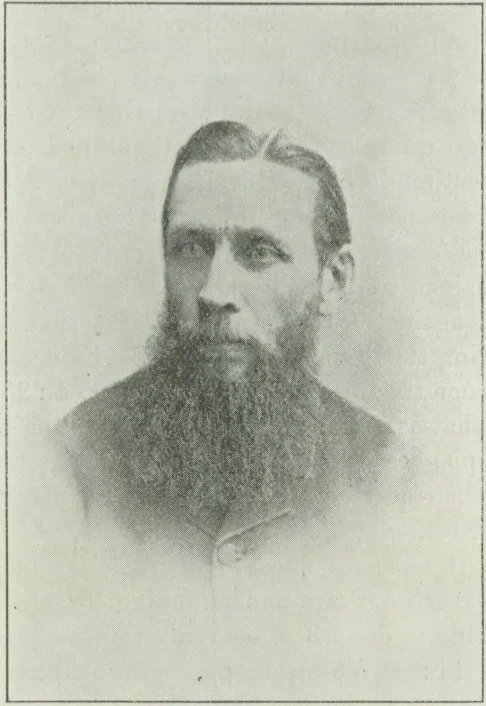
ELDER J. G. MATTESON.
While thus employed, Brother Matteson had his attention called to the truth by Brother P. H. Cady, and after careful investigation, he accepted the light, and connected himself with our people in the fall of 1862. A large part of his former congregation followed him in the truth, and the Poy Sippi Danish church was organized, and became the second Scandinavian church of Seventh-day Adventists, the first being at Oakland, Wis., where the truth found an entrance in the spring of 1858. The accession of Brother Matteson to our ranks was a source of much joy to the people at Oakland; for up to this time there had been no one that could preach the truth to them in their own tongue.
His embracing the truth was also the beginning of a new era in the work of the message, which had previously gone only in the English tongue. He soon began to preach and publish in the Scandinavian language, and the Lord blessed his labors with success. One of his first productions was a tract entitled “Det Nye Testamentes Sabbat” (The New Testament Sabbath), on which he did all the work, not only writing it, but even setting the type himself. This was followed by other publications from time to time.
The next important step was the publication of the Advent Tidende, a twenty-four page Danish monthly, which first began to be issued in January, 1872. It was the first periodical issued by the Seventh-day Adventists in any other than the English language. By means of these publications, and especially the Tidende, a knowledge of the truth reached the Old World, and naturally created a demand for the living preacher. Accordingly Brother Matteson, with his wife, sailed for Denmark in the spring of 1877, and began work at Vejle, meeting with good success. The following year he visited Norway, and in October began to labor in Christiania, where a church of thirty-eight members was organized June 7, 1879. In January of the same year Elder Matteson began the publication at Christiania of the Tidernes Tegn (Signs of the Times), an eight page semi monthly, and two years later the Sundhedsbladet (Health Journal) began to appear. In the years 1883 and 1884 two papers of similar scope to these entered the field in the Swedish language.
Elder Matteson’s labors in Europe extended over a period of ten years, during which time conferences were organized in Sweden and Denmark, and the work well established in Norway. In the year 1888 he returned to America, quite feeble in health. Indeed, he was never robust and strong, though he did a very large amount of work, writing, preaching, and traveling almost incessantly. While conducting a series of meetings in a new place, or laboring among the churches, he would at the same time be doing his regular editorial work, thus really accomplishing the work of two.
Elder Matteson took a special interest in educating young people, and preparing them for service in the cause. Both in Europe and in this country he conducted a number of very successful Bible schools. His last work in educational lines was teaching Bible in the Danish-Norwegian department of Union College, a work which rapidly failing health obliged him to break off about the first of February this year. Hoping that a change of climate would be beneficial, he left College View, and moved to the home of his eldest son, in Southern California; but his stay there was to be but short, for he continued to fail till he fell asleep March 30.
Though delicate in health, Elder Matteson possessed rare vigor of mind and surprising powers of endurance. His thorough acquaintance with both the English and the Scandinavian language, together with his long experience in the work of the message, made his services as editor, translator, and educator especially valuable. A hard worker, and very systematic in his habits, he was able to accomplish a great deal. For a number of years he has been troubled with weak lungs, but this has not prevented him from editing our Danish paper, teaching in the college, and doing a large amount of writing and translating, and some ministerial labor besides.
The deceased leaves a devoted wife and five children to mourn the loss of husband and father. Two daughters have already been laid away to rest in the Lord.
Elder Matteson will be greatly missed, not only by his own loved ones, to whom we extend our heartfelt sympathy, but by a very large number of friends endeared to him by the ties of Christian love. His fruitful and widely extended labors have come to a close; the faithful workman is laid to rest; but the work with which he has been so closely connected, and in which he has acted such an important part, will continue to go forward till it has accomplished the Lord’s purpose; and then the faithful will receive crowns of immortal glory. O. A. O.