CUSTOMS and manners vary in different countries and different ages; but it is interesting to note that the essentials of good form are practically unchanged from century to century. Clement, of Alexandria, Egypt, lived and taught during the second century after Christ. His treatise on table etiquette is still in its essentials binding upon those who would be well behaved at banquets. He says, in one of his books:—
“From all slave manners and excess we must abstain, and touch what is set before us in a decorous way; keeping the hand and couch and chin free of stains, preserving the grace of the countenance undisturbed, and committing no indecorum in the act of swallowing, but stretching out the hand at intervals in an orderly manner. We must guard against speaking anything while eating, for the voice becomes disagreeable and inarticulate when it is confined by full jaws. Nor is it suitable to eat and drink simultaneously ous?
“The natural, temperate, and necessary beverage for the thirsty is water. I, therefore, admire those who have adopted an austere life, and who are fond of water, the medicine of temperance, and flee as far as possible from wine, shunning it as they would the danger of fire.
“Pleasantry is allowable, not waggery. Besides, even laughter must be kept in check; for when given vent to in the right manner, it indicates orderliness; when it issues differently, it shows lack of restraint.
“For, in a word, whatever things are natural to men, we must not eradicate from them, but rather impose on them limits and suitable times. For man is not to laugh on all occasions because he is a laughing animal, any more than a horse neighs on all occasions because he is a neighing animal. We are not to laugh perpetually, for that is going beyond bounds; nor in the presence of elderly persons, unless they indulge in pleasantry for our amusement. Nor are we to laugh before all and sundry, nor in every place, nor about everything.
“And elderly people, looking on the young as children, may, though but very rarely, be playful with them, joking with them to train them in good behavior. For example, before a bashful and silent youth, one might, by way of pleasantry, speak thus: ‘This son of mine is perpetually talking.’ For such a device is instructive, confirming, as it does, what is present by what is not present. Such certainly is the intention of him who says that a water drinker and sober man gets intoxicated and drunk.
“‘In a banquet,’ it is said, ‘reprove not thy neighbor, nor say to him a word of reproach.’ For if the assemblies at festivals take place on account of affection, and the object of a banquet is friendliness toward those who assemble, and meat and drink accompany affection, how should not conversation be conducted in a rational manner, and puzzling people with questions be refrained from, for the sake of affection?’”
The School of Courtesy
By Louise Le Moyne
HOME is the natural school of courtesy. The politeness which is not practiced in the family circle is an artificial thing, no more a part of the character than an overcoat is a part of the man who wears it.
“I want John to go into society young,” said a mother of her son, “so as to learn good manners.” The wiser friend who listened replied, “Keep him out of society till he has learned them.” She knew that the politeness John picked up at parties would be of very little service to him later, while the courtesy ingrained in him by a proper home training would fit him to pass muster at parties, or anywhere else.
The young fellow who sits in the easiest chair in the room while his mother pulls her own chair up to the lamp, has a good deal to learn before he can be called a gentleman. He may have a kind heart and be very fond of his mother, but the courtesy which distinguishes a gentleman has thoughtfulness for one of its main ingredients. The girl who is indifferent about her table manners when only the family are at the table, proves herself not quite a gentlewoman, for such a one recognizes that these refinements of courtesy are a debt she owes to herself quite as much as to others.
Home is the natural school of courtesy, in which fathers and mothers are the teachers. But proficiency in this as in other arts, depends not so much on the skill of the teacher as on the faithfulness with which the pupils practice what they learn.—Louise Le Moyne.
A Flood in China
By Byron A. Meeker
At this writing, July 18, the lowlands all along the great watercourses of South China are covered with water. What is no doubt the worst flood in fifty years is now doing its work of destruction.
One week ago Mrs. Meeker and I returned from Waichow, a city located on the East River about one hundred and twenty miles from Canton by boat. The whole low country along this river is flooded. The day before we left, the water had come up into the basement of Brother Nagel’s house. The mission houses are located on high ground; so when the water reaches the basement, it means that houses in the city are nearly if not entirely covered with water.
It was impossible for us to get a regular boat for Canton, as the water was so high that the larger boats could not pass under the railroad bridge. All along the way the rice fields were flooded, as were also the towns and villages along the river.
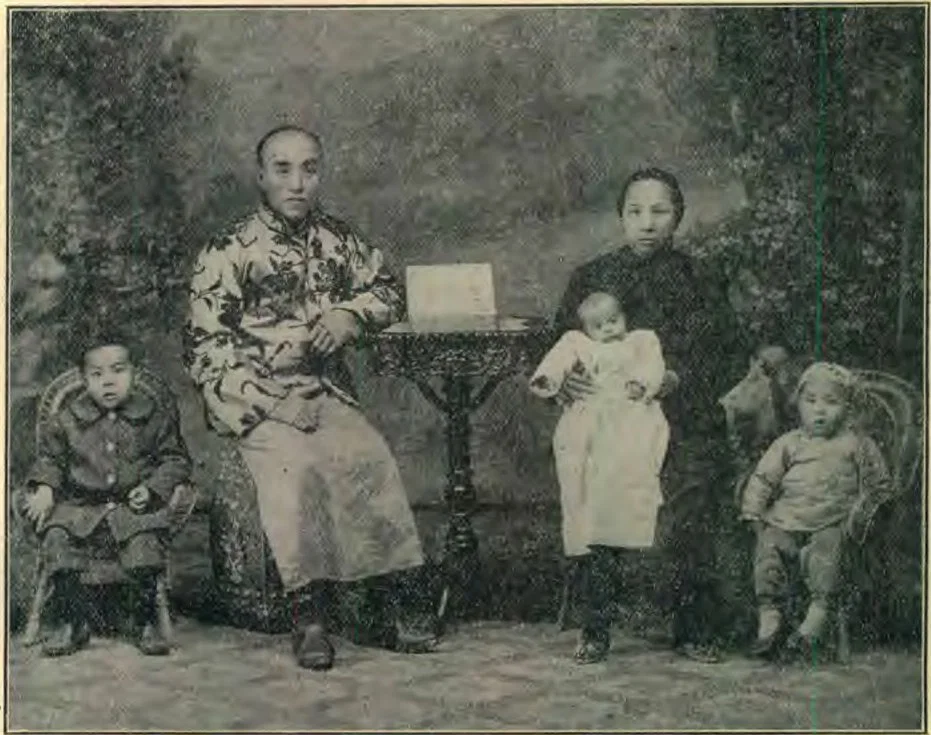
EVANGELIST CHEUNG AND FAMILY, CANTON, CHINA
When we arrived at our home in Canton, we heard that at Wu-chau, a city on the West River, the water had risen sixty-nine feet. Last year the river at this place rose many feet, but Canton did not suffer directly. The day after we reached home, the water came down upon Canton. This is the time of the highest tide of the year; so the high tide acts as a great check to the on-coming flood. The water is held at bay. Tourists in Canton today would have to go sightseeing in boats instead of in the ordinary way.
It is difficult for one to realize the situation. Canton is supposed to have a population something like that of Chicago, and the people live crowded close together. At present they are cooped together in unusually close quarters, many living on temporary stagings. The buildings are largely only one story high. In the suburbs many of the houses are made of adobe. Most of these have fallen down.
The water supply for drinking purposes is bad. Great suffering, especially of the feeble and afflicted, must follow this disaster.
Just after the floods came, a fire broke out in Canton, and it is reported to have destroyed over one thousand lives and two thousand houses. There was plenty of water, but no way to use it as a fire extinguisher.
Canton is only one place of the thousands that are affected by this calamity. Time will tell what the results of the deluge will be; but its meaning is what should concern us. What do all these things now taking place in the world mean? We believe they mean that nothing is secure. Every human refuge is about to fail. Why not learn the lesson, and begin in real earnest to lay up treasure in heaven?
The mission property in the city is flooded, but there is an upstairs; and our homes are on high ground and are not apparently in danger. We believe that God has a special care over the mission property, and we feel grateful to him for his care for us in this heathen land. BYRON A. MEEKER.
Beautiful Belgrade
Mr. Paul du Bochet, a Swiss journalist who recently visited the forlorn capital of Serbia, gives a graphic description of its present desolation. He says:—
“The streets of Belgrade are practically deserted. The city looks as if it had been visited by a plague. There is little life anywhere. Everywhere there are deserted houses, and the desolation of war is seen all about the city. Even the tracks of the street cars are rusting away, as there has been no traffic for months.
“The parks are ruined, the trees shot away, and weeds grow where flowers used to be seen. The university building is almost wrecked by shells, and in ten places its beautiful facade had been pierced by bullets, making a pathetic figure. The king’s palace, too, is no better. A few gendarmes are seen standing before it, looking sad and lonesome. The palace has the appearance of a haunted castle. At the main entrance is written with chalk, ‘Entrance Forbidden.’ Neither high nor low escapes the ravages of war.
“The interior of the palace is almost in ruins. A large shell entered the throne room and smashed the beautiful gold furniture, the magnificent chandelier, and penetrated the walls. There is also a big hole in the roof. The king’s library is also wrecked. The shells have penetrated even to the cellar of the building, smashing some of the supporting walls.
“As a result of the overflow of the rivers Danube and Save, the lower sections of Belgrade have the appearance of a lake. Trees, houses, and furniture are floating about as far as the eye can see. Here and there are sentries on duty, but the population of Belgrade appears to be gone, no one knows where. The city is as quiet as a tomb; there is no business; there are no laughing faces, no children playing in the streets. Everything is dark and forbidding. The tragedy of war has certainly laid its heavy hand on beautiful Belgrade.”
Motion Without Progress: Rocking-Chair Folks
“SOME folks are like rocking-chairs — full of motion without progress.”
Watch-Lighting Device
No more shivering jumps out of bed on dark winter mornings to light a match to see if it's time to get up; for here's a comforting little device which will permit you to lie in bed until the very last minute. Keep it by your bed, and at any time during the night you need only press a button beside your pillow to have a bright light cast on your watch face, instantly showing the hour.
The materials can be purchased at an electrical supply store. Ask for a two-volt battery lamp and receptacle (forty cents); ten feet of No. 18 double conductor lamp cord (ten cents); a pear-shaped push button (fifteen cents); and a dry battery (thirty cents).
A piece of board 5 x 3 x 3 inches, another 6½ x 3 x ¾ inches, and a third ¾ x 1 x 2½ inches, complete the material. The boards should be shaped and fastened together as shown in the illustration, common wood screws being used.
Three small staples will serve to secure the wire on each side of the strip to which the lamp is screwed, and a hook may be used to hang the watch on. A metal strap holds the battery in place. The lamp, battery, and push button are connected as shown in the diagram.—Selected.
Transformation of Indian Thought
A TRACT society in India makes the following remarkable statement:—
“It would be out of place to give names and particulars of the transformation in Indian thought during the past few years, yet as a general fact it may be mentioned that a very large part of our sales of devotional books, such as ‘The Imitation of Christ,’ ‘In Green Pastures,’ ‘Come Ye Apart,’ ‘Daily Light,’ are to non-Christians. Such books are used by the very priests in the preparation of their discourses and prayers in Hindu temples. Whole communities are being influenced in this way.”
The letter printed below is a characteristic document of the present-day Indian Mass Movement:—
“SIR: We have been idolaters in accordance with our ancient custom. Now we have understood there is no use in such worship, and have therefore resolved to turn to Christ. There is no mission working in this region. The Roman Catholics have visited us, but we have heard that there are some defects in their religion. We are farmers. We are very desirous of believing in the Lord Jesus Christ. We therefore beg you to come to us and preach to us (the helpless children of the devil) the good tidings and turn us to the way of salvation. Hoping you will send us a comforting promise. Signed by or on behalf of all the adult inhabitants of Ponnamanda.”— Record of Christian Work.
Discarded Machines
By F. H. Raley
WHAT a sentiment of satisfaction there is in labor well done, no matter what the condition of the performer or of the instrument, so long as the work has been completed and the result of it stands forth and meets the standard of its design.
An evidence of this character may be seen on the Canal Zone at Panama. Scores and scores of truck engines, donkey engines, and locomotives may be seen coupled together on the side tracks, rusting away from the effect of sunshine and rain. By their use, at one time power was generated to remove the materials from a great waterway from ocean to ocean. The work was finished, and now, though worn and weather-beaten, they are evidences of a successful enterprise.
At various places may be seen other machines and engines of a similar character, even more rusty, as large as the others, but without the sentiment of honor there is connected with the first ones; for these began the stupendous task of excavating the Panama Canal, but proved inadequate and were discarded; they failed in the purpose for which they were constructed.
Just so it is, dear friends, in the great work of character building. God has given us the chance to begin a life for eternity, and through Christ we are assured power to make it a success. Though tested severely and worn with service, we should not cause ourselves to be discarded through lack of faith in God's eternal Word, but rather press on faithfully until the day of rewards.
F. H. RALEY.
Cristobal, Canal Zone.
Household Suggestions
INSTEAD of the ordinary method that is used for removing rust stains, try the lemon juice and salt as usual, but place over a steaming kettle. The rust spots will be removed in a few minutes.
Before removing ribbon from lingerie, etc., sew tape, the same length, to one end of the ribbon. In drawing the ribbon out the tape takes its place. When the ribbon goes back again, sew it to the end of the tape, and the tedious task of drawing the ribbon through in the old way is removed.
A satisfactory filling for pincushions can be made of dried coffee grounds, which do not pack down, and never rust the needles.
An excellent way to clean a hairbrush is to take one-half cupful of salt and flour in equal proportions, mix, and rub through the bristles of the brush two or three times. Shake the mixture all out and the brush will be as clean as new. This is better than washing the brush, for it does not soften the bristles.
A sure way to remove ink stains from wash materials is to pour a tablespoonful of kerosene on the spots and rub well. Rinse in kerosene and the spots will disappear as if by magic. This should be done before the regulation washing.
To rid canaries of the parasites which affect them, place a clean white cloth over the cage at night. In the morning it will be covered with very minute red spots, almost invisible without a microscope, which are the vermin so annoying and fatal to birds. Burn the cloth and repeat if necessary.—Selected.
The Hope of Reward Sweetens Labor
“THE hope of reward sweetens labor.”
History of Well-Known Songs
By Lora Clement
LORA CLEMENT
"Jesus, Lover of My Soul"
This beautiful hymn was written by one of England’s most gifted sons, Charles Wesley. Several incidents are suggested as having led to its composition. One is that while preaching in County Down, Ireland, he was attacked by a mob and fled for safety to a near-by farmhouse. Pursued, he finally took refuge under a hedge by the side of a little brook, and there, as the shouts of his enemies drew nearer and nearer, and finally died away in the distance, penned the words which have so often come as a benediction to hearts in their nighttime of sorrow. Another has it that as he stood by an open window one summer day a little bird, pursued by a hawk, sought refuge in his bosom, and inspired the writing of the hymn. Others say that his narrow escape from death during a severe ocean storm led Wesley to “portray in verse the thoughts and sensations of a Christian in deadly peril.” But whatever may have furnished the inspiration, “Jesus, Lover of My Soul” shares with David’s immortal twenty-third psalm the first place in the hearts of thousands, and “the two together voice the creed, the hope, and the prayer of Christendom.”
The music was composed by Simeon B. Marsh, a music teacher of New York State. “One morning in the autumn of 1834 he started on his weekly circuit of singing schools. As he journeyed, the fire of inspiration burned within him, and at the foot of Tribeshill, a few miles west of Amsterdam, he dismounted, and leaving his horse to graze near by, seated himself beneath an elm tree, which stood where now the four tracks of the New York Central Railway bear a mighty commerce to the sea, and jotted down on such paper as he chanced to have, the tune ‘Martyn.’ Arriving at the place of his next appointment, he wrote the new tune on the blackboard for the children’s class.” Encouraged by the welcome it received, Mr. Marsh taught it to his choir, and for the first time it was used in public worship. “The appreciation of the music-loving congregation was instant; but they little dreamed that the fame of the tune they had just heard would be more widespread and enduring than the hills encircling their classic valley, and that its ministry of service would extend through time and eternity.”
"My Faith Looks Up to Thee"
Dr. Ray Palmer, the author of this well-known song, did not pen the words for other eyes. In fact he stated that there was no external cause for its composition, but in the solitude of his chamber, “with a deep consciousness of his own needs, he transferred to paper, as faithfully as he could, what was passing within his own heart.” The words were finally copied into a small morocco-covered pocket notebook which he usually carried. At this time (1875) Dr. Palmer was teaching in New York. Several years later Dr. Lowell Mason met him on the street in Boston, Massachusetts, and asked for contributions to the new hymn and tune book about to be published. The little memorandum containing “My Faith Looks Up to Thee” was shown him, and he asked for a copy of the poem. They stepped into a stationer’s together, and the copy was made. Without much notice Dr. Mason put it into his pocket, but on looking it over later he was deeply impressed with the words, and wrote for them the tune “Olivet,” to which the hymn has been almost universally sung. Meeting Mr. Palmer several days later, he said: “You may live many years and do many good things, but I think you will be best known to posterity as the author of ‘My Faith Looks Up to Thee.’”
"Abide With Me"
The little town of Brixham nestles among the cliffs on the eastern coast of Devonshire, England. Its inhabitants are hardy fisher folk, and this parish was under the care of Rev. Henry Francis Lyte for some twenty-five years. He labored faithfully for his beloved people, though all the while suffering from that dread disease consumption. While still in the prime of life, the time came when he realized that his life work would soon be over, and he prayed earnestly that he might be permitted to do something that would point humanity to the risen Saviour after he had gone to his rest.
In the autumn of 1847 physicians advised Mr. Lyte to give up his work and spend the winter in Italy. On the last Sabbath of his stay in England, September 5, he preached for the last time to his little flock, and celebrated with them the Lord’s Supper. “In words of melting tenderness he pleaded with them to live holy lives; and when he took his leave, there was scarcely a dry eye in the church. The day had been well-nigh perfect, and in the late afternoon, recovering somewhat from the strain of the service, the pastor walked slowly down the terrace to the water he loved so well, and which he knew he was about to leave forever. The benediction of autumn rested upon land and sea, and God’s smile was over all.” As the bright sunset colors faded into twilight, he made his way homeward in prayerful silence and immediately retired to his room. “It was in that hour that the great hymn, ‘Abide With Me,’ doubtless conceived in the walk by the sea, had its birth.” Joining his family later, he read to them the words destined to be a blessing to humanity so long as the heart turns to the Father for help in time of need. His prayer for the privilege of service had been answered.
The actual use of this hymn in church service began in 1861, when it was published in “Hymns Ancient and Modern.” “After one of the meetings of the committee which compiled that book, it was suddenly remembered that there was no tune for hymn 27, whereupon Dr. Monk, the musical editor, sat down and in ten minutes composed the tune that has carried ‘Abide With Me’ to the ends of the earth.”
"Just As I Am"
Dwight L. Moody said of this song: “It has done more good to the greatest number, and has touched more lives helpfully, than any other hymn.” The author, Charlotte Elliott, was born in Brighton, England, March 18, 1789. At the age of thirty-two, severe illness left her a helpless invalid. Rev. Cæsar Malan, a gifted Swiss preacher, was visiting at her home, and one evening they fell into conversation regarding the Christian life. The earnest missionary asked her if she thought herself an experimental Christian. She resented his searching question, and told him that she did not wish to discuss the matter. Dr. Malan answered that he would not pursue the subject if it displeased her, but would pray that she might give herself to Christ. Several days later Miss Elliott apologized12for her abruptness, and confessed that his question and parting remark had troubled her. “I do want to find Christ,” she said; “I want you to help me.” “Come to him just as you are,” Dr. Malan answered; and doubtless he did not dream that these words would inspire a song that, bringing sweet comfort and counsel to troubled hearts, would lead many to the foot of the cross.
Just when the hymn was written is not known, but in 1836 it was first published anonymously. It found its way into scrapbooks and some years later was circulated in leaflet form throughout England. Miss Elliott was at Torquay, under the care of a Christian physician, and he placed one of these leaflets in her hands. “The surprise and pleasure were mutual when she recognized her own hymn, and he discovered that she was the author.”
"From Greenland’s Icy Mountains"
Like many other immortal hymns, this was written hurriedly, to fill a temporary need, and with no thought of its world-wide influence in years to come.
On Whitsunday, in 1819, Dr. Shipley, vicar of Wrexham, preached a sermon “in aid of the Society for the Propagation of the Gospel in Foreign Parts.” In preparation for this service he suggested to his son-in-law, Bishop Heber, on Saturday afternoon, that he write something to be sung in the morning. Accordingly, he retired to a distant part of the study, and in a short time the vicar inquired, “What have you written?” Heber read the first three verses. “There, there, that will do very well,” said Dr. Shipley, but Heber protested that the sense was not complete, and accordingly added the fourth verse. He wished to write still another, but the vicar insisted that it was all right, and so the next morning the hymn was sung in Wrexham church for the first time. It is said that the collection on this occasion amounted to thirty-four pounds. “The original manuscript, bearing the scar of the hook on which it was hung by the printer who put it into type the Saturday it was composed, is still preserved.”
A copy of the words, as composed by Heber, fell into the hands of a lady in Savannah, Georgia, in 1823. She was much impressed with the poem, but could find no tune to suit the measure. Learning of a young bank clerk, Lowell Mason by name, who lived near by, and possessed the wonderful gift of song, she sent a boy over to him with the poem, and in half an hour he returned with the familiar tune which is now universally used in America for “the missionary hymn.”
"It Is Well With My Soul"
In 1874, Mrs. Spafford, the wife of a Chicago lawyer, with their four children, took passage on a French steamer returning to the Continent. A collision with a large sailing vessel in mid-ocean caused the sinking of the steamer, and nearly all on board were lost. Mrs. Spafford gathered her little family on the deck, and knelt in prayer as the boat went down, asking that they all might be saved if possible, or die willingly if that were best. The children were drowned, but the mother was picked up by a sailor, and ten days after the accident landed at Cardiff, Wales. From there she cabled her husband the message, “Saved alone.” D. L. Moody was a close friend of the family, and as Mr. Spafford landed in Liverpool to meet his wife, he left his evangelistic services in charge of others, and hastened to comfort them. “It is well,” said the stricken parents; “we trust an all-wise Father.” They rejoiced even in sorrow that their children had been converted a short time before sailing, and in their memory the bereaved father penned the words of the song which bears the title, “It Is Well With My Soul.”
The “Glory Song”
This stirring hymn is only fifteen years old, yet it has attained unprecedented popularity, and, translated into a score of languages, its influence is world-wide.
The talented author, Mr. Charles H. Gabriel, was born in Iowa, and spent his early years on a farm in that State. At the age of seventeen he was thrown upon his own resources. A fixed purpose, steady perseverance, and untiring industry contributed largely to his success, and as a self-made man he became one of the most popular song writers in America.
While on a bicycle trip with a Chicago publisher, during the summer of 1900, Mr. Gabriel remarked to his friend one day, after a long silence, “I’ve got a song that’s going to live,” and then he repeated part of, “O That Will Be Glory!”
This popular revival melody, which has so thrilled the hearts of men, owes its fame largely to that magnetic gospel singer, Charles M. Alexander. We give in his own words the story of his experience with the “Glory Song:” —
“I remember quite well the first time I saw it in looking over a new songbook. I just glanced at it, and then said to myself, ‘That man has wasted a page, for I do not believe that song will be sung much.’”
“Some months later I stepped into a large Sunday school convention, and heard an audience singing it. It took such hold of me that I could think of nothing else for days thereafter. I began to teach it to large audiences, and soon whole towns were ringing with the melody.”
“In the spring of 1902 I went to Australia at the urgent invitation of Dr. R. A. Torrey, to unite with him in revival services. When I started on this journey I made up my mind that the ‘Glory Song’ should be the popular song of the campaign. I felt that it would stand any pressure that might be brought to bear upon it. I reached Australia a week ahead of Dr. Torrey. I did not know a single person there, but I had several thousand copies of this song printed, and began to prepare for the great welcome meeting in the Melbourne town hall.
“I remember with what anxiety I approached that meeting. I felt that the success of the musical part of the mission depended upon one song catching the brains and hearts of the people. After we had sung a few hymns, I announced that the next would be the ‘Glory Song,’ which was to be the revival song. They picked it up with the usual Australian enthusiasm, and it was an instant success. Within a month it was being sung all over Australia; and a popular writer declared that it had ‘set Australia on fire.’”
Those who desire to pursue this subject further are referred to the following books: “Famous Hymns of the World,” by Allen Sutherland, price $1.50; “English Hymns, Their Authors and History,” by Samuel W. Duffield, price $3.00.
Push: The Door of Success
“ALL those who pass through the door of success find it labeled, ‘Push.’”
Missionary Volunteer Reading Courses
Senior No. 9 — Lesson 1: “Things as They Are,” Pages 1-56
NOTE.—Read carefully the confirmatory notes and the preface. Notice also the glossary. If possible keep with this book a good map of India, and look up every place mentioned in the assignment. Our young people understand, of course, that this book was not written by one of our own missionaries. And while Miss Carmichael does not have all the light on Bible truth which we have, she has written a fine book, from a heart full of love for India. There are two references in this week’s assignment to the natural immortality of the soul, which we, of course, know is not true.
1. MENTION at least three things the confirmatory notes teach about India. Will you read this book, “Things as They Are,” as the writer of the preface suggests? What stimulated the writing of the book? How were the illustrations for it obtained? How did the author feel when she struggled to picture the actual?
2. What experiences during the three afternoon visits among the natives impressed you most? Why? How do the questions asked the missionaries help to reveal the needs of the natives?
3. To what text did the missionary cling? How does the caste system make missionary work very hard? Relate the author’s experience with the old Brahman; with the potter girl.
4. Who is Siva? Why are the devotees of Siva so hard to reach? Who do you think protected Miss Carmichael and Victory from the demon-possessed woman? What may this pathetic experience teach us?
5. What experience did the missionaries have with Wreath? with the girl in Cupid’s Lake village?
6. Contrast your opportunities for becoming a strong Christian with those of the Hindu. Why do Hindus need our prayers?
7. What makes prayer effectual?
8. What in the word picture of the edge of the precipice makes the strongest appeal to you?
9. Describe the two funerals. How did they differ from a Christian funeral? Why did the people bathe after the funerals?
NOTE.—“Livingstone the Pathfinder” is the first of three interesting books the Juniors will read in their course this year. If you have not yet obtained a copy, order one at once from your tract society. When you finish this book, you will take up “Friends and Foes in Field and Forest,” and then comes “Sketches of Bible Child Life.” It would be well for every ambitious Junior to keep a Missionary Volunteer notebook. Jot down in this book things that you hear in young people’s meeting and should remember, and also some of the good things you read. Use several pages of it for Reading Course notes. And now before you begin to read this first book in the new course, jot down in the Reading Course section of your notebook all that you know about Livingstone, and then try to add at least one new item as you read each week’s assignment.
1. PICTURE again in your mind the camp fire scene with which this book begins. Turn to the map in the back of your book and locate the Makololo tribe.
2. What pictures passed before the White Leader’s mind when left alone by the camp fire? Locate the Kalahari Desert.
3. What two things did he do before he went to bed? Why was the camp fire kept burning all night?
4. In what country and village did Livingstone live when a small boy? What were his parents’ names?
5. Who were the Covenanters? Why were they persecuted?
6. What big battle was fought when David was two years old?
7. How old was David when he started to work? Describe his work.
8. What use did he make of his time and money?
9. Do you see anything in the first chapter that helps you to understand why David grew up to be such a successful man? What is it?
10. Why did Livingstone wish to go to China as a medical missionary?
11. How were the difficulties in obtaining a preparation overcome?
12. Why did he go to London in 1838? What interesting place did he visit while there?
13. Why didn’t David Livingstone go to China? And what made him say, “I will go at once to Africa”?
14. Turn to your Bibles and read David Livingstone’s farewell psalm. Then try to think how much you know about the country to which he sailed.
Read It!
By Matilda Erickson
IN the Pacific Press exhibit at the Panama-Pacific International Exposition revolves a very unique globe. It is about five feet in diameter; the surface is dotted with small electric lights of four different colors, representing the Seventh-day Adventist headquarters and mission stations, schools, sanitariums, and publishing houses in all lands; and every time it revolves it tells briefly but emphatically the story of “the Advent message to all the world in this generation.”
You may not see that globe, but it is your privilege to study far more in detail the ever-changing, ever-growing picture of missionary activities in the world. There is a missionary telescope for every Seventh-day Adventist home, and every week it is focused on various points of missionary work.
To him who spends a few hours each week gazing through this missionary telescope, it furnishes a most fascinating, inspiring, and instructive study of God’s work in the world. Little by little the powerful lenses in that telescope draw within range of vision every mission station, with the story of its progress, and every little army of soul winners battling with the powers of darkness in foreign lands. Nor should it be14forgotten that this missionary telescope has also a set of lenses devoted to home missions, and besides these there is attached to it a strong magnifying glass ever discovering new help, comforting promises, and inspiring suggestions for the Bible student.
Some one has said that culture demands that one should know “something about everything and everything about something.” A recent periodical states that Grand Duke Nicholas has demanded that the soldiers in the Russian Army put away their cards and devote their spare time to study of maps and charts or to useful employment. He wants them, so far as possible, to know everything that makes for efficiency in the Russian Army. Surely if there is anything aside from the Bible about which the Missionary Volunteers should know everything possible, it is God’s work in the world; for the Missionary Volunteer is pledged to do what he can to help give the gospel to all the world in this generation.
You are not asking in your heart, What is this missionary telescope for every home? for what could it be but the old faithful Review and Herald, which brings every week to the homes of Seventh-day Adventists its excellent articles on Bible topics, its lucid explanations of Bible prophecies, its genuinely helpful suggestions for home problems, its current history of gospel work in the homeland, and its thrilling messages from the regions beyond?
You cannot be an efficient, live Missionary Volunteer without reading the Review; for next in importance to knowledge of God’s Word comes a knowledge of his work on earth. Then read the Review this week. Read it next week. Read it every week. Read it that you may know how Matt. 24:14 is being fulfilled. Read it that you may be able to pray more earnestly and more intelligently for the needs of Africa, Asia, Europe, South America, and the islands of the sea. Read it that you may be thoroughly prepared to work wherever He calls you to serve. Read it faithfully. Read it regularly. Read it prayerfully. Read it!