It was a fine, warm day. Teddy was lying on the grass under the big elm. Two beautiful birds, with black heads and orange-colored breasts, were very busy in the branches above his head. They were building a nest.
Teddy was quietly watching every movement. He was sure he had seen a picture in mama's bird-book that looked like these birds; and he was going to watch and see how they built their nest. Then he would tell her all about it; and she would find the name of the birds in her book; for that was the way she found the song sparrow's name one day when he was singing in the hedge.
The birds seemed to be very happy in their work. They kept up such a constant chitter-chatter that Teddy wondered if they were really talking, and could understand each other.
Sometimes the long string they were weaving into the nest would get caught in some twig in the big tree. Then again the breeze would carry away a blade of grass at the critical moment. But in spite of these mishaps, the little builders chirped merrily away, the male often pausing to pour out his happy song.
Teddy had heard mama say that people could sometimes learn lessons from birds; and he believed this was a lesson to him—a lesson on patience. Only yesterday he had tried to make a pasteboard box, and the sides would not come even. He tried again and again, and still the sides were uneven. Then he cried, and would have given up; but mama encouraged him, and taught him a little verse,—
“If at first you don't succeed,
Try, try again.”
Teddy remembered how impatient he felt, and he was glad the birds had shown him his fault. Then a little Bible verse that mama had taught him one day in his nature lesson, came to his mind,—“Ask . . . the fowls of the air, and they shall teach thee.” Fowls here meant birds, mama said.
Just then Mr. Oriole flew away; but he was back in a moment with more material for the nest.
“How fast that bird flies! I just believe he has joints in his wings,” said Teddy, under his breath. He was keeping very quiet, that he might not frighten the birds away. Then rising softly, to get a better view, he saw Mr. Oriole bend his tiny legs as he perched on a branch just above the nest, to hand Mrs. Oriole a horsehair. “Yes, sir! he's got 'em in his little legs, too!” shouted Teddy, forgetting that he meant to be oh! so still.
“What is it, Teddy?” called mama, from the porch.
Teddy ran to her side, and told her what he had seen. “Birds have real joints, have n't they, mama?” he asked.
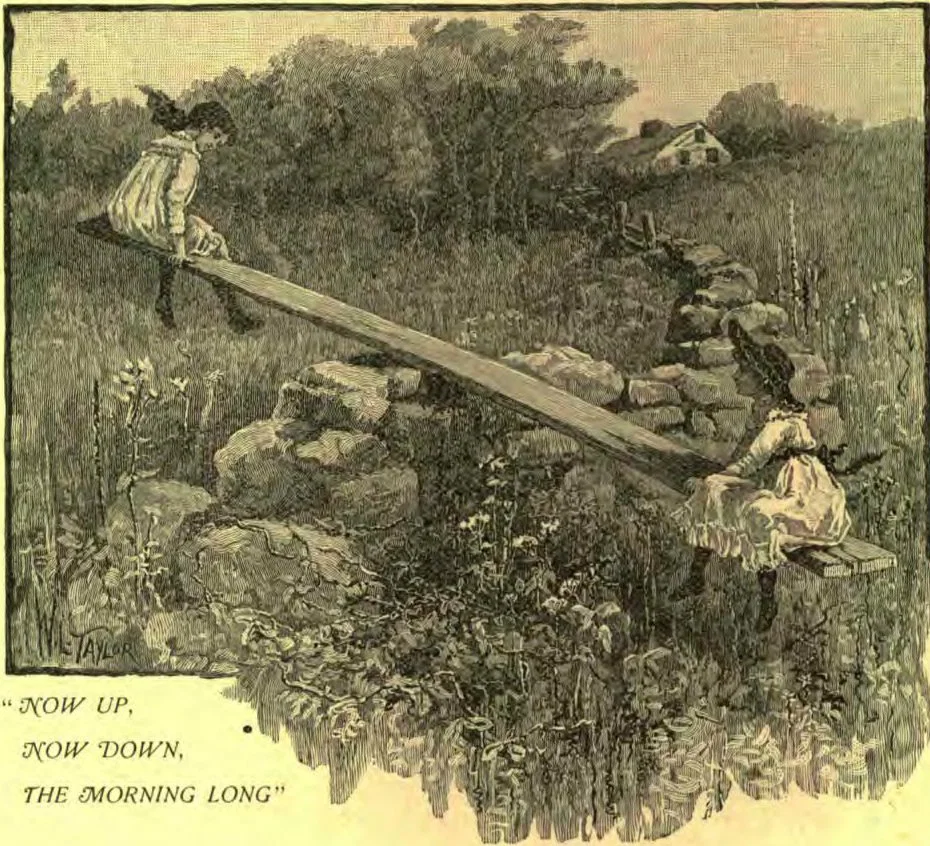
“NOW UP,
NOW DOWN,
THE MORNING LONG”
“Yes,” answered mama, glad that Teddy was so observing. She knew that if he continued to observe the objects in nature, and to learn the lessons they teach, he would some day be a wise and good man. She felt that he ought to know something more about joints, and now was just the time to tell him. So she said, “To-morrow we will learn about the habits of the Orioles, but now I have something more to tell you about joints. We have three kinds of movable joints in our bodies.”
“Three kinds! I thought they were all alike,” exclaimed Teddy.
“No, there are three kinds,” said mama. Taking hold of Teddy's arm, she continued: “Bend your forearm. See how it moves—just back and forth, and no other way. It is like a hinge on a door. For that reason it is called a ‘hinge-joint.’ The joint in the bird's leg is just like the one at your elbow. It is a hinge-joint.
“The joint at your shoulder is called a ‘ball-and-socket joint.’ This joint allows motion in every direction. See! I can move my arm about,—forward, backward, and sidewise. It is this kind of joint—a ball-and-socket joint—that allows the bird's wings to move when it flies.
“There is a little joint here at the wrist. It is called a ‘gliding joint,’ because the bones glide on one another in various directions.”
Mama then took some moist potter's clay, which she kept in a jar, and made a clay shoulder, with a ball-and-socket joint, so Teddy could see just what a ball-and-socket-joint is like. She also let him help her make a gliding joint, to represent the joint in the wrist. They had a picture of the wrist-joint to look at.
For his lesson next day, Teddy made pictures, with his brush and black paint, of the clay joints; and mama told him about that good man David, who said, “I will praise Thee; for I am fearfully and wonderfully made.”
LYDIA M. DROLL.
GERTIE, THE GRUMBLER
It was not at all complimentary, of course, but that was what Gertrude Tucker was called by all her brothers, sisters, cousins, and acquaintances.
“Gertie, the Grumbler,” was just a little brown-haired, brown-eyed girl, with a turned-up nose and about a dozen freckles. The other little Tuckers looked much like Gertie, but in one respect, at least, they were entirely different. The others were merry, pleasant children, easily pleased, and comfortable to live with; but if Gertie had ever been pleased about anything in all the fourteen years of her existence, no one had ever discovered the fact.
The others came in hungry at meal-time, and ate whatever was set before them, without a murmur of complaint, until there was nothing left but the tablecloth and the empty dishes; but Gertie grumbled over the soup, over the shape and size of the crackers, over the temperature of her plate, which no one had ever succeeded in heating to the proper degree, and over all the rest of the dinner, down to the dessert.
When it came to clothes, it was very much the same. The other little Tuckers were always delighted with a new garment of any description, and even welcomed the “hand-me-downs,” as the garments that passed from Johnny to Ned, or from Gertie to Jennie, and so on down to the baby, were called. Jennie, only a year younger than Gertie, but a good deal smaller, had never had anything else but “hand-me-downs;” but she took them all cheerfully, as a matter of course, and never even so much as dreamed of objecting because her red dress was not blue, or her brown dress was made with a full skirt when she wanted it gored.
But if, by any chance, Gertie happened to be pleased with the cloth selected, no one could possibly make the garment to suit her.
But perhaps Gertie was most trying when it came to Christmas or birthday gifts. Her mother stayed awake nights trying to think of just the right thing to buy for Gertie, the Grumbler, but she might better have gone to sleep, as far as the result was concerned. The children, too, devoted most of their pennies to the purchase of something unusually fine for Gertie, if the others had to go without206
If Gertie got a book, she had been longing for a doll; if she found a purse in the toe of her stocking, she “supposed it would have to do,” but she had hoped to find a gold thimble.
One day early in December, Gertie received an invitation to spend a month, including the Christmas holidays, with her Aunt Anna, who lived in the city, where marvelous sights were to be seen. In spite of heroic efforts, Gertie could find no cause for complaint about the invitation, but Mrs. Tucker was discouraged when she found that Gertie’s wardrobe would need replenishing.
“It’s bad enough,” said she, “to make her one new garment at a time, but to think of trying to please her with two new dresses, a jacket and a hat, is enough to give one nervous prostration.”
Gertie’s big brother Tom returned from his medical college for the holidays a few days before her departure for the city, and was much concerned about the little girl’s unfortunate habit.
“Gertie,” he said, “stop grumbling. It isn’t ladylike, and the habit is growing on you. It’s getting to be chronic, and you’d better stop it while you’re young.”
When the day came for Gertie’s departure, her father presented her with a crisp, new five-dollar bill. Gertie’s eyes sparkled; for she had never possessed such a sum before, and she was about to exclaim, “Oh, thank you, papa!” but she remembered in time to pull down the corners of her mouth, and say, mournfully, “Dear me! I wonder if I can get it changed into silver. I should like that so much better.”
“You are to use it for anything you wish,” said Mr. Tucker. “I thought you might like to spend it in some of those big stores.”
Although Gertie did so much grumbling at home, she was too shy and too polite not to give up the unpleasant habit among strangers. Gertie, on her good behavior, was really such a delightful little maiden that her Aunt Anna and Uncle Dick were greatly pleased with her.
She enjoyed the noise and bustle of the great city, and all the unusual sights; but perhaps what she liked best of all was visiting the stores, and making her Christmas purchases. She planned to send a box by express, which was to reach all the big and little Tuckers the day before Christmas, and was planned to fill them with joy and gratitude. She spent much time and thought and all her pocket money upon the contents of the box, and in addition she carefully hemmed a gingham apron for her mother, and made a doll’s dress for little Betty out of the bits of gingham that were left. Altogether, Gertie was delighted with her box; and when at last it was nailed up, and directed plainly in big black letters, and carried to the express-office, she could hardly wait for the postman to bring her the thanks of her grateful relatives.
It was really a very nice box. Considering Gertie’s inexperience, she had used excellent judgment, and all the big and little Tuckers were delighted with their gifts.
“I must write to her at once,” said Mrs. Tucker. “She will be so anxious to know if we like our presents.”
“Mother,” said Tom, “I have an idea—I believe I have discovered a remedy for Gertie’s habit of grumbling.”
“Hurrah for our doctor!” shouted Ned.
“My idea,” Tom went on, placidly, “is to give Gertie a good dose of her own medicine. It will be bitter, but I believe it will do the work. I will write notes of thanks for all of you, and you are to copy and sign them; and unless I am very much mistaken, Miss Gertrude Tucker will resolve on New-Year’s day to stop grumbling forever.”
It took time to persuade gentle Mrs. Tucker to consent to Tom’s plan, but finally she did; and three days after Christmas the mail-bag contained a remarkable collection of letters—all addressed to Miss Gertrude Tucker.
“I already have three pairs of slippers,” wrote her father, “so I have no use at present for the extraordinary pair you sent me, upon which you must have expended as much as twenty-five cents. I suppose you found them on some bargain counter.”
“Twenty-five cents indeed!” exclaimed Gertie. “They cost a dollar, and he said before Christmas he needed some.”
“I was already supplied with more aprons than I needed,” wrote her mother, shedding tears of pity while she penned the cruel words, “and I should have preferred any other color to brown; but I suppose I shall have to be satisfied. The Chinese lily bulbs are a nuisance to plant, and the odor of the blossoms is sickening. I wish you had sent hyacinths instead.”
“And she liked the one Mrs. Brooks gave her last winter the best of anything she had!” wailed Gertie.
“I am sorry,” wrote Tom, “that you wasted your money on a shaving-paper case for me. I am thinking of raising a beard.”
Complacent Johnny, who had never been known to complain of anything short of the toothache, wrote that handkerchiefs were no doubt useful; but that if there was anything on the face of the earth less acceptable than a handkerchief as a Christmas gift, he didn’t know what it was, unless it might be a handkerchief with a letter “J” embroidered in the corner.
“If you must buy cheap perfumery,” wrote Ned, “don’t bestow it upon me. Give it to the cook, or keep it yourself.”
“Ned always helps himself to mine, when I have any,” said poor, bewildered Gertrude.
“How could you buy such homely plaid hair-ribbons?” wrote Jennie, the patient wearer of hand-me-downs. “The book you sent me does not look at all interesting, and I should have preferred a tooth-brush or most anything rather than the photograph-frame you sent.”
“The dress,” printed Betty, “is too small for my old doll, and the new one you sent has yellow hair. Did n’t they have any with brown curls?”
But the last straw was from the baby, who made her mark with much assistance from Tom.
“Got too many bibs and woolly lambs already, and the red comes off the rattle and makes me sick.”
Poor Gertie could not believe her eyes. “Why, the things were beautiful,” said she, “and I never supposed I had such impolite relations! They might at least have pretended to like them. I’m sure I should n’t say such things——”
Then an unpleasant thought came to her.
“I do believe those letters sound like me! Dear me! Is it possible that I am really so disagreeable? I will write to mother right away, and tell her that I did like the pretty waist she sent me, although—” Gertie blushed when she thought of it—“I was going to say that I should have been better pleased with a pink one.”
Three days later she received a very different letter from Mrs. Tucker, who was too tender-hearted to let her suffer long; but Doctor Tom’s medicine had had time to effect a permanent cure, and “Gertie, the Grumbler,” gradually came to be known as “Gertrude, the Good.”—Selected.
Notes and Comments
By A. J. Bourdeau
How to Loosen a Glass Stopper.—To loosen a glass stopper, take a piece of stout string about two feet long; and either tying one end to a stationary object or letting another person hold it, wind the cord about the neck of the bottle once; then move the bottle forward and back a number of times. By doing this the neck of the bottle will become so hot that it will allow the stopper to be taken out at once, without danger of breakage, no matter how thick the glass may be.
Gutta-Percha Trees in the Philippines.—In a recent issue of a German publication it is stated that the Philippine Islands are among the few places where gutta-percha trees will flourish, and the paper suggests the cultivation of these trees as an opportunity for American enterprise. It is well known that rubber is becoming so scarce that, as is the case with paper, new materials are being constantly sought, out of which it, or at least a good substitute, may be manufactured.
A Sane Idea for the Insane.—The directors of the insane asylum at Pontiac, Mich., have given orders that in the laundry department of the institution, electric flatirons be used instead of those heated by gas, as most of the ironing is done by the patients. Electric irons have proved to be peculiarly adapted to insane-asylum service. There is no opportunity for the patients to set anything afire with the irons; and as they are kept at an even temperature, they do not require changing,—an operation requiring the exercise of judgment. This faculty, of course, insane patients do not possess.
One Fruit of Militarism.—Merely to call attention to those countries of the world where the military element predominates, is sufficient to prove the evil effects of militarism. In Germany, for instance, an ordinary citizen can not begin to commit the outrages that are common to the soldiery, without severe punishment. And now it is reported that “instances of brutal treatment of private soldiers by their officers in the Philippines are increasing in number and severity.” Commenting upon this, an exchange says: “Under a régime of militarism, private soldiers and mules would be on an equality, with some advantage to the mule in matters of cruelty.”
Some War Casualties.—At the Moscova, or retreat from Moscow, Russia, the French lost 30,000 men; at the battle of Leipsic, in 1813, the French losses were 65,000 in three days; at Austerlitz the French lost 28,850 men; at Plevna from 18,000 to 20,000 Russians were killed and wounded; and at Gravelotte, in 1870, the Germans lost over 20,000 men, and the French 19,000. The aggregate of the losses at the battle of Stone River, during the War of the Rebellion, was 13,249 on the Federal side, and 10,266 on the Confederate side. At the battle of Gettysburg a large number were killed, and 14,497 wounded on the Federal side; while the Confederates lost 2,592 dead, and 12,760 wounded. Thus it will be seen that the losses reported from the war in South Africa have been slight as compared with those of the great battles of the past.207
A Girl’s Sensible Reply.—The young woman who thinks she will be doing the right thing in marrying a man to reform him from the drink habit, the smoke habit, or any other bad habit, will do well to read with care the following story, told by a correspondent of the Woman’s Journal: “At a hotel where some of us were staying a little while ago, was a beautiful young girl, educated, clever, thoroughly up to date. A handsome fellow was paying her the most devoted attentions, whenever he was sober enough to do so; and all of us felt very anxious lest his attractive manners and lavish display of wealth should win the girl. Late one evening she came into my room, and settling herself among the pillows of the couch, said, ‘John proposed to-night; said I was the only power on earth that could save him; and if I didn’t consent to be his wife, he should fill a drunkard’s grave.’ ‘What did you say?’ I asked, breathlessly. ‘Well,’ she replied, ‘I told him that I was not running a Keeley cure; but if he really wanted to be saved, I would give him the addresses of several that I had heard highly recommended.’”
An Editor’s Perplexity.—The following incident, told with reference to the publication of a certain Bible dictionary, shows how difficult it is nowadays to find intelligent persons who believe the literal statements of the Bible. The editor of the dictionary is said to have given the article on the Deluge to one whom he considered a safe hand; but when the article was sent in, it was found to contain views that would certainly have shocked orthodox readers. It had in it too much of science so-called, and too little of Bible theology. What could be done? The volume had to be published forthwith. In this dilemma the editor put in his dictionary, “Deluge—See Flood.” This, at any rate, postponed the difficulty; and the article on the Flood was given out to a writer who, it was thought, could be better trusted. But when this second article came in, it was found to be worse than the first, and another postponement was necessary. The new volume contained another reference,—“Flood—See Noah,”—the bewildered editor trusting that by the time Noah was reached, he would succeed in finding a man who would be able to mingle so-called science and orthodoxy in due degrees.
Lighting Trains with Electricity.—The trains running on the Paris, Lyons, and Mediterranean Railway, of France, are lighted with electricity. Each car is provided with a dynamo, arranged with its axis parallel to the rails, says the Engineer. A friction wheel on a prolongation of this axis is pressed against one side of a running wheel. In this way the motion of the car-wheel is transmitted to the dynamo, which, in turn, produces the electric light. A friction clutch is so arranged that the disk begins to slip when a current of twenty-eight ampères, at about sixteen volts, is being generated by the dynamo. To develop this amount of current, a speed of about thirty miles an hour is required. At any higher speed than this, the clutch slips, and the dynamo speed is regulated. The most interesting feature, however, of the scheme, is the method of supplying light to the train when it is stationary, or going at slow speed. To accomplish this, the dynamo, while the train is in swift motion, not only furnishes the current for immediate use, but also charges a battery of accumulators, the latter furnishing the required electricity when the train is not in motion.
STUDY the lesson text over and over, till you can answer the questions in the exact words of the text. But do not be satisfied with a mere learning of the text by heart. Study to know what it means, and offer earnest prayer that you may understand it. “Never should the Bible be studied without prayer. Before opening its pages, we should ask for the enlightenment of the Holy Spirit, and it will be given.”
QUESTIONS
1. Who wrote this epistle? What was his position? What is an apostle? Note 1. From whom did he receive this office? V. 1.
2. Who joined with him in the greeting? To whom is the epistle addressed? V. 2.
3. What blessings are proclaimed to those who read this epistle? From whom do these gifts come? V. 3.
4. What does the grace of God bring to men? Titus 2 : 11. To whom does God give grace? 1 Peter 5 : 5.
5. What does the peace of God do for men? Phil. 4 : 7. Of what is this peace the work, or effect? Isa. 32 : 17. How do the Scriptures describe the wicked, or unrighteous? Isa. 57 : 20, 21.
6. What has Jesus done to secure grace and peace for us? Why did he do this? Whose will is it that he should do this? V. 4; note 2.
7. What does Jesus do with our sins? Isa. 44 : 22. What does he ask us to give in return? Prov. 23 : 26. What estimate are we to place upon ourselves, in view of the price paid for us? Note 3.
1. An apostle is one who is sent. Jesus chose twelve, whom he ordained, and sent forth to preach the gospel. Paul was not converted till after Jesus’ ascension, but at his conversion he was called to be an apostle to the Gentiles. Read the account in Acts 9, and note especially verse 15. All through his ministry, Paul was opposed in his work by false brethren. The epistle to the Galatians was written in defense of his office, and of the gospel he preached.
2. Jesus gave himself for our sins; therefore they belong to him. And as they were our sins until he bought them, he must have given himself to us in return for them. This may seem to us like a strange bargain, but it is an evidence of his wondrous love. We ought to be satisfied with such an exchange. Then let him have your sins, and take him instead. And as you receive him, you will learn more and more of the love that led him to die for you. The Lord’s plan is to deliver us from this present evil world. To do this, he does not take us out of the world; but he has prayed for us, that we may be kept from the evil. John 17 : 15. We may sometimes be tempted to complain about the trials and temptations we meet, and to think we could do much better if it were not for the evil around us. But when Jesus has cleansed us from all the evil within us, we may trust him to keep us pure and unspotted from the world.
3. The Lord is disappointed when his people place a low estimate upon themselves. He desires his chosen heritage to value themselves according to the price he has placed upon them. God wanted them, else he would not have sent his Son on such an expensive errand to redeem them. He has a use for them, and he is well pleased when they make the very highest demands upon him, that they may glorify his name. They may expect large things if they have faith in his promises.—“The Desire of Ages,” page 668.
4. The business man may conduct his business in a way that will glorify his Master because of his fidelity. If he is a true follower of Christ, he will carry his religion into everything that is done, and reveal to men the spirit of Christ. The mechanic may be a diligent and faithful representative of him who toiled in the lowly walks of life among the hills of Galilee. Every one who names the name of Christ should so work that others, by seeing his good works, may be led to glorify their Creator and Redeemer.—“Steps to Christ.”
Chicago & Grand Trunk R'y
E. W. Meddaugh and Henry B. Joy, Receivers.
Chicago & Grand Trunk R'y.
Trains arrive and leave Battle Creek.
WEST-BOUND FROM BATTLE CREEK.
No. 9, Mail and Express, to Chicago — 12.15 P. M.
No. 1, Chicago Express, to Chicago — 9.00 A. M.
No. 3, Lehigh Valley Express, to Chicago — 3.40 P. M.
No. 5, Pacific Express, to Chicago, with sleeper — 1.10 A. M.
No. 75, Mixed, to South Bend — 8.20 A. M.
Nos. 9 and 75, daily, except Sunday.
Nos. 1, 3, and 5, daily.
EAST-BOUND FROM BATTLE CREEK.
No. 8, Mail and Express, to Pt. Huron, East, and Detroit — 3.45 P. M.
No. 4, Lehigh Express, to Port Huron, and East — 8.27 P. M.
No. 6, Atlantic Express, to Port Huron, East, and Detroit — 2.25 A. M.
No. 2, Leh. Exp., to Saginaw, Bay City, Pt. Huron, and East — 6.50 A. M.
No. 74, Mixed, to Durand (starts at Nichols) — 7.15 A. M.
Nos. 8 and 74, daily, except Sunday.
Nos. 4, 6, and 2, daily.
A. S. PARKER, Ticket Agent,
Battle Creek.
Cincinnati Northern Railroad Co.
TIME TABLE NO. 3.
In Effect Sept. 24, 1899.
Trains Pass Battle Creek, as follows:
WEST-BOUND.
No. 21, Mail and Express ................................ 6.58 P. M.
No. 23, Accommodation .................................... 2.07 P. M.
No. 27, Local Freight ........................................ 8.25 A. M.
EAST-BOUND.
No. 22, Mail and Express ................................ 8.25 A. M.
No. 24, Accommodation .................................... 1.45 P. M.
No. 28, Local Freight ........................................ 5.30 P. M.
Direct connections are made at Toledo with all roads diverging. Close connections for Detroit and Cincinnati.
J. L. READE,
Ticket Agt., Battle Creek.
E. R. SMITH, City Pass. Agt., 6 West Main St.
To Reach BATTLE CREEK
FROM
CHICAGO, BUFFALO, DETROIT, OR TOLEDO,
Purchase Tickets Reading over the MICHIGAN CENTRAL
“The Niagara Falls Route.”
A First-class Line for First-class Travel between Chicago and New York and Boston. Elegantly equipped through trains pass Battle Creek in each direction daily.
R. N. R. WHEELER, Ticket Agent, Battle Creek.
O. W. RUGGLES, Gen’l P. and T. Agt., Chicago, Ill.
TAKE THE Canadian Pacific Railway
for . . . CHATHAM, LONDON, WOODSTOCK, PORTLAND, OTTAWA, GALT, TORONTO, and MONTREAL, QUEBEC, BOSTON,
All points in New England, the Maritime Provinces, Great Britain, and the Continent.
Illustrated literature, time-tables, and full particulars, upon application to—
J. FRANCIS LEE, GEN. AGENT,
Passenger Dept. 228 SOUTH CLARK ST., CHICAGO
Branch Offices: 76 Ottawa St., Grand Rapids, Mich.; Room D, Chamber of Commerce, Cincinnati, Ohio; 315 Chestnut St., St. Louis, Mo.
RULES FOR GIRLS WHO LONG TO BE POPULAR
Under this heading an exchange prints eight excellent “rules,” whose aim is to bring about the result desired; and while it is undoubtedly true that if girls would live up to these rules, they could hardly fail to be popular in the best sense of the word, it is also true that the girl who does, or refrains from doing, certain things by rule, is likely to be about as attractive as the oddly trimmed and repressed trees beloved of Japanese gardeners but avoided by the admirer of nature’s graceful lines. The girl who desires to be so lovely in character as to win the good-will and regard of all whom she meets, not for self-gratification but in order that she may be a help and blessing to others, will always be glad of suggestions that will aid in perfecting such a character. For such, these “rules” already mentioned, or “suggestions,” as we prefer to call them, are given:—
“1. Remember that a good voice is as essential to self-possession as good ideas are essential to fluent language. The voice should be carefully trained and developed. A full, clear, flexible voice is one of the surest indications of good breeding.
“2. Remember that one may be witty without being popular, voluble without being agreeable, a great talker and yet a great bore.
“3. Be sincere. One who habitually sneers at everything not only renders herself disagreeable to others, but will soon cease to find pleasure in life.
“4. Be frank. A frank, open countenance, and a clear, cheery laugh are worth far more, even socially, than ‘pedantry in a stiff cravat.’
“5. Be amiable. You may hide a vindictive nature under a polite exterior for a time, as a cat masks its sharp claws in velvet; but the least provocation brings out one as quickly as the other. Ill-natured people are never liked.
“6. Be sensible. Society never lacks for fools, and what you may consider entertaining nonsense may soon be looked upon as very tiresome folly.
“7. Be cheerful. Even if you have some trouble on your mind, you have no right to render other people miserable by your long face and dolorous tones.
“8. Above all, be cordial and sympathetic. True cordiality and sympathy unite all the other qualities enumerated, and are certain to secure admiration and respect.”
Union College Year-Book Received for 1900-1901
The Year-Book of Union College, 1900-1901, has just been received. Prospective students and all other interested persons will find much practical information in its columns. It is well printed and illustrated, and will be sent free to all who desire it. Address W. T. Bland, Union College, College View, Neb.