The Youth’s Instructor, Vol. XLIX, No. 46

A THANKSGIVING DAY

The Youth’s Instructor

November 21, 1901

Review and Herald Publishing Company · Battle Creek, Mich. · November 21, 1901

A THANKSGIVING DAY

I THANK thee, Father, for this sky, Wherein thy little sparrows fly: For unseen hands that build and break The cloud-pavilions for my sake,— This fleeting beauty, high and wild, Toward which I wonder as a child; And thanks for the morning’s stir and light, And for the folding hush of night; For all the foam and surge of bloom; For leaves gone glorious to their doom.
I thank thee for the strengthening hills, That give bright spirit to the rills; For blue peaks soaring up apart, To send down music on the heart; For tree-tops wavering soft and high, Writing their peace against the sky; For forest farings that have been; For this fall rain that shuts me in, Giving to my low little roof The sense of home, secure, aloof.
Father of life, I thank thee, too, For old acquaintance, near and true,— For friends who came into my day, And took the loneliness away; For faith that held on to the last; For all sweet memories of the past,— Dear memories of my dead that send Long thoughts of life, and of life’s end, That make me know the light conceals A deeper world than it reveals.
—Edwin Markham.

A NEW COUNTRY

A FEW years ago it seemed as if the supply of unoccupied land in our great West was practically inexhaustible; but recently it has become evident that the amount of tillable soil at government disposal is really quite limited, and as a consequence the opening up for settlement of some of this unoccupied area has supplied the occasion for a mad rush on the part of those who would enter for free land. The opening up of Oklahoma is a noteworthy case in point. One could ask for no greater evidence of American enterprise than to travel over this Territory, noting here and there beautiful cities containing massive brick blocks, up-to-date street-car service, electric lights,—in fact, all the conveniences of our modern life,—remembering that a few years ago these very streets were a part of the unbroken prairie. We should never forget that these wonderful facilities increase our opportunities and therefore our responsibilities.
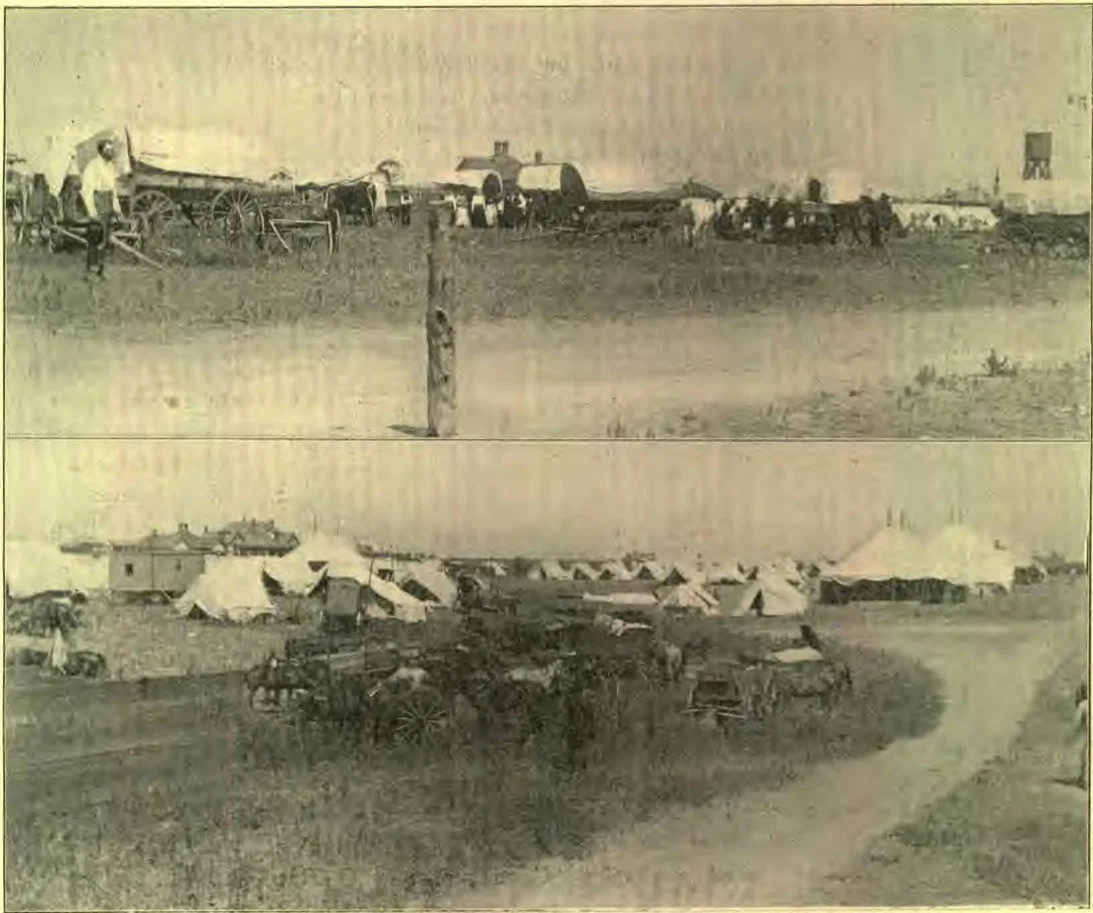
PRAIRIE SCHOONERS — CAMP AT ENID
Our annual camp-meeting was held this year near Enid, one of these young cities. It was quite largely attended, many driving long distances in their covered wagons, or “prairie schooners,” and camping in them while they attended the meeting. The accompanying picture shows this part of the camp.
There was an excellent class of young people in attendance, some of whom decided to enter upon training to fit themselves for medical missionary work, others to prepare for other departments of missionary effort. The experience that these young people have had in helping to transform this virgin soil into productive fields, and in rearing new homes in the midst of all the inconveniences incident to the opening up of a new country, has been an excellent discipline for them. It will be easier for them to endure hardness as good soldiers than for those who have had the misfortune to be brought up in comparative luxury. DAVID PAULSON, M. D.

APOSTASY

“And Moses came and told the people all the words of the Lord, and all the judgments: and all the people answered with one voice, and said, All the words which the Lord hath said will we do. . . . And he took the book of the covenant, and read in the audience of the people: and they said, All that the Lord hath said will we do, and be obedient.”
Thus did the children of Israel pledge themselves to obey the law which, amid awful manifestations of power, God had just spoken from Sinai.
When the law was proclaimed, Satan said: “Here is work for us. At the foot of Sinai, in the very presence of God, let us lead the people to break the law.” God called Moses into the mount, and during his absence Satan worked among the people. He told them that Moses would not return, and suggested that they make a golden calf to worship.
The enemy obtained all that he wished. The people had entered into covenant relation with God. He had espoused them to himself, promising to make them a kingdom of priests if they would obey him. And they had promised to be obedient. But as soon as Moses left them, they treacherously revolted from their Leader. They changed the glory of God into the similitude of an ox. What a terrible sin! The heathen nations could boast of being true to their false gods; but Israel turned from the One who had done such marvelous things in their behalf, to a golden calf. “Up, make us gods, which shall go before us,” they said to Aaron; “for as for this Moses, the man that brought us up out of the land of Egypt, we wot not what is become of him.”
Aaron saw the fierce determination of the ringleaders, and instead of firmly suppressing the discontent, he weakly yielded. Had he stood firm to principle, God would have vindicated his cause. But his wavering made the instigators of evil yet more persistent. Aaron’s history will ever be tarnished by his failure to stand bravely against wrong. By yielding, he sanctioned a great sin, made tenfold greater because the people were in the immediate presence of God and the holy angels.
“And all the people brake off their golden earrings which were in their ears, and brought them unto Aaron. And he received them at their hand, and fashioned it with a graving tool, after he had made it a molten calf: and they said, These be thy gods, O Israel, which brought thee up out of the land of Egypt.”
God saw what was going on in the camp. He saw that the people, even while the divine glory still rested upon Sinai, had yielded to the temptations of Satan, and were plotting against the rule which they had promised to obey. He suffered the treason to rise to its height, that he might teach the evil of apostasy. Then he said to Moses, “Go, get thee down; for thy people, which thou broughtest out of the land of Egypt, have corrupted themselves: they have turned aside quickly out of the way which I commanded them: they have made them a molten calf, and have worshiped it, and have sacrificed thereunto. . . . I have seen this people, and, behold, it is a stiff-necked people: now therefore let me alone, that my wrath may wax hot against them, and that I may consume them: and I will make of thee a great nation.”
Many men would have said: “It is the purpose of God. If he wishes to destroy Israel, I can not help it. They will be destroyed.” Not so Moses. He loved his people better than himself, and in the very words, “Let me alone,” he saw encouragement to hope that if God were earnestly importuned, he would spare the people. He resolved to intercede for them, and he chose the strongest argument he could find. He reminded the Lord of the wonderful work he had done in behalf of Israel. He entreated him not to forget how he had brought them forth out of the land of Egypt with great power and with a mighty hand. “Lord, what will the Egyptians say,” he asked, “if you cut off those for whom you have done so much?”
All the nations of the earth had heard how mightily God had worked in delivering his chosen people from Egyptian bondage,—how, because of Pharaoh’s resistance, his land had been desolated, and all the firstborn of the Egyptians had been slain. They had heard how the host of Pharaoh, pursuing the Israelites, had been drowned in the Red Sea, and a terrible fear had fallen upon them. They wondered what the God of Israel would do next in defense of his people. And now, if Israel should be blotted out, their enemies would triumph, and the name of God would be dishonored. The heathen would say, Instead of the Israelites being delivered so that they could worship their God, they were taken into the wilderness to be destroyed.
“Remember Abraham, Isaac, and Israel, thy servants,” Moses said, “to whom thou swarest by thine own self, and saidst unto them, I will multiply your seed as the stars of heaven, and all this land that I have spoken of will I give unto your seed, and they shall inherit it forever.”
“And the Lord repented of the evil which he thought to do unto his people.” Nevertheless, sin must be punished. The people had broken the law, and it was time for God to work. He must show that he is the supreme Ruler, and that his commands must be obeyed.
Going down to the camp, Moses stood in the gate, and said, “Who is on the Lord’s side? let him come unto me.” Opportunity was given for all to take their stand against idolatry. Those who remained obstinate and defiant must bear the penalty of sin. To those who had taken their position on the Lord’s side Moses said: “Thus saith the Lord God of Israel, Put every man his sword by his side, and go in and out from gate to gate throughout the camp, and slay every man his brother, and every man his companion, and every man his neighbor. And the children of Levi did according to the word of Moses; and there fell of the people that day about three thousand men.”
Thus God showed the fearful result of bold, defiant sin. He commanded that the leaders of the treason should be slain. Thus he bore a public testimony against sin, so that in the future, when God’s people condemned idolatry, and their enemies threw at them the taunt that they had themselves deserted God for a calf, they could answer, “It is true; but judgment fell upon the transgressors. God’s government is unsullied; for swift punishment overtook those who rebelled against him.” Mrs. E. G. WHITE.

SOMETHING BETTER

The Story of a Shrine

Miss S— was in need of a strong man to draw her jinrikisha as she made her daily rounds, visiting and superintending the work of the daily schools under her care. Our faithful cook, who had become an earnest Christian since coming to work for us, had undertaken to find a suitable man.
“Sensei,” he said, returning one day from a tour of investigation, “I have found a young man who would be just the one for the place, I think, but one thing makes him hesitate.”
“And what is that?” asked the missionary.
“Well,” he replied, “he is only just married, and he and his wife would be glad to come here to work; but his mother, who is old and dependent upon him for support, is very faithful in the worship of her gods, and especially of her husband’s spirit. And as her worship is her only satisfaction in life now, her son is afraid to go and live at a Christian place, for fear she would not be allowed liberty in her religious worship. As for himself and his wife, he said they were not particular about such things; but it was different with his old mother, and he could never consent to anything that would interfere with the happiness of her last days. I told him,” continued our cook, “that if they came to live here, he and his wife, being servants in the household, would be expected to attend morning worship daily, but that I was sure his old mother would be allowed perfect freedom to worship as she pleased in her own room.”
“You are right,” replied the missionary. “See the man again, and tell him that as we are not engaging his mother to work for us, she will be entirely at liberty to worship as she pleases, and never obliged to attend our Christian services. Only we can not permit the display of the emblems of her religion outside her own room or on our gateposts, of course.”
So they came, and took up their abode in the gatehouse. The tiny, wrinkled old lady who claimed the dutiful Cho as her son, evidently shrank in awe from the big, fearsome, “foreign teachers”—specimens, to her, from a strange and unknown world, utterly foreign, truly, to everything she had ever known.
At a stated hour each morning the servants of the household were gathered together for instruction in the things of God. Miss S— was the faithful and efficient teacher of this daily class, carefully explaining the word of God and the way of salvation, and leading these darkened souls into the light. Cho and his wife were regular attendants at the morning service, and after we had smiled a cheery “Good morning, O Baa San!” often enough to the dear, wee little woman sitting on the mats in her room by the gate, so that she was accustomed to the sight of us, as we daily passed by, and was losing her fear of us, an invitation was sent her to come with Cho and listen to the teaching. However, invitation after invitation was declined, and the missionaries quietly waited for the Spirit of the Lord to woo and win her.
Meanwhile Cho’s interest was awakened, and developed until at last he took Jesus to be his own Saviour, and erelong sought and received baptism. Not long afterward he gave up smoking, and began to live a quiet, consistent Christian life.
One morning, just as the morning service was beginning, in slipped the little old mother, quiet as a mouse, and dropped on the mats beside her son. No notice was taken of her, and the service went quietly on to the close, and then, as the members of the class bowed low with their heads to the floor—as is Japanese custom before taking one’s departure—the missionary said, quietly but cordially: “We are glad to see you here this morning, O Baa San.” Thereafter she came regularly to hear the “Jesus doctrine,” always quietly dropping in, the last one, at the little gathering, silently listening, and as silently slipping away again at its close. Whether or not any impression was being made upon the heart so long shrouded in the darkness of heathendom, we had no means of knowing. But we prayed on.
Cho’s wife was getting supper ready for the little family in the gatehouse one evening. A baby daughter had come to cheer their home, and had been the unconscious means of drawing the delighted grandmother and the sympathetic “foreign teachers” nearer together. Just now, however, the wee treasure was tucked away in her quilts in a corner of the room, fast asleep, while Kinu, the young mother, was boiling the rice, preparing the fish, and slicing the highly odoriferous pickled radish for the evening meal. A diminutive oil lamp dimly lighted the small apartment. It was early autumn, and the night was cool and clear, and the stars shone brightly down upon the quiet, temporary home of the Bible Training School, their light filtering down through the branches of the weeping willow that stood by the well, and resting tenderly upon the figure of a dear little woman, so small and so frail, standing there in the shadows, with clasped hands and upturned face. “O God!” she pleaded, “if there be one true God, who has done so much for my son Cho, reveal thyself to me also.”
Presently one of the sliding doors of the gatehouse was quietly pushed aside from without, and Kinu looked up inquiringly: “Where have you been, mother? I have noticed of late that you frequently slip outdoors of an evening. Isn’t it cold?” And to the amazement of the daughter-in-law came the quiet, earnest reply: “I have been praying to Cho’s God.”
In the old lady’s face there was a new light, and in her heart a strange, deep, sweet peace—the answer from the unseen Lord.
We heard with great joy that this precious soul, so near the end of a weary lifetime, had at last found rest and peace, and we watched quietly to see the Spirit of the living God still further teach and lead on the soul so newly awakened. Nothing was said about the old idol worship, nor about the worship of the husband’s spirit—ancestral worship, ever the strongest link in the chain that binds souls in the kingdom of darkness. But daily Miss S— expounded the word of the Lord, and, all unseen to human sight, the good seed took root and grew up and bore fruit. Erelong our dear little lady asked to be baptized, and her request was granted.
One day we were both sitting at our desks in the one room that served us then as offices, dining and reception room, when there came a knock at the door. In answer to our “Come in!” the door opened, and in came our wee O Baa San. Approaching the table, she placed upon it a small, wooden shrine, the shrine at which she had so long and so faithfully worshiped the spirit of her deceased husband. “Sensei,” she said, turning to Miss S—, “you may have this shrine. I don’t need it any more. I have something better.”—Mary Bell Griffiths.

The Shadow of a Father's Kiss

As when a father in a garden stoops down to kiss a child, the shadow of his body falls upon it, so many of the dark misfortunes of our life are not God going away from us, but our Heavenly Father stooping down to give us the kiss of his infinite and everlasting love.—Talmage.

Every Humble Life May Shed God's Light

THERE is no life so humble that, if it be true and genuinely human and obedient to God, it may not hope to shed some of his light. There is no light so meager that the greatest and wisest of us can afford to despise it. We can not know at what moment it may flash forth with the life of God.—Phillips Brooks.

DIVISION I—GEOLOGY

Conclusion of Chapter X—Volcanoes
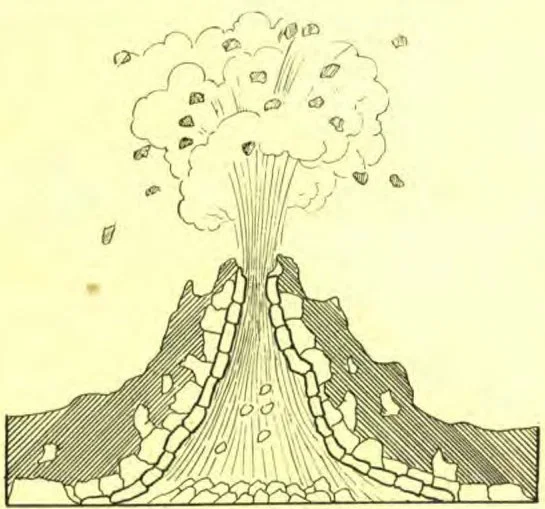
§100. VOLCANOES have their origin largely from the same source as do earthquakes. The internal heat evolved from the coming together of various chemicals, also water and previously burned limestone, ignite large fields of coal and oil; and as a result the most intense heat is produced. When this combination occurs in mountainous districts, especially where they are formed by “upheaval” (see Section 75), the lava, which is produced by the melting together of rock and different ores, in connection with mud, water, fire, smoke, and cinders, finds an egress between the upturned layers of rock, as shown in the accompanying illustration.
§101. When not in a state of active irritation, the internal portion of a volcano fills with hot mud, water, and molten lava. The internal pressure of this substance is estimated at one hundred and twenty-five pounds to the square inch at a depth of only one hundred feet. Through this viscid mass the heated gases rise, bursting on its surface with a force sufficient to throw great globules of liquid from thirty to forty feet into the air.
No. 3. Volcano.
No. 3. Volcano.
§102. In times of moderate action the outburst of cinders from Mt. Vesuvius occurs every three to ten minutes; but in a period of eruption they are almost incessant. According to Sir William Hamilton, the cinders rose to a height of ten thousand feet, or nearly two miles, at the eruption of 1779. This volcano, being situated in the midst of civilized nations, is one of the best known on the earth to-day; but it is insignificant when compared with the mighty spouters of South America and the Indian Archipelago. The largest volcano is that of Kilauea, Hawaiian Islands, which is always active. There are several in South and Central America that are constantly burning; and since the time of the Spanish conquest of Mexico, the lofty peak of Popocatapetl, which towers some 17,550 feet toward the heavens, has never ceased to belch forth its huge volumes of fire and smoke. Before the year 79 A. D. Vesuvius was not known to be active. That year occurred its famous eruption, which destroyed the cities of Herculaneum and Pompeii. So great was even the concussion of the air, that the ceilings at the Palace of Portici, at the foot of the mountain, were destroyed. Sand and ashes fell in such quantities as entirely to bury from sight those ancient cities. Connected with this eruption was a drenching rain, caused by the condensation of the steam and vapors that came gushing from out the crater’s fiery throat. The sand and ashes, being thus converted into mud, flowed into every nook and corner of streets and buildings, preserving these cities and their inhabitants for the inquisitive eye of coming generations. Paintings on the walls, dishes and cooking utensils on the shelves, lady and servant, master and slave, were alike buried instantly where they were when the volume of sand and débris fell upon their unsuspecting city. Bread still in the oven, fruit undergoing the canning process, and manuscript with the writing yet legible have been exhumed. From 1139 to 1307 Vesuvius remained dormant; also between 1500 and 1631 it was apparently extinct; the interior of its crater becoming grown over with rich vegetation. At its eruption in 1779, Sir William Hamilton says that a huge red column of liquid lava mixed with stones was projected to a height of ten thousand feet.
NOTE.—These lessons, comprising a brief study of Geology, Philosophy, Meteorology, and Astronomy have been prepared in response to the many calls that have come for a simple treatise on these subjects, that shall be free from the many infidel theories and deductions that are unscriptural and untrue. They have been written with special reference to the fireside, and the home- and church-school. The author would be pleased to receive, by correspondence, any criticisms or suggestions that will help to make them better adapted to this field of usefulness.
§103. All volcanic eruptions are remarkably similar in their conduct. Immediately preceding the eruption loud subterranean thunders are heard, and earthquake tremors felt. Fountains and springs recede into the earth, while the ground heaves and swells amid an ever-increasing sound as of muffled thunders beneath. Soon a dense cloud of smoke issues from the crater, and spreads out like a gigantic umbrella, enveloping in midnight darkness the cities and villages beneath. But this darkness is only momentary; for immediately follows the terrific roar and the lurid glow of the blood-red torrent of lava that falls in death-dealing floods over the adjacent territory. An oppressive stillness and feelings of foreboding generally precede these occurrences. Horses become restless; herds return from their pastures, bellowing and bleating, as if seeking the protection of man; while insects cease their hum, birds disappear within the quiet of their leafy homes, and all nature seems to portend the coming of some great and terrible event.
§104. Occasionally masses of lava are ejected in the form of huge cannon balls, twelve to fifteen feet in diameter. These, by their rotation, assume a globular form. By cooling off they become solid externally but cellular within.

THERMAL SPRINGS

§105. Thermal, or hot, springs are found most frequently in volcanic regions, for the reason that their origin is similar to that of volcanoes. In Geyser Cañon, north of San Francisco, there is a region of hot springs and fissures emitting steam strongly impregnated with sulphurous fumes. The waters of these springs have a temperature of 206°. Near Clear Lake is Borax Lake, holding borax in solution, and having a deposit of the same on its bottom. Salt springs occur in nearly all parts of the world, generally containing from ten to thirty-five per cent of pure salt.
The hot springs of Napa Valley, California, are thus described by Professor Forest Shepard: “Within the space of a half-mile square are from one to two hundred openings, through which the steam issues with violence, sending up columns of dense vapor to the height of from one hundred and fifty to two hundred feet. The roar of the largest of these can be heard for a mile or more. Many of the openings work spasmodically, precisely like a high-pressure engine, throwing out occasional jets of steam, or volumes of hot, scalding water, some twenty or thirty feet high.”

GEYSERS

§106. For years the geysers of Iceland were a wonder of the world. The largest of these, “The Great Geyser,” has a nearly circular basin, fifty feet in diameter and four feet deep. In the center is a well eight or ten feet in diameter and seventy-five feet deep. Through this perpendicular tube, hot water is continually bubbling over into the basin. When the basin is full, the water becomes agitated, loud explosions like subterranean thunder are heard, steam escapes in large quantities, and finally a column of boiling water is thrown with violent force some two hundred feet in the air. Following this a deafening rush of steam is ejected, and a terrible explosion terminates the phenomenon.
§107. The geysers of Yellowstone Park, in our own country, are now regarded as the finest in the world. The “Beehive Geyser,” represented in the illustration in full action, throws a column of water to a height of over two hundred feet, playing once in about twenty-four hours.

QUESTIONS

Describe an eruption of a volcano, and give its cause. Give the history of Mt. Vesuvius and its eruptions. Describe and give the cause of hot, salt, and mineral springs. Describe the cause and action of a geyser. Do these all spring from local or from one universal cause?
DR. O. C. GODSMARK.

THANKSGIVING DAY

A SACRED pause amid the din And turmoil of a world of care, The rush of life, the grinding mart — And lo! a nation bowed in prayer. Lord, put our worldly fears away, And grant a true Thanksgiving day.
A resting-place, at which the past And present once again unite, To hold communion, close and sweet, With olden dreams of fond delight. Let not a grief-worn memory stay In sight on this Thanksgiving day.
A mount apart, whose summit gleams Above the vapors sharp and clear, Above the poisonous mists of earth, Within a heavenly atmosphere. Lord, meet us there, we humbly pray, In holy love Thanksgiving day!
— Exchange.

Public and Private Character

The public character of a man is the tinsel worn at court; his private character is the service of gold kept at his bankers.—Sir T. Overbury.

FEEDING THE HUNGRY

  • (November 24-30)*

SCRIPTURE STUDY—

  1. Feeding the five thousand. Mark 6.
  2. Command to distribute bread to the hungry. Verse 37; Isa. 58:7.
  3. Experience of the prodigal son. Luke 15:16.
  4. Reproof of false shepherds. Ezekiel 34.
  5. Spiritual significance of “feeding the hungry.” Prov. 10:21; James 1:27.
There are two kinds of hunger,—the physical demand for food and the spiritual demand for truth. God creates both varieties.
Hunger is a cry of the system for nourishment, whether it manifests itself mentally, morally, or physically.
Satisfying genuine hunger of either soul or body is, therefore, a divine ministration.
When Christ said, speaking to his disciples of the hungry multitude, “Give ye them to eat;” this command did not apply to those people alone: it includes every individual similarly situated, with whom Providence brings us in contact.
When we impart to others either spiritual or physical bread, our own will be multiplied as a result.
We are to deal our bread to the hungry. See Isa. 58:7. The original significance of the word “deal” is to “divide,” or “distribute.” Which will result in the greater blessing,—to distribute some of our own bread, or that which belongs to others? Either bread would certainly satisfy hunger; but we fail to receive the highest blessing when we do not impart of our own. There is a ten times greater blessing in sitting down and having a personal talk, Bible study, and prayer with some hungry, discouraged soul, than in giving him a tract. On the other hand, if we have not spiritual bread of our own to divide with such a person, it is far better to give him bread belonging to some one else—bread in the form of a tract—than to send him away hungry.
When the prodigal son was famishing spiritually and physically, there was no one near him who was willing to give him even husks. Is it possible that some one may be living near you, some one whom you meet every day, who is just as hungry as was that prodigal, and that Christ has been saying to you for weeks and perhaps months, “Give ye them to eat,” and your hearing has been so dull that you have not heard the command; and so this person carries his heartache and soul-hunger with him day after day, while you have not given him even husks, to say nothing of the pure milk of the word?
“The lips of the righteous feed many.” Prov. 10:21. If you have been doing this, you have had Christ’s miracle of multiplying the loaves repeated in your Christian experience again and again.
“The mouth of fools feedeth on foolishness.” Prov. 15:14. If you have had no experience in feeding others with wisdom, more than likely you have had some experience in feeding them on foolishness; and if so, you have no doubt already discovered that the gift has been multiplying in your hands until you have the ability to impart more foolishness than you ever thought of when you began to break that kind of bread to others. What we divide to others multiplies in our hands, whether it be sense or nonsense.

A CHAPTER OF WARNING

Ezekiel thirty-four is a chapter that we should read and re-read until we become fully awakened by its trumpet call to the work of feeding others. The second verse pronounces a woe upon those who feed themselves instead of the flock. After you have prayerfully read the fourth verse a number of times, ask yourself whether there is a possibility that it applies to your own case; for if it does, the tenth verse, which shows that your opportunities will soon be taken away, will ere long apply equally well.
Think of the terrible state of mind that some Christian workers can drift into, as described in the eighteenth verse. They not only take advantage of the opportunities that this cause affords them, but they foul the residue with their feet; that is, they trample the principles underfoot. They speak lightly of reforms provided by God himself to fit his people to stand secure when pestilence shall come in like a flood.

SOME PRACTICAL SUGGESTIONS

Thousands of wealthy persons are sickening and dying because they are feeding on that which is not bread, in the form of unwholesome and non-nutritious food, even though it may be very expensive and palatable. Why should not the Young People’s Society get up a tasteful, neat, and wholesome health dinner, and then invite the best young people in the community to partake of it? It will not begin to require the same effort to do this that it would to organize a successful football team. Can we not begin to do as much for the Lord as other young people are doing for the devil?
A few months ago we prepared just such a dinner in our Chicago branch sanitarium, and then extended written invitations to nearly fifty students and teachers in the Chicago University. Among those who attended were several of the leading educators in America; and the good that was accomplished by this effort can not be related in a few short words.
We shall be glad to correspond personally with any who would like to undertake something of this kind, and give them the benefit of our experience, with suggestions as to the best methods. Another thing our Young People’s Society can do, which would be less difficult, but which has in it just as great a blessing, would be to get up a Thanksgiving dinner, or if there is not time for that, then a Christmas dinner, for those in the immediate vicinity whom you have reason to think are not able to assume the expense of an extra good meal at home. Rare tact will need to be manifested in order that the guests may not come to the conclusion that you regard them as beggars; the sensible poor are very sensitive on this point.
If there is some poor widow in your community who is suffering for the necessaries of life while you are enjoying plenty, then you will understand why your spiritual experience has been so unsatisfactory; for the highest manifestation of true religion is not in psalm singing, not speaking in meeting, not even in being secretary of the Sabbath-school, nor in leading a meeting with prayer. These are all symptoms of religion, but a person may do all these, and yet be as destitute of true religion as the mountains of Gilboa are of dew and rain. “Pure religion and undefiled before God and the Father is this: To visit the fatherless and widows in their affliction, and to keep himself unspotted [or uncontaminated] from the world.” James 1:27.

A WONDERFUL EXPERIENCE.

An experience in the earlier days of our Chicago medical missionary work illustrates the wonderful possibilities that may be hid away in a bowlful of hygienic soup. We have now more than half a dozen well-equipped institutions in Chicago, but at that time we had only a little basement room in the criminal center of the city, on Custom House Place. But we were permitted to use each day the spacious mission rooms of the Pacific Garden Mission just adjoining, in which to serve our penny-a-bowl soups to the vast army of starving men stranded here after the World’s Fair.
Dr. Kellogg would spend every Sunday in the work here, going about on various errands of mercy, doing all in his power to relieve the terrible distress everywhere so prevalent. While the men were eating their soup and bread, he would stand on the platform, and plead with them, often with tears, to satisfy their equally famished souls with the bread of life, which, if they partook of it, would satisfy their hunger of soul. And the invitation, I am glad to say, did not fall altogether on dull ears or calloused hearts.
One day a sorry-looking specimen of humanity, whose haggard face revealed the imprints of sin, stood leaning against a center post, being too weak and famished to stand without such assistance. For a time he gazed longingly at the fragrant soup that the others ate, and finally asked the doctor if he would not give him a bowlful, as he did not have the penny to pay. His request was immediately granted. That man was Tom Mackey. The night before, in the mission, he had resolved to end the miserable life of sin that he had been in for nearly forty years; but now his physical hunger and destitute condition were such as to cause him almost to give up in utter despair, and resume the life that he had resolved to leave the night before. The bowl of soup and a kind word started him on the right road, and he at once began to work for others. He opened up a number of missions, and in less than four years he was in charge of the Star of Hope Mission, then one of the most successful missions in Chicago. It is safe to say that God has used Brother Mackey to preach a gospel of salvation that has been accepted by thousands of men who, from a human point of view, were incurable. When he was converted, he could read scarcely a word, but since then he has learned a large part of the Bible by heart. Do any of you suppose that Dr. Kellogg regrets giving to that jewel in the rough—that prodigal son—a penny’s worth of soup? You may never see such results from your efforts in feeding the hungry, but God has said, “Give ye them to eat,” and it is our duty to obey that injunction, whether we see results or not.

SUGGESTIVE QUESTIONS

  1. Name and describe two kinds of hunger. Who causes both? What may those be doing who satisfy hunger?
  2. Why does the command, “Give ye them to eat,” apply to every follower of Jesus? How may it be obeyed?
  3. In what ways may we distribute bread to the hungry? In order to feed another, what must one have?
  4. How is it possible to feed starving souls with undesirable bread? Give some of the warnings of Ezekiel 34, as related to this topic.
  5. Notice the encouraging incidents in this lesson, and if possible relate one of which you know, in the experience meeting following the study. DAVID PAULSON, M. D.

OUR STUDY

This week, on Feeding the Hungry, is very practical. The suggestions it contains may be carried out with good results in many places, and where this would be impossible, other plans for doing the same work will come to those who study the situation carefully. The work of feeding souls can not be neglected by any who profess to be followers of the Master. He has a work for every one. Be ready, as you study, to “speak a word in season to him that is weary,” and then, when you meet with the other young people of your company, tell them of the blessing received in so doing. Nothing encourages like hearing the good experiences of others.
Continue reading: COPY THE PATTERN