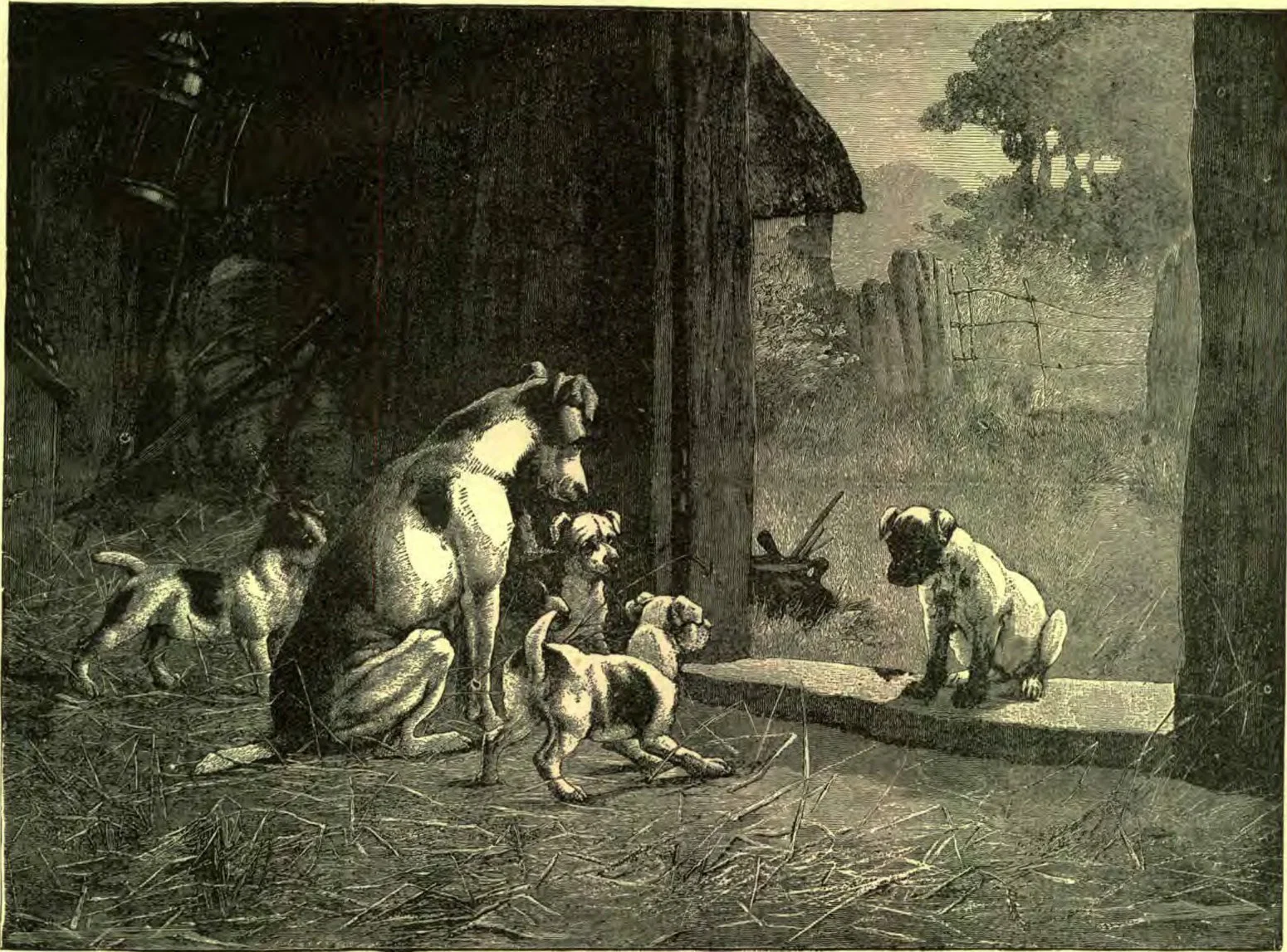
In his word God says to us, “Be ye imitators of God, as dear children.” The word here used is the Greek word mimic. You know what it is to imitate, or mimic, another,—it is to do just what you see him do.
Have you not seen your little baby brother or sister imitate your mother or father, or try to do all that they see you do? All young animals learn by mimicry,—by imitating their parents. This is the way that the little birds learn to fly, and the baby ducks to swim. The old birds show them what they should do, and the young ones follow their parents’ example.
But the reason they can follow the example of their parents, and imitate them, is because they belong to them—they have the same nature. The little chickens could never learn to swim, no matter how hard they might try to follow the example of the ducks and swans. And the young ducks could never mount up like the eaglets, no matter how much they might stretch and spread their little wings in imitation of the old eagles.
And so it is only the children of God, those who have his own nature, who can copy the pattern, and be and do as he is and does. What things soever he doeth, these the Son also doeth in like manner. We are to be imitators of him, as his dear children.
So it is not enough for us to see the Pattern, to learn what Jesus did when he was a little child, and then try to imitate him. We must have his divine nature before we can copy the Pattern, and grow like him. And we can get this only by the gift of his own Holy Spirit.
IN DISGRACE
Of the boy Jesus we are told that “the child grew and waxed strong in spirit, filled with wisdom; and the grace of God was upon him.” So may the grace of God be upon you, dear children, his Spirit filling you, and his hand over you, to form you into his perfect image, in all things like the Pattern he has shown you.
The words of King David to his son Solomon, who was about to build a magnificent temple for the Lord, are for each one of you also: “Take heed, now: for the Lord hath chosen thee to build an house for the sanctuary: be strong, and do it.”
God has chosen you that you should grow into his own beautiful image. He has shown you the pattern like which you are to grow, and has given you his Holy Spirit that you may “be strong, and do it.” Do not disappoint him, but “grow up into him in all things,” to the praise of the glory of his grace. EDITH E. ADAMS.
A SONG OF THANKS
By Margaret E. Sangster
For sowing and reaping, for cold and for heat,
For sweets of the flowers and gold of the wheat,
For ships in the harbors, for sails on the sea,
O Father in heaven, our songs rise to thee!
For parents who care for us day by day,
For sisters and brothers, for work and for play,
For dear little babies, so helpless and fair,
O Father! we send thee our praise and our prayer.
For teachers who guide us so patiently on,
For frolics with mates when our lessons are done,
For shelter and clothing, for every day’s food,
We bless thee, our Father, the Giver of good.
For waking and sleeping, for blessings to be,
We children would offer our praises to thee;
For God is our Father, and bends from above
To keep the round world in the smile of his love.
— Margaret E. Sangster.
THANKSGIVING
By Mrs. P. Alderman
Spring and summer all gone by,
Birds and flowers and sunny sky;
Winds have shaken all the leaves
From the pretty maple trees;
What comes next for pleasure, pray?
Why, the glad Thanksgiving day!
O the pumpkin pies and cakes
That my grandma always makes!
Tells us stories good and true—
How the children used to do;
Says be thankful while we play
On the good Thanksgiving day.
For ’tis God who gave us all
Good things ripening in the fall,—
Apples, rosy-cheeked and round;
Yellow pumpkins on the ground.
See! he opens wide his hand,
Feeds all creatures in the land.
Give the Giver thanks, I say,
On the glad Thanksgiving day.
MRS. P. ALDERMAN.
Children Sowing Gospel Seed and Praying for Others
“When every little hand
Shall sow the gospel seed,
And every little heart
Shall pray for those in need,
When every little life
Such fair, bright record shows,
Then shall the desert bud
And blossom as the rose.”
A SECOND TRIAL
It was commencement at D— College. The people were pouring into church as I entered. Finding the choice seats already taken, I pressed onward, looking to the right and to the left for a vacancy, and on the very front row I found one.
Here a little girl moved along to make room for me, looking into my face with large gray eyes, whose brightness was softened by very long lashes. Her face was open and fresh as a newly blown rose. Again and again I found my eyes turning to the rose-like face, and each time the gray eyes moved, half-smiling, to meet mine. Evidently the child was ready to “make up” with me. And when, with a bright smile, she returned my dropped handkerchief, we seemed fairly introduced. Other persons, now coming into the seat, crowded me quite close up against the little girl, so that we soon felt very well acquainted.
“There’s going to be a great crowd,” she said. “Yes,” I replied; “people always like to see how schoolboys are made into men.”
Her face beamed with pleasure and pride as she said: “My brother’s going to graduate; he’s going to speak; I’ve brought these flowers to throw to him.”
They were not greenhouse favorites; but just old-fashioned domestic flowers, such as we associate with the dear grandmothers. “But,” I thought, “they will seem sweet and beautiful to him for his little sister’s sake.”
“That is my brother,” she went on, pointing with her nosegay.
“The one with the light hair?” I asked.
“Oh, no!” she said, smiling and shaking her head in innocent reproof; “not that homely one with red hair; that handsome one with brown, wavy hair. His eyes look brown, too; but they are not,—they are dark blue. There! he’s got his hand up to his head now. You see him, don’t you?” she asked, eagerly.
“I see him,” I said; “he’s a very good-looking brother.”
“Yes, he’s beautiful,” she replied, with artless delight, “and he’s good, and he studies so hard. He has taken care of me ever since mama died. Here is his name on the program. He is not the valedictorian, but he has an honor for all that.”
I saw in the little creature’s familiarity with these technical college terms that she had closely identified herself with her brother’s studies, hopes, and successes.
“He thought at first,” she continued, “that he would write on ‘The Romance of Monastic Life.’”
What a strange sound these long words had, coming from her childish lips! Her interest in her brother’s work had stamped them on her memory, and to her they were ordinary things.
“But then,” she went on, “he decided that he would rather write on ‘Historical Parallels,’ and he’s got a real good oration, and he says it beautifully. He has said it to me a great many times. I ’most know it by heart. Oh! it begins so pretty and so grand. This is the way it begins,” she added, encouraged by the interest she must have seen in my face: “‘Amid the combinations of actors and forces which make up the great kaleidoscope of history, we often find a turn of Destiny’s hand.’”
“Why, bless the baby!” I thought, looking down into her proud face. I can’t describe how very odd and elfish it did seem to have those sonorous words rolling out of the smiling mouth.
The band, striking up, put an end to the quotation and to the confidences.
As the exercises progressed, and approached nearer and nearer the effort on which all her interest was concentrated, my little friend became excited and restless. Her eyes grew larger and brighter, two deep-red spots glowed on her cheeks. She touched up the flowers, manifestly making the offering ready for the shrine.
“Now it’s his turn,” she said, turning to me a face in which pride and delight and anxiety seemed equally mingled. But when the overture was played through, and his name was called, the child seemed in her eagerness to forget me and all the earth beside him. She rose to her feet, and leaned forward for a better view of her beloved brother as he mounted to the speaker’s stand. I knew by her deep breathing that her heart was throbbing in her throat. I knew, too, by the way her brother came to the front that he was trembling. The hands hung limp; his face was pallid, and the lips were blue, as with cold. I felt anxious. The child, too, seemed to discern that things were not well with him. Something like fear showed in her face.
He made an automatic bow. Then a bewildered, struggling look came into his face, then a helpless look, and then he stood staring vacantly, like a sonambulist, at the waiting audience. The moments of painful suspense went by, and still he stood as if struck dumb. I saw how it was; he had been seized with stage fright.
Poor little sister! She turned her large, dismayed eyes upon me. “He’s forgotten it,” she said. Then a swift change came into her face,—a strong, determined look,—and on the funereal silence of the room broke the sweet child voice: “‘Amid the combinations of actors and forces that make up the great kaleidoscope of history, we often find a turn of Destiny’s hand.’”—
Everybody looked to see. The breathless silence; the sweet, childish voice; the childish face; the long, unchildlike words, produced a weird effect.
But the help had come too late; the unhappy brother was already staggering in humiliation from the stage. The band quickly struck up, and waves of lively music were rolled out to cover the defeat.
I gave the sister a glance in which I meant to show the intense sympathy I felt, but she did not see. Her eyes, swimming with tears, were on her brother’s face. I put my arm around her. She was too absorbed to feel the caress; and before I could appreciate her purpose, she was on her way to the shame-stricken young man, sitting with a face like a statue’s.
When he saw her by his side, the set face relaxed, and a quick mist came into his eyes. The young men got closer together to make room for her. She sat down beside him, laid her flowers on his knee, and slipped her hand in his.
I could not keep my eyes from her sweet, pitying face. I saw her whisper to him, he bending a little to catch her words. Later, I found out that she was asking him if he knew his “piece” now, and that he answered yes.
When the young man next on the list had spoken, and while the band was playing, the child, to the brother’s great surprise, made her way up the stage steps, and pressed through the throng of professors and trustees and distinguished visitors, up to the college president.
“If you please, sir,” she said with a little courtesy, “will you and the trustees let my brother try again? He knows his ‘piece’ now.”
For a moment the president stared at her through his gold-bowed spectacles, and then, appreciating the child petition, he smiled on her, and went down and spoke to the young man who had failed.
So it happened that when the band had again ceased playing, it was briefly announced that Mr. — would now deliver his oration on “Historic Parallels.”
“‘Amid the combinations of actors and forces which,’ the little sister whispered to him as he rose to answer the summons.
A ripple of heightened and expectant interest passed over the audience, and they all sat stone-still, as if fearing to breathe lest the speaker might again take fright. No danger. The hero in the youth was aroused. He went at his “piece” with a set purpose to conquer, to redeem himself, and to bring back the smile into the child’s tear-stained face. I watched the face during the speaking. The wide eyes, the parted lips, the whole rapt being said that the breathless audience was forgotten, that her spirit was moving with his.
And when the address was ended with the ardent abandon of one who catches enthusiasm in the realization that he is fighting down a wrong judgment and conquering a sympathy, the effect was really thrilling. That dignified audience broke into rapturous applause; bouquets, intended for the valedictorian, rained like a tempest. And the child who had helped save the day—that one beaming little face, in its pride and gladness, is something to be forever remembered.—Our Dumb Animals.
HEALING THE CENTURION’S SERVANT
By W. S. Sadler
INTRODUCTORY
Preceding Events.—The prominent events in the Saviour’s life since the preceding miracle,—the healing of the withered hand,—were—
Bible Story of the Miracle.—“After he had ended all his sayings in the ears of the people, he entered into Capernaum. And a certain centurion’s servant, who was dear unto him, was sick, and at the point of death. And when he heard concerning Jesus, he sent unto him elders of the Jews, asking him that he would come and save his servant, and saying, Lord, my servant lieth in the house sick of the palsy, grievously tormented. And they, when they came to Jesus, besought him earnestly, saying, He is worthy that thou shouldst do this for him; for he loveth our nation, and himself built us our synagogue. And he saith unto them, I will come and heal him. And Jesus went with them. And when he was now not far from the house, the centurion sent friends to him, saying unto him, Lord, trouble not thyself; for I am not worthy that thou shouldst come under my roof; wherefore neither thought I myself worthy to come unto thee, but only say the word, and my servant shall be healed. For I also am a man set under authority, having under myself soldiers, and I say to this one, Go, and he goeth; and to another, Come, and he cometh; and to my servant, Do this, and he doeth it. And when Jesus heard these things, he marveled at him, and turned, and said unto the multitude that followed him, Verily, I say unto you, I have not found so great faith, no, not in Israel. And I say unto you, That many shall come from the east and the west, and shall sit down with Abraham, and Isaac, and Jacob, in the kingdom367shall be cast forth into the outer darkness: there shall be the weeping and gnashing of teeth. And Jesus said unto the centurion, Go thy way; as thou hast believed, so be it done unto thee. And the servant was healed in that hour. And they that were sent, returning to the house, found the servant whole.” (The foregoing is an interwoven story of the miracle, gathered from Matt. 8: 5–13 and Luke 7: 1–10, but in the exact language of the Bible.)
Place.—Capernaum.
Circumstances.—At the conclusion of the memorable sermon on the mount, as Jesus was entering Capernaum, he was met by a delegation of the elders of the Jews, bearing a request from a Roman officer concerning the affliction of one of his servants. It appears that this Roman officer was unusually friendly to the Jewish cause; for these Jews told how he had built for them a synagogue, and seemingly urged this upon the Master as sufficient reason why his request should receive particular attention. The centurion, when he knew the Saviour drew near his house, sent messengers to him, expressing a sense of unworthiness to have the Master come into his house, and requesting Jesus simply to speak the word,—thereby giving evidence of such faith in Christ as to draw from the Son of God the remarkable statement: “I have not found so great faith, no, not in Israel.”
Great Lesson.—The personal, visible presence of Jesus is not essential to the healing of either soul or body. The divine word is the cleansing, healing, and saving agent. Jesus’ word of healing power is abroad in the world, and all who will by faith connect themselves with the divine Healer may experience its benefits.
STUDY OF THE MIRACLE
A Certain Centurion.—Let us not be too hasty to judge a man from his occupation or profession. This Roman soldier was apparently living up to his best light. His humility is shown in that his estimate of himself was far below that of his neighbors, as well as by his own sense of unworthiness. This centurion was a generous man, having built a synagogue for the Jews; he was a loving man, for the Jews said, “He loveth our nation;” and he was a conscientious man, as is seen in his tender solicitude for the welfare of his servant. Roman servants were slaves, and ordinarily greatly abused. The narrative of this miracle contains a great lesson concerning the interest Christians should take in their hired help, and those who assist them in various ways.
He Loveth Our Nation.—Matthew would seem to convey the idea that the centurion came in person to Christ. This is probably an interchange of characters, which is commonly met with in history and daily occurrences. Luke calls attention to the fact that it was the elders of the Jews who came to Christ. This Roman officer had succeeded in overcoming the prejudices of the Jews against the Gentiles, as well as that of the conquered against their conquerors, and had won the respect of the community as well as of the elders of the Jewish Church,—a striking illustration of how the most stubborn prejudice may be overcome by a consistent life. We believe this instance is unprecedented in Jewish history.
When the Jews pleaded the centurion’s worthiness and generosity as a reason why Christ should heal his servant, they showed how little they appreciated the basis of Christ’s love, and that Christ did not heal people because they were worthy, but because they were needy; yet he said nothing to these Jewish friends of the Roman soldier, for he had already read the heart of the centurion, and knew his sincere faith and true humility, as was afterward shown when he sent still other friends, saying, “I am not worthy that thou shouldst enter under my roof.”
23. This parable teaches two very important lessons. What are they?
NOTES
1. The parable of the Importunate Neighbor belongs to the second series of Christ’s parables. These were given during his ministration in Perea, beyond Jordan. A brief description of Christ’s work at this time is found in “Desire of Ages,” pages 588, 589. The following is an outline of the parables of Christ:—
FIRST PARABLES
During Ministry in Galilee.—Sower; Seed; Tares; Mustard Seed; Leaven; Hidden Treasure; Pearl of Great Price; Net; Householder.
Close of Ministry in Galilee.—Parable of Unmerciful Servant.
SECOND SERIES OF PARABLES
During Ministry in Perea, beyond Jordan.—Good Samaritan; Importunate Neighbor; Foolish Rich Man; Barren Fig Tree; Leaven and Mustard Seed repeated; Great Supper; Lost Sheep repeated; Lost Drachma; Lost Son; Unjust Steward; Dives and Lazarus; Pharisee and Publican; Wicked and Slothful Servant.
At Feast of Tabernacles.—Parable of Good Shepherd.
THIRD SERIES OF PARABLES
Last Week of Christ’s Ministry.—Parable of the Laborers, in the way to Jerusalem; Parable of Two Sons, Vineyard, and Marriage of King’s Son, given the last day of Christ in the temple; Parable of Fig Tree, Ten Virgins, and Talents, given to disciples on Mount of Olives.
From the foregoing outline it will be seen that the Saviour gave three important series of parables—in Galilee, in Perea, and in Jerusalem, respectively. There are also several minor parables, which he gave at other times; but this outline includes all those given during these three periods of his ministry.
2. The sermon on the mount was the ordination sermon for the disciples. Early that morning the Saviour had set them apart and blessed them, and in the sermon that followed, he taught the Lord’s prayer. The disciples must have forgotten this, and probably had neglected to pray; and when, several months later, they asked Jesus to teach them how, he repeated the prayer that he first gave them.
PARAGRAPHS FROM THE LESSON HELP
1. The selfish neighbor in the parable does not represent the character of God. The lesson is drawn, not by comparison, but by contrast. A selfish man will grant an urgent request, in order to rid himself of one who disturbs his rest. But God delights to give.
2. Our prayers are not to be a selfish asking, merely for our own benefit. We are to ask that we may give. . . . In the parable the petitioner was again and again repulsed, but he did not relinquish his purpose. So our prayers do not always seem to receive an immediate answer; but Christ teaches that we should not cease to pray. Prayer is not to work any change in God; it is to bring us into harmony with God.
3. God does not say, Ask once, and you shall receive. He bids us ask. Unwearingly persist in prayer. The persistent asking brings the petitioner into a more earnest attitude, and gives him an increased desire to receive the things for which he asks.
The Power of Simple Patience
It is not necessary for all men to be great in action. The greatest and sublimest power is often simple patience.—Horace Bushnell.
Talk Only as Loudly as You Live
By J. Wilbur Chapman
ONE ought to talk only as loud as he lives—a rule which would deprive some people of the privilege of shouting.—J. Wilbur Chapman.
Ladies Wanted for Sofa Pillow Work
LADIES WANTED to work on SOFA PILLOWS. Materials furnished. Steady work guaranteed; experience unnecessary. Send stamped envelope to Miss S. McGee, Needle Work Dept., Ideal Co., Chicago, Ill.
GRAND TRUNK R'Y. SYSTEM.
Taking Effect June 2, 1901.
Trains leave Battle Creek.
WEST-BOUND.
No. 2, Mail and Express, to Chicago 12.15 P. M.
No. 7, Limited Express, to Chicago 7.00 A. M.
No. 1, Chicago Express, to Chicago 9.23 A. M.
No. 3, Lehigh Valley Express, to Chicago 3.50 P. M.
No. 5, International Express 2.17 A. M.
No. 75, Mixed, to South Bend 7.30 A. M.
Nos. 9 and 75, daily, except Sunday.
Nos. 1, 3, 5, and 7, daily.
EAST-BOUND.
No. 10, Mail and Express, East and Detroit 3.45 P. M.
No. 8, Limited Express, East and Detroit 5.50 P. M.
No. 4, Lehigh Express, East and Canada 8.22 P. M.
No. 6, Atlantic Express, East and Detroit 2.10 A. M.
No. 2, Express, East and Detroit 7.00 A. M.
No. 74, Mixed (starts at Nichols yard), 7.15 A. M.
Nos. 10 and 74, daily, except Sunday.
Nos. 4, 6, 8, and 2, daily.
W. C. CUNLIFFE, Agent, BATTLE CREEK.
EVERY-DAY COURAGE
Every little while the papers and magazines call attention to lives saved by the efforts of others, often those who are young in years. A sixteen-year-old girl plunges into sixty feet of water to rescue a drowning schoolmate, and holds her head above water till both are rescued; another, a child of ten, saves a drowning boy; an elevator boy, at imminent risk to his own life, runs his elevator again and again to the upper floors of a burning building, till all the dwellers thereon are brought to a place of safety; the young son of a millionaire owner of dynamite works stands on the wooden roof of a building filled with explosives, and loses his life in the brave though vain endeavor to avert the disaster that must follow if the flames have their way. We read—the world reads, and admires the bravery, the cheerful courage, the forgetfulness of self, that have stood out so brightly in the trying hour.
Yes, courage is a fine thing, and worthy of admiration. And the saving of life—can there be anything nobler than this? The Saviour gave the unselfish spirit that puts the welfare of another first, even to the extent of giving up of life itself, as the supreme test of love. To save life—that is the call that brings the physician hurrying to the bedside of the wounded or the sorely stricken; ordinary cases must wait when that call is given.
“But I have no opportunity to do brave things; I have no chance to save life,” some one says. Did you ever stop to think that it often requires as great or greater courage to keep faithfully doing some little duty, day after day, as to win, in some supreme moment, the applause of the world? That this is so is a fact that is recognized by thoughtful persons the world over. A hundred years ago, and more, a rich French baron founded a “prize of virtue,” to be given only to the poor, and never to any one who applied for it—since humility is one of the highest virtues. Not long ago this prize was given to two blind sisters, who live, with their invalid mother, in a tiny village in central France. The story of their humble lives is most pathetic and touching. Both were born blind, but this did not hinder them from having a happy childhood. They were always busy, and singing about the poor little rooms of their home from morning till night. They early learned to help keep the small rooms in spotless order. At last the father died, the mother fell ill, and the little family was about to be broken up. A home was offered the girls, but their mother must be sent to the poor-house. But the loving girls would not consent. “Let us try a while longer,” they said to the magistrate of the little village. “Let us do our best, and then, if we fail, we will do as you think best.” Never idle, now they worked more busily than ever. They learned to wash, a kind-hearted neighbor telling them when the clothes were clean. During the day they washed for the neighbors, and cared for their mother; at night they learned to spin,—and, working thus day and night, they were able to support themselves, and brighten their mother’s declining days.
At last their case was brought to the notice of the French Academy, and the noble sisters were rewarded with the gift they would have chosen had they ever thought of such good fortune—a little home, and an income sufficient for their modest needs.
But though in this one instance the bravery and self-sacrifice of these two blind girls was rewarded, there are hundreds and thousands of instances just as deserving that never come to the notice of the world,—that are never rewarded, except by Him who notes the fall of the humblest bird, and before whose eyes no loving, unselfish deed ever goes unapproved. And is not that the sweetest reward of all?
No opportunity to save life? Every day such an opportunity is given to each one—an opportunity to save life for the kingdom of heaven. Often those who would risk their earthly life to save another, will shrink, and hesitate, and finally lose altogether the priceless opportunity to speak a word in season to some weary soul,—to hold out the hand of comfort and good cheer and friendly sympathy that shall be as a life-line to draw him to the One in whom is his only hope of safety.
So while we admire the brave deeds of others, let us not waste our time in wishing for some such chance to show what we would do. It is wiser to do the every-day things that call for courage in small measures, many times repeated, and to pray that our eyes may be quick to see those whose lives are in peril, and our tongues no less quick to speak the word that shall be to them a savor of life.