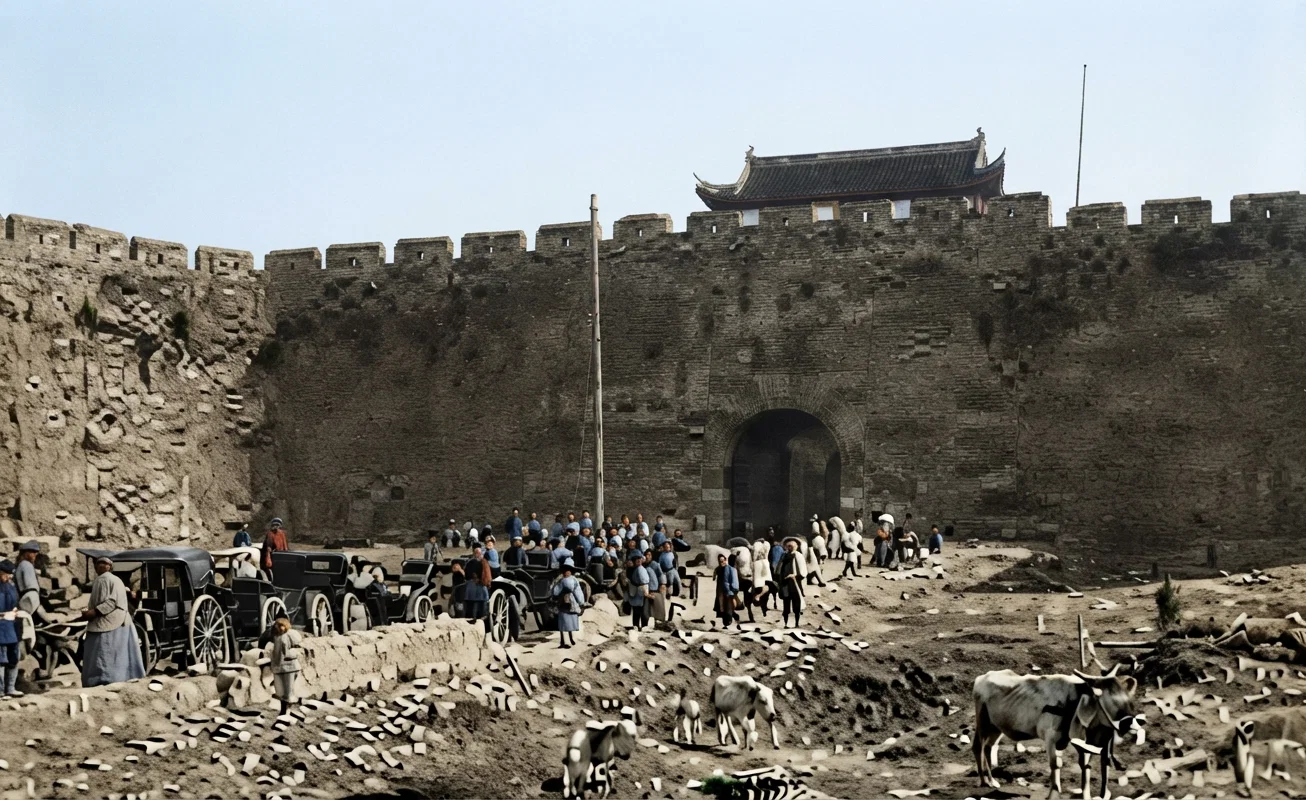
Gate leading into the city of Nanking, the old capital city of China, showing the immense height of the city walls, against which the small field-guns of the revolutionists had but little effect. These walls are from 30 to 50 feet high and 23 feet thick.
Election Gains and Other News
Complete returns of the general elections in Germany show that the Socialists have made a great gain, and their prospects are for still further gains in the reballoting. The emperor has expressed great disappointment at the results of the election, for he had hoped that the people would give him a Reichstag that would enable him to carry out his policy for armament. His conflicts with the Socialists are throwing the emperor more and more closely with the Center or Catholic party. These movements may yet result in reviving the sentiments of the Middle Ages, when the emperor of Germany was also chosen as the emperor of the Holy Roman Empire, and the power of the Papacy be invoked to crush the rising tide of Socialism.
The fire losses in the United States amounted in 1911 to $250,000,000. Much of this loss is due to carelessness. It is said that if a fire should sweep away the buildings embraced in the eight square miles between the Battery and Forty-second Street, New York, it "would be a national disaster, carrying financial panic and ruin in its wake." A president of a great fire-insurance company said, "After such a conflagration there would not be a fire-insurance company left in the world." It is said that New York has the greatest fire hazard of any city in the country.
The Department of Agriculture in California is planning to harvest about four tons of ladybugs in the mountains of the Sierras. There are certain sections there where they may be found in colonies of millions, and they are dug from beneath the snow while in a dormant state, and kept in cold storage until demanded by the fruit grower in fighting the pests, particularly the aphis, that destroys his fruit. Melon growers will demand large numbers of the little bugs to protect their crops.
A large deposit of mineral unlike any heretofore seen has recently been discovered near Grand Valley, Colo. It has many of the characteristics of hard rubber, being a non-conductor of electricity, and suitable for making anything where rubber is now used in electrical appliances, as well as for making combs and the like. If the hopes of the finders are realized it will help to overcome the shortage in the rubber supply, and greatly reduce the price of that commodity.
A bomb was thrown at Yuan Shi Kai, the premier of the Manchu government, in the streets of Peking, on January 15, and, while he escaped, two soldiers and the horses attached to his carriage were killed. He has been frequently warned that an attempt would be made on his life, and has been urged to surrender in consequence.
The Pacific Mail Steamship Company is planning to build four 36,000 ton vessels to ply between New York, San Francisco, Hongkong, and other oriental points by way of the new Panama Canal. Plans for these new vessels are already completed, and it is expected that they will be ready for the opening of the canal.
Postmaster-General Hitchcock has given out that he will urge Congress to insist upon the Government ownership of the telegraph-lines. President Taft is not in harmony with his suggestions, and there may be a break in the cabinet as the result.
The report of the massacre of 10,000 Manchus in the Shensi district is confirmed, and it is reported that on December 8 a messenger came from the Sianfu district with the report that 8,000 had been slain in that province up to that time.
An unconfirmed despatch dated January 14 states that Russia has invaded Mongolia. She had threatened to do this some days ago, and this is probably the carrying out of her threat.
The despatches say that on January 15 the inauguration of the Republic of China was quietly celebrated by a reception held at the residence of President Sun Yat Sen.
The Democratic National Convention will convene in Baltimore on June 25, one week after the Republican Convention meets in Chicago.
Spain is to have a Spanish-American exposition in 1914.
The Washington-Lincoln Number
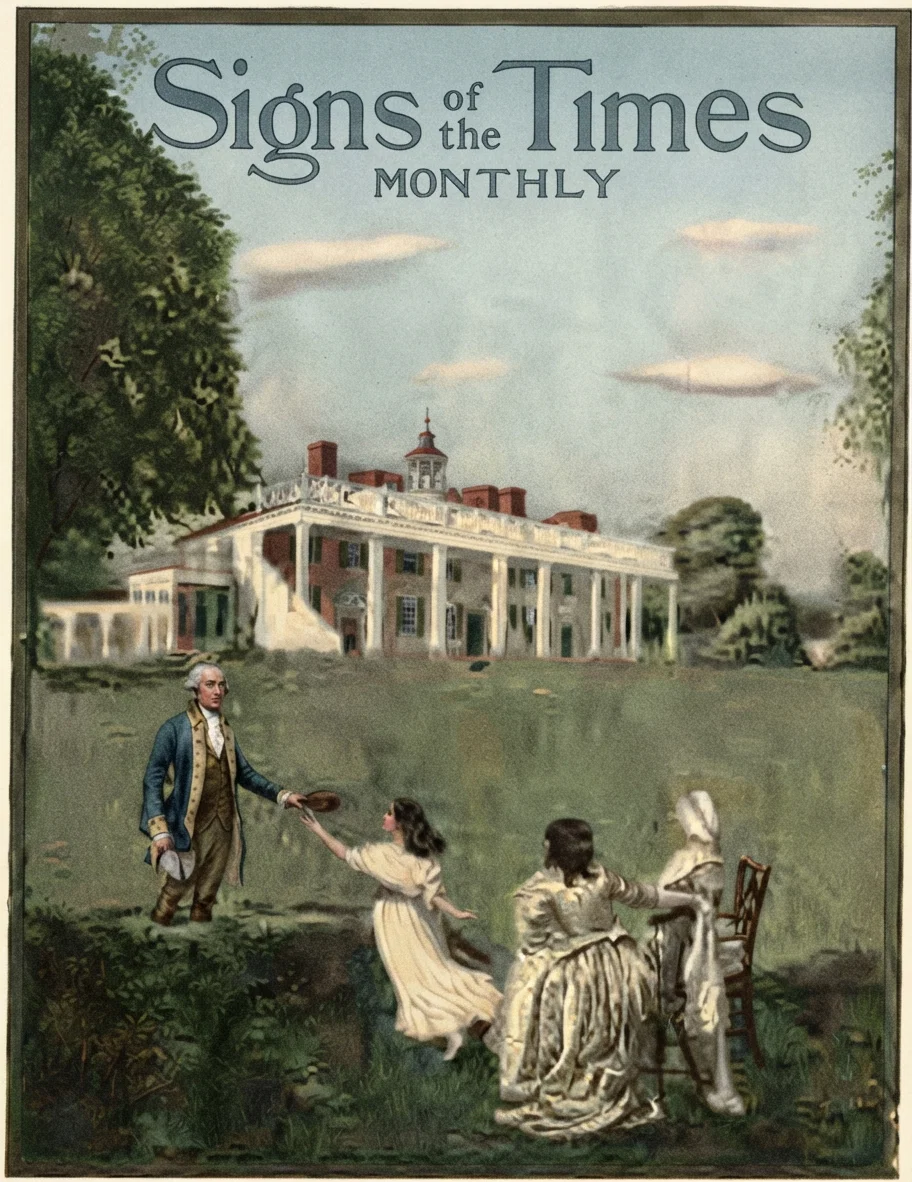
A touching scene from the home life of Washington
The Message of the February "Signs"
By Editor
Washington and Religious Liberty, by M. C. Wilcox, is an article of historical and practical interest. It gives George Washington's attitude toward those who in his day observed the seventh-day Sabbath. His letter to Ephrata community of seventh-day Christians is given, and it well supports the practically universal belief in the greatness of Washington. It may be said to be George Washington's "declaration of religious liberty."
Lincoln and Liberty, by A. O. Tait. Another great man, and the principles that go for genuine greatness. Let us remember, with the man, the principles for which he stood.
The Witness of the Stars, by Frank S. Weston. Not following the beaten path. Startlingly new facts and reasonings. Commended to our readers.
Death Abolished by Life, by J. O. Corliss. The closing article of this series from the pen of Mr. Corliss. It is worth your time.
How to Keep from Falling, by George B. Starr. A good practical article on how to sustain one's Christian experience.
The Redemption of the Earth, by William Covert. God's plan for our world. Worthy of your study. The main principles briefly outlined.
The Second Coming of Christ, Bringing Life and Immortality, by George W. Rine. The second of this series. Commended to the most careful attention of our readers.
There are others, with the usual good line of current topics. Well illustrated.
This number is sure to take well with the people, and is an unusually good one to work with.
Order through your tract society
A Particularly Timely and Important Number of the
The Magazine with the Message
Political Alcoholism
"Political Alcoholism."—This is what Sir Edward Grey calls the jingoism, the war spirit, of the present time. In his great speech before Parliament in November, in which he outlined England's part in the Morocco question, and intimated how near war was, he said:
There are really some people who seem to take delight in suggesting or forming the opinion, from whatever gossip or information they may get from any quarter, that we were near to war; and the nearer we came to war the greater the satisfaction they seemed to get out of it. I do not say we are peculiar in this respect at this moment. It is really as if in the atmosphere of the world there was some mischievous influence at work which troubles and excites every part of it. We are passing this year through a period of great excitement; it is so still. Some countries are in revolution, others are at war; and in several countries which are neither in revolution nor at war there are people who seem to delight in discussing how near they have been, or are, or are likely to be, either to revolution or to war in the past, the present, or the future. Really it is as if the world were indulging in a fit of political alcoholism.—London Weekly "Times" of December 1, 1911.
Sir Edward Grey speaks truly, not knowing that he is recording the fulfilment of a divine prophecy of nearly 2,000 years ago. Said John "the beloved," looking forward to the last days:
And I saw three unclean spirits like frogs come out of the mouth of the dragon, and out of the mouth of the beast, and out of the mouth of the false prophet. For they are the spirits of devils [demons], working miracles, which go forth unto the kings of the earth and of the whole world, to gather them to the battle of that great day of God Almighty. Rev. 16:13, 14.
There is a "mischievous influence at work"—the devil and his angels. It "troubles every part" of the world; for these spirits go to all the kingdoms of earth. And verse 16 declares that they are gathering the world to Armageddon. God's prophet declared it; noted men nearly two millenniums later declare its fulfilment.
National Child Labor Conference
By Editor
The National Child Labor Committee is holding its eighth annual conference in Louisville, Kentucky, January 25 to 28. This committee, of which Mr. Owen R. Lovejoy, 105 E. 22d St., New York, is the general secretary, has helped to get better child labor laws in thirty States this year, and will bring together in this conference twenty-seven affiliated State committees. The conference will be devoted to practical measures for reducing the basis of child labor, and for keeping children in school until they are equipped for efficient citizenship.
Mr. Lovejoy says that "the employer is usually blamed for child labor, but there are other reasons, and one of the most perplexing elements is the fact that the children themselves are against us. They want to get out of school at the earliest possible moment and enter wage-earning industries. The live school men are helping change all this."
And yet there are many cases in which children would be much better employed under proper restrictions, than to run wild in the street, even tho a few hours of the day are spent in school. Sometimes the education received in labor is worth more than the education which the boy receives at school. These things ought to be considered by the national convention.
Unrest in Cuba
In the Republic of Cuba the rival of President Gomez has placed himself at the head of the president's soldiers, and they are demanding the nullification of certain civil service regulations. President Taft has issued an ultimatum to the inhabitants of the island to the effect that if they start a civil war the United States will step in to put a stop to it. Troops and transports are in readiness for any emergency, and it is suggested by some that if the United States enters the island again she may not withdraw.
The Use of Drugs at the Family Table
By Mary W. Paulson, M.D.
IN dealing with sick people we are forcibly reminded of the evil effects of tea and coffee upon the human organism. Frequently patients consult a physician for medical aid who have sallow skins, who complain of palpitation of the heart, or are depressed.
Upon making inquiry into their habits, they admit that they use freely tea and coffee. The wife or mother of the home may say: "I am never hungry for breakfast, but always take my cup of coffee. I could not do my morning work without it, but with it I am able to accomplish my work."
People of such habits must sooner or later visit the clinic or physician's office, because their unnatural demands upon nature finally are overdrawn, and there follows a reaction. It is truly said:
Tea and coffee produce an immediate effect. Under the influence of these poisons the nervous system is excited, and in some cases for the time being the intellect seems to be invigorated and the imagination to be more vivid. Because these stimulants produce for the time being such agreeable results, many conclude that they really need them, and continue their use. But there is always a reaction. The nervous system, having been unduly excited, borrows for present use from its future resources of strength. All this temporary invigoration of the system is followed by depression. In proportion as these stimulants temporarily invigorate the system, will be the letting down of the power of the excited organs after the stimulus has lost its force.
Chemists have examined for us the chemical and nutritive values of tea and coffee. Their report is as follows:
Black Tea
Green Tea
Water
8.20
5.96
Caffein
3.24
2.33
Albumin (insoluble)
17.20
16.83
Albumin (soluble)
0.70
0.80
Alcoholic extract
6.79
7.05
Dextrin
—
0.50
Pectin and pectic acid
2.60
3.22
Tannic acid
16.40
27.14
Chlorophyl and resin
4.60
4.20
Cellulose
34.00
25.90
Ash
6.27
6.07
Roasted Coffee (Mocha)
Caffein
0.82
Saccharine matter
0.43
Caffeic acids
4.74
Alcoholic extract (nitrogenous and coloring matters)
14.14
Fat and oil
13.59
Legumin
11.23
Dextrin
1.24
Cellulose and insoluble coloring matter
48.62
Ash
4.56
Moisture
0.63
In other words, an ordinary teacupful of tea as it is usually drunk contains fifteen grains of solid matter, chief of which are caffein, tannic acid, and volatile oil.
An ordinary cup of coffee contains 1.7 grains of caffein and 3.24 grains of tannic acid. The longer the infusion of these the greater the per cent of tannic acid. This is not true of caffein, as it is easily dissolved.
By studying carefully these figures one can see that in each cupful of tea or coffee the user gets a fairly good-sized medicinal dose of caffein; also that these drinks can not be considered foods. Hutchison says on this subject:
"All experiments go to prove that caffein tends to increase rather than diminish tissue waste. It does not prolong life in starvation, altho it may perhaps lessen the feeling of hunger. . . . We may conclude, then, that tea and coffee are in no sense foods, in that they can neither build up the tissues nor provide them with potential energy, tho they may perhaps act the parts of lubricants in the machinery of the body by diminishing nervous fatigue. It is no doubt that it is this subjective feeling which has led to the very extended use of these beverages by men in all ages and in all countries."
Since they are not foods, what are their effects upon the human body? The principal and active constituents of tea and coffee are caffein, tannic acid, and volatile oil. The effect of caffein upon the body is to stimulate. It exerts its effects upon the central nervous system even more than upon the heart. It removes the sense of fatigue, but produces sleeplessness. It produces an increased heart action, which shows itself by palpitation of the heart, a symptom which is so annoying to many people. In small doses caffein raises arterial tension. For this reason we often find patients who use coffee, suffering from high blood pressure, a symptom which produces apoplexy. In large doses caffein is a depressant to the heart and also to respiration. A noted author of materia medica (Potter) makes this statement:
"Used to excess it disorders digestion and causes functional disturbance of the nervous system, shown by headache, mental confusion, and palpitation of the heart. It increases secretion, blunts sensation, exerts reflex excitability, increases mental activity, and may produce insomnia and great nervous restlessness. It first briefly stimulates the heart and raises arterial tension, but soon depresses both."
Another active constituent of tea and coffee is tannic acid, which, as we have noticed, is contained in both in large percentage. The effect of tannic acid on salivary and gastric digestion is invariably to retard stomach digestion, and in strong infusions of tea it acts as an irritant to the mucous membrane of the stomach, especially if the stomach is empty. The same is true of the volatile oils contained in both tea and coffee, particularly coffee, so that it may be possible for these drugs, taken upon an empty stomach, to keep up a condition of chronic gastric catarrh.
Tannic acid is a powerful astringent. It precipitates pepsin and coagulates albumin, impairs digestion, stops peristalsis, and causes constipation. Its continued use disorders digestion, irritates the mucous membranes, and produces emaciation.—Potter.
One can readily see that instead of taking a food or even something which aids the digestion of food, a drug is used at the table producing the above results, which are certainly not desirable.
We then can understand how tea draws upon "the strength of the nerves and leaves them greatly weakened. When its influence is gone and the increased action caused by its use is abated, then what is the result?—Languor and debility corresponding to the artificial vivacity that tea imparted. When the system is already overtaxed and needs rest, the use of tea spurs up nature by stimulation to perform unwonted, unnatural action, and thereby lessens her power to perform and her ability to endure. The influence of coffee is in a degree the same as tea, but the effect upon the system is still worse. Its influence is exciting, and just in the degree that it elevates above par it will exhaust and bring prostration below par. Tea and coffee drinkers carry their marks upon their faces. The skin becomes sallow and assumes a lifeless appearance. The glow of health is not seen upon the countenance."
The apparent strength which tea and coffee give is false strength and not natural strength. In attempting to stop their use, particularly that of coffee, one suffers from headache, which can be relieved by the application of hot and cold to the head. The heat is applied over the eyes and forehead and sides of the face, the cold in an ice-bag at the back of the neck. Oftentimes this gives relief in a very short time, provided the patient is put to bed and kept quiet and the feet are made warm by a hot foot-bath if necessary. If the determination to stop the use of these drugs is persisted in, in a few days the tendency to headache will disappear and the patient will feel much brighter and clearer than before.
A habit which is deleterious to the action of the human body certainly should be discontinued. Some are afraid to do this, because they believe it would result disastrously with them. Such is not the case. The continuance of these hurtful stimulants is destroying nature's fine machinery, and battering down her fortifications erected against disease and premature decay. The same God who requires that we present our bodies a living sacrifice, is able to help us to overcome the effects of hurtful habits, in order that we may preserve our bodies in the very best condition of health and thus do better service for Him.
Little Things
A good-by kiss is a little thing,
With your hand on the door to go,
But it takes the venom out of the sting
Of a thoughtless word or a cruel fling
That they made an hour ago.
A kiss of greeting is sweet and rare,
After the toil of the day,
But it smooths the furrows out of the care
And lines on the forehead you once called fair,
In the years that have flown away.
'Tis a little thing to say, "You are kind—
I love you, my dear," each night;
But it sends a thrill through the heart, I find,
For love is tender, as love is blind,
As we climb life's rugged height.
We starve each other for love's caress;
We take, but do not give;
It seems so easy some soul to bless,
But we dole love grudgingly, less and less,
Till 'tis bitter and hard to live.
— Selected.
Self-Sacrifice Versus Self-Interest
"THE rule of the world is, 'Look out for number one.' Nothing could be more antagonistic than this to the teachings of Christ. His greatest doctrine, the underlying principle of all His works and deeds, was that of self-sacrifice, looking out for number two. Therefore He has given the plain message that to save our lives we must sacrifice them for the salvation of others."
Ripe Olives
By A. E. Crist
Cured Hygienically
Large size in 50 gallon barrels, 50 cents per gallon; 25 gallons, 60 cents; 5 gallons, 70 cents. Medium or green olives, 10 cents less per gallon; smaller ones, 20 cents less. Black or white figs processed and pressed in 50 pound baskets, 7 cents per pound, f. o. b. Chico. Satisfaction guaranteed. Orders promptly filled. A. E. Crist, Chico, California.
For Sale
Place of one hundred and sixty acres. House, barn, windmill, small vineyard and family orchard. About three miles from Pacific Union College. Price, $2,500. S. J. Blower, R. R. No. 1, Santa Rosa, California.
For Sale
By W. S. Reese
At a sacrifice. New two-story house. All modern conveniences, cement basement, 72 feet front, corner lot, steel lawn fence, variety of fruit and berries. Terms reasonable. Write if interested. W. S. Reese, 331 E. Lodi Avenue, Lodi, California.
Free Sample of E-Z Washing Tablets
Mrs. J. Valentine, Salem, Oregon, writes:
"One lady to whom I sold a quarter's worth of your Washing Tablets came a few days later and took $1.50 worth. Said she never saw anything like it."
You will say the same if you try it. Send your name and address on a postal and receive a free sample. Address Alfred Mallett, 721 H St., Sacramento, California.
Wanted
A Seventh-day Adventist who is a practical nurseryman, one who understands budding and grafting. Would prefer one to take an interest in the business. Fine opening. Good climate. Plenty of good water for irrigation. 4,000 feet elevation. New farming and fruit country. References given and required. Address O. O. Osborne, Deming, New Mexico.
"HERALDS OF THE MORNING"
By Editor
The appalling loss of life by murder and suicide, political and social troubles, dissatisfaction between employer and employee, strikes and fires, wars and rumors of wars—all these are of daily occurrence. What do they mean? and is there any significance to these things at this particular time? To the close observer, all these are evidences that there is a nearing social vortex into which all unsettled factions, and the world at large, will be plunged. When and how this will be brought about is revealed in "Heralds of the Morning." By appealing to the "sure word of prophecy," the author clearly shows that these conditions were to exist just before the Lord's return, and points out many other signs that the Scriptures tell us are certain heralds of the glad morning when strife shall cease, and peace and happiness reign forever. That the reader may understand these events, and be prepared for the final outcome, is our reason for calling attention to this valuable work. More than 150 illustrations vividly portray that upon which the subject-matter treats. A live book upon a live subject.
Bound in cloth, with marbled edges, $2.00.
PACIFIC PRESS PUBLISHING ASSN.
Mountain View - - - California
Liberty Magazine
By Editor
Every Citizen
Should read the Thomas Jefferson Number. Join the Religious Liberty Association by subscribing for this quarterly for one year (25c), and signing its Declaration of Principles.
Some Features
Two-Color Cover-Picture of Jefferson's Home.
Interior View of Jefferson's Home.
Spain and Religious Liberty.
America a Beacon Light to the Nations.
Should the State Teach Religion?
Civil Sunday Laws.
The Menace of a National Religion.
Religious Intolerance of the Federated Churches.
The World's Christian Citizenship Congress.
Inquisition Days in Holland.
Sunday Laws and Citizenship.
The Liquor Traffic and the Home.
History Confirming the Book of God.
Also many other articles and timely illustrations.
Stands for the complete liberty of every man and woman in the world, whether Protestant, Catholic, Jew, or infidel.
Cover design printed in two colors.
25 cents a year, 10 cents a copy.
Special Offer on Ten, One Year
10 or more copies, one year, to one address or to 10 separate addresses, cash with order, only 15 cents each. Sender may include his own name as one of the ten.
A good proposition for agents. Send 10 cents for sample copy.
LIBERTY MAGAZINE
Washington, D. C.
The January Number of Life and Health
By Editor
Send 10 cents for sample copy to-day.
During January, 1912, all subscribers for one year will receive in addition to the 12 numbers for 1912, the beautiful October, November, and December issues free of charge,—15 months for $1.00.
It Will Tell You
How to keep well, how to get well, how to treat diseases at home, and how to sleep, cook, eat, and dress for health.
Questions Answered
Through this new department, just opened, the editor will personally answer all reasonable questions concerning your physical needs and troubles. This department alone will be well worth more than $1.00 a year.
Sample Articles
The Benediction of the Snow.
How Two Mothers Cared for Their Babies.
Significance of Feeble-Mindedness.
Health Work in Milwaukee.
Report of Minneapolis Vice Commission.
What Is True Success?
Paper-Bag Cookery.
Value of Gluten Bread.
Drink and Higher Education.
Other valuable articles on temperance and social problems.
Prices
$1.00 a year, 10 cents a copy. 5 to 40 copies, 5 cents a copy. 50 or more copies, 4 cents a copy.
Send $2.00 for 50 copies, sell 20 to get money back, then sell or give away the other 30 in the interest of health and temperance reform.
A good proposition for agents. Send 10 cents for sample copy and particulars. Over 3,000 regular agents sell it successfully.
LIFE AND HEALTH
Takoma Park, Washington, D. C.
Protestant Magazine
By Editor
The current number
Will Tell You
Of Rome's plan to exclude anti-Catholic publications from the mails.
The difference between genuine and so-called Protestantism.
The meaning of Rome's control of political parties, of the great cities of America, of the public press, public school text-books, etc.
Why and when Rome will again rule the world; also to what extent she is already ruling.
Which of the contending forces will be finally victorious—Roman Catholicism or Bible Protestantism; also how and when the victory will be won.
25 cents a year, 10 cents a copy.
Special Offer on Ten, One Year
10 or more copies, one year, to one address, or to 10 separate addresses, cash with order, only 15 cents each. Sender may include his own name as one of the ten.
A good proposition for agents. Send 10 cents for sample copy and particulars.
THE PROTESTANT MAGAZINE
Washington, D. C.
PUBLISHED WEEKLY
By Editor
(Entered Sept. 15, 1904, as second-class matter at the Mountain View, Cal., post-office, under Act of Congress of March 3, 1879.)
Editor ............................. Milton C. Wilcox
Associate Editors .................... A. O. Tait
...................................... L. A. Reed
Manuscripts should be addressed to the editor. Address all business and make all money-orders, etc., payable to the Signs of the Times, Mountain View, Cal.
N. B. We send no papers from this office to individuals without pay in advance. When persons receive copies without ordering them, they are sent by other parties, and we can give no information in regard to them. Persons thus receiving copies of the SIGNS are not indebted to the office, and will not be called upon to pay for them. Please read the papers you may receive, and hand them to your friends to read.
SUBSCRIPTION RATES
Three months ................................... $0.50
Six months ........................................ .90
One year (50 numbers) ............................. 1.75
With "Questions and Answers" ...................... 2.00
One new yearly subscription and one renewal, or two new yearly subscriptions, sent at one time, $3.00.
Two new yearly subscriptions and one renewal, or three new yearly subscriptions, sent at one time, $4.00.
Three new yearly subscriptions and one renewal, or four new yearly subscriptions, sent at one time, $5.00.
Sample copies sent on application.
Weekly and Monthly SIGNS one year, combined, $2.25.
DATE OF EXPIRATION
The SIGNS wrapper bears date of last issue due on your subscription. Unless renewed in advance, paper stops with expiration date.
If herewith is an order-blank, you will know you have overlooked sending renewal. You will not wish to miss a single issue. Back numbers often can not be furnished.
C. H. Jones, Circulation Manager.
IN THREE DAYS
SAN FRANCISCO
Overland Limited
TAKES YOU
To Chicago
ACROSS GREAT SALT LAKE
AND
HIGH SIERRA BY DAYLIGHT
Luxurious High-class Equipment
Electric Lighted Throughout
Pullman Drawing-room
Stateroom
Vestibuled Sleeping-cars
Careful and Attentive Dining Service
Parlor Observation-car with Library and Cafe
Ladies' Reading-room
Gentlemen's Smoking-room
Daily News Bulletins
Latest Papers and Magazines
Southern Pacific
A Correction
By Editor
A Correction.—Mr. G. W. White, who had an article in the Signs of the Times of September 5, entitled “The Dying Thief,” wishes to note a correction which should be made in a quotation in that article. This quotation is alleged to be from Murdock's Syriac translation, and is thus given: “Verily, I say unto thee to-day, Thou shalt be with Me in Paradise.” Mr. White is at a loss to know how the quotation crept in in that way, and thinks that he must have taken it from some other authority, and wishes to make this correction, so that it may not be repeated by some one else as a quotation from the Syriac.
Murdock's rendering is, "Jesus said to him, Verily I say to you, that this day thou shalt be with Me in Paradise." There is the same difficulty with Murdock that there is with the ordinary version. Rotherham's New Testament translation from the Greek text of Tregelles, critically emphasized, in its twelfth edition revised, renders it this way: "And Jesus said to him, 'Verily, to thee I say, this day, with Me shalt thou be in the Paradise.'" He has this note: "It is left for the reader to determine whether the words 'this day' should be joined (a) with the former part of the sentence, or (b) with the latter. In favor of (a) may be urged, first, the fact that semeron, 'this day,' does not always stand first in the clause to which it belongs (see Luke 2:11; 5:26; 22:34; Acts 20:26; 22:3; 24:21; 26:29); (2) that being essentially a demonstrative word, it will bear any reasonable stress which may be laid upon it, whether it be placed before or after the words which it qualifies; (3) that it is far from meaningless if regarded as belonging to the opening words of asseveration ("Thou dost ask to be remembered then; verily thou art assured now. As on this the day of My weakness and shame, thou hast faith to ask, I this day have authority to answer"); (4) that the latter part of the verse is thus left free to refer to the very matter of the supplicant's request ("Thou dost ask to be remembered when I come in My kingdom; thou shalt be remembered then, and with distinguished favor; thou shalt be in My kingdom; shalt be with Me in the very Paradise of My kingdom, in the garden of the Lord (Isa. 51:3), . . . in that most central and blessed part of the coming kingdom, of which thou dost believe Me to be the destined King.")." Rotherham has more, but this is given in support of placing the comma after "to-day."