LESSON 4.—THE SABBATH IN THE LEVITICAL DISPENSATION.
By M. E. K.
(July 27, 1895.)
REVIEW QUESTIONS.
1. What is the law of God?
2. How can this be proved?
3. How did God give it to man?
4. What difference was manifest in giving the decalogue and in the giving of other law?
5. What is the character of this law, and how long will it continue?
6. What is the character of the Sabbath, and how long will it continue?
1. In the second lesson of this quarter, we learned that the Sabbath is a memorial of whom and what?—Of God and his works both in creation and redemption.
2. Compared with other works of God, how does his work for Israel stand? Deut 4: 32–34.
3. Why did God show such power to and for this people? Verse 35.
20. What sin is mentioned among Israel after returning from captivity in Babylon? Neh. 13: 16.
21. What reproof was given? Verses 17, 18.
22. How, and through whom, was a reform brought about? Verses 19–22.
NOTE.
Every extraordinary manifestation of God’s power to the world is the showing forth of the same power by which the worlds were created. The creation of the heavens and the earth is the greatest manifestation that earth knows, for nothing would be greater than calling them out of nothing. The next greatest display was the redemption of the people from the chiefest of earthly opposing powers, in which the gods of the nation were proved to be vanity. This redemption from Egypt, this making of Israel a separate or sanctified people, was a display of God’s creative power such as has never been seen since the earth was created. God did this to show to Israel and the world that he alone was God, and to spread abroad his name or character in the earth. As the Sabbath was the memorial of God’s creative power in the beginning, so it became to Israel not only a memorial of creation, but a memorial of the same power manifested in redemption and sanctification, and so it becomes to every child of God.
ADDITIONAL NOTES.
It was very proper for God to remind his people of their obligation to keep the Sabbath because of their deliverance from bondage, not only because it was a manifestation of the power of God, as at creation, but because it was the latest exhibition of that power, and because it was manifested especially in their behalf. The parent often reminds the child of something that he has recently done for him as a special reason why the child should be good and obedient. So the Lord, repeating the Sabbath commandment, gives an additional reason why those who have been redeemed from bondage should keep the Sabbath.
That bondage in Egypt was a type of the bondage of sin, into which the whole world was plunged by Adam’s fall. The Lord, by the gospel, receives all who will believe, and who do not murmur as Israel murmured in the wilderness. Those who believe are freed from the bondage of sin, and come into the glorious liberty of the sons of God. The condemnation of sin is removed from them. “There is therefore now no condemnation to them which are in Christ Jesus.” Rom. 8: 1. Egypt and its bondage are past; the child of God is on the way to Canaan, which he expects soon to reach. There are trials by the way, as there were in the literal wilderness, but there are also the purest joys; for God leads the way now as then. When we think of the bondage of sin from which we have escaped, and the blessings of salvation which we enjoy, cannot we remember that we were once servants in bondage, and in the joy of our redemption “keep the Sabbath day to sanctify it,” a glorious reminder of that almighty power by which we are saved?
Viewed in this light, the Sabbath is not merely something to remind us of what was done six thousand years ago. It reminds us of salvation from sin by the power of God, and the Christian enjoys that salvation every day. When the “six working days” are spent in the joys of the gospel, which is “the power of God unto salvation,” the Sabbath comes at the end of the week as a blessed rest in God, and a token of the rest which we constantly enjoy through that power which works in those who believe.
When we keep the Sabbath in that way, we receive the Sabbath blessing. There is a Sabbath blessing. God has said so, and his word makes it so, for his word is the truth. Thus saith the Lord: “Blessed is the man that doeth this, and the son of man that layeth hold on it; that keepeth the Sabbath from polluting it, and keepeth his hand from doing any evil.” Isa. 56: 2. These words of the prophet are as true now as they were when they were first penned. Whoever takes hold of the Sabbath, recognizing it to be a sign of God’s power to create and to redeem, will receive the blessing. The Lord has spoken it, and his word will not return to him void.
By referring to 2 Chron. 23: 17, we find that there was at that time a rival worship against the worship of God in Jerusalem. There was a house, or temple, of Baal, a priest,—probably a high priest is meant,—and altars to Baal. As Sunday was Baal’s day, there was then, as now, two days regarded in Israel for days of especial devotion. At one time, in the days of Elijah, there were only seven thousand worshipers of the true God and observers of his holy day in all Israel; but there was an Elijah among them, and by his prayers and labors a reformation followed. To-day “that woman Jezebel”—the Catholic Church—has introduced the worship of Baal through her Sunday Sabbath all over the world; but a warning message is being given, and it is to go in the “spirit and power of Elijah,” and by it a people are to be made ready for the Lord, who, at his coming will be found “keeping the commandments of God, and the faith of Jesus.” Rev. 14: 12.
The great reform in the last days is upon the Sabbath. Reforms are a recurrence to principles of truth, and their greatness and value depend upon the completeness of this return. A partial reform is better than none, but a full return is the most pleasing to God. There has been a good deal of playing at reform. Protestantism has been built up by various efforts, more or less complete, to return to the first principles of the gospel. A full return and reform will be reached by the people of God before the coming of the Lord. The prediction of such a work is found in Rev. 14: 9–12. The greatest open and unblushing departures from the law of God by professed Christians have been upon the second and fourth commandments. The reformation of the sixteenth century was the means of a reformation from idol worship, and the present work under the third angel will be the means for the restoration of the true Sabbath among those who shall be saved at Jesus’s coming. M. E. K.
GOD'S PLAN FOR YOU.
By Horace Bushnell
Go to God himself, and ask for the calling of God; for as certainly as he has a plan or calling for you, he will somehow guide you into it. This is the proper office and work of his spirit. By this private teaching he can show us, and will, into the very plan that is set for us. This is the significance of what is prescribed as our duty,—namely, living and walking in the spirit,—for the Spirit of God is a kind of universal presence, or inspiration, in the world's bosom,—an unfailing inner light, which, if we accept and live in it, we are guided thereby into a consenting choice, so that what God wills for us we also will for ourselves, setting into it as the needle to the pole. By this hidden union with God, or intercourse with him, we get a wisdom or insight deeper than we know ourselves,—a sympathy, a oneness, with the divine will and love. We go into the very plan of God for us, and are led along in it by him, consenting, coöperating, answering to him we know not how, and working out, with nicest exactness, that good end for which his unseen counsel girded us and sent us into the world. In this manner, not neglecting other methods, but gathering in all their separate lights, to be interpreted in the higher light of the Spirit, we can never be greatly at a loss to find our way into God's counsel and plan. The duties of the present moment we shall meet as they rise, and these will open a gate into the next; and we shall thus pass on, trusting and secure.
— Horace Bushnell.
GLIMPSES OF ANIMAL LIFE.
By T. J. Allen
8.—HEAD-CROWNED MOLLUSKS.
Eyes, ears, mouths, and feet we have met with, but no heads, nor has any creature we have yet examined been able to live out of its watery home. But now a new prospect opens before us. In the study of this division of the mollusca, we shall begin to enter upon earth-life and air-breathing creatures. Not suddenly, however; for all new powers are of slow growth, and we find the largest number of this group still clinging to their old ocean home, and only here and there terrestrial forms mingling with the throng. So we will notice first some of our common water snails, which are found either on the coast or clinging to the stones in some of our brooks and rivers.
Watch a periwinkle some day in his home among the rocks, and see him gently lift his shell, open his horny door, and put out his head. He has two delicate tentacles to feel with, and just behind these, on very short stalks, are set two tiny but keen eyes, the nerves of which join the great nervous mass now for the first time chiefly centered in a head.
The under part of the periwinkle’s body is a flat, crumpled disk, or “foot,” as it is sometimes called, composed of thick muscles; and this, when lengthened out first on one side and then on the other, draws the animal gently along, just as we put first one and then the other foot forward in walking. At the slightest alarm the creature disappears as if by magic into his shell, drawing his horny door close behind him, for the powerful muscles of his mantle enable him to lengthen or shorten his body at will.
If the periwinkle is undisturbed, he pushes out his snout, moving very slowly along, scraping for his food fine shavings off from the sea-weeds as he goes, leaving little dents on the plants behind. This he does by means of a curious instrument. If you could look into his mouth, which opens on the under side of his head, you would find it paved with sharp teeth, just as if a number of minute nails had been driven into it points upward, and it is with these that the periwinkle rasps the weeds, as he rubs his jaw along them.
But this rough file wears away rapidly with constant use, and to meet this difficulty the periwinkle has a complete provision hidden within. The rasp within his mouth is only the ends of six hundred rows of teeth, three in a row, growing on a long, gristly strap, like pins stuck in a pincushion; and this strap, often two and a half inches long, is rolled up in a coil, and stored away in a fold of the neck. As the teeth wear away, the strap comes gradually forward with a new supply of teeth. This strap is generally called the “tongue;” but “rasp” is a more appropriate name.
Now, as our periwinkle walks and feeds, he must also breathe; and wonderful as it may seem to us, no creature below the back-boned animals ever breathes through its mouth. So we must look elsewhere for the entrance to the lungs of the periwinkle. We found that the sponges, jelly-fish, and actinozoans breathe through the skin, the star-fish through the perforated plate in his back, and the oyster by means of the gills which fringe his body. The periwinkle also breathes by means of gills, and we find them safely lodged in a fold of his neck, just within the broad part of his shell. When he draws his body in and closes his door, he shuts up a little pouch of water, to supply his gills with oxygen until his enemy is gone. This also enables him to live for some time when taken from the water.
The periwinkle is a vegetarian, but we have some flesh-eaters in this division. The whelks and cowries are types of these carnivorous creatures. They have to work much harder than the grazing limpet. As the hungry whelk feeds mostly on shell-fish, he has to bore a hole through a solid shell before he can take his meal; and for this he is provided with a boring instrument such as an engineer might envy. His snout, which can be stretched out like the trunk of an elephant, contains a toothed rasp like that of the periwinkle, but much more formidable; and this rasp is moved by powerful muscles, so as to act like a fine saw, and drills a neat round hole in even the hardest shell, through which the whelk can suck out the soft body it contains. It is curious that he does not always know when he will find food within; for he sometimes drills a hole not only in an empty shell, but sometimes even in a shell-like stone.
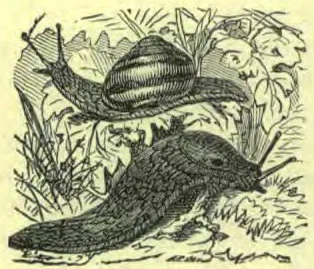
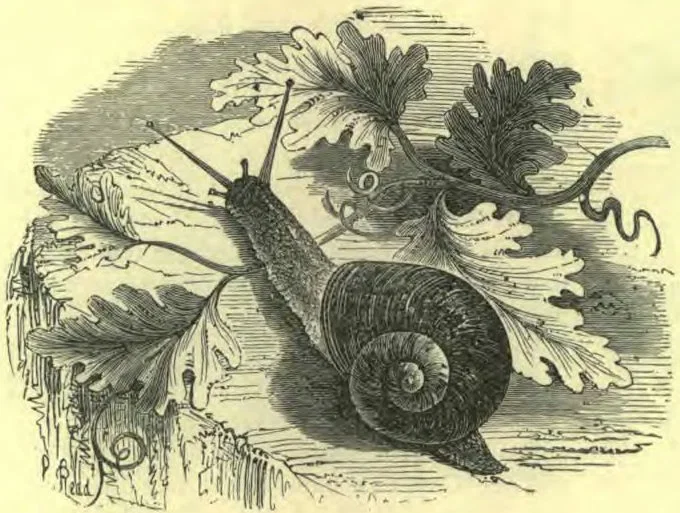
But we must pass on, and notice the air-breathers. We have not much difficulty in recognizing the land snail as being very like the periwinkle, only breathing air instead of water. The way this is done is very simple. If you will watch a snail when his head is out of his shell, you will see a little hole on the right side of the body near the edge of the shell. This opens and closes steadily, and through this hole the air passes in and out of a closed chamber, made by a fold of the mantle. The walls of this chamber are lined with a network of blood-vessels, through which the blood flows, taking oxygen this time from air instead of water.
By this simple arrangement the snail is no longer confined to the sea and rivers, but is able to live in the fields, the woods, and the gardens, feeding on the delicate, juicy plants and leaves, thus getting a share of the rich vegetation of the land. But the land snails have many dangers. They cannot breathe dry air; their bodies must be kept moist, especially the slugs, which have, comparatively, no shell. For this reason, and because birds and hedgehogs feed freely upon them, they are nocturnal in their habits, being found only in their hiding-places during the day.
The snail has sharp eyes set in the end of his tentacles, or “horns.” If you look close, you will see the eyes distinctly. Now in order to be able to retire safely into his shell, he must draw in these eyes and horns. If you watch a snail drawing in his horns, you will see that the eyes disappear down the tube, just as the tip of a glove-finger does when you draw it down from inside the glove. The horns are, in fact, hollow tubes, and a special muscle pulls them in from top downward.
The slugs have no shells except a small cap under the skin just behind the neck, which covers the lungs. The passage way to the lungs can be seen opening and closing on the right side of the body. The absence of a large shell enables the slug to go where a common snail cannot go. All snails develop from eggs. They also have heart and digestive organs.
We have only examined a few of the most common mollusks, but must leave the large sea-mollusks to the realms of natural history.
T. J. ALLEN.
HOW MONEY IS MADE.
Would you not like to know something of the place where your money—the little pennies and nickels you drop in your missionary boxes and collection baskets, and the big dollars which will buy you bicycles—is made, and how it is made? It is made in the United States mint, which was built in Philadelphia in 1792. The corner-stone of the building now used was laid on July 4, 1829. It is of marble, and the roof is covered with copper.
You can visit the mint any day from 9 A. M. to 12, except Sundays and holidays. It is said that over forty thousand persons have visited it in the course of a single year. You enter a little round room where seats are arranged on the sides; here you wait for the usher, who conducts you through the building, and explains everything to you. He has it all at his tongue’s end.
On the left is the weighing room, where all the gold and silver for coining is received and first weighed. These scales will weigh from five hundred ounces to the thousandth part of an ounce, and are examined and adjusted every morning to see that they are correct. It is estimated that fifteen hundred million dollars’ worth of gold has been received and weighed in this room. After the metal has been weighed, it is locked in iron boxes, and taken to the melting room. There are four furnaces here, and the first melting takes place here. The gold and silver, being mixed with borax and other material, is placed in pots, melted, and poured into iron molds, and when cooled is again taken to the deposit room, or weighing room, in bars, where it is reweighed, and a small piece cut from each lot by the assayer. From this the fineness of the whole is ascertained, the value calculated, and the depositor paid.
The process of assaying (testing the fineness and purity of the metal) is next gone through with.
Having been once melted and assayed, it goes to the separating room. Here the gold and silver, used by the mint in the manufacture of coin and fine bars, are separated from each other by acids, etc.
In the melting rooms all the metal used in coining is alloyed, melted, and poured into narrow molds. These castings are called ingots, and are about twelve inches long, half an inch thick, and from one to two and a half inches in breadth. The value of gold ingots223is from six hundred to fourteen hundred dollars; that of silver about sixty dollars. The floors that cover the melting rooms are made of iron in honeycomb pattern, divided into small sections so that they can be taken up to save the dust, the sweepings of which, from the entire building, have averaged in value twenty-three thousand dollars per annum for the last five years.
From the melting room the bars are taken to the rolling room, where they are rolled to the required thinness. When the rolling is completed, the strip is six feet long, or six times as long as the bar. These strips are then passed through the drawing bench until they are of an equal thickness.
The cutting machine comes next—that is, the strips are placed in the immense jaws of the press, from which are clipped the coins (planchets, as they are called). The remnant strips, full of holes, are then remelted.
Now we have the plain coin with nothing on its face. The dies for coining are prepared by engravers especially employed for that purpose at the mint. They cut the devices on soft steel. This having been finished and hardened, constitutes an “original die.” It is too precious to be used directly for coining, so another piece of soft steel takes the impression, and from this latter the coin is engraved.
The coining press is a beautiful piece of machinery, and here the little coin passes in plain and comes out stamped. These machines are fed by women at the rate of five hundred and sixty half-dimes a minute. After being stamped they are taken to the coiner’s room. The gold coins—quarter-eagles—being counted, and weighed to verify the count, are put up in bags of five thousand dollars. The three-dollar gold pieces are put in bags of three thousand dollars each.
The silver pieces are counted on a “counting board.” There is a special vault for counting the nickels and pennies.—Sunday-School Visitor.
HOW SUSIE SOLVED THE PROBLEM.
By Mary R. Diefendorf
“Yes; Susie is very good in algebra,” said mother, a little proudly. She spoke to Grandma Little.
Susie was a neat, pretty girl of sixteen, who had worked very hard to improve her advantages at the village school, that she might be of some help to her mother when she had completed her course, as she had done in June. It was now July. Her mother was a widow, who owned their little house, and had a very small income besides. She had been compelled to be very economical since her husband died. She had the two children to care for, and Susie to keep in school. She was far from strong, but could not afford help, though needing it so much.
Grandma Little was “grandma” by courtesy only. Susie had no living grandparents. This “grandma” was her father’s aunt, who was very well-to-do, and lived with her well-to-do son. She had always taken an interest in her nephew and his family, and often gave evidence of that interest in some kindly way.
Grandma looked over her spectacles at Susie.
“So she was good in algebra?” she said.
“Yes; good in all her studies,” said mother; “and good in algebra especially.”
“Did she receive a medal?” asked grandma.
“No; they gave no medals in the school, you know; but her teachers all said she deserved one.”
“Well, I shall give her one,” said grandmother, decidedly, nodding cheerfully as she spoke. Then she took a bright gold eagle from her purse. “Now, now, Susie, don’t be so foolish,” she said, as the girl began to protest. “If there’s one occasion upon which grandma ought to be allowed to give a little present, it’s now, to make the time memorable—the time when you have become prepared to help your mother and to lead a useful life. Here’s the medal, Susie, and here’s a problem for you to solve. Let your mother know the answer within a week. How can you use this money to the best advantage by dividing it into two equal parts, and procuring something you want very much? Now run along, dear,” as Susie kissed her gratefully, “and think it over.”
“What use is Susie to put herself to?” asked grandma, placidly. “Will she stay at home to help you, or will she go away to teach?”
“I need her help badly enough, it is true,” said Susie’s mother, “and I only wish I could afford to keep her at home; but we absolutely need the money she could earn by teaching to help us along until Bobbie, here, gets to be a man”—patting the curly head of the boy who had crept up to her knee. “I wish Susie could find a place in our village school,” she continued; “but they want experienced teachers there, so I suppose she will have to be away from home, and earn a small salary for a time.”
Then the subject was dropped, and shortly after, grandma went away. Susie thought over her problem many times during the days that followed. One point was settled from the first. One five was to repay mother for the pretty graduating dress. Susie knew how much her mother had herself needed a new dress, and she had taken the five dollars only under the stipulation that it was to be repaid the moment another such bill came into her hands by teaching.
But the other five! Drawing, music, more German lessons, a little trip, some new books—which did she want the most? All seemed so entrancing. She pondered for days. Now she had almost decided for music, now for drawing, now for the books; but amid all her day-dreams there would come uncomfortable thoughts of the needs about home, and somehow, predominant above all, there stood out to her fancy the form of little Robbie, her eight-year-old brother, in his tattered jacket that called so loudly for a new one in its stead. The more that thought occurred to her, the more it grew in favor until it took possession of her mind to the exclusion of all other cherished plans. One day, before the close of the week, she rushed into the room where her mother sat, gave her a hug, and put her precious medal into her hands, saying: “Half is for the dress of course, and the other half for little Robbie’s jacket.” Then she hurried off. Just five minutes later Grandma Little called.
Grandma’s very first question, before she could lay aside her bonnet, was how Susie had solved her problem. When she had learned, she dispatched Robbie to find his sister.
“You have found a splendid solution, my dear,” she said, laughingly, when the young girl had come. “You have a fine head for mathematics; and now let me tell you that I’ve been solving another problem for you. The first thing my daughter-in-law said to me when I went home a week ago, was that she wished she could find a nice, sweet young girl to teach her two little boys. You see, the boys are almost too bright, and learn rapidly, and they’re not very strong; so the doctor thinks they ought not to be confined in school. Harriet says she wants somebody to come for just three days a week, and she’d like some one to help her daughter Alice, too, in her algebra. You see, Alice is a sweet girl, but doesn’t take very well to solving problems, as yet. I told my daughter-in-law I believed I knew just the person for her. Do take it, dear. You can ride there on the cars in fifteen minutes each day; you’ll get a good salary, be with nice people, and you can keep the place for years. Then you can be at home with your mother half the week besides, and help her ever so much. What do you think of my solution of the problem, my child?”
“I think you have a splendid head for mathematics, grandma,” said Susie, as she and her mother together laughed and almost cried for joy.—Mary R. Diefendorf, in New York Observer.
WONDERFUL CHEMISTRY.
“My hair is gray, but not with years,
Nor grew it white
In a single night,
As men's have grown from sudden fears.”
So Byron recognized in the opening lines of his “Prisoner of Chillon” the fact that overwhelming and sudden fear or grief may produce strange physical effects. Every school-boy knows the assertion that in a few days before her execution the hair of Marie Antoinette turned from black to white.
The mysterious influence of mind over body has given rise to a new department in medicine; and but recently scientific experiments have been made in order to investigate what is called the psychophysical, or, in simpler language, the soul-physical, phenomena.
For instance, two kinds of perspiration are now recognized. Exercise gives an absolutely healthy moisture to the body; but the sudden, cold perspiration of a person suffering from a sense of guilt has its own chemical properties. A little of this brought in contact with selenic acid produces a pink color, which cannot be obtained from the perspiration caused by any other emotion.
Some time ago, in a fit of rage, one boy bit another. The wound soon became dangerous, and showed signs of acute poisoning—like rabies. The child's life was barely saved. It has been discovered that anger changes the chemical properties of the saliva, so that it becomes a poison, dangerous to life.
It is well known that the mother's intense anger or grief will change her life-giving milk into a virulent poison. Surprise has caused death and madness. Emotion, therefore, is either stimulating or depressing. It gives life or takes it away. Worry, fret, discontent, unhappiness, dishonor, anger, petulance,—each produces a definite effect upon the system, that acts deleteriously like a poison, and exhausts the body. This is as active in its own way as prussic acid, and may be chemically recognized.
Professor James, of Harvard, an eminent authority in the mental sciences, says: “Every small stroke of virtue or vice leaves its never so little scar. Nothing that we ever do is in strict literalness wiped out.”
As every sinful indulgence makes its own poison that depresses the system, so “every good emotion,” the physiologist assures us, “makes a life-promoting change.” Goodness, cheerfulness, kindness, contentment, have their corresponding physical value, and act as antidotes to poisonous irritants, and so give strength.—Youth’s Companion.
A FOOLISH CUSTOM.
For a long time it has been the custom of ladies, when going shopping, to carry their purse in the hand, as though they wished by so doing to say to every one who saw them, “I am going shopping.” Now it is a manifest truth that next to having one’s money invested in real estate or in a bank, the pocket is the safest place for it. Men do this. If a man should go on the street doing business with his pocket-book in his hand, it would be thought that he had gone daft. In our large cities many women lose their purses because desperate thieves find them so easy to snatch.
It would seem as though, if the ladies do not have cloth enough for a pocket, their sleeves might be made a trifle smaller, and so cloth enough be saved for that purpose. Lately we have seen a new thing in this line. Ladies are carrying their watches suspended from the belt, or hung from the neck, where they will be in sight! They remind one of a mariner with lead and line about to take soundings. It hardly seems possible that the convenience of thieves could be studied to better effect. If this thing keeps on much longer in this way, we shall expect to see keys, penknife, and everything that belongs to the pocket, suspended from the neck or hung from the belt, where they will be in sight. A pocket, especially a lady’s pocket, is a difficult thing for a thief to find. A story is told that once upon a time a lady was awakened in the night by two thieves rummaging her house. They asked her where her money was, and she replied that it was in her dress pocket. Whereupon one of the thieves said, “Let us go, Bill; this is no Stanley exploring expedition.”
THOUGHTS OF THE NIGHT.
By Annie A. Smith
ONE evening, weary with the toil of day,
I sat and watched a happy child at play;
Ah, little one, I thought, thy lot is blest,
With naught to do but play and be caressed.
No saddening grief as yet has touched thy brow;
No thought of pain or care disturbs thee now.
But, baby dear, if thou couldst only know
The weary way thy little feet must go,
Methinks thy laugh would be a cry of pain,
And we should coax thy dimpled smiles in vain.
Thy steps, which on life's stairs now lightly fall,
Will weary be when thou hast climbed them all.
And yet, as now I tread earth's rugged ways,
I feel no longing for my childhood days.
I love the busy whir and stir and strife
That mark the struggles of this mortal life.
We all have our appointed race to run;
'T were shame to linger where we first begun.
Perhaps, when I have climbed the topmost stair
Of the long flight, and feel the evening air
Upon my aged cheek, and see the light
Of life's long day fade slowly from my sight,
With all of earth behind, and heaven before,
I'll be content to be a child once more.
ANNIE A. SMITH.
SCHOOL-BOY HEROISM.
Two boys were in a school-room alone together when some fireworks, contrary to the master’s prohibition, exploded. The one boy denied it; the other, Bennie Christie, would neither admit nor deny it, and was severely flogged for his obstinacy. When they were alone again, the delinquent asked: “Why didn’t you deny it?”
“Because there were only we two, and one of us must have told a falsehood,” said Bennie.
“Then why did you not say that I did it?”
“Because you said you didn’t, and I would share the falsehood.”
The boy’s heart melted; Bennie’s moral gallantry subdued him. When the school resumed, the young rogue marched up to the master’s desk, and said: “Please, sir, I can’t bear to be a liar; I let off the squibs,” and burst into tears.
The master’s eyes glistened on the self-accuser, and the unmerited punishment he had inflicted on his school-mate smote his conscience. Before the whole school, hand in hand with the culprit, as if the two were paired in the confession, the master walked down to where young Christie sat, and said: “Bennie, Bennie, lad, he and I both beg your pardon; we are both to blame!”
The school was hushed and still, as older scholars are apt to be when something true and noble is done—so still they might have heard Bennie’s big boy tears drop proudly on his book as he sat enjoying the moral triumph which subdued himself as well as filled all the rest; and then, for want of something else to say, he gently cried: “Master forever!”
The glorious shout of the scholars filled the old man’s eyes with tears, as he resumed the chair.—Sunday-School Visitor.
A RUSSIAN AMBASSADOR AT ROME.
The czar of Russia has decided to send a regularly accredited ambassador to the Vatican. So it must be that the czar recognizes the pope as a temporal prince, and that he has a rightful claim upon the “states of the church.” This cannot be particularly gratifying to the king of Italy, who does not believe in the temporal authority of the pope. Two independent princes occupying the same capital city, are, to say the least, a very remarkable spectacle; but it has been seen in Rome since 1870. If the patriarch of St. Petersburg should try to be king, and Italy should send an ambassador to him, the probability is that both the patriarch and the ambassador would spend the remainder of their lives in the Siberian mines! This shows that the old adage that “what is sauce for the goose is sauce for the gander” is not always true. Certainly the king of Italy takes a sauce that the czar would not take for a moment. Does the czar intend this for an insult to the Italian government, also to the allies of Italy? It certainly looks that way.
MOUNT HOOD.
It is the custom of many Americans to rush off to Europe to spend several of the summer months in climbing the Alpine heights of Switzerland. This may be well for those who want to see Europe, and can afford the expense; but America has some grand mountain scenery of her own, and we are beginning to find it out. Mount Hood, of Oregon, is one of the grandest peaks that ever was visited by man. It is a peak of the Cascade range, and reaches a height of eleven thousand nine hundred and thirty-four feet. Its summit is six thousand feet above the line of perpetual snow. From the top a most magnificent view may be obtained of the other snow-capped heights of the range, the beautiful Willamette valley, and the “deep and dark blue ocean,” a great highway for the traffic of the world.
At Portland, Oregon, which lies upon the beautiful Willamette River at the mountain’s base, a club of mountain-climbers has been organized. None can join the club until they have climbed to the summit. In fact, the club was organized upon the top of the mountain, July 19, 1894. Two hundred enthusiastic mountain-climbers, of both sexes, were present. While they were there, a thunder-storm passed below their feet, and they looked down at the play of the lightning among the clouds. The object of the club is to call attention to the fact that America is not excelled in the beauty and grandeur of her scenery.