The Youth’s Instructor, Vol. LIII, No. 10

A Tree for a Watch-tower

The Youth’s Instructor

March 7, 1905

Review and Herald Publishing Assn. · Washington, D. C. · March 7, 1905

A Tree for a Watch-tower
It seemed very peculiar, when we first came to India, to see people sitting in the fields watching their crops.
At this season a crop called “jewari,” which has the appearance of sugar-cane, is ripening. The birds seem to think a share belongs to them, and truly they must get their food somewhere. But the poor owner generally has only one field, and that sometimes not larger than a garden.
Therefore, upon a tree in the center of the field, or at the side, he makes himself a “nest,” or a place on which to sit, and he looks not unlike a huge bird himself. The “nest” is made of brush with dried grass piled on top. He or his wife and child sit day after day from early morning till night, watching the birds from the crop. Often he has a rope tied to another tree or stalk, and by catching the other end, he swings it back and forth across the bending heads of the “jewari.” He also takes along up to this “nest,” a sling and a supply of small stones, also a large basket of balls the size of walnuts, which he has made of mud from the pond, and baked in the sun. There may be seen bottles and old clothes too, hanging up for “scarecrows.”
And scream! oh, how he screams! It would frighten you at first. I must confess that was my experience, while walking on the road alone, one morning. A man in the field near by began screaming so terribly that I thought he was telling me to beware of something,—but what? I could not understand a word of the language then, but I could see nothing dangerous.
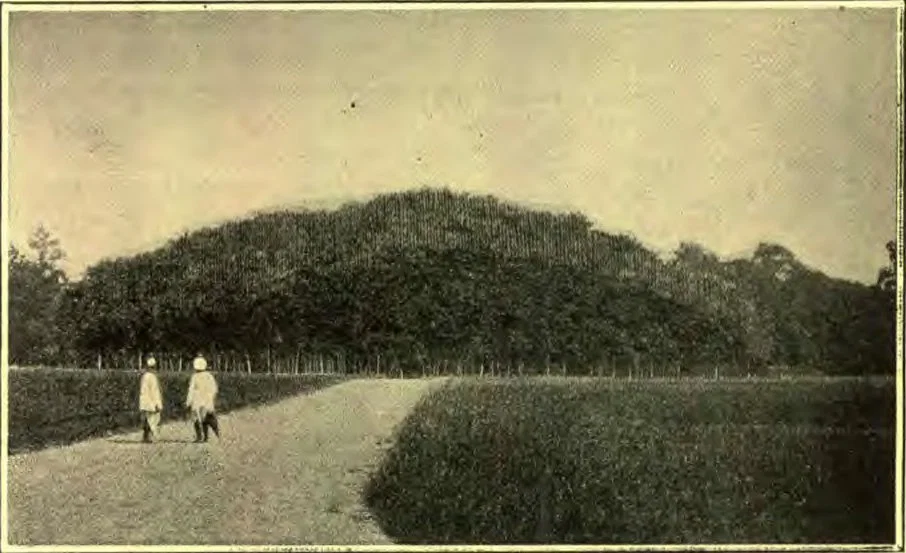
A BANYAN TREE OF INDIA
When we say that watching is of no use, as the birds get all they want anyway, they reply: “That is true, but the other man watches: and so must I, or he will drive them all over on my crop.”
It does seem that birds as well as monkeys do not fear the natives, for you know that the Hindoos will not kill them. The English and Americans use their guns, so the birds are rather shy of them.
There are many, many crows. They are tame, and are not always black, but rather of a lead-color. At our boarding-house when stopping in Bombay, they come into the rooms and sit about, “cawing.”
At Anklesvar one day every one left the kitchen, and the door was open, so these black gentlemen went in, overturned a basket of eggs, and apparently greatly enjoyed the feast.
Pretty green parrots may be seen flying about too. We had “roasting-ears” in our garden, but they and the crows claimed their share.—Effie S. Long.

Christmas in India

ON Christmas day the sanitarium family and a number of the mission workers went out to spend the day in the botanical garden of Calcutta. At this season the weather is like autumn in America, dry, bright, and cold enough to make one enjoy moving briskly about. Lunch baskets, bicycles, children, and older persons all found a place on a small steamer. Soon the whistle blew, and we started out in search of a pleasant place to spend the day. The trip was a few miles down the Hoogly River, which connects Calcutta with the high seas, and here all the year are ships from many countries, coming and going with various kinds of cargo. They bring to us all sorts of cloth and wares from the West, and take away tea, coffee, bamboo, cocoanuts, and spices.
The sailors honor Christmas day by stretching a long row of flags of all nations from one end of their ship to the top of the two or three masts, and then down to the other end of the vessel. Twenty-five or more large steamers together with many smaller crafts along the course of the river, all of which were thus decorated, made an interesting sight.
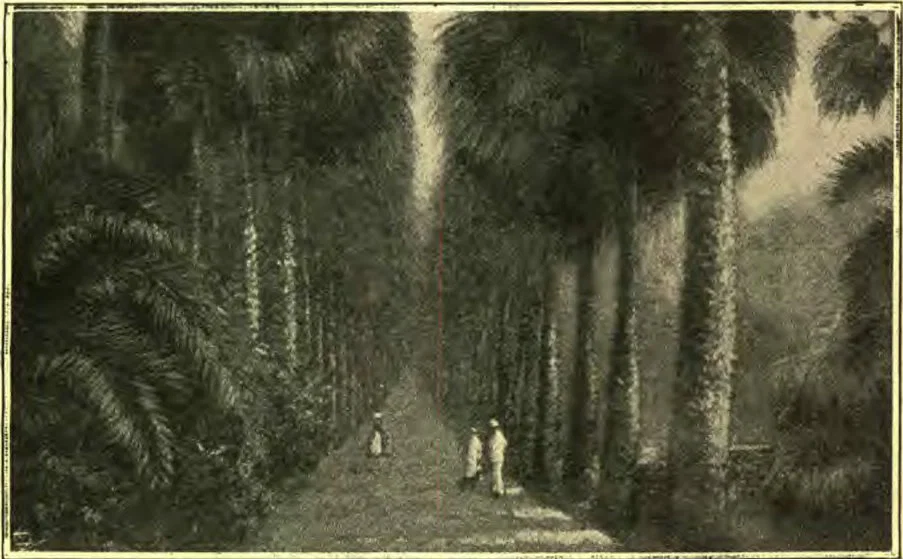
After enjoying for a while the changing scene of a busy harbor, we came to the garden. We entered at the beginning of two main drives, Palm and Banyan Avenues. Leaving our lunch baskets in a good place with a native to guard them, we passed down Palm Avenue. Soon after reaching the garden, the company scattered, some on bicycles and some on foot, to admire the beauty of the place; for this is in a tropical country with no cold as in the north, no ice nor snow, not even frost; so the plants, and even delicate flowers, are blooming as in May or June. The small greenhouses here and there are covered with pretty climbers, and are filled with a profusion of beautiful, blossoming plants.
PALM AVENUE
PALM AVENUE
Later on we all met at the banyan tree, the largest, handsomest, and most wonderful tree in the world. The picture gives you an idea, but it does not reveal the trunk from which some of the branches extend to a distance of eighty feet. These branches are supported by living props, which, being let down as tendrils, took root, and became trees also. The banyan has no limit to its size, though the tendrils are often destroyed, leaving only the main trunk. While we sat under the mammoth tree with the warm sun streaming down through the foliage, enjoying the beauty of God's handiwork, Elder Shaw read to us about India, its needs, and the importance of our work. After lunch we returned to Calcutta to work until another Christmas. L. F. HANSEN.

Let Your Light Shine

As we were approaching Cape Town, that pearl hidden away in beautiful Table Bay, and seemingly jealously guarded by the line of mountain tops, aptly called “The Twelve Apostles,” which seem to lean out with parental interest over the city and bay, we saw a sight which impressed itself deeply upon me, and has followed me ever since. It was late, and quite dark for the beautiful southern midnight.
From looking ahead where the lights of our long-anticipated haven gleamed like the unnumbered fireflies in the summer meadows of my far-away youthful home, my glance fell over the rail upon the water flung ruthlessly aside by the iron foot of our mighty ship. It glistened with a bright luster, for each little phosphorescent animal, irritated by the passage of the ship, had awakened and lighted its tiny lamp. Elsewhere the water was dark and motionless.
I could not keep from thinking: How much this is like the true Christian character. When everything is pleasant and calm about us, and there is nothing to irritate or trouble us in any way, there is little to indicate our true standing in the Christian life. But when the storms of life toss us to and fro; when the dark clouds which seemingly have no silver lining pile up around us; when the furnace of affliction is finding out our dross, and it seems that even God has veiled his face from us—then it is that true Christian character will shine out. Let us remember it was only the “troubled waters” which had healing power, and only when Table Bay was churned by the passage of our stately ship, did it shine with its silvery light.
It is in the darkness of this sin-cursed earth that our light should shine brightest. Therefore, “Let your light so shine before men, that they may see your good works, and glorify your Father which is in heaven.”—Alfred A. Robie.

The Place of the Imagination

ONE of the most precious faculties given the human mind is that of imagination. Because of the perverted use of that power, some have been led to frown upon it, and to look upon those who are imaginative as impractical and unreliable. And, indeed, it is one of the nicest tasks to distinguish and choose between those flights of the mind which are irresponsible and fantastic, and that exercise of the imagination which is proper and valuable. Yet we are no more justified in condemning or despising imagination because of the fantasies which its wrong use has created, than in decrying the faculty of reason because, by its unaided exercise, men have been led into infidelity.
We think of fiction as the realm of imagination, yet fiction is only the misuse of one form of imagination. All our memories, all our conceptions of things heard of but unseen, are illuminated by the aid of imagination. Imagination is the circumambient air which diffuses and reflects the light upon all sides of the object under inspection. Without it our memories would be but sharp forms and black shadows, like the mountains of the moon; our conceptions of objects described by others would be nothing, only words. We exercise imagination unconsciously in almost every mental action; it is an untiring minister to our pleasure and our progress.
To cease the reading of fiction is not to repress the imagination; it is to give a chance to train and develop imagination. Romance carries our imagination upon its back, letting it see many countries, many people, many things, but never encouraging it to exert itself for that purpose. Sober truth, by many a half-concealed secret, by many a partial glimpse, by many a reward of exertion, coaxes our imagination, buoys it up, until its free, strong limbs carry it lightly over the hills of Time and Eternity, ever free, yet self-controlled.
The normal child lives in a world of delightful imagination. All things which he is learning, new and wonderful, call out its power, and he thrives with its proper exercise. It may be easily spoiled in him; it is a delicate machine, not to be rudely touched by unskilled fingers. The reckless hand of a fairy may disarrange the wheels and hopelessly ruin its harmony; the rough buffet of giant or gnome may demoralize it in terror. Properly trained, through natural sights and true stories, it may be a useful servant, under the control of its master. And while it must yield its supremacy, at the proper age, to the rising power of logic, it continues, in its subordinate position, as a most important factor in mental life.
What are the proper fields for its exercise? First, it belongs to the time of childhood. There is a subtlety about its operation there which defies analysis. For us it transformed commonplace things into beautiful things; all the world, known and unknown, was romantic to us. There was a keen delight in play, in holidays, in gifts, which if we ever feel nowadays, gives us almost a spasm of pain by its intensity.
Largely by its correct or its wrong training has been determined our present mental condition. If the imagination was fed with fairy tales and fictitious stories, its powers became so debauched that it would not yield readily to legitimate rule when the new epoch was reached, and day-dreaming, dawdling, and fiction reading became more and more powerful temptations. If truth in word and thought was taught and enforced, the mind maintained its purity and freedom of action, and was ready to greet the change, and assume its new role of reason and action. Rosenkranz says: “The fostering of the sense of truth from the earliest years up, is the surest way of leading the pupil to gain the power of thinking. The unprejudiced, disinterested yielding to truth, as well as the effort to shun all deception and false seeming, is of the greatest value in strengthening the power of reflection.”
Many young men and women who are not addicted to story reading, as well as many who are, have lost much of the power of imagination. Let us see where it should be used, and therefore why regained.
Probably all have read or heard many stories from the Bible which they do not remember. It is lamentable how many of our young people know but little of Biblical history. Perhaps they have heard the stories, but straightway have forgotten them. Why? — Because they heard only the words. If these had been real to them, they would have called into play their imaginations, and pictured out the scenes described, until there would have been, in their memories, not sentences, but mental, almost visual, pictures. Have you ever seen the ark that Noah built? Now, as the picture comes up, do you hear the ringing of the hammers? Do you see the groups of stalwart men and beautiful women who stand out in the bright sunshine this dewy morning, and laugh and chat together about the strange fantasy of the old man Noah? Have you ever sat and talked with Abraham under the oak trees in Moreh? Are you familiar with the shapes of the two great hills on either side? Have you ever walked forth with Isaac at Beersheba in the cool of the evening, to meditate in the fields? I did that one day in the spring, as the sun was setting in a gorgeous vestment of clouds far over the rolling prairies of a Dakota scene. The low, rolling hills, the herds around the watering-trough, the stillness of the air, and the calm of the whole evening scene, brought irresistibly to my mind that evening when Isaac went out and met Rebecca coming with the camels. So I walked and talked with Isaac for a while, and I am sure I knew much more of his character than I did before.
Have you ever pictured the palace that is being built for you in the New Jerusalem? Are its walls opaque, and is its roof impervious to rain? Have you taken a Sabbath-day journey from the far northern lands of Asher, through the softly lighted woods and the fields where the lamb and the lion follow you peaceably together, up the gently swelling slopes of the great and high mountain from which you shall see the fair and glorious city, set like a jasper jewel in the green fields of Eden? Have you followed the lovely Jesus as he leads the one hundred forty-four thousand into the glorious temple without the gates; or when, with a voice like the musical flow of many waters, he calls to you and to me and to all our brethren to sit down at the feast of the marriage supper, where the tables, extending many miles, are loaded with the fruits of the new earth? Have you questions ready to ask Enoch? Do you anticipate some of your visits to Adam’s estate? Do you think of the time when you will go out of the gate of Benjamin with Jonathan, for a visit toward the south? or when you will soar with a king of Arcturus through the glory-gates?
How much legitimate food there is for the imagination! Let one caution be given. The mind should not be left fancy-free to make for itself images which may bear no resemblance to the truth. There is material in the Bible, in the Testimonies, in the reports of geographical expeditions, in accounts of ancient customs and manners, which we should gather to make our creations exact. Let us study to find these facts, let us dig for them, before we clothe them with the garments of imagination, that we may have true, not spurious, creations. Fiction is content to let the fancy roam untrained; truth employs imagination to make clear pictures from dim realities.
The value of this exercise of the imagination is incalculable. It helps to fix our minds upon true, beautiful, and glorious things; it inspires us by its cheer, by making more real things which are now somewhat vague to us. A proper preparation for its exercise makes us careful and exact students, scholars indeed, in certain lines of study. We are compelled to search out and gain much which we miss in a casual reading. The exercise of the imagination makes us sympathetic, observant, quick of intuition. It is indispensable to the teacher. The fact is, the dearth of teachers is partly attributable to the neglect of the cultivation of the imagination in children and youth.
The scope of the field in which imagination may play is not limited, except by such barriers as were set Adam: “Of every tree of the garden thou mayest freely eat: but of the tree of the knowledge of good and evil.” The directions for its employment are simple. If adhered to, they will guide the mind into right channels, and open before the soul visions of happiness, of beauty, and of glory that otherwise never can be realized.
A. W. SPAULDING.

B. F. M. SOURS

Come

COME! come! Love calls for thee! Soul, art thou sad? The Saviour died to cheer thy life And make thee glad.
Come to his arms of love: Delay not—come!— And love and gladness are thy lot, And heaven thy home.
Behold, he calls thee still! Do not delay, But take the purity, the joy, He gives to-day.

B. F. M. SOURS

Reading Furnishes Materials; Thinking Makes Knowledge Ours

REMEMBER the saying of Locke, “Reading furnishes the mind only with the materials of knowledge; it is thinking makes what we read ours.” Telling puts another clasp on memory.

Gradual Vanishing of Great Salt Lake

THERE is much recent interest in the Great Salt Lake, the Dead Sea of America,— an interest based on two particulars, its salt production and its seeming shrinkage. The harvesting of salt from its waters began with the coming to its shores of the Mormons in 1847, when the salt then obtained was due to the summer evaporation of water held in little ponds or basins. About 1860, dams were built to increase the size of these ponds, which were flooded in the spring, and the water evaporated during the summer, the salt being raked up in piles along the banks, and used as needed.
When the process of reducing silver ore by the chlorin process was discovered, the demand for salt grew rapidly, and the output increased, reaching a total of fifty thousand tons in 1890. The increase has been steady since then, and to-day Utah is the sixth salt producer among the States, the fifth in value of product. The harvest increased from 96,720 barrels in 1886 to 417,501 barrels in the year 1902.
By continual loss of water through evaporation, Great Salt Lake has become a highly concentrated solution of salt, and there is much reason to believe that this process will continue, and the lake gradually dry up. In 1886 its area was estimated at about 2,700 square miles, while recent surveys make it only 2,125 square miles. The cause of this shrinkage, though not absolutely known, is variously believed to be due to evaporation, to irrigation, or to a subterranean outlet. Whichever it be, if this gradual vanishing continues, the lake is doomed.
Four barrels of the water will leave, after evaporation, nearly a barrel of salt. The lake was discovered in the year 1820, and no outlet from it has yet been ascertained. Four or five large streams empty themselves into it, and the fact of its still retaining its salient properties seems to point to the conclusion that there exists a secret bed of saline deposit over which the waters flow, and that thus they continue salt; for though the lake may be the residue of an immense sea which once covered the whole of this region, yet by its continuing so salt with the amount of fresh water being poured into it daily, the idea of the existence of some such deposit from which it receives its supply seems to be only too probable.
There are no fish in the lake, but myriads of small flies cover the surface. The buoyancy of the water is so great that it is not at all an easy matter to drown in it. The entire length of the Salt Lake is eighty-five miles, and its breadth is forty-five miles. Compared with the Dead Sea, the Great Salt Lake is longer by forty-three miles and broader by thirty-five miles.— Week’s Progress.

Horace Wells and the Discovery of Painless Tooth-Drawing

Anesthetics

DURING the month of December, 1844, Mr. Colton, a popular itinerant lecturer on chemistry, delivered a lecture on “laughing-gas” in the city of Hartford, Connecticut. In his audience was Mr. Horace Wells, an enterprising dentist of the town, with a marked leaning toward mechanical invention.
After the lecture, the speaker afforded his hearers the usual amusement of inhaling the gas in order to undergo its peculiar effects. Wells, who was an interested on-looker, noticed that one of the men, under the excitement brought about by inhalation of the gas, was not conscious of hurting himself when he fell on a bench near by and bruised and cut both knees severely.
This man, even after he became clear-headed again, was certain that he experienced no pain at the time of the fall. Wells had always believed that something would be found to make tooth-drawing a painless operation, and after witnessing the occurrence already mentioned, he was thoroughly convinced that during the temporary insensibility brought about by the use of the gas and the intense nervous excitement produced, teeth might be readily drawn without pain to the patient.
Wells at once decided to offer himself and one of his largest teeth to test the theory. The next morning Colton, the lecturer, gave him the gas, and his friend, Dr. Riggs, extracted the tooth. Wells remained unconscious for a few minutes, and then exclaimed: “A new era in tooth-pulling! It did not hurt me more than the prick of a pin. It is the greatest discovery ever made.”
During the next few weeks Wells extracted teeth from twelve or fifteen persons under the influence of the nitrous oxid, or laughing-gas, and gave pain to only two or three. Encouraged by the success attained, Wells went to Boston, wishing to enlarge the reputation of his discovery, and to have the opportunity of administering the gas to some person undergoing a surgical operation.
Dr. Warren, the senior surgeon of the General Hospital of the State, asked that Wells demonstrate the effects of the gas on some one from whom he would draw a tooth, before permitting him to use it during a more difficult operation. Wells undertook to administer the gas before a large body of students, to whom he had previously explained his plan. Unfortunately, the bag of gas was taken away from the patient too soon, causing him to cry out when the tooth was drawn. The students hissed and hooted, the discovery was denounced as an imposture, and Wells left Boston, disappointed and disheartened.
Soon afterward he gave up dentistry, and neglected the use and study of nitrous oxid, till a discovery more important than his own recalled to him his former views. This other discovery was the effects produced by inhaling sulphuric ether, which was often used for the relief of asthma and other similar diseases.
Ether could be more readily obtained than nitrous oxid, and for this reason it came to be often inhaled for amusement by chemists’ lads and surgeons’ pupils. It was often thus used by young people in many sections of the United States, and the fun occasioned was called “ether frolics.” During one of these so-called frolics a negro boy lay unconscious for such a long time that he was supposed to be dead. The fright occasioned put an end to the ether frolics in that neighborhood; but a certain physician named Wilhite was so interested in the effects produced by the ether, that he continued to experiment with it, in company with other physicians. Under the excitement brought about by inhalation, one of the doctors observed that he was unconscious of the blows which he received by chance as he rushed aimlessly about under the influence of the ether.
This person was Dr. Long, who had heard of the remarkable recovery of the negro boy after an hour’s insensibility, and, seeing something out of the ordinary in his own sensations, he determined to use the ether in an effort to allay the suffering during some surgical operation. In March, 1842, he induced a Mr. Venable, who was very fond of inhaling ether, to take it until he was quite unconscious. When this was done, Dr. Long removed a tumor from Venable’s neck. No pain was felt, and no evil results followed the experiment, which was tried again during the next two or three years with similar success.
Although his successful operations were known and talked of in his neighborhood, Dr. Long did not publish any of his observations and discoveries for the benefit of the world at large. He wanted to test the ether more thoroughly in some more difficult and dangerous operation, after which he intended giving his observations to the world.
In the meantime other physicians, knowing nothing of Long’s success, were experimenting, and in 1846 ether was administered with success during a difficult operation at the Massachusetts General Hospital, the patient experiencing no sensation of pain during the trying ordeal. The discovery first made by the unfortunate Wells was now complete, and in a few brief months was in use in the leading cities of Europe and America.—Hilton R. Greer, in The Children’s Visitor.

The Dangerous Moment

THERE is no richer soil for sins against one's self than the mood of discouragement. It is in times of depression that men and women whose instincts are good, whose impulses are sound, and who mean to do right, fall into temptation.
Moods of spiritual depression are exactly like moods of physical depression; when the tone of the system is lowered, germs of disease, which are readily thrown off in health, find a foothold, and set in motion most dangerous disorders. In health a person can live with perfect impunity in conditions which become fatal when he is physically reduced. In like manner, when his hopes are high, and the outlook is fair, he easily repels temptations which have almost overwhelming force when he has lost confidence in himself, and sees no hope ahead. In depression clear judgment is almost impossible, and the man who wishes to guide his life wisely will learn that, although he can not at all times immediately throw off depression, he can have such a knowledge of himself that he will not, while in this state of mind, decide important matters or take important steps.
Depression and discouragement in every form ought to be recognized as things to be struggled against and overcome in the strength of God. They are the open doors through which the worst evils come. Many a man on the verge of a worthy and enduring success has blighted his life hopelessly by wrecking his future in a passing mood of depression. There is but one safe rule, and that is always to hold ourselves spiritually at the highest valuation; to refuse to be cheapened even in thought by disasters, misfortunes, or apparent failures; to believe, with Browning, that “all turns to the best with the brave;” and to hold one’s self something greater than the creature of circumstances, fortunate or unfortunate. The man who sets his face toward an ultimate aim which is worthy of himself can afford to disregard passing storms, the rising and falling of tides, cross-currents, or even the most appalling tempests. MAX TRUMAN SMITH.

Making Apples Without Cores

A Western horticultural genius has succeeded in producing a coreless apple, and arrangements have already been made to propagate it on a large scale in the great commercial apple orchards of the West. Two thousand of the trees are now available for propagation, but it is estimated that in 1906 the growers will be able to put 2,500,000 young trees on the market. It is claimed that the tree is hardy and suitable for any climate where the old style apple will grow.
The only thing resembling a blossom is a small cluster of tiny green leaves which grow around the newly formed apple, and shelter it. Being devoid of blossoms, it is claimed that the fruit offers no effective hiding-place in which the codling-moth may lay eggs. Moreover, there is nothing to fear from frosts.
The skin of the new apple is red, dotted with yellow. As with the seedless orange, so with the seedless apple, a slightly hardened substance makes its appearance at the navel end. But this can be removed by culture.
Apple culture is more important even than orange culture. In the United States there are 200,000,000 apple-trees in bearing, from which 250,000,000 bushels of fruit are annually harvested. In ten years these trees will give a yield of 400,000,000 bushels. At the present time the apple consumption of the United States is eighty pounds per head of the population per year. By bushel measure the American apple crop is four times greater than the entire wheat yield of Great Britain and Ireland.—Search-Light.

THE WEEKLY STUDY

Paul at Ephesus

OPENING EXERCISES.
SCRIPTURE FOR STUDY: Acts 19:11-22.
TEXTS FOR PERSONAL STUDY: 1 Thess. 2:19, 20; Phil. 4:1.
REFERENCE STUDY: “Sketches from the Life of Paul,” pages 134-140.
TOPICS FOR STUDY:—
Special miracles wrought. Exorcists at work. Their humiliation. Many believed. Books burned. The word grew mightily. Paul’s purpose. Timothy and Erastus sent to Macedonia.

Notes

“Ephesus was not only the most magnificent, but the most corrupt of the cities of Asia. Superstition and sensual pleasure held sway over her teeming population. Under the shadow of her idol temples, criminals of every grade found shelter, and the most degrading vices flourished.”
“As Paul was brought in direct contact with the idolatrous inhabitants of Ephesus, the power of God was strikingly displayed through him. The apostles were not always able to work miracles at will. The Lord granted his servants this special power as the progress of his cause or the honor of his name required. Like Moses and Aaron at the court of Pharaoh, the apostle had now to maintain the truth against the lying wonders of the magicians.”
“The miracles of Paul were far more potent than had ever before been witnessed in Ephesus, and were of such a character that they could not be imitated by the skill of the juggler or the enchantments of the sorcerer.”
“The influence of these events was more widespread than even Paul then realized. . . . These scenes in the ministry of Paul lived in the memory of men, and were the means of converting many to the gospel long after the apostle himself had finished his course.”
“When the Ephesian converts burned their books on magic, they showed that the things in which they had once most delighted were now the most abhorred. . . . Here was given the best evidence of true conversion.”
“Fifty thousand pieces of silver,” according to Dr. Adam Clarke, amounted to about two thousand dollars.
G. B. T.

A Man of Prayer

IN passing through Northampton I went into the old cemetery, swept off the snow that lay on the top of the slab, and I read these simple words: “Sacred to the memory of David Brainerd, the faithful and devoted missionary to the Susquehanna, Delaware, and Stockbridge Indians of America, who died in this town, aged thirty-two years, Oct. 8, 1747.” That was all there was.
Now that man did his greatest work by prayer. He was in the depths of those forests alone, unable to speak the language of the Indians, but he spent whole days literally in prayer. What was he praying for? He knew that he could not reach these savages; he did not understand their language. If he wanted to speak at all, he must find somebody who could vaguely interpret his thought; therefore he knew that anything he should do must be absolutely dependent upon the power of God. So he spent whole days in praying, simply that the power of the Holy Ghost might come upon him so unmistakably that these people should not be able to stand before him. What was his answer? Once he preached through a drunken interpreter, a man so intoxicated that he could hardly stand up. That was the best he could do. Yet scores were converted through that sermon. We can account for it only that it was the tremendous power of God behind him.
Now that man prayed in secret in the forests. A little while after, William Carey read his life, and he was so moved by it that he went to India. Henry Martyn read his life, and by its impulse he went to India. Payson read it as a young man of twenty years, and he said he had never been so impressed by anything in his life as by the story. Murray M’Cheyne read it, and was powerfully impressed by it.
But all I care is simply to enforce this thought, that the hidden life, a life whose days are spent in communion with God in trying to reach the Source of power, is the life that moves the world.—Dr. A. J. Gordon.

Alone With God

ALONE with God in the evening, When are past the cares of the day, When the hot, flushed clouds of sunset Have faded to sober gray. The troubles that weighed my spirit, In the hush of the darkness cease; I'm alone with God in the evening, And my soul is filled with peace.
Alone with God in the evening, But memory's thoughts will stay, Perchance the duty I did not do, Or the word I did not say; I think of those vanished chances, With a tender, a sad regret, Alas, for the good that I might have done, Ere the sun of the day was set!
Alone with God in the evening; Is the record dark or fair That has gone all day to the gates of heaven, To be recorded there? I think of each sinful action, With a troubled heart and brain; For the day that's gone to eternity, I can never live again.
Alone with God in the evening, I fall on my knees and pray That he, from his tender, pitying heart, Will forgive the sins of the day, And a peace settles down o'er my spirit, I rest like a weary child; I'm alone with God in the evening, And to him I am reconciled.
L. D. SANTEE.

Encouraging Words

THE Young People's Society of Westphalia, Michigan, has ten members. Some are quite young. When the Society was organized, the members wanted to begin work at once. It happened that the church had only one tract on hand, “The Sufferings of Christ.” Three of the youngest children started out with seventy-two of these tracts to sell. At noon they came back with only four, and they had some good reports to give. They had sold one tract for four cents, given one away, and while the rest were offered for four cents each, sixty-six purchasers voluntarily paid five cents for the tract. So on their return the little workers could report sixty-seven tracts sold, one given away, and $3.34 to invest in more tracts.
The Society has interested some not of our faith in the Southern work, and several of these have offered donations. Five dollars thus received has been sent, and some money is still on hand. All were of good courage when I last visited them. It is certainly encouraging to see that our young people are waking up to the work for this time.
While at the session of the conference, I learned that the Grand Rapids Society was planning to place a laborer in the field, and that it would be one of their own number if possible. Can not other Societies do likewise, or several Societies work together to this end?
D. H. LEWIS, Director.

For India

MISS ISABEL DUNSCOMBE recently sent to the Mission Board secretary the following letter:—
The Boston church held missionary exercises January 7 for the benefit of the mission work in India. Interesting and instructive exercises were carried out by the children.
A year ago mite boxes were given to the intermediate class of eight. The proceeds from the boxes amounts to $4.28. The children took up a collection from the audience amounting to $6.02; total, $10.30, which I send to you as a missionary offering to India.
Our prayers go with this offering that the Lord may bless.

Choosing a Life-Work

THIS is a most solemn matter. No one ought to drift into a life-work. No one ought to allow another to choose it for him. No one ought to inherit it. God alone knows for what calling he has endowed each person. He has foreordained certain good works for each one, in which he should walk. By waiting on him in faith and with an unbiased mind and a surrendered will, every young person may discover this sacred path, and walk in it to the joy of his heart, to the blessing of the world, and to the glory of God. If this should be done, there would be less misfits in life. We believe also that many more of our young people would feel called into definite Christian work as the result. What greater happiness or honor than to give one’s whole time to the service of God and man?—Christian and Missionary Alliance.

Keep Moving

A LITTLE fellow one afternoon was thoughtfully studying a picture called “The Game of Life.” His attention was centered upon the play board. He moved his fingers from square to square, then, pointing to the young man in the picture, and looking wonderingly at me, exclaimed, “Say, uncle, why doesn’t he move?”
The question is a serious one. Every person is playing the game of life, but how we procrastinate! I sometimes think that angels exclaim, “Why doesn’t he move?” The end of all things is at hand. The moments left us in which to move are very few. It is well to be careful, but far better simply to trust God and keep moving. While the earth revolves, while planets and suns make their circles without one moment’s delay, let us, who are the special object of God’s care, keep moving.
WILLIAM YARNELL.
Continue reading: Washing Dishes