“WHAT’S the trouble, little Edith,
With your rosy face awry?
That drooping frown upon your forehead
Makes you seem about to cry.”
“O, I’ve got to wash those dishes!
How I hate it no one knows!”
And down her cheeks the tear-drops trickle,
And the frown much deeper grows.
“If this washing came but weekly,
And then it could be laid away,
But it seems to last forever,
Two or three times every day.
“Heavy pots and pans and kettles,
And a lot of things beside;
Hard the labor, yet not noticed,”
And poor Edith sobbed and cried.
“I am sorry you dislike it;
It is tiresome, well I know,
But, dear Edith, it is noticed
By Him who knows our ev’ry woe.
“And, looking down from highest heaven,
He’ll cast on you his loving smile,
If you labor washing dishes
With a song of praise the while.
“In his teachings, you remember,
‘Whatsoever task,’ said he,
‘That your hand may find to render,
Do it well as unto me.’
“That will make your task seem lighter;
Try it now, my Edith dear,
And whene’er you get discouraged,
Sing his praise with hearty cheer.”
— Marietta C. Du Bois.
The Most Satisfactory Incident of My Life
By C. G.
AFTER a lapse of sixty years of active life, in looking over the events that have marked the course of that period, it would be a strangely selfish one indeed could I not note some event that gives a pleasant, warm, and quickening impulse to my feelings, and marks certain events as the happiest, or at least, the most satisfactory of my life.
The one I relate here is one which, while it cut off the aspirations of my young manhood, and deprived me of opportunities that every ambitious person desires at this period of life, still in the remembrance of a filial duty done, repays me well for all I otherwise might have gained by turning from the opportunity presented.
I was in my twentieth year. My ambition was to secure an education that would fit me for some position in life above the digging and delving of the masses.
My father, divining the thoughts that filled my mind,—I had said nothing, knowing his inability to help me,—told me I could have my time, and to do as I wished with the means I might henceforth earn.
I left my humble home about midsummer, and went to work in the harvest-field for advanced wages. Strong, and glowing with health and hope, I did my part with good cheer.
After securing the harvest for my employer, he settled with me, partly paying me for my services, and asking me to allow him on my wages for some grain my father had gotten of him the spring before, but which, as yet, was unpaid for.
Here was a way which I felt rather glad of to express my gratitude to my father for allowing me to be the master of my future, although it would make quite an inroad upon my earnings and the carrying out of the ambition of my heart.
I next went over to my uncle’s, about five miles away, where my father was securing his oat harvest on land he had taken on shares.
I thought I might help him some, as he was quite alone. I found him and my uncle getting in the grain, so I took my uncle’s place, and went into the field for the next load, leaving him to rest in the shade.
In the course of conversation with my father, I learned that he was much straitened just then for means to supply the needs of his large family — my younger brothers and sisters.
I knew he needed money; even the few dollars I had with me would be of much help to him. I did some serious thinking as he pitched the bundles from the load over the big beam to my uncle, who mowed them away.
As the last bundle was tossed from the wagon, my mind was fully made up. I climbed upon the rack as my father took the lines to back the team from the barn for another load.
“Father,” said I, “don’t you want some money?”
“Yes, I do,” said he.
“How much?” I asked.
“All you have,” was his reply.
His whole expression touched my heart. I knew he needed it, and much more than I had to give.
I took from my pocket six five-franc pieces,—the principal silver in circulation at that time,—and handed them to him, retaining a twenty-five-cent piece for my own needs.
I could see by the expression of his countenance that it was received gladly as well as unexpectedly.
Father was grateful for even so small a sum; for it was much to him, as my mother told me after his death, which occurred about four weeks from that time.
When I next saw him, he was on his death-bed. He gave me his plans, told me to be faithful to my mother, and carry out his wishes as far as I was able; and here ended my ambition for an education.
I taught two terms of school, but felt that I was too handicapped to secure the desire of my heart, and so settled down to a life of farming and hard work, which, in those days, meant working early and late, cheap farm products, little money, high dry goods and groceries.
In speaking with my uncle some time after my father’s death of what I had foregone, his reply was a consoling one, as I have realized in the passing years: “Boy! you can roll that act of yours under your tongue all your days, and find it a sweet morsel.” C. G.
What a Chinese Boy Did
A boy was admitted into a missionary school in China, his mother being dead. He remained several years, and not only learned the truth, but received it into his heart. When only fourteen years of age, he went to his friends during what we call the Christmas holidays. One afternoon he went into a village temple. As he was looking at the idols, an old man, very feeble, came in with tottering steps, and, laying a few incense sticks before an idol, began to pray, and then passed to the next idol, and so on to all the rest.
The boy thought to himself: “Here is an old man, who has not long to live; and he does not know the way to heaven. But I am only a boy; I can’t tell him.” The young people in China are taught to treat the aged people with great respect; and it would have been impertinent for the little boy to attempt to teach the old man.
“What is to be done? He has no one to teach him,” thought the boy, as he saw him pass from idol to idol; and, as he thought, the tears ran down his cheeks. These tears were eloquent, as the boy felt forced to go to the old man and say, “Would you mind a boy speaking to you? I am young; you are very old.”
“What are you crying for?” said the old man. “Can I help you?”
“Sir, I am crying because I am sorry for you.”
“Sorry for me! Why?”
“Because you are aged, and can not live long, and you don’t know the way to heaven.”
“What! Do you know the way to heaven?”
“I know that Jesus saves me, and will save you.”
“Who is Jesus?” asked the old man.
The boy told him the story of God’s love, and the man’s heart melted as he listened. “Boy,”6he said, “I am over sixty years of age, and I have never heard such words. Have you had dinner?”
“No, sir; not yet.”
“Come home with me, then, and you shall tell the old lady the story you have told me.”
The boy went home with the old man, and told the story of the love of God, while the aged couple listened with great interest. He was invited again and again, and stayed in their house the whole of his holiday; and the result was that through this faithful servant of Christ, they were both led to the Saviour before they ever saw or heard of a missionary.
Four years later, Mr. J. Hudson Taylor, who recently related this story, accompanied the youth to the home of the aged couple, and found them truly devoted Christians, and, naturally, warmly attached to the lad. Said the old man, “But for this boy, my wife and I would have died in darkness.”—Selected.
Brave Coley
WHEN Coley Patteson was a boy at Eton, he was popular with all his schoolmates. He studied well, and besides he was “captain of the boats,” and on the cricket eleven. At a certain gathering coarse songs were started. They were part of the traditions of the school, and had been sung for years.
But Coley was as brave morally as he was physically. He declared that these songs should not be sung in his presence. When one started, he left the room—something few boys would have dared to do under the circumstances. Then and there, however, the custom stopped.
That brave boy at Eton, who courageously stood up for his principles, even at the risk of being described as “tied to his mother’s apron-strings,” became a famous missionary in the South Seas. As missionary, Coleridge Patteson fearlessly faced the Melanesians with their clubs and arrows, and daily risked his life for the cause of Christ. Physical courage has a moral foundation. Dare to do right, boys, and nothing of physical danger then can daunt you.—New York Observer.
A Lesson to the Young
By G. B. Thompson
THE world has recently been shocked by the murder of almost an entire family. The perpetrator of this monstrous crime is said to be one of the boys of this family. When arraigned for his terrible deed, he is said to have shown no sign of remorse. One of the things which prepared this depraved youth for his inhuman act is that of trashy reading. The Washington Post says:—
“He has been well educated along some lines, but his work in schools seems to have been subordinated by him to his own research. Although he has read a great deal of decent literature, dime novels have always fascinated him. . . .”
“His insatiable hunger for such reading, his seclusion from the rest of the residents of the town, and his intense imagination, fed as it has been by copious supplies of bad literature and delvings into the occult, seem to have combined to make him so abnormal that the abnormal itself has lost all terrors for him.”
To feed the mind on the vicious literature of novels is a terrible vice. It ruins us for time as well as for eternity. The world is filled with the most precious literature, the study of which is elevating and refining. Instead of filling the mind with that which is wicked and vile, it lifts the thoughts to the pure atmosphere of heaven. Many a bandit and desperado, whose bloody deeds have startled the world, received, when boys, their early training around the home fireside, reading the imaginary deeds of some ruffian. The gray hairs of many a father and mother have gone down into the grave in sorrow and disgrace because of the lawless acts of a wayward son, whom they had seen laying the foundation for his reckless course in the reading of trashy literature, and restrained him not. I sincerely hope that no reader of the INSTRUCTOR is addicted to the ruinous vice of “novel reading.”
G. B. THOMPSON.
Another Work-basket
By Mrs. E. M. Long
Model No. 3
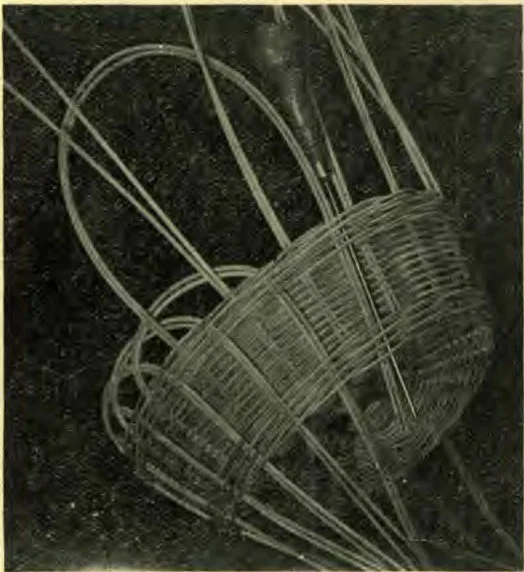
MATERIAL, reeds Nos. 3, 4, and 5. Make a base exactly as directed for Model No. 2, but make it seven inches in diameter. The spokes should always be cut one inch longer than diameter of base. Cut thirty-eight stakes of No. 4 reed, each twenty-two inches long. Insert one stake each side of each spoke. Bend up sharply. If you have a small pair of pincers, give the well-soaked stakes a hard squeeze just at the edge of base. This will enable them to make a sharp bend without danger of breaking. This basket will be woven with double stakes,—two stakes (one each side of spoke) used as one,—and will not have a rope. Bend one long No. 3 weaver near its center, and place the loop over one pair of stakes; insert one end of another weaver into the base at the right of the next pair to the right of the one just used. With the bottom of basket toward the worker, and using the three weavers now ready, put on the upset—four rows of triple twist, drawing the first row very tight.
FIG. 1
The ends of spokes may be left exposed, but they will be covered later with a braid. Above the upset put one and three-fourths inches of single weaving, then three rows of waling twist, and finish with one row of pairing, as in Model No. 2.
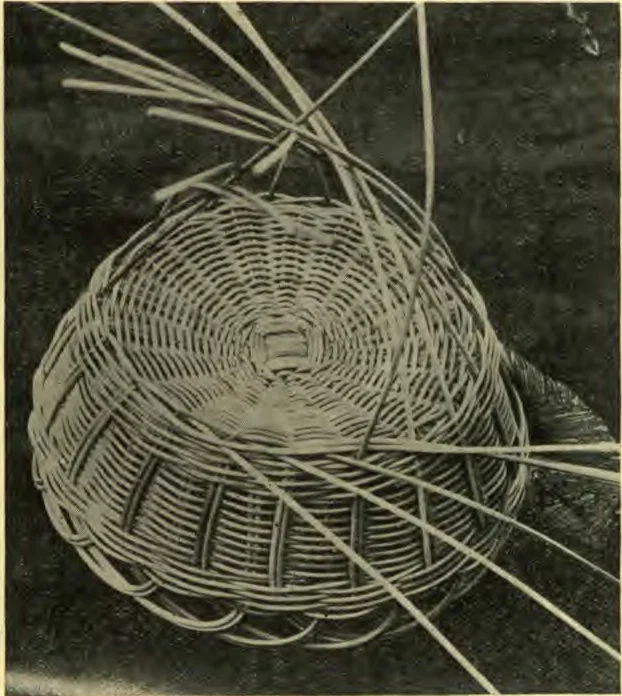
For the border, take any pair of stakes, pass them to the right back of two pairs of stakes, and with the aid of the awl drawn through pairing and waling, outside of single weaving and through the upset, leaving a loop one inch deep at top. Take next pair of stakes at right, and treat in the same manner. Fig. 1. Repeat until all are used. Give special attention to the last two pairs, and see that all the loops are even. Invert the basket; cut the right stake of each pair as short as possible. Pinch each of the remaining stakes close to the bottom of the basket.
FIG. 2
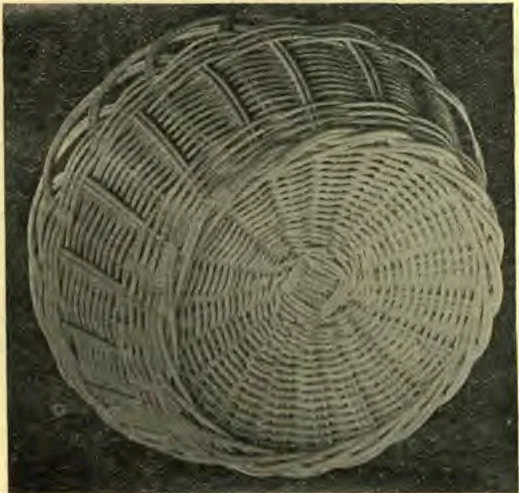
To form the braid, take any stake, pass it to the right back of one stake, and draw it well down with end on outside; treat next stake at right in same way. Repeat until four are down. Take the left stake of the group laid down, pass it to right over the others that are down, in front of the first standing stake, back of the next stake and out at first vacant space; holding this firmly in position, lay the first standing stake down close behind it, bringing the end out in same space. Fig. 2. Keep the two side by side, not one above the other. Now with the thumb of left hand placed in front of what has become first standing stake, let the forefinger hold in position the two stakes laid back of it. With the right hand take the left stake of the group that are down, pass it to right over those that are down, in front of first standing stake, back of next and out. Lay first standing stake close down behind it. Repeat until all the stakes are down. When the first four stakes have been used, the rest will be found in pairs. Always use the right one of the pair—the longer one. The last four stakes will have to be threaded in beside the first four to complete the first part of braid. Tying a bit of thread near to basket around each of the first four stakes before they are laid down will help you to locate them in finishing off. When all the stakes are down, it will be seen that there are still four pairs, and also four vacant spaces. Take the long stake of the left pair, pass it to right, and with the help of the awl slip it in front of the first stake laid down,—the left of the group with thread tied around,—bring it out next to weaving of basket, in first vacant space. The long stake of next pair should be placed in front of next one with thread, etc. When finished, this part should be exactly like the rest of the braid, and there should be one stake projecting from each space around the basket just below the braid. Give each a firm pull to insure its being tight, then cut close to basket. The ends should scarcely be visible. To avoid having them in the outside of basket, this braid may be made by working toward center of base instead of outside of basket.
FIG. 3
A coat or two of white shellac added to any reed work gives greater firmness, and protects from soil. Wood-alcohol may be used to lessen the expense.
MRS. E. M. LONG.
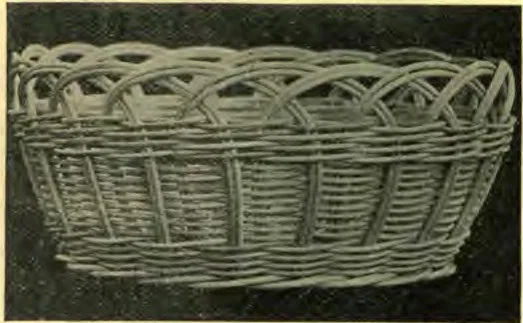
FINISHED BASKET
XI—Our Reasonable Service
(March 18)
MEMORY VERSE: “I beseech you therefore, brethren, by the mercies of God, that ye present your bodies a living sacrifice, holy, acceptable unto God, which is your reasonable service.” Rom. 12: 1.
Questions
1. How much was included in the redemption of man? 1 Cor. 6: 20.
2. What appeal is made by the apostle Paul showing that the body is included? Rom. 12: 1.
3. What kind of service does he say this living sacrifice is? Same verse, last clause.
4. That the sacrifice may be complete, what step must be taken? 2 Cor. 7: 1.
5. What transformation will these promises, accepted, work in our natures? 2 Peter 1: 4.
6. What is the one object to be obtained through health reform? Note 1.
7. For what will the message of which it is a part fit the people of God? Note 2.
8. Describe the conditions existing in the last days. Luke 17: 26-30.
9. Against what especially are those living in that time warned? Luke 21: 34.
10. What led to the giving of the principles of health reform to this people? Note 3.
11. What is our duty in view of such loving interest on the part of our Father? Note 4; Rom. 12: 1.
12. What is embraced in thus offering our bodies a living sacrifice? Rom. 12: 2.
13. What promise is made to the obedient? Isa. 1: 19.
Notes
1. “It should ever be kept prominent that the great object to be attained through this channel [health reform] is not only health, but perfection and the spirit of holiness, which can not be attained with diseased bodies and minds.”—“Testimonies,” Vol. I, page 554.
2. “Health reform is one branch of the great work which is to fit a people for the coming of the Lord. It is as closely connected with the third angel’s message as the hand is with the body.”—Id., Vol. III, page 161.
3. “It was in love that our Heavenly Father sent the light of health reform to guard against the evils that result from unrestrained appetite.”—“Christian Temperance,” page 134.
4. “Our first duty, one which we owe to God, to ourselves, and to our fellow men, is to obey the laws of God, which include the laws of health.”—“Testimonies,” Vol. III, page 164.
INTERMEDIATE LESSON
XI—Synopsis of Old Testament History —Egypt to Babylon
(March 18)
MEMORY VERSE: “But made his own people to go forth like sheep, and guided them in the wilderness like a flock. And he led them on safely, so that they feared not.” Ps. 78: 52, 53.
The children of Israel increased so fast in Egypt that the king feared they would become stronger than the Egyptians. So he commanded that all the little boy babies should be killed when they were born. It was at this time that Moses, whom the Lord raised up to lead Israel out of Egypt, was born. His mother hid him for three months, and he was afterward adopted by Pharaoh’s daughter, and brought up in the court as her own son. Here he was taught all the learning of the Egyptians; but when he was forty years old, he was obliged to flee for his life from the wrath of the king. He found refuge in Midian, and became a keeper of sheep. After forty years the Lord appeared to him, and told him that the time had now come for him to lead Israel out of bondage. Aaron, his brother, was to help him in this great work.
Ten dreadful plagues were brought upon the people and the land of Egypt before the king would let Israel go. On the night of the last plague—the slaying of the first-born—the feast of the passover was instituted.
When Jacob and his sons came to Egypt, they, with their families, numbered about seventy persons; but now, four hundred years later, there went out of Egypt a great company of six hundred thousand men, besides women and children.
The Lord led his people by a pillar of fire by night, and a pillar of cloud by day; he parted the waters of the Red Sea before them, that they might pass over in safety, and destroyed the armies of Egypt that tried to cross after them; when Israel’s food failed, he gave them manna to eat; and when there was no water, he caused a stream to spring out of the rock, that they might drink. Their health was preserved, and there was not one feeble person in all their tribes.
At Mount Sinai the children of Israel were encamped about a year. Here the ten commandments were spoken by God in the hearing of Israel, and the laws that were to govern them as a nation were given to Moses. The tabernacle was also built and set up at this time.
After this, the people journeyed to Kadesh-Barnea, on the southern coast of Canaan. Here twelve men were chosen to search out the land before the people entered it; but only two—Caleb and Joshua—brought back a good report of it. These faithful men urged the children of Israel to go up at once and possess the land; but they believed the evil report of the ten spies, and murmured against the Lord. They were even ready to stone Caleb and Joshua.
Because of their unbelief, the Lord said that none of those men, save Caleb and Joshua, should enter the land of Canaan. For forty years they wandered about in the wilderness till all those who were above twenty years of age on the night when the people left Egypt were dead. Near the end of this time, Aaron and Moses died, and Joshua was appointed leader of Israel. At the end of the forty years he led Israel to the east side of the River Jordan, and the Lord caused the waters to divide, so they could pass over into the land that had been promised Abraham for his heirs.
Jericho was the first city taken by the children of Israel. After that, other cities were conquered, the Lord giving his people the victory over their enemies. The land was then divided by lot among the twelve tribes.
For a little more than three hundred years after the death of Joshua, the people were governed by judges. Gideon and Samson were two judges who were raised up to deliver Israel from their enemies. In the days of Samuel, who was both priest and judge, the men of Israel asked for a king. “Now make us a king,” they said, “to judge us like all the nations.” In thus asking for a king they were rejecting the Lord as their ruler.
Saul, the son of Kish, was the first king of Israel. He was “a choice young man, and a goodly;” and though he ruled well at first, he became so proud and disobedient that the Lord chose David, the son of Jesse, to be king in his place.
David reigned wisely and well in Israel for forty years. His son, Solomon, who also reigned forty years, built the beautiful temple. He was very wise and very rich; but in his old age he did not serve the Lord fully. At his death the kingdom of Israel was divided. Two of the tribes made Rehoboam, the son of Solomon, their king, and were called the kingdom of Judah. The remaining ten tribes chose Jeroboam, a great soldier, for their king, and were known as the kingdom of Israel.
The kingdom of Israel lasted about two hundred fifty years. Its kings were wicked men, who led the people into idolatry. At last the ten tribes were carried away into captivity by the Assyrians.
The kingdom of Judah was also governed by many wicked kings; but there were a few who loved the Lord, and tried to put away idol-worship during their reigns. This kingdom lasted nearly four hundred years, but was finally overthrown by Nebuchadnezzar, king of Babylon. This king laid waste the city of Jerusalem, burned the beautiful temple, and carried away its sacred vessels to Babylon, together with a great number of captives.
Thus the nation that God had chosen for his own people, but that rejected him as their Ruler, came to its end as an independent government.
Questions
1. How strong did the children of Israel become in Egypt? What order was finally given by the king? Who was born about this time? Tell how he came to be adopted by the daughter of Pharaoh.
2. How long did Moses live in the king’s palace? What was he taught? Why did he go away? For how many years did he tend sheep? Who then appeared to him? What did he tell him?
3. How many plagues were brought upon Egypt before the king let Israel go? What was the last plague? What solemn feast was instituted on this night?
4. Tell how the Lord cared for his people on their journey. Where were they encamped about a year? What was done at this place?
5. Where is Kadesh-Barnea? How many men were chosen to search out the land of Canaan? What two reports were brought back? Which did the people choose to believe? What was the result?
6. Who was chosen to be leader of Israel? When did he lead them into the promised land? What city was first taken? How was the land divided among the tribes?
7. Tell how long the people were governed by judges, and name two of them. Why did they wish a king? Who was the first king of Israel? How did he rule?
8. Who was David? How long did he rule Israel? Tell all you can about Solomon. How was the kingdom divided at his death?
9. How long did the kingdom of Israel endure? What became of it then? How long did the kingdom of Judah last? What kind of men were its kings?
10. Tell what finally became of this kingdom. What lesson may be learned from this experience of Israel in rejecting the Lord as their Ruler?
Not One Holy Day, But Seven
“Not one holy day, but seven.
Worshiping, not at the call of a bell, but at
the call of my soul.
Singing, not at the baton’s sway, but to the
rhythm in my heart.
Loving because I must.
Giving because I can not keep.
Doing for the joy of it.”
Arkansas Against All Trusts
The State of Arkansas by its legislature has taken the strongest stand possible against the horde of trusts, and it will be interesting to watch the inevitable struggle there between principle and business. The King-Davis-Logan anti-trust bill became a law last month, and the State now occupies the unique position of being the only one in the Union with a law so drastic that no trust goods can be sold in the State, and no insurance company can do business within its borders if it is a member of any trust, combination, or organization anywhere on earth to control rates here or elsewhere.—Search-Light.
Basket Making Article Reference from Instructor 1905
The article on basket making which contains the model for the base of the basket described in this number was printed in the INSTRUCTOR dated Jan. 7, 1905.
A Tract Handed on the Steam-Cars
“ONE of our ministers recently handed a gentleman on the steam-cars a tract, and he said, ‘You gave me a paper once before on the cars. It was called The Signs of the Times, and I liked it so well I subscribed for it.’” The lesson is apparent.
Young People's Societies: Why Fewer Reports Reach the Instructor
IF our Young People's Societies are working in accordance with their aim, The Advent Message to All the World in This Generation, and are having blessings that always come as the result of earnest service, why are there not more reports sent to the Instructor?
The Heart Attuned to Heavenly Things
“THE receiver of the wireless telegraph station is ready to respond to a delicate electric wave, and so it gets and gives out the messages. So a heart that is adjusted to heavenly things will be always in receipt of good news from God, and will give it out to men.”
Why Christ Joins Our Religious Conversation
“It has been asked what would have been the result if the two men on the Emmaus road had been talking about the sheep-market down at Jerusalem, or the price of olive-oil, or doves, or young pigeons. Probably Christ would not have joined their company. The failure of religious conversation is one of the reasons why our hearts are not oftener made glad by Christ’s presence.”
The Bird Within the Egg
A TRAVELER tells of holding in his hand an egg of a rare East Indian bird. The egg was so near the hatching that the bird inside was pecking away at the shell. He could hear it struggling for its freedom. It was not content with its cramped, dark life. There was a larger life for it outside. It could soar away on wings to greet the morning light; it could put on splendors of beauty; it could look on mountains, valleys, and rivers, and bathe in the pure air of sunny skies. So the Spirit of God in the heart makes one discontented with earthly limitations. It creates a longing for a larger life and a wider freedom. And it makes possible the satisfying of the longing for holiness, strength, beauty of character, and power of helpfulness.
Our Means
By Ellen G. White
THE goods that we handle are not our own, and never can this fact safely be lost sight of. We are but stewards, and on the discharge of our obligation to God and man depend both the welfare of our fellow beings and our own destiny for this life and for the life to come.—Mrs. E. G. White.
Hopeful Omens
Two incidents in the official life of Russia occurred last week, which to some give occasion for a more hopeful view of Russia's future. On the first day of February the czar received in person a delegation of workmen from St. Petersburg factories. While he greeted each delegate cordially, there was no opportunity for a statement of grievances. The entire time was occupied by the czar's address. The only significant feature of the incident is that the workmen were received at all. Later the czar charged the committee of ministers to develop and extend principles of reform. He also commanded that a pension be paid to orphaned children and cripples whose misfortune was caused by the troops on January 22, and that order be restored in all parts of the country by peaceful methods.
The Hallowed Mouth
By Amos R. Wells
“Then the Lord put forth his hand, and touched my mouth.”— Jeremiah.
Thy hand, the central point of power!
My mouth, so poor and weak!
But touch it, Lord, and in that hour
I shall be strong to speak.
My tongue shall thrill with eager stress,
Nor ever lag again;
And, touched by God’s almightiness,
Shall touch the hearts of men.
— Amos R. Wells.
A Good Point
“Oh, I had a lot of books to read!” said a young fellow who had been housed for six weeks with a lame leg. “I read so many books that I don’t know what I did read. I can’t remember a thing in any of them now.” And he added, thoughtfully, “It seems like a waste of time; but how can you help forgetting?”
One of the simplest and safest ways to get the most out of good books is by discussing the characters and events in the books with other people. Taking notes is also a sure method, but many books come in one’s way to read at a time when real note-taking is out of the question. The digesting of a book, by the process of thinking and talking about it, is the most important, and yet the most often neglected, method.
In a recent description of the daily life of a young Greek student who lived far back, three or four hundred years before Christ, occurs this statement: “It is said that his teachers spent a great deal of their time with him in expounding which hero was brave, and which was prudent, and who was famed for justice, who for temperance.” That student remembered what he stopped to discuss. His own ideas and standards became modified by such discussions. He trained himself thus for practical life. A few good books and papers carefully read will give a liberal education.
Talking over a book with another person acts in the same way upon one’s own mind and character. Knowledge shared with another becomes knowledge saved to one’s self.—The Myrtle.
God's Children Never Absent from His Mind
“God’s children are never absent from his mind.”
The Stability of Thy Times
“THE stability of thy times and the strength of thy happiness shall be wisdom and knowledge.”