The Youth's Instructor, Vol. LII, No. 28

Be of Good Cheer

The Youth's Instructor

July 12, 1904

Review and Herald Publishing Assn. · Washington, D.C. · July 12, 1904

Be of Good Cheer

Be of good cheer, Morning is near; Soon its bright beams in the east shall appear, Yonder its first faint gleams come from afar, Shines in the east its fair heralding star.
Ye who have wept, Ye who have kept Sorrowful vigil while others have slept, Oh, lift up your heads and break forth into song! Weeping shall change into gladness ere long.
Then be of good cheer; Triumphant and clear, Soundeth the tread of a host drawing near; Warriors they, who are coming this way, Lo, they are marching and watching for day.
Then join the great throng Who fight against wrong, For onward and upward their path winds along To that heavenly city where happiness waits; And at dawning of morning they sweep through the gates. VIOLA E. SMITH.

The City of Rio de Janeiro

ONE of the most picturesque cities in Brazil, South America, is the city of Rio de Janeiro, with the great sugar-loaf mountain looming up at the entrance. Especially in the evening when first sighted from the harbor, under the soft southern twilight and the myriad twinkling lights from the different hillsides, the city makes a picture like that of fairyland. There are several large mountains situated near the city which are said to have passed through the usual eruptions, but even now look as if they were ready to burst forth any moment.
Although Rio de Janeiro (River of January) is a beautiful city, its comeliness is greatly marred by the careless way the natives distribute their waste substances over the hillsides where they live. This profuse but unsightly ornamentation can be seen for long distances.
The prevailing language is Portuguese. To the natives every foreigner who can speak English is an Inglezer (Englishman). In their slow and easy way the people are very hospitable. The Portuguese are not great meat eaters; their favorite dish is black beans seasoned with a little dried meat. Mandioc, which is the root of the mandioc plant ground into flour, is a nourishing article of diet, and is extensively used. This may be eaten raw or cooked.
Yellow fever is a common but ever-dreaded disease. One case that I observed was of a woman who took the fever one day, and died the next day. The husband hired an old woman to mourn for his wife. This woman was expected to scream in a most uncanny way; first she would begin rather low, then gradually ascend until she reached a piercing scream. She was obliged to keep this up all day. One living in this city for some time grows accustomed to such things, for many of the customs of the ancient civilized and heathen nations are zealously followed here.
THE CITY OF RIO DE JANEIRO
One that I thought ridiculous is that of the priest passing along the street, carrying a long stick with the image of some saint on the top; this he would hold up to the windows of the houses, expecting all to kiss the image, and drop a piece of money in the box which was attached.
Saints’ days abound here, almost every evening marks the celebration of some saint day. The gatherings and processions resulting from these celebrations cause a great deal of unwelcome noise to those not participating in the celebration. One of the special days in Rio de Janeiro is the Carnival; at this time all the senoras and senorettas come forth in gay attire. A simple but common custom observed at such a time is that of throwing upon another bits of sweetly scented paper. The one receiving this attention regards it as a compliment. In the processions images of the saints are carried, and every one is expected to bow or remove his hat in reverence. An Englishman passing in the crowd failed to do this; the people became angry and threw stones at him so that he was badly injured. The Roman Catholic faith is the predominant feature of everything here, as it is in all the South American countries.
Everything in the city is expensive, but usually of a good quality. The people generally charge the “Inglezer” twice the proper amount, for he is always regarded as rich. Some of the fruits are curious both in looks and taste. Mamao, similar to our muskmelon in form and size, grows on a slender tree about fifteen feet high; the leaves and fruit are at the top of the tree, and the wood is soft and fibrous. The Jaboticaba is a tree much like the apple-tree in shape, and when in flower is a pretty sight, for the flowers and fruit grow all around the trunk of the tree, instead of on the branches. The fruit, however, is sweet and insipid. The Jaca, one of the queerest of all, has the fruit, which is about the size of a watermelon, grouped near the top. We had much fun throwing long sticks into these Jacas, the juice squirting out on our hands and clothes. Since it is almost impossible to remove the gummy liquid, our fun was followed by something altogether less enjoyable.
We will now say adieu to Rio de Janeiro. Perhaps I may tell you at another time about the interior of South America, where I lived for a while among almost savage people, catching a glimpse of cannibals who had eaten several missionaries. VIOLET G. HAWKSWORTH.

“Just as I Am”

The hymn for February, in the course of monthly memory hymns for young people’s and junior societies that is to run through the year, is “Just as I am.” This is probably the most influential hymn ever written, owing to its large and successful use by evangelists. Certainly it is the greatest evangelistic hymn in the language.
Its author, Charlotte Elliott, was born in Clapham, London, England, in 1789. In 1821 she was seized by a severe illness, and became an invalid for life, though she lived to the good old age of eighty-two, dying at Brighton in 1871. Her sufferings made Miss Elliott most thoughtful for others in distress, and most of her hymns were written with such persons in mind. Did not God have that purpose in permitting her to become sick?
In 1822 she met the great evangelist of Geneva, Switzerland, Dr. Henri Abraham Cesar Malan, who profoundly influenced her life, and with whom she corresponded for forty years, keeping the anniversary of their first meeting as “the birthday of her soul.”
This famous hymn has been attributed to that meeting as its occasion, and the story has often been told how, when Dr. Malan urged her to become a Christian, she at first rudely repulsed him, but afterward, repenting, had asked him to tell her how she could find Christ, his answer being, “Come to him just as you are.” This reply, it has often been said, was the origin of the hymn. “Just as I am,” however, was written many years later, and was, as Col. Nicholas Smith says, “the spontaneous language of her heart in 1836, when a storm of pain and sorrow seemed to assault her soul.” However, if the conversation with Dr. Malan really occurred as related, the words might still have remained in her memory all those years, to bring forth that rich fruit at last.
The hymn first appeared in The Christian Remembrancer, of which Miss Elliott became editor in 1836, inserting in the first number several of her own poems, this among them, and all without her name. Soon after its publication a lady, who admired it greatly, had it printed in leaflet form, and widely distributed. Miss Elliott was very sick, and one day her physician gave her one of these leaflets to comfort her, not knowing that she was the author. It is said that the sufferer wept tears of grateful joy when she saw this evidence that God had so used her efforts, though put forth from a feeble body.
The hymn, as first printed, had six stanzas. The seventh was added later, but certainly no one would be willing to lose it. Here is the hymn entire:—
“Just as I am, without one plea, But that thy blood was shed for me, And that thou bidst me come to thee, O Lamb of God, I come!
“Just as I am, and waiting not To rid my soul of one dark blot, To thee, whose blood can cleanse each spot, O Lamb of God, I come!
“Just as I am, though tossed about With many a conflict, many a doubt, Fightings and fears within, without, O Lamb of God, I come!
“Just as I am, poor, wretched, blind, Sight, riches, healing of the mind, Yea, all I need in thee to find, O Lamb of God, I come!
“Just as I am, thou wilt receive, Wilt welcome, pardon, cleanse, relieve, Because thy promise I believe, O Lamb of God, I come!
“Just as I am (thy love unknown Has broken every barrier down), Now to be thine, yea, thine alone, O Lamb of God, I come!
“Just as I am, of that free love The breadth, length, depth, and height to prove, Here for a season, then above, O Lamb of God, I come!”
Miss Elliott’s brother, a clergyman, Rev. H. V. Elliott, once said: “In the course of a long ministry, I hope I have been permitted to see some fruit of my labors, but I feel far more has been done by a single hymn of my sister’s.” After the author’s death more than a thousand letters were found among her papers, giving thanks for blessings received from “Just as I am.” Moody once declared that no hymn has done so much good, or touched so many hearts.
For example, in the summer of 1895, the young people of the Lenox Road Methodist church of Brooklyn sang this hymn in their service, and, as it happened, the hymn was sung also in the church service following. A few doors away lay a young lawyer in his room. All windows were open, and he heard the hymn twice repeated. At the time he was in the midst of a fierce struggle with conscience, and the hymn determined him to be a Christian.
One day Mr. Wanamaker told his great Sunday-school in Philadelphia that one of their number, a young man who had been present only a week before, lay dying, and had asked the school to sing in his behalf “Just as I am, without one plea.” The hymn was sung with so much feeling, and especially the third stanza, that a visitor who was present was led to Christ, being freed on the spot from “many a conflict, many a doubt.”
Once John B. Gough was placed in a pew with a man so repulsive that he moved to the farther end of the seat. The congregation began to sing “Just as I am,” and the man joined in so heartily that Mr. Gough decided that he could not be so disagreeable after all, and moved up nearer, though the man’s singing “was positively awful.” At the end of the third stanza, while the organ was playing the interlude, the man leaned toward Mr. Gough and whispered, “Won’t you please give me the first line of the next verse?” Mr. Gough repeated,—
“Just as I am, poor, wretched, blind,” and the man replied, “That’s it; and I am blind—God help me; and I am a paralytic.” Then as he tried with his poor, twitching lips to make music of the glorious words, Mr. Gough thought that never in his life had he heard a Beethoven symphony with as much music in it as the blundering singing of that hymn by the paralytic.
Many similar stories might be told of this hymn; and best of all are those scenes that must be familiar to all “our readers,” when, during the singing of this hymn in revivals, now one soul and then another has determined to make the blessed surrender to the Lord Jesus.
Miss Elliott wrote in all about one hundred fifty hymns, most of them in the same meter as “Just as I am.” Of these, perhaps the most beautiful was “Thy Will Be Done,” which begins “My God and Father! while I stray.” This was a special favorite of Queen Victoria’s, and comforted her much on the death of her daughter, Princess Alice of Hesse, the mother of the present czarina of Russia. This beautiful hymn first appeared in Miss Elliott’s Invalid’s Hymn-Book.
Other hymns by the author of “Just as I am” are the well-known “With tearful eyes I look around,” “O Holy Saviour, Friend unseen!” and “Christian, seek not yet repose—watch and pray.” Surely, with such a record, few would be inclined to question the estimate of Dr. David R. Breed, who declares that “Miss Elliott is the greatest of English female hymn-writers.”
One of her own couplets became her favorite motto, and may well be taken as a summary of her beautiful life:— “O Jesus, make thyself to me A living, bright reality.” — Amos R. Wells.

The Life of Daniel—The Sabbath Test

DANIEL and his companions had a conscience void of offense toward God. But this was not preserved without a struggle. What a test was brought on the three associates of Daniel, when they were required to worship the great image set up by King Nebuchadnezzar in the plain of Dura!
The three Hebrews were called upon to confess Christ in the face of the burning fiery furnace. It cost them something to do this, for their lives were at stake. These youth, imbued with the Holy Spirit, declared to the whole kingdom of Babylon their faith,— that He whom they worshiped was the only true and living God. The demonstration of their faith on the plain of Dura was a most eloquent presentation of their principles.
The lessons we may learn from the loyalty of the Hebrew captives toward God and his law, have a direct and vital bearing upon our experience in these last days. We have a confession to make different from that which we have made; and we shall have to make it under trying circumstances. In order to impress idolaters with the power and greatness of the living God, we, as his servants, must reveal our own reverence for God. We must make it manifest that he is the only object of our adoration and worship, and that no consideration, not even the preservation of life, can induce us to make the least concession to idolatry.
The vainglory and oppression seen in the course pursued by the heathen king, Nebuchadnezzar, is being and will continue to be manifested in our day. History will repeat itself. In this age the test will be on the point of Sabbath observance. The heavenly universe behold men trampling upon the law of Jehovah, making the memorial of God, the sign between him and his commandment-keeping people, a thing of naught, something to be despised, while a rival sabbath is exalted as was the great golden image in the plain of Dura. Men claiming to be Christians will call upon the world to observe this spurious sabbath that they have made. All who refuse will be placed under oppressive laws. This is the mystery of iniquity, the devising of satanic agencies, carried into effect by the man of sin.
The people of God will enter into no controversy with the world over this matter. They will simply take God’s Word for their guide, and maintain their allegiance to him whose commandments they keep. They will obey the words of Jehovah: “Verily my Sabbaths ye shall keep: for it is a sign between me and you throughout your generations; that ye may know that I am the Lord that doth sanctify you. Ye shall keep the Sabbath therefore . . . for a perpetual covenant.”
When the Sabbath becomes the special point of controversy throughout Christendom, the persistent refusal of a small minority to yield to the popular demand will make them objects of universal execration. It will be urged that the few who stand in opposition to an institution of the church and a law of the state, ought not to be tolerated; that it is better for them to suffer than for whole nations to be thrown into confusion and lawlessness. This argument will appear conclusive; and against those who hallow the Sabbath of the fourth commandment will finally be issued a decree, denouncing them as deserving of the severest punishment, and giving the people liberty, after a certain time, to put them to death. Romanism in the Old World, and apostate Protestantism in the New, will pursue a similar course toward those who honor all the divine precepts.
The season of distress and anguish before us will require a faith that can endure weariness, delay, and hunger,—a faith that will not faint, though severely tried. Those who now exercise but little faith are in the greatest danger of falling under the power of satanic delusions and the decree to compel conscience. And even if they endure the test, they will be plunged into deeper distress and anguish in the time of trouble, because they have not made it a habit to trust in God. The lessons of faith which they have neglected, they will be forced to learn under a terrible pressure of discouragement.
We should now acquaint ourselves with God by proving his promises. Angels record every prayer that is earnest and sincere. We should rather dispense with selfish gratifications than neglect communion with God. The deepest poverty, the greatest self-denial, with his approval, is better than riches, honors, ease, and friendship without it. We must take time to pray. The youth would not be seduced into sin if they would refuse to enter any path save that upon which they could ask God’s blessing.
My dear young friends, if you are called to go through a fiery furnace for Christ’s sake, Jesus will be by your side. To you he declares: “When thou passest through the waters, I will be with thee; and through the rivers, they shall not overflow thee: when thou walkest through the fire, thou shalt not be burned; neither shall the flame kindle upon thee.”
The threats of men sink into insignificance beside the word of the living God. Be loyal and true, and the God who walked with the three Hebrew children in the fiery furnace, who manifested himself to John on the lonely island, will be with you. His abiding presence will comfort and sustain you, and you will realize the fulfilment of the promise, “If a man love me, he will keep my words: and my Father will love him, and we will come unto him, and make our abode with him.” MRS. E. G. WHITE.

Simple Experiments in Science

If a boy is handy with his knife, and can borrow a hammer, plane, and saw, he can easily and quickly construct a clock that will mark off the minutes and hours with considerable accuracy. And in the making of it, he will be learning more about why and how clocks keep time than most people ever know.
But leaving that for another time, we will begin some simple experiments this week, which, like the making of the clock, are both entertaining and instructive. They set us studying out the whys and wherefores of things, give us a better knowledge of the curious doings that are going on in the world around us, and so help us finally to read and teach “the great lessons that God’s hand has written in earth and sea and sky.”
Fig. 1.
Fig. 1.
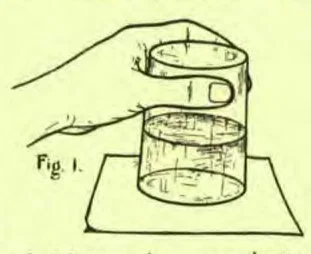
In the first place fill a glass half full of water, over its mouth lay a square of paper or cardboard, and hold it there while you invert the glass. Now draw your hand away, and lo! the water does not spill—and no wonder; for pressing against that water is all the weight of fifty or more miles of air. The pressure of this great air column is sufficient to keep in place about thirty-two feet of water; for on every square inch of the earth’s surface, and on the surfaces of all the objects on the earth, the air presses with a force of nearly fifteen pounds. From this fact a simple problem in arithmetic will tell us how many thousand pounds’ air-pressure there is on the surface of our bodies, and yet we are not crushed, because the pressure within us exactly and delicately balances that without. If in some way we manage to remove a large share of the outside pressure, blood will burst from our noses, and the eyes will seem to start from their sockets. Men who have ascended to great heights in balloons often have had hemorrhage of the lungs, which, in some cases has proved fatal before denser atmosphere could be reached. Tourists who ascend Pike’s Peak in Colorado, by means of the cog railway, sometimes experience much discomfort from nosebleed, on account of the lightness of the air.
Fig 2
Fig 2
Fig. 3.
Fig. 3.
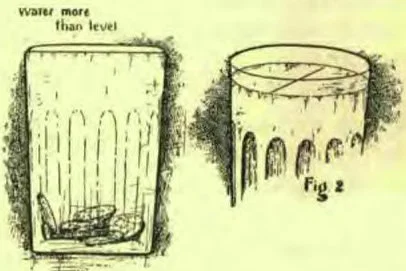
Figure 2 shows one of the most curious experiments imaginable. It is called the “floating iron,” and seems to indicate that steel is lighter than water! To make it, simply drop a clean bright sewing needle as gently as possible on the water. It floats! and it floats because the surface particles, or molecules of the water, in some unknown way cling together and form a skin on the water of sufficient strength to support the needle. If you look closely, you will see that the surface of the water bends downward to form a trough in which the needle rests. The feet of the common little water-skaters on our creeks and ponds, act just as this needle does, not allowing the insect to sink.
Continuing with this experiment, fill a clean glass to the brim with water. We now ask our young friends how many pieces of money can be thrown into the water without any overflowing. Those who are not familiar with the experiment will answer that the glass is already full, and will hold nothing more. Nevertheless, we may drop in penny after penny, to a dozen or more, before a drop is lost, and the film on the water, binding it together, again offers a very simple explanation of the trick.
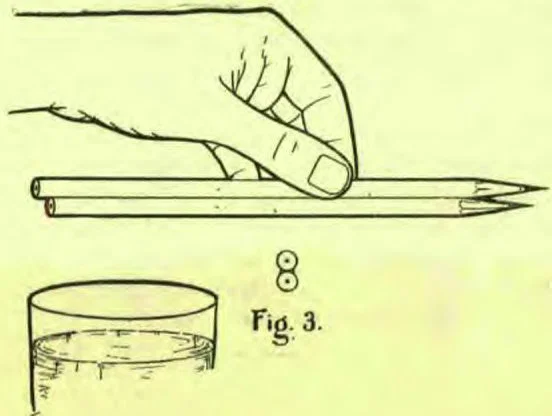
Next, hold two round pencils of the ordinary kind close together, and put a number of drops of water along the line of contact till the whole line is full, and you will find that by holding to the upper pencil only, both may be lifted, and moved about freely. Again the explanation is that the curious water-skin, or surface tension, which also gives water drops their shape, allows a considerable thickness of water to rest on the table without flattening out. When you wonder why rain and dew-drops are nearly round, simply think of them as little elastic skins filled with water; for that is what they really are, and they are round just as a little shapeless rubber bag becomes a beautiful round balloon when filled with gas or air.
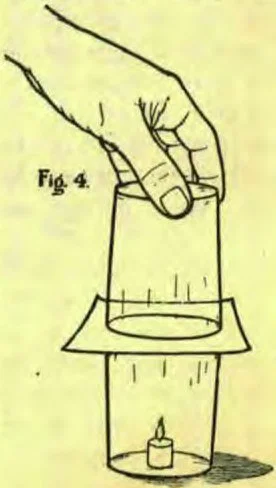
Our first experiment suggests another in atmospheric pressure. Select two glasses of the same size, so that they will fit exactly when placed one on top of the other. Put a little piece of lighted candle in one of them, cover it with some thick wet paper, and press the remaining glass on the top quickly. In a very few moments the candle will have burned the oxygen from the air in the glass, and created a partial vacuum therein having less pressure than the outside air. The air outside will accordingly hold the two together tightly. See Fig. 4.
No doubt you have all seen a spirometer, and watched people blow into it to test the strength of their lungs. All that is needed to make a very effective spirometer is a strong paper bag and some kind of tube to tie into the mouth of it. The tube must be of thick rubber, metal, or heavy paper, so that it will not crush while tying in. Place a weight on the bag, blow into the tube, and an exclamation of wonder will be heard when in this way a large boy is actually lifted “with a breath.”
We shall now be content to mention one more experiment. Take the little piece of candle again, insert a nail in one end, so that it will float upright, and let it burn in the water. The question is, How long will it burn, and what will it do before the water puts it out? The answer is, The water will not put it out at all; for as the candle burns, it becomes lighter, rises still more and more, and burns on and on to the very end in the form of a pretty cup, with the light just so high above the table all the time. Such a contrivance is useful where a stationary candle flame is required, as in some scientific tests. To make a deeper cup, a heavier nail is attached to the candle.
EDISON DRIVER.

The Way Trees Grow Old

Simple Spirometer.
Simple Spirometer.
UNLESS the date of planting is known, a tree can keep the secret of its age as long as it lives. Only when it is cut down and the rings that then show on this cut surface are counted, can its exact age be told. Especially when a tree is sawed down, leaving the stump with a smooth, flat surface, is it easy to count its years. Such trees as the oak, chestnut, or pine add a thin layer just under the rough outer bark each year. These layers harden into tough woody fiber, and one after another make the tree larger and larger around. When the tree is cut down, these layers show, just as the layers in an onion cut in half. As each ring counts for a year, the age of trees that have grown straight and tall is very easy to determine, while in gnarled, wind-twisted trees the rings run into one another, and can scarcely be distinguished, and thus some of the famous old sentinels on the mountain tops hide the secret of their age forever. As the trunks of trees grow larger layer by layer, the rough outside bark which lasts from year to year cracks wider and wider in its efforts to fit the big round body it was not made for, and great fissures and furrows appear, such as are seen in the oak. Some trees, like the birch, change their bark year after year. The birch bark that peels off is almost as thin as paper, and split in a thousand places with the swelling of the live new wood just beneath it.—Selected.

The Wants of an Empress

A FEW weeks before last Christmas the empress of Germany, while conversing at a reception in the Berlin palace with a baroness whose husband is very rich, was asked by her what things in the world she liked best.
“Your Majesty, excuse my question,” the baroness added, “but it would be a great honor if I could do something to please you.”
The empress smiled in her motherly way.
“My dear,” she replied, “it would not be possible for you to give me the things I like best, for I already have them.”
“Indeed, your Majesty,” said the baroness; “may I make bold to ask what they are?”
“There are four things I prefer to all others. They are my kaiser [emperor], my kinder [children], my kirche [church], and my kuche [kitchen].” —Week’s Progress.
Fig. 4.
Fig. 4.

THE WEEKLY STUDY

The Controversy Ended

(Concluded)
CHAPTER STUDY: “Great Controversy,” Chapter Forty-two, pages 669-679.
LESSON TOPICS:—
Satan’s vivid but sorrowful retrospect.
His confession of God’s justice.
Wrath of wicked directed against their leader.
Final retribution.
Safety of the righteous.
Fire of vengeance.
Earth renewed.
Eternal reminders of sin’s sad story.
Privileges heaven offers to the saved.
“Walk in the sunless glory of perpetual day.”
“Dwell safely in the wilderness, and sleep in the woods.” Eze. 34: 25.
“Crystal streams and waving palms.”
“No more death, neither sorrow nor crying.”
“Stand in the presence of ineffable glory.”
“Study with never-failing delight.”
“Highest ambitions realized.”
“New heights to surmount, new wonders to admire.”
Song of universal adoration.
PERSONAL LESSONS:—
“Where stand you?”
“Let him deny himself.” Matt. 16: 24.
“To him that overcometh.” Rev. 3: 21.
“They that turn many to righteousness.” Dan. 12: 3.

Note

The series of lesson studies from “Great Controversy” closes with this one. Would it not be well to take time for a social service, that all may speak of the personal good derived from the study of the things that are coming upon the earth, and for speaking of the advance steps that are imperative just now if the eternal prize is to be won by the army of youth?
Continue reading: What Are the Opportunities for Work in the Cities?