The Youth’s Instructor, Vol. 34, No. 32.

THE ROBE OF CHRIST’S RIGHTEOUSNESS
Earlier text: THE ROBE OF CHRIST’S RIGHTEOUSNESS

IMPORTANT BIBLE SUBJECTS.

LESSON 19.—THE SEVENTH DAY THE LORD'S DAY.

1. WHERE were the children of Israel forty-five days after they left Egypt? Ex. 16: 1.
2. How long was this before the giving of the law from Sinai? Compare Ex. 16: 1 with Ex. 19: 1, 10, 11.
3. What did the Lord there promise to give them? Ex. 16: 4.
4. In so doing, concerning what did he design to prove them? Ib.
5. How often were they to gather the food? Ib.
6. Did this include the Sabbath also? Ex. 16: 26.
7. If they gathered more than they needed, what was the result? Ex. 16: 19, 20.
8. How then were the people provided with food on the Sabbath? Ex. 16: 5, 22–24.
9. How long was this kept up? Ex. 16: 35.
10. By thus miraculously providing food for the people, and by a miracle preserving it over the Sabbath, when none fell, what did the Lord indicate?—He showed how highly he regarded his Sabbath.
11. What else was also proved?—That the Sabbath was not any seventh part of the time, but the seventh day of the week, and that only.
12. Is there a day that belongs specially to the Lord? Rev. 1: 10.
13. To what day does he apply the title “my holy day”? Isa. 58: 13.
14. And which day is the Sabbath? Ex. 20: 10.
15. Then which day is the Lord’s day?
16. What honor should be given to Christ? John 5: 22, 23.
17. How does God tell us to honor him? Isa. 58: 13.
18. Then can we honor Christ as we ought, if we do not keep the Sabbath?
19. Since the Sabbath is the memorial of creation, why should we keep it in honor of Christ, the same as in honor of the Father? Heb. 1: 1, 2; Col. 1: 16, 17.
20. If Christ made the worlds, how many days did he work in the beginning? Ex. 20: 11.
21. On what day must he also have rested? Gen. 2: 3; Heb. 4: 4.
22. As a consequence, of what does Christ declare himself to be Lord? Mark 2: 28.
23. Then when we say that the seventh day is the Lord’s day, to whom do we refer by the word “Lord”?—To both the Father and the Son. See John 1:1-3; 10:30.

SALE OF RARE COINS.

If any are in possession of rare coins, like those described below, and are in need of means to help in some worthy object, they might find it to advantage now to dispose of their treasures. A late exchange says:—
“Three weeks ago, in Philadelphia, there was sold at auction a large number of United States and colonial coins and pattern pieces belonging to the cabinet of Doctor Edward Maris. Among the coins purchased was a United States ‘pattern’ silver dollar of 1838, having a plain edge, which brought $117.50. A Centennial dollar of bronze composition was sold for $90. Among the collection of colonial pieces, a Franklin cent in silver, without legend or date on the obverse side, was purchased for $201. A series of New Jersey coins were knocked down to one purchaser for $551.
“The following were also sold: A pattern cent of 1792, one of the early Mint designs, $67.50; half-dime of 1805, proof surface, $65; a 25-cent pattern piece of 1875, $35; United States quarter eagle of 1796, with stars, $45.50; a ‘Confederatio’ copper of 1785, $130; a dime of 1802, $34;

FORGOTTEN TREASURE BROUGHT TO LIGHT.

During the recent count of the moneys and securities in the United States Treasury, owing to the change of treasurers, a heavy square box, wrapped in red tape and securely bound, was found in an out-of-the-way nook of one of the vaults.
The key had been mislaid and was nowhere to be found. The box had been in the vault for many years, and had been almost forgotten. The services of a locksmith were secured, and on opening the box it was found to contain a bottle of diamonds, a bottle of pearls, a bottle of attar of roses, and a lump of gold.
One of the older employees identified these as articles which had been presented to President Monroe, about the year 1825, by the Japanese government, and which had been stored in the Treasury pending the passage of an act of Congress authorizing their acceptance. Congress failed to legislate on the subject, and the articles were deposited in the Treasury, where they have remained ever since.—Exchange.

CENSUS STICKS.

The Indian chief Numana, the census Supervisor in Nevada, was once sent out to collect statistics of the aboriginal tribes; and the Danville (Ky.) Tribune thus describes the report which he prepared:—
“His enumerators were all Indians, and a single sheet of blank paper and a pencil apiece comprised their equipment. Upon this paper each Indian made a circle to represent a wigwam or camp, and within those he placed figures to represent the number of persons in a family, the squaws being distinguished by lines representing gowns, and smaller figures denoting children of various sizes.
“The chief made up his report from these sheets by taking a number of willow sticks of various lengths to denote adults and children of different sizes, notching those representing females, and sending the sticks in bundles to the census office. This method, though rude, served to furnish an accurate census of the Piutes.”

The Chelmon: A Fish That Hunts with Water

A FISH called the chelmon is very common in Japan. This, like the goldfish, is kept for amusement. It is an inch or so in length, quite flat, and has bright eyes. The mouth is drawn out, perhaps half an inch, into a little bony tube, which acts like a miniature popgun. When the chelmon spies an insect, it shuts its mouth quickly, sending out a drop of water, which wets the wings of its victim, and, unable to fly, it falls an easy prey to the little hunter.—S. S. Visitor.

Green-Sward: The Meaning of "Sward"

GREEN-SWARD in the green skin or covering of a lawn. The word “sward” is an old Anglo-Saxon term for skin.

PERILOUS VOYAGING.

THERE is never a lack of persons who, having no ability or inclination to distinguish themselves in a worthy enterprise, are scheming to make themselves notorious through some fool-hardy undertaking. The popular craze with this class now seems to be to swim the Whirlpool Rapids below Niagara Falls. Many of you have read the late account of the man who successfully performed the feat in a barrel. Another has boasted that with a jacket of cork he can do still greater wonders. Ignorant or reckless of the true value of life, these persons risk it to become conspicuous for a little moment, as it were, in the eyes of a selfish world.
Sometimes the mania has been to jump over some great cataract of water, as the Niagara and Genesee Falls; and lives have been lost in this attempt.
To witness the effect of the waters upon vessels which should make the descent of the falls, a few experiments have been made, the circumstances of which may interest the readers of the INSTRUCTOR just now. The editor of the Inter-Ocean gives them as follows:—
“There have been three such instances. The first was in 1827. Some men got an old ship—the Michigan—which had been used on Lake Erie, and had been pronounced unseaworthy. For mere wantonness they put aboard a bear, a fox, a buffalo, a dog, and some geese, and sent it over the cataract. The bear jumped from the vessel before it reached the rapids, swam toward the shore, and was rescued by some humane persons. The geese went over the falls, and came to the shore below alive, and therefore became objects of great interest, and were sold at high prices to visitors at the Falls. The dog, fox, and buffalo were not heard of nor seen again. Another condemned vessel, the Detroit, that had belonged to Commodore Perry’s victorious fleet, was started over the cataract in the winter of 1841, but grounded about midway in the rapids, and lay there until knocked to pieces by the ice. A somewhat more picturesque instance was the sending over the Canada side of a ship on fire. This occurred in 1837. The vessel was the Caroline, which had been run in the interest of the insurgents in the Canadian rebellion. It was captured by Colonel McNabb, an officer of the Canada militia, and by his orders it was set on fire, then cut loose from its moorings. All in flames, it went glaring and hissing down the rapids and over the precipice, and smothered its ruddy blaze in the boiling chasm below. This was witnessed by large crowds on both sides of the falls, and was described as a most magnificent sight. Of course there was no one on board the vessel.”

GRANDMOTHER'S MISSIONARY STORY.

LAURA ALLEN sat in the low window-seat in a brown study. It was evident that her thoughts were far away, for although the world outside was bright with birds and flowers, and her pet canary was singing most sweetly over her head, striving to attract her attention, her brown eyes never wandered.
Grandma entered the room unnoticed, and smiled to herself to see Laura so quiet, a thing very unusual for her. Curious to know the cause, and catching sight of an open book in her lap, grandma peeped over her shoulder. She had been reading, and her favorite volume, “Sunshine,” still lay in her lap, and its bright pages were open at the portrait and sketch of Mrs. Ann H. Judson.
It was not till she felt a gentle hand on her shoulder that Laura looked up. Her face brightened, and she said quickly,—
“Grandma, I've been thinking that I should like to earn some money all my own self to give on her next missionary Sabbath. It's easy enough to ask papa or mamma for some, but I've been reading to-day about Mrs. Judson, and how much she suffered that the heathen might learn about Christ, and I thought I would like to do something too. Of course I can't be a missionary to Asia, but I can help send others there, only I should like to have the money my very own. It would seem more like sacrificing, you know.”
“I know just how you feel, dear,” said grandma, “for when I first felt the ‘missionary spirit,’ I was a little girl not nearly as old as you.”
“Why, did they have missionaries then, grandma?”
“Oh, yes; that was about the time Mrs. Judson came back on her visit to America; and that was the time I first heard of her, or of missionaries either, that I can remember.”
“Do tell me about it, please.”
For the INSTRUCTOR.
For the INSTRUCTOR.
“Well, I was a very small child then, but I can remember it as plainly as if it were to-day. Mrs. Judson was about to return to Burmah, accompanied with other missionaries. She had been for two years in America, and had labored all that time to interest others in the missionary work, and to obtain means to aid in it. Her zeal aroused nearly all the churches in the little villages near where she had been stopping, and near where I lived; and the mission in Burmah, and plans for raising means to send there, was all the people talked about. The ministers preached long sermons about it, and a great many collections were made. But more yet was planned to be done before her return. A series of missionary services were being held in our village church, and every one was invited to aid in the good work. The pastor would visit from house to house, and talk about the mission. I remember well when he visited at our house. I was very much stirred up about the mission, and so were my brother and sister, and we were anxious to give some too, though we hadn't a penny of our own in the world. We didn't dare to say anything to the minister about it, for in those days children only spoke to their elders when spoken to; but we three talked it over together, and decided that if father and mother would let us, we would earn some money ourselves. Our parents were only in very moderate circumstances, and as they kept no servants we were expected to do considerable work, so whatever we did we would have to do in the time allotted us for play.
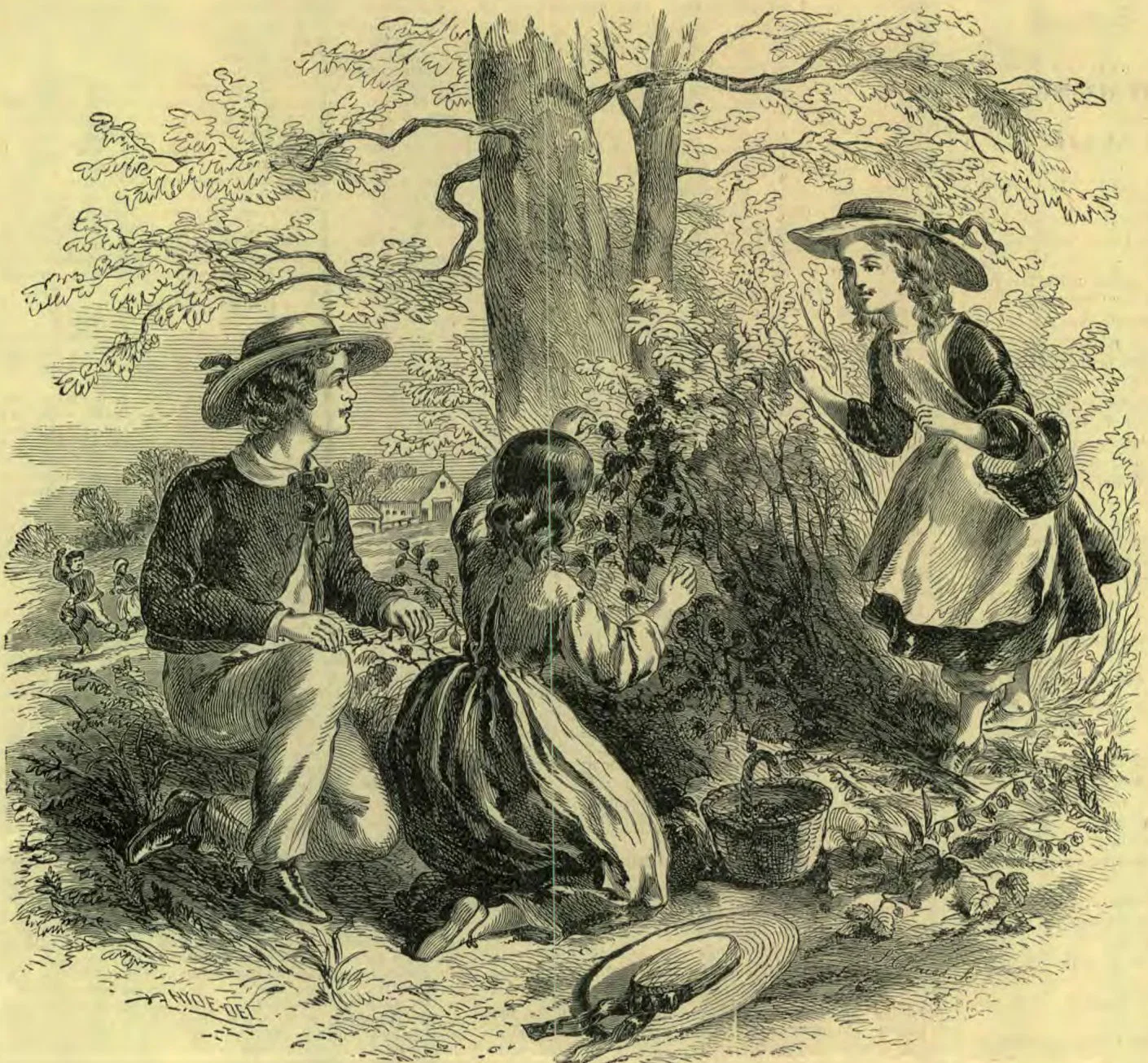
“We finally mustered up courage to tell father and mother our wishes, and though they were some surprised, as it was not common then, as now, for children to have part in such enterprises, they were willing if we could find anything to do. It was in the height of the blackberry season, and we had decided beforehand that if our plans met with success, we would gather blackberries to sell; so every afternoon, after the work was done up, and Harriet and I had finished our set task at the spinning-wheel, and had pieced so many quilt-blocks, or knit so many times round the socks we were knitting for winter's use, Henry would join us from the field; and after many orders from mother not to go too far, we were off for the woods. We spent the rest of the afternoon filling our pails, and then at night we girls did Henry's share of the chores, while he took the berries to the village store.
“We worked in this way until the berries were all gone, and at the end of the week each of us had about twenty-five cents. We had never had so much money in all our lives before, and it seemed to us a large sum; but although it had cost us our coveted play-spell and many a rough scratch in the briars, we never regretted giving the toil or the money. It was some time before the next collection was taken, yet we never thought of using the money for any other than its intended purpose; and finally, when Mrs. Judson sailed, we had the satisfaction of knowing that it went with her on its mission. How well it accomplished it, we will never know here, but I do not think, Laura, that of all the money I afterward earned and spent, any that I ever used for myself gave me as much real pleasure as did that twenty-five cents.”
“You put that out at interest, didn't you, grandma?” said Laura; “and it's been drawing a good interest ever since. I'm going to get some of my very own to lend to the Lord before our next ‘fourth Sabbath.’” And she did.
S. ISADORE MINER.

Letter Budget.

AMY E. and FREDDIE M. HALLOCK send a letter from Faribault Co., Minn. Amy writes: “Freddie and I thought we would each write a letter for the Budget. We have a little brother two years old, who is lots of company for us. His name is Percy. I am nine years old. We go to day school in the summer, but in the winter it is too far to go in the cold. We like to go to school. Our grandma Kelsey is our teacher in the Sabbath-school, and we like her very much. I hope we shall see our letters printed because we have never seen any letters from this place. I am trying to do right.”
In writing his first letter, Freddie says: “I am ten years old, and have learned to help my pa some. I expect to follow after him this spring and drive the team to do the dragging of one hundred and fifty acres of land. Before we get through, I think I shall get tired doing so much walking. I get my lessons in Book No. 2, and attend Sabbath-school this winter at grandpa Kelsey’s. I want to be a good boy, so I can be saved with the INSTRUCTOR children that Jesus will take to reign with him.”
Do any of the little farmer boys have an idea how many miles Freddie walked in driving the team over so much ground? May be his legs ached a good many times, but we suspect the muscles grew stronger and stronger every day, so that now he can outstrip many another boy of his own age in walking. It is exercise that gives the muscles strength, you know. Just so it is the exercise of all the good traits of character that makes boys and girls strong for the right; and if Amy and Freddie are doing this, they will be of the number which will be saved out of the INSTRUCTOR family.
LULU A. WHITLOCK writes from McLeod Co., Minn. She says: “It has been snowing hard all day. I have been learning my Sabbath-school lesson on ‘Warnings of the Judgment,’ and as I was tired, I turned the paper and read a piece from Eld. Canright entitled, ‘The Bird and the Looking Glass.’ We like to read Eld. Canright’s writings in the paper, as it reminds us of his visit here thirteen years ago, when, through his teaching, we began to search for truths which led us to keep the Sabbath of the Lord. We have a very nice, comfortable church nearly completed, and a pleasant Sabbath-school of thirty-eight members, a mile and a half from us. Mamma was superintendent three years and seven months, and only missed two Sabbaths during that time. As mamma is secretary now, she is going to read our scholarship at the close of the quarter, so we are going to study very hard, that we may be marked perfect; and we want a perfect record in heaven. I have three sisters. My two older ones are married, and one of them has a little girl most three years old, which we love very dearly. We are going to teach her the commandments. We shall all try to attend the camp-meeting next summer. I should like to visit the dear friends at the Office who prepare such nice lessons for us. I hope we may meet in that beautiful city spoken of in our lesson yesterday.”
The snowy season is passed and your camp-meetings ended before your letter appeared in the Budget. We trust you were not disappointed in attending the meeting, or in the benefit derived from it; and if, in your every-day duties, you follow that good example of faithfulness and perseverance set you by your mother in her duties as superintendent, what shall hinder the pearly gates opening to welcome you?

SPECIAL PREMIUM OFFER.

GOLDEN GRAIN SERIES.

For every new subscription, accompanied with 85 cents, we will give “The Golden Grain Series,” consisting of a package of ten beautiful pamphlets of 32 pages each. These comprise a choice collection of sketches, stories, poems, etc., adapted to the wants of children, and contain more reading matter than can be found in many dollar books. Remember, the whole series, 320 pages, and the INSTRUCTOR, for a year, for 85 cents.
Address, YOUTH’S INSTRUCTOR BATTLE CREEK, Mich., Or, PACIFIC PRESS, Oakland, California.

You have reached the end of this edition.

The Youth’s Instructor · Aug 11, 1886