Giving the Message to People of Other Tongues in the United States
By A. Boettcher
A. BOETTCHER
WHEN the light of the everlasting gospel for the last generation began to enlighten the world, God drew the races of the earth to one country, in order to reach them with the last glorious message. At about the beginning of the “time of the end,” or the beginning of the last century, immigration began really to set in, and people began to flock into the United States.
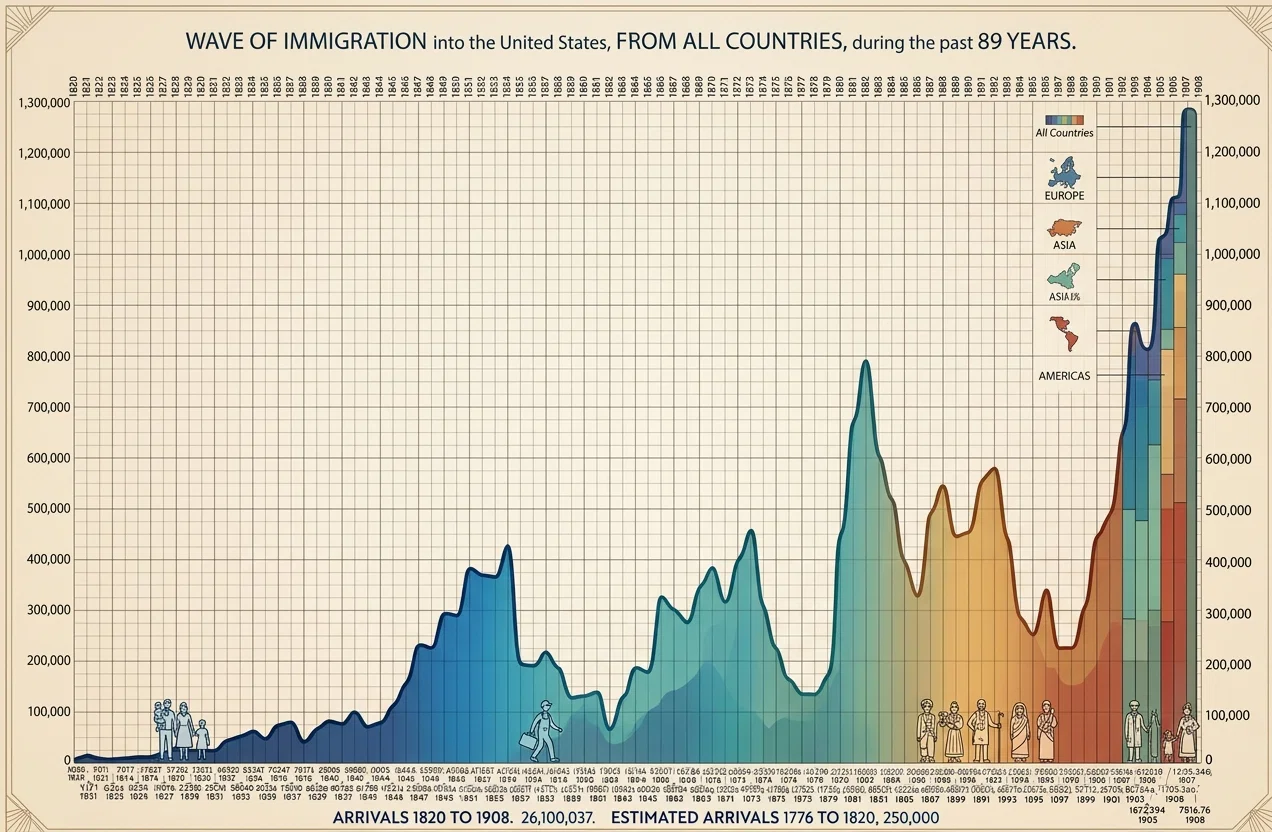
First it started slowly, hardly noticeable. But at that time when God gave his special message in 1844, the first wave of immigration really began. It continued, till in 1854 it reached the first high mark of four hundred one thousand per annum, a number equal to the total of all the people who had landed here prior to the year 1830.
When God has a special plan in view, he creates circumstances to bring about the fulfilment of the same. It was so at the deliverance of Israel from the bondage of Egypt. It was thus at the time of the restoration of the city of Jerusalem and the rebuilding of the temple after the captivity of Babylon. God not only aroused the minds of his own people to feel the necessity of this work, but moved upon the hearts of the kings of Persia, and especially Cyrus, to fulfil his will at the right time.
WAVE OF IMMIGRATION into the United States, FROM ALL COUNTRIES, during the past 89 YEARS.
The third angel’s message was to go to “every nation, and kindred, and tongue, and people,” and God not only showed his chosen ones the necessity of missionary effort in the regions beyond, but also drew many from those lands to these shores, where they would find the best opportunities to learn the message and take it back to their fellow countrymen. In the beginning of the last century, in Europe and elsewhere, attention was called to the United States. On account of oppression, and for other causes, numbers were, through unseen forces, driven to emigrate hither. The years 1840 to 1844 mark an especial era in the flow to the States. The tide began to rise steadier and higher than ever before; and it has continued to do so till to-day. God had started to fulfil the great plan of the age—to bring the last message to the nations of the earth. Something took place in many countries to induce emigration to the new world. In places religious persecution was the cause of driving many to the land of liberty.
When once the host of the enemy surrounded the city of Dothan, and the servant of the prophet could not see the hand of God which was with them, Elisha prayed, “Lord, I pray thee, open his eyes, that he may see. And the Lord opened the eyes of the young man; and he saw.” 2 Kings 6:17. Even so we need a clear vision to understand what this migration to the United States means to us. Elisha’s prayer is well applicable to our time, because we should realize the divine hand in this marvelous movement—a movement never seen in the past—and the great blessings we may bring through the gospel to this vast army coming to our land.
Surely the fields are ripe for harvest, and many are ready to hear the gospel.
When the immigrant arrives in our country, the old religious ties have been weakened by the voyage, sometimes broken altogether. The bulk of the new immigration, which began in 1880, is Roman or Greek Catholic. And while in their respective countries these are the state religions, yet the ties are not very strong after the individual leaves his home country. “We are tired of our church and our priests,” is an answer we often meet in our labor with this class. The same is experienced by others who have come in contact with them. Mr. Groose says: “Thousands of these nominal church-members drift into open infidelity or schools of atheism, or else into nothingism. Their former church does not keep them, and Protestantism does not get them.”
Perhaps the condition prevailing in many large cities will show this more clearly. In one city in Massachusetts, it is said, where there are one thousand seven hundred Italians, only fifty or sixty attend the Roman Catholic Church; and in another of six thousand, only about three hundred go to it. They are tired of the Roman Catholic Church, and have lost faith in its priests. Similar reports come from all parts of the country.
The tide of immigration is rising higher and higher. We have not in the past been able to do much for the foreigners already here—and still they continue to come at the rate of a million a year. Shall we be able in the future to care for these incoming millions? God has provided us with some means to carry the message to them. There is literature in our publishing houses in nearly thirty different languages. Will you help to distribute this literature among your foreign neighbors?
New York City.
In Eastern Prussia
By Guy Dail
GUY DAIL
We are just at the close of the seventh annual session of the Prussian conference, which was in session here at Insterburg from January 12 to 16. Of the forty-four churches and companies in the field, forty were represented by one hundred twelve delegates and by more than another hundred of our brethren and sisters. The evening lectures, conducted by Elders H. F. Schuberth and O. Luepke and Dr. E. Meyer, who have been present to assist the regular conference workers, were attended by from three hundred to eight hundred persons.
Many of our members in eastern Prussia are farmers; their manner of living is simple; frequently they do not have the privilege of regularly attending Sabbath services; but the spirit of liberality which has characterized them here, and the unity manifested in all business transactions of the conference, show that they have a heart for God's cause. One well-to-do farmer has pledged all his gain from now on to the support of the third angels' message.
We are especially pleased to see so many promising young men and women among us, and believe that there are not a few of them who will be found self-sacrificing laborers for the Master in the near future. The interest they show in missionary and young people's work is refreshing to our hearts, as it helps to bring life and activity into the churches in the east Prussian field.
During 1909 there were one hundred fifty additions through baptism and by vote, giving us a present membership of nine hundred eleven; twenty-five were dismissed by letter, twelve were disfellowshipped, and nine were lost by death. We are glad that three new companies could be received, with a combined membership of forty-two. The tithe for the year shows a gain of sixteen thousand marks, or 6.66 marks per member,14over 1908. After the auditing committee had settled with the fifteen workers on the conference pay-roll, and one thousand five hundred marks had been voted for the Galician Mission in Austria, and one thousand set apart to the educational fund of the union conference, and two hundred marks to the canvassers' relief fund, there is still a surplus in the treasury. To assist in paying for the land secured at Friedensau last summer, over two thousand seven hundred fifty marks was raised in cash and pledges among the brethren present. There were fifty-one copies of “Ministry of Healing” sold at the meeting.
Our canvassing work for the year shows an increase of three thousand marks in sales, 29,436 marks' worth of publications having been placed in the homes of the people. We now have twenty-eight regular canvassers in the Prussian Conference, and there are six ministers, four licentiates, and five Bible workers. Elder E. Bahr was re-elected president.
The services were all graced by God's Spirit, especially upon the Sabbath, when Brethren M. Schuerer and C. Kapitz were ordained to the gospel ministry.
One feature of special interest is the work among the many thousands of Poles living in the two provinces of East and West Prussia,—which compose the territory of the Prussian Conference,—and we were glad to meet our Polish translator, who lives in this field. He is of great assistance to us in getting out literature for this nationality. There are about four million inhabitants in the Prussian Conference.
The outlook for the future is encouraging. It is planned to begin here also a series of tent-meetings in the summer. This will prove quite a new experience to our workers in this part of Germany. We bespeak for our work and workers in the Prussian Conference a hearty interest in the prayers of God's people in all parts of the world.
Insterburg.
Encouraging Prospects in Japan
By W. L. Foster
W. L. FOSTER
To tell of all the encouraging features and the little things that help to make our burdens easy, would require much more space than could be spared in one number of the REVIEW. But look on the map of Japan, and you will notice a small body of land called Kiusiu, surrounded by water. It is, indeed, small, but contains a population nearly equal to that of the States of Washington, Oregon, California, and Texas. Such a thing seems almost impossible; but it is, nevertheless, true. And these people are without Christ; God loves them, but they know it not. When truly converted, they make good Christians. They love this message just as much as we do, and are as willing to sacrifice for its advancement.
We had our week of prayer the last week of December. It is the custom of the Japanese, upon the approach of a new year, to send greetings to all their friends. And during the first three days of the new year, they make just as many friendly visits as possible. Also, before New-year’s day, for several days they are busily engaged in preparing refreshments for their guests. Their visits are necessarily short. Usually they leave only their cards in the tray placed in the entrance for that purpose. But if slightly acquainted, it is customary for the guest to partake of his host’s generosity. This is usually tea, machi, tobacco, and sake. But even at such a time, the attendance during the week of prayer showed that some, although not yet Christians, were more interested in their soul’s welfare than in the festivities.
Our house is on a busy, noisy street, near the gateway to the largest temple in the city. It is estimated that forty thousand persons sometimes visit the temple in a single day, and these, with very few exceptions, are without a ray of hope beyond the present life; and in many cases it would seem there is no hope or joy in the present life.
Each week ends with something accomplished. So the first week of the year closed with four hundred fifty of the paper, Owari no Fukuin (Gospel for the Last Days) in the homes of Nagasaki, and seventy-five copies mailed to different parts of the island. As we were doing this, we thought of the way the message had its beginning. A few days after the distribution of the papers, a young man called at the home of Brother Tsukamoto, saying he had read the paper, and wanted more of the light it contained. Now he is attending the Bible studies, and seems deeply interested.
LITTLE SHINTO SHRINES OF JAPAN
A student of one of the higher schools here in the city, one evening asked me what my church taught. After I had spent thirty minutes telling what we teach, and why, he asked for some literature, and said, “Six years ago a man came to our village with some papers called Owari no Fukuin.” This was none other than one of our faithful workers. The young man’s interest was aroused by it. There is a growing interest in this ancient stronghold of heathenism. I could tell the story of a number who seem to be coming from darkness into light. We have the promise of a tent effort as soon as the brethren can come; but it will take them six months to finish the duties already pressing upon them. Then comes the terrible heat of summer. We are planning other things for Nagasaki, which I will write about later. Also, we are hoping several of the canvassers can be spared this spring, to enter upon labor somewhere in Kiusiu. God’s care is over us. We feel his power, and can see his guiding hand. Now is the opportunity to give Japan the message. The people will receive it, if they have an opportunity.
Those who come to this empire will find all that their fond ambitions are longing for, if it be to have a place in God’s vineyard.
The old year closed—closed with forty-nine souls buried in the watery grave to arise to receive newness of life. This makes our hearts rejoice, and we are already praying that at least one hundred may find the way of life during the year to come.
Nagasaki.
Those Lazy Missionaries
By Mary W. Riggs
“Good morning, ma’am; my name is Hunter, and I am traveling through the interior of Turkey, in the interests of the Blank Company, of Chicago. May I see Rev. Dr. Bailey, who I understand is the senior missionary in this station?”
“Yes, he is; but this morning he has gone down to Mezireh, three miles away, to see the vali (governor) about a permit for a man to remodel his house. The poor man, being in trouble, came to Dr. Bailey for advice, and Dr. Bailey, although eighty-three years of age, has gone on horseback to do what he can for the man.”
“Will you show me where Rev. Mr. Knox lives?”
“Yes, I can; but I happen to know that he is not at home to-day. He has gone to a village, three hours’ journey away, to show the boys on the orphanage farm how best to prepare the ground for the sowing of wheat. He will not be home till late this evening.”
“Is this a good time to see Rev. Mr. Chase, the president of the theological seminary?”
“I am sorry to say that he is not here just now. He had to go to the other side of the city to start the orphan rug weavers on a new pattern which he has just prepared, and to attend to a few other matters in the rug business. If you wait, you can probably see him at noon.”
“Where is Rev. Mr. Rice, the president of the college?”
“If he is not in his office, he is probably at the iron shop putting one of the machines in order; or he may have gone to see to something in the carpenter shop. It is hard to find him among all the shops of the self-help department of which he has charge. Perhaps he is in the printing-office. I will send this boy to find him.”
“Are the missionaries generally occupied with such things? I supposed I should find them preparing their sermons or calling on the people or having private religious conversations with the students.”
“You see there is no one to do these things unless the missionaries do them.”
“I should think they needed some mechanic or man with a business training to help them out. Isn’t there enough for the ministers to do without their doing this kind of work?”
“O, yes, plenty! But you see there is not enough money to send out both ministers and business men.”
“Now, I am a business man, and I never knew there was such a need for business men on the mission field. I have never thought much about missionary work, because I supposed it belonged to the ministry. If business men were in the missionary work, on the field, I mean, appointed by the board, we business men would take more interest, and we might even support one of them. I am really interested in this state of affairs. Are there no missionaries who are not ministers?”
“Yes, there are many physicians. And there are a few others who are most useful men. I have one in mind who made himself so indispensable to one of our stations, when he was a tutor in the college there, that the missionaries asked the board to appoint him as a regular missionary, and he is now one of the most important men there, though not a minister.”
“What kind of work does this man do?”
“He is the treasurer of both station and college, is dean of the college, and with his wife he has charge of the fifty youngest boys in the boarding department, making a home for them, being a father to them while they are away from their homes. Here comes Mr. Rice. From his appearance I judge he has been investigating the inside of the well which he recently had dug, and into which he is putting a pump worked by a windmill, which took much ingenuity and physical force to set up in place.”
“I am glad to have this new light on the work the missionaries have to do. When I get back to America, I shall tell people about it, and it seems as if we ought to manage to send out men of various kinds of training, so that the great principles of division of labor, which is so important in other lines of work, may be put in practise in sending the gospel message to all parts of the world.”—Mary W. Riggs, in Christian Work and Evangelist.
Behold, He Cometh!
By Mary A. Morris
MARY A. MORRIS
Sure as the budding trees and flowers
Tell us when spring is here,
So, many signs as certain tell
His coming very near.
The darkened sun, the crimsoned moon,
The stars that fell like snow
Or falling of untimely figs,
Were signs seen long ago.
And still the tokens multiply.
They hasten swiftly on,
And nearer bring to longing hearts
The coming of the dawn.
Men’s hearts are failing them for fear;
The nations are distressed;
The warring elements proclaim
This old earth’s deep unrest;
Convulsive tremors rend her heart;
Earthquake and fire and flood,
With no uncertain sound, proclaim
That awful day of God,
When he shall come, the judge of all—
The ages strong Desire—
To render recompense, and his
Rebuke with flames of fire,
Behold, he cometh! ye who watch
Through the long night of fear,
And wrong, and sin, lift up your heads;
Redemption draweth near.
O blessed day for those who here
The way of truth have known;
For safe at last they stand upon
The sea before the throne.
Dear land of love, our weary hearts
Long for the rest of home.
O Christ, our peace and righteousness!
Come, dear Lord, quickly come.
Willow Lake, S. D.
Chinese Perspectives on Humanity
NG POON CHEW, a brilliant Chinese editor, statesman, philosopher, and humorist, residing in the United States, in speaking of China, says: “We have imported men who are followers of the humble Christ, the Prince of Peace, to show us how to kill and be killed.” Of Chinamen, he says: “I can’t help being a Chinaman. If I had had my choice of complexions, I might have selected blue or green, but as it was, I had to take yellow. The complexion is not the man. A Chinese person is a human being, after all, and it has been discovered that all blood is red.”
Espirito Santo (Brazil) General Meeting
By F. W. Spies
THE first general meeting for Brazil has just closed. It was held at Santa Maria, in the province of Espirito Santo. The weather and the roads were excellent, which was indeed much in favor of a good attendance, as some of the brethren had a two-days' ride on muleback to reach the place, and at the time of heavy rains and swollen streams traveling is often stopped entirely in some places.
While some did not surrender their lives entirely to the Lord, and, consequently, did not receive all the blessings he had for them, others obtained a new experience, and we trust the future will bring them many precious victories over imperfections of character, and they thus be helped to stand before the King at his appearing.
Some questions of special interest to the brethren were discussed, among them the payment and proper use of the tithe, and whether it is consistent to use the tithe in the support of church-schools. The evening services were well attended by those not of our faith, who gave the best of attention to the word preached.
Crops were very poor in this section last year, and the coffee crop, which is the chief product of this province, promises not more than a quarter of the usual yield this year. Notwithstanding this condition, the people have not suffered for want of food. And as we consider the many calamities that are visiting different parts of the world, we feel that we have every reason to be thankful for the degree of prosperity that has been granted to our brethren and to others who reside in this province.
Elder John Lipke assisted us at the Santa Maria session, and his labors were much appreciated. We are now waiting for the train to come to take us to Victoria, and we hope soon to be in Rio de Janeiro, where next Friday evening commences a general meeting of three days for our people at that place.
Plans have been laid to have a young man join Brother Joseph Lindermann, the laborer in Espirito Santo, and for both of them to direct their attention chiefly to the natives.
As the dear readers of the REVIEW remember at the throne of grace the different mission fields and their workers, we in Brazil ask to be remembered likewise, that the Lord may abundantly bless us here. F. W. SPIES.
In Haiti
THE Bible Society Record has a report from its Cuban agent, who recently visited Haiti and San Domingo. At Cape Haitien he found Elder W. J. Tanner. The agent says:—
“As the Wesleyans have a native worker here, I went ashore, expecting to attend the services, but found that the weather had been such that services had been temporarily suspended. The pastor, however, was glad of the opportunity to get a family Bible and pocket Testament, and more than glad at the prospect of having some Bible work done in his field. I then called on the Adventist minister, Mr. Tanner, an American, paying a man to lead and carry me over the flooded streets. I was very hospitably entertained for the night in their home.
“The next day, Mr. Tanner called with me to see Mr. Mackenzie, a leading merchant, a thorough Scotchman, though born in Jamaica, and, strange to say for Haiti, an enthusiastic Christian and Methodist. Mr. Mackenzie has been many years in the country, and was delighted to know that the American Bible Society was taking an interest in Haiti. He thought the time was most opportune. He said: ‘The people are restless and dissatisfied. They want something that they have not, and do not know what it is. They are beginning to think that it may be in the Bible. I have given away all I had. A good colporteur could sell hundreds all through these mountains.’
‘To sum up: Here is a country one fifth the size of Cuba, with very nearly Cuba’s population (from one and a quarter to one and a half millions), with a very inadequate missionary force. I know of only four white workers in the republic: two Wesleyans, one Baptist, located at Jacmel, on the Caribbean, just south of Port au Prince (I understand he is working independently), and Mr. Tanner, the Adventist, in Cape Haitien. And this is the way we are helping Haiti to work out her own salvation. We must not leave her to the mercy of those whose only aim is to make commercial gain out of her weakness.”
Northern Illinois
By William Covert
OUR Harvest Ingathering has not been quite so successful this year as it was last, and yet we are expecting more funds to come in. We have already received $929.33. I am not able to estimate the amount that we shall yet receive. Doubtless it will exceed one thousand dollars. Our annual offering up to date is $908.57. There will be some more added to this.
I am happy to report that we have secured the services of Brother W. D. Forde, a colored minister from Barbados, to take up work among that people in Chicago. We are expecting the Lord to greatly bless his work. The members in the church where he will serve are quite full of courage, and we hope to see a large work done among this people soon. We are making a special effort to provide a good meeting-house for them as soon as possible. A special offering is to be taken up in every church in the Lake Union Conference on Sabbath, March 19, to assist in building this meeting-house. It will probably cost several thousand dollars, but we are sure that it will be money well invested. Our courage in the Lord's work is good.
Wm. COVERT.
In the New Earth
By M. E. Yergin
M. E. YERGIN
ALL forever and forever,
All the glad, sublime forever,
Through the God-lit, sun-lit daytime of
that vernal land of spring,
Home shall bud and bloom and flourish,
Tendrilled loves shall drink and nourish,
And through all the rolling ages there
shall be no parting sting.
Ceaseless age on ages going,
Friendship ever shall be flowing,
And the golden cords of love and life
shall ne’er untie nor break;
’Neath the vine-tree’s sweet perfume,
By the jeweled silver home,
Friends and loves shall e’er regather at
the fuller feasts they make.
Ancients from the olden ages,
From the first creation ages,
Ancients from the vales and hills of
God’s unnumbered starry spheres,
We shall meet at moons together
In the endless lovetime weather
Where the throne of God creates the
light of all of heaven’s years.
Sloping flowered hills of glory,
Vales in June-time’s perfumed story,
Shall resound and overecho with the
greeting courtly hosts
Treading light the blossomed land,
Winging o’er the jeweled strand,
Touching harp and hand, as, singing,
homeward seek their planet coasts.
Jesus only, Jesus ever,
Through the long, long, long, forever,
Is all life’s Desire of Ages in God’s
morning-land of spring;
And he graces all the places
With his love to light the faces
Of the gathered radiant beings who adore
him while they sing.
Chicago, Ill.
Florida
By William H. Branson
As a result of a series of meetings held at Livingston, and another at Lockhart, a modest church building has been erected at the latter place, and a church of thirteen members organized. There is also a prospect of a few others uniting with them soon. Elder E. W. Webster and the writer conducted the first series, and Brother C. V. Achenbach assisted in the latter.
A few in both places took their stand for the precious truth, and as the towns were quite near each other, it was thought best to unite them all in one church. The church building was erected before the tents were taken down, the tent company assisting in the work. We believe this is in harmony with the instruction that the Lord has given the field workers through the spirit of prophecy. The money was nearly all raised in the immediate vicinity by those who had attended the meetings, and on Feb. 6, 1910, the church was dedicated to the worship of God, free from debt. This service was conducted by Elder R. W. Parmele, our State president. Brother H. A. Shreve, of the Orlando Sanitarium, was elected elder of the new church.
Elder E. W. Webster, Brother C. P. Whitford, and the writer are now conducting a tent effort at Miami, where we also hope to be successful in raising up a church. The work is onward in all parts of this State, and God is blessing all the laborers. W. H. BRANSON.
The Pacific Union College
By George A. Irwin
At the annual California conference, held recently in Lodi, the educational work on the Pacific Coast received very careful consideration. For a number of years, our denominational school work in this field has been in rather an unorganized condition. Since the close of the Healdsburg College, nearly two years ago, there has been no general training-school of collegiate grade in the Pacific Union Conference.
For some years prior to the closing of Healdsburg College, it was thought by many that a property more suitable for school work should be secured, so that the students in training might be surrounded by wholesome and uplifting influences, and might have opportunity to secure the development of character that comes to those who combine mental and moral training with a proper exercise of the body in useful labor. At various times, an effort was made to find a suitable place to which the school work carried on at Healdsburg might be transferred. Sister E. G. White was intensely interested in this movement, and urged the brethren to persevere in their search for a property that could be utilized to advantage.
In August, 1908, a property at Buena Vista, near Sonoma, was found, and a contract was entered into for its purchase. But before the time came for the property to be turned over to our people, the owner made conditions that our brethren did not feel free to comply with. The failure to secure this property was a great disappointment to those who were negotiating for its purchase; but Sister White told them that the matter would come out all right,—that the Lord had some better place, and that they should make further search.
In a little while, the brethren found a place, known as the Angwin summer resort. This place is located eight miles from the town of St. Helena, the nearest railway station, and less than six miles from the St. Helena Sanitarium. It is situated on Howell Mountain, at an elevation of 1,750 feet. The place includes 1,636 acres, five hundred of which is under fence. Near the buildings, there is a beautiful and fertile valley, containing one hundred five acres of excellent farm and garden land in a good state of cultivation. In this tillable tract of land there is twenty acres of bearing orchard and small fruits, including apples, peaches, cherries, prunes, plums, quinces, blackberries, and grapes. Thirty acres, accessible to an ample supply of water for irrigation, is suitable for gardening purposes.
On the property there are, all told, about twenty buildings, in excellent condition. The large hotel has more than thirty rooms, including parlor, sitting-room, a dining-room thirty-six by thirty-six feet, a large kitchen with modern conveniences, and twenty-nine bedrooms. Beneath are ample cellars, and flanking the building on either side are several cottages, with a combined capacity for about sixty persons. There are roomy barns for horses, for cattle, and for grain; a carpenter- and blacksmith-shop fitted with tools, a large swimming tank one hundred by forty feet, a power-house, and other smaller buildings. In addition to these, there is an amusement hall thirty-six by seventy-two feet, attached to which is a billiard room, and also a bowling alley sixteen by eighty-five feet. The amusement hall has been transformed into a chapel, and the bowling alley and billiard room are utilized as recitation rooms, thus making it possible for the managers to conduct a school of moderate size, fairly well equipped, without having to erect other buildings the first year.
This whole property was purchased for sixty thousand dollars. Taking into account the large amount of timber on the place, which some have estimated will yield several millions of feet of sawed lumber; and also taking into account the fruit, and the abundant water-supply (springs with a daily flow of two hundred seventy-six thousand gallons), as well as the isolation of the property from the wicked influences that are always at work in the plains and near our large cities, this property is an ideal place upon which to carry forward an industrial school for the education, training, and discipline of those who desire to become practical missionaries.
Up to the time of the meeting held at Lodi early in February of this year, the Angwin school, or “Pacific College,” as it was first named, has been a California Conference enterprise. At the time of the union conference recently held at Mountain View, the delegates and representatives thought that it should be made a union conference school, and carried forward as the college for the Pacific Union Conference, rather than as a school for a local State conference.
When this proposal was brought up for study during the California Conference meeting at Lodi, our general educational policy was discussed, and resolutions were adopted that we follow the plan outlined by the General Conference in behalf of the unification of our educational work. It was also unanimously voted to make the Angwin school the college for the union. A board of seven directors for the ensuing school year was appointed.
This board met on the school grounds, February 9, 10, and, after organizing, took up the problem of selecting a faculty, and discussed plans regarding the future policy of the school. It was the unanimous consensus of opinion of the board that, while this school should provide for a full collegiate course, and choose teachers who are qualified to carry the different departments in a good, strong way, at the same time the industrial feature should be strictly adhered to.
Inasmuch as the Angwin property was not purchased until nearly all of our other schools were in operation last fall, it could not be expected that there would be a large attendance the opening year. No calendar or formal announcement in regard to the school was put out before its doors were opened for students. Nevertheless, there has already been an enrolment of about seventy-five, and a good beginning has been made in actual school work. And now that, by the action of the Pacific Union and the California conferences, this school has been made a college for the entire Pacific Union Conference, we may reasonably expect a good attendance next year.
It was my privilege to spend Sabbath and Sunday, February 12, 13, at the college, and to speak three times to the students. During the Friday evening service, when the time came for a social meeting, nearly every student in the chapel bore testimony.
Those having charge of the school anticipated some difficulty in the beginning, to get the students to co-operate heartily in an effort to follow the industrial plan; but I am told that there has not been so much difficulty in this direction as was anticipated. Most of the students who are now in attendance, seem to be in full sympathy with this method of education, and both the young men17and the young women are taking hold in earnest. It was certainly a gratifying sight to see some of the young men getting their teams and wagons and axes and tools, preparatory to going out to cut and haul timber. Others were starting out with their implements to prune the orchards; still others were preparing to plow land for a vegetable garden; while another company were starting out with two yoke of oxen to haul logs for the sawmill. The whole place was a scene of busy activity, and all the workers seemed cheerful and happy.
A sawmill has been purchased, and will soon be ready for operation. There are two or three hundred logs already cut, and some of these have been hauled to the mill. The limbs from the felled trees are being hauled in and sawed into stove wood with a buzz-saw connected with the engine.
It is the plan of the managers to supply work to many young men who desire to pay part of their tuition in this way. From the timber hauled to the mill, lumber will be cut not only for sale, but to build any buildings that may be needed on the grounds. In the erecting of the buildings, the principles of carpentry will be thoroughly taught to the young men.
A calendar will soon be issued, announcing the various lines of book study offered, and also the industrial departments to be carried forward in connection with the operation of the school. Each department is to be manned by competent and experienced teachers of reputation in the denomination.
In my judgment, there are great possibilities before Pacific Union College, and I bespeak for it both the interest and the patronage of parents and guardians who believe in industrial education, and who would be pleased to have their children attend a school that is isolated from the evil influences to be found everywhere near the great centers of population.
GEO. A. IRWIN.
Maryland
By L. E. Sufficool
FEBRUARY 6 the writer opened a series of meetings at Crystal Falls, Washington Co., Md. From the first it seemed evident that the Lord had directed in the work, and as the meetings came to a close, we were able to organize a church of twenty-one members. Others have already requested membership, and when admitted, the membership will be twenty-five. The interest is spreading, and within the next year, the brethren hope to be able to double their membership. A Sabbath-school with a membership of fifty has been organized, and is doing most excellent work.
The work in Hagerstown is onward. As the result of the Bible work, souls are accepting the truth as it is brought to them from week to week. Our Sunday night meetings are well attended, and we expect great things of the Lord in this field. We ask to be remembered in the prayers of God's dear children.