Ancient Britain: Caesar's Invasion and the Britons
Page 1
The Youth’s Instructor
Feb 23, 1881
S. D. A. Publishing Association · Battle Creek, Mich. · Feb 23, 1881
Ancient Britain: Caesar's Invasion and the Britons
By John Norton Loughborough
ANCIENT BRITAIN.—NO. 2.
When Cæsar set out for his conquest of Britain, B. C. 55, he sailed from Calais, France, crossed the Straits of Dover, and first planted his standard in what is now the county of Kent, on a point of land where stands the town of Deal.
The Romans found the Britons a strong, well-formed, and good-tempered people, and wished to have them for slaves and soldiers. But although the weapons of the Britons consisted of only bad swords, weak spears, poor bows and arrows, and shields of basket work covered with leather, they were so fierce as to be a terror even to the bold Roman soldiers, who had good swords and spears, and shields covered with iron, and were also clothed in armor, consisting of pieces of iron covering their backs, breasts, arms and legs. For this reason the only effective weapon of the Britons was their bow and arrows.
The Romans, however, with all the advantage of superior weapons, found it a difficult task to conquer the fierce Britons; and they were obliged to build very strong walls around their houses, and maintain a constant watch, lest they lose even what they had gained.
Before the coming of the Romans, the Britons formed their houses with sticks, and smeared them over with mud. They would build several of these mud huts near together and surround them with a high fence, composed of the trunks and limbs of trees, to keep the bears, wolves, and foxes from coming in the night to destroy their children, their flocks, and poultry. These clusters of houses constituted their towns.
Where now stands London, the largest city in the world, then stood their mud-hut London-town, on the river Thames. Some authors claim that there has been a settlement on the site of London since the year 1107 B. C. There are authentic records that B. C. 54, London was the capital of the Trinobantes and the royal seat of their sovereigns.
When London was conquered by the Romans, it was so hidden away among the trees of the wilderness that it could hardly be seen. They cut down the large trees around it, built large houses of stone for dwellings, established a market, and, to facilitate traffic, introduced money made from the silver and copper they had found in Britain. Tacitus, the Roman historian, tells us that in A. D. 51 it contained “many merchants and much merchandise.” In A. D. 61 the Romans called it Lundinium, or Colona Augusta. They built a strong stone wall around their possession, with four principal gates. They built a strong tower in the town, in which they could place their women, children, and treasures, in case of an attack.
But how unlike the ancient is the modern London! All these early walls and towers have passed away. Hills have been leveled, and some of the ancient Roman floors and streets have been found twenty feet below the present streets. The mud-hut town hid in the wilderness has grown to a city eighteen miles in length by eleven in breadth, with over 4,000,000 inhabitants and 1700 sub-postoffices for their accommodation.
J. N. Loughborough.
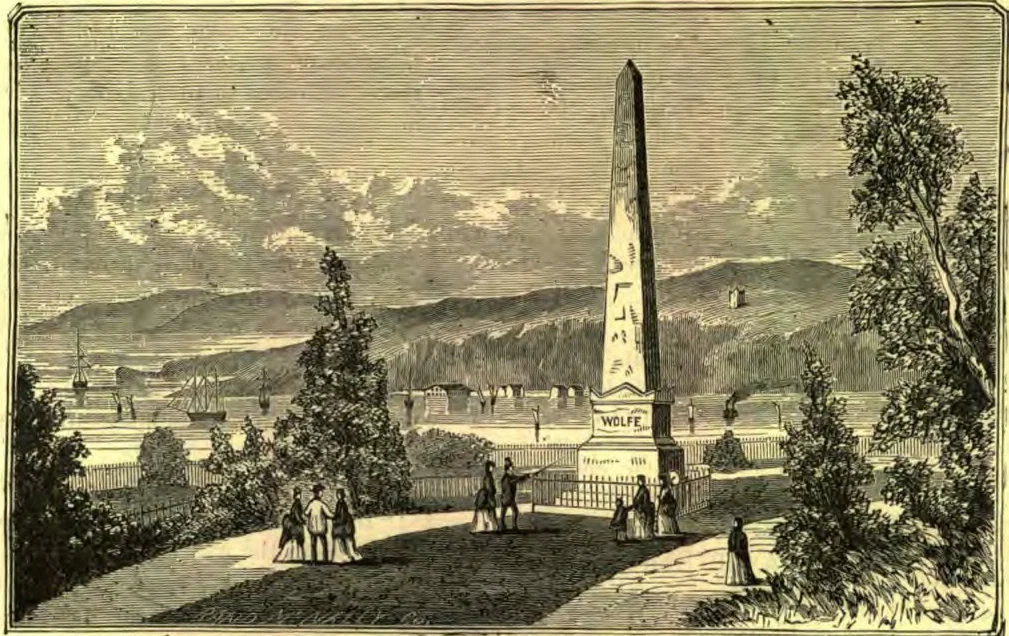
WOLFE'S MONUMENT.
By W. C. G.
On the plains of Abraham, in the ancient city of Quebec, stands the monument erected to the memory of General Wolfe, whose bravery and devotion to the cause of his country have been the admiration of all students of history, as they have read the account of the gallant siege of Quebec under Wolfe, and its equally gallant defense, under Montcalm, Sept. 13, 1759. The monument commemorates the bravery of both officers, who fell at nearly the same moment, in deadly conflict with each other, both fighting for what they believed to be the cause of right.
The fortifications of Quebec were considered well-nigh impregnable, and up to the time of the siege above referred to, were held by the French in fancied security. But General Wolfe, in command of the English forces, conceived the project of scaling the cliffs from the river's bank, and though finding but little sympathy among his officers in the bold undertaking, he successfully carried it out under cover of darkness, and the result is known to history.
One feature of this battle is worthy of emulation by the Christian soldier. It is recorded of the brave General Wolfe that he pressed forward in the thickest of the fight, and received a mortal wound. He was carried to the rear, and while his life-blood was fast ebbing away, he heard the cry, “They run! they run!” On learning that his foes were retreating, he exclaimed, “God be praised; I die happy!” Although he was not personally to enjoy the results of his victory, he died in the happy consciousness that his cause was to triumph, even though its success was sealed with his blood.
The conflict between right and wrong has been going on for six thousand years. The final victory is yet a thing of the future; but the gallant soldiers of the Cross have been falling in defense of the right all the way along. Even though apparently defeated, they have been allowed a glimpse of the prospective victory, and, like Wolfe, have been able to exclaim, “I die happy!”
It is given the Christian soldier to know the final result of the warfare in which he is engaged. As the great apostle has stated it; “I therefore so run, not as uncertainly; so fight I, not as one that beateth the air.” Though wrong may seem to triumph, and the banners of right be trailed in the dust, it is only a temporary defeat. “Truth crushed to earth will rise again; the eternal years of God are hers.” Though we may fall at our post, let us be happy in the thought that it is the post of duty, and that faithfulness to duty has its sure reward. W. C. G.
The Value of Health, Joy, and Rest
AFTER you have been sick, you know the value of health; after you have had sorrow, you can appreciate joy; when you are tired, then rest is truly sweet.
Chinese Economy and the Value of Money
The Chinese are noted for their economy. In China, a penny of our money is divided into more than twenty pieces, each of which has a value in the market. Everything which a poor man requires is cheap, and thus money goes a great way.
DRAWING WATER.
I HAD drank with lip unsated
Where the founts of pleasure burst;
I had hewn out broken cisterns,
And they mocked my spirit's thirst.
And I said, Life is a desert,
Hot, measureless, and dry;
And God will not give me water,
Though I pray and faint and die!
Spake then a friend and brother,
“Rise and roll the stone away!
There are founts of life upspringing
In thy pathway every day.”
Then I said—my heart was sinful,
Very sinful was my speech—
“All the wells of God's salvation
Are too deep for me to reach.”
And he answered, “Rise and labor!
Doubt and idleness is death;
Shape thou out a goodly vessel
With the strong hands of thy faith!”
So I wrought and shaped the vessel,
Then knelt lowly, humbly there;
And I drew up living water,
With the golden chain of prayer.
—Selected.
A MOTHER'S LOVE.
We do not suppose it possible for any child to understand the depth and the strength of a mother's love. For her child, the mother will cheerfully suffer almost any pain and hardship. She will deny herself in every way for the sake of her dear ones, and strange as it may seem, in all this she obtains her greatest pleasure.
Children find everything prepared for them by the kind and loving hands of a mother. Their food is made ready; their clothing is made and kept in order; their beds are prepared; a thousand little wants are thought of and provided for by a mother's love. When sickness comes, it is the mother's soft hand that cools the fevered face, that smooths the pillow on which the weary head lies restless, and gives the medicine that is to bring back health.
When childish sorrows come, her loving heart gives out the tenderest sympathy, and makes the child feel that he has one dear friend, at least, who will never tire of listening to the story of his grief.
If the children think as they ought about the love the mother has for them, they will be careful not to do or say anything that will grieve her. They will seek to make her burden as light as possible, and to make her feel that they are grateful for the love she has for them.
One of the most celebrated of English writers, Lord Macaulay, has written a beautiful tribute to his mother:
“Children, look into those eyes, listen to that voice, notice the feeling of even a single touch by that hand! Make much of it while you have that most precious of all good gifts, a loving mother. Read the unfathomable love of those eyes, the kind anxiety of that tone and look, however slight your pain. In after life you may have friends, fond, dear, kind friends; but never will you have again the inexpressible love and gentleness lavished upon you which none but a mother bestows. Often do I sigh in my struggles with the hard, uncaring world for the sweet, deep security I felt when, of an evening, nestling in her bosom, I listened to some quiet tale suitable to my age, read in her tender and untiring voice. Never can I forget her sweet glances cast upon me when I appeared asleep; never her kiss of peace at night. Years have passed away since we laid her beside my father in the old church-yard; yet still her voice seems to whisper from the grave, and her eyes to watch over me, as I visit spots long since hallowed to the memory of my mother.”—S. S. Advocate.
THE STEPPING-STONES.
By J. E. M.
A LITTLE girl was taking a walk one day with a friend, through beautiful fields, when they came, on their return home, to a wide but shallow stream they wished to cross. The bridge was a long way off, but there were good, tried stepping-stones all the way over.
“Oh, I am afraid!” said the child.
“But you see the stones, dear; they hold out all the way across.”
“But the water is so wide!” she said tearfully, looking up and down the stream.
“Yes, but it is very shallow. See how easily I can cross it.” So, carefully picking her way, she went quite over, and then returned.
Very timidly the little girl entered the water. “Just one step at a time is all you have to take,” said her kind guide.
So one step followed another—the first few were the hardest to take—and soon she was safe on the other shore, smiling at her fears.
“It was not so hard, after all,” she said, looking back on the watery way. “Just one step at a time brought us safely over.”
“Remember this walk, dear, when you have other hard things to do. Go forward, and the way will look easier and easier. When troubles come, as they are almost sure to do in this world, don’t look at the waters before you, but at the stepping-stones Jesus places for your feet. ‘The thing that we feared’ very often does not come upon us, or if it does, Jesus sends such comforts as we never could have imagined. Here is a strong, firm stepping-stone that has often saved me from sinking: ‘As thy days, so shall thy strength be.’”
There came many times in her after life when Mary remembered that day’s lesson, and it brought cheer and peace to her soul.—J. E. M., in Child’s World.
HONESTY TESTED.
GEORGE and Harry worked in the same shop; but as the working season was about over, and there would be little work to do during the summer months, their employer informed them, as they settled up on Saturday evening, that he could only give one of them work hereafter. He was very sorry, he said; but it was the best he could do. He told them both to come back on Monday morning, and that he would then decide on the one he wished to remain. So the young men returned to their boarding-house a good deal cast down; for work was scarce, and neither knew where he could obtain a situation, if he were the one to leave.
That evening, as they counted over the week’s wages, Harry said to his friend,—
“Mr. Wilson has paid me a quarter of a dollar too much.”
“So he has me,” said George, as he looked at his.
“How could he have made the mistake?” said Harry.
“Oh! he was very busy when six o’clock came; and handling so much money, he was careless when he came to pay our trifle,” said George, as he stuffed his into his pocket-book.
“Well,” said Harry, “I am going to stop as I go to the post-office, and hand it to him.”
“You are wonderful particular about a quarter,” said George. “What does he care for that trifle? Why, he would not come to the door for it, if he knew what you wanted, and I am sure you have worked hard enough to earn it.”
But Harry called, and handed his employer the money, who thanked him for returning it, and went into the house. Mr. Wilson had paid each of them a quarter more than their wages on purpose to test their honesty.
So, when Monday morning came, he seemed to have no difficulty in determining which one he would keep. He chose Harry, and intrusted the shop to his care for several months when he was away on business, and was so well pleased with his management that, when the work commenced in the fall, he gave him the position of superintendent. Five years afterward, Harry was Mr. Wilson’s partner, and George worked in the same shop, but as a common laborer.
There is nothing like a good character when you want employment. Some young men can always get work, no matter how dull the times are; while others can find nothing to do even when help is scarce, simply because they cannot be trusted.—Kind Words.
A WORD TO GIRLS.
Every young girl, in the sweet freshness of life's morning, should settle first of all the question of what she owes to Christ. It is a personal question, which should go home to every heart. Consecrated Christian womanhood can do very much for the Master. No loveliness of face, no grace of form, no engaging qualities of disposition, however amiable, are enough to make a girl really beautiful, strong, and winsome, unless added to all, there is the gentleness of a holy life, the sweetness of an unfaltering faith, and the benignity of a full surrender of the soul to the Lord.
A girl whose home is pleasant, and whose parents are well placed socially, should consider it a privilege to extend a helping hand to other girls less favorably situated than herself. Many an unobtrusive courtesy,—a flower, a book, a kind word, a call, an invitation to tea, to walk, a pleasant recognition when coming into or going out of church,—may be given to others whose homes are dull, whose associations are uncongenial, and whose range of occupations is narrow. How life broadens and brightens, too, to her who regards it as a precious trust from God! We are made glad by what we give, and not by what we get. She who has it in her power to begin a pleasant thing, to set a fair example, and to inspire those near her to right ways and generous works, wields woman's most royal scepter. One diffident, shy, yet brave and womanly girl, can do much to renovate and revolutionize the society in which she moves.—Selected.
THE BEAUTIFUL ART.
The shapeless block of marble,
Beneath the sculptor's hand,
Becomes a thing of beauty
To gladden all the land.
The daubed and dingy canvas,
Beneath the painter's brush,
Reflects the glow of heaven,
And the forest's answering blush.
And words of common echo,
Beneath the poet's pen,
Receive a life-power mighty
To stir the hearts of men.
But a higher art and nobler—
He masters it who would—
Is overcoming evil
By oft returning good.
—Ladies' Repository.
TALK OVER WHAT YOU READ.
NEARLY forty years’ experience as a teacher has shown me how little I know of a subject until I begin to explain it or teach it. Let any young person try the experiment of giving in conversation, briefly, connectedly, and in the simplest language, the chief points of any book or article he has read, and he will at once see what I mean. The gaps that are likely to appear in the knowledge that he felt was his own, will no doubt be very surprising. I know of no training superior to this in utilizing one’s reading, in strengthening the memory, and in forming habits of clear, connected statement. It will doubtless teach other things than those I have mentioned, which the persons who honestly make the experiment will find out for themselves. Children who read can be encouraged to give, in a familiar way, the interesting part of the books they have read, with great advantage to all concerned. I know more than one youth who has laid the foundation of intellectual tastes in a New England family, where hearty encouragement was given to children and adults in their attempts to sketch, in brief, the books which they read and the sermons and lectures to which they listened.—Christian Union.
LIVE FOR SOMETHING.
LIVE for something. Do good, and leave behind you a monument of virtue that the storms of time can never destroy. Write your name in kindness, love, and mercy on the hearts of thousands with whom you come in contact year by year, and you will never be forgotten. No; your name, your deeds, will be as legible on the hearts you leave behind, as the stars on the brow of evening. Good deeds will shine as the stars of heaven.
A Little Girl's Wish to Be Remembered
THE little girl who was disappointed because her name could not be found in the Bible, said, “Never mind! I will be such a good girl that if ever another Bible is written, my name will go into it.”
A Mother's Love: Verses on Maternal Devotion
A MOTHER'S love, how sweet the name!
What is a mother's love?
A noble, pure and tender flame,
Enkindled from above,
To bless a heart of earthly mold;
The warmest love that can grow cold;
This is a mother's love.
THE GREATEST HERO.
WHO is the greatest hero?
He of the strongest might?
Or he that now, and always,
Dares only do the right?
Who is the bravest hero?
He of the sharpest sword?
Or he that in all places
Dares speak the truest word?
Who is the noblest hero?
He that rules all the land?
Or he that his own spirit
Holds always in command?
LESSONS ON NEW-TESTAMENT HISTORY.
LESSON 18.—SECOND TOUR THROUGH GALILEE.
“And forthwith, when they were come out of the synagogue, they entered into the house of Simon and Andrew, with James and John.” Now Simon’s wife’s mother was very sick with a fever, and her friends besought Jesus to do something for her. “And he came, and took her by the hand, and lifted her up; and immediately the fever left her, and she ministered unto them.”
“When the even was come, they brought unto him many that were possessed with devils; and he cast out the spirits with his word, and healed all that were sick; that it might be fulfilled which was spoken by Esaias the prophet, saying, Himself took our infirmities, and bare our sicknesses.” And as devils came out of many, they said, “Thou art Christ the Son of God. And he, rebuking them, suffered them not to speak; for they knew that he was Christ.”
“And in the morning, rising up a great while before day, he went out, and departed into a solitary place, and there prayed. And Simon and they that were with him followed after him. And when they had found him, they said unto him, All men seek for thee.” “And he said unto them, I must preach the kingdom of God to other cities also; for therefore am I sent.”
“And Jesus went about all Galilee, teaching in their synagogues and preaching the gospel of the kingdom, and healing all manner of sickness, and all manner of disease among the people.”
“And there came a leper to him, beseeching him, and kneeling down to him, and saying unto him, If thou wilt thou canst make me clean. And Jesus, moved with compassion, put forth his hand, and touched him, and saith unto him, I will; be thou clean. And as soon as he had spoken, immediately the leprosy departed from him, and he was cleansed.” “And Jesus saith unto him, See thou tell no man; but go thy way, show thyself to the priest,” “and offer for thy cleansing those things which Moses commanded, for a testimony unto them.” “But so much the more went there a fame abroad of him: and great multitudes came together to hear, and to be healed by him of their infirmities. And he withdrew himself into the wilderness, and prayed;” yet even there he could not long find rest, for “they came to him from every quarter.”
“And again he entered into Capernaum.” “And it came to pass on a certain day, as he was teaching, that there were Pharisees and doctors of the law sitting by, which were come out of every town of Galilee, and Judea, and Jerusalem; and the power of the Lord was present to heal them.” “And straightway many were gathered together, insomuch that there was no room to receive them, no, not so much as about the door; and he preached the word unto them.” And as he was preaching, four men came, bringing on a bed one who was sick of the palsy. “And when they could not find by what way they might bring him in because of the multitude, they went upon the housetop, and let him down through the tiling with his couch into the midst before Jesus. And when he saw their faith, he said unto him, Man, thy sins are forgiven thee. And the scribes and Pharisees began to reason, saying, Who is this that speaketh blasphemies? Who can forgive sins but God alone? But when Jesus perceived their thoughts, he answering said unto them, What reason ye in your hearts? Whether is easier, to say, Thy sins be forgiven thee; or to say, Rise up and walk? But that ye may know that the Son of man hath power upon earth to forgive sins, (he said unto the sick of the palsy,) I say unto thee, Arise, and take up thy couch, and go unto thine house. And immediately he rose up before them, and took up that whereon he lay, and departed to his own house, glorifying God. And they were all amazed, and they glorified God, and were filled with fear, saying, We have seen strange things to-day!”
QUESTIONS.
On leaving the synagogue, where did Jesus and his disciples go? Mark 1:29.
When he had come into the house, what was he requested to do?
Tell how the woman was healed.
What was done at evening, as soon as the sun was set? Matt. 8:16.
What did many of the devils say as they were cast out? Luke 4:41.
How did our Lord show still further power over them?
What did Jesus do in the morning, a great while before day?
Who followed him?
When they had found him, what did they say to him?
What reply did he make?
What tour did Jesus then make?
How did the poor leper present himself to the Saviour?
What did our Lord say to him?
What was the effect of the Saviour’s words?
What charge did Jesus give the man?
What effect did this miracle produce upon the people?
Where did Jesus then go?
Did he long find retirement in the wilderness?
After Jesus had again returned to Capernaum, what noted men were one day present as he was preaching? Mark 2:1; Luke 5:17.
How great a company finally gathered to hear him?
While Jesus was speaking to the multitude, who was brought to him in a bed?
What difficulty did the men who brought the paralytic have to encounter?
How did they finally succeed in bringing the sick man into the presence of the Saviour?
What did Jesus say to the afflicted man?
On hearing these words, what did the scribes and Pharisees think?
Did they suppose that Jesus knew their thoughts?
What did Jesus say to them?
What did he say to the paralytic, in order that all men might know that the Son of man hath power upon earth to forgive sins? Luke 5:24.
What did the sick man immediately do?
How were the people affected by this?
SCENES IN THE LIFE OF CHRIST.
LESSON 5.—BETHLEHEM.
The hill on which Bethlehem stands is about a mile long from east to west, and its steep sides, being carefully terraced, are planted with fine fruit trees. The neighboring country is exceedingly beautiful, and was once even more so than at present. The surrounding hills and valleys are covered with figs, olives, vines, and pomegranates.
Bethlehem was the birthplace, and for many years the home, of king David; and as we go up the hill leading to the gate of the town, we may be almost sure that we are treading on the very ground so often pressed by the feet of that wonderful man, who was a shepherd, a conqueror, a psalmist, and a king, excelling alike in all. As we walk through Bethlehem, we may look off across the country on whose plains the fair Ruth gleaned after the reapers of Bo'-az, among whose hills and rocky ravines David tended his flocks, and from whose wild gorges must have come those savage beasts that David slew with his single hand.
But a greater than David was to be born in Bethlehem. More than a thousand years after the time of David, a company of shepherds in the fields near Bethlehem were keeping watch over their flocks by night, when a light brighter than the sun shone around them, and they saw an angel, who said, “Fear not; for, behold, I bring you good tidings of great joy which shall be to all people. For unto you is born this day in the city of David, a Saviour, which is Christ the Lord.” He also told them that in a certain place in Bethlehem they might find the infant Saviour lying in a manger.
“And suddenly there was with the angel a multitude of the heavenly host, praising God, and saying, Glory to God in the highest, and on earth peace, good will toward men.”
Then the angels went away, and the shepherds, leaving their flocks, hastened to Bethlehem, and came to the place that had been pointed out by the heavenly messenger. There they found a humble man by the name of Joseph, with his young wife Mary, and by them, in a manger, an infant. This was all just as the angel had told them, and the little child was really Christ the Lord.
“And the shepherds returned, glorifying and praising God for all the things that they had heard and seen;” “and they made known abroad the saying which was told them concerning this child.”
The home of Joseph and Mary was far away, among the hills of Nazareth; but the Roman emperor had made a decree that all the world should be taxed, and since Joseph and Mary were of the family of David, they had come to Bethlehem, the city of David, to have their names enrolled.
Now in those days the Lord required people to present the oldest child to the priest, and to offer a lamb for a burnt offering, and a young pigeon or a turtle-dove for a sin-offering. So when Jesus, as the child was called, was forty days old, Mary took him up to Jerusalem; but as she was not able to offer a lamb, she took two birds, for so the law allowed poor people to do. When Jesus was brought into the temple, Simeon and Anna, a prophet and prophetess of great age, knew, as soon as they saw him, that he was to be the Saviour of the world. So they praised God, and told the people that this child was the Redeemer that had been promised in the Holy Scriptures.
QUESTIONS.
How long is the hill on which Bethlehem is built?
How are its steep sides made beautiful?
How does the neighboring country appear?
Describe the surrounding hills and valleys.
What great man was born in Bethlehem, and had his home there for many years?
Of what may we be quite sure, as we go up the hill toward the gate of the city?
What things have happened in the country that may be seen from Bethlehem?
What took place on one of these fields more than a thousand years after the time of David? Luke 2:8, 9.
What did the angel say to the shepherds?
What did he tell them they might find in Bethlehem?
What suddenly appeared with the angel?
Repeat the words of praise uttered by this choir of angels.
What did the shepherds do when the angels had gone away?
What did they find in Bethlehem?
Why did Joseph and Mary stay in such a place as this?—Because there was no room for them in the inn.
What did the shepherds do when they had seen these things? Luke 2:20.
What did the shepherds tell? Verse 17.
How did this affect the people who heard it? Verse 18.
Where was the home of Joseph and Mary?
How did they come to be in Bethlehem?
In those days what did the Lord require the people to do with their oldest child?
How did Mary fulfill this requirement?
Why did not Mary offer a lamb?
When Jesus was brought into the temple, who knew him to be the Saviour of the world as soon as they saw him?
What did they do?
ORIENTAL HOUSES.
By E. B.
The houses of Syria and Palestine bear little resemblance to those of our country at the present day. Yet, like the country, and the manners, customs, and dress of its people, the style of dwellings has little “changed with the changing years.” Though the effect upon the people themselves may not have been the best, one good result has come from this persistence of fashions among the people of the East, for by it the descriptions of the scenes of Bible times are made more real and vivid to the student than they otherwise could be.
The houses of Palestine usually consist of four square walls, covered with flat roofs. Some of them are two or three stories high, but generally, especially outside the towns, they have but one story and one room. The walls are usually built of limestone, though some of the poorer houses have them made of small stones, or pebbles, mixed with clay, which soon becomes dry and hard in the sun.
The roofs are made by first laying strong poles across the top of the walls from side to side, some two or three feet apart. On these poles, sticks and brush are placed, and still above, earth or gravel, to the depth of a foot or eighteen inches, thus giving abundant chance for grass and weeds to spring up on the house-top. And it is said that they grow there now, just as in Bible times, “when the grass upon the house-tops withered before it was grown up.” Some of these roofs are built much more slightly than this, so that they must frequently be patched to keep out the rain in the wet season.
The better class of these dwellings have an open court in the center, surrounded on all sides by the rooms of the house. This court often contains a fountain or is at least planted with trees or shrubs, thus making it a very pleasant place to rest. It is often covered with a temporary roof, or awning, to keep off the hot rays of the sun. Most of the common houses, however, are either surrounded by a court, or have it simply on one side. The housetop is a favorite place of resort for the people, especially at eventide, so outside stairs are usually found leading up to the roof. When the court is in the center of the house, the stairs generally go up on the inside. On these house-tops, which are frequently surrounded by a low parapet, or railing, the people often sleep at night, thus avoiding the heat, and troublesome insects.
We may suppose that the house in which Jesus was speaking to the people when the paralytic was brought to him, was one of the common kind—covered over by a flat roof and surrounded on one or more sides by a yard, or court, which was filled with people, pressing about the open door and windows to catch the gracious words of the Master; for those who brought the man thither “could not come nigh unto Him for the press.” So they carried the “one sick of the palsy” up the outside stairs to the roof, and “when they had broken it up” (to do which they would have only to remove the earth and sticks for a space), they let their burden down through, to the feet of Jesus, those who bore him probably remaining on the roof, where they might see the Master, and hear him speak the words of healing.
Oh for a faith like to that of these Galileans, which would lead us to seek as earnestly to remove all obstacles that separate us from the Master! E. B.
HOW EFFIE HELPED.
One day, when she came home from school, Effie found the sitting-room and kitchen occupied by cousins and friends, all very busy and very lively, for they were making preparations for a wedding. One of Effie's sisters was soon to be married, and of course there was a great deal to be done.
Effie thought how nice it would be if she could help make the cakes and spread on the icing; for it was a country wedding, and much of the “refreshment” part would have to be done at home. It seemed such easy work mixing things together, beating eggs, etc.
So Effie went first to one and then to another, begging that she might be allowed to help.
“No, child, no; what do you know about such things?” a rather impatient old lady said to her.
Another said:—
“Oh my! now school's out, we shall have no more peace. Children are always in the way?”
After she had been rebuffed in all her attempts at being useful in the pleasant way she wanted to be, she happened to cast her eyes upon a large work-basket in a corner of the sitting-room, and she saw that it was filled with stockings and socks waiting to be looked over and repaired.
“Now, if I really want to be useful,” thought the little girl, “I might get these stockings out of the way for this busy week. They have been forgotten, I suppose—but I would rather make cakes.”
Effie was but eleven years old, but she knew how to darn very nicely, for her mother had taught her, and she had been willing to learn.
Down she sat, therefore, close to the table in the corner, so as to be out of the way, and began her self-denying work.
The merry laughter among the young cousins as they went in and out to the oven with their delicate cakes and other things, was pleasant to Effie, and she longed to be among them; but she thought,— “Mother will be so tired by this evening that she will not want to do her darning, and it will be a nice surprise to her when she finds all these socks and stockings put in their proper drawers all ready for use.” So she persevered with her quiet task, glancing once in awhile toward the busy group, and admiring their skillful performances.
One of the cousins who had been “cross” to Effie noticed how industrious and steady she seemed at her work in the corner, and after awhile brought over a beautiful iced queen-cake and gave it to her.
But that, nice as it was, gave her not half the pleasure she felt, when, toward the close of the afternoon, her mother, tired with her baking and other work, sat down by her work-table saying,— “I would like to lie down and rest a little, but I must get the week's mending out of the way. But who has been here before me, I wonder?” she added with surprise.
“Your little daughter,” said one of the other girls. “I could not but notice her, after she had been refused when she wanted to help with the cakes and sweet things. Not many little girls would have been so thoughtful about doing work that was not attractive.”
And when Effie was kissed and thanked by her mother, and had seen her comfortably resting after her labors, she certainly felt much happier than if she had been allowed to help with the icing and other ornamental matters which seemed so tempting to her among her young cousins. She felt sure now that she would only “have made a mess,” as they said, for she knew nothing about such doings.
Little girls are sometimes troublesome when they undertake to do things of which they have no knowledge, and are called “officious.”
This day's experience was useful to Effie. She had borne patiently the disappointment of not being allowed to help in the way she would have preferred, but in the performance of a nearer duty, she had proved herself really a valuable assistant; and in after years she learned to know and value, under all circumstances, the wise and practical suggestion, “Perform the duty that is nearest thee.”—Golden Days.