Pacific Press Publishing Company · New York · Feb 10, 1898
Worldly Religion Versus True Christianity
There is no danger that the world will ever cease to be religious, for it is human nature to be religious. But when people lose Christianity, their religion naturally allies itself with worldly power and fights its battles with carnal weapons. Worldly religion is worse than none at all.
Christians Speak for All Men.
JESUS CHRIST came into this world, as he said to Pilate, to “bear witness unto the truth.”
The purpose which brought him here is the same which brings every individual into the world who is “born again.” Christians, like their Master, are here to bear witness unto the truth.
It is because of this, which condemns the world, that the world has hated them and persecuted them.
Christians are not in this world to ask favors for themselves of the world. If the world leaves them free to enjoy the exercise of their rights, well and good. But in any case their enunciation of the doctrine of individual rights, as with any other Christian doctrine, is for the purpose of bearing witness to the truth, which concerns all men alike.
Before the bar of truth all men stand; by it all must be judged. Whether the Christian be in the private assembly, or before the legislature, or in court to answer for obedience to the dictates of his conscience, these conditions82remain unchanged. The real bar is the bar of truth. Christians are the witnesses; and by their testimony those who hear it are to know whether they themselves stand justified or condemned.
This was forcibly illustrated in the experience of the apostle Paul. Brought before Felix in bonds, to answer for the crime with which he was charged by the Jews, Paul bore witness unto the truth, which, while vindicating him against the Jews, was of such magnitude and universal application that Paul the prisoner was lost to view before the overwhelming significance of the eternal principles of right conduct. The record is that “as he reasoned of righteousness, temperance, and judgment to come, Felix trembled, and answered, Go thy way for this time; when I have a convenient season, I will call for thee.” Acts 24:25.
In bearing witness unto the truth, as it is in Jesus Christ, self is lost to view, and in its place all mankind appear as heirs of the inalienable rights which God has given them—rights by the exercise of which they are to determine their eternal destiny for weal or woe.
It is thus that Christians stand before the legislatures of the land, asking that no laws be enacted which will interfere with the individual prerogative of rendering to Cæsar the things that are Cæsar’s, and to God the things that are God’s.
Sunday Law Is No Substitute for Moral Backbone
A SUNDAY law is a poor substitute for moral backbone.
Honesty Is the Best Policy
“HONESTY is the best policy;” and this means to be honest with your conscience.
Policy Versus Principle: Time and Eternity
THE individual who rates policy above principle evidently imagines that time outweighs eternity.
The National Reformers' Demand on Conscience and Government
THE modest demand of the National Reformers is that the people will please allow them to be conscience for the government.
Dependence on God Versus Dependence on Mortals
“If people did not choose to be so independent of God, they would not be so miserably dependent upon their fellow mortals.
Is the Constitution Godless Without God's Name?
IF the Constitution is a godless document because it does not contain the name of God, is the Book of Esther a godless book?
Does the Civil Sunday Prove Evolution?
Does the “civil Sunday” prove the theory of evolution? No one can question that it evolved from something purely religious.
Legislation Exists to Preserve Rights, Not Grant Them
THE purpose of legislation is not to grant rights, but to preserve them. To assume the authority to grant rights is to deny that rights inhere in the individual.
Why Ministers Favor a Civil Sunday
CAN anyone tell why it is that the ministers and religious societies can see better than any other classes of the people the necessity for a purely “civil” Sunday?
Sunday Trade and the Love of Money
If it were not for the love of money, a great many people would close their shops on Sunday who are now “forced” to keep them open, notwithstanding they feel very bad about doing business on that day.
Another Scripture Study for the “Christian Citizen.”
By Alonzo T. Jones
OF his disciples, Jesus says, “They are not of the world, even as I am not of the world.” “Ye are not of the world, but I have chosen you out of the world.” “Love not the world, neither the things that are in the world. If any man love the world, the love of the Father is not in him.”
The state is altogether of this world. No state will ever see any other world than this.
Yet Christ says that Christians are not of this world; nor of the things that are in the world.
Now the problem is, How can a man be not of this world; and yet be a part of that which is altogether of this world? How can he be not of, and love not, the things that are in the world, and yet be a material, an active part of a thing that is solely of this world and can never possibly be of any other? The only fair, logical, or reasonable answer to these questions settles the question of the relationship of Christians to the states and governments of this world.
So completely is the state a thing of this world that when a man is born, he is born into the world and into the state at the same time. So long as he remains a part of the world, he is a part of the state. And so long as he remains a part of the state he remains a part of the world. And all this by the very fact of his having been born at all.
But Christianity calls men to “be born again:” to be “born from above:” to be born of the Spirit. And when this is done he is born into another kingdom, into another government, into another world. And it is just as true that when a man is born again, he is born into another kingdom at the same time, as it is that when he is born the first time, he is born into the state at the same time.
When a man is born again, that birth is just as real as was the first one. When he is born again, that birth is as distinct from the first one as day is from night. And the realm, the government, the world, into which he is born when he is born again, is just as distinct from the realm, the government, and the world into which he was first born, as the new birth is distinct from the first birth. The two things are so essentially different in all their characteristics that they cannot possibly be blended.
The state is of nature wholly: Christianity is of grace wholly. The state is altogether natural: Christianity is altogether spiritual. The state is of the earth: Christianity is of heaven. Thus in nature and characteristics the two things are absolutely separate and distinct. They cannot be united nor blended in the same person, nor in the same things. No: “they are not of the world.” “If any man love the world, the love of the Father is not in him.” “Know ye not that the friendship of the world is enmity with God? Whosoever therefore will be the friend of the world is the enemy of God.”
But the Lord has given us an unmistakable standard of comparison: “They are not of the world, even as I am not of the world.” What was the attitude of Christ toward the states and the kingdoms of this world? It was one of total separation from all of them in every way. And this is not simply that he did not have anything to do with them, but that he would not have it. It is not that he passively ignored it, but that he actually refused to have anything to do with the state. He was offered the kingdom of Judea, and he refused it. He was offered all the kingdoms of the world, but he refused them all. His kingdom was not, and is not, of this world.
And he is the standard of all Christianity. He is the sole example of all Christians. And they are not of the world, even as he is not of the world. They are not of the things that are in the world, even as he is not of the things that are in the world. A. T. J.
“Christian Politics.”
CHRISTIANITY is not of this world.
To his followers Jesus Christ said (and still says): “Ye are not of the world, but I have chosen you out of the world;” and in his memorable prayer (John 17) he said of them, “They are not of the world, even as I am not of the world.” Vs. 14, 16.
That which is of the world, the world loves, and that which the world engages in with all ardor may safely be set down as being congenial to worldly taste.
And in what does all the world engage more zealously than in politics?83
The very acme of worldliness is represented in political organizations and methods.
The ballot is an instrument of worldly power. The agent of evil makes use of it as gladly and as freely as does anyone. Not so of the instruments of righteousness,—the weapons which are not carnal.
In the very nature of things, therefore, there can be no such thing as Christian politics.
“Christian politics”—that which we see developing in this country by that name—is politics in its worst and most dangerous form.
Proof That This Is a Christian Nation.
“It is sometimes flippantly asserted that ‘This is not a Christian nation;’ you have no right to a Christian Sabbath protected by law, for the Constitution of the United States prohibits the establishment of religion.” Thus begins an argument to prove that this is a Christian nation, which appears in Vol. 5, No. 1 of “Sunday Reform Leaflets,” issued by the Sunday League of America, with headquarters at Columbus, Ohio.
The assumption that this is a Christian nation is the basis for many appeals for legislation, state and national, to enforce the observance of Sunday.
There are many facts which bear upon this question, and they are not so far beneath the surface of things that they cannot be readily pointed out for consideration. Let us examine a few of them for the evidence which they furnish upon this point.
Is this a Christian nation because the people spend some hundreds of millions of dollars every year for whiskey and similar liquors, and about five millions to carry the gospel to the heathen?
Are we a Christian nation because we prefer to give ten times as much for tobacco to smoke and chew as we are willing to give for foreign missions?
Is this a Christian nation because it maintains a great and growing navy for the purpose of inflicting death and destruction upon its enemies?
Is this a Christian nation because it always demands satisfaction for any real or fancied insult to its dignity?
Is this a Christian nation because it shuts up the transgressor in prison, instead of forgiving him the offense?
Are we a Christian nation because we are ruthlessly exterminating the beautiful birds—taking from them the life the Creator gave them—in order that our ladies may have feather-trimmed bonnets to wear to church?
Are we a Christian nation because our church-going people are split up into a hundred irreconcilable divisions and sects?
Are we a Christian nation because nine-tenths of the people are twice as eagerly engaged in the pursuit of money and pleasure as in the pursuit of piety?
Which one of these perfectly evident facts demonstrates that we are a Christian nation? Or do they all unite to prove the point?
Will the Sunday League of America—or anyone for that matter—please inform us how this is.
The Individual vs. the Masses.
Mr. Brown.—Good morning, neighbor Smith; what's this you are working on? What are you trying to do by heaping up this mountain of brick?
Mr. Smith.—Why, friend Brown, I'm going to have a very fine building; one of the finest that was ever made, when it's finished.
Mr. Brown.—Y-e-s; but it don't look like much of anything now; I should say it was in pretty bad shape for a building.
Mr. Smith.—Oh, yes, it does look so just now; but it's going to look a great deal better pretty soon.
Mr. Brown.—But you're not doing any brick laying, my friend; you're having the brick just dumped down onto the top of the mass in heaps.
Mr. Smith.—Oh, I'm not paying any attention to the individual brick; that method is out of date. The individual is nothing; it's the mass that counts.
Mr. Brown.—U-u-m, I see. Well, I don't think your building will be a success.
Mr. Smith.—You're a pessimist, Brown; I've no patience with a person who still clings to that old doctrine of individualism. Come around two or three weeks later, and you'll see that I know what I am doing. Good morning.
Mr. Brown.—Good morning.
MORAL.—The best government, like the best building,84is that in which most careful attention is bestowed upon the individual constituents that enter into it.
Kansas Court Upholds Will Funding Masses for Dead
By A. T. J.
The Supreme Court of Kansas has legally recognized and sustained the Catholic doctrine of purgatory. A will by which money was left for the purpose of paying for masses for the dead was contested.
The will was sustained. There can be no fair objection to this in itself. For surely people have the right to do with their own money any harmless thing that they may choose. And if money was willed to pay some one for whistling a certain number of times over the grave of the one making the will, the will should be sustained. So with money willed to pay for saying masses. One is as harmless as the other.
But the court did not stop here. Indeed it did not begin here. It began with the Catholic doctrine of purgatory, as quoted from a Catholic book of doctrine and from the Catholic Bible. And it sustained the will first of all because of the “wholesomeness” of this doctrine: and secondly because the Bill of Rights and the Constitution of Kansas “interferes with no mere religious practices except such as tend to subvert the foundation of public morals and order.”
How courts do love to wander off into the realms of religion, and then sustain their action in so doing by quoting the clauses of the Bill of Rights and the Constitution which forbid their doing so! A. T. J.
A Kingdom Usurped.
By J. O. C.
As learned from a previous paper, the kingdom of God is composed of five constituents, or necessary parts, namely; territory, subjects, the King, his throne, and his laws. That kingdom complete must retain all these features. To take away from the compact any one of these is to destroy the unity of the kingdom. In every part of God’s kingdom these must not only be retained in harmony with each other, but all these parts must render homage to the one sovereign King. Any portion of these elements, not so related to the general whole, is in rebellion against their rightful Ruler.
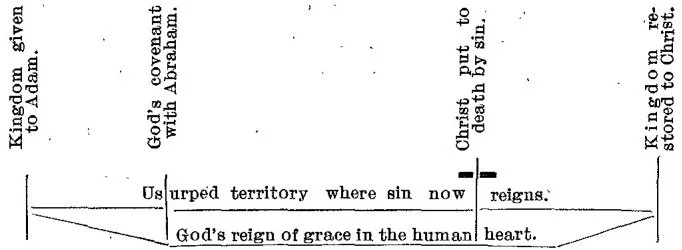
When man in Eden was induced to transfer his allegiance from the king of heaven to Satan’s rule of sin, he not only withdrew himself, as a subject, from that compact, but the territory which had been entrusted to his dominion, as God’s representative, was also transferred to the rule of sin, and man became Satan’s representative in that portion of the universe, to govern it after the model of force. Thus it is seen that, as shown by the line drawn across the diagram, a portion of the original kingdom was affected by sin. The earth and its inhabitants, represented by that part of the diagram marked B, were by this cut off from the government of heaven, as shown by A, and became the territory and subjects of another government.
In this transfer it was impossible to make over to the usurper more than these two parts,—the territory with its subjects. The king, with his throne and laws, being higher than man, and therefore beyond his reach, were not in his power to carry over to the side of Satan. These being eternal in their nature, remain forever as they were before sin entered. This being true, the three eternal, unchangeable elements of the kingdom of God can never combine with the rule of earthly governments, because of the difference of their administrations. Love and force, as governmental policies, cannot possibly unite. God cannot join the divine elements of his government with those of earthly rule, because his righteousness and love are entirely incompatible with the laws of sin and force.
The Saviour therefore said truly, “Ye cannot serve God and mammon.” Matt. 6:24. The reason is plain. Such a course would necessitate serving two masters who are directly opposite in every particular, which would be utterly impossible. So, then, while the influence of human selfishness, combined with Satan’s system of government, controls the world, it cannot be true that God unites the will of heaven with these revolting portions of his kingdom to enforce obedience to his law. When one is forced to do a thing, his mind does not give consent, and without the consent of the mind, one cannot serve the law of God. Rom. 7:25. So long, therefore, as the mind remains unchanged from its carnal state, it is always, and at all times, enmity to God and his rule. Rom. 8:7. God cannot add his sanction to any attempt to force obedience to him; and still retain his gentleness, which alone makes men great in righteousness. Ps. 18:35.
Since the reign of sin, which makes force the predominant element in earth’s governments, separated the earth and its dwellers from God’s kingdom, it must be necessary for that rule to pass away before the earth can again become a part of the kingdom of righteousness. To this end the Saviour has instructed all to daily pray, “Thy kingdom come, thy will be done in earth, as it is in heaven.” Matt. 6:10. God’s will is not done in heaven because its inhabitants are forced to it, nor are different degrees of consecration known in the service there rendered. All the service of that intact reign is therefore complete in single-mindedness, and no one there dissents in any degree from the mind of Jehovah.
The restoration of that perfect rule in the earth must therefore be the entire elimination of sin from every heart and from every nook of the territory usurped by Satan. In other words, the kingdoms of this world must become “the kingdoms of our Lord, and of his Christ,” that he may rule therein forever, just as he now reigns over that portion of the territory and subjects which were never subjected to the rule of sin. But this work must begin in the hearts of the subjects, and under the influence of God’s Spirit, rather than by the force of law. It must be accomplished by those loyal to God’s government entering the usurped territory and proclaiming “liberty to the captives” in the name of the king of heaven (Isa. 61:1, 2), and pointing them to a better reign, as exercised by the Lord himself, rather than by using the laws of the usurped territory to enforce an obedience prescribed by them as the will of heaven.
It almost seems as though men are blind who cannot see that Satan, having brought sin into the world, and so secured control of it, will never try to make its inhabitants become loyal to heaven, the very government of which he is an avowed enemy. It is indeed strange that so few suspect that the laws enacted in Satan’s territory, apparently looking to setting up the reign of God there, are but a feint,—a politic move—to cover up Satan’s opposition to God, by his appearing to be an “angel of light” (2 Cor. 11:14), and that he deludes men by this device actually to assist him in his work, under the pretense that they are thus advancing the interests of the kingdom of God.
The Pharisees of Christ’s time were similarly deceived. They believed that their nation and country constituted the kingdom of God, even though fallen under the exacting rule of the Roman power. Knowing no form of government but that which was external and visible, they supposed that when their kingdom was again liberated from a foreign yoke, it would be done by being reconquered85by the Messiah, who would then rule over them and their territory in person. So, as a test by which to decide whether Christ was really the Messiah or not, they demanded of him to tell them when he would reinstate the kingdom of God among them. His answer was clear and decisive: “The kingdom of God cometh not with observation [margin, outward show]; neither shall they say, Lo, here! or, lo, there! for, behold, the kingdom of God is within you.” Luke 17:20,21. In other words, the outward form of God’s government on earth is lost. It will not return in that shape, but must, for the time, be established within you, and your bodily members become wholly subject to God’s will from the heart, even though your territory be ruled over by a foreign power.
The earthly part of God’s kingdom having been separated from the government of heaven, the way was then opened by which men might signify their loyalty to God, even though living in the territory of a hostile government. To show the nature of this arrangement, let us study the following diagram:—
The upper horizontal line will represent the kingdom over which man was given dominion at the beginning (Gen. 1:26), and which, upon the entrance of sin, became subject to the rule of Satan. Man being born upon this usurped territory, is by nature a slave of sin, but is invited by the gospel of Christ to renounce the service of Satan, and yield allegiance to the king of heaven. But inasmuch as the territory under which men are born is detached from the kingdom of heaven, and must remain a part of the realm of wickedness until sin is destroyed out of it, an arrangement has been made by which man may connect with that part of the kingdom of heaven that remains steadfast, including the King, his throne, and his law, these to be enshrined in the heart. This, of course, constitutes him a subject of that kingdom which reigns within. The lost territory, however, cannot be received thus, but must be waited for until it also is cleansed from sin, when it will be restored to its original domain, and so the kingdom of God be again united in its original perfect state.
This reign of God in the heart is known as the kingdom of grace (Heb. 4:16), and has run parallel with earthly kingdoms ever since the fall of man. It is indicated in the diagram by the lower horizontal line. Growing out of man’s necessity for a purer and more satisfying government than that in which fate has placed him by birth, it stands in the place of the lost territory until that territory can be restored to the reign of heaven. Whoever, therefore, becomes an “adopted” citizen of this kingdom of grace is “called out,” in heart, from the rule of earth, hence must count himself a “pilgrim and stranger” in a foreign land, an alien from the commonwealths of earth, to be looking for “a city which hath foundations, whose builder and maker is God.” Heb. 11:9,10.
As this temporary kingdom grew out of, and runs parallel with, the kingdom first given to man, but now usurped by Satan, so when that territory is again restored to its first condition, the two will be merged into one perfect state, and those who have been subjects of the kingdom of grace will then be subjects of that perfect and eternal reign of righteousness. This is clearly shown in the following words of the Saviour: “Then shall the king say unto them on his right hand, Come, ye blessed of my Father, inherit the kingdom prepared for you from the foundation of the world.” Matt. 25:34.
Then the kingdom which was prepared for man at the foundation of the world; which was given to him, and passed over to the control of Satan, will have been redeemed by Christ and restored to man, who will again “reign upon the earth,” as at the beginning. But more upon this in another paper. J. O. C.
The Bible and the “Tradition of the Elders.”
By Isaac Morrison
BY ISAAC MORRISON.
Mr. Brown (to the book merchant, Mr. James):—My new neighbor has been telling me that Sunday, the first day of the week, is not the Sabbath; and he read to me from the Bible, “The seventh day is the Sabbath of the Lord thy God, in it thou shalt not do any work;” and in the New Testament of Christ’s most intimate followers after his crucifixion, where it says, “They rested the Sabbath day, according to the commandment.” This was not the first day of the week, but the day just preceding it, which was the seventh day; for “when the Sabbath was past, . . . very early in the morning, the first day of the week, they came to the sepulchre at the rising of the sun.” (Luke 23:56; 24:1; Mark 16:1, 2). What do you think about it, Mr. James; is not that about the truth in the matter?
Mr. James.—Tut, tut, Mr. Brown, I hope you are not going off to join the Adventists! (Turning to his clerk), John, what do we believe on the Sabbath question?
Clerk (reaching for a book on the shelf above the Bibles).—I will read it from one of our standard Methodist books, “Binney’s Theological Compend Improved,” by Rev. Amos Binney and Rev. Daniel Steele, D.D. From pages 169, 170, and 171, I read these paragraphs:—
“The Sabbath. By this is meant: 1. The day appointed of God at the close of creation, to be observed by man as a day of rest from all secular employment, because that in it God himself had rested from all his work.Gen. 2:1–3.
“3. The original law of the Sabbath was renewed and made a prominent part of the moral law, or ten commandments, given through Moses at Sinai. Ex. 20:8–11.86
“5. Jesus, after his resurrection, changed the Sabbath from the seventh to the first day of the week.”
Mr. James.—See how clear and plain that makes the change of the Sabbath from the seventh to the first day of the week, Mr. Brown!
Mr. Brown.—O, but we are Protestants, and the Protestant rule of faith is, “The Bible, and the Bible alone;” “To the law and to the testimony: if they speak not according to this word, it is because there is no light in them” [Isa. 8:20; 2 Tim. 3:15–17]. Why didn’t you take down the Bible to see what you believe, rather than your standard church books to see what your church elders and bishops would allow you to believe that the Bible taught on that subject?—What does the Bible say about the change of the Sabbath?
Clerk.—Here are two paragraphs (pp. 171, 181) right on that point, that will make the matter clear:—
“It is true there is no positive command for infant baptism, . . . nor is there any for keeping holy the first day of the week.
“Jesus, after his resurrection, changed the Sabbath from the seventh to the first day of the week . . . When Jesus gave instructions for this change we are not told, but very likely during the time when he spake to his apostles of the things pertaining to his kingdom.” Acts 1–3. This is probably one of the many unrecorded things which Jesus did. John 20:30; 21:25.”
“In this we are only following what is freely admitted by the greatest bodies of Christian workers, and by all the greatest Protestant denominations: as you can see by the following paragraphs from the superintendent of the Sabbath-Observance Department of the National and World’s W. C. T. U. and the president of the American Sabbath Union, which was organized and is coöperated in by fourteen of the leading denominations in the United States:—
“‘Ques.—If Jesus wished the day changed, why did he not command it?
“‘Ans.—A command to celebrate the resurrection could not wisely be made before the resurrection occurred. He probably gave his own disciples such direction afterwards, “when speaking of things pertaining to the kingdom.”’”—Leaflet No. 3 of the Sabbath-Observance Department of the National W. C. T. U., by Mrs. J. C. Bateham, Superintendent of the Sabbath-Observance Department of the National and World’s W. C. T. U.
“Our opponents declare, ‘We are not satisfied with inferences and suppositions; show us where the first day is spoken of as holy, or as being observed instead of the seventh; we must have a direct positive command of God.’ We admit there is no such command. But if we are to be limited by such a demand, all of us shall soon find ourselves in a very entangling predicament.”—“Pearl of Days” Leaflet, No. 3, by Rev. Geo. S. Mott, D. D., President of the American Sabbath Union.
Mr. James.—See how clearly that settles the question! That “Theological Compend” is a handy book to have to help you out on such questions. Let me sell you a copy, Mr. Brown.
Mr. Brown.—But what your clerk read from those standard authorities reminds me of what my neighbor further said about the unfinished Protestant Reformation from the traditional errors of the Roman Catholic Church; which church, like the Jewish Church in the days of the Saviour (Matt. 15:1–9, 13), rests upon the “tradition of the elders” and the authority of the church instead of the Bible. Especially is this so on this Sabbath question. Let me read you a few sentences from standard Catholic works that my neighbor loaned me:—
“You are a Protestant, and you profess to go by the Bible, and the Bible only; and yet in so important a matter as the observance of one day in seven as a holy day, you go against the plain letter of the Bible, and put another day in the place of that day which the Bible has commanded. . . . We come to the time of the (so-called) Reformation, when it so happened that those who conducted the change of religion in this country left this particular portion of Catholic faith and practice untouched.” “It was the Catholic Church which, by the authority of Jesus Christ, has transferred this rest to the Sunday in remembrance of the resurrection of our Lord. Thus the observance of Sunday by the Protestants is an homage they pay, in spite of themselves, to the authority of the church.” “Reason and common sense demand the acceptance of one or the other of these alternatives: either Protestantism and the keeping holy of Saturday, or Catholicity and the keeping of Sunday. Compromise is impossible.”
Then I guess we are in for finishing that great Reformation from the errors of what the Apostle John and all early Protestants have styled, “The mother of harlots and abominations of the earth.” And do you know, Mr. James, that the Catholic Church makes this Sunday-keeping above everything else the sign of our submission to them instead of to what God says in the Bible? Listen to this:—
“Which church does the whole civilized world obey? Protestants . . . profess great reverence for the Bible, and yet by their solemn act of keeping Sunday they acknowledge our power and obey our church instead of the Bible. The Bible says, ‘Remember the Sabbath day to keep it holy,’ but the Catholic Church says ‘No, keep the first day of the week,’ and all the world bows down in silent obedience to the mandates of the Catholic Church.” Compare this with Rom. 6:16.
And they make this Sunday institution the seal or mark of their power and authority that renders valid their laws and enactments among Protestants. Says Cardinal Gibbons, who is at the head of the Catholic Church in the United States:—
“Of course the Catholic Church claims that the change was her act. . . . And the act is a mark of her ecclesiastical power and authority in religious matters.”
You certainly would not wish me, when enlightened on the subject, to knowingly adopt the rule of faith of the Roman Catholic Church in the place of the Protestant rule—“The Bible, and the Bible alone;” nor to adopt the very seal or mark by which it proves and attests its87power and authority; and all this just in order to still continue to keep Sunday. And of course you would not care to be found in that situation either. Let me lend you these Catholic books, Mr. James, to read in connection with Dan. 7:25 and Rev. 14:9–10.
Mr. James.—Here are some customers coming in. Excuse me, Mr. Brown.