The Youth’s Instructor, Vol. 43, No. 50.

CALCUTTA

The Youth’s Instructor

Dec 12, 1895

S. D. A. Publishing Association · Battle Creek, Mich. · Dec 12, 1895

CALCUTTA
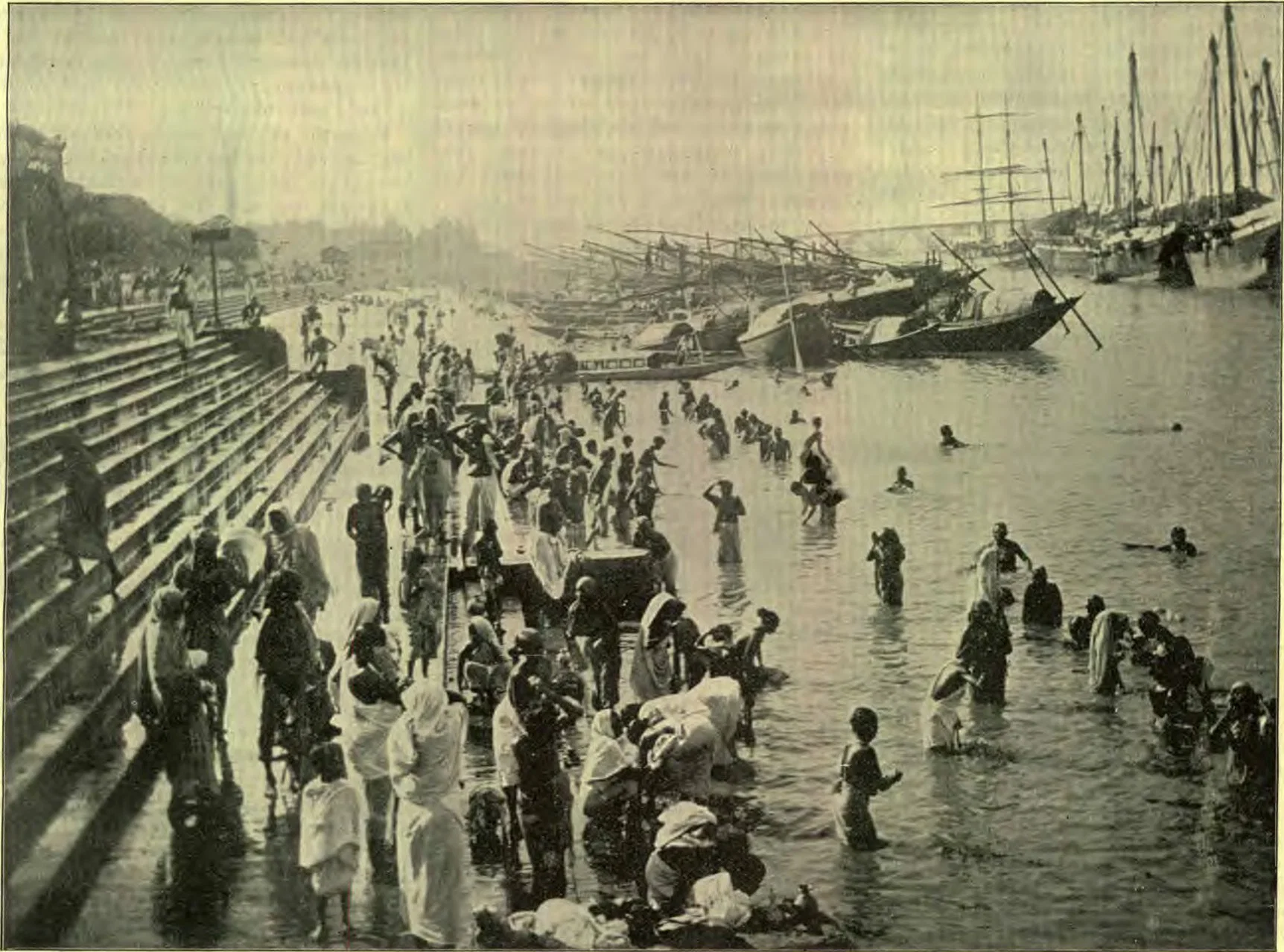
BATHING ON THE BANKS OF THE HUGLI.
CALCUTTA, the capital of India, is situated on the east bank of the Hugli, about one hundred and twenty miles from the sea. It is supposed that it derived its name from Kali ghat, a temple of Kali, the chief goddess of India. This temple was built about three centuries ago, and is situated in the southern part of the city. The goddess is represented as having a black skin, and a hideous and terrible countenance dripping with blood, encircled with snakes, and hung round with a necklace of skulls. She is dancing upon the body of her husband, and in all respects resembles a fury more than a goddess.
The population of Calcutta is about one million, among whom are Chinese, Japanese, Persians, Cingalese, Burmese, Jews, and, in fact, representatives of every Eastern nation, as well as a larger number of Europeans than is found in any other city of India.
In the center of the city is a large open space of several hundred acres, covered with beautiful shade trees and green grass, and intersected by numerous well-kept roads, forming a very pleasant resort for walks and drives. Here one can always get fresh air, and of course it adds much to the healthfulness of the city.
In the European quarter the houses are built close together, yet they often have large trees growing in the enclosures, or compounds, as they are called. This is an agreeable rest to the eyes, under the glare of an Indian sun. The presence of trees and the absence of chimneys on the houses make the scene quite different from a city view at home. Another feature will at once strike the European eye, and that is the flat roofs, which form a very pleasant resort in the morning and evening. On account of the hot climate of India, all the houses have a great many windows and doors, and these are generally kept wide open, except during the day in the hot season and during the night in the cold season.
The native quarters, however, are very different; and with the exception of the houses of some of the wealthier classes, are miserable in the extreme, in many instances consisting of but one small room for a family of six or eight. This fact has given rise to the reproach that Calcutta, while a city of palaces in front, is one of pigsties in the rear.
Such dwellings are bearable in the cold season, when most of the time is spent out-of-doors; but during the rains, no words can describe their wretchedness. Then the cooking cannot be done out-of-doors, and as most of the houses have no chimneys, the smoke is allowed to escape as best it can, giving the passer-by who is unacquainted with the facts the impression that the houses are all on fire.
The streets of the native quarter are lined with shops about eight by ten feet in size, entirely open in front; so by walking along the street the passer-by can know just what each shopkeeper has. Passing along a street, one will see men sitting cross-legged on the ground in their shops, sewing upon the most elaborate garments, for all the dressmakers are men; in the next shop, perhaps, two women may be grinding at the mill, just as is described in the Bible; then just beyond these may be the shops of the gold-beaters, the engravers, the blacksmiths, the grocers, the sweetmeat venders, the tailors, and the like. The barber has a traveling outfit, and will accommodate his customers wherever he chances to meet them on the street. In the road is seen the ancient two-wheeled bullock cart drawn by the patient oxen with their huge wooden yoke. Taking the scene all together, it looks very primitive.
It is a very common sight in Calcutta to see the natives bathing in the water of the river to wash away their sins. They are not taught that it is a great sin to lie, steal, or cheat; but they would regard it as a sin to omit any of the usual acts of worship, or even to be touched by a Christian after they had bathed in the sacred water. It is the work of the missionary to tell of the Fountain which has been opened for sin and uncleanness, and that not by works of righteousness which we have done shall we be saved, but according to His mercy by the washing of regeneration and the renewing of the Holy Ghost.
GEORGIA A. BURRUS.

CHILD LIFE OF JESUS.—NO. 4.

Jesus loved children, and ever influenced them for good. He cared for the poor and needy even in his childhood. In every gentle, tender, and submissive way he sought to please those with whom he came in contact; but though so gentle and submissive, no one could lead him to do anything that was contrary to the word of God. Some admired his perfection of character, and often sought to be with him; but others who regarded the sayings of men more than the word of God, turned away from him, and avoided his company. Throughout his childhood and youth, he manifested the same perfection of character as marked his after life.
As Jesus looked upon the offerings that were brought as a sacrifice to the temple, the Holy Spirit taught him that his life was to be sacrificed for the life of the world. He grew up as a tender plant,—not in a large and noisy city, full of confusion and strife, but in the retired valleys and among the hills. From his earliest years he was guarded by heavenly angels; yet his life was one long struggle against the powers of darkness. Satan sought in every way to tempt and try him. He caused men to misunderstand his words, so that they might not receive the salvation he came to bring them. He was opposed both at home and abroad, not because he was an evil-doer, but because his life was free from every taint of sin, and condemned all impurity. He found his greatest happiness in communing with nature and with nature’s God. He was faithful in obeying the commands of God, and this made him very different from those around him, who disregarded the word of God. His stainless life was a rebuke, and many avoided his presence; but there were some who sought to be with him because they felt at peace where he was. He was gentle, and never contended for his rights; but his own brethren scorned and hated him, showing that they did not believe in him, and casting contempt upon him. In his home life, where he should have found peace, he found only strife, envy, and jealousy. He loved his brethren, but they made his labors unnecessarily hard, because he was so willing and uncomplaining. He did not fail, nor become discouraged. He lived above the difficulties of his life, as if in the light of God’s countenance. He bore insult patiently, and in his human nature became an example for all children and youth.
Christ showed the greatest respect and love for his mother. Though she often talked with him, and sought to have him do as his brethren desired him to do, he never showed her the least lack of devotion. His brethren could not cause him to change his habits of life. He knew there was nothing wrong in thinking about the works of God, in showing sympathy and tenderness toward the poor, the suffering, and the unfortunate. He sought to soothe the sufferings of both men and dumb animals. Mary had felt greatly troubled when the priests and rulers came to her to complain about Jesus; but peace and confidence came to her troubled heart as her son showed her what the Scriptures said about his practises. At times she wavered between Jesus and his brethren, who did not believe that he was sent of God; but she saw enough to show her that his was a divine character. She saw him giving his life for others, meeting the people where they were. She saw him growing in grace and knowledge, and in favor with God and man.
His life was as leaven, working amid the elements of society. Harmless and undefiled he walked amid the careless, the thoughtless, the rude, and unholy. He mingled with the unjust publicans, the reckless prodigals, the unrighteous Samaritans, the heathen soldiers, the rough peasants, and the mixed multitudes. He looked upon them all with pity and love. He addressed himself to them,—not for the purpose of discouraging and condemning them, but to present lessons to them that would be a savor of life unto life to those who should believe. He treated every human being as having great value. He taught men to look upon themselves as persons to whom had been given precious talents that if rightly used would elevate and ennoble them, and secure for them eternal riches. By his example and character he taught that every moment of life was precious, as a time in which to sow seed for eternity.
From childhood to youth, from youth to manhood, Jesus worked out in his life the principle of the law of God. He weeded life of all vanities, and taught that it was to be cherished as a treasure, and be employed for holy purposes. He taught that character was precious, and that every moment of life was to be passed in the service of God in such a way as to be a saving salt to preserve society from moral corruption. MRS. E. G. WHITE.

Converted Children Worth More Than Wealthy Converts

A CHILD of ordinary capacity and destitute of property, but converted to God in childhood, is frequently worth more to the church than ten wealthy men converted at the noon of life.—John Todd.

Trust in God Amid Life's Storms

WHAT cares the child when the mother rocks it, though all storms beat without? So we, if God doth shield and tend us, shall be heedless of the tempests and blasts of life, blow they ever so rudely.—Henry Ward Beecher.

THE OLD SCOTCHMAN'S PRAYER.

I was pleased the other day with a story which an aged Scotch minister told me about an old Scotchman, who, many years ago, was on his way to a meeting of the people of God, held in a tent, or some such temporary structure.
The old pilgrim was poor and ill-clad and partly deaf, but he trusted in the Lord whom he served, and rejoiced in his kind providence. On his way to the meeting he fell in with another Christian brother, a younger man, bound on the same errand, and they traveled on together.
When they had nearly reached the place of meeting, it was proposed that they should turn aside behind the hedge, and have a little prayer before they entered the meeting. They did so, and the old man, who had learned in everything to let his requests be made known unto God, presented his case in language like the following:—
“Lord, ye ken weel enough that I'm deaf, and I want a seat on the first bench, if ye ken let me have it, so that I can hear thy word. And ye see that my toes are sticking through my shoes, and I don't think it is much to your credit to have your children's toes sticking through their shoes, and therefore I want ye to get me a pair of new ones. And ye ken I have nae siller, and I want to stay there during the meeting, and therefore I want you to get me a place to stay.”
When the old man had finished his quaint petition, and they had started on, his younger brother gently suggested to him that he thought his prayer was rather free in its forms of expression, and hardly as reverential as seemed proper to him in approaching the Supreme Being. But the old man did not accept the imputation of irreverence.
“He's my Father,” said he, “and I'm weel acquainted with him, and he's weel acquainted with me, and I take great liberties with him.”
So they went on to the meeting together. The old man stood for a while in the rear of the congregation, making an ear-trumpet of his hand to catch words, until some one near the pulpit noticed him, and, beckoning him forward, gave him a good seat upon the front bench. During the prayer the old man knelt down, and after he rose, a lady who had noticed his shoes, said to him:—
“Are those the best shoes you have?”
“Yes,” said he; “but I expect my Father will get me a new pair very soon.”
“Come with me after the meeting,” said the lady, “and I will get you a new pair.”
The service closed, and he went with her to her house.
“Shall you stay during the meeting?” said the good woman as they went along.
“I would, but I'm a stranger in the place, and have nae siller.”
“Well,” said she, “you will be perfectly welcome to make your home at our house during the meeting.”
The old man had thanked the Lord that he had given him all the three things he had asked for; and, while the young brother's reverence for the Lord was right and proper, it is possible that he might have learned that there is a reverence that reaches higher than the forms and conventionalities of human taste, and which leads the believer to come boldly to the throne of grace to find all needed help in every trying hour.—Baptist Weekly.

Trust in the Lord and Do Good

“Trust in the Lord, and do good; . . . and verily thou shalt be fed.”

NATIONAL DEFENSES.

GENERAL NELSON A. MILES, commanding officer of the United States army, in his late report has much to say in regard to the defenses of the nation. General Miles holds that our present fleet is very inadequate to prevent an invasion of this country, nor does he seem to place much dependence upon torpedoes and torpedo vessels. As a soldier, he believes more in land defenses, and these he reports to be very deficient. New York City is now defended the best of any of our cities. Any hostile ship now attacking that city would have to run a gauntlet of eight miles under the fire of the heaviest guns, and in a channel that at a few hours’ warning can be lined with torpedoes. San Francisco, Cal., and Norfolk, Va., are also in a fair state of defense; but there are many of our thriving cities, like Boston and Philadelphia, which have no defenses worthy of the name. It must be remembered that our cities, which were once considered well prepared for a hostile invasion, have by the invention and manufacture of heavier cannon, been placed in a practically defenseless condition. The stone and brick forts which would stop a forty-two pounder of Lord Nelson’s day, would be crumbled to dust by a few shots from the rifled cannon carried by modern ships of war. General Miles recommends that all our seaboard cities be prepared for defense, and that the army be increased in proportion to the increase of the population. He thinks that we should now maintain an army of sixty thousand men.
The defenseless condition of our border on the Great Lakes is also discussed by General Miles, and on account of his report and for other reasons, the American people are taking much interest in our defenseless condition on the Canadian border.
The treaty between Great Britain and the United States forbids either nation to build or maintain more than two revenue cutters on the lakes. It is held by the people of the States that Canada has built her revenue cutters in such a manner that they may quickly be converted into dangerous cruisers. Then England can bring ships of war of moderate dimensions into the lakes by the St. Lawrence River. The fact that a ship of war cannot be built on the lakes is very displeasing to the people of Chicago, Detroit, and other enterprising cities, where contracts for the building of such ships would gladly be taken. Naturally, these cities feel that they have been unjustly discriminated against to their great loss.
For some years succeeding the civil war in this country, little was said here in regard to war, except as the old soldier fought his battles over again by the fireside; but the lapse of time and the tremendous preparations made for war by the European powers, with the unsettled state of affairs generally, is affecting this country so that there is quite a war spirit here as well as in Europe. This is to be regretted; but as long as evil reigns in the hearts of men, so long will nation rise against nation and kingdom against kingdom. By and by, when earthly kingdoms will have passed away, there will be one kingdom “under the whole heaven,” and Christ will be the King. Of him it is said: “He maketh wars to cease unto the end of the earth.”

CHURCH LOTTERIES.

THE evils of lotteries are so well known that acts of Congress have been passed in this country, to prevent them. The great Louisiana lottery, with headquarters at New Orleans, did a thriving business for years, but it was finally compelled to cease its business in the United States. It therefore packed up, and moved to Central America, where it gained an extraordinary concession from one of the Central American governments.
Church lotteries, however, continue to flourish, though they are evidently not looked upon with as much favor as they used to be. The Catholic Church has always favored the lottery as a means to raise money, but a new use has now been found for the lottery by the zealous priests of that faith. In the city of Mexico some of the Catholic churches are selling lottery tickets at ten cents each. The prizes are masses, which the priests will offer for whomsoever the winner of the prize shall designate. These masses, or prayers, are for the benefit of some soul who is supposed to be in purgatory. One church got seven hundred dollars, there being seven thousand tickets sold. This was a substantial benefit to the church. Whether the souls in purgatory were benefited by the masses cannot be demonstrated so easily. The Mexican government is not pleased with the affair, and the legality of this scheme for money-catching will be considered.

LOWERING OF THE GREAT LAKES.

The great drainage and ship canal, now in process of construction from Lake Michigan, at Chicago, to the Mississippi River, is awaking some apprehension in the towns and cities upon the Great Lakes, for fear that this extra drain upon the lakes will so lower the water that the shipping interests will be damaged thereby. All wharves are built in reference to the depth to which the vessels sink, so that they may come as near land as possible; and a lowering of a few inches of the level of the lakes would require the rebuilding of these wharves, entailing a heavy expense. It is probable that the general government will have something to say in the matter, since the great lakes are a part of our national boundary, which the United States will be called upon to defend in case of war with Canada.
The alarm felt by the people of the towns on the lakes is intensified by the fact that the lakes at the present time are unusually low. For over nine years the rain-fall has been deficient. The great droughts have had their effect upon the lakes. Only in one year (1890) was there a normal amount of rain from 1886 to 1895. Civil engineers have calculated that Lake Michigan has suffered a fall of four and one-half feet.
It may easily be seen that if the drainage canal should further deplete the waters of the lakes, and there should be no increase in the supply of water, the changes that would be required all around the lakes to meet the existing conditions would require an enormous outlay of money. This will be one of the problems with which Congress will have to deal upon assembling, as it is a subject that naturally is not bounded by State lines.

GIFTS AND PRICES.

A FEW weeks ago the papers fairly rang with the praises of a very wealthy man who had just given an immense sum of money to the Chicago University. It is generally believed that his money has been obtained by means that may be fairly considered to be questionable. One of the professors of that college has been obliged to sever his connection with it, and in a spirited discussion with the principal of the college, he maintains that he was removed because, in his lectures on political economy, he struck against the ways of the illegal trusts, of which this great backer of the university is such a remarkable example. We do not pretend to know whether this is true or not, but the expelled professor has succeeded in making many people believe that his statement is truthful. And then, close upon his retirement from the university, the big donation referred to was given, and the rich man's gift has so dazzled the eyes of the people that even those who are the most outspoken against illegal trusts are so paralyzed by the munificence of the great donation that all the evils of trusts are for the time forgotten.
But another thing has lately occurred, which although a purely business transaction, throws light upon the subject. Scarcely was the ink dry upon the newspapers which glorified this liberal donator, when the price of oil, which is the commodity entirely controlled by this great benefactor of the Chicago University, began to rise. In one week there were three advances in price, and countless numbers of extra nickels from the pockets of the common people were poured out for this necessity of life; and very quickly this extra price reimbursed the wealthy donor for his benefaction to the university!
And now the question is, Who gave the money to the university? The expelled professor will probably make a note of this, and in some other college, where the rights of the common people may be safely championed, he will draw another vivid object-lesson on the evils of trusts, and the way they get their money.

TURKISH AFFAIRS.

THE condition of the Ottoman empire continues to be the most absorbing theme of European discussion, and the people of this country are scarcely less interested than those living nearer to the “sick man.” In his great anxiety to maintain his throne, the sultan so forgot or ignored the rules of diplomacy as to write a personal letter to Lord Salisbury, the British premier, promising to give his personal attention to the proposed reforms. But the enflamed condition of the people of the empire, both Turks and Armenians, is such that the sultan, even should he do his best, will find a very difficult task to restore order. Good feeling, after what has occurred, can never take place. The Armenians pose before the world as Christians, and so gain much sympathy; but the spirit they manifest toward the Turks is fully as wicked as the spirit manifested toward them by the Turks, and some writers assert that it is much more so. Consequently there have been many bloody encounters, and candid estimates go to show that fifteen thousand Armenians and two thousand Turks have been killed. Excited estimates greatly exceed this number. The powers are pressing the sultan for permission for their ships to pass through the strait into the Black Sea, for the protection of their citizens; but the sultan is slow to grant them the privilege. Meanwhile the forts are being thoroughly prepared for defense, and the reserves of Turkish troops are being called out as fast as possible all through the empire. If the powers could agree as to the disposition of the sick man’s estate, the empire of Turkey in Europe, at least, would soon be over.
M. E. K.

SOWING AND REAPING.

When we go out into the fields and see the farmer sowing wheat, we are led to think there will be a harvest of wheat by and by; but should we find, on closer examination, that it is not all wheat he is sowing, we would question in regard to the harvest he will reap; or should we chance to pass by a field at harvest-time, and find that more than half the stalks are mustard or cockle, we would conclude that the farmer sowed more of these kinds of seed than of grain.
The Bible says, “Whatsoever a man soweth, that shall he also reap.” Now look around you for the truthfulness of this saying. If you see a man who is a drinking man, and who uses tobacco, you will find that he is reaping what he sowed in his younger days. If you see a man who swears and lies and cheats, you may make up your mind that he put that kind of seed in the ground when he was a boy. It was perhaps deceit, disobedience, bad temper, slang words, that brought forth the fruits of lying, cheating, and swearing. What do you think of the crop these men are reaping? Do you wish to gather one like it?
If you see a man who is temperate in all things, honest, and honored by all who know him, you can judge what he has been sowing. It will lead any boy to say, “I want to be just like that man when I become a man.” Now, boys, if you want to be good men, begin now by being good boys. If you sow seed that will bear good fruit when it is ripe, you may rest assured that you will be respected by all when you become men.
Be “temperate in all things,” is a good principle to start on. Make up your mind that you will never use tobacco or strong drink in any form. Decide that you will not indulge in these things if your friends do. Have a principle in all you do, that will lead you to stand firm, even though your associates try in every way to get you to join them in sowing evil seed. Be sure always to look forward to the harvest, and carefully study the seed to see if it is what you want to reap.
J. H. D.

NO CAUSE FOR FEAR.

The knowledge that there is a God of infinite power often has the effect to alarm people greatly. They fear that this power will be exerted for their harm, but there is no just reason for such apprehensions. It is true that “power belongs to God;” but since he is a loving Father to his children, we may rest assured that his power will be manifested in our behalf, and not for our damage. It is only by determined opposition to his will, and by continuous rejection of his mercy, that we incur his displeasure. If he rejects us at last, it will be because we have long rejected him. “The fear of the Lord is the beginning of wisdom;” but we must not understand that this fear of him which he requests, is of a slavish character; it is a reverential regard for him, the Creator of all things. The fear that should be felt by God’s children toward him, is closely akin to love. Thus we are commanded to “fear God, and keep his commandments,” and we are told again: “This is the love of God, that we keep his commandments.” This is the perfect love, which casts out fear.
In several places in the word of God we read of angels visiting men, when their first words were, “Fear not.” To Gideon the angel said: “Peace be unto thee; fear not: thou shalt not die” (Judges 6:23); and Daniel was comforted and strengthened by the words of the angel: “O man greatly beloved, fear not: peace be unto thee; be strong, yea, be strong.” Dan. 10:19.
Perhaps the most remarkable statement of this kind to be found in the Bible is the one recorded in Matt. 28:5. Jesus had risen from the dead, and the Roman guards had fallen helpless before the presence of the angel of the resurrection. At this time two weak women, approaching the sepulcher, caught a glimpse of this glorious angel, before whom the keepers had become as dead men; but he immediately exclaimed to them, “Fear not ye: for I know that ye seek Jesus, which was crucified. He is not here: for he is risen, as he said. Come, see the place where the Lord lay.”
Here the reason why they need not fear is very clearly told; they sought Jesus—“I know that ye seek Jesus.” They therefore had no cause for fear. Let us take these words, which were so comforting to those to whom they were addressed at that time, and apply them to ourselves. Do we love Jesus? Are we reading his words daily, and endeavoring to understand and obey them? Is it our chief desire to follow him, to be his children, to receive of his spirit, and to be guided by him in all things? In a word, do we seek Jesus? If so, the words of the angel are for us as well as for those to whom they were directly addressed. So when we are tempted to doubt or are inclined to fear, let us remember these precious words: “Fear not ye: for I know that ye seek Jesus, which was crucified. He is not here: for he is risen;” and let our hearts rise in trusting faith to that place to which Jesus has risen,—to the right hand of God, where he now lives to make intercession for us.

BIBLE STUDY ON THE POWER OF SIN.

Sin is of Satan.—“He that committeth sin is of the devil; for the devil sinneth from the beginning.” John 3:8. We cannot serve God and mammon at the same time. Our life reveals which master we are serving. (See Rom. 6:16.) “Whatsoever is not of faith is sin.” Rom. 14:23. “All have sinned, and come short of the glory of God.” Rom. 3:23. While we have all been the servants of sin, we do not need to be such at present.
Foolishness is Sin.—“The thought of foolishness is sin.” Prov. 24:9. How often foolish thoughts are entertained by us, not realizing that these things are only the device of Satan to keep us in his bonds! We excuse ourselves because others, who profess to be followers of Christ, take this course. Others look to us, and follow our example. Our foolish words are not only holding us in Satan’s power, but are leading others with us.
Sin is Deceitful.—“Exhort one another daily, while it is called To-day; lest any of you be hardened through the deceitfulness of sin.” Heb. 3:13. Satan is a deceiver (John 8:44); and while we think we are led in the right way, we may be directed by the evil one. Jer. 17:9. The influence of Satan is not always felt until he has entrapped us in his snare. If we would be free, we must break the cords before they are wound around us too tightly.
We Can be Free.—“Who can say, I have made my heart clean, I am pure from my sin?” Prov. 20:9. Those who do say this are mistaken, for the word says: “If I wash myself with snow water, and make my hands never so clean; yet shalt thou plunge me in the ditch, and mine own clothes shall abhor me.” Job. 9:30, 31. We see what evil we have done, and how we are bound as slaves to Satan; but all attempts to free ourselves by our personal efforts only show us our own helplessness. (See Jer. 2:22.)

POINTERS TO SUCCESS.

DURING the late civil war in this country, a general of the Union army was sent with an army to invest, and if possible to capture, a fort held by the Confederates. He did not succeed, and later, in an interview with President Lincoln, he told the president the great obstacles which prevented him from succeeding in his undertaking. Mr. Lincoln listened patiently, and then, with a quizzical smile, he said: “Well, general, you have not mentioned the greatest difficulty of all.” “Why, what is that?” said the general. Mr. Lincoln replied, “You did not believe that you could do it!” A few days later Mr. Lincoln’s words were proved true, for another general, who had succeeded to the command, took the fort.
The above true story illustrates a truth that may be seen in a thousand ways. The man who succeeds is the one who believes he can succeed. A discouraged person is half defeated at the very start.
WE once had the experience of swimming in the ocean,—or in the surf, as it is often called, for the waves come tumbling in as high as a man’s head. It was very different from swimming in still water, and for a while we were puzzled to know how to swim. We found that we must either go over the breakers, or they would go over us. The only thing to do when we saw a big wave coming, was to make a great effort, and go over it. Otherwise we were half smothered under a crushing weight of water. This principle holds true in regard to other things. We must either go over our trials or sink under them. It is always best to go over them, and if we put forth our best efforts, we shall generally succeed. But if we do not believe we shall succeed, it would be a wonder if we make any progress.
WE should always aim to do our work well, no matter what it is. When General Grant first reported for service, he found his commanding officer greatly in need of abstract forms upon which to make out his reports. He at once began this humble clerical work, to the great satisfaction of his superior officer. He did his work well. A little later he took the city of Vicksburg. He put the same careful, painstaking work into each task, and succeeded. God sees all the little things we do, as well as the big things. True greatness does not always consist in doing great things. It may be seen in the smallest matters. It is an old saying, “Whatsoever is worth doing, is worth doing well.” Said an apostle, “Whatsoever ye do, do it heartily, as to the Lord, and not unto men.” God takes account of all our work, whether it is faithfully or carelessly performed. We should be admonished by this always to do our best. The Christian should strive for perfection, and surely there is no danger that our work will be too perfect.
M. E. K.

LESSON 13.—TRUE PROTESTANTISM.

(December 28, 1895.)

ITS ORIGIN.

1. What is the meaning of the word “protest”?—“1. To affirm in a public or formal manner; to bear witness; to declare solemnly; to avow. 2. To make a solemn declaration . . . expressive of opposition.”—Webster.
2. By whom and when was a notable protest made?—By the Christian princes of Germany, in 1529.
3. Against what did they protest?—Against the assumed right of the church to use the power of the state, and the multitude of abuses growing out of it,—against a union of church and state.
4. What did they declare?—That “in matters of conscience the majority has no power.”—D’Aubigne’s “History of the Reformation,” Book 13.
5. What has been truthfully said of this protest? (See note 1.)
6. What were those who made this protest afterward called?—Protestants, or protest'-ants.
7. What was the doctrine enunciated by this protest called?—Protestantism.

UNIVERSAL PRINCIPLES.

8. Are the principles of this protest in harmony with the teachings of Christ, and the course pursued by the apostles? Matt. 22: 21; Acts 4: 19, 20; 5: 29.
9. Have other churches than the Romish church persecuted when they sought and gained control of the power of the state? (See note 2.)
10. Is the union of church and state wrong, then, simply when that church is united to the state?
11. Is it not wrong in principle?
12. What is it, therefore, to be a true Protestant?—To protest against the union of church and state on principle, and the workings of it wherever found.

WHO ASK AND WHO REFUSE STATE SUPPORT.

13. What is said of the word of God? Heb. 4: 12.
14. What power is there in that word? Heb. 11: 3.
15. Therefore, will those who have a “thus saith the Lord” for their doctrines, feel the need, or ask for the assistance, of state laws in support of their faith?
16. Do Baptists ask for a law enforcing baptism, or the Disciples a law enforcing the Lord’s supper, or the Seventh-day Adventists a law enforcing the observance of the seventh day?
17. Who is it, then, that calls for the aid of the state? (See note 3.)
18. On which side of the controversy do true Protestants naturally stand?—On the side of God’s word.

PROTESTANT APOSTASY.

19. What is the Roman church now attempting to do? (See note 4.)
20. Why do not the Protestant churches see what the papacy is aiming at? (See same note.)
21. What do the Scriptures say of the professed Christian world in the last days? 2 Tim. 3: 1–5; Rev. 14: 8; 18: 1, 2.
22. What course will be pursued in the old and new worlds toward commandment-keepers, and by whom? (See note 5.)
23. What position will the papacy then occupy, and how will it be regarded? Rev. 13: 3, 8.
24. How will she regard her condition? Rev. 18: 7.
25. When Romanism and apostate Protestantism so far unite as to constitute the great Babylon of Rev. 18: 1–8, what warning is due? Verse 4.
26. What do the people now need? (See note 6.)
27. And what is this?—The warning of the third angel’s message, the closing work of the “everlasting gospel to men.” Rev. 14: 6–10.

SABBATH-SCHOOL HINTS.

Thorough reviews will aid the mind in retaining thoughts of the lessons.
In reviewing, let the mind go back over the whole series for the quarter, and connect the points so that the mind grasps the whole subject.
After the quarter’s lessons are finished in the Sabbath-school, make them an outline for further study on religious liberty. Do not be satisfied with a surface understanding. Study its depths, until every part is clear to your own mind.
There are many good reference books on this subject that throw much light on the different parts. A good history of the Reformation will give excellent information on the principles of religious liberty as taught and practised by the Reformers. The debates of Lincoln and Douglas open up before the mind President Lincoln’s views of the true position of the state.
But let us not forget that true personal Christian liberty fits a man to decide in regard to the correct principles of religious liberty. He who has Christian liberty will recognize the principle of liberty in everything he does. “Whatsoever ye would that men should do to you, do ye even so to them,” is the basis of true religious liberty. If we have not this, we will not accept the other; for the latter depends upon the knowledge we have of Christ.
J. H. D.

A PRESENT HELP.

Do not believe that God offers himself as a guide in his providence and a guide toward a holy life in his spirit, and yet will leave the mind alone which soberly explores the dark places of truth in the hope of his aid. How he can aid, it is useless to ask; but that he can aid, who is truth itself, and has sure access to minds and hearts, you must not doubt. He may move in all silence; he may act on the soul and so on the mind indirectly; he may cause—as often happens—external things to illustrate truth in some remarkable manner. But be assured of this, that if, in obedience and hope you wait on him, he will bring you to the sunlight at last. And then the rest, the peace of having passed through and left behind you the wilderness of doubt, will be a lifelong enjoyment.—T. D. Woolsey.

Who Is a True Man

Who is a true man? He who does the truth, and never holds a principle on which he is not prepared in any hour to act, and in any hour risk the consequences of holding it.— Thomas Carlyle.
Continue reading: TILLIE AND THE PEAR