The Youth’s Instructor, Vol. 43, No. 50.

CALCUTTA
Earlier text: CALCUTTA

TILLIE AND THE PEAR.

TILLIE TUTTLE was spending a few weeks with grandma on a pleasant New England farm. Tillie’s father had been born and brought up on that farm, and you can imagine how pleasant it was for Tillie to hear grandma tell the things papa used to do when he was little. Tillie thought she must go with Jane each day to feed the calves and the geese and the chickens, because that was what papa did once, you see. Of course the calves and geese and chickens were not the same ones he fed, but they grazed in the same meadow, or swam in the same pond, or laid eggs in the same dusty old barn.
Oh, it was such fun for Tillie!—quite a change from city life; but between you and me, she didn’t help much. Yet grandma never told her so. She would change Tillie’s apron when she came in with it dripping with milk from the calf-pail, or with its hem all wadded up into little bunches where the calves had sucked it; and she would wash the tiny hands all covered with wet corn-meal, listening all the while to Tillie’s chatter about how she had “helped just like papa,” with a twinkle in her eye, and a queer smile at the dirty clothes and hands. There were large washings stretched upon the line at the old Tuttle farm those days.
Then when it rained, what fun it was to go with grandma to the attic, and see the trundle-bed papa used to sleep in, and some very funny clothes he wore when he was a very little boy! Grandma had a little black box full of letters he wrote to her when he was in college, and Tillie loved to read them, spelling the words aloud for grandma to pronounce. Once she said, when she had finished a particularly jolly letter: “Papa and I have always felt real ’quainted, ’cause he’s known me all my life, you know; but I ’spose when I go back home, we’ll be ’intermer’ than ever, ’cause now I feel as if I’d known him all his life, too.”
Yes, Tillie’s visit was a delightful one; and if it had not been for one naughty thing that she did when grandma left her alone one day, there would have been nothing to mar her memory of that summer’s stay on the old farm.
Back of the farm-house, quite a bit, was the orchard. Some of the trees there were very old,—older than grandma herself,—so old that they had begun to die. Then grandma had a new orchard planted, that they might always have plenty of fruit. The new fruit-trees were of the best kind, and bore very large fruit. Some of them bore that summer for the first time, and grandma was anxious to test the quality of the fruit on each tree. Only one or two pears, or peaches, or apples hung on some of the smaller trees, so that grandma charged all the family not to touch them, but to let them hang till they were ripe, and then she would give them all a taste.
On the lowest limb of one particular pear-tree hung a very fine, large pear, the only one on the whole tree. Grandma set great store by that pear, and so did Tillie. Almost every day grandma went out to see how fast it grew; but Tillie went four or five times a day. I do not know what attracted Tillie so, unless it was that she knew she must not touch it. Anyway, she spent hours under that tree, just wishing that pear was hers. She could have had all the pears she wanted in the old orchard,—pears that in the city she would have thought the very nicest. “But this is so much nicer,” she would say to herself, “that I can’t like the others when I think of it. Why, it is almost as big as my head! I do wish it would hurry up, and get ripe.”
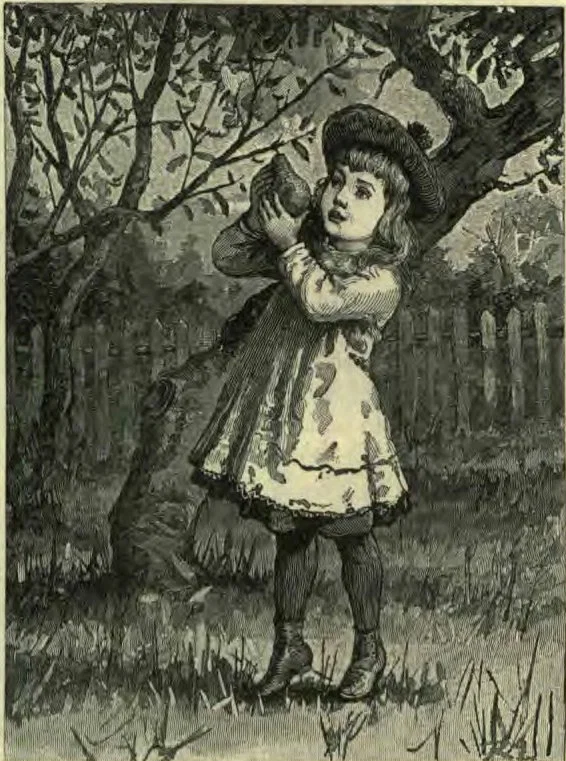
Grandma said one day, “This pear will be ripe to-morrow; then we will have a feast.” That afternoon she went to town, and Tillie went out in the orchard. How tempting that pear did look! Its great golden-brown side, with just a tint of red burnt in by the sun, looked as if it said, “Oh, I am so good, little girl!” Tillie thought she could resist it no longer. By standing on her “tippy-toes,” she could just reach the beauty, and almost before she knew it, she had bitten a piece out of it as it still dangled on the limb.
But the moment she tasted it, somehow it lost its expected flavor, and she spit it from her mouth, and crouched down on the grass, crying as if her heart would break. By and by she heard the wheels of grandma’s carriage as it came up the lane. Dashing the tears from her eyes, she made a brave resolve. Slowly she went to the house, where she found grandma busy getting supper. Tillie followed her back and forth, back and forth, from pantry to table, trying to get courage to speak, for grandma was so very busy that she didn’t notice her. Finally a little sob caught grandma’s ear. “Why, Tillie, child! what is the matter?”
“O grandma, I want to go home!”
“You blessed child! are you homesick? Come, get in grandma’s lap.”
“I’m not homesick, grandma,” moaned Tillie, as she crept into those loving arms, “but I ought to go home.”
“Ought to go home?” repeated grandma. “Why, we can’t spare you yet. Who will feed the calves and the geese and the chickens? You’re not tired of helping so quick, are you? Besides, we were going to pick the big pear to-morrow. I’ll tell you what, Tillie! We will pick it this very night, and have it for supper. So don’t cry any more.”
But at that Tillie’s tears only fell faster, and grandma couldn’t imagine what the trouble could be, till she managed to make out, between tears and sobs, that Tillie had “bit an awful large hole right in the big pear, and there it was yet hanging on the tree.”
Then grandma kissed Tillie, and told her that of course she had done very wrong, but that it was so much more honest to tell grandma about it than to wait until it was found out, or to tell a naughty story about it, that she didn’t think she would cry any more. They would go down and pick the pear, and as likely as not there would be enough for supper, after all.
And, sure enough! the piece Tillie had bitten out was only as big as her four front teeth; and as they were very, very small teeth, there was a great plenty for supper. Tillie said she had no idea that pear could taste so good, ’cause it didn’t taste as it did the first time, a bit, and that she never would do such a naughty thing again. And she never did.
MRS. S. ISADORE MINER.

THE LITTLE WHITE SHAWL.

“O MAMA, must I?” and she could hardly keep back the tears as she spoke. “Julia said she couldn’t possibly wait, and it will take ever so long to reset this stocking heel. Can’t I leave it until I get back?” pleaded Mary.
“My little daughter knows her mother’s wish,” quietly answered Mrs. Kelso.
Knowing that it was useless to say more, Mary took her knitting, and went into her grandma’s cozy room. After the heel had been raveled and reset, the old lady said: “Please open the lower bureau drawer, Mary, and bring me the little brown roll in the left-hand corner.” Taking off the worn wrapping-paper, she held up a little white wool breakfast shawl, slightly colored by age. “This little shawl caused me a great deal of grief once, Mary; but,” she continued, “I learned from it a very useful lesson.”
“Did you make it, grandma?” asked Mary.
“Yes, dear, when I was no older than you. Madam Haywood, as we all called her, offered a prize of a bright gold eagle to the girl in our neighborhood, under fourteen years of age, who should spin the wool, and from the yarn knit the best breakfast shawl.”
“Could you spin, grandma?”
“Yes, indeed! all the girls were taught very early to spin, and even weave the flannel of which our garments were made. Mother gave me enough rolls for my yarn, and in a few days I had them about all spun. One bright morning, as I was laying out the few remaining rolls, Silas Pillsbury, a neighbor’s lad, came in to invite me to spend the afternoon at his father’s sugar-camp. I was in a great hurry to get my work done, and so neglected to keep the fire going. The cold made my wool act terribly, and when I had my last skein half spun, the yarn broke short off. Mother came into the room just in time to see my trouble. ‘Prudence,’ she said, ‘you must draw out the yarn a bit, and splice the thread neatly.’ I was in too great a hurry to heed her remark, and when she left the room, I hastily tied the threads together, and went on with my spinning. The next day I began my shawl. The pattern was suggested by my Aunt Hetty, who was at the time making us her annual visit. Among all the girls in the neighborhood, there was only one whom I feared, and she was Comfort Pettibone. Her grandmother had been in her day a fancy weaver, and I was afraid she might suggest to Comfort a pattern that would surpass mine. When the time allowed for the contest was over, Madam Haywood appointed an afternoon for the examination of the shawls, and the awarding of the prize. Our mothers were all invited with us to her home, where we were to spend the afternoon and take tea.”
“Did you get the prize, grandma?” put in Mary, with a great deal of anxiety.
“Wait just a moment, child, while I tell you. Comfort Pettibone seemed confident of success, and I heard her tell Hope Winship not to mind if she didn’t get the prize; that she would buy her something real nice the next Christmas. I remember mother’s taking my hand, and whispering to me not to raise my hopes too high. There was a bit of doubt about two of the shawls. Finally one of them was placed on the sofa with the others. How joyful I was! When Madam advanced to the middle of the room, I noticed that the shawl in her hands was mine. She began to speak, then stopped, and carried my work to the window for a better light. In a moment she called to one of her sisters to bring the shawl—and it was Comfort’s—that had just been laid upon the sofa. She again returned to the middle of the room, and said: ‘If it hadn’t been for a knot in the yarn of Prudence Packard’s shawl, the prize’—and then, without waiting to hear more, I buried my face in mother’s black silk apron. On the way home mother inquired why I was so quiet. The reason was that I was wishing so hard that I had spliced that yarn; and I’ve wished so ever since!”—Adelbert F. Caldwell.

POEMS BY EUGENE FIELD.

Dutch Lullaby.

WYNKEN, Blynken, and Nod, one night, Sailed off in a wooden shoe— Sailed on a river of misty light Into a sea of dew.
“Where are you going, and what do you wish?” The old moon asked the three. “We have come to fish for the herring-fish That live in this beautiful sea; Nets of silver and gold have we,” Said Wynken, Blynken, And Nod.
The old moon laughed and sung a song, As they rocked in the wooden shoe; And the wind that sped them all night long Ruffled the waves of dew; The little stars were the herring-fish That lived in the beautiful sea. “Now cast your nets wherever you wish, But never afeard are we!” So cried the stars to the fishermen three, Wynken, Blynken, And Nod.
All night long their nets they threw For the fish in the twinkling foam, Then down from the sky came the wooden shoe, Bringing the fishermen home; 'T was all so pretty a sail, it seemed As if it could not be; And some folk tho't 't was a dream they'd dreamed Of sailing that beautiful sea; But I shall name you the fishermen three: Wynken, Blynken, And Nod.
Wynken and Blynken are two little eyes, And Nod is a little head, And the wooden shoe that sailed the skies Is a wee one's trundle-bed; So shut your eyes while mother sings Of wonderful sights that be, And you shall see the beautiful things As you rock on the misty sea, Where the old shoe rocked the fishermen three, Wynken, Blynken, And Nod.

Little Boy Blue.

THE little toy dog is covered with dust, But sturdy and stanch he stands; And the little toy soldier is red with rust, And his musket molds in his hands. Time was when the little toy dog was new, And the soldier was passing fair; That was the time when our Little Boy Blue Kissed them, and put them there.
“Now, don't you go till I come,” he said, “And don't you make any noise!” So toddling off to his trundle-bed, He dreamt of the pretty toys. And as he was dreaming, an angel song Awakened our Little Boy Blue— O, the years are many, the years are long, But the little toy friends are true!
Aye, faithful to Little Boy Blue they stand, Each in the same old place, Awaiting the touch of a little hand, The smile of a little face. And they wonder, as waiting the long years thro', In the dust of that little chair, What has become of our Little Boy Blue Since he kissed them, and put them there.

“Good-By—God Bless You.”

I LOVE the words — perhaps because When I was leaving mother, Standing at last in solemn pause, We looked at one another; And I—I saw in mother's eyes The love she could not tell me— A love eternal as the skies, Whatever fate befell me.
She put her arms about my neck, And soothed the pain of leaving, And, though her heart was like to break; She spoke no word of grieving; She let no tear bedim her eye, For fear that might distress me; But kissing me, she said good-by, And asked our God to bless me.

EUGENE FIELD.

Several weeks ago the first page of a Chicago paper had a cartoon showing a bit of Lincoln Park and a stretch of Lake Michigan, and a bust of Eugene Field, which a little girl of four, held up by another little girl of ten, was kissing upon its marble cheek. Above the picture was the title, “In Days to Come.” It was meant to show the love the children would have for the memory of the poet whose best work had been done for them.
Mr. Field seemed to understand the feelings of children,—to feel for himself how big and strange the world is, how full of unknown things, to little eyes that have looked out upon it for less than a dozen years. He knew that dreaming and waking are not so very different to heads of five years old, and that all the world is a wonderland, full of beautiful sights that grown-up people never see; of vast shadowy things reaching up to heaven, and sparkling silvery things that go down somewhere, nobody knows where; of little fairy nooks and bowers, where the air is filled with tiny whispering voices that only tiny ears can hear; that there are also many terrible things, that grown-up people have forgotten about, and never meet now-a-days. He knew that dreamland is a more wonderful land still, full of rarer beauties, stranger people, and more frightful “things.” He knew all these secrets, and wrote about them for those wee folk who know them, too. Perhaps it was because he had seven pairs of those wise little eyes and ears around his writing-desk, that he found out such secrets; may be it was that he hadn’t forgotten the time when he was little, before his eyes and ears were shut up from seeing and hearing wonders, as all eyes and ears must be shut when the big, bullying World comes and carries off the dreamer from elfd om of childhood and mountain country of youth to his dreary, dingy, sorrowing city.
Perhaps it was because he loved his childhood that Mr. Field remembered it so well. Its memories were happy memories to him. One of the latest things he wrote was these verses, which were for an album:— “I know ’t is folly to complain At whatsoe’er the fates decree, Yet, were not wishing all in vain, I’d tell you what my wish might be. I’d wish to be a boy again, Back with the friends I used to know, For I was, oh! so happy then; But that was very long ago.”
Not only were the friends, the games, and the scenes of childhood dear, but with what zest did we read the books that appealed to our undulled fancy! In our youth we lived half in the world we read about; we hid our book beneath the pillow, and when the light was out, we repeated its passages over in our fresh young memory. What a chord is touched by the closing stanza of “Boccaccio”!—
“So rest you there upon the shelf, Clad in your garb of faded brown; Perhaps some time my boy himself Shall find you out, and take you down. Then may he feel the joy once more That thrilled me, filled me, years ago, When reverently I brooded o’er The glories of Boccaccio.”
The woes of childhood he has not forgotten. The earnestness of their tender lives often makes those griefs very keen. No matter that they seem trifling when looked back upon by the man or woman; they are real enough to the child. It is with delightful humor and faithfulness that he describes the terrors of nightmare in “Seein’ Things.” The good resolution of the last stanza is commended to boys and girls who eat large suppers and go early to bed.
“An’ so, when other naughty boys would coax me into sin, I try to skwush the tempter’s voice ’at urges me within; An’ when they’s pie for supper, or cakes ’at ’s big an’ nice, I want to—but I do not—pass my plate fr them things twice! No, ruther let starvation wipe me slowly out of sight, Than I should keep on livin’, an’ seein’ things at night!”
Eugene Field was born in St. Louis. His parents were from Vermont, and both traced their descent from the earliest settlers of New England. He received a college education, finishing his course, after some time spent in other places, at the University of Missouri. He went into the newspaper work soon afterward, in which profession he continued all the rest of his life. Besides his poems for children, he wrote many stories for them, and many pieces for older readers. He was a lover of Homer and Horace. From Horace he made a sort of free translation which he called “My Sabine Farm.” He also wrote some scholarly papers, which were looked upon as valuable.
After living in several places, he settled in Chicago, where he lived for a number of years. There, in his home on Halsted street, he died a month ago, very suddenly. The friends of Field, the writers of books and writers for papers all over America, and the many readers who knew him by what he had written, were surprised and grieved to learn that the morning of November 4 had broken upon his family and his companions, and found him no longer among them. He had sat up the night before, laying out plans of what he would do for many years to come, he and a friend, and when the friend awoke the next day, it was to find that the heart that beat so firmly in the evening, had stopped still in the night. Many, when they heard the news of his death, sent letters of sympathy to his family. No doubt many others thought how they, too, might be as suddenly called to quit their work, with no chance to cover up its faults. It would be well then, they might have thought, if their friends could say as a friend of Field said of him, that there was perhaps not a line of his writings that he could have wished to blot out, if he had known that the end of all things for him was near. C. B. MORRILL.

LOOK OUT FOR HEROES.

“O Johnny, robbers again!” cried an anxious mother to her boy. “Why do you never read about anything but crimes and fights when you read the newspaper? There are stories of good people and the good things they do, as well as of bad people and bad ones. Why don’t you read about them? I should think you would enjoy reading of heroic deeds.”
“People don’t seem to do any,” Johnny protested; “at least I never find them in the papers.”
Now it is unfortunately the fact that, though heroic deeds do find their way to the papers, they do not hold the conspicuous positions accorded to narratives of crime. This is partly due to the fact that it is in some sense a safeguard to society to have its enemies and their methods described, partly because it is to the interest of police and detectives that their successes should be made known, and greatly because the horrors resulting from crimes, violence, and elaborate tricks and plans, offer an easy chance to the sensational reporter to interest the public. It is not often that a striking narrative of equal length can as readily be made from a good act as from a bad one. The acts which are brave and splendid are usually also brief and simple; and a hurried reporter crowds them into a paragraph. But such paragraphs are worth watching for.
The day after Johnny’s conversation with his mother, he found a marked passage in the morning paper. It described the rescue of a father and son, both entangled in a lily pond where they had been bathing, by an invalid, who knew when he plunged into the water that he ran not only the risk of being himself entangled, or of being pulled under by the drowning pair, but of dying at any moment simply from the excitement or the shock of the cold water.
A few days later another paragraph was marked: a gallant engineer had died at his engine, losing his life for the sake of his passengers, when he knew a collision was impending.
“We can hardly help knowing something of men who do wrong in the world,” said the wise little mother when Johnny spoke of these incidents; “but don’t let us allow them to make us overlook the men who do right. If we must read of the weak and the guilty, let us not forget the brave and the strong. Let us look out for the heroes.”
In one household, at least, this suggestion has borne fruit. There is a blue scrap-book upon the sitting-room table which Johnny is always ready to show and explain to visitors. It is filled with newspaper cuttings, and is labeled on the back in gilt letters of his own drawing, “Brave Deeds”; and he never tires of gathering new and noble items for its pages.
—Selected.

FAITHFUL KITTY.

The day before Alexander III of Russia was born, an English nurse entered the service of the Russian royal family. I forget her full name, but in the palace she was known as “Kitty.”
A God-fearing woman, she exercised a powerful influence on the children under her care, and they returned that care with unbounded love and respect.
In her old age the czar gave her apartments in the Winter Palace, for, since the death of Alexander II, it is no longer used as an imperial residence, though it still serves for some of the state occasions.
Here rooms, a carriage, servants, and everything that thought could desire, made the old nurse’s declining days easy. Her room was crowded with birthday and other presents from every member of the great family she had so faithfully served; and, in these surroundings, rather less than two years ago, the time came for Kitty to die.
Again and again the emperor would come and sit by her bedside, to read her a chapter out of the English Bible that she had so often read from to him when he was a little child; for to her early endeavors he owed the strengthening of whatever was good in him, and he repaid her with almost the affection of a son to his mother.
The last time that he came to see her, the old nurse was past consciousness, and failed to give him her usual smile of recognition. Alexander bent down over the dying face, and said tenderly: “Kitty, darling, don’t you know me, your emperor?” But Kitty never spoke again. Her life’s work was done.
The morning of the funeral found the emperor and some other members of the family in the room, with the British chaplain of St. Petersburg, and the undertakers.
As the moment came for putting the body into the coffin, the man stepped forward to do so; but the czar motioned him back. “No; no one shall touch her but ourselves,” he said; and then beckoning to his brother, the Grand Duke Sergius took the feet, and he lifted the head, and they gently laid the remains in the coffin.
It was a miserable winter’s day, but Alexander III walked two miles from the Winter Palace through the streets of St. Petersburg and over the frozen Neva, behind the coffin of his old English nurse, to see it laid in the grave.—Exchange.

WATCHING, WALKING, WORKING.

Are you watching for the Master Day by day? As each golden morn is breaking, Does the thought your spirit cheer— May be ere the day is over He’ll appear?
Are you walking with your Master Day by day? Simply walking on with Jesus, Trusting him for one step more; Thankful that he veils the future Yet in store?
Are you working for the Master Day by day? Are you gathering in some lost ones, Following in the Saviour’s track, Till the keeper of the vineyard Cometh back?
Go on watching, walking, working, Day by day. In the little time that’s left you; Even though the way be dark, Press still onward, upward, heavenward, Toward the mark.
— Good Way.

THE WARS OF THE WORLD.

Since 1800 England has had fifty-four wars, France forty-two, Russia twenty-three, Austria fourteen, Prussia nine—one hundred and forty-two wars in all, by five nations, with at least four of which Christianity is a state religion. And what is stranger still, the horrors of war, far from lessening with the progress of centuries, seem only to increase in their frightful intensity. If one is to measure the interests of man by his expenditures, then assuredly the supreme passion of civilized Europe in the evening of the nineteenth century is war; for one third of all the revenues that are drained from labor and capital is devoted to paying merely the interest on the cost of past wars, one third for preparations for future wars, and the remaining third to all other objects whatsoever. Our age has sown, as no other, the dragon’s teeth of standing armies, and the human grain is ripe unto the harvest of blood. It needs but some bold incendiary mind to set the world on fire. In the wars of the nineteenth century fifteen thousand million dollars have been spent, and five million lives have been destroyed.
War is unchristian. Dogs fight because they are dogs—and when men fight, they manifest more of the animal than the human. War is murder on a big scale. Great generals are often great murderers.—Safeguard.

A FRIEND OF ST. PETER.

The late Dr. Yandell was fond of telling the following joke: A lady patient one morning greeted him with the remark:—
“Doctor, I had such a singular dream about you last night.”
“Indeed. What was it?”
“Why, I dreamed that I died and went to heaven. I knocked at the golden gate, and was answered by Peter, who asked my name and address, and told the recording angel to bring his book. He had considerable difficulty in finding my name, and hesitated so long over the entry when he did find it that I was terribly afraid something was wrong; but he suddenly looked up and asked:—
“‘What did you say your name was?’ I told him again. ‘Why,’ said he, ‘you have no business here. You’re not due these ten or fifteen years yet.’
“‘Well,’ said I, ‘Dr. Yandell said—’
“‘Oh, you’re one of Yandell’s patients, are you? That accounts for it. Come right in! Come right in! That man’s always upsetting our calculations in some way.’”—Exchange.

ANOTHER SIDE.

IN our Sabbath-school lesson of this week especial prominence is given to the fact that Protestantism is determined opposition to the union of church and state. This is true, and perhaps in the discussion of the subject of religious liberty this is all of the principles of Protestantism that need be presented; but there is another very important side to true Protestantism, that must not be overlooked, and that is the sufficiency of the Holy Scriptures for salvation. The church at the time referred to in the lesson depended more on what the church said than it did on what the Scriptures said. The belief in the sufficiency and fulness of the Scriptures was an important part of the protest of the princes at Spires; it is therefore a part of true Protestantism. Let this be remembered. It has an important bearing upon the question, What is Protestantism?

You have reached the end of this edition.

The Youth’s Instructor · Dec 12, 1895