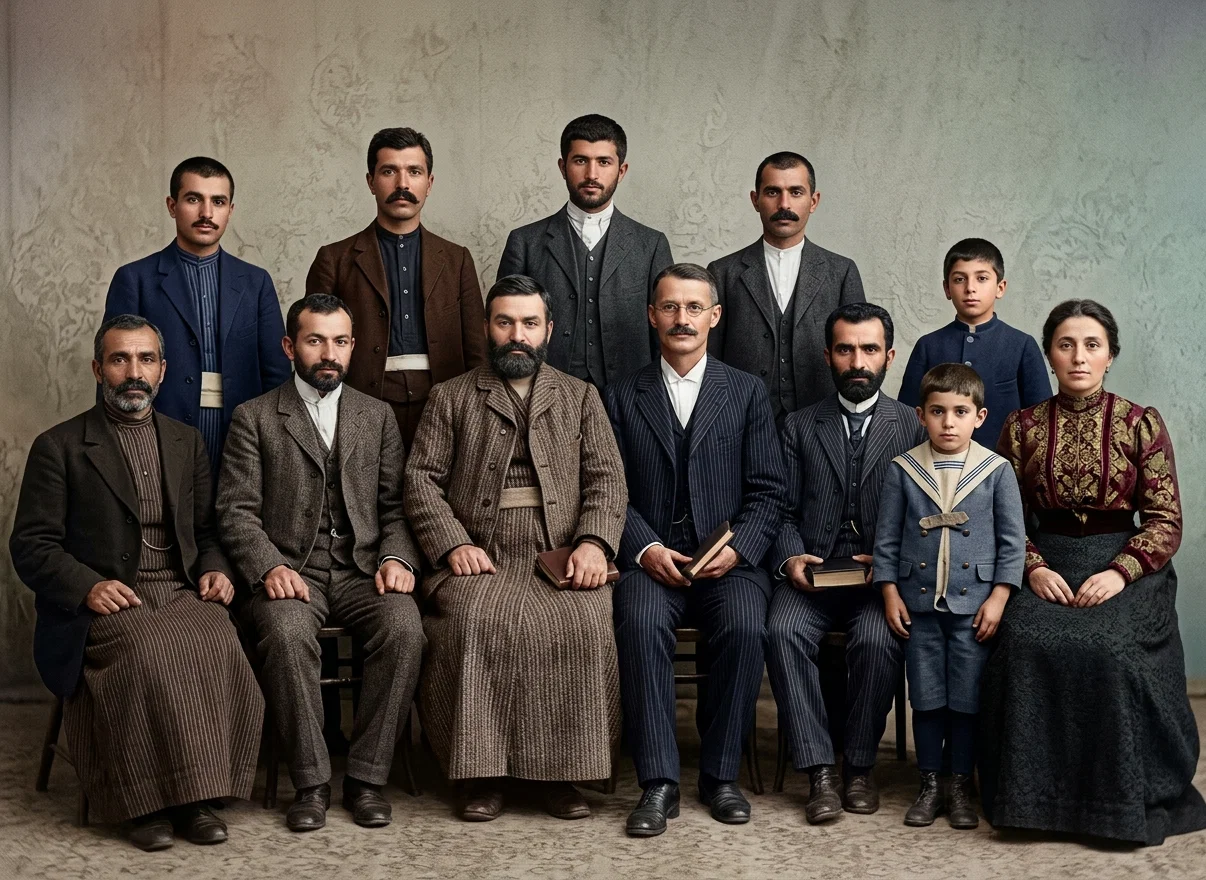
Knowing that many of the readers of the REVIEW are watching with intense interest the movements of the message in the Oriental mission field, I take pleasure in submitting the following report of my visit to the dominions of the sublime porte. And as quite a number of secretaries have asked me to write a letter to their missionary societies, I beg leave to suggest that each regard this as a personal missionary letter to his society.
ARMENIAN WORKERS. ELDER W. H. WAKEHAM IN THE CENTER. BROTHER Z. G. BAHARIAN AND FAMILY AT THE RIGHT
For some time I had been planning a visit to our Armenian workers in Turkey, but found no opportunity until after my return from the General Conference. Conditions seeming favorable for such a trip, in October I boarded the French steamer “Niger,” at Port Said, Egypt, and sailed for Beirut, Syria, a short voyage of about eighteen hours.
At this place we were detained twenty-four hours in quarantine, and considered ourselves fortunate that it was not a much longer period, as sometimes it is from seven to fourteen days. During the summer months, all boats from Egypt are subject to quarantine regulations before entering any Turkish port. Most of the time this precaution is useless, and it puts a serious embargo on general traffic. We were landed by the steamer’s boats, and taken into quarantine quarters, which, while very plain and primitive, were clean and airy. The people who look after these quarters, however, are not in the business for their health.
One has his choice of sleeping out of doors on the ground, or paying eighty cents for a bed in a very poorly furnished room, with several other persons. If he wishes food, he must pay an equally modest sum. The exorbitance of this will appear when the reader is informed that after our release we secured excellent accommodations at the Hotel Victoria—large, airy, well-furnished rooms, including full board—for one dollar a day. This was vastly different from the expense of living in Egypt.
Having to wait in Beirut two days for another boat, I hunted up Brother and Sister Haussmann, a German family, and the only Sabbath-keepers living in the city. Here also I found our Syrian worker, Brother Elias Zarub, who had come in from his village, about two days distant, to meet me. These brethren seemed of good courage, and we had a profitable season of prayer and Bible study together. While here, we laid plans to spend some time, after my return from Asia Minor, visiting some scattered brethren in Syria.
Leaving Beirut October 10, we started on our journey. But as our boat was a cargo boat, it not only traveled slowly, but went in a very roundabout way, and called at various ports, stopping from twelve to eighteen hours at each place. Our first stop was at Larnaca, one of the chief ports on the island of Cyprus. I called to mind the experience of Paul on this island with the deputy of the country, also with the sorcerer, Bar-jesus. See Acts 13:4-12. The third angel’s message has also reached this island. Two Sabbath-keepers, Armenians, live here, the result, in part at least, of Brother Baharian’s efforts some years ago. One of these has been baptized, and the other has been waiting for some time for some one to administer to him the sacred rite. Some time soon I hope to visit this island with an interpreter, Turkish and Greek being the languages spoken, and develop the work there.
Our boat next stopped at Mersina, near the city of Tarsus, the birthplace of Paul. And finally, on Friday evening, October 13, I landed at Alexandretta, the chief port in this part of the country. On landing, my baggage underwent a most thorough overhauling. Every bundle and package, every book and tract, was carefully examined, and I was made to realize that I was under the government symbolized by the star and the crescent. Fortunately, I had no contraband articles nor compromising literature, having been forewarned. So I could preserve a serene, and even smiling, countenance while my goods were being literally ransacked, and questions were being asked that in America would be considered impertinent. It came to an end at last, and I was “passed.”
At this place I found one family of Sabbath-keepers, the father of whom had been in the truth about eight years. His son, Brother Enoch Ayvazian, one of our workers who was imprisoned with Brother Baharian, met me at the boat landing, and found for me a lodging-place in a hotel. I remained here over the Sabbath, and held services with this family in their humble home, though I could do but little in the way of instructing, except to point out passages of Scripture and let them read in their own language. Brother Enoch knows but little English, and my knowledge of Turkish is nil. However, we managed to get along very well, and they were encouraged. They do not often see a minister, or others of like faith.
Before leaving Alexandretta, I called on the American consular agent, and was very cordially received. I learned from him some of the “ups and downs” of missionary work in Turkey. He told me that I was free to go where I wished, and preach any doctrine, without fear of personal injury, but that Turkish subjects might be fined and imprisoned for listening to me, thus effectually hindering any missionary effort of that character. He related an incident where this method had been pursued, and more than twenty persons put in jail for the crime of listening to a missionary.
On account of heavy rains, we did not start from this place until Monday, when, having secured a comfortable closed carriage drawn by four small horses, we set out for Aintab, a four-days’ journey, accompanied by Brother Enoch, as our guide and interpreter. In another carriage bound for the same place were three Mormon missionaries,13two of them recently from Utah. Though mere boys—the leader being but twenty-one—they called each other “Elder,” and had thoroughly learned their “testimony,” and recited it well. We had many conversations on the way, and hope that seeds of truth were sown in their hearts. The leader is a bright, genial youth, who has made good progress in the Turkish language for the short period—two years—he has been here. But from infancy his mind has been so molded by the narrow theology of Mormonism, that it seems difficult for him to understand that there is any truth outside of the Mormon church. They supposed that none but Mormons taught that the gospel was preached to Adam, and he seemed much surprised when I stated that it was, and wished to know where and how I had learned that truth. One of them finally admitted that I had many truths.
These young men leave their homes, come to this far-away land, brave dangers, suffer privations, struggle with a difficult language, with no salary, their actual expenses only being paid, for the purpose of propagating a stupendous system of error. And these are but samples of hundreds of their missionaries in various parts of the world. Where are the young men, hundreds of whom have been educated in Seventh-day Adventist schools, who will do as much for the glorious truths of the third angel’s message? Some of them are in the field, doing splendid service; but hundreds more are needed. Who of my readers have given themselves to God for service in these most needy and most difficult fields? May the Lord of the harvest send out consecrated workers to every part of the world.
Arriving at Aintab, we were given a most hearty welcome—men, women, and children coming to meet us on the run, as our carriage rolled into the city. We were taken to the home of Brother Baharian, where we found comfortable quarters, and a few faithful souls whose hearts God has touched. Here are men who have endured for years the most bitter persecution—men who have spent long, weary months behind prison bars, separated from all dear to them on earth—all for the truth—and who yet are as free from complaints, as full of zeal and courage and determination in the Lord’s work, as any I have seen anywhere in the most favored countries. And though they look up to me as their instructor, I feel that I can learn many things from them.
Assembled here at Brother Baharian’s house are four of our Armenian workers, besides Brother and Sister Baharian. These, with two or three other Sabbath-keepers, who attend more or less irregularly, constitute the members of the Armenian Workers’ Bible Institute, the first of its kind ever held in this part of the country. Our daily program is as follows:—
Rising ........................ 6:00 A. M.
Devotional exercises .......... 7:00 A. M.
Breakfast ...................... 7:30 A. M.
Bible study .................... 8:30 A. M.
Health lesson ................. 10:30 A. M.
English ....................... 12:30 P. M.
Dinner ........................ 2:00 P. M.
Visiting and study hours 3 to 7:00 P. M.
Bible study .................... 7:00 P. M.
Occasional inquiry meetings are held at the close of the Bible study. This gives our workers opportunity to do personal work with those who may be interested in the truth.
The outside attendance at the evening meetings and the Sunday services ranges from twelve to thirty; and the services at these times are adapted to meet the needs of those who may attend. The Lord is blessing us greatly in this school, and we believe the workers will go from here greatly strengthened for the conflicts of life.
It is very difficult for one who has not been here to appreciate the difficulties under which our brethren are laboring in this country. Seventh-day Adventists are practically outlaws in Turkey. They have no legal standing. They can not marry, can not be born, can not even die and be buried legally. They can not travel from one village to another without liability to arrest and imprisonment. They can not hold any public meetings. They can not get permission to do any of these things, because the head of the so-called “Protestant Nation” in Turkey refuses to recognize them as Protestants. They are continually at the mercy of their enemies. Our meetings here are liable to be closed at any time, and every one in attendance to be arrested and imprisoned. This, of course, does not apply to the writer, as citizens of other nations are exempt from such restrictions. Since our meetings here began, Brother Enoch has been arrested, because he had no passport, and he was released only on the guarantee of one of the business men of the city that he would come before the officials whenever he was called. But notwithstanding these difficulties, the everlasting gospel is again being preached on the old battleground of sin where Paul and Silas suffered and died; and the laws were worse then than they are now. Nothing can hinder God’s work.
On the second Sabbath of our meetings, the rite of Christian baptism was administered to a brother who had come all the way from Iconium, about twelve days’ journey by wagon, and in the afternoon we had a blessed communion service together. This brother has been keeping the Sabbath for five years, and had never before seen an Adventist minister. He reports five other Sabbath-keepers in his village, who desire baptism. These are largely the fruits of his efforts. Thus the truth is finding its way to the honest-hearted, even in this land of great difficulties.
On Sabbath, December 9, the Lord came especially near, as we tried to present the exalted calling of the gospel worker. In the evening Brother Alexander Buzugherian was ordained to the work of the ministry, and the manifest presence of the Holy Spirit confirmed the action of the church. May God bless the workers as they go forth from this institute, and make them mighty, through him, in pulling down strong-holds of sin.
It will be of interest to our readers to know that Aintab is but a short distance from the Euphrates River. A little further to the east and south is Haran, where Abraham stopped on his way to Canaan.
Cairo, Egypt.
Church Federation in China
By H. W. MILLER, M. D.
H. W. MILLER, M. D.
The following statements are from the report of the conference of missionaries held at Peking, in September, 1905, nearly every Protestant church in China being represented. The principal theme of the conference was that of confederation. Mr. Mackenzie, of the Canadian Presbyterian Mission in Honan, spoke as follows: “We must be one in Christ for China, which is now out of Christ, that we may give to her what we have received, do for her what has been done for us. We must not fall behind the general world movement toward federation and union. The strongest part of what we have to give to China is what we hold in common; the weakest part is that which separates us. The vision of the world in Christ yet to be, will bring us together in an irresistible unity.”
The report further states: “As to the name for the Protestant Church (in Chinese), it did not seem wise to follow the suggestion of a few in emphasizing our opposition to the Roman Catholic Church, with whom we should hope for ultimate union.”
In a paper by Geo. T. Candlin on the subject of confederation, he declared “the time just at the rounding out of the first century of missionary effort in China, most opportune for the consummation of this great work. The ideal should be nothing less than one Christian church for China. Is it not worth striving for? Could anything so strongly commend us to China’s people and China’s rulers? The alternative is stern and melancholy,—a score or more of missions working independently; a Protestant community of one hundred and fifty thousand divided among a score of churches; the native leaders, in their growing independence, perpetuating the petty differences of which they would have known nothing had they not been taught, magnifying what were once, perhaps, living issues, but were long since dead. Are such things to harass and perplex the church in China for all coming time? This one Christian church for all China is to be brought about by first dreaming and then doing. There must first be the ideal if we are to have the real. This federation of the church is a vital necessity. Union is natural; separation unnatural. What God has called us to establish is the kingdom of God; there is but one kingdom of God. The church is the body of Christ; there14is but one body of Christ. The church must have an external, visible body; it is at least incongruous that it should have a number of bodies. Now is the time for federation, when things in China are still in the making, neither made nor spoiled.”
After the discussion of this paper, resolutions were passed indorsing union, and appointing committees to perfect this union as soon as possible.
The reader will readily see that the missionaries are one with their home societies in courting the favor of the government and desiring union that their power may be more effective. This we conclude not only by inference, but by direct statements from them to that effect. They also recognize that there is very little difference between them and the Catholics, and are wondering how it is that they have been so separate in the past. Neither can they harmonize their petty differences with their idea of a universal kingdom to be established. They readily pass over the words in Matt. 10: 34, 35, where Christ says he came not to send peace on earth, and believe it their duty to establish the kingdom of God. We wonder if Christ will recognize this kingdom when he comes with all his holy angels to reap earth’s harvest. The only thing lacking now to make their union complete is to come in contact with the third angel’s message; they will then swarm together, and use the power that they now seek from the heathen rulers of China.
Shang-tsai Hsien, Honan.
China
By W. C. HANKINS
KULANGSU, AMOY.—We are all in good health, and of good courage, and we feel more thankful to the Lord every day for bringing us to this place. We have stood the heat of the summer very well, and at the present time our health is as good as it ever was, if not better.
A VIEW OF AMOY FROM THE MISSION BUILDING SITE
The work is onward. One intelligent young man from up-country, a graduate of one of the mission high schools here in Kulangsu, having heard a little of the Sabbath truth from Brother Timothy when he was here, came down a few weeks ago to inquire further. As Brother Keh was up-country at the time, I studied with him. Afterward he came down while Brother Anderson was here, and, after a further study with Brother Keh, announced his desire for baptism, and to go with Brother Keh to preach the gospel. There is also another young minister, a former pupil of Brother Keh, who is convinced of the truth, and whom we expect to see obey shortly.
While Elder Anderson was here, we went up-country with Brother Keh, for a three-days' trip. While on this trip, Elder Anderson and I were impressed with the immensity of the work before us: just a medium-sized city has two or three hundred thousand inhabitants, while one like Canton has millions; and then at distances of about half a mile through the country, are villages, each containing one or two thousand inhabitants. The question arose in our minds, How are we to warn all these people in the short space of time left to us, and with such a limited number of workers? We compare the work here with that in the States, and when we consider that while the United States has one hundred times as many workers, we have six times as many people, who are much more difficult to reach on account of their ignorance. We certainly should have more workers.
But even with all the laborers that will ever be sent to China, the work here will be of such a nature that every laborer will need to make haste in proclaiming God's last message of mercy.
As we talked over the situation as we saw it while among these millions of people, we could not help but feel that our work here must be something of the nature of that of John the Baptist and the Saviour,—going from city to city and from village to village, giving the message of warning, distributing literature containing the message, and trusting God for the increase, not expecting to stay, even in a large city, more than two or three weeks, and in the villages perhaps but a few hours. The message thus given would be sure, if given in the spirit and power of God, to awaken an interest in the hearts of the people, and so would spread from village to village and from city to city, so that in a comparatively short time all China could hear the gospel, and the honest in heart be gathered out for the kingdom of God.
I feared, when we came, that at least two years of comparative idleness, as far as aggressive gospel work was concerned, would be our fate, but I have been agreeably disappointed. Although giving a great deal of time to language study, there have been many opportunities for giving the gospel.
And now let me add just a few lines, as a plea for help. We need workers. We need them now, so that we may make a united effort, and carry this immense land by storm. Send us young men who can learn the language, and who love the Lord. This is a grand place to be—because God is here, and is with this work.
W. C. HANKINS.
One out of Every Five
By Mrs. F. Howard Taylor
ONE fifth of all the women of the world are found in the homes of China. One baby girl out of every five is cradled in a Chinese mother's arms, unwelcomed and unloved, unless by that poor mother's heart.
One little maiden out of every five grows up in ignorance and neglect, drudging in the daily toil of some poor Chinese family, or crying over the pain of her crippled feet in the seclusion of a wealthier home. Among all the youthful brides who day by day pass from the shelter of their childhood's home, one out of every five goes weeping in China to the tyranny of the mother-in-law she dreads, and the indifference of a husband she has never seen.
One out of every five, at the close of earthly life, passes into the shadow and terror that surround a Chinese grave, never having heard of Him who alone can rob death of its sting. One fifth of all the women are waiting, waiting, in China, for the Saviour who so long has waited for them.
What a burden of responsibility does this lay upon us—the women of Christendom!—Mrs. F. Howard Taylor.
China’s Golden Opportunity
To the church, China is not the “yellow peril;” it is the golden opportunity. —Selected.
West Africa
By D. C. BABCOCK
FREETOWN, SIERRA LEONE.—I had occasion to call on the leading Baptist minister the other day, and found he had arranged to have a talk on the Sabbath question and other truths. He is the one with whom I conversed concerning a church they have and use but little. We have decided to ask them to let us have it, that we may have a place in which to hold public meetings.
This minister arranged for other ministers to meet us, and together have a study over the Sabbath question. The others did not appear; but with all frankness and confidence he opened the question. The Lord helped, and before I left him, I sold him a copy of “Bible Readings,” and supplied him with “Who Changed the Sabbath?” “The Lord’s Day,” and other tracts.
Last Sunday, Canon Cole, of the English church, made a public statement that the Seventh-day Adventists, now located with their mission on Rawdon Street, are right on the Sabbath question.
Sunday, after services, an English church minister came and spent about three hours with us, considering the Sabbath question.
Mrs. Babcock is quite successful in selling books to the ministers, and there seems to be little opposition. Our books sell with little difficulty, and the people are anxious to get them. To one lady I sold a copy of “Bible Readings,” seven copies of “Last Day Tokens,” and seven of “His Glorious Appearing.” My sales have been in a very small compass,—not more than one square in an ordinary city,—and have amounted to four pounds. We are endeavoring to do our work systematically.
A young Methodist lady, now teaching school, has decided to take up the canvassing work, and has already begun preparation for it.
There are many other interesting features of our work, which I can not mention at this time, but we are arranging for future work as fast as possible. I believe that now is the time for us to make a decided move for the work in West Africa; and while we need not make any great display, we need to set our stakes so solidly that they will not be pulled up. We need not spend any great amount of money in locating a place to train our workers, but we need a small beginning, so that no time may be lost, our health fail, and the work again be retarded. The city is not the place for our training-school. We need to be where we can have land to till, and come as near as possible to meeting our expenses. There is no difficulty in raising good vegetables and fruits here. Cabbage grows quite large and solid, also tomatoes, and many other things that we raise in the States.
I am very anxious to see the canvassing work established so that it will bear its own responsibility.
D. C. BABCOCK.
A Spanish Field at Our Own Doors
By Augusta S. De Angeles
Since Jan. 1, 1905, I have been laboring in the Arizona Conference as a Bible worker. I was in Phoenix until May 15, doing house-to-house work among the Mexicans. Two, the parents of eight children, accepted the truth, in spite of much opposition. They were baptized while we held our conference meeting.
At Tucson I spent two months. Elder Serna—one of our Mexican laborers—and I conducted meetings in the Seventh-day Adventist church. Brethren Ernest and Bond were holding tent-meetings, and as a result baptized about eleven, I think. Then we reorganized the church, with a membership of about forty, Mexicans and Americans. Officers were selected out of both nationalities. Services have to be conducted in both languages—one in the early morning, and the other late in the afternoon, as it is too hot in the middle of the day.
Brother and Sister Serna and I then left for Globe, a mining town of about fifteen hundred people. We stopped by the way to visit another Seventh-day Adventist Mexican church, to encourage the members. We found some faithful ones here. Two families came five miles every evening, walking both ways, so anxious were they to get every word we had to say. One of these families had two babies to carry and several other children to bring. They are very anxious for a church-school, but can not support a teacher. They are trustees of the public school, and offer it to some Seventh-day Adventist teacher who can speak Spanish. Is there no one among us who can fill this opening? Bible studies could be given outside of school hours. Besides, the teacher could be of much help in the church. There are about thirty children, all Mexicans, who speak no English, all Seventh-day Adventists, except a few Methodists, who do not object to us.
Since we have been in Globe, Brother Serna has baptized eleven, consisting of Methodists, Baptists, and Catholics, including a Mexican missionary, who is greatly rejoicing in the truth. One sister, who accepted the truth at Mesa, through the labors of Brother Ybarra, took the stage to this place, coming out of her way in order to be baptized.
We began to preach in the street a week ago, Brother Serna and I alternating in teaching the Scriptures to the passing public. We have many calls for literature, but have none to give or sell. The majority of the people have no Bibles, and we have no tract to offer them after our meetings. We find in our audience almost as many Italians as Mexicans, who want tracts, and of course we have none for them either. I speak this language also, and could make good use of some literature.
Many Americans who understand Spanish listen to us. To these I have been able to hand some papers and tracts, but my supply is nearly exhausted. I would like to have a good supply of these. If any one will be kind enough to send me some, post-paid, they will be thankfully received, especially the tracts, and the sender will be assisting in the work in the Lord's vineyard. A Mexican wanted one of the Capital and Labor number of the Signs which I was handing out last evening. He could not read it, but I suppose he intended to get some one to translate it for him.
As a result of our street work so far, we have been called by four different families to come and teach them at their homes. One is a proprietor of many small tenement-houses around their home. We held meeting there yesterday afternoon, and arranged to hold a service every Wednesday and Sunday at 3 P. M. Most of the tenants will attend. All are Catholics. Another family are backsliders from the Christian Church. We held a meeting at their home Sunday, and they expressed a strong desire to join our Sabbath-school, which we organized a week ago with a membership of thirteen adults and ten minors. One of our street listeners came last Sabbath to join the school.
There are four Seventh-day Adventist Mexican churches in this territory, two in New Mexico, and one in Colorado.
Many of our Mexican people do not send their children to school, and they are growing up without knowing how to read well, even in their own language. Even those not of our faith do not approve of the public school. Land can be had very reasonably here, an adobe edifice can be easily constructed, and I know that many children from the neighboring States and from Mexico would fill up a school as fast as we could accommodate them. An English department could be conducted for the benefit of those who wish instruction in that language. A small press could be used in connection with the institution, and for printing literature.
AUGUSTA S. DE ANGELES.
Ceylon
By Harry Armstrong
COLPETTY.—As a result of our tent-meetings, several have been led to see many truths, including the Sabbath of the Lord. We are praying that they may have grace to fully embrace it and keep it holy. One man, with his wife, was threatened with excommunication if he continued to come to the tent and accepted the views of Seventh-day Adventists. Last Sunday morning, when they went to their church, they were asked if they believed the doctrines taught by us, and they answered “Yes.” They were then excommunicated, and turned out of the “synagogue.” They came to my bungalo, and we had prayer and a Bible study together. We also arranged a meeting for every Sunday morning in their bungalo, where they will gather in their friends to hear the word of God. This brother was also dismissed from his work, because of his integrity and love for the truth. Others are also passing through persecution and trial. We do pray that the Lord may strengthen them by his power and grace.
Several of the ministers here have visited their flocks, warning them against the meetings in the tent. But we rejoice to say that some of their sheep, having grown thin and feeble on the barren moors of human tradition, desire to be fed in green pastures, and they still continue to come. We are called “sheep-stealers” by some, but we rejoice in knowing that some poor wandering sheep are being received back into the true fold of Christ.
There is much to encourage us in this work. It is true we have to do much patient toiling, and often we have seemed to toil in vain; but some are being gathered in, and we believe that here, after patient, faithful labor, will be found a loyal people, keeping the commandments of God, and having the faith of Jesus. HARRY ARMSTRONG.
Recent Experiences in Battle Creek
By G. W. Amadon
The week of prayer in this city was an occasion of more than ordinary interest. To make this season of greater benefit to the entire church, cottage meetings were appointed in numerous places in the city. There were about fifty of these small gatherings, and it was planned that from fifteen to twenty-five persons would constitute a group. In several cases those not of our faith attended, and the effect on all was generally excellent. In some instances requests have been sent to the church elders to have these meetings permanently continued. The cottage meetings were held on only four evenings of the week of prayer, the other services being in the Tabernacle, for the benefit of the entire congregation.
During the week the Lord sent his servants, Elders Daniells and Irwin, here, with instructions to read to the church certain Testimonies of his Spirit for our admonition. These messages were of a heart-searching character. They pointed out the defects of some in high positions, and the danger of introducing false philosophy and a specious interpretation of the Scriptures into the work of God. Sharp were the reproofs, touching the entreaties, and pathetic the warnings for all—leaders and people, high and low—to turn to God lest sorer judgments should come upon us. It is sad to write that these messages indicated a state of rebellion and depravity in our midst such as none would expect in so favored a place as the Battle Creek Seventh-day Adventist church. Such puerile objections as the age of the instrument employed by the Spirit in giving the testimonies of warning, and that the one through whom they are given is biased by human influences in writing them, are not uncommon here.
To facilitate the matter of getting the messages before the people, up to the present writing many meetings have been held—more than thirty in all. A great many of these have been general gatherings in the Tabernacle, some unusually large. Several of the meetings have been devoted wholly to answering questions pertaining to the validity of the Testimonies, and matters relating thereto. The burden of this feature of the work seemed to fall principally to the lot of Elder Daniells. Other meetings were not of so general a character. In these, persons who had quite lost faith in the spirit of prophecy and its operations, freely conversed in reference to their condition, and through prayerful counsel and the help of God, were extricated from the mire of unbelief. Not a few such are now rejoicing in that liberty which makes them free indeed. There were very many experiences of this kind. Some of the meetings were occasions for prayer, in which the presence of God was very earnestly supplicated. And many have been the instances in which small groups of from eight to twelve or more, have met to cry earnestly to Heaven in view of the forbidding condition of spiritual matters here.
In the meantime the city press reporters have been unusually active, and the journals have published from day to day the most unscrupulous statements regarding the Testimonies and the author.17The wrath of the dragon has been stirred, and threats of resorting to the law to stop the reading of the Testimonies have been made by individuals both in the church and out.
It is a pleasure, however, to add that the general effect of these heaven-sent messages of reproof has been excellent. Scores, and doubtless hundreds, who had lost faith in the spirit of prophecy, and had settled into a state of spiritual indifference, are now rejoicing in the restored light of the divine presence. Particularly has a good work been done for the younger medical students, the nurses, and sanitarium workers. For this let humble thanks be given to the God of heaven; and should evangelistic efforts be continued, we might expect a great revival of the work of God in Battle Creek.
But that all the men in high positions here have not sympathized with the recent work is only too apparent. Indeed, one sermon was preached in the Tabernacle, which, however good the intentions were, was more calculated to embarrass and confuse than to help. As a natural result a number are more confirmed in being on the wrong side in this crisis.
January 3, the evening following the effort just mentioned, Elder Daniells read further from the spirit of prophecy, and after general remarks to the audience, left on the next train for Washington, to which place he had been called by telegram. G. W. AMADON.