The Youth’s Instructor, Vol. 34, No. 36.

AUNT MARGARET'S DEVICE
Earlier text: AUNT MARGARET'S DEVICE

IMPORTANT BIBLE SUBJECTS.

LESSON 23.—THE AUTHORITY FOR THE CHANGE OF THE SABBATH.

1. What did Isaiah say of Christ’s relation to the law of God? Isa. 42:21.
2. What did Christ himself say of it? Matt. 5:17, 18.
3. What have we found to be the practice of Christ and the apostles?
4. Did Sunday-keeping originate in the days of the apostles?—Ans. “We hear less than we used to about the apostolic origin of the present Sunday observance, and for the reason that while the Sabbath and Sabbath rest are woven into the warp and woof of Scripture, it is now seen, as it is admitted, that we must go to later than apostolic times for the establishment of Sunday observance.”—Christian at Work (Presbyterian), Feb. 18, 1886.
5. Is there any direct command for this Sunday observance?—Ans. “The change from the seventh to the first day of the week appears to have been gradually and silently introduced, by example, rather than by express precept.”—Dr. Scott, Comment on Acts 20:7.
6. When and by whom was the first Sunday commandment given?—Ans. “Whatever may have been the opinion or practice of these early Christians, in regard to cessation from labor on Sunday, unquestionably the first law, either ecclesiastical or civil, by which the Sabbatical observance of that day is known to have been ordained, is the edict of Constantine, A. D. 321.”—Chambers’s Encyclopedia, art. “Sabbath.”
7. Did this edict require the observance of Sunday as a Sabbath?—Ans. “Let all the judges and town people, and the occupation of all trades, rest on the venerable day of the sun, but let those who are situated in the country, freely and at full liberty attend to the business of agriculture, because it often happens that no other day is so fit for sowing corn and planting vines.”—Part of the decree of Constantine.
8. When and by what authority was abstinence from agricultural labor on Sunday first recommended?—Ans. “It was not till the year 538 that abstinence from agricultural labor on Sunday was recommended, rather than enjoined by an ecclesiastical authority (the third council of Orleans), and this expressly that the people might have more leisure to go to Church and say their prayers.”—Chambers’s Encyc., art. “Sabbath.”
9. When was liberty to labor on Sunday fully taken away?—Ans. “Nor was it till about the end of the 9th century that the Emperor Leo, the philosopher, repealed the exemption which it [agricultural labor] enjoyed under the edict of Constantine.”—Ib.
10. How did Paul describe the papacy? 2 Thess. 2:3, 4.
11. How was it to exalt itself above God? Dan. 7:25.
12. Does the Roman Catholic Church acknowledge this charge?—Ans. She does, and boasts of it. Thus:—
“Ques. Have you any other way of proving that the Church has power to institute festivals of precept?”
“Ans. Had she not such power, she could not have done that in which all modern religionists agree with her; she could not have substituted the observance of Sunday, the first day of the week, for the observance of Saturday, the seventh day, a change for which there is no scriptural authority.”—From the Doctrinal Catechism.
13. What does the Catholic Church claim as the proof of her authority?—Ans. “Ques. How prove you that the Church hath power to command feasts and holy days?”
“Ans. By the very act of changing the Sabbath into Sunday, which Protestants allow of, and therefore they fondly contradict themselves by keeping Sunday strictly, and breaking most other feasts commanded by the same Church.”—From “Abridgment of Christian Doctrine.”
14. Upon what foundation do all festivals of the Church rest?—Ans. “Sundays and holy days all rest on the same foundation, namely, the authority of the Church.”—“Catholic Christian Instructed.”
15. Do professed Protestants concur in this statement?—Ans. “We rest the designation of Sunday on the Church’s having set it apart of its own authority. The seventh-day rest was commanded in the fourth commandment. . . . The selection of Sunday, thus changing the particular day designated in the fourth commandment, was brought about by the gradual concurrence of the early Christian Church, and on this basis, and none other, does the Christian Sabbath, the first day of the week, rightly rest.”—Christian at Work, Jan. 8, 1885.
16. What is the only position that the true follower of Christ can take on this question? Acts 5:29.
17. What does God say? Ex. 20: 8–10; Ex. 23: 2, first clause.

Fresh Thought from the Bible's Inspiration

HE who would always have fresh thought should turn frequently to the Bible for its inspiring suggestions. No man will say that he has turned to that source of intellectual stimulus, and been disappointed in his search. Herein is the wonder of that Book of books. Whoever goes to it inquiringly—and however often—finds something there that he has not seen before, and that is worth his finding.

HOW RETTA GAINED A FRIEND.

“If ye love me, keep my commandments.” This was what Retta Barnes read as she stood before her glass braiding her long brown hair. By the glass hung a calendar, with a verse for each day, and this was the one for Tuesday morning.
Now Retta did love Christ, and the first words, “If ye love me,” made her think more about the text than she sometimes did.
“I do love Christ,” she said. “Yes, I'm sure I do; but I neglect his commandments. Of course I don't lie or steal, or do anything like that, but I do lots of things I ought not to do. I'll try to-day to do whatever seems to be Christ's command.” Then, knowing that it would be useless to try in her own strength, she asked God to show her what were his wishes, and help her to carry them out.
On her way to school she was joined by Mamie Willis and Bessie Morrison. They chatted about their lessons until Mamie said: “Let's go slower girls. There's that new girl, and we will overtake her and have to walk with her if we hurry so.”
“I wonder what she is like,” Retta said; “I think I should not like her.”
“So do I,” said Mamie, “and I would rather not have anything to do with her. She can't be very bright, for she's a class behind us, and I'm sure she is older.”
“It would be a bother to have to take her in,” Bessie said. “She looks different from the rest of the girls, and would make a sort of break.”
Here some one else overtook them, and the subject was dropped.
During the morning prayers a troublesome problem kept coming into Retta's head, until her attention was arrested by the words, “This is my commandment. That ye love one another, even as I have loved you.”
“That just fits my verse,” she thought; and just then some movement of the “new girl” recalled the talk on the street. “We didn't sound very loving toward her,” she said to herself. “But how can one love her without knowing her?”
“Whose fault is it if you don't know her?” Conscience asked. “She has been in school more than a week, and you have just barely said, ‘Good morning,’ or ‘Good evening.’ Talk and be friendly to her, and there will at least be some chance of loving her.”
“I shouldn't like her anyway,” Retta said to her conscience; “and she has such an awkward walk, and not a bit of style. I have friends enough, and she would just be in the way.”
To this, Conscience replied: “Christ says you are to love ‘even as I have loved you.’ He loved you when you did not care for him, or try in any way to please him.” And then that “If ye love me” came in again, and Retta saw plainly that if she wanted to carry out her morning prayer, her chance was here. So on her way to class she dropped the cluster of sweet peas she had worn, into the lap of the new comer, and as she returned to her seat, was met by a sweet though shy smile.
“I believe the poor girl has been lonely and homesick,” she thought. “Well, I've made a beginning, and I think I'll like her better than I thought.”
After that the way was not hard. At recess she talked to the stranger, whose name was Mary Bowen, and found that she had always lived in the country, where the school year was much shorter than in town.
“That accounts for her being somewhat behind,” Retta thought. “She's not stupid, if she isn't stylish.”
The next day she invited Mary to go to prayer-meeting with her, and from that time took pains to make her feel at home and happy.
Mary was a good girl, studious, ladylike, yet fond of fun. Gradually she and Retta were drawn closer and closer together; till at last they discovered that they were firm friends.
Many years have passed, and each year adds to the love they have for one another, and Retta likes to remember that she gained this dear friend because she loved Christ, and loving him, tried to keep his commandments.—Youth's Evangelist.

Paths to Ruin and the Need for Care

How many paths to ruin lead! To shun them, oh, what care we need! Though small at first, they touch the road That's broad, and by the wicked trod.

THE GREAT LAMP.

A VENERABLE minister looked down on his congregation, composed of Sabbath-school boys and girls, and said: “Dear children, can you tell me what a lamp is?”
And they looked at him and at one another, and murmured some of them, confused answers, and hung their heads shyly.
“What! Does nobody know what a lamp is?” he exclaimed with surprise.
All at once he heard a voice: “Something to hold a light, sir.”
“That’s just right,” was the minister’s glad reply. “An empty lamp is of no use in the dark. Can you repeat a text which mentions the Bible as being like a lamp?”
Without waiting a moment, the same young voice rang out again: “Thy word is a lamp unto my feet.”
“Ah, yes,” said the aged minister, “the Bible is a lamp giving light to the whole earth. And how about the light of children—where shall we find that?”
“In the Lord Jesus. He says, ‘I am the Light of the world.’” And again it was the same voice.
“One child answers well,” said the minister, and he scanned the sea of faces to discover who it was.
A little girl told him it was blind Arthur.
Yes, it was blind Arthur Beatty who answered so correctly about God’s glorious lamp and its still more glorious light. The minister told his little hearers never to try to go, even a few steps, on life’s journey without their precious lamp, or they would stumble into trouble and sin. He asked them, as I also ask you, dear children, to learn all they possibly could of God’s word, so that they might not at another time be so unready with their answers, and more than all, because the light shines brightest on the path of those who study the Lamp, and know it best.—Leaves of Light.

Letter Budget.

The Letter Budget has at last passed through the big snow storms and is enjoying the birds and the sunshine. Soon we shall hasten through the summer months, to be ready for that big pile of letters telling what the harvest has been, and how much you have set apart to bring you sheaves in the final harvest. We begin the Budget with one from—
Minnie Halleberg, who writes from Stevens Co., W. T. She says: “I am only six years old, and cannot write very well myself, so please let mamma write for me. I go to school, where I am trying to learn to read and write. This year is the first I ever went to school. I have not been absent one day now for six weeks, nor tardy but twice; I have three fourths of a mile to go to school. I have four sisters and three brothers. My youngest sister, Pearly Eunice, is a very good baby, and we think much of her. I help mamma take care of her. Sometimes when I come home from school, I go with my other sisters to gather flowers on the hills. We had lots of melons and tomatoes last year, and they were so nice. Pretty soon mamma will plant more. We have no Sabbath-school here, and we do not know when we will have. I will try to be a good girl.”
A. Mather, of Cass Co., Mo., writes: “This is my first letter to the Budget, and as most of you give your ages, I guess you will like to know my age. I am forty-six, but I only know it by the years being in the past, as I do not feel old. I love and enjoy the Sabbath-school very much. We all go when the weather will admit. I take great interest in reading the Letter Budget, and I hope all the little writers are trying to be good. There are very many things that tempt us, so let us pray to our heavenly Father daily to help us guard against every appearance of evil; then we must do all we can to help answer our own prayers, for God is not going to make us leave off our idle, vain and foolish ways against our own wills. I would like to see all the Instructor family together. I have about two thousand silk-worms that have hatched out to-day. Taking care of them is nice work.”
May Crosker, of Todd Co., Minn., says: “I am a little girl seven years old. I have no one to play with, for my only brother and sister sleep in Jesus. I want to be a good girl so I can meet them when the Lord brings them with him. I have kept the Sabbath with my parents all my life. I go to Sabbath-school every Sabbath, and have my lessons perfect every time. We have a neat little church building, which is only one mile and a half away. Papa gave me a little patch of cabbage last summer, and I sold it, and after taking out the tithe, put the rest into the missionary money. Papa and mamma pay their tithes, and they teach me to do the same. I feel glad to do it. I am going to have a missionary garden this summer. If it does not amount to much, it may help save some one. I have learned the Lord’s prayer, which I think is nice to repeat.”
Tommy and Georgie Divelbiss, George and Mary Barrett and Albert Britten write a company letter. They say: “As we have never seen a letter from this school, we thought it would be nice to write one. We are members of the same class, and will write our letters, but our teacher will combine them into one. We study Book No. 3. When we finished Book No. 3, we could repeat from memory all its contents as a story. Our present teacher has taught us for several years, so you may know how attached we are to her. Two of us, Tommy and Georgie, are going to leave for Arkansas, and may not have Sabbath-school privileges; but we hope to be faithful. We love the Lord, and hope to be saved with the Instructor family.”
Sena Johnson wrote a letter from Shelby Co., Iowa, saying, among other things, “Now spring is here, and the beautiful birds are flying from tree to tree, singing their sweet songs. They are very glad, for now they can build their nests and raise their young. I am a little girl nine years old. With my parents, brothers, and sisters, I attend the Sabbath-school. I learn my lessons in the Instructor, which I like to read.”
Edith Cornforth, writing from York Co., Neb., says: “I am twelve years old, and the oldest of twelve children. Willie and I are going to raise a garden and some chickens. We do a good deal of work, but we are well and strong, and have a good time. I am much pleased with our good paper and the letters written for it. We have had so many storms we could not get to Sabbath-school.”
Martha L. Larson, of Dickinson Co., Iowa, writes. She says: “Not having seen any letter from this place, I will try to write one. I am fourteen years old, and have two sisters and one brother, all older than myself. Father and mother came from Norway. I can talk Norwegian too. I have relatives living in Norway, whom I have never seen. I see signs of spring everywhere, but I have not laid my plans to get missionary money. We have a nice willow grove around our house. The leaves are just coming out, and mother says it makes her think of the resurrection, when everything will be new and bright. I like to pick the pretty flowers. I got a Bible last fall, and I am now reading about Balaam and Balak. I hope that, like Balaam, I would not sin or do anything against the Lord for a house full of silver and gold.”
For the INSTRUCTOR.
For the INSTRUCTOR.

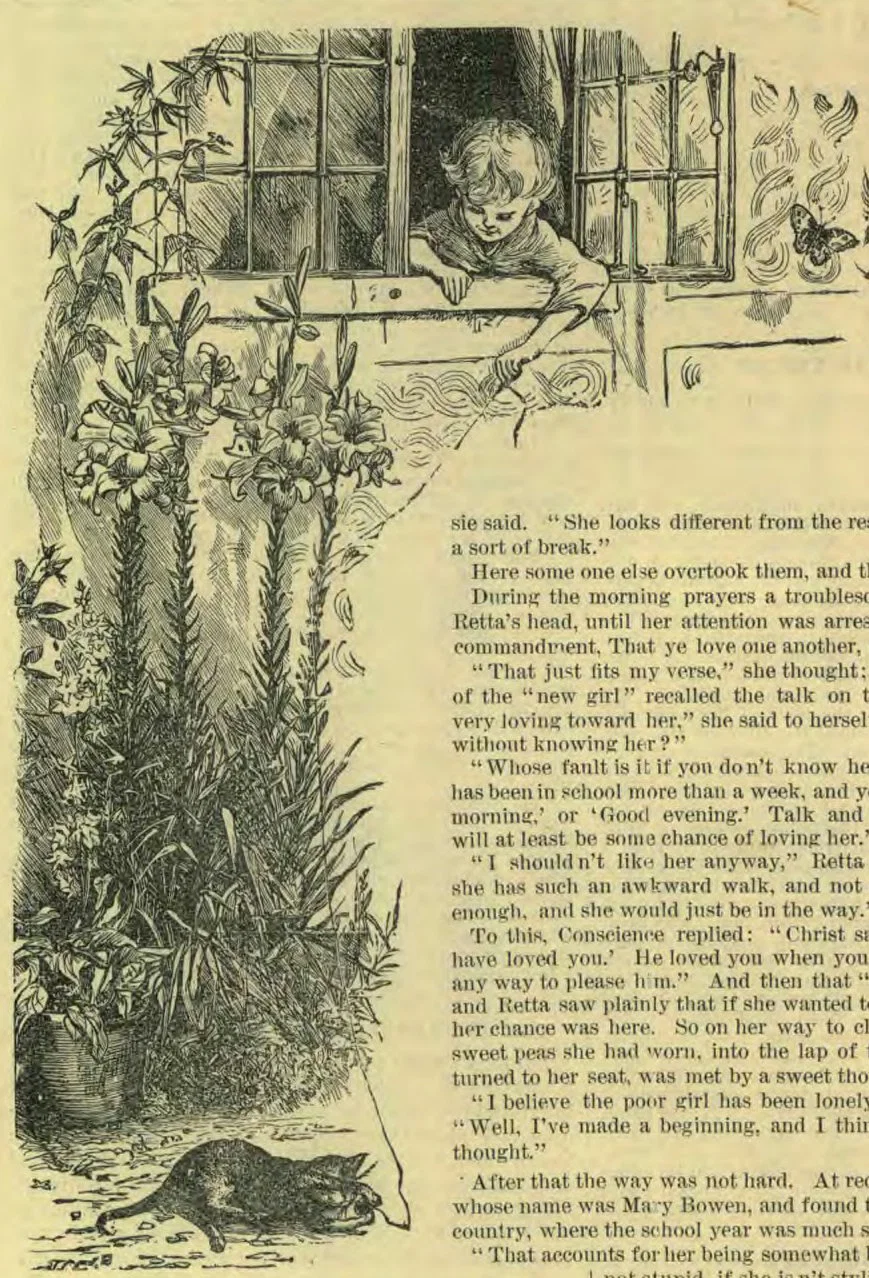
THE FISHERMAN'S LUCK.

OUT in the dawn of the morning, When the sun rose smiling and warm, Three boys trudged from the kitchen, With dinner pails hung on one arm; The other carried a fish pole, Hook, line, sinker, and bait; “We’re off for a whole day’s fishing, And won’t be back until late.”
Robbie, the five-year old darling, Looked after, with wistful eyes; “But he was only a baby, While they were wonderful wise.” Poor Robbie’s red lips quivered, But only a teardrop fell, As he rushed away to the nursery, Where babies are wont to dwell.
But mamma soon heard such laughter,— And she scarcely thought it true,— When she heard the rogue’s voice calling, “O mamma, I’m fishing, too.” And lo! from the latticed window There peeped a curly head, With a ball of string suspended— But the fish was a cat instead!
Yet his sport was just as merry, For it gave him no alarms, Till tired of play he fell asleep With his fish curled up in his arms. At night three tired but wiser boys Came home without a boast For it seemed, for all of their hard day’s work, The baby had caught the most. S. ISADORE MINER.

You have reached the end of this edition.

The Youth’s Instructor · Sep 8, 1886