The Youth’s Instructor, Vol. 32, No. 8.

THE FLYING SQUIRREL

The Youth’s Instructor

Feb 20, 1884

S. D. A. Publishing Association · Battle Creek, Mich. · Feb 20, 1884

THE FLYING SQUIRREL.
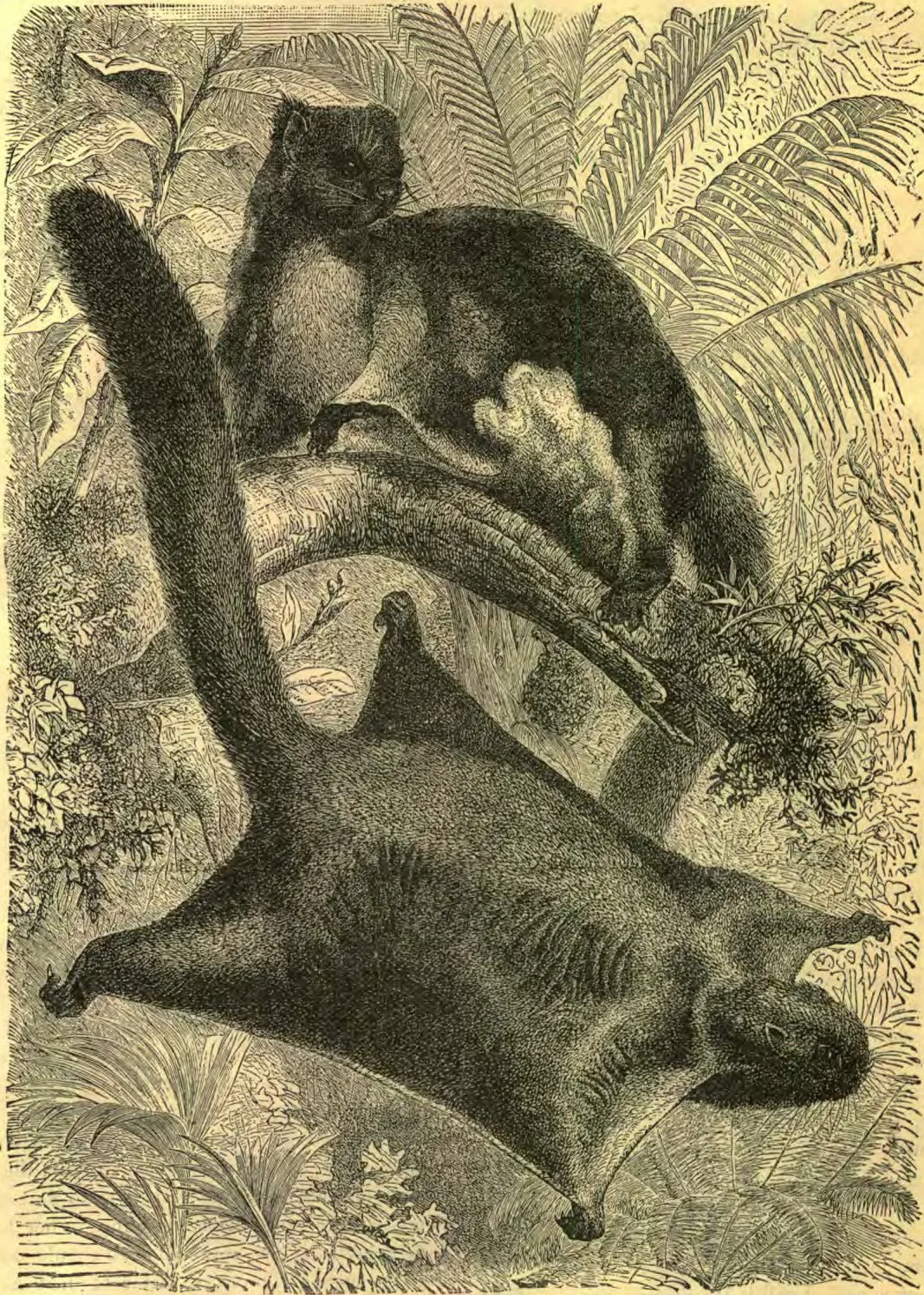
Among the many curious and interesting animals which are found in our country, and also in other countries, is the flying squirrel, of which the artist has given us a very good view in the accompanying engraving. There are several species of this queer little creature, all very similar, yet differing in some particulars. They are found not only in America, but in Russia, Australia, India, Java, Siberia, Poland, and other countries, each species showing some little difference in appearance and size.
The principal difference between them and the common squirrels is in the peculiar membrane, or skin, which extends between the fore and hind legs, and by means of which the animal sails in a descending line from a high point to a lower, supported as by a parachute. It is supposed by many that the animal has the faculty of flying like a bird; but this is a mistake. There is nothing resembling the act of flying in its movements, such as is seen in the flying-fish; it simply leaps from a high point, spreading out its legs, and expanding the membrane between them, as shown in the engraving, and sails a distance of forty or fifty yards; and when it wishes to alight, the impetus of its course enables it to ascend in a curved line to about one-third the height from which it started; then running quickly to the top of a tree, it re-descends in a similar manner, and will thus travel a long distance in a few moments without touching the ground.
The flying squirrel is a harmless and gentle little creature, and is easily tamed. It is a nocturnal animal, rarely appearing until sunset, when its gambols and graceful flights may often be seen in wooded places, as they come out from their hidden retreat in search of food.
One species, found in New Holland, is said to attain to the size of a half-grown cat, and its meat is considered by the natives as excellent food; but as it remains hidden and asleep in its nest in some old hollow tree during the day-time, it is difficult to capture, and so is comparatively safe from every foe, except the ever hungry and ever watchful native, whose eye is capable of detecting almost anything eatable, however deeply it may be hidden from sight. A slight scratch on the bark of a tree, or a chance hair that has adhered to the side of the aperture into which the animal has entered, tells its tale to the native hunter as plainly as though he had seen him enter; and with the most remarkable acuteness, he is able to tell from the appearance of the scratch and the aspect of the hairs, how long a time has elapsed since the squirrel entered its hiding-place. The native climbs the tree until he reaches the aperture, and then with his hatchet strikes the body of the tree to learn the position of the animal in the cavity. Having learned this, he cuts a hole through the side of the tree, and reaching in, he seizes the animal, and jerks it out; and dashing its head against the side of the tree, he drops it to the ground dead.
In almost any public museum in our country, stuffed specimens of this beautiful little creature may be seen and examined, and much may be learned in regard to its peculiar habits. J. W. B.

THE SNOW-STORM.

THE old earth, lying bare and cold Beneath the winter sky, Beheld the storm-king marshal forth His battle force on high. “Ah! soon,” she said, “beneath the snow Full warmly I shall lie.”
The wind unfurled his banners, And rushed into the fray; The round moon hid her jolly face Within a cloud of gray; And not one single star peeped out To drive the gloom away.
The snow, encamped behind a cloud, Sent flying, here and there, Its white-winged heralds to proclaim Its presence in the air; Until, at last, the fairy host Burst from its cloudy lair.
The snow-flakes, rushing downward, Each in a whirling dance, Before the winds are driven Like armies by the lance; But still upon the waiting earth The shining hosts advance.
The wild wind, shrieking as he goes, Flies fiercely to and fro, And strives, with all his mighty force, To sweep away the snow; But bravely still the soft flakes fall Upon the earth below.
It charges with no battle-cry; But pure, and soft, and still, It falls upon the waiting earth, Its promise to fulfill; And foils the angry, shrieking wind By force of gentle will.
The foe has furled his banners, And hastened from the fray; The round moon peeps with jolly face From out the cloud of gray; And all the stars come twinkling out, To see who gained the day.
There all the earth lay shining, In garments pure and white; The snow fulfilled its mission, And, conquering in the fight, Had warmed the old earth to the heart Beneath its mantle white.
—St. Nicholas.

ONE YOUNG MAN'S “NO!”

In a hotel billiard-room at a fashionable resort were half a dozen young men, playing for money and “the drinks.” An acquaintance, having some errand to one of the players, came in, and was urged to make one of the party in the game.
“Bring another hot Scotch?”
“Not for me,” said Harry, peremptorily, and with a bit of extra color in his face.
“Oh pshaw! You won’t play?”
“No; I don’t wish to.”
“Nor you won’t drink a bumper with us?”
“Jack, you are going too far. I would drink if I wanted it. You would not force a man to drink who is not thirsty?”
“Oh fudge! Harry, you’re afraid to risk a dollar! You’d drink a hot Scotch, or a glass of wine with us if you dared to play. O Hal, I didn’t think you’d grown so timid!”
Now the young man’s face flushed to some purpose. It was a handsome face; and he looked really noble, as he drew himself up to his full height. “Boys, you have spoken freely to me. I am timid, I confess. I am fearful; but you know very well that I fear not the loss of a dollar. I will tell you, presently, what I do fear. Do you remember Dan H.?” naming a young man, who, not a year previously, had been apprehended, tried, and convicted of forgery and embezzlement to a large amount; and who was, at that very time, serving his penalty in State’s prison. That young man, a trusted book-keeper and cashier, had been intimate with these very youths.
“You remember him, I know,” Harry continued, “and you can remember the time when he was as jovial and happy over his billiards, and whisky, and his gambling, as you are now. Oh, do not wince! I call it by its right name. If it is not gambling, what is it? Boys, if Dan had been a little fearful in those days, he might have been differently situated now.” Then he added, in a lower tone, and with deep solemnity,—
“And now, I’ll tell you, frankly, of what I am afraid; I have a mother—you know whether she loves me or not—and I have a sister looking to me for joy and comfort in life. I have also a business character; and, I trust, a broad, bright future before me. Must I tell you—I am afraid—I shrink in mortal dread, from anything that can endanger these sacred interests. Not for all the world would I knowingly and willingly bow my dear mother’s head in sorrow. And since even the appearance of evil may weaken the prop of a sterling character, I will try to avoid that. Now you must understand me. Go on, if you will, and enjoy yourselves if you can. It would be misery for me to join you here.”
He then called aside the young man whom he had come to see, who after a brief private conversation with Harry, put up his cue, and announcing that he should not go on with the game, quietly went out with his friend.
Two balls remaining on the table, were not pocketed. The game was suffered to end where it stood. There was a question asked by one of the five remaining as to what should be done with the money. The chief answered instantly, and without argument, by giving each man back his dollar. Then they went out, leaving full one-half the drink in their glasses untouched.
Subsequent inquiry showed that three of those youths had not been seen in the billiard-room since that evening; two of them had occasionally dropped in together, and played a social game; but had neither put up money nor drank. Of the sixth, nothing was learned.
The end no man can see. There is a power in personal influence, that we sometimes undervalue. Many a weak youth has escaped temptation because a stronger companion said “No,” and many another has fallen because no such help was near.
—Kind Words.

JESUS AS A SON.

In his own early life he illustrated the dutiful subordination proper in the child to the parent. Notwithstanding the urgency of his Father's business, which he could but anticipate even in boyhood, he went back from the temple and the admiring doctors with Joseph and Mary, and came to Nazareth, and was subject unto them.
“The blossom of his inner life, which had opened and spread abroad its first fragrance in the temple, was to continue expanding in the obscurity of Nazareth; and Mary was to wait eighteen years, keeping all those sayings in her heart, before anything else unprecedented should occur.” But the ineffably grave character of his work did not bury out of his sight the relationship ordained of his Father. Hanging on the cross, bearing a load the like of which never lay on any other, his eye found out the guardian of his early human life, and his wise foresight provided for her: “Woman, behold thy son!” To the disciple: “Behold thy mother!” And John, who had a good social position, “from that hour . . . took her unto his own home.” O sons of those self-sacrificing mothers, who may be even now lonely, feeble, and hungry for sympathy and affection, I do not say to you be manly, be grateful, be loyal, be tender, be chivalrous; all this one might well say. But I do say to you, be Christ-like; and before you provide for yourself, and before you set up your own home, see that there be shelter, love, and care for her whom you learned, when you had learned little else, to call mother.—John Hall, D. D.

ENDEAVOR

The soul grows strong in noble strife, This is the law forever; Be it the motto of thy life— Endeavor! Oh, endeavor!
Strive for the mastery of self, From all low aims to sever, From passion, pride, and love of pelf— Endeavor and endeavor!
Let thy mind entertain the good; Corrupt guests harbor never; Feed on high thought—’t is angel’s food— Endeavor, still endeavor!
Spurn all the blandishments of sin, But follow virtue ever; Her smile ’t is blessedness to win— Endeavor, aye, endeavor!
—Frank E. Hale.

A Safe Compass for the City-Bound Lad

“WELL, my boy, so you are going to try your fortune in the city? I tell you it is a dangerous ocean to launch your craft on,” said a man to his neighbor’s son.
“Yes, sir,” answered the lad, taking his Bible from his pocket; “but you see I have a safe compass to steer by.”
“Stick to it, stick to it,” cried the man, “and the devil may blow hot or blow cold, he can’t hurt so much as a hair of your head.”

EDITOR'S CORNER.

“DON'T tell mother!” are words which we sometimes hear from young lips, and although we may not know the circumstance that called them forth, we are never favorably impressed with the speaker. We look upon him with suspicion, feeling that he is guilty of misconduct that needs a vigilant eye to detect, and faithfulness on the part of some one to correct.
We were going to give you a talk upon this subject, but we have something so good from the pen of another that we give you the following extract from it. If the practice of hiding things from mother is indulged in by any of the readers of the INSTRUCTOR, we hope they will read and re-read what is here said, and let it be the means of producing a reform in their lives:—
“When I hear the young exclaiming, ‘Don't let mother see this! hide it away; don't tell mother where I am going,’ I tremble for their safety. The action which will not bear the kind scrutiny of a mother's love, will shrink into shame at the look of God. Little feet that begin life by going where a mother does not approve, will not easily learn to walk in the narrow way of the Lord's commandments.
“‘Don't tell mother!’ has been the rallying cry of Satan's best recruits for hundreds of years. From disregard of the mother's rule at home, springs reckless disregard of the laws of society. ‘Don't tell mother!’ is a sure step downward—the first seat in those easy cars of habit, which glide so swiftly and so silently, with their freight of souls, toward the precipice of ruin.
“The best and the safest way is always to tell mother. Who so forgiving as she? Who so faithful? Who so patient? Through nights of wearisome watching, through days of wearing anxiety, through sickness and through health, through better and through worse, a mother's love has been unfailing. It is a spring that never becomes dry. Confide, dear young readers, in your mother; do nothing which she has forbidden; consult her about your actions; treat her ever with reverential love. It has been the crowning glory of truly good and great men, that, when hundreds and thousands bowed in admiration at their feet, they gave honor to their mothers. A good mother is a gift to thank God for forever. Happy are they who early learn to appreciate her worth.
“Boys and girls, never go where a ‘don't tell mother’ is necessary to cover your footsteps.”
M. J. C.

A LESSON IN OBEDIENCE.

“JACK! Jack! here, sir! hie on!” cried Charlie, flinging his stick far into the pond. Jack didn’t want to go; it wasn’t pleasant swimming in among the great lily leaves, that would flap against his nose and eyes, and get in the way of his feet. So he looked at the stick and then at his master, and sat down, wagging his tail, as much as to say, “You’re a very nice little boy; but there was no need of throwing the stick in the water, and I don’t think I’ll oblige you by going after it.”
But Charlie was determined. He found another switch, and, by scolding and whipping, forced Jack into the water, and made him fetch the stick. He dropped it on the bank, however, instead of bringing it to his master; so he had to go over the performance again and again, until he had learned that when Charlie told him to go for the stick, he was to obey at once. Charlie was satisfied at length, and with Jack at his heels, went home to tell his mother about the afternoon’s work. He seemed quite proud of it. “It was pretty hard work, mother,” he said. “Jack wouldn’t mind at all until I made him; but now he knows that he has to do it, and there will be no more trouble with him, you see.”
“What right have you to expect him to mind you?” asked his mother quietly.
“Right, mother? Why, he is my dog! Uncle John gave him to me, and I do everything for him. Didn’t I make his kennel my own self, and put nice hay in it? And don’t I feed him three times every day? And I’m always kind to him. I call him ‘nice old Jack,’ and pat him, and let him lay his head on my knee. Indeed, I think I’ve the best right in the world to have him mind me!”
His mother was cutting out a jacket. She did not look up when Charlie had finished; but going on steadily with her work, she said slowly, “I have a little boy. He is my own. He was given to me by my heavenly Father. I do everything for him. I make his clothes, and prepare the food he eats. I teach him his lessons, and nurse him tenderly when he is sick. Many a night have I sat up to watch by his side when fever was burning him, and daily I pray to God for every blessing upon him. I love him. I call him my dear little son. He sits on my lap, and goes to sleep with his head on my arm. I think I have the ‘best right in the world’ to expect this little boy to obey me; and yet he does not, unless I make him, as I would make a dog.”
“O mother!” cried Charlie, tears starting to his eyes, “I knew it was wrong to disobey you; but I never thought before how mean it was. Indeed, I do love you, and I’ll try—I really will try—to mind you as well as Jack minds me.”
“Dear Charlie,” said his mother, “there is a great difference between you and Jack. You have a soul. You know what is right, because you have been taught from the word of God; and you know, too, that the devil and your wicked heart will be always persuading you to do wrong. That is a trouble which Jack cannot have; but neither has he the comfort you have; for you can pray to our dear Saviour for help, and he will teach you to turn away from Satan, and to love and obey him alone. When you learn to do this, you will not find it difficult to be obedient to me; and when we truly love, it is easy to obey.”—Ladies’ Repository.

NEW-TESTAMENT HISTORY.

LESSON 175.—REVIEW ON ACTS 12 AND 13.

1. What cruelties was Herod permitted to practice about this time? Acts 12:1–4.
2. Tell how Peter was delivered from prison. Verses 6–8.
3. What did Peter think had happened? Verse 9.
4. How was he undeceived? Verses 10, 11.
5. Tell how a company of believers were surprised at the appearance of Peter. Verses 12–16.
6. How was Herod smitten? Verses 20–23.
7. How were Barnabas and Saul ordained? Acts 13:1–3.
8. By what authority were they sent forth? Verse 4.
9. At what place did they first preach? Verse 5.
10. By whom were they opposed when they had gone through the island unto Paphos?
11. Whose conversion did this man try to hinder? Verses 7, 8.
12. How was he punished? Verse 11.
13. To what place did the apostles next go? Verse 13.
14. To what place did they continue their journey? Verse 14.
15. How did they obtain an invitation to speak? Verse 15.
16. How did Paul introduce Jesus as the Saviour? Verses 16–23.
17. What testimony did he quote from John the Baptist? Verse 25.
18. How did Paul apply this message? Verse 26.
19. What did he say of the treatment that Jesus had received at Jerusalem? Verses 27–29.
20. How had Jesus triumphed over all their persecutions? Verses 30, 31.
21. What important announcement did Paul make to the Jews at Antioch? Verses 38, 39.
22. How were Paul’s words received by both Jews and Gentiles? Verses 42, 43.
23. What stirred up the opposition of the Jews on the next Sabbath? Verse 45.
24. What bold declaration did Paul then make? Verses 46, 47.
25. What effect had these words? Verse 48.
26. How far did the work extend? Verse 49.
27. How were the apostles finally driven from that part of the country? Verse 50.
28. Whither did they next go?
29. Were the disciples disheartened by these persecutions? Verse 52.

A WORD TO THE SCHOLARS’ MOTHERS.

We would not lay any further burden upon you than many of you bear already, and yet we would make one appeal to you on behalf of the home-teaching of your children. It may be that you have entered into the oft-suggested plans for the home study of the Bible lessons, and are now helping your children each week. If so, you are on the way to great blessing, both for yourself and for them. But if you have not taken up this work, will you not earnestly begin at once? All that is necessary is that you give a few minutes each day to the studying of the next Sabbath’s lesson with the young people of your family. Begin on Sunday, or better still, on Sabbath evening. Read it over with them, and each day study some parts of the lesson. It is for their sake that we present this request so earnestly. Without home interest and help they will not be likely to prepare the lessons at all; but with your aid they will always be thoroughly prepared. You know well the importance of filling every young heart with Bible truth.—Westminster Teacher.

A FRIEND AT THE DOOR.

THERE is a Friend knocking at the door. Who would not arise and welcome him? Who would listen to his calls with inattention? He has waited long, and still waits a response from you. Can you refrain longer from yielding to the impulses of the heart to admit him without delay? He is your dearest friend; he brings you the choicest treasures, the most precious gifts; why not arise and make him your guest at once? He wants to dwell with you. He will scatter your sorrows, bear your griefs, multiply your joys, and bring the sunshine of peace and happiness to the soul. Do you not want the presence and companionship of one so dear?
But this friend is about to depart, to return no more. Surely you will welcome him without hesitancy. You will show him every mark of respect with unfeigned gratitude.
Now, my dear young friends, allow me to ask each one of you: Have you welcomed Jesus? He is knocking at the door of the heart; will you admit him? Will you allow him to stand without, pleading for admission; waiting to pardon all your sins, and finally to give you a place with him in the kingdom of bliss and immortal glory? “He gently knocks,”
“Has waited long, is waiting still; You treat no other friend so ill.”
Jesus is our dearest friend. He has shed his blood for us. For us he died upon the cross. Will we confess our sins, and find pardon and peace? “If we confess, he is faithful and just to forgive us our sins, and to cleanse us from all unrighteousness.” Again, he says: “My little children, these things write I unto you, that ye sin not. And if any man sin, we have an advocate with the Father, Jesus Christ the righteous.”
When Jesus was upon this earth, going from place to place “doing good,” he folded the children in his arms and blessed them, saying, “Suffer little children, and forbid them not, to come unto me: for of such is the kingdom of Heaven.” Though the blessed Saviour cannot take the children of the INSTRUCTOR family in his arms, and bless them, he can send his Holy Spirit from on high to fill their souls with peace and happiness; he can pardon all their sins, and make them shining lights in this world of sin and sorrow.
How many of the dear young friends we herein address shall we meet among the redeemed?
A. S. HUTCHINS.

PERSONAL EFFORT.

The Sabbath-school teacher should not feel as though he had done his whole duty by simply going through his routine work during the Sabbath-school hour. It is certainly necessary and beneficial to do this faithfully and well; but unless it is followed up by earnest personal effort with individual members of the class during the week, a great blessing will be lost.
Become acquainted with your scholars, and show an interest in their welfare. If one or more of them are absent from the school, make it a point to find out the reason for it before the next Sabbath. They may, perhaps, be sick, and a friendly visit from the teacher may do much good and be highly appreciated. Or they may have become discouraged from some reason or other, and your visit to them may be the means of bringing them light, hope, and joy.
Perhaps some of your class are becoming careless and indifferent; they are not very punctual in their attendance, and their lessons are not well learned. A visit to them is certainly in place, and you may succeed in arousing their interest anew in the work. Still better would it be under such circumstances to meet with the whole class some evening to look over the lesson with them, and show them how to study and become interested in the word of God.
What opportunities for good such occasions present! Teacher and scholars become acquainted with, and learn to feel an interest for, each other. An interest is created in the study of the Bible, and the teacher finds opportune moments when a word spoken for Christ may lead some unconverted one to God.
Let us then watch for opportunities to do good, and improve them. If we work with the spirit of Christ and with a love for souls, the Master will bless our efforts to the good of those around us, our own souls will be watered, and we shall reap a rich reward in the kingdom of God.
A. B. O.

ONE OF THE BOYS.

LITTLE boy, one winter morn, trudged along a country-road to school. The schoolhouse was a long way off, and the wind blew cold over the prairie. It was a little schoolhouse, a brown patch against the gray sky, the fields, bare and wide, stretching each side of it for miles. The wind bent the branches of a tall oak just in front, a flake of snow hurried here and there through the air, and a flock of crows in the oak called, “Caw, caw, caw!”
He was a little fellow, only ten. The books he carried under his arm, were The English Reader, Daboll’s Arithmetic, and Webster’s Spelling Book; and he had a roll of foolscap paper and a quill pen. He had a dinner basket, too. The cold wind whistled about his ears, but he marched bravely on. What cared he for the cold! His clothes were of the warmest, if they were odd. His coat and trousers were made of buckskin, his cap of coonskin.
You would have thought it a queer school-house. It was a log house with small windows, and had only one room, with desks against the four sides of the wall; or rather, one long desk reaching all the way round the wall. Before this were placed long, high benches, without any backs. A large box stove, and a teacher’s desk with very long legs, looking some like a daddy-long-legs, was the only other furniture of the room.
On one of these high benches, with his legs dangling down, this boy seated himself, after he had said “Good morning” to the master, hung up his cap, and put away his dinner basket. His cheeks were glowing rosy red from the long walk in the wind, and his eyes were keen and bright, ready for fun or study either.
He studied his arithmetic the first thing. The “sums,” as they used to call the examples then, were long and hard, and it often took hours of puzzling, before he could see his way through the knotty problem, and “get the answer;” for Mr. Crawford, the teacher, would not lift his finger to help one of his boys and girls until he was quite sure they had tried their very best to help themselves. But Abraham—that was this boy’s name—was not of the kind that wished for help. He never liked to give up beaten, but would stick to the toughest example until he mastered it.
That night, when he went home, he carried a prize with him. His teacher had lent him the Life of Washington. Books were scarce in that new western town, and if there was one thing in the world that Abraham loved, it was reading.
He could hardly wait until he had his chores done after getting home, he was in such a hurry to begin that new book bound in leather. Well, the chores were done at last, supper was over, and he was in the chimney corner eagerly reading his book. When he went to bed, he laid it up carefully on the shelf, in a good, safe place, he thought.
He did not notice, though, that a huge crack between the logs was just above it. If he had noticed, he would not have thought that in the night a terrible storm of wind and rain would come up, and that the rain would come driving right in on that new borrowed book. That is the very thing it did, though. In the morning, when Abraham went to get it, it was soaked through and through. Now what was to be done? Should he dry it and straighten it out, and make it look as well as he could, then slip it back into the master’s desk and say nothing, and let him think something had happened to it in the desk?
Satan whispered, probably, that he might as well as not do so. But this honest boy did no such thing; he took it at once to Mr. Crawford, and told him the whole story. He offered, besides, to pay in work for the harm done to the book. Mr. Crawford had a little farm and plenty of work to do, so he told him if he would pull cornstalks for him three days, the book should be his. Abraham was delighted. The book was not injured so but that when it was nicely dried, it could be read as well as ever.
Do you know that this same boy who wore buckskin clothes and a coonskin cap, and who was honest and true, became the President of the United States, the noblest, best man, next to Washington, that ever sat in the White House, and that he was Abraham Lincoln?
I think the name “Honest Abe,” must have been given him very far back, don’t you? An honest boy, as a rule, makes an honest man.—The Pansy.

SOMETHING ABOUT THE MIDGET SHEEP.

THE very smallest of all sheep is the tiny Breton. It is too small to be very profitable to raise, for it cannot have much wool; and as for eating, a hungry man could almost eat a whole one at a meal. It is so small when full grown that it can hide behind a good-sized bucket.
It is a dear little creature for a pet, for it is very gentle and loving, and because it is so small, is not such a nuisance about the house as was the lamb that belonged to a little girl named Mary. It would need to be a very large little girl—a giant girl, indeed—who could take an ordinary sheep in her lap and cuddle it there; but any little girl could find room in her lap for a Breton sheep.
When it has been brought up as a pet in the house, it soon learns to tell whether its human friends are happy or not. If any person whom it likes is very much pleased about anything, and shows it by laughing, the little sheep will frisk about with every sign of joy; but if the person sheds tears, this tiny friend will show its sorrow in an equally unmistakable way. A kind word and loving caress will also fill it with happiness, while a cross word or harsh gesture will cause it pain. Though it may be frolicking with the children, if any one should treat it roughly, it would go right off and lie down sorrowfully by itself.
This tiny sheep many, many years ago was the native sheep of Great Britain. It has been displaced by other breeds, till it has almost disappeared. I have been told that occasionally a few of them may be seen on the barren grounds between the British and Bristol channels. We like to have children read stories of little lambs, for we would that they might grow up as innocent and free from guile as they. R. S.

SUFFER THEM TO COME.

“Come unto me,” the Saviour said; O little children, come, Upon his bosom lay your head, Find in his heart a home; He loves you truly, tenderly, And therefore says, “Come unto me.”
“Permit them,” so the Saviour said To those who sternly frowned; He loved to hear the gentle tread Of infant feet around, And spread his arms to take them in, To fold and shield from every sin.
“Forbid them not,” again he said, “The world is drear and chill; I only can their spirits feed, And guard from mortal ill; Here let them lie in peaceful rest, By woe or guilt no more distressed.”
O Jesus! ever blessed Lord! We come, we come to thee! At thy inviting, welcome word, From all besides we flee; Beneath thy sheltering wings we hide, There may we evermore abide.
—Selected.
Continue reading: Letter. Budget