How safe are the innocent babes that we lay
In the grave's silent chamber to rest!
They quietly wait for the dawning of day.
How sweet is their slumber! how blest!
In anguish we watched while they struggled for breath
All through the long hours of the night;
We wept when we yielded them over to death,
And hid them away from our sight.
We miss them — we miss them! Yet why should
we weep?
They are safe from all trouble and care;
And Jesus the Saviour Himself blessed their sleep.
They need not a tear nor a prayer.
Those dear little feet never strayed into sin;
Those sweet lips were guileless and pure;
They know naught of struggles without or within;
Their life is in Jesus secure.
Beneath the watchcare of His all-seeing eye
They rest, free from earthly alarms;
The angels have noted the place where they lie,
And will bear them again to our arms.
But, O, for the loved on the mountains astray
In the dark, in the storm, in the cold,
Who have no desire for the dawning of day,
Not a wish to come into the fold!
Their innocent babyhood days long have flown;
Their feet have strayed far from our side;
Their hands have slipped long ago out of our
own,—
Farther off than the children who died.
O, mother who sittest with sorrow-bowed head,—
With sad eyes, tear-laden and dim,
Weep not o'er the grave of thine innocent dead;
The living — O, sorrow for him.
St. Johns, Oregon.
Our Bible Reading
Religious Liberty
1. What statement of Christ forms a good basis for all the true religious freedom?
All things whatsoever ye would that men should do to you, do ye even so to them: for this is the law and the prophets. Matt. 7: 12.
2. How was the principle in the foregoing text recognized in the Constitution of the United States when this Government was formed?
Congress shall make no law respecting an establishment of religion, or prohibiting the free exercise thereof; or abridging the freedom of speech, or of the press; or the right of the people peaceably to assemble, and to petition the Government for a redress of grievances.—Amendments to the Constitution, article 1.
NOTE.—No one would desire to have some one else force his peculiar religion upon him. Hence we could not do to others as we would that they should do to us, if we attempted to force our religion upon them. And in declaring for the separation of religion from the affairs of the State, the United States Government placed itself in harmony with the “Golden Rule.”
3. Has God “ordained” civil governments, and enjoined obedience to them?
Let every soul be subject unto the higher powers. For there is no power but of God: the powers that be are ordained of God. Whosoever therefore resisteth the power, resisteth the ordinance of God: and they that resist shall receive to themselves damnation. For rulers are not a terror to good works, but to the evil. Wilt thou then not be afraid of the power? do that which is good, and thou shalt have praise of the same: for he is the minister of God to thee for good. But if thou do that which is evil, be afraid; for he beareth not the sword in vain: for he is the minister of God, a revenger to execute wrath upon him that doeth evil. Wherefore ye must needs be subject, not only for wrath, but also for conscience’ sake. For for this cause pay ye tribute also: for they are God’s ministers, attending continually upon this very thing. Render therefore to all their dues: tribute to whom tribute is due; custom to whom custom; fear to whom fear; honor to whom honor. Rom. 13: 1-7.
4. Was an attempt made to entangle the Master over this question of the prerogatives of the civil power?
Then went the Pharisees, and took counsel how they might entangle Him in His talk. And they sent out unto Him their disciples with the Herodians, saying, Master, we know that Thou art true, and teachest the way of God in truth, neither carest Thou for any man: for Thou regardest not the person of men. Tell us therefore, What thinkest Thou? Is it lawful to give tribute unto Cæsar, or not? Matt. 22: 15.
NOTE.—The leading men of the Jewish nation in the time of Christ spent much of their time in trying to devise ways by which they could entrap the Master and thus get Him condemned either for heresy against the church or for sedition against the civil government. They exulted in the idea that they had devised the question in the foregoing scripture so cunningly that no matter how He would answer they would have Him in their trap. The Jews at that time held that Cæsar, or the civil power of Rome, was a usurper, and that it was an outrage for them to have to pay tribute. So if He should tell them it was lawful to pay tribute, they would bring Him before the bar of the church for heresy. On the other hand, if He should say that it was not lawful to pay tribute, they would have Him condemned for treason before the court of Cæsar. In either case they were sure they had Him in a corner, and could drive Him into their snare.
5. In replying to the Pharisees and the Herodians, how did Christ show that there was a legitimate and separate field for both the Church and the State?
But Jesus perceived their wickedness, and said, Why tempt ye Me, ye hypocrites? Show Me the tribute money. And they brought unto Him a penny. And He saith unto them, Whose is this image and superscription? They say unto Him, Cæsar’s. Then saith He unto them, Render therefore unto Cæsar [the civil power] the things which are Cæsar’s; and unto God the things that are God’s. Matt. 22: 18-21.
NOTE.—In answering His wily questioners the Saviour showed that there was a respect as well as duty that we owe to civil authorities. He also showed that there were obligations that we owe to God. Each has a distinct and separate sphere. They are not to be confused. We are to render our homage to God direct, and because of our love for Him, and not because the State demands it. If we submit to State control in matters of religion, we permit the State to intervene between us and God. The State, of right, has only to do with this world. Our worship of God has to do with the world to come, and that is clear beyond the dominion of the State. Thus from every standpoint it may be seen that the State is a temporary arrangement for this present transitory world of sin. It has no right to attempt to enter the field of a man’s religion, which has to do altogether with another world, that comes after and beyond this present one.
God’s Place in the Soul
“If God’s place in the soul is empty, nothing else can ever fill it.”
Ultraextravagance in Domestic and Social Life
By G. W. Rine
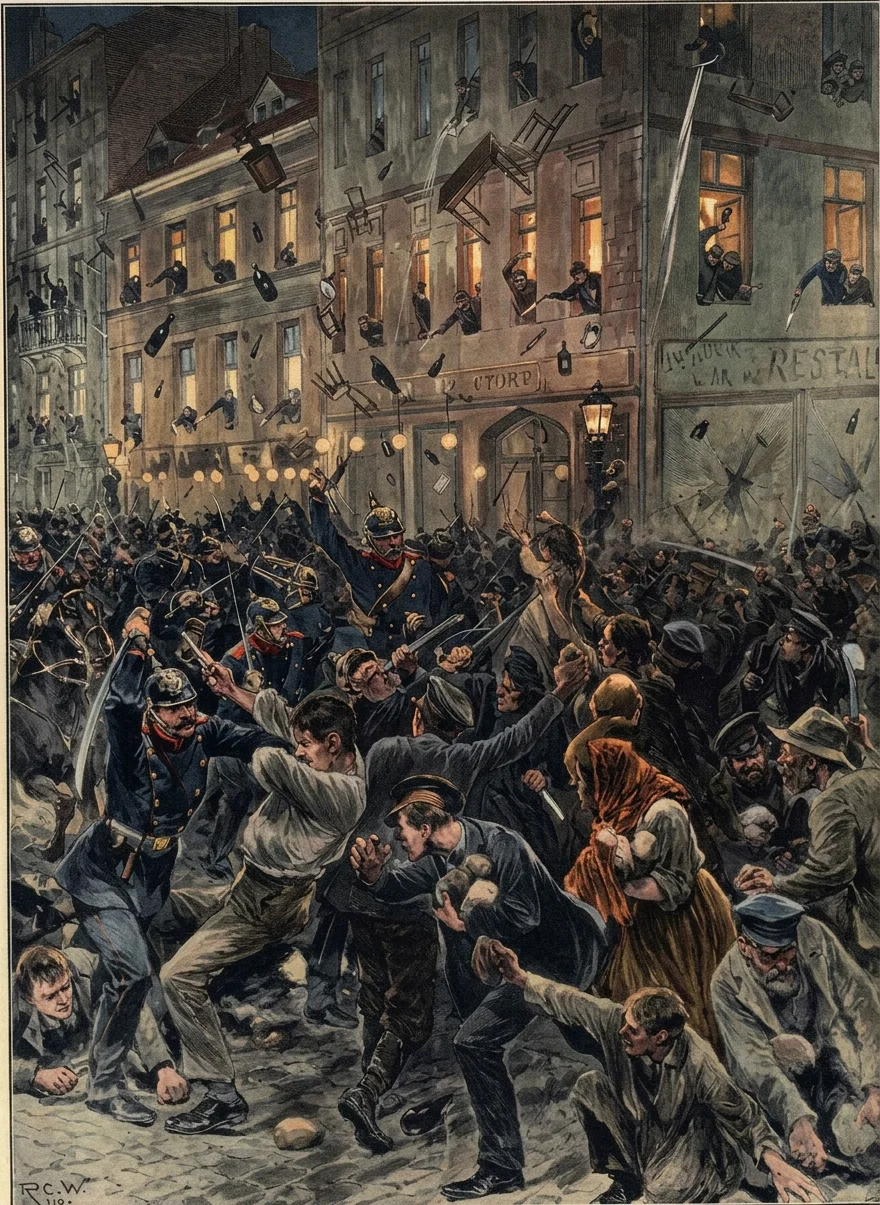
Photograph of a scene of rioting in Berlin, Germany, one of the strongest military countries in the world, and one of the best policed cities
IN the February (1911) "Everybody's Magazine" Mr. Frederick T. Martin, himself a millionaire, says in part: "The miserable excesses of society are an open book. I can not blind my eyes, nor deafen my ears, nor close my nostrils, and forget them. That decay has set in, I know; that it has struck deep, as yet I can not bring myself to believe." Mr. Martin goes on to state what he believes to have been the immediate CAUSE of the mad extravagance so glaringly prevalent in the society of the idle rich. "It was the magic of gold; it was the poison of idle wealth," he declares. "It was the curse of gold," he repeats, "no more, no less — the same poison that blighted the glory of Athens, that ruined the splendor of Rome, that brought upon Bourbon France the terror of the Revolution." He adds this significant declaration: "It is a melancholy fact that the impetus toward extravagance, excess, idleness, debauchery, and shamelessness comes to us from the underworld."
Less than a year ago an Italian scholar visited America. He gave to the public his impressions, and some of them are significant. For instance, he found that the wife of one of our millionaires wears a necklace that cost more than $600,000. Immediately following the birth of a son to this woman, a retinue of servants was formed for the sole benefit of the infant. Among those who made up this corps of retainers were four nurses and four high-priced physicians. The infant reposed in a ten thousand dollar cradle.
Embellishing a Five Million Dollar Palace
A money-king of the Middle West, wishing to make New York City his home, recently purchased for $2,000,000 the palatial residence of a deceased friend. The original cost of the palace was almost $5,000,000. The new owner expended $85,000 in embellishing the walls and ceiling of his bedroom, with carvings, enamels, and gold. Over the windows were suspended ten pairs of curtains that cost $2,000 a pair. The wardrobe in this famous room represents an outlay of $150,000; the dressing-table, $65,000; the wash-stand, $38,000; and the bed hangings cost fifty dollars a yard. The chimneypiece and the overhanging mantel and the four doors consumed a mere $18,000.
Somewhat more than a year ago one of the popular magazines published an article on "Luxurious Newport," describing conditions not only disgraceful, but even alarming. It is well known that for years the ultrarich and wantonly extravagant people of the North Atlantic cities have made Newport their summer rendezvous. Hence Newport is to-day the center of social conditions which in many of their aspects remind us of the wild and senseless prodigality that marked the decadent days of ancient Babylon, Greece, and Rome. The treasures of money that are wickedly wasted in spectacular display, in riotous luxury, and in more or less refined debauchery, stagger one's credulity.
Forty Thousand a Year for Clothes
We are reliably told that the typical woman of the Newport "smart set" spends $40,000 a year on her clothes, and that a "leading dressmaker" declares that $60,000 is not too high an estimate." Her dinner gowns represent $5,000; her shoes and stockings, $1,300; her hats and veils, $1,200; her handkerchiefs, $100 each; and so on. From $1,000 to $1,500 is frequently lavished on a single entertainment. One family owns fifteen automobiles, and spends $50,000 yearly on yachting. The average yearly expenditure of this "set" is $300,000 a family. Many a family, of course, spends far more.
The man "who can contrive some novel, stunning, and morally questionable means of enabling one rival, in this fierce competition, to outshine another, is richly rewarded." Invent something new in the way of food, costume, furniture, or equipage, which will stir these jaded prodigals with a new sensation, and you can sell it at your own price. "And so," writes the editor of the San Jose "Mercury," "the carnival of extravagance, pride, luxury, self-indulgence, and sensuality goes on, ever rising higher, wilder, and more furious."
We all know, too, that these regrettable conditions are not peculiar to Newport. They are most deeply rooted there, but they have spread over all Europe and America, wherever the idle rich have multiplied.
Not long ago a Southern millionaire bought an imported motor-car. The original cost was $12,000. He looked it over in scorn, and called in decorators. The car was completely refitted. It was equipped with a diminutive drawing-room, a sleeping-room, with hot and cold water fixtures, and space was found for even a small bath tub. A kitchen fully equipped with cooking utensils was added. And when the various mechanics completed their work, the car had been transmuted into a sumptuously furnished home on wheels. The first cost of $12,000 had been brought up to $30,000, and the owner was temporarily satisfied.
In the closing hour of an elaborate function in New York City, the guests leaned back languidly to listen to the singers. The cigarettes were11passed around. Up to that moment there had been nothing exceptional about the banquet; and as the host was famous for the startling novelty of his dinners, many of the guests were disappointed. Soon their disappointment gave way to admiration. "Each cigaret was rolled, not in white paper, but in a one hundred dollar bill, and the initials of the host were engraved upon each in gold letters. This strange conceit was applauded until the voices of the singers struggled amid the uproar."
A young millionaire of the Middle West owns a unique hat; it is made of greenbacks. Its cost was exceptional, as twenty thousand dollars in bills were used in making it. It looks precisely like the white hats worn by gentlemen. The owner, we are told, lacks imagination, and for that reason more involved methods of "burning" his money did not occur to him. Another young Croesus gave a banquet in honor of his small black and tan dog. The festivities were extremely gay. Of the invited friends, the men came in evening clothes, and the women bedecked in swishing silks and flashing jewels. In the midst of the gay festivities the host formally decorated his dog with a fifteen thousand dollar diamond collar. It was made up of seven hundred small brilliants. "The guests shouted their approval, and the dinner was regarded as a huge success."
As in the Latter Days of Rome
In the February (1911) "Scribner's Magazine," Prof. J. L. Laughlin tells his readers that during the past year diamonds to the value of $48,000,000 were imported into the United States. He says, "What is going on amongst us is not new; it is an outcome of rapidly growing wealth, like that in later Rome." He reminds his readers that the danger is not confined to those who have abounding wealth to spend. The passion for social position is almost universal; and the example of the rich who have low ideals is avidly followed by those who have meager incomes.
A London despatch to the American press, of date April 15, 1911, contained this significant bit of information: "Wearing precious heirlooms, diamonds and pearls, set in the buckles of their shoes, is the latest craze among smart, up-to-date women. Harem and the fashionable narrow-line skirts show so much of the feet that buckles are in great and increasing demand at present, and the woman who can afford real gems in her buckles is not content with imitation. She either has her buckles set with diamonds which she buys for the purpose at a cost of $250 to $1,500 a pair, or else she has her ancestral diamonds or pearls turned into shoe ornaments. 'There is a steady demand for real gem-incrusted buckles just now,' the manager of a large London firm of jewelers said, 'and I think the fashion will grow as the coronation draws nearer.'"
Half Million for Cigarets for New York Women Alone
The New York "World" informs its readers that in 1909 New York women burned up half a million dollars in the form of cigarettes. That is a pretty snug sum for the women of one city to send up in smoke in a single year. These figures are furnished by dealers, who cater particularly to women. One of them seeks no other trade. The "World" states that the reason for the astonishing increase of the smoking vice among women is simply this: "They took it up because it looks 'smart,' in much the same way that a small boy takes his first smoke. In much the same way it has grown on them, until now they are wrecking their nerves with nicotin, to say nothing of squandering great sums of money." Smoking is no longer a fad with many of these women; they must have their after-meal "pull" just as much as they must have their meals.
Thousands of women in the metropolis smoke fifteen to twenty cigarettes a day. We are told that in one of the fashionable shops which caters exclusively to feminine trade, the young woman who conducts the place sells to many a woman as many as ten thousand a year. The "World" correspondent gives the following estimate of what one fashionable woman will spend for smoking in a year: 10,000 cigarettes, with initial or monogram, at three dollars a hundred, $300; in-laid tabouret, $500; cigaret ring, $100; cigaret holder, $50; cigaret cases, $300; total, $1,250.
Thomas E. Watson, the noted writer on political and social questions, says that ten years ago the American people consumed three billion cigarettes a year, but that in 1909 they consumed eight billions. He says further, "In the rush for money, IN THE RUSH FOR PLEASURE, in the licentious indulgence of the lusts of the flesh, the whole nation seems to be plunging hellward."
Fifty Thousand to Save a Dog
The San Francisco "Chronicle," September 30, 1907, said editorially: "A widow, two maids, and a veterinary surgeon recently flew in a special train from Los Angeles to New York in the hope of prolonging for a short time the life of a dog which had already passed the allotted age of the cur tribe and was suffering from acute pneumonia. On arrival at New York the dog died, and is to have a monument." This trip involved an expenditure of $50,000.
How do the idle rich live? Principally, of course, by what is called rent and interest; that is, by the fruits of the labor and the abstinence of others, for which they return no equivalent. In the words of Professor Laughlin: "Wealthy women of to-day have come to regard work as demeaning. They would be mortified to be caught doing ordinary work in their households, which their mothers before them very likely did as a matter of course. Idleness has come to be a mark of social eminence. Whether a woman is properly to be included or not in 'good' society is almost decided by the fact that she takes her breakfast and spends her mornings in bed."
Is there not something radically wrong with society when 75,000 children in New York City alone go hungry to school every morning, notwithstanding the fact that there are 1,500 millionaires in that city? There are 10,000,000 people in the United States to-day who are not adequately fed and sheltered; that is, who are in poverty. "By poverty," says Jack London, "is meant that condition in life in which, through lack of food and adequate shelter, the mere standard of working efficiency can not be maintained."
Nations Overthrown by Luxuriant Vices
The overwhelming testimony of history is to the effect that every nation that has died, has died of the vices which are bred of wealth and luxury. In short, it was the reign of sin that killed them. That is the one lesson of history which needs heeding to-day. It was the wild extravagance, unbridled luxury, and arrogance of the rich of old Babylon and Rome that stirred the poor to frenzy and drove them to plunder the rich. Thomas Watson is convinced that "if something is not done to check the rising tide of discontent in this country, there will be the bloodiest struggle between the rich and the poor that ever drenched a continent with human blood." But in opulent old England and in pleasure-loving France the outlook is equally ominous.
Altho Mr. Watson had no thought of Holy Writ when he uttered the foregoing dark words, yet there is abundant Scripture warrant for his prediction. In the last chapter of his epistle, the prophet James declares: "Come now, ye rich, weep and howl for your miseries that are coming upon you. . . . Ye have laid up your treasure in the LAST DAYS. . . . Ye have LIVED DELICATELY on the earth, and TAKEN YOUR PLEASURE."
Again, the inspired Paul predicts: "But know this, that IN THE LAST DAYS grievous times shall come. For men shall be LOVERS OF SELF, lovers of money, . . . without self-control, . . . LOVERS OF PLEASURE rather than lovers of God." 2 Tim. 3: 1-4.
"Behold, this was the iniquity of thy sister Sodom; pride, FULNESS OF BREAD, and PROSPEROUS EASE was in her and in her daughters; NEITHER DID SHE STRENGTHEN THE HAND OF THE POOR AND NEEDY. And they were haughty, and committed abomination before Me: therefore I took them away as I saw good." Eze. 16: 49, 50. Sodom was in the days of Lot. Now note the prophecy of our Lord respecting our day: "Likewise even as it came to pass in the days of Lot; they ate, they drank, they bought, they sold; . . . but in the day that Lot went out from Sodom it rained fire and brimstone from heaven, and destroyed them all: after the same manner shall it be in the day that the Son of Man is revealed." Luke 17: 28-30. Is not the evidence conclusive that society is to-day repeating the sins of ancient Sodom? Will the harvest be different?
G. W. RINE.
War Prospects.
By Editor
The little European flurry has aroused a great deal of interest, or at least the daily papers are endeavoring to arouse a great deal of interest over it. Germany has been feeling that France is getting too strong a hold in Morocco; therefore she sent her ships and seized Agadir. This has stirred France, who is putting her men on a war footing, and it has also stirred England. Some have in consequence been predicting war, and we have been asked what we thought regarding it. The Signs of the Times is not looking for war at this time. "The Most High ruleth in the kingdom of men." God has a work to do in the earth. That work is set forth in many places in the Scripture, Rev. 7:1-3 among others. God is gathering out of this last generation all those who have any desire to serve Him, and will yield themselves to His own perfect plan; and His mighty invisible intelligences are holding the winds of strife until His work is finished. He will permit, in His own providence, no wide-spread, desolating war until His work is done. There may be local disturbances, local conflicts, such as passed between Russia and Japan; but these will only serve to hasten His work. These will invariably mean open doors to His missionaries and His truth. For this God is working; for this He permits these conflicts to take place. But the great, world-wide conflict, the great war of Armageddon, will not occur until God's work is done. But the great war preparations among the world-blinded nations will go on just the same, even as His prophet of old told us that it would. Joel 3:14-16.
The World-Wide Sunday Law.
For years this journal has predicted that there would be not only a national Sunday law, but a world-wide Sunday law, in which all the nations of the earth would join, and out of which would grow persecution. This position was taken upon the prophecies of God's Word, before there was any indication whatever that the powers of the world would yield to it. It was pointed out that the great European powers were hostile, that the United States loved liberty, and that the great heathen nations, like China and Japan, would be wholly opposed to such a measure. But America is yielding step by step, the European powers are more or less in harmony with it, and a despatch dated May 11 from Peking, China, declares that an imperial edict declaring that beginning May 14 the Chinese shall observe Sunday as a day of rest, has been promulgated. Faith in the Word is becoming fact in history.
The "New York American" says that "some whisky is advertised without a headache, but no Munchhausen goes so far as to advertise any without a heartache." In fact, every brand is full of it.
LETTERS TO A YOUNG MAN
BY A YOUNG MAN
VIII. The Secret of Knowing—The Awfulness of Sin
MY DEAR ROBERT,—
The mystery of life will never be fully solved this side the grave. There is solemn truth in the scripture, "God is great, and we know Him not." But there is also truth in the noble saying of Paul, "I know whom I have believed, and am persuaded that He is able to keep that which I have committed unto Him against that day." God in His infinity of glorious power we who are finite may not know; but God as our own loving heavenly Father, who knows and supplies all our wants, and who is willing and able to do exceeding abundantly above all that we can ask or think,—such a God we may know most intimately, and in that knowledge be truly happy.
The secrets of the universe that some men trouble over, can best be solved in the secret of His presence. Men must love sacred things, at least in some degree, before they can understand them. They must assume a humble attitude, the attitude of a learner, if they would have a revelation from Him who dwells on high in the heavens, but also in the hearts of the lowly.
It can not be too strongly insisted upon, that the humble inquirer can not in the nature of things be turned away. There never yet lived man or woman who sincerely felt after God without in some degree finding Him out; and usually the more humble and persistent the search, the greater the illumination. The Bible puts the whole thing in one little verse: "This poor man cried, and the Lord heard him, and saved him out of all his troubles." He "cried." That means something more than offering up a conventional prayer, that comes from the lips only. He was a "poor man," and cried out of the depths of his poverty; his heart went out in that prayer, the whole power of his being was wrapped up in it, and the cry was heard and answered. Verily the prayer of faith shall save the doubter far more than thousands of books or sermons on the evidences of Christianity or the inspiration of the Bible.
It is this earnest seeking after the things of the Spirit, that is so sadly lacking in the life of to-day. Men are not lifting up their hands to heaven; they are not asking, "What must I do to be saved?" Publicans are not offering the prayer, "God be merciful to me a sinner." Men are trying to forget that they are sinners; and in this their attitude of mild indifference,—"broad-mindedness" is the term some apply to it,—they are rapidly drifting into a condition of doubt as to the very existence of God.
The cure for such a condition lies in the blessed invitation, "Taste and see that the Lord is good." "Prove Me now," are the words of God Almighty. "Look unto Me, and be ye saved, all the ends of the earth."
And, of course, back of this looking to the Lord for salvation, must lie some sense of what one is to be saved from, some sense, in other words, of the true character of sin. Next to his prayer for the divine favor, let the young man pray, and that most earnestly, that sin may appear to him exceeding sinful, may stand out in all its dark, lurid colors, as the thing that leads to death.
The thought sometimes comes to the young man: "What matters it if I sow a few wild oats? Other men have done so in their youth, and they are good men now, and looked up to. A certain amount of dissipation belongs to the period of youth. A young man of spirit can not avoid it."
All such reasoning is wholly deceptive; it proceeds from elementary ignorance of the nature of sin and the consequences of sin. In the first place, it is of the nature of sin to defile, to separate from God and good, and to bind with chains that can be broken only with great difficulty, humanly speaking, often not at all. It is like descending into an underground palace, provided, no doubt, with many a gilded chamber, but also with gloomy dungeons that have bolts and bars. No, the young man may go into sin of his own free will; but he doesn't come out of it so easily. Coming out means a terrible conflict. Yes, and even when the conflict is successful, the marks of sin remain. "A cut limb may be cured," wrote Drummond, "but the scar remains forever. An earthquake is over in three minutes; but centuries after, the ground is still rent into gulfs and chasms which ages will never close. So the scars of sin on body and mind and soul live with us in silent retribution upon our past, and go with us to our graves."
One of the deeply sad things in life is that an evil act once committed can never really be recalled. An hour foolishly spent never comes back to be spent wisely. An opportunity neglected never presents itself a second time at the same door. Other opportunities may come, thank God, but never that identical one. And the wrong done in one moment of lightness and frivolity, or one moment of anger, may be lamented for many years thereafter, but not undone.
"Take my influence," cried a repentant sinner on his death-bed; "take my influence and bury it with me." But the thing was impossible. For centuries after a man dies, his influence lives on for good or for ill; yea, it never really dies. This is according to the laws of the universe, and it makes life wondrously solemn.
Because sin defiles the soul and is infinite in its evil consequences, the young man is urged everywhere in Holy Scripture to keep himself from it. "Keep thy heart with all diligence; for out of it are the issues of life." "Enter not into the path of the wicked, and go not in the way of evil men. Avoid it, pass not by it, turn from it, and pass away."
And the best way to avoid the evil, is to do the good. Be a full-blooded Christian. Don't try Christianity of the half-and-half kind; there is no satisfaction in it. Put youthful enthusiasm into your service for Christ. Be in earnest about it. Follow hard after righteousness; it is the only way to attain it.
What infinite beauty in a life that is moment by moment in touch with the divine, a life that is molded after the heavenly pattern, one in which the very tones of the voice are under gentle restraint, that they may rightly represent the Master. Such a life breathes a heavenly influence, renewing itself daily from God, and flowing out in kindness to earth's needy children. Such a life is its own reason for existence, and it bears the most powerful testimony that can be borne to the wisdom and love of the Creator.
These, dear Robert, are some of the thoughts that come to me as I contemplate the dangers and the opportunities of the young man who is trying to be a Christian, and who wishes his life to tell for good. May you continue to be alive to your opportunities, and may you quickly turn aside from temptation, is the prayer of your friend, L. P.
Do It Well
A JOB slighted because it is apparently unimportant leads to habitual neglect, so that men degenerate, insensibly, into bad workmen.
“That is a good rough job,” said a foreman in our hearing, recently; and he meant that it was a piece of work not elegant in itself, but strongly made and well put together.
Training the hand and eye to do work well leads individuals to form correct habits in other respects, and a good workman is, in most cases, a good citizen. No one need hope to rise above his present situation who13suffers small things to pass by unimproved, or who neglects, metaphorically speaking, to pick up a cent because it is not a dollar. Some of the wisest lawmakers, the best statesmen, the most gifted artists, the most merciful judges, the most ingenious mechanics, rose from the great mass.
A rival of a certain lawyer sought to humiliate him publicly by saying, "You blacked my father's boots once." "Yes," replied the lawyer, unabashed, "and I did it well." And because of his habit of doing even mean things well he rose to greater.
Take heart, all who toil! all youths in humble situations, all in adverse circumstances! If it be but to drive the plow, strive to do well; if only to cut bolts, make good ones; or to blow the bellows, keep the iron hot. It is attention to business that lifts the feet higher up on the ladder.—Anon.
She Was Very Commonplace
By A. J. Waterhouse
She was not “emancipated,” and nobody termed her “new,”
And I’m really pained to mention that from clubs she quite withdrew.
She could hear the name of Browning with no sign of soulful sighs,
And that she had read her Shakespeare she would rarely advertise.
She had culture, but of “culchah” she was shy, I’m grieved to state;
And I’ve seen her wear a costume that was three weeks out of date.
“Bridge?” she said. “I think that gambling is a sin and a disgrace.”
O, I may as well admit it,—she was very commonplace.
But you should have seen her children as they nestled by her side;
And you should have seen her husband as he gazed on her with pride;
And I have a little notion, as they looked on her dear face,
That they never once suspected she was very commonplace.
She was not “emancipated,” but she toiled to bless her brood,
Quite forgetting sighs for Browning, as she labored for their good.
She was somewhat short on “culchah,” but she was so long on home
That her husband and her children never cared from thence to roam—
Never cared for crimson blossoms that the primrose path supplies,
Since they found the greatest pleasure in the lovelight in her eyes.
Full content with humble duties unto which love added grace—
O, it must be quite apparent she was sadly commonplace.
Quite old-fashioned! Yet for love of one whose mem’ry we recall,
With a tear that half is starting and is half inclined to fall,
Let us thank our God, my brothers, of the morn we left behind,
That He gave to us dear mothers of the good old-fashioned kind.
—A. J. Waterhouse, in “California Weekly.”
Story of Pitcairn Island
Told by a Native Daughter
THIS fascinating story begins with the mutiny on the sloop-of-war Bounty in 1789, when Captain Bligh was dragged from his bed and cast adrift in an open boat with eighteen unfortunate companions.
From murderous mutineers to peaceable Christians, faithfully observing the commandments of God, is the wonderful history of the settlement of Pitcairn Island by the Bounty's mutinous crew.
In simple but beautiful language the writer of this tale, Miss Rosa Young, a native daughter, unfolds the story of love and hate, crime and its punishment, and the development of a happy race of islanders.
266 pages, tastily bound in cloth. Price, post-paid, $1.00
Pacific Press Publishing Association
Mountain View, Cal.
Portland, Ore. Calgary, Alberta Kansas City, Mo.
Colds.—By G. H. Heald, M.D. A treatise on the causes, prevention, and cure of colds. White leatherette binding. 58 pages, 25c.
Address this office.
Thoughts from the Mount of Blessing
By Editor
Thoughts from the Mount of Blessing.—An exposition of Christ's Sermon on the Mount. It has 218 pages and six chapters: On the Mountain-side, The Beatitudes, The Spirituality of the Law, The True Motive in Service, The Lord's Prayer, Not Judging but Doing. A new edition just printed on fine enameled paper, new type, and reillustrated with 27 beautiful half-tone engravings specially prepared for the book by eminent New York artists. It will be found full of comfort and blessing by all fortunate enough to obtain and read it. A beautiful gift book. Fine cloth cover, 75 cents.
"Exceedingly Valuable"
"I received a copy of 'Questions and Answers.' . . . I have given it a very careful examination, and consider it an exceedingly valuable book to be placed in the hands of our people. I would like to see a copy of it in every Adventist home. We will do what we can in this conference to encourage our people to secure it."
"Perhaps I can best express my idea of the desirability of such a book by saying that for some time before the notice of its publication was sent out, I had been cutting out the Query Department of the 'Signs,' with the idea of later classifying and putting them in some permanent shape for reference. Now I have been saved that labor, and have something better than I could have arranged."
"I received the little book 'Questions and Answers.' . . . From what little examination I have been able to give it so far, I consider it a valuable little help. . . . We have appreciated the 'Signs of the Times' very much in our field, and believe the Lord is using the same to lead men and women to accept the third angel's message."
"The new book 'Questions and Answers' came to my desk a few days ago. I have always been a very interested reader of the Question Corner of the 'Signs,' and receive this book with great pleasure. I am much pleased with the general make-up of the book and the way the questions are arranged by subjects."
" . . . My appreciation of the little book 'Questions and Answers,' which came to hand a few days ago. At the recent ministerial institute at Philadelphia, one of the most valuable features was the question box; and I have found in conducting conventions, that the question box was one of the most interesting and best appreciated parts of the program. I think that the idea of gathering and classifying the questions and answers that have been appearing in the 'Signs' is a splendid one, and I am sure that all will find such a book a very valuable help. There is danger that a writer, as well as a preacher, may say a great deal without really touching some vital point that may be troubling the people. 'Questions and Answers' is where they can ask for what is wanted and get it."
"Can ask for what is wanted and get it."
See ad in another column
IN THREE DAYS
SAN FRANCISCO
Overland Limited
TAKES YOU
To Chicago
ACROSS GREAT SALT LAKE
AND
HIGH SIERRA BY DAYLIGHT
Luxurious High-class Equipment
Electric Lighted Throughout
Pullman Drawing-room
Stateroom
Vestibuled Sleeping-cars
Careful and Attentive Dining
Service
Parlor Observation-car with
Library and Cafe
Ladies' Reading-room
Gentlemen's Smoking-room
Daily News Bulletins
Latest Papers and Magazines