This season of prayer has been appointed, as no doubt all know, for December 12-19. We have held many such seasons in the past, but this season of seeking God with prayer is more important than any previous one.
“We are standing upon the threshold of great and solemn events. The whole earth is to be lightened with the glory of the Lord as the waters cover the channels of the great deep. Prophecies are being fulfilled, and stormy times are before us. . . . The angels are holding the four winds, that they shall not blow, until the specified work of warning is given to the world; but the storm is gathering, the clouds are loading, ready to burst upon the world, and to many it will be as a thief in the night.”
“Intensity is taking possession of every earthly element; and as a people who have had great light and wonderful knowledge, many of them are represented by the five sleeping virgins with their lamps, but no oil in their vessels; cold, senseless, with a feeble, waning piety.”
In these solemn hours what are we called upon to do? “Gather yourselves together, yea, gather together, O nation not desired; before the decree bring forth, before the day pass as the chaff, before the fierce anger of the Lord come upon you, before the day of the Lord's anger come upon you. Seek ye the Lord, all ye meek of the earth, which have wrought his judgment; seek righteousness, seek meekness: it may be ye shall be hid in the day of the Lord's anger.” Zeph. 2: 1-3.
“Gather the people, sanctify the congregation, assemble the elders, gather the children, and those that suck the breasts: let the bridegroom go forth of his chamber, and the bride out of her closet. Let the priests, the ministers of the Lord, weep between the porch and the altar, and let them say, Spare thy people, O Lord, and give not thine heritage to reproach, that the heathen should rule over them: wherefore should they say among the people, Where is their God?” Joel 2: 16, 17.
“Come, my people, enter thou into thy chambers, and shut thy doors about thee: hide thyself as it were for a little moment, until the indignation be overpast. For, behold, the Lord cometh out of his place to punish the inhabitants of the earth for their iniquity: the earth also shall disclose her blood, and shall no more cover her slain.” Isa. 26: 20, 21.
Shall we heed these invitations of mercy, all of which are applicable to our time?
“For the baptism of the Holy Spirit, every worker should be breathing out his prayer to God. Companies should be gathered together to call upon God for special help, for heavenly wisdom, that the people of God may know how to plan and devise and execute the work. Especially should men pray that the Lord will choose his agents, and baptize his missionaries with the Holy Spirit. For ten days the disciples prayed before the pentecostal blessing came. It required all that time to bring them to an understanding of what it meant to offer effectual prayer, drawing nearer and nearer to God, confessing their sins, humbling their hearts before God, and by faith beholding Jesus, and becoming changed into his image. When the blessing did come, it filled all the place where they were assembled; and endowed with power, they went forth to do effectual work for the Master.”
This season of prayer will give just such an opportunity as the Bible and the Testimonies point out in the statements already quoted. Shall it be a pentecostal blessing to us? If so, we must seek the Lord as did the disciples of old. Can we afford to do less? Do we have a less important message to bear to the world than they had?—No; even a more solemn warning is committed to our hands. The truth as it came from the hands of Christ and the apostles in its purity, and with apostolic power, must be sent to the whole world in this generation to enlighten the earth with the glory of God, and prepare a people for his coming.
Shorn of the strength of heaven, we cannot do the work. But God has said again to his people, “Arise, shine; for thy light is come, and the glory of the Lord is risen upon thee. For, behold, the darkness shall cover the earth, and gross darkness the people: but the Lord shall arise upon thee, and his glory shall be seen upon thee.” Isa. 60: 1, 2. If we consecrate all that we are and have,—ourselves, our means, our ability,—God will use us in the glorious triumph of the message at this time. Again I say, shall not this season of prayer be the time when we shall do all this more fully than we have ever done before? We pray God that it will.
The Week of Prayer
By R. C. Porter
R. C. PORTER
The times are perilous. Every day brings its tests of faith to the child of God, and along with the test of our faith the news of the strife between capital and labor, terrible train wrecks, storms, earthquakes, pestilence, or other fulfilments of the prophetic word which declare that the coming of the Lord draws nigh.
One special feature of the last days is the spirit of worldliness that shall so insidiously creep in that it will take men unawares, and they will be found eating and drinking, planting and building, just before the coming of the Son of man, as they were in the days of Noah and of Lot. There is danger that this condition of things in the world may steal in upon the church so that they will become indifferent to the times in which they live, to the dangers of the hour, and the important work to which God has called them. “Rich, and increased with goods,” and having “need of nothing,” are the words used by the True Witness in speaking of the condition in which the church just before the Master’s coming regards herself. Overcharged “with the cares of this life,” “lukewarm,” “neither cold nor hot,” “wretched, and miserable, and poor, and blind, and naked,” is the true condition of Christ’s professed church when his coming is at the door, and he is making his final appeal through it to save the world from the seven last plagues, and the awful calamities that attend his coming. How pitiful the sight!—Christ who came from all the endearments of heaven to save a lost world, animated during his entire life with the one all-absorbing12thought of living to save the lost, his life to be henceforth the example of his people, and now, in the very closing call of the great missionary plan which he set on foot to save the world, he finds this terrible apathy settling down upon his people, through whom alone he can work in making his final plea to a lost world.
How pathetically he pleads for a reformation: “I know thy works, that thou art neither cold nor hot: I would thou wert cold or hot. So then because thou art lukewarm, and neither cold nor hot, I will spew thee out of my mouth. . . . I counsel thee to buy of me gold tried in the fire, that thou mayest be rich; and white raiment, that thou mayest be clothed, and that the shame of thy nakedness do not appear; and anoint thine eyes with eyesalve, that thou mayest see. As many as I love, I rebuke and chasten: be zealous therefore, and repent. Behold, I stand at the door, and knock: if any man hear my voice, and open the door, I will come in to him, and will sup with him, and he with me. To him that overcometh will I grant to sit with me in my throne, even as I also overcame, and am set down with my Father in his throne. He that hath an ear, let him hear what the Spirit saith unto the churches.” In this last rallying call to preparation for service before we are invited to sit with Christ in his throne, how full of meaning is that plea: “If any man hear my voice.” The entire professed church of the last days will not hear it. We can not look one to another for an example in these days of lukewarmness. Every soul must come directly to Jesus, and in loving submission repent and be clothed for service, or be spewed out of his mouth. This solemn and decisive call is an evidence of the deepest love. Nothing less than this will save his people. Their eyes must be anointed that they may see the needs of their own hearts and repent, or they will be lost.
They will, if spiritual, see the needs of foreign fields, and hear the cry of the millions in the darkness of heathen lands, which the third angel’s message alone can enlighten. Every soul is now on trial. The Lord is giving us financial prosperity,—not that we may acquire money or property for the troublous times before us when we can not use it, or for the fires of the last days, but for the advancement of his work. “Let him that thinketh he standeth take heed lest he fall.” The adversary will deceive if possible the very elect.
Do we not need the benefit of a week of prayer at this time to consider our personal needs, and consecrate ourselves, our talents, our means, and all there is of us to the work of the message, which is on the very eve of final triumph? We can not afford to sacrifice sufficiently formally to accept the message and not surrender all for Christ, and so fail at last. Let us be wise and heed the instruction and counsel of the Faithful and True Witness, awake to the call to service, and at last as overcomers sit down with the Master in the enjoyment of the dominion of universal “peace, good will toward men.”
“Seek ye the Lord, all ye meek of the earth, which have wrought his judgment; seek righteousness, seek meekness: it may be ye shall be hid in the day of the Lord’s anger.”
Obeying the Word
The foolishness of God is wiser than men, and the weakness of God is stronger than men. It was when Christ was rejected and slain that he triumphed. As long as men were following him, applauding his sayings and his mighty works, desiring him for their king, he seemed powerless to help them. They misunderstood all his teaching. When they had murdered him, he had a new hold on them. He showed them at once both the greatness of his unconquerable love and the blackness of their own hearts. They saw with new eyes. At last they understood him, and they understood themselves.
It has been the same in the history of the church. What Christians have not been able to do by their toil and effort, they have accomplished by laying down their lives. The blood of the martyrs has been the seed of the church.
The weapons of our warfare are not carnal. By the cross Christ overcame, and the carnal indifference of men can only be conquered by spiritual lives, revealing afresh the dying of the Lord Jesus. It is natural to crave for the outward tokens of success in Christian work, but God works in ways that are despised by men. The cross, which is the power of God to faith, is foolishness and a stumbling-block to the wise of this world.
We need not be deceived as Israel was. If we set Jesus Christ continually before us and seek for spiritual anointing, our eyes will be opened. While we receive his Word as a quickening power, our ears will not be heavy. But God's servant must be blind and deaf toward earth if his eyes and ears are to be open toward heaven. He must either be of the earth, earthy, or of heaven, heavenly.
God is still sending forth his Word, his commandment, which is life everlasting, but it is falling again upon deaf ears and blinded eyes. Many see that God's Word rebukes their lives, that they are not keeping his spiritual Sabbath which teaches them to trust only in God, but honoring the works of the flesh in obeying rather the commandment of men. Many believe the Word in their hearts, but their eyes are on the synagogue out of which they will be thrust if they venture to differ from others, on the situation they fear to lose if they do not work on the seventh day. They have heard the commandment of God, but they are listening rather to the myriad human voices, the traditions of the elders, the theories of ministers, the counsels of worldly wisdom. They are treading again the path that Israel trod. Their feet are wandering from the way of life, and drawing near the darkness where Satan has control of men. “Yet a little while is the light with you. Walk while ye have the light, lest darkness come upon you: for he that walketh in darkness knoweth not whither he goeth. While ye have the light, believe in the light, that ye may be the children of light.”
“The flesh profiteth nothing.” Jesus said, “He that believeth on me, believeth not on me, but on him that sent me. And he that seeth me seeth him that sent me.” God was in Christ, reconciling the world unto himself. Christ knew the Father, and his one ambition was to be God's messenger, to give to others the word which God commanded him to speak. That word was his own life, for he lived by every word which proceeded out of the mouth of God.
The Word would save every one who received it, and those who rejected it must answer to it at the last day. Christ was sent with the Word to save, not to judge, only to give light that men should not abide in the darkness. The man who rejects light has condemned himself to be in darkness.
When the rejecters of God's Word come to the judgment of the great day, it is the Word they have heard and despised that condemns them. They have forfeited eternal life, and when they long for it exceedingly, they see that it was they who cut themselves off from it by not receiving the Word that brought it to them as a free gift. The service of Christ, the joy of the redeemed, a home in heaven, the companionship of the angels, all appeal to them as they never thought they could, but all these they deliberately rejected when they turned from the Word of Christ. Now their portion is in the outer darkness where there is weeping and gnashing of teeth.—Present Truth.
The Sheep That Was Lost
ON the Aleutsch glacier I saw a strange and beautiful sight—the parable of the “ninety and nine,” repeated to the letter. One day we were making our way with ice-ax and alpenstock down the glacier, when we observed a flock of sheep following their shepherd over the intricate windings between the crevasses, and so passing from the pastures on one side of the glacier to the pastures on the other. The flock numbered two hundred, all told.
But on the way one sheep got lost. One of the shepherds, in his German patois, appealed to us whether we had seen it. Fortunately, one of the party had a field-glass. With its aid we discovered the sheep up amid a tangle of brushwood on the rocky mountainside.
It was beautiful to see how the shepherd, without a word, left his hundred and ninety-nine sheep out in the glacier waste, knowing they would stand there still and perfectly safe, and went clambering back after the lost sheep until he found it; and he actually put it on his shoulders, and returned “rejoicing.”
Here was the Lord’s parable enacted before our eyes, though the shepherd was all unconscious of it. And it brought our Lord’s teaching home to us with a vividness which none can realize but those who saw the incident.—“Leaves of Light.”
A Message From Chile
By H. F. Ketring
H. F. KETRING
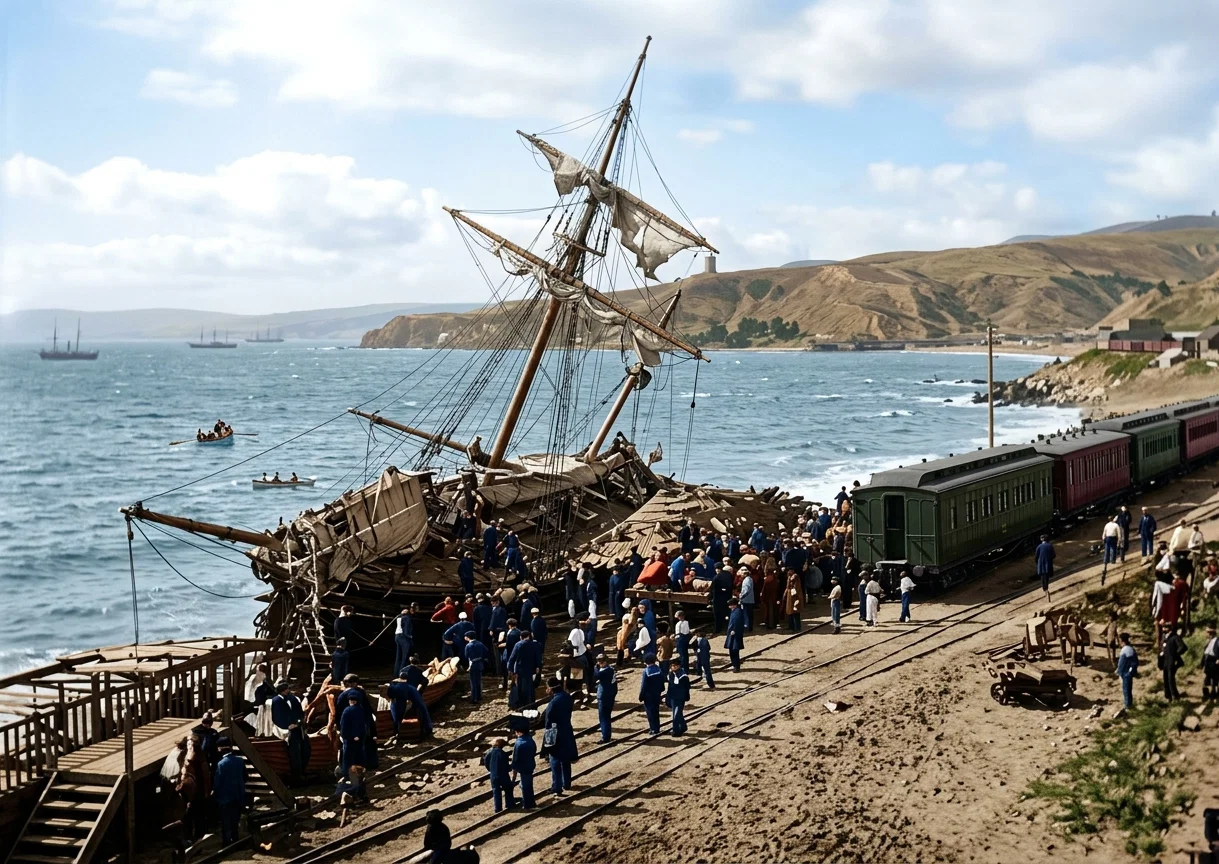
THE “FOYLEDALE” AFTER THE STORM
MAY 19 I left home, to make a trip north, to visit the churches and scattered members. The twenty-sixth I reached Valparaiso, where we have a small company of believers, and where our Spanish minister, Elder Balada, is located. There we had some very interesting meetings, further instructing them in the truth.
June 1 was a day long to be remembered by the people of Valparaiso. For several days the sea had been very restless, but the night of the thirty-first of May a terrible tempest arose, and the sea rolled into the shelterless harbor as if it would engulf the whole city. All night long the sea raged like a boiling pot. The wharf, which was over a mile long, was entirely destroyed, while merchandise of every description was either washed into the sea or many squares back into the streets of the city. The fury of the storm may be faintly imagined from the fact that the waves reached the fourth story of the houses on the street facing the harbor.
During the night many of the steamers cut their moorings, and went out into the ocean, fearing less the broad Pacific, which was no less turbulent, than the ship-filled harbor.
But the “Arequipa,” one of the largest Pacific steamers, by some means had her anchor chains crossed, and was unable to leave. Finally, getting crossways with the waves, the fury of which was terrible, she succumbed, and went to the bottom with passengers and crew. A few were picked up by the other ships. She was ready to leave for San Francisco, and should have left that day but for the storm.
In the accompanying illustration we have a view of the “Foyledale,” an English sail ship, which was torn from her moorings, and washed up against the wharf, where she was dashed to pieces. The crew at last climbed the rear mast, the only one left, from which, after frantic efforts, eight of them were rescued by the life-saving crew, the rest having been washed out, including the captain’s wife and little boy. The ship in the distance also met a similar fate.
As we see these omens of the greater destruction that is so soon to come upon the dwellers on the earth, should we not consecrate our all to God in order that his work of warning the world be not hindered, but go with a mighty power to the ends of the earth?
June 9 I left Valparaiso for Los Andes, in company with Brother Balada. Los Andes is a beautiful city, high up in the Andes Mountains on the way to Buenos Ayres, Argentina. From that city we walked about twelve miles farther up into the mountains to visit a company of believers.
As it was nearly dark when we arrived at Los Andes, the most of our journey on foot was made by moonlight. While climbing up through the canyon, we thought of the Waldenses in their mountain homes, and wondered how soon we, like them, would have to make our “place of defense” in “the high places of the earth.” We remained with the brethren in Los Andes for several days, during which time several obtained the victory over the “mate” habit, and we all rejoiced together.
We next went to Santiago, and spent some time with the church at that place. We then visited the scattered brethren and sisters in different places.
The work is advancing, perhaps as rapidly as could be expected with so few workers. Pray for us, and if the Lord should answer your prayers by telling you to come, or to give to help some one else to come and help us, thank him that he hears and answers prayer.
Iquique, Chile.
The Chinese Women
By Hattie Howell
MRS. HATTIE HOWELL
The women of Asia are prisoners for life. Be they members of Mohammedan harems, of Indian zenanas, or of households in that still more remote Eastern country whose people number one third of the inhabitants of the globe, be they simply born in Asia, their only escape from sorrow and misery, loneliness and desolation, ignorance and narrow-mindedness, superstition and pollution, which the birthright of the Orient entails upon them, is through the sometimes early, but frequently too tardy, and often much-coveted and self-induced death. They are, one and all, captives of crushed and broken spirits.
That which every Eastern woman is taught to regard as the goal of her existence, is her wedding day, no less inevitable in China than in the remaining Asiatic countries.
Entering upon her married estate with a “certain fearful looking for” of the “afterward,” she finds the troubles of her girlhood aggravated by her new surroundings, which already begin to add their own burden of afflictions to her heart. A Chinese girl of twenty-one or twenty-two years, who is unmarried, is not only herself disgraced, but she is as well a disgrace to her father and mother; and after that, so questionable does her character become in the eyes of her countrymen, that it is with difficulty a husband may be secured for her. The girls of China are usually married before they are eighteen, to men, one, two, or three years their senior.
The age of their betrothal is variable. Among the poor, a baby girl one or two years, or even a few days, old is not uncommonly sold into the family of her future husband, where she is cared for until considered of a suitable age for marriage with one of the sons. In circles more well-to-do, little girls, though not bargained for and sold as a financial burden too heavy to be borne by the parents, are, if permitted to live, betrothed from one to twenty years before their marriage.
On the one hand, her parents want to be rid of her, and yet if possible, obtain a son-in-law of education and influence. On the other hand, the young man’s family select a wife who they think has capacity and training for work, in consequence of which it not infrequently happens that when a servant is wanted—for such does every daughter-in-law become—a buxom girl of twenty is married to a boy half her age.
Suicide among the young married women of China is so excessively frequent that it is scarcely a matter of remark. When the young wife is discovered,14and rescued from her suicidal attempts, she often meets the pitiful reproach from her mother, “Why didn’t you die when you had a chance?” Perhaps the daughter-in-law lives on till the day when she, too, may become a mother-in-law, her sons having grown up and brought home their wives; and thenceforth in the increasing household of children and grandchildren, her will is supreme. But have the sorrows and hardships allotted her by the unkindness and cruelty of her husband’s mother, softened and fitted her to mitigate the mental and physical sufferings of her daughters-in-law? How unvarying the law that the human heart does to others as it has been done by!
Now as best you can, picture to yourself our Chinese sister as she really is, or as circumstances make her. During the long months before her birth, it is hoped she is not “a girl.” When it is known that a little daughter is in the house, no loving hearts receive her. The father is disappointed or enraged, and the mother bemoans the birth of one whose lot must be so sorrowful. A daughter is rarely ever welcome in China. Infanticide in the past was so prevalent that in the homes of the poor only one or two girl babies were saved, the others being drowned, left to starve by the wayside, or thrown into the baby towers prepared for little foundlings. Wealthy families treat similarly the little girl who unfortunately comes to their home, and simply—because they do not want her. Many times rather than have the father take the child’s life (for it is he who commits the deed), the mother pleads that the child be sold as a slave. Poor little children! born without love—die without love. Many a Chinese woman can say at her death, “No one ever loved me.”
When only a few years old, the child’s mother inflicts upon her the most terrible torture, loosening, and wrenching, and twisting the ligaments of the baby feet, and crushing the bones into a stylish and beautiful stump, while she regards not the days and nights of shrieks and wails from the little one, which finally die away into a prolonged and breathless succession of groans.
From her infancy to her marriage, the little girl leads a shut-in life in the narrow confinement of her own home, though really there are few homes in China. The architecture of our houses does not enable us to conceive of the dinginess and cheerlessness of the ordinary Chinese house.
As every phase of life in China is closed about with ceremonies, forms, and customs, so the day of the maiden’s wedlock demands that she and her mother weep. But I am quite sure tears are seldom feigned on that occasion; no doubt they are usually the overflow of sad and trembling hearts.
One of our students was once telling us of the feastings and festivities connected with the marriage of his sister, when we inquired of the bride. “O, lief she lie on the bed and cry,” was the reply; and the story of her lying there in tears, for a week, was told by her own brother without the least sign of pity or sympathy.
The Chinese are characteristically insensible to the sufferings of others.
Among all classes of Chinese—high and low, rich and poor—the opium habit is making fast inroads. In the social life of the men, it holds about the same place as does wine in America. But among the women of China, the habit is acquired through its use to assuage their sufferings and beguile their sorrows, while not a few seek death by it. Thousands of Chinese children are being born slaves to the drug.
The rapidly wide-spreading use of opium, together with ancestor worship, are counted two of the most formidable obstacles to the spread of the gospel in the Chinese empire. And because of the latter of these hindrances, many think that the most successful efforts can be put forth for the women of China. She, the matron of her house, whose will is implicitly obeyed by her sons and daughters, is the one who instructs them in the religion of their fathers. By her, in the retirement of their own home, the children are taught to worship the dead, and to bow before the ancestral tablets. From earliest infancy they are not only steeped in the smoke of tobacco and opium, but also in the fumes of the incense burning before some household god, in his niche.
When the bastiles of the women of China are stormed by the missionary, there will, through his followers, be a literal fulfilment of Christ’s mission to earth; for it was foretold of him that he would “proclaim liberty to the captives, and the opening of the prison to them that are bound.” Isa. 61:1.
Thus far in the history of missions, work has been done almost exclusively for the poor; for the missionaries have been unable to break through the impenetrable barriers built about the Chinese ladies. Of course none but women can work for women, and it seems that the consecrated medical woman has the readiest access to the courts, and consequently to the hearts of the women. What the Christian physician discloses concerning the cruelties and barbarities inflicted upon the inmates of these homes is very little known in the outside world. The ailments of women and children in China are considered unworthy of notice, and are allowed to run on, until the maladies become chronic. In case of malignant and contagious diseases, nothing is done for the sick person, he being, in nine cases out of ten, shut up and locked within a room, with only a vessel of water by his side,—there to die. Occasionally his friends unbar the door enough to prod him with sticks, in order to ascertain whether he is alive,—all this because so great is their fear and dread of the tormenting devils, whom they are reported to hear muttering from every article of furniture in the sick room. Relying quite fully upon charms and superstitious customs for the relief of disease, as they do, it seems as if the message of Christ—“Daughter . . . be whole of thy plague”—has more of meaning for them than for us.
O my sisters in Christ, are not some of you longing to devote your lives to carry the news of redemption to some of these poor souls, who with us are “prisoners of hope”? See Zech. 9:12. Would it might be that “the women who publish the tidings are a host;” for unto the Chinese woman is the word: “Shake thyself from the dust; arise, and sit down, O Jerusalem: loose thyself from the bands of thy neck, O captive daughter of Zion.” “For the Lord hath called thee as a woman forsaken and grieved in spirit.” “In a little wrath I hid my face from thee for a moment; but with everlasting kindness will I have mercy on thee, saith the Lord thy Redeemer.” Isa. 52:2; 54:6, 8.
Mission Notes
A MOST urgent appeal has been received from Brother E. W. Thoman, of Chile, for additional laborers for that destitute field. Since Brother A. R. Ogden has been compelled to retire on account of Mrs. Ogden’s ill health, only one American laborer is left in the field. Brother Thoman reports the conversion of a minister who has been in the field for a number of years.
REPORTING the arrival of the nurses in Japan, Dr. Lockwood writes: “I can not tell you how glad we were to welcome them here. It did seem almost impossible that they should come on the boat sailing from Vancouver, October 5. We are truly grateful to the Mission Board and others in America for the effort put forth to hasten their coming. Their arrival means more to us and the work here than a car-load of equipments; nevertheless, we need the equipments, also.”
A MISSIONARY family indeed is that of Mr. and Mrs. B. Broomhall, who for many years were connected with the China Inland Mission. Their youngest son, a surgeon of great promise, who has been honorary surgeon at the London Hospital, Bethnal Green, and St. Marks, has recently gone to the province of Shan-si, North China. He will take up the work laid down by martyrs of the recent massacre. He is the fifth child that Mr. and Mrs. Broomhall have given to the mission field in China.
A NATIVE missionary in China has had remarkable results from his gospel work. On being questioned by a missionary, he said that his work was supported by a merchant in the United States, and that every week he sent to him a list of the natives he had been able to reach, and who were under some conviction. On his return to the United States, this missionary visited the merchant, and going into his inner office, found an open Bible with the list of Chinese names. The merchant told him that every day he locked his office door and spent an hour more in prayer for these individuals by name. — Selected.
Society Islands
By L. A. Roth
PAPEETE, TAHITI.—During the month of June I noticed, not far from our little home in Pirea, an old man, who made his abode in a little shanty. I visited him, and found that he was an old United States soldier. Little by little I won his confidence, and learned that he had been a Christian in the past, but everything did not go very smoothly, and he had yielded to the enemy. He was planning to leave for the States. When I talked to him, just before going away, about his soul's salvation, he said, “It is no use; I am a lost man. I have gone too far; there is no redemption for me.” Again and again I told him of Jesus and his willingness to take away sin, and make a new man of him. I quoted to him Isa. 1:18. For four hours the Lord helped me to strive against Satan, who had taken possession of his heart, and then I went home, leaving the result with Jesus. I invited him to our church service before going away, and he came, and his thirsty soul was abundantly refreshed with the water of life.
The next day I made him a present of some of our papers and tracts, and invited him to visit our church in Oakland, telling him where the services were held. I received a letter from him on the return trip of the steamer which carried him from the island, which gives strong evidence that he has accepted the Lord as his Saviour. Another person who has been in a backslidden state made a new covenant with the Lord, while living with us. She later returned to her home, and has stood firmly against much opposition.
L. A. ROTH.
Japan
By S. A. Lockwood
KOBE.—The work among the Japanese people continues to grow, and it seems quite likely that there will be a Seventh-day Adventist church organized in Kobe before the new year. One of the largest churches in this city had the Sabbath truth preached to them. A man and his wife received a tract, and then came to the house for Bible readings. They decided to accept present truth, and asked to have their names withdrawn from the church roll. It created no little commotion. Others have decided to go out with them. Thus this whole church has heard the truth, and is stirred over the matter. But they do not feel very kindly toward us for distributing the tracts, thus seducing their members. However, our nurses went to all alike, Christians and non-Christians, in distributing publications. We can not tell what the end will be, but we are sure that the Lord is working upon the hearts of the people; and we leave the result with him. The foreign leader of the church referred to above tried to ridicule one of his men by saying that his church was very large in America, while the Seventh-day Adventist Church was insignificant. The man replied: “This is the truth which they have, and I should follow it if there were only one other on the earth who believed it.”
Our Sabbath-school averages sixteen adult members, and is held in the sanitarium dining room.
S. A. Lockwood.
Turkey
By Z. G. Baharian
MARASH.—The third angel’s message entered this city in 1895 through two brothers who were converted at the massacre. For about six years they were the only Sabbath-keepers in the city. One of them went to Albistan with a business, where he still dwells. Through his active labors, several souls accepted the truth, so that in Albistan about ten rejoice now in the message. The other brother also worked faithfully in Marash, and the Lord gave him several converts. In the last two years five souls have accepted the truth. Several days ago I received a letter telling of the obedience of another. This new brother relates his experience, which sounds like the trials of the Inquisition of old. He belonged to the Armenian church, but was led to the Protestant church through the meetings held in the homes of the people. His interest was in spiritual things. Through one of his friends he was led to our brother to study the last message. Seeing that this is truth, he continued in his study. Protestant people, seeing his interest in our message, tried every means to hinder him, but in vain. His father was enraged against him. One night he heard his father talking to his mother: “O wife, if I knew for certain that this boy would be a Sabbath-keeper, I would kill him now.” The church committee called upon him several times, and tried and censured him as a heretic. At last he gave himself to the Lord, and united with our little flock.
All the members in Marash are active, and several others are studying the message under trying circumstances. A student in C. T. College at Aintab has been interested through the readings sent by them. God is helping me in preparing lessons from the Bible for their benefit. They are a means in the hands of our scattered brethren to work among the people.
A VISIT TO NICOMEDIA.—In September a brother came from Bardizag to Constantinople for a short time on account of his wife’s health. While we were talking about the condition of the churches in that province, he asked me to go with him to Bardizag. About five years I was detained in Constantinople, but the Lord convinced me that this time I must go, trusting his protecting power. September 27 we left, and16passed that night in the city of Nicomedia. I was glad to meet there the two souls who came into the message only four weeks ago. We had an interesting meeting. Next day, not being molested by the police, we crossed the bay to Bardizag. O, the joys and rejoicings when the brethren and sisters met me once more. I stayed there eleven days, holding meetings.
God in a marvelous way put his hands over our enemies, and no one dared to stir the police against me. This was a miracle. October 3 was a blessed Sabbath day. Our subject was the cross of Jesus revealing the secret spirit of sin, which is enmity against God. Sin always conceals its real character, showing itself to be righteousness. But God gave his Son to dwell in the flesh where sin had had the dominion. Sin rose up against him, persecuted him, and killed him, Jesus also gave himself to be killed that it might be known to all that sin is enmity against God. But the sin is in us. So the cross of Jesus reveals unto us that the sin which entered into us deceitfully and works in us deceitfully, is enmity against God. Whatever we do toward each other, we do it to God. This truth led them to repent. When they saw that in everything that they do against one another, the spirit is to put God to death, they were separated from sin, and were reconciled to God and to one another. I found by experience that we shall not war against God if we really see that we are doing so.
When I was thinking of coming back to Constantinople, there came from Shag-shag, a call to visit this place also. God encouraged me to accept the call, and I remained there four days. For a long time this company had been left to themselves, and many questions had arisen among them; but, thank God, he came near and gave repentance to their hearts. Language can not describe the wonderful workings of the Spirit. Every soul was thinking about himself, and not about some one else; and when each one was reconciled to God, peace and harmony reigned. God gave us victory over sin. Two brothers from Bardizag had accompanied me, and we returned with great joy.
While we were entering into Bardizag, word came to us that the police were waiting for me, because some one had stirred him up during my absence. We did not enter into the town till it was quite dark. And next day, very early I crossed the bay to Nicomedia; and arrived at Constantinople in safety. Thank God for his guiding and protecting hand! Thank God for such a blessed experience! Z. G. BAHARIAN. Constantinople.
Cook Islands
By G. F. Jones
RARATONGA.—The Cook Islands are now before us as a field to open up. Raratonga is the only island of the group that has been entered. I am looking forward to the time when, with a knowledge of the language, we can visit the different islands. I do not think it will be long, for there shall be delay no longer.
We are building a church in Raratonga, and hope to have it finished before Brother Piper and his family leave. The brethren on the island have a mind to work, and this to me is ample evidence that we can accomplish much in the other islands. So we are of good courage. G. F. JONES.
Bermuda
By Jas. A. Morrow
HAMILTON.— During the month of October we were blessed by seeing one unite with us in baptism, and another keep her first Sabbath, the last Sabbath in the month. Although this may seem small, it greatly cheers our hearts. To see the faces of these light up for joy, as they have decided to walk in all the commandments, brings joy unspeakable into our lives.
The profit on my book sales for the last month amounted to $28.32. I am still holding services with the forty-three ex-Boer prisoners of war that are here. Some of them seem much interested. JAS. A. MORROW.