Three months ............................... $0.50
Six months ................................... .90
One year (50 numbers) ........................ 1.75
With "Questions and Answers" ............... 2.00
With Bible Atlas (maps only) ............... 2.25
With Bible Atlas (maps and text) ........... 2.50
With Bible Dictionary ...................... 2.50
One new yearly subscription and one renewal, or two new, sent at one time, $3.00.
Two new yearly subscriptions and one renewal, or three new, sent at one time, $4.00.
Three new yearly subscriptions and one renewal, or four new, sent at one time, $5.00.
Five or more copies to one person, six months, each $0.60.
Five or more copies to separate addresses, six months, each $0.65.
Weekly and Monthly SIGNS one year, $2.25.
G. C. HOSKIN, Circulation Manager.
THE PERSECUTED ONE TURNS PERSECUTOR
By J. O. C.
Calvin Flees from Persecution in France—In Geneva He Persecutes His Opponents While Still Bemoaning the French Intolerance—Sure Results of Church and State Union
THE human intellect is so constituted that, whatever it accepts as right and proper, it sets itself the task of constraining, in one way or another, all other minds to adopt the same in practise. It logically follows, therefore, that when a church creed holds the balance of power in civil government, the tenets of religious credit are made prominent in political legislation. It matters little how strenuously members of such groups may have before reasoned against legal enactments which curtailed their own freedom in religious activity, after power has come into their hands to enforce exceptionable decrees upon others whose religious views differ from their own.
EACH WANTED HIS RELIGION FOR THE STATE
Reading the history of past government transitions, one is strangely impressed with the seeming inconsistencies exhibited, especially by men whose names stand high on the roll of fame. It is generally agreed that the sixteenth century Reformation developed some strong minds, as Luther, Zwingle, Melanchthon, Farel, and Calvin. But it has been as widely recognized that hardly two of these Reformers were entirely agreed regarding what were then considered cardinal points of faith. It is hardly necessary, in this study, to canvass these technical differences, which do not now seem of weighty significance. One thing, however, that all these men more nearly viewed alike was that their individual sentiments of religious duty were worthy of incorporation in the civil compact of government.
NOT THE RELIGION, BUT ITS UNION WITH THE STATE
The prime reason for this was probably their early education in this direction; and inasmuch as they themselves had been victims of that system, they reasoned that by putting civil government on the basis of a purer religion than the one they had so lately repudiated, a more desirable form of government would come forth to bless the world. But the unbiased onlooker can now see that the particular form of religion was not that which wrought the mischief of the Dark Ages, but the union of religion with civil power, which gave authority to enforce the recognition and practise of religious dogmas, which wore out the lives of all whose intellects forbade cooperation. In other words, it was the intolerance of bigoted humanity, without regard to specific points of faith, that chased out dissenters, and made their existence miserable.
FLEES FROM PERSECUTION TO PERSECUTE OTHERS
Take the case of that noted Reformer John Calvin, for instance. Having suffered persecution from the Catholics of France, his native country, for his dissenting religious views, he sought refuge in Geneva, Switzerland. There, receiving from William Farel charge of the spiritual concerns of that city, he in time won a place for himself at the head of the consistory, which, though the kirk session of elders, was also the assembly that made the governing rules of the city.
With Calvin at the head of that body, it should not seem strange that its constant effort was mercilessly to enforce arbitrary rules for the regulation of the city's religious life and conversation, by scourging and otherwise. It naturally followed that an opposition party, known as "libertines," should irritate the soul of the Reformer, especially as he was a confirmed dyspeptic. Complaining of the treatment he received, in a letter to Bullinger, pastor of Zurich, he says, "The wicked people about me, knowing that I am irritable, my stomach troubling me often and in various ways, have lately been striving to get the better of my patience."
CALVIN CONDEMNS THE FRENCH FOR WHAT HE WAS DOING
In this same letter, he mourns over the fact that in France three persons of the reform faith had just been burned for their religion, and eight others were lying in prison cells for the same cause. Yet he did not seem to see that what he condemned in the acts of the Catholic Church, he was doing for the Protestant party. In a letter to Sulzer, pastor of Basel, about the same date, he says:
"If the papists approve themselves so zealous and so much in earnest for their superstitions, that they cruelly persecute and shed the blood of innocent persons, is it not disgraceful in Christian magistrates to show so little heart in defending the assured truth?"
To show what was meant by this, it is only necessary to state that one Philibert Berthelier had offended Calvin by attending a ball with his wife, and it was demanded of the court that he should be punished. In the quarrel that followed, one Jerome Bolsec became involved, and it has been authoritatively stated that Calvin sought the life of this last-named opponent, but was foiled because of the high standing of the man in the community.
WHILE PERSECUTING HE DISCOURSED ON CLEMENCY
One would almost suppose that Calvin must have forgotten that he had formerly edited and published, at his own expense, "Seneca on Clemency," in which occurred this sentiment:
"It belongs to the nature of the merciful man that he not only uses opportunities of vengeance with moderation, but does not avail himself of even the most tempting occasions to take revenge."
He was also the author of "Calvin's Institutions," in which he emphatically denounced the "right of the sword" in dealing with heresy. Yet when he became spiritual dictator of Geneva, and would brook no opposition to his own will and purpose, he seemed to forget these generous sentiments, and his own earlier aspirations after toleration.
Writing to a French lady, Madame de Cany, when in the zenith of his power, he referred to some one who he thought behaved ungratefully toward both him and his correspondent, and said:
"I assure you, madam, that had he not taken himself off so speedily, I should have held it my duty, in so far as it lay with me, to have him burned alive." (Quoted from "Epistles of Calvin," by Guenitz and Reuss.)
This expression tells that notwithstanding the austere religious sentiments held by the Reformer, he was not above taking the life of any who provoked sufficiently his natural severity of temper.
COULD NOT TOLERATE ANY BUT HIS OWN BELIEF
His dealings with Michael Servetus alone show this. Space forbids entering here the details of that case, but a mere reference to it will suffice for the end in view. Servetus was a native of Spain; but at the time under notice, he was an eminent physician of Vienne. He had previously aroused the ire of the Reformer by some letters in which he denounced infant baptism, and advocated peculiar theories about the nature of the Son of God. Though the letters were highly Christian in sentiment, and conformed to Calvin's expressed views regarding the papal system of religion, the Reformer was highly incensed, and wrote to Farel that if Servetus should come to Geneva with his doctrines while Calvin had authority there, he would not suffer him to go away alive. (From the original letter in the Paris library.)235Referring to this letter, the celebrated Hugo Grotius is said to have remarked quite truthfully that "it shows that antichrist has not appeared by Tiber only, but by Lake Leman also." In view of the treacherous course taken by Calvin to compass the death of Servetus, one can hardly deny the affirmation of the eminent lawyer.
HELPED HIS OWN PERSECUTORS TO CATCH SERVETUS
Working through a young man named Trie, the now celebrated Reformer furnished the zealots of the church he had himself denounced and abandoned, and the organization which regarded him as a rank heretic, with the evidence by which he believed they would certainly bring Servetus to the stake. The hated one was therefore arrested in Vienne, notwithstanding his rank as a successful physician of twelve years' continuance, and was imprisoned. By reason of his place in society, he was permitted to escape, and found his way to Geneva, where he was ferreted out and brought to his death by Calvin, the passionate chief of the Genevan council.
The history of these proceedings reveals that one's profession of religious integrity does not insure Christian treatment to others when he has the power of civil authority back of his decrees. A social polity that recognizes the civil rights of all religions as being equal under the law, and requires none to adhere to any specific dogma, is the only safe system of government among humans.
SYSTEMATIC BIBLE STUDY
THAT wonderful book of Romans is a part of our regular reading during these weeks. The first chapter for this week's reading tells of the law of the Spirit of life in Christ Jesus that has made us free from the law of sin and death. It tells how we may pass from the condemnation of sin into the great liberty of the gospel of Christ. These chapters in Romans are worthy of more than ordinary study. This book should be read as frequently as possible, for it is one of the most wonderful books in the Bible. It presents the gospel in its various phases in a way that is masterly in its logic. The statement has been truthfully made that there is no book of logic that is equal in value to a careful study of the book of Romans.
Read one chapter in Numbers each week-day and two on the Sabbath. Read one psalm each day. Read one chapter in Romans each week-day and two on the Sabbath.
4290 — TRIBULATION FOR TEN DAYS
By Editor
I should like to have you explain in the "Question Corner" the prophecy in Rev. 2:10. Are we living in that ten day or ten year prophetic period now?
This is part of the message to one of the seven churches, the church of Smyrna. These seven messages to the churches are prophetic of seven periods in the experience of the church, covering the Christian age, from the time of the apostles down to the coming of Christ. This prophecy of the ten days (or ten years prophetic time) applies during the period of persecution under Diocletian, which continued just ten years, from A. D. 302 to 312.
While the experiences of the church in all the ages are combined in its experience during the last years of its history, and this prophecy may apply in a measure to the persecution the church will undergo just prior to the second advent of Christ, it applies in a primary and definite sense to the time above stated.
4291 — "WHATSOEVER THY SOUL LUSTETH AFTER"
Kindly explain Deut. 12:22. Does this mean they could eat unclean meat?
No, this text has no reference to the eating of unclean and clean meats. The question is regarding the place of slaying the animals. They were formerly restricted to slaying the animals at the sanctuary; and when the people were dispersed in their homes from Dan to Beer-sheba after their occupation of the land of Canaan, this necessarily could not be maintained. And so, while (as in verse 13) they were to offer their sacrifices as formerly at the place of worship, permission was given them to slaughter at home what was necessary for the table. There were certain animals that were consecrated for the service of the sanctuary, and the people had been prohibited from using these as common articles of diet; but now this prohibition was removed, and they were permitted to eat of them the same as of the roebuck and the hart. The "unclean" and "clean" in this text pertains to persons, not meats. After performing certain rites, or touching unclean things, the people were made unclean for a time, and were debarred from eating any of the sacred meats. But they were now to be as free in killing and eating domestic animals, as of wild animals, which had formerly been allowed for food but not for sacrifice.
In interpreting these texts, we must remember that the Lord is consistent, and does not in one text command His people to do one thing, and then reverse it in another. Just two chapters later in this book (Deuteronomy 14), for the second time the law regarding clean and unclean meats was given to the Israelites, which shows that the Lord is not, in this twelfth chapter, giving them license to eat unclean meats.
4292 — TIME OF CHRIST'S CRUCIFIXION
According to Matt. 12:40, wasn't Christ crucified on Wednesday?
From Luke 23:52-56, we learn that Christ was laid in the sepulcher on the preparation day; and this text shows that the preparation day was the day just before the Sabbath. It is in these times commonly called Friday. John 19:13-42 also gives quite a detailed account of the scenes attending the crucifixion, and these verses likewise show that the Master was crucified on the day just before the Sabbath.
The difficulty in the mind of our inquirer is probably over the fact that Matt. 12:40 speaks of Christ's being three days and three nights in the heart of the earth. Christ permitted Himself to be arrested and taken in custody by the powers of earth on the fifth day of the week, or Thursday, and that power was not broken until the following first-day or Sunday morning; and most Bible students agree that Christ referred to these powers of earth that thus were permitted to hold Him for three days and three nights, rather than to the literal earth itself.
Besides this, the Bible, in other passages, counts parts of days for the full day. For instance, in Esther 4:16 she asks Mordecai to gather all the Jews that were in Shushan and ask them to fast for her, and neither to "eat nor drink three days, night or day," and she adds, "I also and my maidens will fast likewise." Then the first verse of the fifth chapter says, "It came to pass on the third day, that Esther put on her royal apparel, and stood in the inner court of the king's house," showing that this third day, on which she went to present herself before the king, was counted as one of the full days in which fasting was enjoined.
4293 — "KINGDOM OF GOD WITHIN YOU"
I would be pleased to have you explain through the "Question Corner" Luke 17:20-22, especially verse 21, where it says, "Neither shall they say, Lo here! or, Lo there! for, behold, the kingdom of God is within you."
This expression in the original Greek is "in the midst." In verse 20, "cometh not with observation" shows that it comes not with watching or lying in wait, as for something to be outwardly manifest and to come immediately.
It could not be said of a self-righteous, Christ-rejecting Pharisee, that the kingdom of God, as to its spiritual content, was within him; but the kingdom of God was actually in their midst in the persons of Christ the King and His disciples. God's kingdom is peopled by individuals who receive the principles of that kingdom into their inmost hearts. The developing of the perfect Christ life in the heart of the individual does not make any great outward show or spread. After the principles of His kingdom have thus developed within the hearts of individuals, and we reach the time of His coming, then the kingdom of heaven will come with outward show (see verse 24); but the kingdom of God must first be developed in the hearts of men and within the privacy of the inner lives, in order for us to participate in the experiences of that desirable day.
4294 — ACCUSER OF THE BRETHREN
Will you kindly inform me whether the word "brethren" in Rev. 12:10 is a mistranslation? Should it read "the accuser of our brother?"
No; in all the translations that we have, it is as in the Common Version. At Christ's triumph over the devil at the cross, He broke the power of Satan, and made a way by which all who have faith in Him can claim the victory through His righteousness imputed for their sin. Before Christ's death, Satan could rightfully accuse the brethren, and claim them as his captives; but the One who has paid the penalty for their sin can silence his accusations, and he can no longer accuse Christians as he accused Job before God.
The New Paganism
Cardinal Basilio Pompili, vicar-general of Rome, in his pastoral letter denouncing the modern forms of dance, urges courageous action "in defending the sanctity of Christian usages against the dangers threatening and the overwhelming immorality of the new paganism." One of the worst and cruelest forms of paganism was that which was manifested under the guise of Christianity during the Dark Ages; and the cardinal is quite right in warning against the new paganism that is now coming out under the blazing intellectual light of the twentieth century, and still in the guise, to a large extent, of Christianity. One of the crazes of this age is to introduce into our churches all forms of amusement, including theatrical performances, and all in order that the people may be gathered into the church; and as this is done, many people receive the mistaken notion that if they have the formalities of religion, they may go to any lengths that they please in hilarity and worldly pleasure, and still be accepted in the eternal world. God is calling for character, and for men to learn to enjoy true pleasure. We should see that the counterfeit the world presents is not in reality pleasure at all.
MODERN INVENTIONS AND THE MISSIONARY
By C. L. Butterfield
By C. L. BUTTERFIELD
A Revolution Worked in Korea in Two Decades
PASTOR C. L. BUTTERFIELD is superintendent of our mission work in Korea. Having been in that field for a number of years, he has had personal observation of much that he tells about in his article.
WE often think of the great ocean liners as aiding mission work by carrying missionaries to their fields of labor and by forming a connecting link between them and the home land. And truly they are great aids when compared with ocean transportation of fifty years ago. But to-day they are not the only aids enjoyed and used, but just one of many.
ONLY TWENTY-SEVEN YEARS AGO
Twenty-seven years ago, mission work in Korea was commenced at Pyong Yang, the second city in size, and located one hundred seventy miles north of Seoul, the capital. The city could be reached by going up the Tai Tong River from the Yellow Sea; but there were no roads either wagon or rail, no telephones, no telegraph lines, and mail from America had to be brought from Seoul once a month on ponies' backs.
NOT A WHEEL TURNED IN ALL THE COUNTRY
At that time there were no wagons or carts here. In fact, not a wheel turned in all Korea. But here as elsewhere, "the entrance of Thy word giveth light"; and the coming of the missionary, bearing the glad tidings of salvation through Christ to those who in their spiritual darkness were bowing down to idols of wood and stone, meant not only spiritual light and life and joy in Christ, but it also meant that the dawn of a better day had arrived.
RAILROAD ACTIVITIES
It was in 1907 that the railroad reaching from the port of Fusan at the southern extremity of the peninsula, and passing through Seoul and Pyong Yang to Weiju on the Manchurian border, was completed. Now this railway, ending at Fusan, is the eastern terminus of the great Trans-Siberian Railway connecting with the trunk lines of Europe; and it is possible to travel from Seoul to London, a distance of nearly eight thousand miles, in comfort and ease in only twelve days' time. Branch lines have been built from this main line, and now there are nearly one thousand miles of railway in this small country, and more is built each year.
ANNEXATION TO JAPAN AND PROGRESS
Since the annexation to Japan, great improvements have been made. Five years ago we wished to print a small monthly paper, but there was no way of sending it to the subscribers in the country unless we sent a man to deliver it. To-day we received an order for one thousand six hundred copies of our twenty-eight page magazine, to be sent to agents more than twenty-five miles from the railroad, and at least two hundred miles from here. In three days the postman will deliver them at the agents' homes. The postage was only $2.25.
Splendid roads are under construction, connecting all the important towns of the country. On these, automobile lines are established, and are well patronized. Only a short time ago, the writer wished to visit a new company of Adventists living fifteen miles from the railway station. He expected to walk that distance, but found it to be an automobile road, and in forty minutes had gone twelve miles for only thirty-five cents.
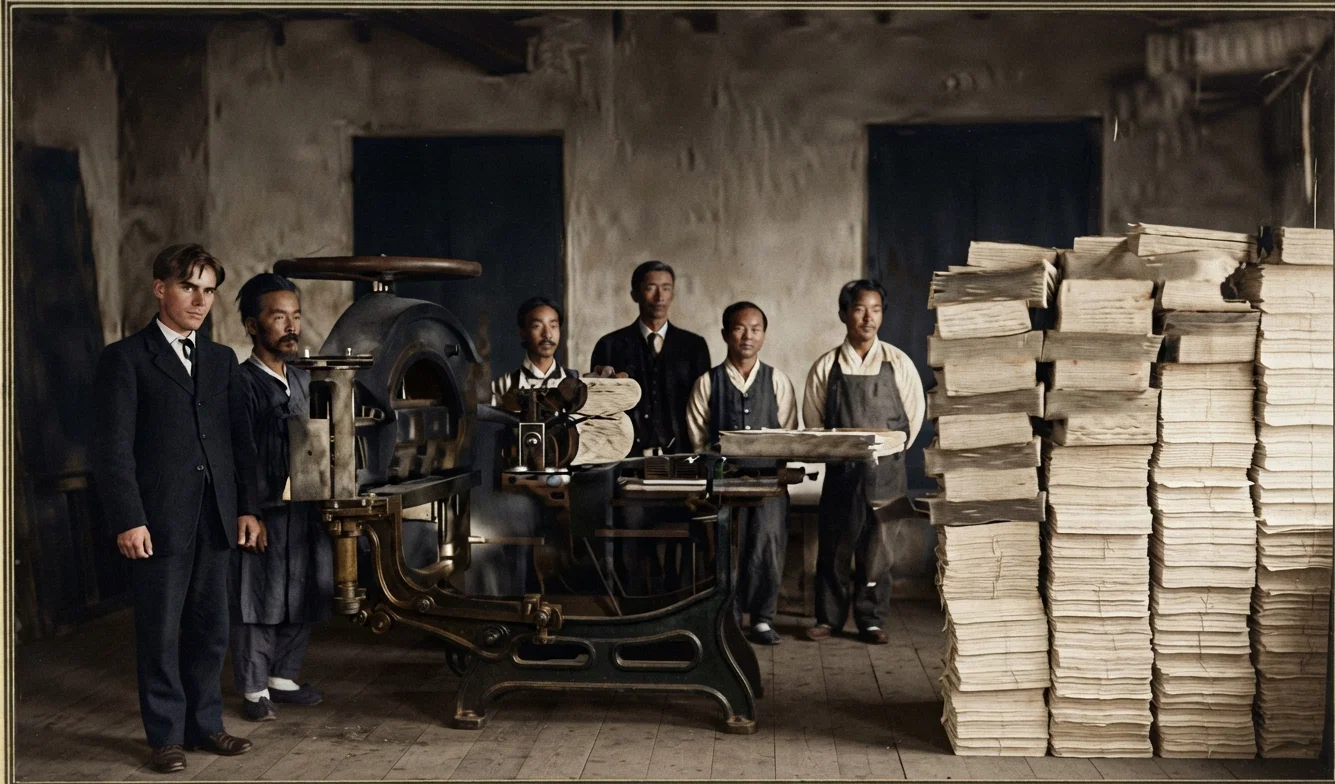
Although the first recorded printing by movable type — A. D. 1403 — was in Korea, the development of this art remained for the coming of the missionary. To-day there are several daily papers printed here, besides weeklies, monthlies, and books. In our own publishing house we have issued, during the past year, an average of three thousand copies a month of our magazine, a two thousand edition of a treatise on Revelation, a three thousand edition of a book after the order of "Bible Footlights," an eleven thousand edition of a thirty-eight page tract on the signs of Christ's coming, and we are now printing a ten thousand edition of the tract "Waymarks to the Holy City." Aside from these, there has been the Sabbath-school Quarterly, and smaller tracts, etc.
By these and many other inventions, missionary work in Korea has been revolutionized during the past twenty years. New missionaries coming to the field know nothing of the hardships, privations, and primitive methods of work of those who first came.
THESE IMPROVEMENTS AND THE ONWARD MESSAGE
But why all these improvements? Are they provided in order that missionaries may have an easier time, and keep in touch with the world by having American mail delivered to their door every four or five days?—Not at all. The hour has struck for this message to be given to the world, and God is wonderfully preparing the way, "for He237will finish the work, and cut it short in righteousness."
Now is the time to arise and give the message to every nation, kindred, tongue, and people. Every modern invention is at our command to aid in the work. Not only so, but God is waiting to baptize us with the Holy Spirit and power. The preaching of this message will soon culminate in the close of the Judgment in heaven, and the glorious appearing of Jesus Christ to receive His people to Himself. Therefore let us make use of every material aid that God has prepared for us, and also the aid of the Holy Spirit, in winning souls who will stand with us in that great day, and exclaim, "Lo, this is our God; we have waited for Him, and He will save us: . . . we will be glad and rejoice in His salvation."
C. L. BUTTERFIELD.
The Korean Industrial School
By Prof. H. M. Lee
Methods of School Work
By PROF. H. M. LEE
This school is located fifteen miles to the north of the city of Pyeny Yang, in the northern part of Korea. An ordinary map shows the position of this city, and from it one may gain an idea of where Soonan is located.
The name of our school is Ui Myung Hak Kio. This is the name chosen for it by the Koreans, and by which it is known everywhere. The first word, when literally translated, is what is right. The second word means bright, brilliant. Hak Kio means school. So by the profession of our name, this school is to uphold the "brightness of the truth."
We sincerely hope that it will be true to its name, and by the students it sends out, may cause the brightness of the gospel and this closing message to shine in all dark Korea.
BOYS AND GIRLS TAUGHT SEPARATELY
In these Eastern countries, schools for boys and those for girls are kept quite distinct from each other. The sexes are not permitted to mix as with us Westerners. But as the cost and the work involved in conducting two separate schools is so great, we have boy and girl students together here.
At present they are not in the same classes, but the two schools are carried on in the same building. This makes it possible for one corps of teachers to do the work in both schools. In the west end of the schoolhouse is the boys' school, and in the east end the girls'. There is a chapel between, separating the two schools.
Although the school has been in operation some four or five years, not until last fall have we had suitable quarters in which to work. Through the generosity of our American Sabbath-schools, we obtained the means to erect our present brick schoolhouse, which is situated on high ground and can be seen from afar.
THE TEACHING FORCE AND GRADES OF WORK
We have ten teachers to carry on the work of the school. Miss Scott and I are the foreign teachers; and while we do much teaching, our principal work is to oversee the teaching and administer the funds of the school. We have much also that needs to be done in the way of preparing suitable text-books in Bible, history, and nature study.
One of our teachers is a Japanese. His time is spent in teaching his language to the Koreans. Now that Korea is a Japanese province, much stress is put upon the mastery of the national language. One period a day is given to it. Our other teachers are all Koreans.
We have two grades of work,—the primary course of four years, and the higher common school, which corresponds in many ways to our high school work in America. This course is also four years. Above this grade we will have a teachers' training course and a ministerial course.
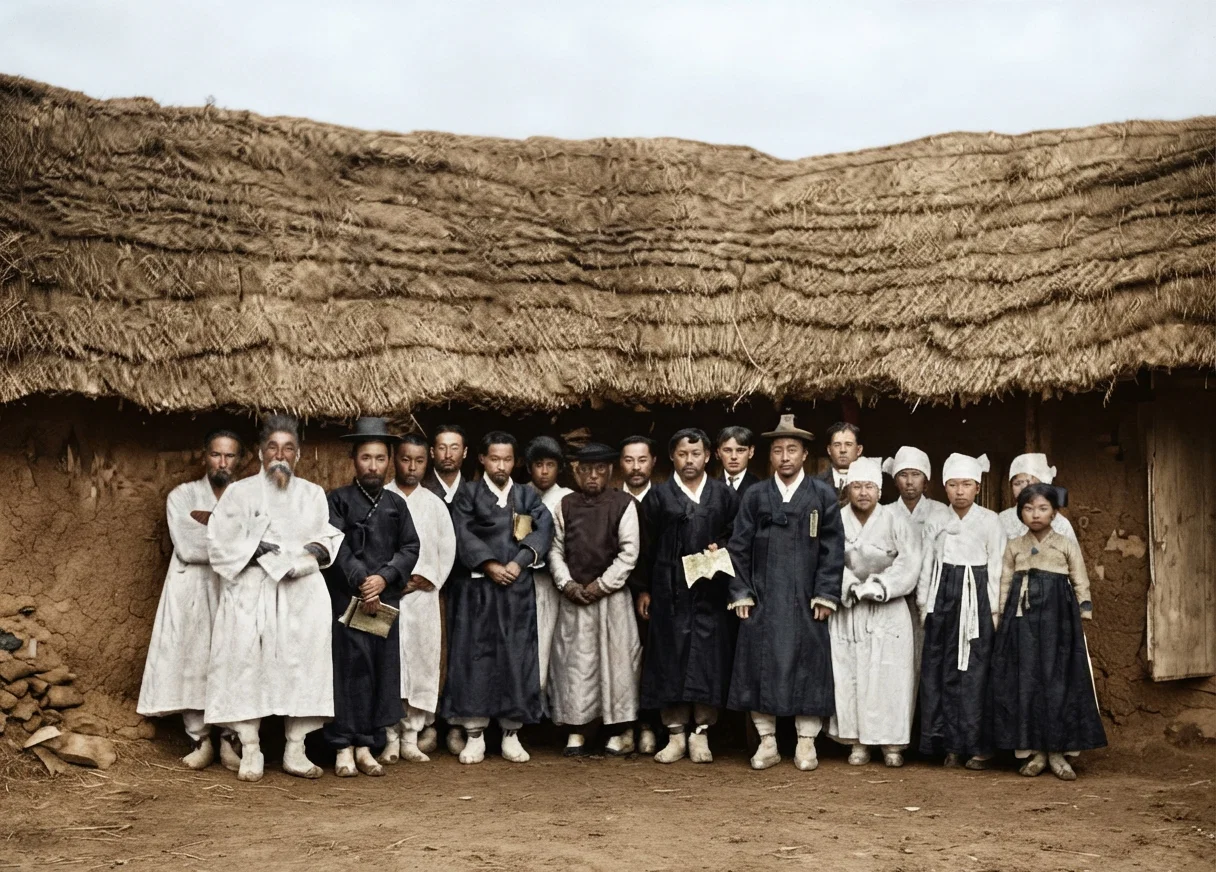
GROUP OF BELIEVERS AT REAR OF OUR CHURCH BUILDING, CHINNAMPO, KOREA
The subjects of study are Bible, Japanese, arithmetic, algebra, geometry, Chinese literature, botany, zoology, physics, chemistry, general history, agriculture, sericulture, geography, drawing, singing, physical culture. This is a pretty full program, you will say; and so it is. Korean young people who have a mind to study, seem to be able to do this amount of work in the eight years given to it.
In March, 1913, we graduated our first class, consisting of five boys and one girl. Four of these are now teaching in our church schools. This spring a good-sized class will finish their work here, and we hope they will become efficient workers in the harvest-field.
THE FARM AND ITS PURPOSE
As very few of our students are able to provide the means to meet their school expenses, we have a farm of some thirty-five acres. This furnishes not only a means of their earning the money they need, but also a most practical line of work for them to learn. We wish to teach them to use their hands and minds in useful labor. The faithful performance of daily duties, and of work necessary to obtain daily food, will help to build character more rapidly than will the study of books.
Our present attendance is seventy-two; but now that we have a more commodious place in which to work, we shall expect to get more students.
The Spirit of Adoption
By E. A. Sutherland
A HEART-BROKEN father entered an institution where children were cared for, hoping to find some little one to fill the place made empty by the death of his own child. He and his wife looked through the rooms, and talked with one child after another, but each little one was passed by. Finally they came to an unpromising child. Her brown eyes were crossed, and her skin was rough and unkept; but almost before he knew it, the little one held out her arms to the man, and with tears in her voice, said, "Papa." The strong heart gave way. He clasped the child to his breast, and went home with it. The spirit within that child vibrated in harmony with his spirit of fatherhood, and he knew the child was to be his own.
And so Paul tells us that the great Father above, in looking over this world for children to adopt, finds here and there some who have received that spirit of adoption, and they cry out, "Father, Father." It is that spirit that brings them into the family. They take His name. They become heirs, even joint heirs with His only Son. That is the drawing power of Christianity. "The Spirit itself beareth witness with our spirit, that we are the children of God."
E. A. SUTHERLAND.
Marvelous Transformation
By Siamon Bunyani
Long ago we drank beer, and danced, and worshiped idols, and fought one another; but because of the power of God that caused you to send teachers here to teach us of God and His word and His Sabbath, we do not do these things now. But please, brethren, do not get tired sending teachers here, because the sheep must have a shepherd.